Janet Holland
Thesis submitted for the degree of
Doctor of Philosophy
in the
University of London
Insti tute of Education
University of London
2
ABSTRACT
The research focuses on patriarchy and class, and the relationship
between these two principles of social organisation. The two themes take the
form of (a) a consideration of the position of women and men in the social
division of labour and the impact of pa tr iarchal ideology on the
conceptualisations held by adolescents of women and men in the labour force
and in domestic work, and (b) the construction of a model of the social division
of labour which enables distinctions to be made between specific fractions of
the middle class. To place the study in context, there is a critical review of
some explanations for the sexual division of labour and its manifestations in
industrialised society, and of the way in which the concept of patriarchy has
been utilised in such explanations. The influence which prior theoretical
application of the concept of patriarchy has had on its use in the current
study is discussed. In principle the study is concerned with the ideological
positioning of individuals in particular class locations, and the intersection of
patriarchal ideology and practice with that of class. The derivation of the
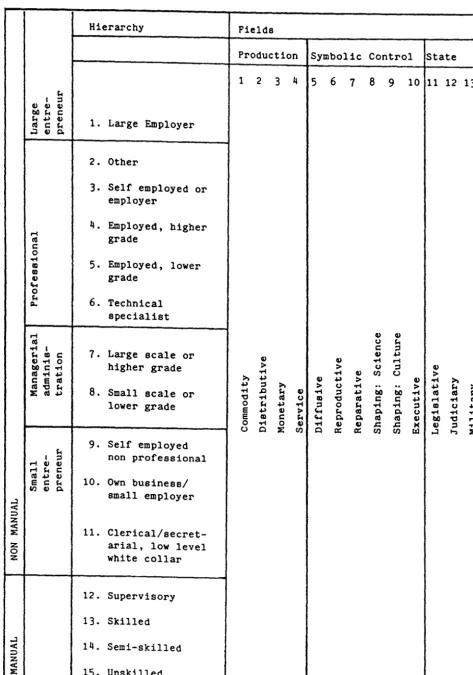
model of the social division of labour used to allocate the sample of
adolescents in the study to class locations is described. The network of social
relations is divided into three fields: those of production, of symbolic control,
and the state. The relationship between the approach taken here and that of
theorists who have dealt with the nature of class relations is discussed in the
study. In the model the fields of production, symbolic control, and the state
are subdivided into specific areas and mapped onto the occupational hierarchy,
providing a grid onto which particular occupations can be placed. Fathers and
mothers of the adolescents in the study are located in this social space.
The empirical research consists of an extensive questionnaire put to 950
twelve to thirteen and fifteen to sixteen year old girls and boys, drawn from
State and public schools. The basic vqriables to which their responses are
related are age, gender, social class and locations within social class. The
questionnaire had five major sections dealing with: information about the
adolescents' home and educational background; questions related to gender
differentiation and the sexual division of labour in work, education and the
home; questions dealing with aspects of the social division of labour exemplified
by the occupational hierarchy; questions relating to education and to certain
general political issues. Qifferences and similarities amongst the groups based on
our variables were found and are discussed In terms of ideological positioning
ACKNOWLEDGEMENTS
I am much indebted to my supervisor Basil Bernstein for his enthusiasm,
unflagging support, and for many hours of valuable discussion.
So many of my friends have provided endless moral encouragement and
intellectual assistance that I cannot list them a:1. I would like to mention In
particular Eileen Albury, Cristian Cox Donoso, Lesley Caldwell, Lynne
Chisholm, Gunilla Dahlberg, Tupu Gordon, Peter Holland, Gerry Lander,
Maureen McNeil, Vivienne Selzer, Betsy Stanko, and Gella Varnava-Skouras.
am especially grateful to Chris Knee for his constructive suggestions.
lowe too my thanks to the children who co-operated with me In the
research and to Jo Foster who produced such a well ordered text.
Without the patience and love of Robert Albury I could never have
T ABLE OF CONTENTS
Acknowledgements
Table of Contents
List of Tables
List of Figures
List of Appendices
PART 1
INTRODUCTION AND THEORETICAL BACKGROUND
TO THE STUDY OF GENDER AND CLASS RELATIONS
INTRODUCTION
Chapter One
The sexual division of labour and the concept of patriarchy
1 Introduction
2 Sex or gender?
3 Patriarchy
3.1 Patriarchy as the primary source of division in
society
3.2 Gender and class: patriarchy and capitalism
3.3 Patriarchy as a monolithic concept
3.4- The concept of patriarchy in this study
4- Women and class
4-.1 Traditional focus on the family as the source of
women's class location
page
3
5
17
27
28
29
35
35
36
37
38
4-0
4-4-4-7
4-9
4-9
4-.2 Cross class families and proletarianisation 50
5 Institutional sites of the reproduction of gender relations
54-5.1 Production and the family
54-5.2 Education 57
6 Ideology and the reproduction of gender and class
divisions
Notes
61
6
page
Chapter Two
The theoretical derivation of the model of class used in this
study
1 Introduction
2 The concept of class
3 The middle class
3.1 The professional managerial class
3.2 The salaried middle class
3.3 The new class
3.4 Class groupings and closure
3.5 Economic, political, and ideological determinants
of class location and the boundary problem
77
77
78 83 84
86
87 88
90
3.6 Descriptive models of the middle class and cleavage 94
4 Ideology 95
5 Ideological positioning 101
Notes
Chapter Three
Theory and description of the model of class used in the
study to distinguish the substantive social groups
1 Introduction
2 Divisions within and between the fields of symbolic
control and production
2.1 Divisions between the field of production and
symbolic control
2.2 Divisions within the fields of production and
symbolic control
2.3 The model we have used
3 The hypotheses taken to the data
104
III
111
115
115
117
121
page
4 Empirical specification of the class and field location
of the sample 124
4.1 Description of the model of class used in this study 126
4.1.1 Sectors within the field of production 126
4.1.2 Functions within the field of symbolic control 127
4.1.3 The core functions of the state
4.2 The occupational hierarchy
5 Women and class
Notes
PART 2
THE EMPIRICAL STUDY OF ADOLESCENTS' CONCEPTIONS
OF SOCIAL AND SEXUAL DIVISIONS
Chapter Four
The sample and method used in the study
128
128
130
130
137
1 Introduction 137
2 The sample 138
2.1 Origins of the study and construction of the sample 138
2.2 Obtaining a sample with the required attributes 140
2.2.1 The middle class sample 140
2.2.2 Brief descriptions of the schools from which
2.2.3
2.2.4
the middle class sample was obtained
The working class sample
Brief descriptions of the schools from which
the working class sample was obtained
2.3 Description of the sample
2.3.1 The working class subsamples
2.3.2 The middle class subsamples
141
143
144
146
150
3 The methodology employed
3.1 Choice of procedure
3.2 Advantages and disadvantages of a questionnaire
method
3.3 Mode of interpretation
3.4 The structure of the questionnaire
3.4.1 Modelling
3.4.2 Modelling of gender differentiation
3.4.3 Modelling of the social division of labour
and social relations
3.4.4
3.4.5
3.4.6
Modelling of educational processes
Further aspects of social and political
modelling
Questions requiring information
4 Administer ing the questionnaire
5 Coding the responses
5.1 Objectives and problems of coding
5.1.1 Sources of the ca tegor ies
5.1.2 Allocation of responses to categories
(a) Level of interpretation
(b) Reliability of allocation to categories
8 page
156
156
157
158
160
161
162
165
166
167
168
168
169
169169
1695.2 The basic coding 171
5.2.1 Topic area: 1. The social division of labour and
its social relations and gender differentiation 171
5.2.2
(a) Aspirations and expectations
(b) Aspiration as a member of the opposite sex
Topic area: 2. Gender differentiation
(a) Gender differentiated education
(b) Male and female work
5.2.3 Topic area: 3. The social division of labour
5.2.4
and its social relations
(a) Income differentials
Topic area: 4. Educational processes
(a) The value of education for the individual
(b) How to get on a t school
172
175
5.2.5 Topic area: 5. Further aspects of social and
poli tical mode !ling
(a) Who runs the country?
(b) Po Ii tical parties
5.3 Refocussing the basic coding for specific analyses
6 Methods of analysis
Notes
Chapter Five
Analyses and results: general measures
1 Introduction to the results
1.1 Types of analysis
1.2 Presentation of results
2 Discussion of initial indices and analyses
2.1 Introduction
2.2 Indices of support for or rejection of dominant
societal values
2.3 Results on the indices relating to dominant
societal values
2.3.1
2.3.2
Gender differences
Class and intra class differences
2.4 Factor analysis
2.5 Intra-me differences on selected questions
2.5.1 Refocussing of coding categories for the
index of field orientation
2.5.2 Results on the index of field orientation
3 Overview
Notes
Chapter Six
Introduction to the results on specific topic areas
Introduction
2 The concepts of classification and framing
3 Some data on the family derived from Wells' study
3.1 Positional and personal families
4 A test of the hypothesis relating positional and
personal families to class and intra class location
4.1 Procedure
4.2 Results
4.2.1 Differences between means on positional
page 214 215 217 218 218
score: sample located by father's occupation 218
4.2.2 Some comparisons based on both mother's and
father's location
4.2.3 Gender differentiation in these families
5 Overview
Notes
Chapter Seven
The adolescents' modelling of gender differentiation
1 Introduction
2 The index of gender classification
2.1 Questions used, refocussing of the coding and
examples of recoded responses
2.1.1 The questions and recoding
2.2 A note on strength and weakness of classification
in the answers
3 Construction of the index of gender classification
4 Results on the index of gender classification
4.1 Comparison between mc and wc groups
4.2 Intra-mc comparison
4.2.1 Gender com par ison within the mc groups
4.2.2 Comparison between the 'ideal typical'
groups within the mc
4.2.3 Comparison between groups with both mother
and father in the same field
5 When the unit is an item in the topic area
5.1 Domestic labour
5.2 5.1.1 5.1.2 5.1.3 What 5.2.1 5.2.2 is
Comparison between mc and wc groups
Intra-mc comparison
Some examples of responses to the questions
on domestic labour
important in life?
Comparison between mc and wc groups
Intra-mc comparison
5.2.3 Some examples of responses on the questions
on what is important in life
6 Overview
6.1 The general picture
6.2 Dynamic patterns in the data
Notes
Chapter Eight
The adolescents' modelling of the social division of labour
1 Introduction
2 The index of the adolescents' modelling of the social
division of labour
2.1 Questions used, refocussing of the original coding,
and examples of recoded responses
2.1.1
2.1.2
The questions used in the index
Refocussing the coding
3 Construction of the index of the adolescents' modelling
of the social division of labour
4 Results
4.1 Background to the index: income differentials
4.1.1
4.1.2
Comparison between mc and wc groups
Intra-mc comparison
4.2 Background to the index: strength of classification
of high and low earners
4.2.1 Comparison between mc and wc groups
4.2.2 Intra-mc comparison
4.3 Results on the index
4.3.1
4.3.2
4.3.3
Comparison between mc and wc groups
Intra-mc comparison
Summary of the results on the index of the
adolescents' modelling of the social division
page
288
285
288
of labour and background questions 291
5 When the uni t is an item in the topic area
5.1 Why do people work?
5.1.1 Com par ison between mc and wc groups
5.1.2 Intra-mc comparison
5.2 What effect does work have on people's lives?
5.2.1 Comparison between mc and wc groups
5.2.2 Intra-mc comparison
5.3 Trade unions, strikes and unemployment
5.3.1 Comparison between mc and wc groups
5.3.2 Intra-mc comparison
5.4 How to earn more money
5.4.1 Comparison between mc and wc groups
5.4.2 Intra-mc comparison
5.5 Summary of results on individual questions
6 Overview
6.1 The general picture
6.2 Dynamic patterns in the data
Notes
Chapter Nine
The adolescents' modelling of the educational process
1 Introduction
2 The indices on education
2.1 Questions used, refocussing of original coding,
and examples of recoded responses
2.2 Refocussing the coding
3 Construction of the index
4 Results
4.1 Comparison between mc and wc groups
4.1.1
4.1.2
The classificatory relation
The systemic relation
4.2 Intra-mc comparison
4.2.1 The classificatory relation
4.2.2 The systemic relation
5 When the unit is an i tern in this topic area
5.1 Educational aspiration
5.1.1 Comparison between mc and wc groups
5.1.2 Intra-mc comparison
5.2 Personal autonomy in educational decisions
5.2.1 Comparison between mc and wc groups
5.2.2 Intra-mc comparison
5.3 Sex stereotyping of school subjects
5.3.1 Comparison between mc and wc groups
5.3.2 Intra-mc comparison
6 Overview
6.1 The general picture
6.2 Dynamic patterns in the data
Notes
Chapter Ten
The working class re-examined
1 Introduction
2 Comparison of the wc children who have high educational
page 333 333 333 333 335 335 337 338 339 339 340 342 342 345 345 345 346 350 350 354 356 358 358
aspirations with other wc and mc groups 361
2.1 The adolescents' modelling of educational processes 362
2.1.1 The classificatory relation between
education and production 362
2.1.2 The systemic relation between education
and production
2.2 The adolescents' modelling of the social division
of labour
2.3 The adolescents' modelling of gender relations
363
365
3 Overview
Notes
Chapter Eleven
Further aspects of social and political mode11ing
1 Introduction
2 Property
2.1 Personal ownership
2.1.1 General comments and comparison between
me and we groups
2.1.2 Intra-me comparison
2.2 Desire for ownership
2.2.1
2.2.2
Comparison between me and we groups
Intra-me comparison
2.3 What belongs to all?
2.3.1
2.3.2
Comparison between me and we groups
Intra-me comparison
2.4 Common ownership
2.4.1
2.4.2
2.4.3
Comparison between me and we groups
Intra-me comparison
Examples of responses
3 Order and change
3.1 Who rules the individual?
3.2
3.3
3.4
3.1.1
3.1.2
Comparison between me and we groups
Intra-me comparison
Who rules the country?
3.2.1 Comparison between me and we groups
3.2.2 Intra-me comparison
Political parties
3.3.1 Comparison between me and we groups
3.3.2 Intra-me comparison
Change
3.4.1 Comparison between me and we groups
3.4.2 Intra-me comparison
4 Overview
4.1 The general picture
4.2 Dynamic patterns in the data
Notes
Chapter Twelve
Occupational aspirations and expectations amongst the
adolescents
1 Introduction
2 Results from the questions on aspirations
2.1 Aspirations and expectations
2.1.1
2.1.2
2.1.3
Comparison between me and we groups
Working class high aspirers
Intra-me comparison
2.2 Occupational aspiration as a member of the
opposite sex
2.2.1
2.2.2
3 Overview
Notes
Conclusions
1 Introduction
Comparison between me and wc groups
Intra-me comparison
2 The efficacy of the concepts, methodology and model
employed
2.1 The major conceptual tools
2.1.1
'Dominan t' ideology, ideological positioningand hegemony
2.1.2 Classifica tion
2.1.3 Patriarchy
2.1.4
The model of the social division of labouremployed in the study
2.1.5
The questionnaire2.1.6
Levels of meaning16
3 Major findings 448
3.1 Education 449
3.2 Work and the social division of labour 452
3.3 Politics and other social issues 453
3.4 Gender 455
3.5 Class and gender 458
4 In conclusion 460
Notes 461
Bibliography 463
LIST OF TABLES
Table 3.1
The model of the social division of labour
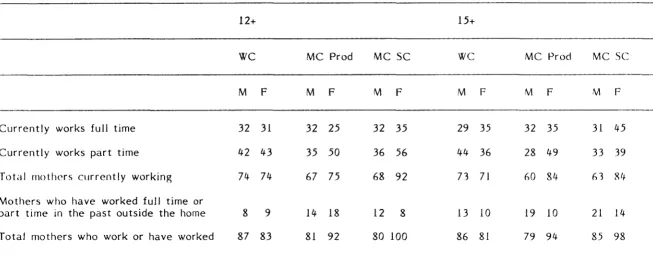
Table 3.2
Mothers' work for those in our sample with a precise field
loca tion (in percentage terms)
Table 4.1
The sample in manual/non-manual terms
Table 4.2
The sample in terms of an eight point breakdown
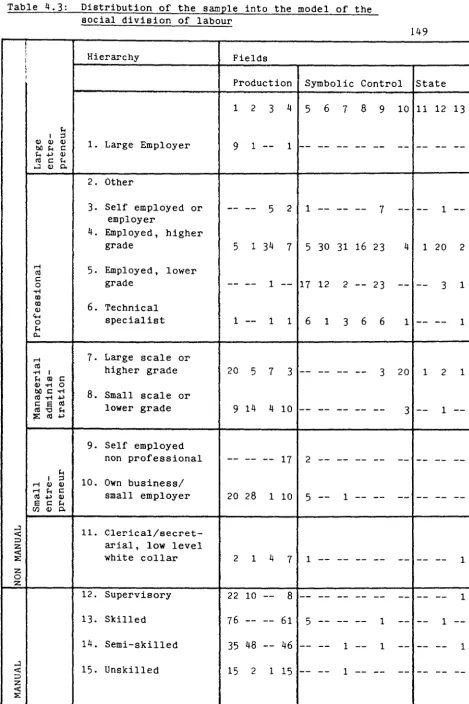
Table 4.3
Distribution of the sample into the model of the social
division of labour
Table 4.4
The working class subsample
Table 4.5
The middle class subsample by field
Table 4.6
The 'ideal typical' middle class subsample
Table 4.7
Both mother and father In the same field for the middle
class subsample
Table 4.8
Relationship between the field location of fathers and
mothers in our sample
page
125
132
146
148
149
150
152
153
154
Table 5.1
Levels of significance of differences between boys and girls
on three indices
Table 5.2
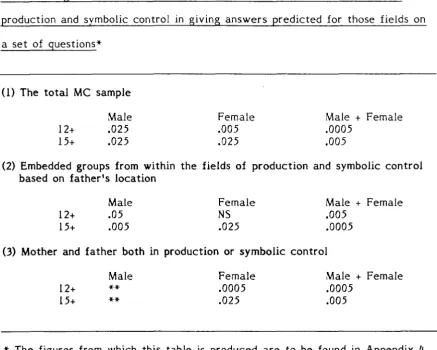
Levels of significance for differences between adolescents
in the fields of production and symbolic control in giving
answers predicted for those fields on a set of questions
Table 5.3
Percentage of selected groups within the sample givmg
'Production' or 'Symbolic Control' types of response
Table 6.1
Outline of ideal types of positional and personal families
Table 6.2
Differences between means on positional score for social
class groups
Table 6.3
Comparisons between groups based on mother's and father's
occupations
Table 6.4
Differences between means for positionality on gender
differentiation responses
Table 7.1
Types of responses generated by each question on gender
differentiation
Table 7.2
Comparison between mc and wc groups on the degree of
strength and weakness of their gender classification
18
page
195
203
205
216
219
220
222
235
Table 7.3
Comparison within the mc on the degree of strength and
weakness of their gender classification: the field of
production and the field of symbolic control
Table 7.4
Comparison between 'ideal typical' groups within the mc on the
page
240
degree of strength and weakness of their gender classification 242
Table 7.5
Comparison within the mc on the degree of strength and
weakness of their gender classification: those with both
mother and father in the same field
Table 7.6
Percentage change with age on the index of gender
classification: movement into weak classification
Table 7.7
Selected responses on domestic labour: comparison between
mc and wc groups
Table 7.8
Selected responses on domestic labour: comparison within
the mc
Table 7.9
Percentage change with age on selected questions on
domestic labour
Table 7.10
Proportions of the mc and wc groups suggesting that the father
has responsibility for looking after the home and family
243
245
248
252
253
Table 7.11
Selected responses on the most important thing in the
adolescents' lives: comparison between mc and wc groups
Table 7.12
Selected responses on the most important thing in the
adolescents' lives: comparison within the mc
Table 7.13
What is important in life? Percentage changes with age for
selected responses
Table
7.14-Strength as a reason for the distribution of women and men
in the labour force
(i) Proportion arguing that female and male differences in
types of work are due to differences in physique or strength
(ii) Percentage change with age in those arguing that female
and male differences in types of work are due to differences
in physique or strength
Table 8.1
Are income differentials fair or unfair? Comparison between
mc and wc groups
Table 8.2
Are income differentials fair or unfair? The intra-mc
comparison
Table 8.3
Strength of classification of the income distribution in terms
20
page
257
260
261
263
283
284
of high and low earners: comparison between mc and wc groups 286
Table
8.4-Strength of classification of the income distribution in terms
Table 8.5
The index for classification of the social division of labour:
comparison between mc and wc groups
Table 8.6
The index for classification of the social division of labour:
the intra-mc comparison
Table 8.7
The largest proportion of each group falling into combined
categories on questions on the social division of labour
Table 8.8
Age movements between 12+ and 15+ on issues related to the
social division of labour in terms of percentage point
differences
Table 8.9
Combined responses on reasons for work: comparison between
page
289
290
294
296
mc and wc groups 298
Table 8.10
Combined responses on reasons for work: the intra-mc
comparison
Table 8.11
The effects of work on life: comparison between mc and wc
groups
Table 8.12
The effects of work on life: the intra-mc comparison
Table 8.13
What are trade unions for? Comparison between mc and wc
groups
299
301
302
Table 8.14
Comparison between mc and wc groups on selected questions
on employment
Table 8.15
Intra-mc comparison on selected questions on employment
Table 8.16
Major responses on what three occupation holders could do
if they thought they should earn more money for their work
(i) Comparison between the mc and wc groups
(ii) Intra-mc comparison
Table 8.17
Age movements between 12+ and 15+ on selected questions
on employment for both class and field groups
Table 9.1
Recognition of the classificatory relation between education
22
page
307
308
311
312
and production by the mc and wc groups 334
Table 9.2
Recognition of the systemic relation between education and
production by the mc and wc groups
Table 9.3
Recognition of the classificatory relation between education
335
and production by the intra-mc groups 336
Table 9.4
Recognition of the systemic relation between education and
production by the intra-mc groups
Table 9.5
Distribution of the mc and wc groups into basic focus of
examinations to be taken
338
Table 9.6
Degree to which students saw themselves as involved involved in
examination decisions
,.
Table 9.7
Proportion of the class groups cons-idering that what they do
at school will be useful when they leave
Table 9.8
Are some school subjects more suitable for boys and others
for girls? Comparison between mc and wc groups
Table 9.9
Are some school subjects more suitable for boys and others
for girls? The intra-mc comparison
Table 9.10
Comparisons between class, field and gender groups on
selected educational issues
Table 9.11
Age movements for selected issues on education, class and
field groups
Table 10.1
Comparative characteristics of high educational aspirers
Table 10.2
Gender differences In examinations to be taken for working
class high educational aspirers compared with the rest of
the wc group
page
343
344
346
347
348
349
360
Table 10.3
Comparison between wc high educational aspirers and other
groups on the index of the classificatory relation between
education and production
Table 10.4
Comparison between wc high educational aspirers and other
groups on the index of the systemic relation between
educa tion and production
Table 10.5
Comparison between wc high educational aspirers and other
groups on the index of classification of the social division
of labour
Table 10.6
Comparison between wc high educational aspirers and other
groups on the index of classification of gender relations
Table 11.1
24
page
363
364
365
366
Class, gender and age groups owning particular types of items 375
Table 11.2
Within class, gender and age groups owning particular types
of items
Table 11.3
Selected responses on the property questions for the class
comparison
Table 11.4
Selected responses on the property questions for the
comparison within the middle class
377
383
Table 11.5
Age movements for the class and field groups on property
issues
Table 11.6
Selected responses on Issues of order and change for the
class comparison
Table 11.7
Selected responses on issues of order and change for the
comparison within the middle class
Table 11.8
Age movements for the class and field groups on issues of
order and change
Table 11.9
Comparisons between class, field and gender groups on issues
page
385
392
393
39lf
of social and political modelling 395
Table 12.1
Aspirations and expectations: the class comparison
Table 12.2
Sources of inspiration for the adolescents' occupational
aspirations: the class comparison
Table 12.3
Aspirations and expectations: the intra-mc comparison
Table 12.lf
Sources of inspiration for the adolescents' occupational
aspirations: the intra-mc comparison
lf16
lf17
lf18
Table 12.5
Work as opposite sex the same as the individual's own
aspiration in percentage terms
Table 12.6
Types of jobs suggested as opposite sex aspiration as a
percentage of total responses
Table 12.7
Percentage of subjects refusing to offer an opposite sex
aspiration
Table 12.8
Opposite sex work aspirations amongst those in the fields of
production and symbolic control
26
page
421
422
424
LIST OF FIGURES
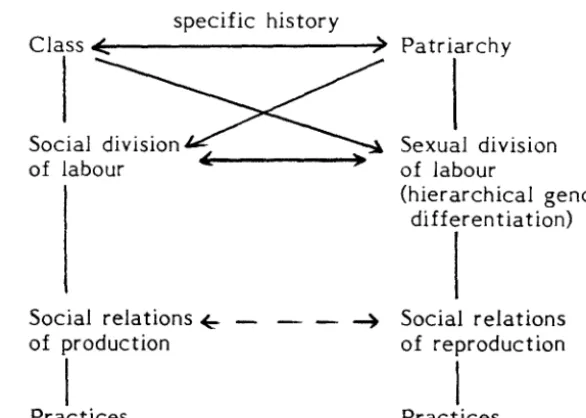
Figure 1.1
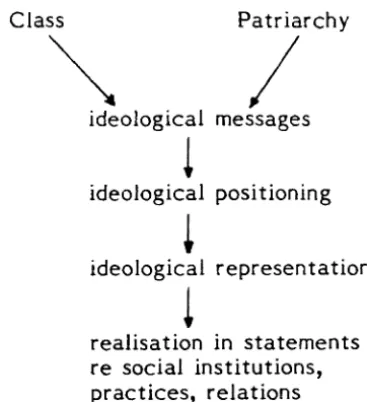
Patriarchy and class
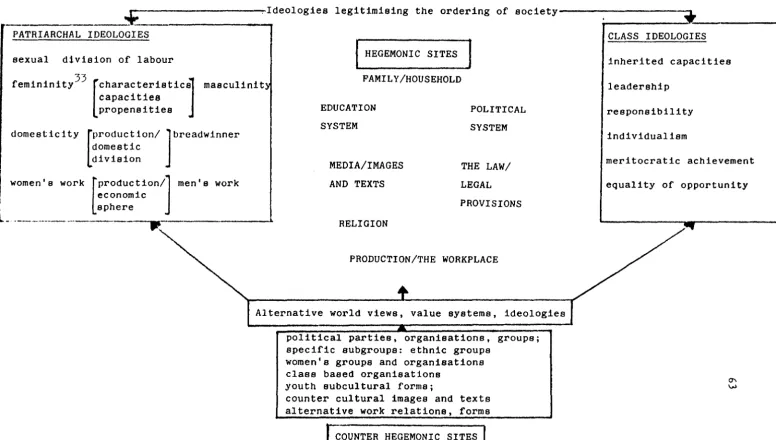
Figure 1.2
Hegemonic processes
Figure 3.1
Pedagogic capital and the fields of the model
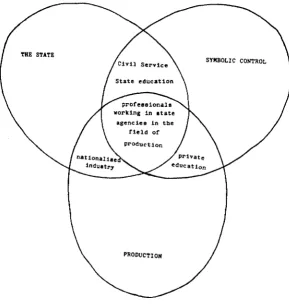
Figure 3.2
Products of public and private sectors and agents of
symbolic control
Figure 3.3
Interrelationships between the fields of the model
Figure 4.1
Class, patriarchy and positioning
Figure C.1
Hegemonic processes
page
48
63
118
118
120
160
LIST OF APPENDICES
Appendix 1
A few examples of fathers' occupations falling into specific
fie ld locations
Appendix 2
Introduction to the research for the adolescents
Appendix 3
Factor analysis
Appendix 4
(a) Figures from which Table 5.1 was derived
(b) Figures from which Table 5.2 was derived
Appendix 5
The index of the adolescents' modelling of the social
division of labour; Figures for 'ideal type' groups and those
with both mother and father in the same field
Appendix 6
Indices of the recognition of the classificatory and systemic
relations between education and production: Figures for
'ideal type' groups and those with both mother and father
in the same field
Appendix 7
The adolescents' modelling of the educational process:
A question by question approach
Appendix 8
Aspirations and expectations of all groups in terms of the
top three levels of the Hall-Jones scale
page
485
487
489
491
492
494
INTRODUCTION
The object of this study is an investigatio:l of the nature and mode of
understanding which adolescents have of the prhciples on which the social
division of labour and forms of social control are based. The major focus IS on
adolescent conceptions of the location of wome:1 in the social and sexual
division of labour. We attempt to indicate the effect of patriarchy 01"1 the
views held by adolescents of both social and sexual divisions, and the ways In
which these views are mediated through their class location.
Considerable effort has been expended in the social sciences In the past
to describe and understand the nature of society in terms of class relations.
The concept of social class has proved invaluable, if sometimes confusing and
ill-defined, in explaining inequalities in the dist:- ibution of power, of control,
and of scarce material and symbolic resources. The social division of labour,
encompassing both the technical division of labour and the associated social
relations of production, has formed the basis for such analyses. Enmeshed with
and entwined around this hierarchy of privilege and power based on class
relations, another exists; the hierarchy of power relations based on gender,
and the privileging of the male in most areas of social organisation and
experience. The principle on which this paral1el and interlocking hierarchy is
based can be described as that of patriarchy. The concept of patriarchy has
been used in the past in psychoanalysis, for example, to describe the power of
the father, and in social an thropology to explain the power of men over
younger men and women. Some theorists and commentators would prefer to
limit its usage to these traditional types of definition. Others consider that
the concept can be redefined and used to help to explain the all-pervasive
sexual division of labour which penetrates every area of life. The development
of the concept in this latter respect has a history far shorter than that of the
concept of class, even if this history has often proved as confused and
contradictory.
For social theorists who accept the existence of these parallel
principles of social organisation, class, specifically its manifestations In
capitalist society, and patriarchy, the question of the relationship between
30
women and the hierarchy of privilege based on gender, evidently predates
capitalist society and the particular sets of class relations which develop in
that setting. Capitalism can be seen as incorporating these pre-existing
patriarchal or sexual divisions into the class divisions which were crucial to
that system - and historical descriptions of the way in which this has been
done, to the advantage of men in different class groups, have been attempted
(for example by Hartmann, 1979, and Lown, 1983). The advantages to
capi talism of the sexual division of labour have also been considered (for
example by Beechey, 1977, and Bruegel, 1979). The possible interrelation IS
ignored, however, by some feminist writers, who see two parallel systems, one
ruled by class divisions relating to the sphere of production and economic
factors, and another ruled by patriarchy, relating to the sphere of
reproduction and the relations between women and men (Firestone, 1970;
Delphy, 1977). Whilst total separation might be a useful approach for
theoretical and analytical purposes, it ultimately falls short as an explanation.
The specific interrelation between these two principles has not been fully
articulated, and is an area of major theoretical concern in the field of study
of women in society (which cannot of course be separated from the field of
study of men, since both exist in relation to each other).
The study reported here can be seen as reflecting the problems
associated with theorising this interrelationship. The content of the study
attempts to trace the ideological positioning of adolescents in terms of class
and gender identities, in relation to both class and gender relations
themselves, and is exploratory in nature.
Chapter 1 consists of a critical review of significant contributions to
the study of patriarchy and gender. The purpose is twofold:
(1) to delineate the problematic within which this study is located, and
(2) to place the study within that context.
The chapter reviews the uses to which the concept of patriarchy has been put
in the literature, describes the way in which it is used in the present study,
and goes on to discuss briefly the institutional sites for the reproduction of
gender relations. We examine the operation of the sexual division of labour
inside and outside the domestic unit, and the reproduction of gender
hierarchy, drawing attention to the part played in this process by the family,
ideological construction of the sexual di vision of labour and the way in which
it is embedded in the major institutions of society leads to the formulation of
a model which attempts to describe the processes of hegemonic ideological
control and the resistances to this control which are engendered in the
counter-hegemonic field. The model forms both a condensed theoretical
justification and a framework for the derivation of the experimental
instrument used in the study. The adolescents' responses as described In the
results section provide the flesh for this framework.
When considering the effect of class on the representations of society
held by the adolescents we were particularly concerned with fractions of t;,e
middle class, specifically with the differentiation between the old middle class
and the new middle class. Class analysis is a kalaedoscopic minefield for the
uninitiated or unwary, and for most proponents a firm grip is provided not so
much by a clear definition of what they mean by class, but by a particular
perspective. A model of class relations was developed in this study which
draws essentially on a marxist perspective in that the crucial defining
characteristic of class is relationship to the means of production, and that the
consciousness of the individual derives from that relation. The model IS
influenced by the work of recent theorists who have elaborated and advanced
the conceptualisation of superstructural factors, frequently in the effort to
define class boundaries.
Chapter 2 provides a review of the sources for the development of the
model used in this study to allocate the adolescent sample to class positions.
The representations of the adolescents which are uncovered in this
investigation are regarded as indicators of their ideological positioning within
the network of social relations, and the way in which this term is used and
understood in the study is described in this chapter, with a brief review of
theories of ideology which have been influential in generating this stance.
Chapter 3 provides the theoretical justification and a detailed description of
the model. This model of the social division of labour is based on the
distinction between the old and the new middle class, using Bernstein's (I 977,
1980) characterisation of these class fractions as the field of production and
the field of symbolic control. The core functions of the state are included In
the model and subdivisions within the three fields are specified. This
32
influenced by the work of Goldthorpe and Hope (1974) so as to generate a
grid representing social spaces into which specific occupations can be
categorised. The adolescents' mothers and fathers are allocated to this social
space on the basis of their work, and their children to a social class location
on the basis of the father's occupation.
The class location of women has traditionally been bound to their
position in the family, of origin or marriage, with scant attention paid to
their own work in production. This positioning of women within the family is a
major ideological message in support of the sexual division of labour, and as
such has been both incorporated into the discourse of the social sciences, and
developed and elaborated in theories emanating from this field, as part of the
work of the construction of ideology and of hegemonic control. The class
location of women is the linchpin of the relationship between class and
patriarchy; at the level of grand theory, its insertion would require a total
realignment of the theoretical constructs associated with class and patriarchy,
an epic venture. Whilst this thesis is not a contribution at the level of grand
theory, we are concerned to understand the relationship between class and
patriarchy. We discuss the issue and the class location of women in the
theoretical introduction to the work (Chapters 1 and 3) and pursue it in our
empirical study. The mothers in our sample are allocated to a class position
on the basis of their own relation to production, and in some analyses the
position of both mother and father are taken into consideration.
Chapters 4 - 12 present the empirical study. The empirical work is
based on a large sample of 950 adolescents. It is exceptional in a study of
this type for such a large sample to be used, and it means that when we
break the sample down into subcategories, as we do for many of our analyses,
there are still respectable numbers in the relevant cells. The derivation and
generation of the sample is described in Chapter 4, as are the ways in which
it has been redefined for specific analyses which were undertaken. The sample
is allocated to the model of the social division of labour reported in Chapter
3. Chapter 4 deals with methodological aspects of the study and includes a
description of the questionnaire which was used.
The questionnaire consisted largely of open ended questions, and an
deal with the answers. An outline and some examples of this basic coding
system is given in Chapter 4.1 This basic coding was redefined and refocussed
in some of the analyses, and specific details of the refocussing of the original
coding, which forms a crucial part of the exploration of the concepts used in
the analyses performed on this data, are presented at the point in the thesis
where the specific analyses and results are presented.
The description of these specific analyses and the results obtained from
them provide the main empirical part of the thesis and appear in Chapters 5
-12. A number of general analyses were undertaken in an attempt to
encapsulate the broad sweep of the data and provide a framework into which
the more specific analyses could be placed and these are presented in Chapter
5. The questionnaire was divided into topic areas which focussed on particular
aspects of social organisation, and these topic areas are each considered in a
separate chapter in turn. In Chapter 6 a general introduction to the results in
the specific topic areas is accompanied by a report on an analysis by the
current author of some data provided from a study by Gordon Wells of
children and language. By using these data we have been able to indicate a
link between particular family types and the fields of the social division of
labour which we have identified in our model, those of production and of
symbolic control. The topic areas covered in the following three chapters are
gender differentiation (in Chapter 7), the social division of labour (in Chapter
8), and the educational process (in Chapter 9). For these three topic areas we
tried to capture the adolescents' modelling of this particular aspect of social
organisa tion by using a concept developed by Bernstein (1977) which offers a
link between specific practices within institutions and the structure and
organisation of power in society - the concept of classification. The way in
which this concept has been used for each topic area is described in detail,
and the results of its application to the data given for each part of the
questionnaire in turn. In some instances the responses on individual questions
or items are discussed separately, since it was not possible to incorporate
them into the analysis based on the concept of classification and the details
and results on these questions appear at the end of each chapter dealing with
the topic areas of the questionnaire. After the ini tial introduction in Chapter
6, which provides a general description of the concept of classification and
the reasons for its use in the study, the format is the same for each chapter.
311
where relevant, followed by the particular ques:ions included in the index
developed for that topic area and the refocussing of the original coding wh:ch
was required. This is followed by a description of the construction of the
index used, the results comparing adolescent groups based on the variables ;)f
class, gender, age and location within the middle class, first on the index a:1d
then on any individual questions which could not be incorporated into the
index. Finally there is a discussion of the results, which attempts to pull
together the similarities and differences between our groups on the issues
raised in each topic area.
In Chapter lOwe examine more closely a Darticular group of working
class children, those with high educational aspirations, and compare them with
other groups in the sample. Chapter 11 deals with further aspects of social
and political modelling not covered in the above topic areas, which are
reported on a question by question basis without the application of the
concept of classification.
Chapter 12 consists of a separate section which appeared on the
questionnaire, dealing with the adolescents' responses to a series of questions
on occupational aspirations and expectations. The results are related to the
literature on occupational choice, and some of the deficiencies of the work in
this area are noted. The findings are also related to our major concerns, class
and gender inequalities. We draw together the most important of our findings
and discuss their implications in the conclusion to the study.
We begin then in Chapter 1 with a review of the relevant contributions
to the study of patriarchy and gender divisions.
Footnote
1 The entire set of coding frames/networks constitutes a coding manual,
CHAPTER 1
THE SEXUAL DIVISION OF LABOUR AND THE CONCEPT OF PATRIARCHY
Introduction
The adolescents in this study express certain views about the social and
sexual division of labour, class and gender relations. These adolescents are
constructing their own place in gender and class hierarchies through a process
involving experience of material conditions, social relations and interactional
pr actices, and ideological messages in the inst i tutions of the society in which
they live. We regard the views which they express as indicating at some level
elements of the ideological positioning which has and is taking place for them.
In Chapter 2 we discuss at a general level theories of class which have
influenced this study. In this chapter we will briefly touch on some of the
research and theorisation on women which has contributed to the position
taken here.
In order to describe the principle upon which gender hierarchy is based,
we have adopted the concept of patriarchy, using it to refer to the power and
control which is exerted over women by men, and we trace the derivation of
this concept in the literature, in order to define our usage.
Areas of investigation which are particularly relevant to this study, and
which have produced both empirical material and new theorisations of
women's position have focussed on women's work and labour market
experience, domestic labour, the class location of women, education, and the
role of ideology in maintaining sexual divisions. In the expansion of the study
of women which has taken place over the last decade or so, in some instances
existing theories from the 'male-stream' (0' Br ien, 1981: 6), notably those of
Freud and Marx, have been appropriated; in others these theories have been
explicitly attacked and replaced by alternative formulations. Feminist
objections to Freud's psychoanalytic theory for example have argued that it
provides ideological reinforcement for women's oppression by describing the
characteristics of femininity in terms of immutable structures of the psyche.
36
and historical situation, incorporating historically and socially specific notions
of male superiority whilst claiming to be an ahistorical and universalistic
theory of psychic development (Burniston et aI, 1978). Mitchell (1974),
however, argues that the social nature of sexual definition is inherent In
Freud's theoretical formulations, and uses his concepts for an analysis of the
functioning of the ideologies of sex and gender. Her work has been the
starting point for a line of study incorporating psychoanalytic theory into the
understanding of women's subordination. 1
Socialist feminists see the root of female oppression in the working of
the capitalist system, and use ~arx's theory as a starting point for an
explanation. Within this overall theoretical orientation there are many
different stances. The limiting positions in the range are (1) a primary
concern with Marxist analysis and the application of this analysis to women
without questioning the ca tegor ies and concepts employed, and (2) a
recogni tion of fundamental problems with .Marxist theoretical formulations and
their unconsidered application to women. Those who take the latter position
argue that Marx's theory is in need of radical modification if it is to
articulate the interaction between class and gender - they frequently use the
concept of patriarchy in developing such a reformulation. Studies of women's
position in society have focussed on gender hierarchy and the subordination
and devaluation of women.
2 Sex or gender?
The term 'sexual division of labour' is used at the most general level to
describe the division of male and female activities into those which take
place in the public arena, associated with production and the social, and those
which take place in the private arena, concerned with reproduction and the
individual, but it can also apply to the separation of the spheres of activity
of men and women in both the home and the market place.2 Weight is placed
on the distinction between sex, seen as a biological category, and gender as a
socially constructed category by some authors (for example Oakley, 1972: 16;3
Brake, 1976: 174). This avoids the pitfalls of biological reductionism, the
snare of the immutable in the 'nature' of men and women. For others,
biological are inextricably entwined. Rubin (1975: 159), for example, argues
that "the sex/gender system is the set of arrangements by which society
transforms biological sexuality into products of human activity, and in which
these transformed sexual needs are satisfied". MacKinnon (1983: 635),
similarly emphasising sexuality, argues that
"Since I believe sexuality is fundamental to gender and
fundamentally social, and that biology is its social meaning in the system of sex inequality, which is a social and political system that does not rest independently on biological differences in any respect, the sex/gender
distinction looks like a nature/culture ~istinction. I use sex
and gender relatively interchangeably."
Mackintosh (1981: 2) concludes that in her discussion of the activities and
relations of men and women, which she terms the sexual division of labour,
she will use the concepts of 'gender' and 'gender relations', but that this
"does not assume that any of the divisions studied can be deduced from
differences between the biological sexes". This study will follow Mackintosh
in the use of the terms 'sexual divisions' and 'gender'.
3 Patriarchy
The concept of patriarchy itself is one which has emerged in its most
recent form in feminist studies on the position of women, and is the subject
of considerable controversy within this field of study. The two positions which
form the boundary of the range available are (1) that patriarchy is an
unnecessary, loosely and very variously defined concept with biologistic and
universalistic overtones, which is of little or no value in attempting to come
to grips with the problems associated with analysing and explaining the
posItIOn and experience of women in society (Adlam, 1979: 98; Barrett, 1980:
10 ff; Rowbotham, 1979: 970); and (2) that patriarchy is a crucial and
essential concept in the task of understanding women's subordination,
potentially having the force which the concept of class has in the marxist
explana tion of social relations, although further theoretical work may be
necessary and appropriate to develop this critical concept (Eisenstein, 1979;
38
In the following section we will give some examples of usage of the
concept of patriarchy which will also serve to illustrate the basic positions in
feminist analysis of women's subordination, radical, revolutionary and socialist
feminist, and the similarities and differences which exist within these
positions. At the broadest level the socialist feminist critique of radical and
revolutionary feminist analyses of women's subordination is that it is
essentialist, focussing on one set of relations, those between men and women
with no account taken of other social differences and divisions; and the
radical and revolutionary feminist critique of socialist feminist analysis is that
it is itself subordinated to a male constructed conception of class as the
major motor of history. Within these overall positions, however, there are
wide variations, as will be shown below.
3.1 Patriarchy as the primary source of division in society
Millet (1970) introduced the concept of patriarchy into feminist
discourse, using it to refer to male domination over women and the power
relations which sustain women's subordination to men. Millett defines
patriarchy as follows:
"Our society, like all other historical civilisations, is a patriarchy. The fact is evident at once if one recalls that the military,
industry, technology, universities, science, political office, and finance - in short every avenue of power within the society,
including the coercive force of the police, is entirely in male
hands" (p. 25).
From this radical feminist perspective sexual division and hierarchy becomes
the fundamental division in society, a position taken in opposition to the
marxist analysis which postulates class as the primary division. For Millett the
rule of women by men is "sturdier than any form of segregation, more rigorous
than class stratification, more uniform, certainly more enduring" (p. 25) and
"whatever the class of her birth and education, the female has fewer
permanent class associations than does the male. Economic dependency
renders her affiliations with any class a tangential, vicarious and temporary
The family is seen as crucial in socialising children into gender specific
roles, temperaments and statuses, and radical fe-ninists emphasise particular
aspects of women's oppression in the area of reproduction - for example
childbirth, abortion, and motherhood. Revolutionary feminism takes this
emphasis on biological reproduction one stage further and, following Firestone
(1970) develops a theory of patriarchy and sex-class based on male ownership
of and control over women's reproductive capacities. In this argument there
are two systems of social class, one the economic class system based on
relations of production, and the other the sex class system, based on relations
of reproduction. Patriarchy refers to this second system where women are
subordinated to male control over their reproductive power (Jeffreys, 1977:
10) and it is the constancy of this power which provides the unchanging basis
of patriarchy. The latter position, rooting female subordination in biology and
emphasising the universal nature of gender hierarchy, has been criticised for
undermining the usefulness of the concept of pa tr iarchy by the universalistic
claims, leaving no way of explaining the different manifestations of gender
hierarchy and patriarchy in different cultures, and at different historical
junctures.6 A more important criticism is that of biological reductionism and
the concomitant dangers of the immutability of the 'natural' (Beechey 1979:
70, Barrett 1980: 12). Further criticisms from socialist feminists refer to the
inadequacy of the definition of reproduction in radical and revolutionary
feminism, which they see as too narrowly focussed on blOlogical reproduction,
and to the fact that two autonomous systems of class are postulated to exist
in parallel, with no discussion of the relationship between them.
Delphy (977) has developed a materialist feminist analysis locating the
source of women's subordination in marriage and the family. She argues that
there are two modes of production in contemporary capitalist society, (1) the
industrial mode of production defined by capitalist property relations and
capitalist exploitation; and (2) the family mode of production which is defined
by patriarchal relations of production and the exploitation of women by men.
Delphy has a broad general definition of patriarchy as sexual division (Delphy,
1977), but the focus for her conception of pa tr iarchy is more specifically
located in the family, which is for her the site of the economic exploitation
of women where both their productive and reproductive labour is appropriated
by men. As a result of their common position in the patriarchal domestic mode
'+0
of their husband, which is derived from his relation to the industrial mode of
production. Delphy's work has been criticised, again largely from a socialist
feminist perspective, for the separation of two types of class, women as a
class, and class for men derived from economic activity, and a lack of
consideration, as with other radical and revolutionary feminists, of the
relation between class and patriarchy.
3.2 Gender and class: patriarchy and capitalism
Socialist feminists who have found the categories of marxist theory
inadequate to deal with the problem of the subordination of women have
argued that what is required is an understanding of the articulation of the
interaction between class and gender through the economic, political and
ideological levels of the social formation. The concept of patriarchy is
frequently adopted as a basis for the analysis of this interaction, and, In
common with revolutionary and radical feminists, it is argued that the
principle of patriarchy predated capitalism, and that the divisions of
capitalism were meshed with or grafted onto the already existing sexual
divisions (Beechey, 1979; Hartmann, 1976). In some instances the emphasis is
on the material basis for women's oppression, and realisations of patriarchal
power in material practices and institutions of society. Others draw attention
to patriarchy as ideology, and in the latter case psychoanalytic theory is
frequently incorporated into the theoretical formulation (Mitchell, 1974).7
Hartmann (1976), taking a materialist position, provides an his tor ical
analysis of the interaction of the principle of patriarchy and the processes of
capitalism, placing emphasis on the role of the male worker in restricting
women's participation in the labour market, with examples from both the UK
and USA.8 The argument here is that the principle of patriarchy, operating
through men in the interests of men, could either be in conflict or could
coincide with the interests of the capitalist class. Hartmann reaches towards
a definition of patriarchy as "a set of social relations between men, which
have a material base, and which, though hierarchical, establish or create
interdependence and solidarity among men and enable them to dominate
women" 0981: 197), arguing that the material base for patriarchy is male
A further line of socialist feminist analysis with a materialist approach
has directed attention towards the social relations of reproduction as the
locus of patriarchy. Edholm et al (1977) have provided conceptual refinement
of the notion of reproduction, which helped to clarify the area for later
writers. They suggest that three elements should be distinguished in the
concept of reproduction: (1) social reproduction of relations and forces of
production - what has to be reproduced for the social formation to continue,
(2) reproduction of the labour force both in terms of day to day maintenance
and the allocation of agents to positions in the labour process over time, and
(3) human or biological reproduction.
Work on the relations of reproduction and the family can be found in
articles in Women Take Issue (CCCS, 1978), by Hartmann (1976 and 1979),
Eisenstein (1979) and MCDonough and Harrison (1978). The difficulties
encountered in this approach can be illustrated with reference to the latter
authors. McDonough and Harrison attempt to show that an analysis of
patriarchy in its symbolic aspects and an orthodox marxist analysis are equally
one-sided and argue that "an adequate marxist feminist analysis must attempt
to relate the form of organisation of the sexual division of labour in the home
and in production to the historically specific form of organisation of
procreation and sexuality" (p. 39). Mitchell (1974, discussed below) is taken as
an example of the first approach to patriarchy in its symbolic aspects and
they look at her use of Freud's analysis of the operation of ideology and the
laws of human order, both of which are for Freud patriarchal, based on the
law of the father. In their view Mitchell's attempt to specify a set of general
abstract formal propositions about the nature of the unconscious and ideology
is "theoretically incompatible with a concrete understanding of the forms and
conditions and effectivity under which ideology operates and of their relation
to other structures within the wider social totality" (McDonough and Harrison,
1978: 24). They conclude that the unconscious must be analysed in its
historical specificity, in concrete kinship structures and class ideologies. The
authors suggest that what they see as the orthodox marxist definition of
patriarchy as a form of organisation of labour in the household (p. 25) is
equally inadequate, and for them the development of the concept of
patriarchy "must lie in the interrelation between the relations of production