ISSN 2348 – 7968
MIMO System for a 5G Wireless Communication Networks:
A Key to Gigabit Wireless System
Mukesh kumar[1] Satya Prakash Sinha[2] Jolis Gupta [3]
M.Tech ,ECE department M.Tech ,ECE department M.Tech ,ECE department
SRMS CET Bareilly, India SRMS CET Bareilly, India SRMS CET Bareilly, India
Abstract— This article presents on 5G mobile networks. The 4G wireless communication systems have been deployed or are soon to be deployed in all over world . However, with an growth of wireless services and mobile devices, there are still some challenges that cannot be accommodated even by fourth generation, such as high energy consumption and the spectrum crisis. Wireless network designers have been facing the continuously increasing demand for high data rates and mobility required by new wireless applications and therefore have started research on fifth generation wireless systems that are expected to be deployed beyond 2020. In this paper, we propose a potential cellular architecture that outdoor scenarios, separates indoor and discuss technologies for 5G wireless communication networks, such as Multiple Input Multiple Output (MIMO). The focus of the present article is on advanced techniques for higher spectral efficiency and improved coverage for cell edge users. New applications with a wide variety of requirements, including higher user data rates, reduced latency, increased number of devices, enhanced indoor coverage, and so on .Future challenges facing these potential technologies are also discussed.
Keywords— Capacity, channel models, multiple-input multiple output (MIMO), MIMO orthogonal frequency division multiplexing (MIMO-OFDM), space–time coding, spatial multiplexing ,
I. INTRODUCTION
This article proposes a novel 5G mobile network architecture that accommodates the evolution of communication types, end-user behavior, and technology. The article first highlights trends in end-user behavior and technology to motivate the challenges of 5G networks. Some potential enablers are identified, and design principles for a 5G network are highlighted. This is followed by the articulation of a 5G mobile network architecture together with details of some fundamental technology enablers and design choices, and a discussion of issues that must be addressed to realize the proposed architecture and an overall 5G network. Despite the advances made in the design and evolution of fourth generation cellular networks, new requirements imposed by emerging communication needs necessitate a fifth generation (5G) mobile network. New use cases such as high-resolution video streaming, tactile Internet, road safety,
remote monitoring, and real-time control place new
requirements related to throughput, end-to-end (E2E) latency, reliability, and robustness on the network. Furthermore, several emerging trends such as wearable devices, full immersive experience (3D), and augmented reality are influencing the behavior of human end users and directly affecting the requirements placed on the network. MIMO can provide spatial
multiplexing gain, diversity gain, and interference reduction capability. Therefore, it has been viewed as a critical technique to improve spectral efficiency of future wireless systems. From the data traffic evolution over the last years, high capacity demands can be expected for the future evolution of mobile radio. It is commonly assumed today that around 2020, a new fifth generation (5G) of mobile networks will be deployed.
Additionally, future home
audio/visual (A/V) networks will be required to support multiple high-speed high-definition television (HDTV) A/V streams, which again demand near 1Gb/s data rates. Its challenge faced by WLANs and home A/V environments as well as outdoor wireless wide area network (WWAN) systems for fixed /nomadic access is non-line-of-sight (NLOS) propagation, which induces random fluctuations in signal level, known as fading. Designing very high speed wireless links that offer good quality-of-service (QoS) and range capability in NLOS environments constitutes a significant research and engineering challenge. In this paper, we provide a technology, known as input multiple-output (MIMO) wireless, that offers significant promise in making 1Gb/s wireless links in NLOS environments a reality.This paper has been prepared as Section II A
Potential 5G wireless Cellular Architecture , Section III Building Massive MIMO, Section IV System Capacity And Data Rate 5G Wireless Technologies, Section V Building Gigabit Wireless Link, Section VI MIMO-OFDM, Section VII MIMO result ,Section VIII Advantages and Disadvantage of MIMO system, , Section IX Conclusion.II. APOTENTIAL5GWIRELESS
CELLULARARCHITECTURE
www.ijiset.com
ISSN 2348 – 7968 users are normally equipped with limited numbers
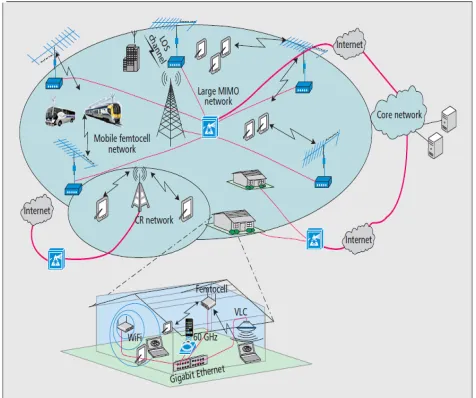
of antenna elements, but they can collaborate with each other to form a virtual large antenna array, which together with BS antenna arrays will construct virtual massive MIMO links. Large antenna arrays will also be installed outside of every building to communicate with outdoor BSs or distributed antenna elements of BSs, possibly with line of sight (LoS) components. Large antenna arrays have cables connected to the wireless access points inside the building communicating with indoor users. This will certainly increase the infrastructure cost in the short term while significantly improving the cell average throughput, spectral efficiency, energy efficiency, and data rate of the cellular system in the long run.
Figure 1. A proposed 5G heterogeneous wireless cellular architecture.
The 5G cellular architecture should also be a heterogeneous one, with macrocells, microcells, small cells, and relays. To accommodate highmobility users such as users in vehicles and highspeed trains, we have proposed the mobile femtocell (MFemtocell) concept [1], which combines the concepts of mobile relay and femtocell. MFemtocells are located inside vehicles to communicate with users within the vehicle, while large antenna arrays are located outside the vehicle to communicate with outdoor BSs. An MFemtocell and its associated users are all viewed as a single unit to the BS. From the user point of view, an MFemtocell is seen as a regular BS. This is very similar to the above idea of separating indoor (inside the vehicle) and outdoor scenarios. It has been shown in [1] that users using MFemtocells can enjoy high-datarate services with reduced signaling overhead. The above proposed 5G heterogeneous cellular architecture is illustrated in Fig. 1.
III. MASSIVEMIMO
The term massive MIMO has been introduced for using a much larger number of antennas per site than today. In
particular, the number of antennas is assumed to be, say, 10 times larger than the total number of streams served to all terminals in a cell. In this way, significant beamforming gains become possible, and more users can be served in parallel [4]. MIMO systems consist of multiple antennas at both the transmitter and receiver. By adding multiple antennas, a greater degree of freedom (in addition to time and frequency dimensions) in wireless channels can be offered to accommodate more information data. Hence, a significant performance improvement can be obtained in terms of reliability, spectral efficiency, and energy efficiency. In massive MIMO systems, the transmitter and/or receiver are equipped with a large number of antenna elements (typically tens or even hundreds). Note that the transmit antennas can be co-located or distributed (i.e., a DAS system) in different applications. Also, the enormous number of receive antennas can be possessed by one device or distributed to many devices. Besides inheriting the benefits of conventional MIMO systems, a massive MIMO system can also significantly enhance both spectral efficiency and energy efficiency [2]. Furthermore, in massive MIMO systems, the effects of noise and fast fading vanish, and intracell interference can be mitigated using simple linear precoding and detection methods. By properly using multiuser MIMO (MU-MIMO) in massive MIMO systems, the medium access control (MAC) layer design can be simplified by avoiding complicated scheduling algorithms [3]. With MUMIMO, the BS can send separate signals to individual users using the same time-frequency resource, as first pro. Consequently, these main advantages enable the massive MIMO system to be a promising candidate for 5G wireless communication networks.
IV. SYSTEMCAPACITYANDDATARATE5G
WIRELESSTECHNOLOGIES
In this section, based on the above proposed heterogeneous cellular architecture, we discuss some promising key wireless technologies that can enable 5G wireless networks to fulfill performance requirements. The purpose of developing these technologies is to enable a dramatic capacity increase in the 5G network with efficient utilization of all possible resources. Based on the well-known Shannon theory, the total system capacity Csum can be approximately expressed by
ISSN 2348 – 7968
macrocells, microcells, small cells, relays,
MFemtocell [1], etc.), number of subchannels (via massive MIMO [5], spatial
modulation [SM] [8], cooperative MIMO, DAS, interference management, etc.), bandwidth (via CR networks [7], mm wave communications, VLC [6], multi-standard systems, etc.), and power (energy-efficient or green communications).
Beyond 2020 mobile networks need to support a 1000-fold increase in traffic relative to 2010 levels, and a 10- to 100-fold increase in data rates even at high mobility and in crowded areas. Besides the available bandwidth, high frequency bands also allow for mMIMO using antenna arrays with small form factors, which can provide a 10-fold increase in capacity compared to conventional single-antenna systems [4]. Nevertheless, high frequency bands suffer from high path loss attenuation and are limited to line of sight (LOS) and short-range non- LOS environments. Massive MIMO can be exploited to extend the coverage of higher frequency bands by relying on beamforming gains. Advanced physical layer techniques, such as higher-order modulation and coding schemes (MCS), such as 256-quadrature amplitude modulation (QAM), increase spectral efficiency and can be combined with mMIMO to increase system capacity. By adding some intelligence at the transmitter and receiver, potential interference can be coordinated and cancelled at the receiver to increase system throughput .
V. BUILDINGGIGABITWIRELESSLINKS
The performance improvements resulting from the
use of MIMO systems are due to array gain, diversity gain, spatial multiplexing gain, and interference reduction. We briefly review each of these leverages in the following considering a system with transmit and receive antennas.
A. Array Gain
Array gain can be made available through processing at the transmitter and the receiver and results in an increase in average receive SNR due to a coherent combining effect. Transmit/receive array gain requires channel knowledge in the transmitter and receiver, respectively, and depends on the number of transmit and receive antennas. Channel knowledge in the receiver is typically available whereas channel state information in the transmitter is in general more difficult to maintain.
B. Diversity Gain
Signal power in a wireless channel fluctuates randomly (or fades). Diversity is a powerful technique to mitigate fading in wireless links. Diversity techniques rely on transmitting the signal over multiple (ideally) independently fading paths (in time/frequency/space). Spatial (or antenna) diversity is preferred over time/frequency diversity as it does not incur an expenditure in transmission time or bandwidth. If the transmitter and receiver links composing the MIMO channel fade independently and the transmitted signal is suitably constructed, the receiver can combine the arriving
signals such that the resultant signal exhibits considerably reduced amplitude variability in comparison to a SISO link and we get transmitter and receiver diversity. Extracting spatial diversity gain in the absence of channel knowledge at the transmitter is possible using suitably designed transmit signals .
C. Spatial Multiplexing Gain
MIMO channels offer a linear ( transmitter ,receiver) increase in capacity for no additional power or bandwidth This gain, referred to as spatial multiplexing gain, is realized by transmitting independent data signals from the individual antennas. Under conducive channel conditions, such as rich scattering, the receiver can separate the different streams, yielding a linear increase in capacity.
D. Interference Reduction
Cochannel interference arises due to frequency reuse in wireless channels. When multiple antennas are used, the differentiation between the spatial signatures of the desired signal and cochannel signals can be exploited to reduce interference. Interference reduction requires knowledge of the desired signal’s channel. Exact knowledge of the interferer’s channel may not be necessary. Interference reduction (or avoidance) can also be implemented at the transmitter, where the goal is to minimize the interference energy sent toward the cochannel users while delivering the signal to the desired user. Interference reduction allows aggressive frequency reuse and thereby increases multi cell capacity.
VI. MIMO-OFDM
So far we discussed signaling techniques for frequency-flat fading MIMO channels. the basic principles of MIMO-OFDM, a particularly attractive modulation scheme in frequency-selective fading channels. We start with the signal model. Denoting the discrete-time index by , the input–output relation for the broadband MIMO channel is given by The
www.ijiset.com
ISSN 2348 – 7968 transmitter, following which a cyclic prefix (CP) of
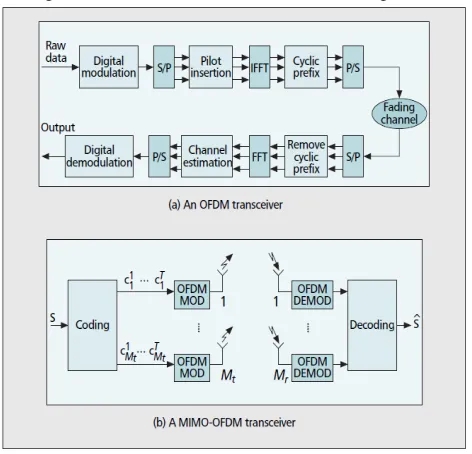
length L containing a copy of the first samples of the parallel-to-serial converted output of the IFFT block is pre pended. At the receiver, the CP is removed following which a length N FFT is performed on the received signal sequence. The net result is that the frequency-selective fading channel is decomposed into N parallel frequency-flat fading channels, each having bandwidth B/N. IFFT/FFT and CP operations being performed at each of the transmit and receive antennas. The use of MIMO-OFDM decouples the frequency-selective MIMO channel into a set of N parallel MIMO channels with the input–output relation for the i th (i=0,1,2,3,..N-1) tone
given by.Spatial
Spatial multiplexing in MIMO-OFDM systems reduces to spatial multiplexing over each tone with the choice of receiver architectures being identical to that for frequency-flat fading MIMO channels with SC modulation. the bit stream to be transmitted is first encoded, then modulated and interleaved. The resulting data symbols to be transmitted are mapped across space and frequency by a space-frequency encoder. The receiver demodulates the received signal and estimates the transmitted space-frequency codeword followed by reinter leaving and decoding .
Fig. 2 A simplified block diagram of MIMO-OFDM system
VII.MIMORESULT
Fig 3The average system spectral efficiency of a CR network as a function of the number of primary receivers with different values of interference thresholds Q (number of secondary receivers = 20).
Fig 4. An illustration of a multi-user capacity region. The sum capacity may
penalize certain users, depending on the shape of the capacity region.
Fig 5. Uncoded probability of error for channel inversion, regularized
ISSN 2348 – 7968
Fig.6. capacity for different MIMO antenna configurations
Fig.7 A heterogeneous mobile network using triple-sectored macro-sites .
Fig8. Interference is more localized when using massive MIMO,
VIII.ADVANTAGESANDDISADVANTAGEOFMIMOSYSTEM
A. Increased number of users
More users on the same frequency space means that the network provider has lower operating costs in terms of purchasing frequency space.
B. Increased Range
As the MIMO focuses gain on the communicating device, the range of operation increases. This allows the area serviced by a smart antenna to increase. This can provide a cost saving to network providers as they will not require as many antennas /base stations to provide coverage. network providers as they will not require as many antennas /base stations to provide coverage.
C. Security
Naturally provide increased security, as the signals are not radiated in all directions as in a traditional Omni-directional antenna. This means that if someone wished to intercept transmissions they would need to be at the same location or between the two communicating devices.
D. Increased bandwidth
The bandwidth available increases form the reuse of frequencies and also in adaptive arrays as they can utilize the many paths which a signal may follow to reach a device.
E. Reduced Interference
Interference which is usually caused by transmissions which radiate in all directions is less likely to occur due to the directionality introduced by the smart antenna. This aids both the ability to reuse frequencies and achieve greater range.
F. Complex
A disadvantage of smart antennas is that they are far more complicated than a traditional antennas. This means that faults or problems may be harder to diagnose and more likely to occur.
G. More Expensive
As MIMO system are extremely complex, utilizing the latest in processing technology they are far more expensive than traditional antennas. However this cost must be weighed against the cost of frequency space.
IX. CONCLUSION
www.ijiset.com
ISSN 2348 – 7968 communication technologies, can be seen as
promising candidates to provide high-quality and high-data-rate services to indoor users while at the same time reducing the pressure on outdoor BSs. We provided a brief overview of MIMO wireless technology covering channel models, capacity, coding, receiver design, performance limits, and MIMO-OFDM. The field is attracting considerable research attention in all of these areas. The major feature of MIMO links for use in wireless network. MIMO exploits the space dimension to improve wireless systems capacity, range and reliability. It offers significant increases in data throughput and link range without additional bandwidth or increased transmit power.
X. ACKNOWLEDGMENT
This work was supported by Shri Ram Murti Smarak College of Engg. & Technology Bareilly. The authors express the thanks to Department of Electronics & Communication Engg. For the valuable advices.
References
[1] F. Haider et al., “Spectral Efficiency Analysis of Mobile Femtocell Based Cellular Systems,” Proc. IEEE ICCT ’11,Jinan, China, Sept. 2011, pp. 347–51.
[2] F. Rusek et al., “Scaling Up MIMO: Opportunities and Challenges with Very Large Arrays,” IEEE Sig. Proc. Mag., vol. 30, no. 1, Jan. 2013, pp. 40–60
[3] C.-X. Wang and S. Wu, “Massive MIMO Channel Measurements and Modeling: Advances and Challenges” IEEE Wireless Commun.., submitted for publication.
[4] E. G. Larsson et al., “Massive MIMO for Next Generation Wireless Systems”, IEEE Commun. Mag., vol. 52,no. 2, 2014, pp. 186–95.
[5] F. Rusek et al., “Scaling Up MIMO: Opportunities and Challenges with Very Large Arrays,” IEEE Sig. Proc. Mag., vol. 30, no. 1, Jan. 2013, pp. 40–60.
[6] H. Haas, “Wireless Data from Every Light Bulb,” TED website, Aug. 2011; http://bit.ly/tedvlc
[7] X. Hong et al., “Secondary Spectrum Access Networks: Recent Developments on the Spatial Models,” IEEE Vehic. Tech. Mag., vol. 4, no. 2, June 2009, pp. 36–43.
[8] . M. D. Renzo et al., “Spatial Modulation for Generalized MIMO: Challenges, Opportunities, and Implementation,” Proc. IEEE, vol. 102, no. 1, Jan. 2014, pp. 56–103
[9] S. Gollakota, S. Perli, and D. Katabi, “Interference Alignment and Cancellation,” ACM SIGCOMM Comp. Commun.Rev., 2009.
[10] “Advanced 5G Network Infrastructure for the Future Internet — Public Private Partnership in Horizon 2020,” 2013.
[11] Y. Kishiyama et al., “Future Steps of LTE-A: Evolution toward Integration of Local Area and Wide Area Systems,” IEEE Wireless Commun., vol. 20, no. 1, 2013,pp. 12–18.
[12] A. Osseiran et al., “Scenarios for the 5G Mobile and Wireless Communications: The Vision of the METIS Project,” IEEE Commun. Mag., current issue.
[13] A. Paulraj, D. Gore, R. Nabar, and H. Bolcskei, “An overview of MIMO communications - a key to gigabit wireless,” Proc. of the IEEE., vol. 92, no. 2, pp. 198–218, Feb. 2004.
[14] D. Aronsson, Channel Estimation and Prediction for MIMO OFDM Systems: Key Design and Performance Aspects of Kalman-based
Algorithms, Ph.D. thesis, Uppsala Univ., 2011,