NUMERICAL METHOD OF SIMULATION OF MATERIAL INFLUENCES IN MR TOMOGRAPHY M. Steinbauer and R. Kubasek
Faculty of Electrical Engineering and Communications Brno University of Technology
Czech Republic
K. Bartusek
Institute of Scientific Instruments
Academy of Sciences of the Czech Republic Czech Republic
Abstract—Generally all Magnetic Resonance Imaging (MRI) tech-niques are affected by magnetic and electric properties of measured materials, resulting in errors in MR image. Using numerical simula-tion we can solve the effect of changes in homogeneity of static and RF magnetic fields caused by specimen made from conductive and/or magnetic material in MR tomograph. This paper deals with numerical simulation of material susceptibility influence to magnetic field.
1. INTRODUCTION
In MR tomography, strong magnetic field is used (above 1 T). Because MR is very sensitive to inhomogeneity of this field, even such weak induced magnetic field as from para- or diamagnetic material is significant. Second mechanism, which affects field homogeneity, is magnetic field off eddy current induced by RF impulse in conductive material. Aim of this paper is in simulation of weakly magnetic material influence to static magnetic field.
double precision arithmetic and sufficiently fine mesh, because change of the magnetic field in vicinity of slightly magnetic materials is weak in comparison to basic static magnetic field. Second approach may use single precision arithmetic, because only reactional field (induced own field of magnetic material) is computed.
2. 2D ANALYTIC SOLUTION
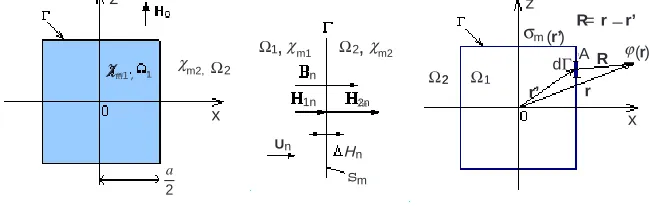
Let’s have specimen with susceptibility χm1 surrounded by reference medium with known susceptibility χm2 and placed into static primal magnetic field with magnetic intensity vector H0 oriented in uz
direction — see Fig. 1 left. We have to determine magnetic intensity Hof incurred field, which is superposition of primal and reaction field Hr (effect of specimen magnetization).
m1, 1
m2,
m2, 1,
χ χ Ω2
Ω1,χm1 Ω2,χm2,m2
2n n
1n
Hn
Un
z
x x
z
sm
2 2 Ω1
r’
dΓ AR
R= r_r’
ϕ(r)
r
_
2 a
σm(r’)
Ω
Figure 1. 2D analytic model for rectangular specimen (left), replacement of specimen magnetization effect by surface magnetic charge at the area boundaries (right) and boundary detail (middle).
Because there are not variable currents in whole area, magnetic field is irrotational (rot H = 0) and we can use scalar magnetic potential
H=−gradϕm. (1) Magnetic potential of primal field of intensityH0 is
ϕm0=−
∆H=H−H0
∆H(r) = 1 2π
Γ
σm(r) ur
R(r,r)dΓ. (3) Surface magnetic charge invokes scalar magnetic potential [5]
ϕmr(r) =− 1 2π
Γ
σm(r) lnR(r,r)dΓ. (4)
Total scalar magnetic potential at pointris superposition of static primal field intensity (2) and contribution from charged bound (4)
ϕm(r) =−Hz− 1
2π
Γ
σm(r) lnR(r,r)dΓ. (5)
Using condition of magnetic flux Bn = Bnun we obtain an integral formula for surface magnetic charge density normal component conjunction on bound Γ (see Fig. 1 middle)
Bn=µ0(1 +χm1)H1n=µ0(1 +χm2)H2n (6)
Analogically to the Gauss theorem causes magnetic charge of densityσmat point A magnetic field of intensity
∆Hn =±
σm(A)
2 . (7)
Using (5) and (1) we have the normal components of magnetic field intensity at point A (Fig. 1 middle)
H1n=H0uzun+
1 2πgrad
Γ, r∈Ω1
σm
rlnR(r,r)dΓun, (8)
H2n=H0uzun+
1 2πgrad
Γ, r∈Ω1
σm
rlnR(r,r)dΓun. (9)
Whenever A∈Γ and thusr ∈Γ, has integral in formulas (8) a (9) singularity at point A (wherer =r). We can remove this singularity omitting pointr=r from integration and taking field contribution of this point using (7) instead. So we can write
H1n =H0uz·un+
1 2π
Γ
r=r
σm
r 1
R(r,r)dΓuR·un−
σm(A)
H2n =H0uz·un+ 1 2π
Γ
r=r
σm
r 1
R(r,r)dΓuR·un+
σm(A)
2 , (11)
where was used
grad lnR(r,r) = 1
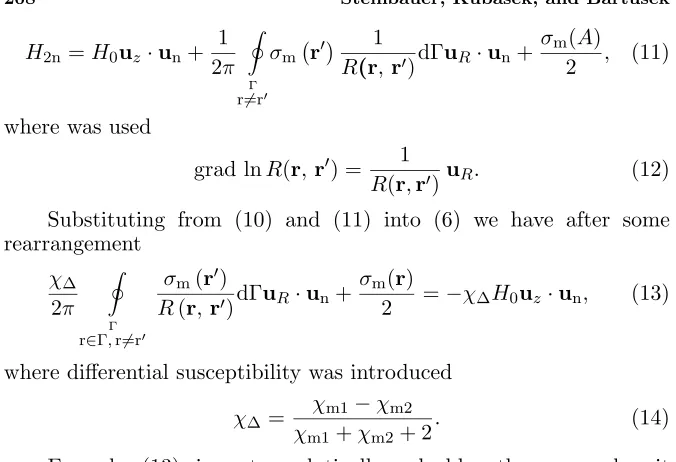
R(r,r)uR. (12) Substituting from (10) and (11) into (6) we have after some rearrangement
χ∆ 2π
Γ
r∈Γ,r=r
σm(r)
R(r,r)dΓuR·un+
σm(r)
2 =−χ∆H0uz·un, (13)
where differential susceptibility was introduced
χ∆=
χm1−χm2
χm1+χm2+ 2
. (14)
Formula (13) is not analytically solvable, thus we solve it numerically by mean of boundary element method. After solution of (13) using collocation method described in [5] we have obtained results, shown in next figure. Shape of magnetic flux density is in the Fig. 2. In this simulation the aluminium specimen (Ω1) was considered with χm1 = 22 · 10−6, length of specimen z = 20 mm, thickness
a= (3, 5 and 7) mm. Specimen was immersed into the water with
χm2=−9·10−6−(Ω2).
-0.2 -0.1 5 -0.1 -0.0 5 0 0.05 0.1 0.15 0. 2 -4
-2 0 2 4 6 8 10 12 14x 10
-5
x (m)
a= 7m m a=5mm a=3mm
b = 20mm
m1= 22e -6
χm2= -9 6
B(T)
χ
3. 3D NUMERICAL SOLUTION
Three dimensional numerical modeling was provided using FEM and Ansys software. The scalar magnetic potential was computed by solving of Laplace’s equation
∆ϕm= divµ(−gradϕm) = 0. (15)
One of used model is in Fig. 3. Here weakly paramagnetic specimen is surrounded by diamagnetic reference substance. The model was meshed with Solid96 element type. Boundary conditions were set up to achieve induction B0 = 4,700 T in z-axes direction:
ϕm=const.on the surfaces Γ1, Γ2, ∂ϕ∂nm = 0 on the shell surface Γ3.
m2
χ m1
m2 ,
1
3
4
2
χ
χ
Figure 3. FEM model (left) and compute result (right) for magnetic flux density.
FEM modeling and solution is described in [8]. One of obtained results — the module of magnetic inductionBalong the “path” marked in Fig. 3 — is shown in the figure in the right.
4. CONCLUSIONS
Both method of numerical modeling of magnetic field deformation in MRI, caused by weakly magnetic specimen, which were described here, was compared with experimental results [3, 8]. Proximity of measured and numerically modeled data was good — see [5]. To enable comparison, simulation was adjusted to the same conditions as experiment: size of sample, susceptibilities and magnetic field of B = 4.7 T.
tomography. The method uses Gradient Echo (GE) method and benefits from magnetic induction field shape in specimen vicinity, which is immersed in reference medium with measurable MR signal. After an optimization this method can be used for investigation of the materials used in MR tomography as well as of biological tissues affecting quality of MR images.
ACKNOWLEDGMENT
This work is supported by the grants GAAV B208130603 and GAAV B208130604.
REFERENCES
1. Ernst, R. R., G. Bodenhausen, and A. Wokaun,Principles of NMR in One and Two Dimensions, Oxford Science Publishing, 1987. 2. Sep´ulveda, N. G., I. M. Thomas, and J. P. Wikswo, Jr., “Magnetic
susceptibility tomography for three-dimensional imaging of diamagnetic and paramagnetic objects,” IEEE Transaction on Magnetics, Vol. 30, No. 6, 5062–5069, 1994.
3. Kubasek, R., M. Steinbauer, and K. Bartusek, “Material influences in MR tomography, measurement and simulation,” Journal of Electrical Engineering, Vol. 8, 58–61, Zilina, 2006. 4. Wang, Z. J., S. Li, and J. C. Hasselgrove, “Magnetic resonance
imaging measurement of volume magnetic susceptibility using a boundary condition,” Journal of Magnetic Resonance, Vol. 142, 477–481, 1999.
5. Hwang, S. N. and F. W. Wehrli, “Experimental evaluation of surface charge method for computing the induced magnetic field in trabecular bone,” Journal of Magnetic Resonance, Vol. 139, 35–45, 1999.
6. Eastham, J. F., R. J. Hill-Cottingham, I. R. Young, and J. V. Hajnal, “A method of inverse calculation for regions of small susceptibility variations,”IEEE Transaction on Magnetics, Vol. 33, No. 2, 1212–1215, 1997.
7. Eastham, J. F., R. J. Hill-Cottingham, I. R. Young, J. V. Hajnal, P. J. Leonard, and W. Lin, “Use of finite element analysis to calculate field changes in low susceptibility materials,”Proceedings
of Compumag 95 International Conference, 546–547, Berlin,
Germany, 1995.