International Journal of Research (IJR)
e-ISSN: 2348-6848, p- ISSN: 2348-795X Volume 2, Issue 08, August 2015Available at http://internationaljournalofresearch.org
Captcha and Its Techniques for Providing Security in Web and
Applications
K.V. Reddy
1; D.Shiva Rama Krishna
2& D.C.Janardana Reddy
31Professor, Dept of CSE, Marri Laxman Reddy Institute of Technology & Management, Hyderabad, Telangana
2Assistant Professor, Dept of CSE, Marri Laxman Reddy Institute of Technology & Management,
Hyderabad, Telangana
3PG Scholar, Dept of CSE, Marri, Marri Laxman Reddy Institute of Technology & Management,
Hyderabad, Telangana
ABSTRACT
With expansion of internet and its services, a large number of organizations are making use of password to provide security. The password is most convenient means of authentication. But now a day’s password becomes hacked by the attacker. To provide more security, we are using Kerberos and the video CAPTCHA as authentication technique. Kerberos is a authentication protocol and CAPTCHA is a (Completely Automated Public Turing Test to tell Computer and Human Apart) test which provide a way to differentiate user into a human and malicious program. CAPTCHA become the most widely used standard security technique to prevent automated computer program attack. Our aim is to proposed a system which can be a better than existing CAPTCHA and provide higher level of authentication CAPTCHA is an acronym for Completely Automated Public Turning Test to tell Computers and Humans Apart. Captcha is one of the widely used techniques for preventing malicious program from accessing the web resource automatically. Now a day’s for web security there exists different type of Captcha such as text Captcha, image Captcha, audio Captcha and video Captcha. In this paper online security scheme is constructed with text and graphical
passwords. Captcha and Graphical passwords are integrated and a novel family of graphical password systems built on top of Captcha technology is called as Captcha as graphical passwords (CaRP). The CaRP scheme is enhanced with more attack handling mechanisms that improves the level of security in online application system and also provides better authentication.
Keywords: CaRP; Captcha; Graphical Passwords; Accessing
I. INTRODUCTION
International Journal of Research (IJR)
e-ISSN: 2348-6848, p- ISSN: 2348-795X Volume 2, Issue 08, August 2015Available at http://internationaljournalofresearch.org
hosts which are linked to elevated bandwidth Internet connections. This will be diminishing the performance of the system. CAPTCHA is a well known security protection; it is used to protect these types of malicious programs [1].
First time CAPTCHA was invented in 2000 at Carnegie Mellon University by John Langford, Nicholas J. Hooper and Luis Von Ahn. CAPTCHA is an acronym for ―Completely Automated Public Turning Test to tell Computers and Humans Apart‖. Completely Automated Public Turing test to tell Computers and Humans Apart (CAPTCHAs) are a class of automated challenges used to differentiate between legitimate human users and computer programs (`bots') on the internet. CAPTCHAs have many practical security applications, including preventing the abuse of online services such as free email providers [2]. The need for a more secure yet user friendly CAPTCHA arises. A CAPTCHA system must satisfy the following three characters:
1) Human can recognize the contents and pass it easily.
2) It is invoked to prevent robots to pass the system or to increase the processing cost through continuous attack.
3) It should be generated easily and quickly. CAPTCHAs have several applications for practical security, Captcha is in various designs consist of text based or image based [3].
In sequence to overcome the disadvantages of text based method, the image based Captcha was initiated. Various internet web search engines like Yahoo, Google, and Bing etc to use Captcha to distinguished among a authorized user and a malicious program. Captcha technique includes wide variety of applications such as the Website Registration Protection, shield against spam’s and worms, avoiding comment spams and avoiding the
dictionary attacks. A Turing test was intended for establish the cleverness of a computer [4, 5].
The Turing test is the Captcha series present as a judge and the other person act as user. When the user be failed the Turing test, consider to be a machine. To defend the online email and further services from being injured by bots, Captcha is a standard web application for protection practice. In particular, the puzzle based panel cartoon has an extremely eminent conflict to attacks, security and simple to access. Furthermore, the evaluation cartoons is humorous and attractive for humans, the panel cartoon Captcha inspiration is the popular feasible be seen as a pleasurable and enjoyable Turing test that does not harmfully have an effect on convenience for users. By using these category of Captcha representation the user can simply access their submission by assemble this section within certain time duration. So among this progression the hackers cannot be able to attack the method during various injections. Jigsaw puzzle is a cartoon puzzle that mandatory a set of plenty mini and interlocking small images. On completing the puzzle it generates a picture [6].
It is widely accepted that a good CAPTCHA must be both robust and usable. The robustness of a CAPTCHA is its strength in resisting adversarial attacks, and this has attracted considerable attention in the research community. There are some properties defined for the development of CAPTCHA. [8]
Automated: It must be possible for a machine to automatically generate and grade the challenges.
International Journal of Research (IJR)
e-ISSN: 2348-6848, p- ISSN: 2348-795X Volume 2, Issue 08, August 2015Available at http://internationaljournalofresearch.org
Usable: Humans must able to solve the test in reasonable amount of time. The effect of users language, physical location, education and perceptual abilities should be minimal. Challenges should be easily and quickly solved by humans.
Secure: The program generates the test should be difficult for machines to solve by using any algorithm. The underlying AI problem must be a well-known and well-studied problem. Where the best existing techniques are weaker than humans [9].
II. RELATED WORK
CAPTCHA as graphical passwords (CaRP) is both a CAPTCHA and a graphical password scheme. CaRP addresses a number of security problems altogether. Notably, a CaRP password can be found only probabilistically by automatic online guessing attacks even if the password is in the search set. CaRP also offers a novel approach to address the well-known image hotspot problem in popular graphical password systems, such as Pass Points that often leads to weak password choices. CaRP offers reasonable security and usability and appears to fit well with some practical applications
for improving online security. Animal Grid and
Click Text easier to use than Pass Points and a combination of text password and CAPTCHA. Both Animal Grid and Click Text had better password memo ability than the conventional text passwords. On the other hand, the usability of CaRP can be further improved by using images of different levels of difficulty based on the login history of the user and the machine used to log in [7].
Existing Captcha:
A. Text-Based Captcha: Words in the distortion
form. This is the most commonly used CAPTCHA.
Because it does not need any learning or training, so it is easy to use. Text-based CAPTCHA is most widely deployed in many famous websites like Yahoo, Hotmail, Gmail,
YouTube, PayPal etc. Text-based CAPTCHA is more secure to defend automated program if it is properly designed, i.e., the distorted form of a word cannot be recognized by robots easily. However, if the word is misrepresentative, it is hard to recognize by humans. Text-based CAPTCHA is the most popular, easiest and simplest mechanism among all the CAPTCHA techniques. The text-based CAPTCHA is difficult to use when there is any large deformation in the presented character or the user does not have good educational background. And it also fails when the user face difficulty in reading [6, 7].
Fig.1. Examples of text _based CAPT CHAs
B. Image-Based Captcha: In this, users are
International Journal of Research (IJR)
e-ISSN: 2348-6848, p- ISSN: 2348-795X Volume 2, Issue 08, August 2015Available at http://internationaljournalofresearch.org
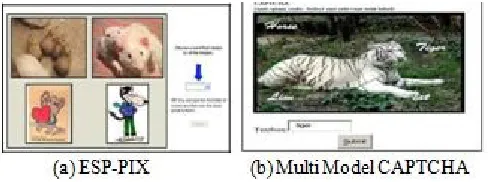
difficult to break this test using pattern recognition technique. The users of this CAPTCHA usually interact using a pointing device, e.g., mouse. In general, image-based CAPTCHAs require larger web page area, and need an image database maintained at the server. ESP- PIX is a Captcha script that instead of asking you to type letters requires that you look at a set of pictures and then select the word that best describes all the images [11]. It is available in English therefore end user must have a comprehensive English vocabulary. There are only 27% people in the world are English speaking.
Fig 2. Examples of image-based Captcha
C. Audio and Video Based Captcha: The program
picks a word or a sequence of numbers at random, renders the word or the numbers into a downloadable audio file and background noises are added to the sound clip using TTS software to make the test more robust against bots. It then presents the distorted sound clip to the user and asks users to enter its contents. These systems are highly dependent on the audio hardware and need to install essential software like Adobe Flash on their computers. These barriers lead to spend user's time more than standard response time which is typically about 5-15 seconds. Because of high level of distortion characters produce similar sound like ―d ―and ―b‖. These English words are unfamiliar to non-English humans. It helps visually disabled users but the worst case is for people who have
problem in both hearing and vision. YouTube which currently stores and indexes close to 150 million videos used as a video dataset in video based CAPTCHAs. However; video is also more complex and need more time and bandwidth to answer the challenge than other schemes [12].
III. PROPOSED SYSTEM
Captcha: The basic Captcha requires the user to type some alphanumeric characters specifically, alphabets or digits as of an imprecise image which is illustrated on the system display. The purpose of this kind of analysis is to avoid the unnecessary bots from accessing websites. In this proposed method, a security primitive based Captcha technology with graphical password system was presented to improve the online security. Its deal with an amount of security troubles altogether, for example, online guessing attacks, relay attacks and surfing attacks.
The methods used are:
Know the working methodologies of
Captcha
Identify the functioning technique of Ajax
Understand Jigsaw cartoon puzzle
This proposed method completely contributes a CAPTCHA by a panel cartoon. In this panel cartoon
International Journal of Research (IJR)
e-ISSN: 2348-6848, p- ISSN: 2348-795X Volume 2, Issue 08, August 2015Available at http://internationaljournalofresearch.org
drag and drop method. After each progress, the webpage will be automatically reloaded. It is easily accessed and it has lesser time.
The scheme illustrated in Captcha challenge is applied, when the number of failed login attempts the threshold generated on the web account. A small threshold is applied for failed login attempts from unknown machines but a large threshold is applied for failed attempts from known machines on which a successful login occurred within a given time frame. This technique can be incorporated into CaRP (Captcha as graphical Password) to improve its usability:
1. A regular CaRP image is concerned when an account has accomplished a threshold of failed login attempts. As in, different thresholds are applied for logins from known and unknown machines.
2. Otherwise an ―easy‖ CaRP image is applied. An ―easy‖ CaRP image may take several forms depending on the application requirements.
It may be an image provided by underlying Captcha generator with less distortion or overlapping, a permuted ―keypad‖ wherein un distorted visual objects (e.g. characters) are permuted, or even a regular ―keypad‖ wherein each visual object (e.g., character) is always located at a fixed position. These different forms of ―easy‖ CaRP images allow a system to adjust the level of difficulty to fit its needs. With such a modified CaRP, a user would always enter a password on an image for both cases are listed as in above said and other extras are not required. Between the two cases difference lies in that a hard image is used in the first stage whereas an easy image is used in the second case.
Typically, the basic task that a CAPTCHA imposes to users is intuitive, easy to understand and easy to remember. Thus, CAPTCHA has a relatively good memorability.
1. Average solving time: Users complete
International Journal of Research (IJR)
e-ISSN: 2348-6848, p- ISSN: 2348-795X Volume 2, Issue 08, August 2015Available at http://internationaljournalofresearch.org
with most of the users taking around 11.61 seconds and for Microsoft’s CAPTCHA is 11.93 seconds. So it has better efficiency compare to others.
2. Accuracy: Accuracy or the success rate is
defined how successfully a participant can pass a CAPTCHA challenge .The total number of correct attempts of Contextual Conversation CAPTCHA (e.g. 88.04%) is higher than Microsoft’s CAPTCHA (e.g. 83.69%) as shown in Table II, which clearly indicates that users are able to solve more challenges of Contextual Conversation CAPTCHA correctly. Fig 6 shows a graphical representation of the difference in success rates among 3 tests used in our evaluation which signifies the proposed CAPTCHA has a higher accuracy or success rate.
IV. CONCLUSION
The Various CAPTCHA alternatives are
continuously emerging, and this race will continue and more advance. The basic idea of CAPTCHA is to tell computer and machine apart and this concept is worth to be discovers for several reason. We have proposed the first CAPTCHA that uses video understanding to distinguish between humans and machines. As a contribution toward improving the web security in the field of an automated challenge and response against attacks issued by automated programs, we proposed a
more robust video based CAPTCHA. Since a weak CAPTCHA implementation can only provide a false sense of security, we have been addressing the principle features which contribute in effective way to provide more secure challenge. We explore the security and usability of video CAPTCHA, and to propose a system which can be a better system than existing CAPTCHA and also provide higher level of authentication using Kerberos.
REFERENCES
[1]. Tamang, Tsheten, and PattarasineeBhattarakosol. "Uncover impact factors of text-based CAPTCHA identification." In Computing and Convergence
Technology (ICCCT), 2012 7th International
Conference on, pp. 556-560. IEEE, 2012.
[2]. Kuo-Feng Hwang, Cian-Cih Huang, and Geeng-Neng You. "A Spelling based CAPTCHA system by using click." In Biometrics and Security Technologies (ISBAST), 2012 International Symposium on, pp. 1-8. IEEE, 2012.
[3]. Saxena, Ashutosh, Nitin Singh Chauhan, K. R. Sravan, AparajithSrinivasanVangal, and David Palacios Rodrguez. "A new scheme for mobile based CAPTCHA service on Cloud." In Cloud Computing in Emerging Markets (CCEM), 2012 IEEE International Conference on, pp. 1-6. IEEE, 2012.
[4]. D'Souza, Darryl, Phani C. Polina, and Roman V. Yampolskiy. "Avatar captcha: Telling computers and
humans apart via face classification." In
Electro/Information Technology (EIT), 2012 IEEE International Conference on, pp. 1-6. IEEE, 2012.
[5]. Kiran Jain Azad, "CAPTCHA: Attacks and weaknesses against OCR Technology." Global Journal of Computer Science and Technology 13, no. 3 (2013).
International Journal of Research (IJR)
e-ISSN: 2348-6848, p- ISSN: 2348-795X Volume 2, Issue 08, August 2015Available at http://internationaljournalofresearch.org
IEEE TRANSACTIONS ON INFORMATION
FORENSICS AND SECURITY, VOL. 9, NO. 6, JUNE 2014.
[7]. Nikitha Bhasu and Raju. K. Gopal, ―Enhanced Security Solution to Prevent Online Password Guessing Attacks,‖SSRG International Journal of Computer Science and Engineering (SSRG-IJCSE) – volume1 issue6 August 2014.
[8]. Qi Ye, Youbin Chen, Bin Zhu, ―The Robustness of a New 3D CAPTHCHA,‖ 11th IAPR International Workshop on Document Analysis Systems, 978-1-4799-3243-6/14 $31.00 © 2014 IEEE
[9]. Sanket Bhat, Saumitra Damle, Priyanka Chaudhari, Abhijeet Saraogi, ―KERBEROS: An Authentication Protocol,‖ International Journal of Advance Research in Computer Science and Management Studies, Volume 2, Issue 2, February 2014.
[10]. Varun Ambrse Thomas, Karanvir Kaur,‖Cursor CAPTCHA –Implementing CAPTCHA Using Mouse Cursor ,‖978-1-4673-5999-3/13/$31.00 ©2013 IEEE.
[11]. Chundong Wang, Chaoran Feng, ―Security Analysis and Implement for Kerberos Based on Dynamic Password and Diffile-Hellman Algorithm, ‖Fourth International Conference on Emerging Intelligent Data and Web Technology, 2013 IEEE.
[12]. Nipun Manohar, Yogesh Kusmude, Chetan Konde,‖ A Spelling Based CAPTCHA System Using Click, “International Journal of Computer Science and Management Research, Vol 2 Issue 4 April 2013.