Voltage Stability Analysis of Radial
Distribution Network under Critical Loading
Condition
I.Revathi1, G.Venkateswarlu2, T. Purnachandra Rao3
PG Student [PSEG], Dept. of EEE, VR Siddhartha Engineering College, Vijayawada, Andhra Pradesh, India1
Assistant Professor, Dept. of EEE, VR Siddhartha Engineering College, Vijayawada, Andhra Pradesh, India2,3
ABSTRACT: Voltage stability has become an important issue of power system stability. This work is concentrated on
finding weak busses with voltage stability index analysis for Radial Distribution System (RDS). In this work Optimization of Multiple Distribution Generating Unit using Voltage Stability Index and Analytical Approach with Forward, Backward Sweep method (FBS). In this work a novel approach has been implemented to reduce the losses in the radial distribution system. This work has been done in two phases. From the first phase of work identification of weak nodes with voltage stability index, which are most sensitive to voltage collapse using the Branch Injection and Branch Current (BIBC) and Branch Current and Branch Voltage (BCBV) matrix have been analyzed. This feature enables us to set an index threshold to monitor and envisage system test case stability, so that a proper action can be taken to prevent the system from collapse. From second phase, optimal allocation of Multiple DG with the objective as minimizing the distribution line losses with cost attributes. . It is vitally essential to characterize the size and location of multiple DGs’ to be placed and the cost of DG’s, with the cost of line loss when the DG is active. By virtue of some intrinsically characteristics of distribution systems, as the structure is radial in nature, immensely colossal number of nodes, with an extensive range of R/X ratios, the conservative techniques diverges in the distribution system for the determination of optimum size and location of these multiple Distributed Generations (DG). The projected approach and results are validated on IEEE 33,69 bus standard test systems.
KEY WORDS
:
.
Weak bus, load modelling, voltage stability, voltage collapseI.INTRODUCTION
A centralized power generation is followed by a typical power system. The transmission and distribution system acts like a barrier between this centrally generated power and the consumer. A continuity of delivering to the load is more important for transmission and distribution companies to maintain their reliability in the system. Reliability according to consumer can be defined as the continuous supply to the consumer end or the ability of the power system components to deliver electricity to all points of consumption. Reliability is often measured by outage indices defined by the Institute of Electrical and Electronics Engineers (IEEE) Standard 1366. According to supremacy in load increment, these concentrated generations will not satisfy the needs of consumer, so that this DG has come into picture with new difficulties and advantages. Depending upon this increase in load the generation should increases instantly, but concentrated generation did not satisfy the load demand in optimal concern.
II. VOLTAGE STABILITY INDEX
is occurred is taken as weak bus .DG
is placed at that node. Voltage stability margin is determined for each bus using Eq. (2.31) and the bus with minimum VSM is determined. VSM of each bus is a number between 0 and 1. The method is based on the BIBC matrix and helps us to develop a computerized algorithm for the calculation of each bus index value of any distribution system.
III.
LOAD MODELINGDepending on nature of publication lodes are modelled as 1. constant power load
2. constant impedance load 3. constant current load 4. composite load
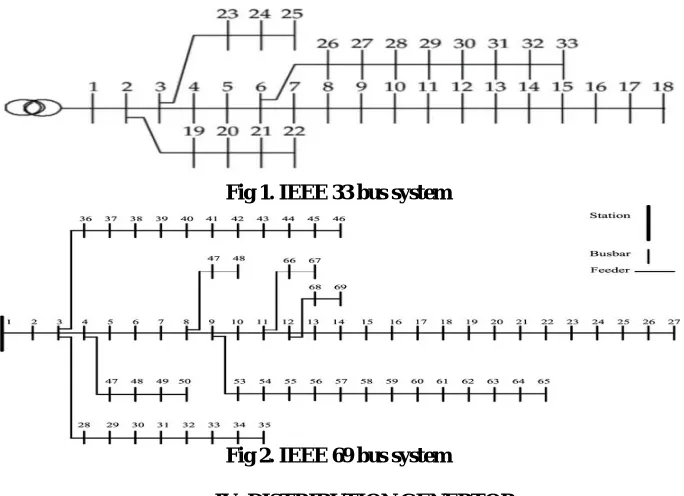
Fig 1. IEEE 33 bus system
Fig 2. IEEE 69 bus system
IV. DISTRIBUTION GENERTOR
will depend upon three factors. Those are voltage limits of system, fault levels, thermal limits of considered lines, lines and substation. The above three technical factors affect the size and place of DG. For minimizing losses in the distribution systems, distribution companies (in India DISCOMs’) operate these DGs’ locally to handle at load side within above technical factors. Before introducing the DG in steady state / practical system the (DISCOM) distribution companies will make sure that if any violation in these three technical factors for secures operation. Some of the worst cases the system faces when distribution system
1
. Maximum load and no generation 2. Minimum load and maximum generation3. Minimum voltage at the load when DG size exceeds its range.
IV.MATLAB RESULTS
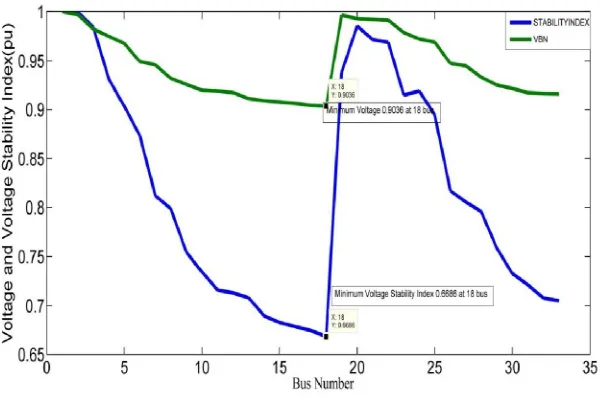
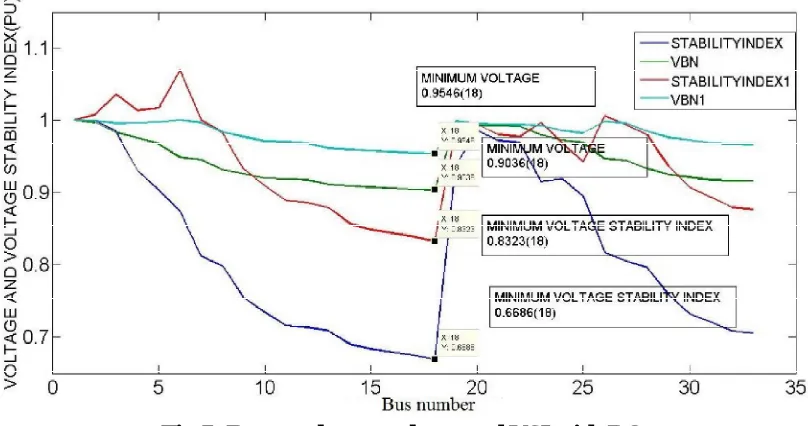
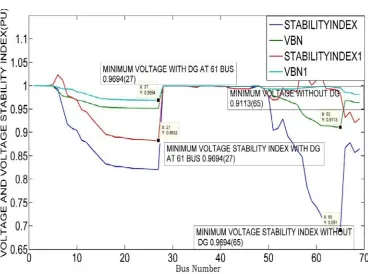
The MATLAB results has done on less than 5 MW DG .The Placement of DG is done based on voltage stability index. By taking IEEE33,69 bus test system we are considered. In all of these cases, by placing DG then minimum voltages and minimum voltage stability index values are improved and critical node is shifted from 65th bus to 27th bus in IEEE69 bus test system and critical node doesn’t shifted in IEEE33 bus test system .18th bus will be the weak node in both cases i.e with DG and with out DG.
Fig 3: Bus number vs voltage and VSI without DG
Fig 4: Bus number vs voltage and VSI Without DG
From fig:4 the minimum voltage and minimum voltage stability index is occurred at 65th bus in IEEE69 bus system .those values are 0.9113 and 0.9694..
Fig 5: Bus number vs voltage and VSI with DG
Fig 6:Bus number vs voltage and VSI with DG
From figures:6 the minimum voltage is occurred at 65th bus that value is 0.9113 and minimum voltage stability index value is 0.9694. By placing DG at 61st the minimum voltage is occurred at 27th bus that value and minimum voltage stability index is shifted from 0.9694 at 65th bus to 0.9694 at 27th bus.
V.CONCLUSIONS
A Forward, Backward Sweeping method (FBSM) has been implemented to find out the bus voltages of radial distribution network. Comparison of minimum voltage at weak nodes for constant power, constant current and constant impedance load types are done. Optimal location with DG has been found using analytical approach to improve the voltage profile. The main theme of this work is voltage profile improvement rather than voltages stability improvement.
REFERENCES
1. Yearbook.Enerdata.Net/Electricity –Domestic Consumption Data -By Region World Final Electricity Consumption Between 1980 And 2030 Twh
2. Tsikalakis A.G and N.D.hatziargyriou,”Enivironmental benefits of distributed generation with and without emission trading,” Energy Policy35.6 (2007): 3395-3409
3. Das D, Kothari DP, Kalam A. “A simple and efficient method for load flow solution of radial distribution networks”. International Journal of Electrical Power and Energy Systems 1995; 17 (5): 335±346
4.Alsaadi, and B. Gholami “An Effective Approach for Distribution System Power Flow Solution” International Scientific Index, Electrical and Computer Engineering, Vol: 3, No: 1, 2009 waset.org/Publication/14357