ISSN 2348 – 7968
Smart Trash system: An Application using ZigBee
Pavithra1,
Embedded System, Sathyabama University, Chennai, Tamil Nadu, India
Abstract
Pollution is the introduction of contaminants into an environment that causes instability, disorder, harm or discomfort to the ecosystem i.e., physical system or living organisms. Especially growing countries and most populated cities are severely affected by the pollution. Ignorance of cleanliness is spoiling our environment. The aim of this paper is to mainly concentrate on eradicating this issue and then reduce it. The smart trash consists of two sensors namely IR and gas sensors. The IR sensor placed inside the trash sense the level of trash and gas sensor will sense the toxic gases. Once the trash is filled, alarm rings. The RFID placed inside the trash will intimate about the overflowing of trash to the corporation office. The RFID placed at the corporation office is serial interfaced with PC. The visual display is coded with VB. The information regarding the removal of trash is sent to the respective area truck driver about the location of the field trash can. The complaint report contains the exact location of the trash can. If the trash can is not replaced at a right time, the microcontroller placed at the trash can intimate the information to the corporation office once again. The intimation will be displayed in corporation office LCD continuously until the trash is removed. Once the truck driver removes the trash the alarm stops and continuous intimation to corporation office and truck also ends. Database of every trash bin can be maintained by municipality. Due to immediate disposal of bin, spread of disease can be reduced.
Keywords:RFID, trash, corporation office, truck driver, IR and gas sensors
.
1. Introduction
The Municipal solid waste management is one of the major environmental problems of Indian cities. Waste management is the collection, transport, processing or disposal, managing and monitoring of waste materials. The term usually relates to materials produced by human activity, and process is generally under taken to reduce their effect on health, the environment or aesthetics. It is the distinct practice from the resource recovery which focuses on delaying the rate of consumption of natural resources. All waste materials, whether they are solid, liquid, gaseous or radioactive fall within the remit of waste management.
Waste management practices can differ for developed and developing nations, for urban and rural areas, and for residential and industrial producers. Management of non hazardous waste, residential and institutional waste in metropolitan areas is usually the responsibility of local government authorities, while management for non
hazardous commercial and industrial waste is usually the responsibility of the generator subject to local, national or international authorities.
ISSN 2348 – 7968
2. Related works
Liakot [3] describes paper deals with the solid waste monitoring and management system using radio frequency identification (RFID) associate with intelligent systems. The system consists of RFID system, mobile communication like GSM and geographical information system (GIS) for tracking vehicle position. The proposed system would be able to monitor the solid waste collection process and management the overall collection process. It would provide in time solid waste collection, tracking the vehicle position through the GIS database and also overcome the disadvantages such as usage of minimum route, low fuel cost, clean environment and available vehicle. The technologies that would be used in the proposed system are good enough to ensure the practical and perfect for solid waste collection process monitoring and management for green environment.
Roshan Issac [2] describes that the rapid urbanization in Kerela has led to increased generation of municipal solid waste(MSW), which will seriously affect the society and the quality of life of people. Although some action has taken from the part of government against this, the poor management of waste has led to pollution and to the emission of greenhouse gases. The main issues with waste management are the high cost associated with no returns, lack of real time feedback from the people about unauthorized dumping and various transportation issues. For a case study, we have taken thiruvalla municipality situated between 9°23’06’’ N to 76°34’30’’E latitude and 9°38’2’’N to 76.575°E longitude in pathanamthitta district,kerala. To address this issue we have introduced a system called SVASTHA which is a Sanskrit word which means “be healthy and hygienic”.
Maher Arebey [1] described that the increase of population of a country, proper management of cumulative of municipal solid waste(MSW) become more acute for maintaining green environment. In conventional approach a number of trucks collect the MSW and then transport and transfer these MSW in apre-specified location, but all the above jobs are not properly monitored. It is very important to monitor the trucks and record the information related to the collecting time and area from a central location to ensure the job well done. This project exploits the tremendous power of RFID technology and present the development of an electronic monitoring(e-monitoring) system to overcome the aboveproblem in the conventional approach. The proposed e-monitoring system is an embedded system that consists of RFID technology interfaced with PIC micro-controller and a web based computerized software. It has been tested in the laboratory environment as well as in the field environment. The test
results show that the system functions properly and is working real time. Municipal authority can monitor the SW collecting status through the system and can generate different reports to improve the performance of their service. The prototype developed in this project can be further improved and used for commercial purpose.
3. System Design
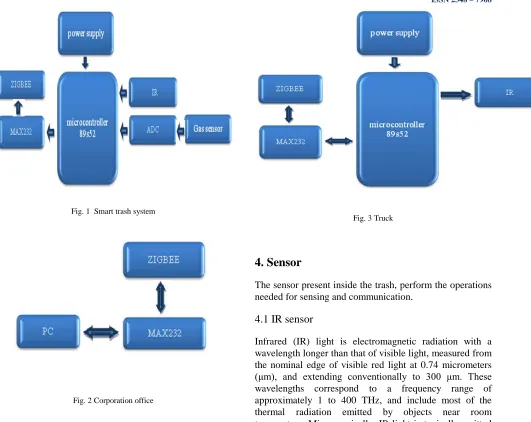
The proposed model is a solution for the problem of insanitation. Our paper consists of three modules namely smart trash, truck, corporation office. The trash consists of two sensors namely IR and gas sensors. The IR sensor placed inside the trash sense the level of trash and gas sensor will sense the toxic gases. The ZigBee placed inside the trash will intimate about the overflowing of trash to the corporation office. The ZigBee placed at corporation office is serial interfaced with PC. The visual display is coded with VB coding. From the corporation office the information regarding the removal of trash is sent to the respective area truck and it will be displayed in LCD. The ZigBee placed at the truck intimates the driver about the location of the field trash can. The complaint report contains the truck number and exact location of the trash can. If the trash can is not replaced in a particular duration, the microcontroller placed at the trash can produce the second intimation to the corporation office. The smart trash receptacle finds to be cost effective and a better way of maintaining the environment clean and healthy. The proposed model is described as follows,
3.1 Smart Trash
The smart trash consists of two sensors namely IR and gas sensors. The IR sensors placed inside the trash sense the level of trash and gas sensor will sense the toxic gases. Once the trash is filled, Alarm in the trash rings. The ZigBee placed inside the trash will intimate about the overflowing of trash to the corporation office.
3.2 corporation office
ISSN 2348 – 7968
Fig. 1 Smart trash system
Fig. 2 Corporation office
3.3 Truck
From the corporation office the information regarding the removal of trash is sent to the
Respective area truck driver and it will be displayed in LCD. The ZigBee placed at the truck intimates driver about the location of the field trash can. The complaint report contains the truck number and exact location of the trash can. Once the truck driver removes the trash the alarm stops and continuous intimation to corporation office and truck also ends
.
Fig. 3 Truck
4. Sensor
The sensor present inside the trash, perform the operations needed for sensing and communication.
4.1 IR sensor
Infrared (IR) light is electromagnetic radiation with a wavelength longer than that of visible light, measured from the nominal edge of visible red light at 0.74 micrometers (μm), and extending conventionally to 300 μm. These wavelengths correspond to a frequency range of approximately 1 to 400 THz, and include most of the thermal radiation emitted by objects near room temperature. Microscopically, IR light is typically emitted or absorbed by molecules when they change their rotational-vibrational movements.
ISSN 2348 – 7968
4.2 IR emitter and IR phototransistor:
An infrared emitter is an LED made from gallium arsenide, which emits near infrared energy atabout 880nm [6]. The infrared phototransistor acts as a transistor with the base voltage determined by the amount of light hitting the transistor. Hence it acts as a variable current source. Greater amount of IR light cause greater currents to flow through the collector-emitter leads. As shown in the diagram below, the phototransistor is wired in a similar configuration to the voltage divider. The variable current travelling through the resistor causes a voltage drop in the pull-up resistor. This voltage is measured as the output of the device.
IR reflectance sensors contain a matched infrared transmitter and infrared receiver pair. These devices work by measuring the amount of light that is reflected into the receiver. Because the receiver also responds to ambient light, the device works best when well shielded from the ambient light, and when the distance between the sensor and the reflective surface is small(less than 5mm). IR reflectance sensors are often used to detect white and black surfaces. White surfaces generally reflect well, while black surface reflect poorly. One of such applications is the line follower of a robot.
4.3 Gas sensor:
Sensitive material of MQ-2 gas sensor is SnO2, which with lower conductivity in clean air. When the target combustible gas exist, the sensor’s conductivity is higher along with the gas concentration rising. MQ-2 gas sensor has high sensitivity to LPG, propane and hydrogen, also could be used to Methane and other combustible steam, it is with low cost and suitable for different application. When a metal oxide crystal such as SnO2 is heated at a certain high temperature in air, oxygen is absorbed on the crystal surface with a negative charge. Then donor electrons I the crystal surface are transferred to the absorbed oxygen, resulting in leaving positive charges in a space charge layer. Thus, surface potential is formed to serve as a potential barrier against electron flow. Inside the sensor, electric current flows through the conjunction parts (grain boundary) of SnO2 micro crystals. At grain boundaries, absorbed oxygen forms a potential barrier which prevents carriers from moving freely. The electrical resistance of the sensor is attributed to this potential barrier. In the presence of a deoxidizing gas, the surface density of the negatively charged oxygen decreases, so the barrier height in the grain boundary is reduced. The reduced barrier height decreases sensor resistance.
4.4 ZigBee performance:
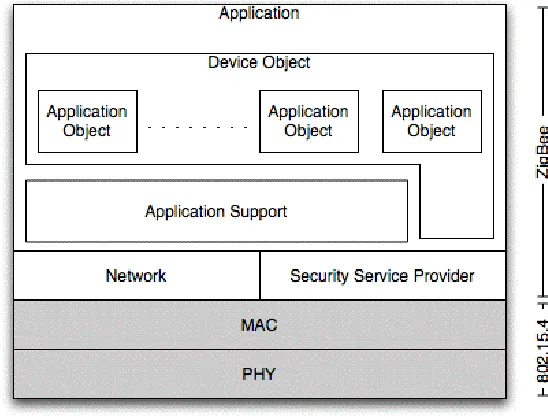
Zigbee is a specification for a suite of high level communication protocols using small, low-power digital radios based on an IEEE 802 standard for personal area networks. Zigbee devices are often used in mesh network form to transmit data over longer distances, passing data through intermediate devices to reach more distant ones. This allows ZigBee networks to be formed ad-hoc, with no centralized control or high-power transmitter/receiver able to reach all of the devices. Any ZigBee devices can be tasked with running the network.
Fig. 4 ZigBee Protocol stack
5. Results and Discussion
Municipal solid waste management(MSWM) is one of the major environmental problems of Indian cities. Improper management solid waste(MSW) causes hazards to in habitants. Various studies reveal that about 90% of MSW is disposed of un scientifically in open dumps and landfills, creating problems to public health and the environment. In the present study, an attempt has been made to provide a comprehensive review of the characteristics, generation, collection and
transportation,
disposal and treatment technologies of MSW practiced in India.ISSN 2348 – 7968
provide in time solid waste collection and also overcome the disadvantages such as usage of minimum route, low fuel cost, clean environment and available vehicle. The technologies which are used in the proposed system are good enough to ensure the practical and perfect for solid waste collection process monitoring and management for green environment.
In this project the module 1 indicates the level and gas presents in the trash bin. It indicates the alarm and sends the information to the corporation office. Then the corporation office pass the information to the truck. From the corporation office the information regarding the removal of trash is sent to the respective area truck driver and it will be displayed in LCD. The ZigBee placed at the truck intimates the driver about the location of the trash can. Once the truck driver removes the trash the alarm stops and continuous to corporation office and truck also ends.
6. Conclusion
The smart trash receptacle, gives a solution for unsanitary environmental condition in a city. This prevents many diseases caused due the toxic gases emanating from the overflowing trash can. Thus this project holds the belief that overflows of the trash can on the streets could be avoided. It helps to maintain a clean and healthy environment throughout the country. Database of every trash bin can be maintained in municipality. The communication between trash bin, municipality and truck member is also easily maintained. The smart trash receptacle finds to be cost effective. This concept can be extended to maintained sewage level, corporation water tank overflowing maintenance, road traffic maintenance.
7. Future Work
For the IGNIS project it is important to evaluate the technological concepts developed by the project have the potential for improving the waste management in future megacities. This involves testing the potential of technological solutions to contribute to the alleviation of the current problematic situation in Addis Ababa. Additionally, it is important for the IGNIS project to find out to what extent the performance (financial, socioeconomic, environmental, etc) of the waste management system could be improved as a result following the implementation of the proposed strategies. For this purpose, a set of simulation models is being conceptualized and developed using a modeling methodology (namely System Dynamics), which allows the evaluation of how the waste management situation would
evolve if a set of strategy options were to be introduced .This is done by comparing the future development of the system in absence of the strategies (business as usual) with the development of the system in the context of applied strategies will have. At the core of this set of models is the “performance assessment model”, which describes the current situation and serves as the basis for the comparison as well as evaluation of alternative strategies. The second type of models represents the design and implementation of alternative strategies for a sustainable waste management. However, these “strategy design models” do not work alone. Instead, they are built on top of the performance assessment model, which describes the way the situation(e.g. financial, environmental, socioeconomic) could develop (given that the current conditions remain unchanged),while the strategy design models show which changes would occur if the proposed strategies were to be introduced.
References
[1] Maher Arebey, MA Hannan, Hassan Basri, Huda Abdullah ”Solid Waste Monitoring and Management using RFID,GIS and GSM” in Proceedings of the 2009 IEEE Student conference on research and development,(SCORD 2009),Serdang,Malaysia.
[2] RoshanIssac, “SVASTHA An effective solid waste management System for Thiruvalla Municipality in Android OS”, in IEEE GSM Dept. of computer Science and Engineering.
[3] LiakotAli.Md, Mahbubul Alam, Abu Nayeem Redwanur Rahman.Md,”RFID Based E-Monitoring system for municipal Solid Waste Management”, in 7th International conference on Electrical and Computer Engineering, Dhaka, Bangladesh 2012.
[4] Raghumani Singh.Ch and Mithra Dey, “Solid Waste Management of Thoubal Municipality”, in Manipur,A case study, ISBN-978-1-4673-0178-7.
[5] Yann Glouche, Paul Couderc, “A Smart Waste Management with Self-Describing objects” in SMART 2013: The Second International Conference on Smart Systems, Devices and Technologies, IARIA, 2013. ISBN: 978-1-61208-282-0. [6] Chowdhury, B.”RFID-based real-time smart waste