Grasping and Manipulating Moving Objects
in the Presence of Moving Obstacles
Ali Chaabani
1, Mohamed Sahbi Bellamine
2, Moncef Gasmi
3PhD Student in National School of Engineering of Tunis, University of Manar, Tunisia1
Assistant Professor, Computer Laboratory for Industrial Systems, National Institute of Applied Sciences and
Technology, University of Carthage, Tunisia2
Professor, Computer Laboratory for Industrial Systems, National Institute of Applied Sciences and Technology,
University of Carthage, Tunisia3
ABSTRACT: In this paper, we proposed a motion planner with robot controller of the 7 degree-of-freedom Barrett WAM to grasp a moving object in the presence of moving obstacles without any prior knowledge of the surrounding environments. The motion planner is based on a randomized planning algorithm capable of planning. This algorithm is an extension of RRT-JT which uses the Jacobian-based gradient descent to instruct a 7-DoF WAM robotic arm, in order to grasp a moving target, while avoiding moving obstacles. The robot’s trajectory is generated by the distances between the target, obstacle and the end-effector. We present a simulation of a scenario that starts with tracking a moving mug while avoiding moving obstacles then grasping it and finally placing the mug in a determined position. The proposed algorithm successfully grasped a moving object in a reasonable time and it is assuring a maximum rate of success.
KEYWORDS: Grasping, trajectory, moving obstacles, moving object, planning, robot hand.
I. INTRODUCTION
Nowadays, techniques in robotics are getting mature and people expect robots to do more complex tasks in human daily life. The problem of grasping a moving object in the presence of obstacles with a robotic manipulator has been reported in different works. There have been many studies on grasping motion planning for a manipulator to avoid obstacles [1]. In high-level services, the ability of the robot to grasp objects is essential and the motion planning of controlling the manipulator to grasp the objects without collision has been studied for a long time. The sampling-based planning algorithms such as Rapidly-exploring trees (RRTs) [2] and Probability Roadmap (PRM) [3] algorithms are popular in recent years because of their ability to rapidly discover the connectivity of high-dimensional configuration spaces. However, the goal of the manipulator during human-robot interaction is not stationary but dynamic. In this paper, to increase the robot's ability of interaction with human and environments, we proposed an approach for the Barrett WAM to grasp a moving object in the presence of movable obstacle in the environment.
The whole system is composed of three parts: (1) Perception (2) Motion planner (3) Robot control. In the part of perception, we use the object’s position to detect and track the target. Motion planner is based on the RRT-JT algorithm witch used to generate the trajectory which controls the robot motion in joint with considering the motion of the obstacle.
unknown moving obstacles for mobile robots. In [9] we presented a simulation of a scenario that starts with tracking a moving mug, then grasping it while avoiding static obstacles.
In this work, we present both cases of grasping static and moving objects in the presence of moving obstacles in the environments by using the RRT-JT. The environment doesn't to be known or built models in advance. All we require to know are the initial position of the moving object and the initial position of the moving obstacle. This paper presents a motion planning and controlling an arm of a humanoid robot for grasping and manipulating of a moving object without cameras. We used an algorithm to control the end effector pose (position and orientation) with respect to the pose of objects which can be moved in the workspace of the robot.
The paper is organized as follows. A description of the Rapidly-Exploring Random Trees (RRT) is detailed in section 2. Then, in section 3, we give a brief overview of the environment used in this paper. The next section contains a description of the WAM™ arm. In Section 5 contains Target and obstacle velocities. In Section 6, we present the robot motion control. Finally, Section 7 some results are given, then the conclusions and future works.
II. RAPIDLY-EXPLORING RANDOM TREES (RRT)
In previous work [10],[11], approaching the motion planning problem was based on placing the end effector at pre-configured locations, computed using the inverse kinematics(IK) applied to some initial samples taken from the goal region. These locations are then set as goals for a randomized planner, such as an RRT or BiRRT [12], [13]. The solution presented by this approach remains unfinished because of the miss considered probabilistic aspect. The issue is that the planner is forced to use numbers priori chosen from the goal regions.
Another way to tackle the grasp planning, certain types of workspace goals, is to explore the configuration space of the robot with a heuristic search tree, and try to push the exploration toward one goal region [14]. Nevertheless, the goal regions and heuristics presented in [15] are highly problem specific to generalize and tricky to adjust. Drumwright and Ng-Thow-Hing [16] employ a similar strategy of extending toward a randomly-generated IK solution for a workspace point. In [17], Vande Weghe et al. present the RRT-JT algorithm, which uses a forward-searching tree to explore the C-space and a gradient-descent heuristic based on the Jacobian-transpose to bias the tree toward a work-C-space goal point. [18] present two probabilistically complete planners: an extension of RRT-JT, and a new algorithm called IKBiRRT. Both algorithms function by interleaving exploration of the robot's C-space (Configuration space) with exploitation of WGRs (Workspace Goal Regions). The extended RRT-JT (Fig. 2) is designed for robots that do not have such algorithms and is able to combine the configuration space exploration of RRTs with a workspace goal bias to produce direct paths through complex environments extremely efficiently, without the need for any inverse kinematics.
III. SYSTEM OVERVIEW
We use the Open Robotics Automation Virtual Environment (OpenRAVE) which is primarily used for storing the environment representation of the manipulators, sensor positions, and other scene models. We use the OpenRAVE software to control both the WAM arm and Barrett hand.
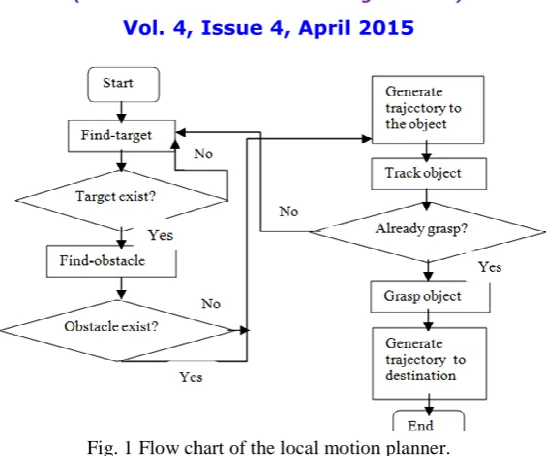
Fig. 1 Flow chart of the local motion planner.
The flow chart of the motion planner is as in Fig. 1. First, we attempt to locate the target, if the target exists, we attempt to locate the obstacle, if it exists, we command the robot to displace to the target while avoiding the existing obstacle. Finally, the robot grasps the target and makes it to the desired position.
IV. THE WAM™ ARM
The WAM arm is a robotic back drivable manipulator. It has a stable joint-torque control with a direct-drive capability. It offers a zero backslash and near zero friction to enhance the performance of today’s robots. It comes with three main variants 4-DoF, 7- DoF, both with human-like kinematics, and 4-DoF with 3-DoF Gimbals. Its articulation ranges go beyond those for conventional robotic arms [20].
We use WAM 7-DoF Arm with attached Barrett Hand.
Fig. 2 WAM 7-DoF dimensions and D-H frames, [21].
Fig. 3 D-H generalized transform matrix.
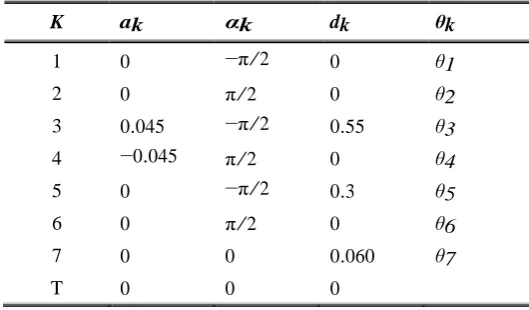
•ak-1 =the distance from Zk-1 to Zk measured along Xk-1 •dk =the distance from Xk-1to Xk measured along Zk • αk-1 =angle between Zk-1 to Zk was approximately Xk-1 •θk =angle between Xk-1 to Xk was approximately Zk The Table I contains the parameters of the arm with 7-DoF
Table I.7-DoF WAM frame parameters
K ak αk dk θk
1 0 −π/2 0 θ1
2 0 π/2 0 θ2
3 0.045 −π/2 0.55 θ3
4 −0.045 π/2 0 θ4
5 0 −π/2 0.3 θ5
6 0 π/2 0 θ6
7 0 0 0.060 θ7
T 0 0 0
As with the previous example, we define the frame 7TToolfor our specific end effector. By multiplying all of the transforms up to and including the final frame, we determine the forward kinematics for any frame on the robot. To determine the end tip location and orientation we use the following equation:
0T
Tool = 0T 1 1
T 22 T 33 T 44 T 55 T 66 T 77 T Tool
The transformation equations used to update the manipulator's joints until the distance between the end effector and the moving object almost equal to zero. Once the position of the contact is achieved, the Barrett hand closes its fingers and grasps the object.
V. TARGET AND OBSTACLE VELOCITIES
From the first position 𝑎 𝑥1, 𝑦1, 𝑧1 to the second position 𝑏 𝑥2, 𝑦2, 𝑧2 which 𝑥2= 𝑥1+ ∆𝑥 , 𝑦2= 𝑦1+ ∆𝑦 and 𝑧2= 𝑧1+ ∆𝑧 and 𝑡𝑎→𝑏 = 𝑡𝑠𝑙𝑒𝑒𝑝 + ɛ which 𝑡𝑠𝑙𝑒𝑒𝑝is the time to sleep en 𝑎 and ɛ is the time from 𝑎 to 𝑏) 𝑉𝑥 =
∆𝑥
𝑡𝑎 →𝑏 , 𝑉𝑦 =
∆𝑦
𝑡𝑎 →𝑏 and 𝑉𝑧 =
∆𝑧
𝑡𝑎 →𝑏 so the target’s velocity 𝑉𝑇 = 𝑉𝑥𝑖 + 𝑉𝑦𝑗 + 𝑉𝑧 𝑧 and the obstacle’s velocity 𝑉𝑂= 𝑉𝑥𝑖 + 𝑉𝑦𝑗 + 𝑉𝑧 𝑧
VI. ROBOT MOTION CONTROL
𝑀 𝜃 = 𝐽𝑖𝑇 𝜃 𝑀𝑖 𝑛
𝑖=1
𝐽𝑖(𝜃)
Also calculate potential part,
𝑃 𝜃 = 𝑚𝑖𝑔
𝑛
𝑖=1
ℎ𝑖(𝜃)
Second, I computed the torques of each joint using Lagrange equation, which is, 𝑑 𝑑𝑡 𝜕𝐿 𝜕𝜃 − 𝜕𝐿 𝜕𝜃= 𝜏 where τ represents the torque of the joint and,
𝐿 𝜃, 𝜃 = 1 2 𝜃
𝑇𝑀 𝜃 𝜃 − 𝑃(𝜃)
After expanding the components of the equation, the equation is as following: 𝑀 𝜃 𝜃 + 𝐻 𝜃, 𝜃 𝜃 + 𝐺 𝜃, 𝜃 = 𝜏
Where 𝑯 𝜽, 𝜽 is the Coriolis and centrifugal force term and 𝑮 𝜽, 𝜽 is the gravity term and
𝜽 = 𝜽𝟏 𝜽𝟐 𝜽𝟑 𝜽𝟒 𝜽𝟓 𝜽𝟔 𝜽𝟕 T 𝐚𝐧𝐝 𝜽 = 𝒅𝜽 𝒅𝒕 , 𝜽 =
𝒅𝟐𝜽 𝒅𝒕𝟐.
B) Using the Jacobian
Given a robot arm configuration q∈Q (the configuration space) and a desired end effector goal xg∈X, where X is the space of end effector positions R3, we are interested in computing an extension in configuration space from q towards xg. Although the mapping from Q to X is often nonlinear and hence expensive to deduct, its derivative the Jacobian,is a linear map from the tangent space of Q to that of X , that can be computed easily (J q̇=ẋ, where x∈X is the end effector position (or pose) corresponding to q). Ideally, to drive the end effector to a desired configuration xg, (d xg /dt≈0: object moves slowly) we could compute the error e(t)=( xg −x) and run a controller of the form q̇= KJ-1e, where K is a
positive gain. This simple controller is capable to attain the target without considering any possible barriers or articulation limits. However this turn into a complex controller, where the inverse of the Jacobian must be done at each time step. To escape this expensive approach, we use alternatively the transpose of the Jacobian and the control law fall into the form of q̇ = KJTe. The controller eliminates the large overhead of computing the inverse by using the easy-to-compute Jacobian instead. It is easy to show that, under the same obstacle-free requirements as the Jacobian inverse controller, the Jacobian transpose (JT) controller is also guaranteed to reach the goal . The instantaneous motion of the end effector is given by ẋ =Jq̇ = J(KJTe). The inner product of this Instantaneous motion with the error vector is given by
eT ẋ= keTJJTe ≥ 0. As this is always positive, under our assumptions with obstacles, we may ensure that the controller will be able to make onward progress towards the target [17].
VI.RESULTSANDANALYSIS
A) GRASPING OBJECT
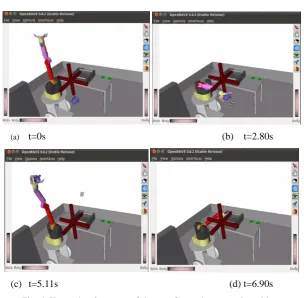
(a) t=0s (b) t=2.80s
(c) t=5.11s (d) t=6.90s
Fig. 4. Example of a successful case of grasping a moving object
As mentioned in Fig. 4, the grasping of the object is done successfully. Fig. 4.a show that the hand of the robot keeps at a distance from the object, the Barrett hand and the object are in the initial position, Fig. 4.b the object moves with the velocity V1= 8cm/s and the robot moves to the position of the centroid of the object that the center of the barrett hand should coincide with the position on the object which is closest to the barrett hand, opens the fingers, closes the fingers and finally grasps the object. In Fig. 4.c the robot picks up the object and moves it to the desired position. In Fig. 4.d the robot puts the target in the desired position and opens his fingers.
To capture the moving object safety and to lift it up stably without slippage, the end effector needs to be as controlled as the relation between their position and the object ‘ones. So they determine the actual position of the moving object, and pick the closest distance between the end effector and the target.
B) Object and obstacle have the same velocity
Fig. 5 illustrates the curves of the robot, the obstacle and the object: the robot avoids the moving obstacle which moves in the space with a velocity V= 8cm/s and grasps the object in time Tgrasp= 2.75 s, which moves in the space with velocity V= 8cm/s. The robot puts the object in the desired position in time Tend= 6.75 s.
Table II. Object and obstacle move with V=8cm/s Tgrasp(s) Tend(s)
Trial1 2.75 6.75
Trial2 2.81 6.49
Trial3 3.09 6.92
The medium of grasp time in table II is T=2.88 s
C) The object’s velocity double of the obstacle’s velocity `
`
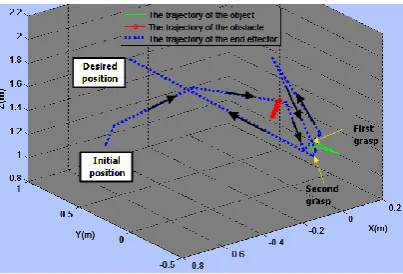
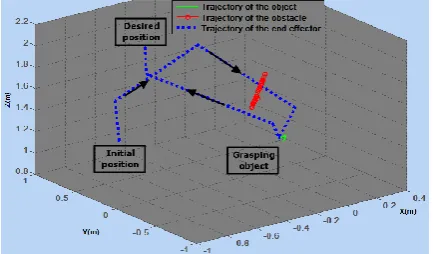
Fig. 6. The trajectory of the object, the obstacle and the end effector.
Fig. 6 illustrates the curves of the robot, the obstacle and the object: the robot avoids moving obstacles which moves in the space with velocity V= 8cm/s and grasps the object in first grasp in time Tgrasp1= 2.95 s, which moves in the space with velocity V= 16cm/s, but it’s unstably grasp, so the robot opens its fingers and change its trajectory, it repeats a second grasp in Tgrasp2= 5.30 s. The robot puts the object in the desired position in time Tend= 9.15 s.
Table III. Object moves with V=16cm/s and obstacle moves with V= 8cm/s
Tgrasp(s) Tend(s)
Trial1 2.95-5.30 9.15
Trial2 3.66 8.64
Trial3 3.35 7.89
The medium of grasp time in table III is T=4.10 s
If we double the velocity of the object, we remark that the first time to grasp is about the double.
If we increase the velocity of the object, the robot finds some difficulty in grasping the moving object. Therefore, increasing the speed affects on the time of grasping the moving object, even the direction of movement of the object affects on the time of grasping.
D) The obstacle’s velocity double of the object’s velocity
Fig. 1. The trajectory of the object, the obstacle and the end effector.
Fig. 7 illustrates the curves of the robot, the obstacle and the object: the robot avoids moving obstacles which move in the space with velocity V= 16cm/s and grasps the object in time Tgrasp1= 3.20 s, which moves in the space with velocity V= 8cm/s. The robot puts the object in the desired position in time Tend= 7.13 s.
Table IV. Object moves with V=8cm/s and obstacle moves with V= 16cm/s
Tgrasp(s) Tend(s)
Trial1 3.20 7.13
Trial2 2.93 7.50
Trial3 3.13 7.05
The medium of grasp time is T=3.08 s.
The table IV presents results separately of the time for grasping the moving object while avoiding obstacles, and the time to move the object to the desired position. Times are nigh in the different trial.
If we double the velocity of the obstacle, we see that the results are nigh but slightly higher. Therefore, increasing the speed of the obstacle affects on the time of grasping the moving object, even the direction of movement of the object affects on the time of grasping. We demonstrate that the robot is able to grasp the moving object in a reasonable time.
VI.CONCLUSIONS
We have presented a simulation of grasping a moving object while avoiding a moving obstacle with different velocities and move it to a desired position while avoiding obstacles using the 7-DoF robotic arm with the Barrett hand in which we involve the RRT algorithm. In fact, this algorithm allows us overcome the problem of the inverse kinematics by exploiting the nature of the Jacobian as a transformation from a configuration space to workspace.
We set forth separately the time of grasping the moving object shifting with different velocity in the presence of a moving obstacles and the time to put this object in a desired position. Firstly, it moves with velocity V1=8cm/s. Second, it moves with velocity V2=2V1. The proposed algorithm successfully holding the moving object in a rational time putting it in the aim station.
Times are nigh in the different trial. The presence of moving obstacles increases the speed of grasping the object. The times recorded in which the velocity of the object is upper than the obstacle are slightly higher.
In this article, we have studied an algorithm dedicated for grasping a moving target while trying to escape a moving obstacle with Barrett hand. A future work will tend to increase the velocity of the object and the obstacle.
2] J. Kuffner, Jr. and S.M. LaValle, “RRT-connect: An efficient approach to single-query path planning, in Proc“.,IEEE Int. Conf. Robotics and Automation, pp. 995-1001,2000.
[3]L. Kavraki, P. Svestka, J. C. Latombe, and M. H. Overmars, “Probabilistic roadmaps for path planning in high-dimensional configuration space“, IEEE Trans. Robotics and Automation, vol. 12, no.4, pp.566-580, 1996.
[4]T.Adam Leper, Kayden Hsiao, “Strategies for human-in-the-loop robotic grasping“, Robot Manipulation and Programming ,2012.
[5]K.Nagase,Y.Aiyana, “Grasp motion planning with redundant dof of grasping pose“, Journal of Robotics and Mechatronics Vol.25No.3, 2013. [6]F. Flacco, T. Kroger, A. De Luca and O. Khatib. “A depth space approach to human-robot collision avoidance“, IEEE Int. Conf. Robotics and
Automation, pp. 338-345, 2012.
[7]S. Haddadin, H. Urbanek, S. Parusel, D. Burschka, J. Rossmann, A. Albu-Schaffer and G Hirzinger, “Real-time reactive motion generation based on variable attractor dynamics and shaped velocities“, IEEE/RSJ Int. Conf. Intelligent Robots and Systems, pp. 3109-3116, 2010.
[8]J. Vannoy, and X. Jing, “Real-time adaptive motion planning (RAMP) of mobile manipulators in dynamic environments with unforeseen changes“, IEEE Trans. Robotics, vol. 24, no. 5, pp. 1199-1212, 2008.
[9]A. chaabani, M. S. Bellamine, M. Gasmi, “Motion Planning and Controlling Algorithm for Grasping and Manipulating Moving Objects in the Presence of Obstacles“, IJSCAI, 2014.
[10]J. K. M. Stilman, J.-U. Schamburek,T. Asfour, “Manipulation planning among movable obstacles“, IROS , 2007.
[11]K.K.Y.Hirano, S.Yoshizawa, “Image-based object recognition and dexteroushand/arm motion planning using rrts for grasping in cluttered scene“, IROS, 2005.
[12]S. LaValle, J. Kuffner, “Rapidly-exploring random trees: Progress and prospects“, Proceedings Workshop on the Algorithmic Foundations of Robotics, in WAFR, 2000.
[13]S.M. LaValle, Planning algorithms, Cambridge, U.K.: Cambridge University Press, available at http://planning.cs.uiuc.edu/(2006)(Accessed on 16/02/2015).
[14] R.D.D.Bertram, J.Kuffner, T.Asfour, “An integrated approach to inverse kinematics and path planning for redundant manipulators“, ICRA, 2006.
[15] E. Drumwright, V.Ng-Thow-Hing, “Toward interactive reaching in static environments for humanoid robots“, Proc.IEEE/RSJ International Conference on Intelligent Robots and Systems, pp.846–851, 2006.
[16] D.F.M. Vande Weghe, S.Srinivasa, “Randomized path planning forredundant manipulators without inverse kinematics“, Humanoids, 2007. [17] S.Dmitry Berenson, “Planning Using Task Space Regions“, by the National Science Foundationunder GrantNo.EEC-0540865, 2009. [18]M.V.Weghe, “Randomized path planning for redundant manipulators without inverse kinematics“ , 2008.
[19] E.L.Damian, “Grasp planning for object manipulation by an autonomous robot“, Master’s thesis, National Institute of Applied Sciences of T oulouze, 2006.
[20]M.W.Spong,M.Vidyasagar, “Robot dynamics and control“ , 1989. [21]WAM Arm User’s Guide, www.barrett.com (Accessed on 22/02/2015).