ISSN 2286-4822
www.euacademic.org DRJI Value: 5.9 (B+)
Effect the contamination with
Aspergillus flavus
on
quantity of some trace elements composition in
wheat, rice and corn flour
A.L. SUHAD M. ALJUBORY, A.L. SHAIMAA M. ALABDALLY
Biology Department Science College, Kufa University Iraq
Abstract:
This study included effecting Aspergillus flavus fungi on some trace elements (TE) that compositions in three types of flour related to wheat, rice and corn grains . Ability of A.flavus isolates to produce aflatoxin was tested by thin layer chromatography(TLC) ,the positive result was noticed by accruing blue fluorescence under ultra-violate light 360nm with the same retardation factor of stander aflatoxin B1 and B2. Three samples of flour was sterilized by autoclaving then inoculated by A.flavus then digested for measuring concentrations of five TE (copper Cu, Zinc Zn ,Manganese Mn , Lead Pb and chromium Cr) by atomic absorption spectrophotometric ,the results of TE contents of rice flour indicated to significantly decreasing in Cu and Pb minerals (4058*10-4ppm and 1135*10-4ppm
to 2029*10-4ppm and 670.5*10-4ppm respectively ,but non significantly
decreasing Zn element (1326*10-4 ppm) in control sample to(1178*10 -4ppm ) in contaminated sample, while significantly increasing and
non-significantly in Cr and Mn elements where the concentrations were elevated to 329*10-4ppm and 970.5 *10-4 ppm in contaminated
samples compared with control samples (79*10-4ppm and 873*10-4
ppm respectively. Also in wheat flour the results were significantly decreasing in concentrations of Zn ,Pb and Mn (1455*10-4 ppm
,846*10-4 ppm and 1354*10-4 ppm to 1178*10-4 ppm ,650*10-4 ppm and
Cu and Cr elements concentrations (3333*10-4 ppm and 303*10-4ppm)
in contaminated samples compared with control (2029*10-4ppm and
237*10-4ppm) respectively. In corn flour the results showed
significantly decreasing in Zn ,Cr and Mn concentrations (3895*10 -4ppm ,237*10-4ppm and 2173*10-4ppm) in control samples to (3181*10
-4ppm ,158*10-4ppm and 1211*10-4ppm) in contaminated samples
respectively ,but there were significantly increasing in Cu and Pb concentrations (1159*10-4ppm and 0 ppm) in control to (2898*10-4 ppm
and 650*10-4ppm) respectively in contaminated flour samples.
Key words: Aspergillus flavus, contamination, wheat, rice, corn flour
Introduction
anemia but toxicity of it mostly associated with liver damage. Zinc elements is involving in the activity of about one hundred enzymes such as RNA polymerase, carbonic anhydrase ,deficiency of this metal was common in un developing countries and mainly associated with malnutrition (Hamilton et al ,2002). But these corps are susceptible to fungal attack either in the field or during storage, Aspergillus flavus was an important genera associated with contaminated products during storage and transit (Bhat RV.,1988). This fungi was using the compositions of these grains for aflatoxin production and caused several changes in chemical such as carbohydrate , lipid and protein ,so these fungi may reduce nutrient contents of food that infected with it (Fraga ,1985 ;Adebayo et al ,2006). For all these reasons ,this study aimed to know the changes in quantity of some TE that compositions in grain flour of wheat ,rice and corn after infected it A. flavus that producing aflatoxin.
Materials and methods
1-Aspergillus flavus isolate:
The fungi isolate was gained from microbiology laboratory of biology department of science collage \university of kufa.
2-Testing ability of A. flavus for aflatoxin production: These experiments included:
A-Extraction of aflatoxin from A. flavus cultures according to Esuneo ,2002 method: one week old of A.flavus culture used for extracting ,the culture was cut by sterile needle and transferred to electric mixer, 20ml of chloroform was added ,then mixed for 10min., mixture was filtered by filter paper(Whatman .1), supernatant was taken to oven for concentration the extract into 1ml only.
Dorner,2002 method: Activation TLC in oven 120c0,1h. then put
the spots of sample extract and stander aflatoxin on one strait line (about 2 cm between spots) , then transfferd TLC to mobile phase system that consist of chloroform and methanol( 98:2) ,after the ended of retardation TLC was taken out and dried ,then put under UV light to calculate Rf of spots and compared between them.
3-Preparing the samples of flour:
The samples of wheat.rice and corn grains were gained from local markets of Al-Najaf al ashraf city and grinded by mill to prepare flour, then sterilization by autoclaving in 121c0 and 1
bar pressure for 15 min.,then put the samples in clean disposable cups with covered in three replications for each types of flour to inoculate it and three other as control (without inoculation).
4-Preparation of inoculum and contamination samples:
7 days old cultures of A.flavus used a source of conidia the suspension was filtered and center fuged twice for 5 min. and re suspended in sterile distilled water (Railey et al,1997). About 50g of each type of flour samples were uniformly inoculated with diluted spors solution for three replications , the inoculated samples were transferred to incubate at 30c0 for 15
days.
5-Trace elements determination: included two stages
A-Digest samples: 0.2 g of each samples were taken and put in conical flask(250 ml) and added mixing of perchloric acid HclO4
and sulphric acid H2SO4 with 1:1 ratio and leaved for one night
to complete digestion ,then transferred for tow hours on digestion apparatus(figur1) .
Mn),and tow heavy metal (Lead Pb and Chromium Cr) Jorhem L.,2000 method was fallowed.
Figure1 showed samples after digestion Figure2 showed (A.A -6300-DAIGEN, SHIMAZU-JAPAN)
Results and discussion:
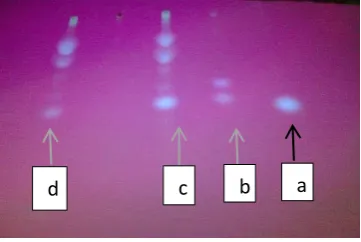
The testing of TLC was showed that A.flavus isolate could produce aflatoxin through seeing blue fluorescence under ultra-violate light 360nm having the same RF of stander aflatoxin B1 and B2 (figure 3), this result agreed with another study referred to ability of 75% of A.flavus isolates to produce aflatoxin B1 (Yu et al ,2004).
Figure 3 showed TLC under uv light a-stander aflatoxin B1, b-stander aflatoxin B2, c and d- samples
Tables 1, 2 and 3 showed inter action of A. flavus inoculation with micro minerals concentrations composition in wheat , rice and corn flour samples . the TE contents of control and
inoculated samples were found tend to increased and decreased in three types of flour such as (Cu ,Mn and Pb) ,but it tend to decreased in Zinc metal concentration and increased of Chromium concentration after inoculated samples with A. flavus. These results lined with Ehsan et al (2009) who showed that various minerals like Ca,P,Pb,Mg,Fe,Zn and Se were decreased while Na,Mn,Cu and Cd increased after inoculated the almond seeds with A. flavus. The decreased of Zinc metal in all inoculated samples might be illustrated the A. flavus dependence on substrate compositions of flour of microelements and used it for aflatoxin production (Fraga ,1985;Ade bayo et al ,2006), but the height chromium metal concentration might be related to absorption it from contaminated water by fungi and used this element for forming cellulase degradable enzyme that usage for degrading plant cells.
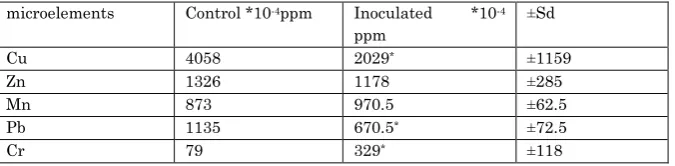
Table 1 microelements concentrations compositions in rice flour samples
microelements Control *10-4ppm Inoculated *10-4 ppm
±Sd
Cu 4058 2029* ±1159
Zn 1326 1178 ±285
Mn 873 970.5 ±62.5
Pb 1135 670.5* ±72.5
Cr 79 329* ±118
Table 2 microelements concentrations compositions in wheat flour samples
microelements Control *10-4ppm Inoculated *10-4 ppm
±Sd
Cu 2029 3333.5* ±1304.5
Zn 1455 1178.5* ±18.5
Mn 1354 917.5* ±62.5
Pb 846 650* ±196
Cr 237 303* ±66
Table 3 microelements concentrations compositions in corn flour samples
microelements Control *10-4ppm Inoculated *10-4 ppm
Cu 1159 2898.5* ±1739.5
Zn 3895 3181.5* ±520.5
Mn 2173 1211.5* ±142.5
Pb 0 650* ±237
Cr 237 158* ±26
REFERENCES
Adebayo-Tayo BC.,Onilude AA., Ogunjobi AA.,Gbolagade JS.,OladaboMO.,2006. Detecting the fungi and aflatoxin in shelved bush mango seeds (irvingia spp) stored for sale inYUO, Nigeria. Elecron J. Environ. Agic .food chem.,5(5):1569-1574.
Aschner M.,2000, Manganese :brain transport and emerging
research needs. Environ. Health perspect.
108(suppl.3),429-432.
Bhat RV.1988. Mould deterioration of agriculture commodities during transit problems faced by developing countries .int J.of food microbial .7:219-225.
Cesar G.Fraga ,2005,Relevance essentiality and toxicity of trace elements in human health. Molecular aspects of medicine,235-244.
Davis, C.D Greger, J.L.,1992. Longitudinal changes of manganese dependent super oxide dismutase and other
indexes of manganese and iron status in
women.AM.J.clin.nutr.55,747-752.
Ehsan Ali, Saleemullah, Farida Anjum, Barkat Ali Khan and Ahmed Zubair,2009. Aflatoxin contamination and mineral profile of almond seeds. Mycopath 7(1): 39-44. Esuneo,W,(2002).Soil and Seed Fungi ,TRE press.pp. 506. Fraga R.S.,1985. Effect of fungal infection on chemical
composition of some seeds and aflatoxin production. Grasses R Aceities 36,357.
Jorhem, L, 2000. Determination of metals in foods by atomic absorption spectrometry after dry ashing, NMKL collaborative study. J. AOAC. Int., 83: 1204-1211.
Kanumakala S.,Boneh A.,Zacharin M.,2002.pamidronate treatment improves bone mineral density in children with menkes disease .J.Inherit. Meab. Dis. 25,391-398. Nutrient data laboratory, United SDtates ,department of
agriculture .retrieved June ,2004.
Prod STAT, FAO STAT,retrieved December 26,2006.
Rabin O., Hegedus L.,Bourre,J.M.,Smith Q.R.,1993.Rapid brain uptake of Manganese II across the blood – brain barrier.J.Neurochem.61,509-517.
Railey J, Mandel HG, Sinha S, Judahand DL, Neal GE, 1997. Invitro activation of human Harvey -ras Proto Onco gene by aflatoxin B1. Carcinogensis., 18: 905-910.
Rashid A.,1986. Mapping zinc Fertility of soils using ind :cator,plants and soil analyses.(PhD dissertation) ,university of Hawaii. HI.USA.
Sheila john,Sadhana Rajmohan, S.Karthega , Anna Rangin, B.S.Vasanthi ,2004,Nutrition and dietetics ,text book corporation collage road Chennai .first edition.
Sobolev V.S. and Dorner J.W.(2002).Cleanup procedure for determination of aflatoxins in major agricultural commodities by liquid chromatography .J.. of Association of Official analytical Chemist s International,85:642-645.