ISSN (Print) : 2320 – 3765 ISSN (Online): 2278 – 8875
I
nternational
J
ournal of
A
dvanced
R
esearch in
E
lectrical,
E
lectronics and
I
nstrumentation
E
ngineering
(An ISO 3297: 2007 Certified Organization)
Vol. 3, Issue 8, Aug 2014
DOI:10.15662/IJAREEIE.2014.0308089
Copyright to IJAREEIE www.ijareeie.com 10953
Android-Based Navigation System Using PHS
in Hospital
M.Dhinakaran 1, N.S.Vijayalaksmi2, V.G.Vengatesan3
Assistant Professor, Department of Electronics and Communication Engineering, SKP Engineering College
Tiruvannamalai, Tamilnadu, India1, 2, 3
ABSTRACT: With the increase in the number of elderly people, a guidance system that can be used for medical
examination in hospitals becomes to attract attention. As a position estimation technology for indoor guidance, a Wi-Fi positioning system has been studied. However, Wi-Fi radio waves are not available in the hospitals because that affect operations of medical equipment.
In this paper, we propose a new realtime indoor guidance system using Personal Handy-phone System (PHS) and Android device for visitors in hospitals. Our proposed system utilizes a combination of Received Signal Strength Indication (RSSI) of PHS and Dead Reckoning based on sensors of an Android device in order to estimate a user’s indoor position without affecting operation of medical equipment. Through the experimental evaluation, we have clarified that the proposed system has successfully guided subjects to the destinations with accuracy of 93.3[%].
KEYWORDS: Indoor Position Estimation, PHS, RSSI, Dead Reckoning, Android
I. INTRODUCTION
In a large hospital consisting of many medical departments, it is difficult for visitors to reach their destinations smoothly. In particular, in case of a medical examination, visitors often get lost because they should visit many medical departments that are apart from each other. This causes a serious problem particularly for elderly people. To solve this problem, a guidance system that can be used in hospitals is attracting attention. In the guidance system, indoor position estimation is one of the most important technologies.
As the indoor positioning technology, Dead Reckoning has been widely studied [1], [2], [3]. In the Dead Reckoning, a user’s movement is estimated by analyzing data obtained from various sensors (e.g., acceleration, gyroscope, etc.). Especially,in recent years, Android phones become the best candidate of the sensing device because they are equipped with a wide variety of sensors. Furthermore, as an indoor position estimation technology, a wireless positioning system using Wi-Fi [4], [5] has been studied. However, Wi-Fi access points are not available in the hospitals because 2.4GHz radio waves affect operations of medical equipment. On the other hand, an indoor Personal Handy-phone System (PHS) is commonly used for constructing inter-office telephone in the hospitals.
This is because a PHS device does not use the 2.4GHz Industry-Science-Medical (ISM) radio bands and its maximum transmission power is much lower than a cell phone [6].
Therefore, this paper proposes a new realtime guidance system for hospitals using a PHS and an Android device. The Android device estimates user’s position based on the Received Signal Strength Indication (RSSI) of PHS radio waves in addition to Dead Reckoning with acceleration, compass and gyroscopes sensor, and then displays route guidance. A user-friendly interface on the Android is also proposed, which can be easily understood even for elderly people. Furthermore, the effectiveness of the proposed system is evaluated through route guidance experiments.
II. EXISTING STUDIES
ISSN (Print) : 2320 – 3765 ISSN (Online): 2278 – 8875
I
nternational
J
ournal of
A
dvanced
R
esearch in
E
lectrical,
E
lectronics and
I
nstrumentation
E
ngineering
(An ISO 3297: 2007 Certified Organization)
Vol. 3, Issue 8, Aug 2014
DOI:10.15662/IJAREEIE.2014.0308089
Copyright to IJAREEIE www.ijareeie.com 10954
As indoor positioning technologies, methods using radio waves transmitted from multiple transmitters have been researched and developed. In these systems, signal strength of radio waves of Wi-Fi [8] is used. However,these radio waves use the ISM bands, which may interfere with medical equipment, and hence must not be used in hospitals. On the other hand, PHS can be used for inter-office telephone in the hospital because the impact on medical equipment is very small [10]. Furthermore, as shown in Table 1, the output power of PHS is small compared with a cellular phone. An outdoor positioning method using radio waves of PHS has already been studied [11]. However, the practicality of PHS radio waves for indoor guidance system has not been investigated.
Furthermore, a positioning technology using sensors on the Android device has been studied [12]. Position estimation using various motion sensors is called Dead Reckoning. The Dead Reckoning does not generate radio wave, hence the indoor position estimation method using the Dead Reckoning is a useful tool in the hospital. However, in the Dead Reckoning, error of the sensor data is accumulated with time [13].
III. PROPOSED SYSTEM
A. OVERALL STRUCTURE OF PROPOSED SYSTEM:
Figure 1. Overview of the guidance system in a hospital using PHS
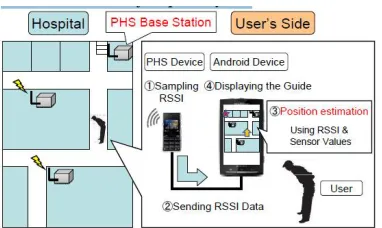
Figure 1 shows an overview of the proposed guidance system in the hospital. This system provides a route guidance interface which is easy even for elderly users to understand.
The procedures of the system are given as follows.
1. A PHS device samples RSSI of radio waves from PHS base stations (PBS). 2. The RSSI is transmitted from the PHS device to an Android device through USB.
3. The Android device estimates the user’s position based on the RSSI and Dead Reckoning using sensors. 4. The Android device displays a guidance of the user’s position to the destination.
ISSN (Print) : 2320 – 3765 ISSN (Online): 2278 – 8875
I
nternational
J
ournal of
A
dvanced
R
esearch in
E
lectrical,
E
lectronics and
I
nstrumentation
E
ngineering
(An ISO 3297: 2007 Certified Organization)
Vol. 3, Issue 8, Aug 2014
DOI:10.15662/IJAREEIE.2014.0308089
Copyright to IJAREEIE www.ijareeie.com 10955
B.DEAD RECKONING:
Dead Reckoning is a method of estimating the user’s position based on the sensor data. In the Dead Reckoning, the position change is estimated by detecting user’s movements and changes of the moving direction of the user from the sensor data. The procedure of the Dead Reckoning is composed of the following ways.
1. The number of steps during walking is detected by an acceleration sensor.
2. A moving distance is calculated by multiplying the number of steps and the user’s stride length. 3. Direction of movement is detected by compass sensor.
4. Turning direction at a corner is estimated using a gyroscope sensor values.
5. The estimated position is adjusted to coordinates of the corner when the change of the moving direction is detected in order to correct error.
In this study, we use an Android phone “Galaxy Nexus” that is equipped with these sensors for the Dead Reckoning. In addition, a subject is assumed to hold the Android phone as its screen can be seen.
the proposed application.
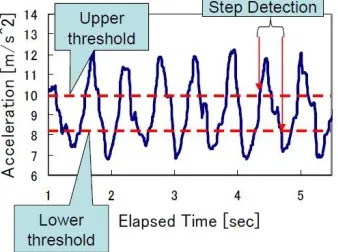
Figure 2. 3-axis acceleration during walking
Figure 2 shows 3-axis acceleration data during walking. It is clear from the figure that acceleration sensor values vary step by step. As shown in this figure, we set two threshold values so that user’s walking can be detected. The system judges that the user walks one step when the acceleration value is less than the lower threshold after exceeds the upper threshold. In proposed application, value of the upper threshold is set to 9.99[m/s2] and the lower threshold is set to 8.17[m/s2].
Next, the moving direction of the user is to be detected. In the proposed application, the user is assumed to stay on the straight line between nodes. Thus, the application detects whether the user goes forward or backward on the path by using the value of a compass sensor. And then, an estimated position of the user is moved stride length toward the estimated moving direction
C. PHS BASED INDOOR LOCATION ESTIMATION:
The position estimation using the Dead Reckoning has weakness when it is used in an open space and escalators of a hospital. As shown in Figure 8, escalators are often deployed in a large hospital. While a user is taking an escalator, the Dead Reckoning is not available because the sensors cannot catch any movement of the user.
Moreover, the Dead Reckoning has a problem in terms of the accumulated error. In the Dead Reckoning, an impact of accumulated error appears when walking distance becomes longer in the same direction, because actual stride length of the user varies step by step. It is possible to correct the accumulated error by corner matching. However, when multiple intersections exist in the moving direction, the corner matching may select a wrong position. Furthermore, in the open space as shown in Figure 8, the corner matching is difficult because the moving direction of the user can be changed anywhere.
ISSN (Print) : 2320 – 3765 ISSN (Online): 2278 – 8875
I
nternational
J
ournal of
A
dvanced
R
esearch in
E
lectrical,
E
lectronics and
I
nstrumentation
E
ngineering
(An ISO 3297: 2007 Certified Organization)
Vol. 3, Issue 8, Aug 2014
DOI:10.15662/IJAREEIE.2014.0308089
Copyright to IJAREEIE www.ijareeie.com 10956
Figure 3. Use of RSSI of PHS for detection of user’s position
Figure 3 shows a use of RSSI of PHS for detection of user’s position. Here, PBSs are deployed on each of floors and a user has a PHS device. The proposed application detects an approach to the PBS by referring to RSSI values measured by
the PHS device, and changes the user’s estimated position to the location nearby the PBS. Likewise, it is possible to correct the accumulated error in open space by utilizing PBS deployed in such doorway.
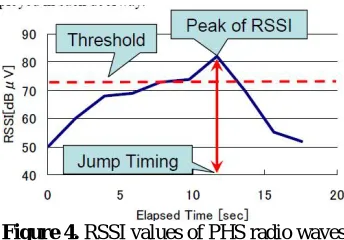
Figure 4. RSSI values of PHS radio waves
RSSI values of PHS radio wave are illustrated in Figure 4. When the user accesses the PBS, the RSSI value exceeds the threshold and becomes peak. Thereby, the estimated position
jumps to coordinates of the PBS point. In the proposed application, the threshold is set to 72 [dBμV].
D.USER INTERFACE
The Route Guidance Screen displays information for guiding a visitor from the estimated position to the destination. User interface of the guidance should be friendly for elderly people who are main visitors of a hospital. Therefore, we adopt Turn by Turn method [15] as a UI of the guidance display. The Turn by Turn method guides the user to a destination by indicating the moving direction at each corner.
ISSN (Print) : 2320 – 3765 ISSN (Online): 2278 – 8875
I
nternational
J
ournal of
A
dvanced
R
esearch in
E
lectrical,
E
lectronics and
I
nstrumentation
E
ngineering
(An ISO 3297: 2007 Certified Organization)
Vol. 3, Issue 8, Aug 2014
DOI:10.15662/IJAREEIE.2014.0308089
Copyright to IJAREEIE www.ijareeie.com 10957
Figure 5. Output at User End
IV. EVALUATION OF ROUTE GUIDANCE APPLICATION
A. OUTLINE OF EXPERIMENT
In order to evaluate the performance of the proposed guidance application, we have conducted route guidance experiments.The details of the experiments are given as follows.
5 subjects move to their destinations according to guidance UI of the application.
Each subject walks 3 routes.
6 points on the map are assumed as medical examination points (e.g., C.T. scan room), and a start point is
assumed as Reception.
Each route includes all 6 medical examination points,and the final destination is the start point.
The application detects arrival of the user when the subject presses the “Arrival Button”.
Stride of each subject is calculated in advance from the number of steps when walking a corridor of 40m.
In order to evaluate correction method using the RSSI of the PHS, we have conducted experiments using two types of position estimation methods (Dead Reckoning only and Dead Reckoning and PHS).
B. EXPERIMENT RESULT
ISSN (Print) : 2320 – 3765 ISSN (Online): 2278 – 8875
I
nternational
J
ournal of
A
dvanced
R
esearch in
E
lectrical,
E
lectronics and
I
nstrumentation
E
ngineering
(An ISO 3297: 2007 Certified Organization)
Vol. 3, Issue 8, Aug 2014
DOI:10.15662/IJAREEIE.2014.0308089
Copyright to IJAREEIE www.ijareeie.com 10958
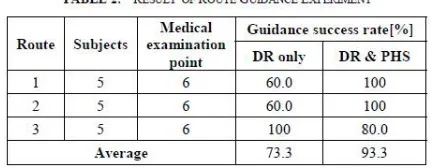
When the method uses the Dead Reckoning only, the guidance success rate was 73.3[%]. On the other hand, theposition estimation using the Dead Reckoning and thev SSI of PHS achieved a high success rate of 93.3[%]. This is because the Dead Reckoning cannot decide the correct one from multiple nodes on the same corridor, while the estimated
position can be corrected by detecting that the subject had passed in front of the PBS from the RSSI values. These results suggest that the position correction by RSSI of PHS is
effective.
The method using the Dead Reckoning and PHS could not complete the guidance in Route 3. This was caused by the case when the stride length of a subject became longer than the premeasured one. Therefore, we will develop an automatic adjustment method of user’s stride in the future study.
V.CONCLUSIONS
This paper has proposed a realtime guidance system in a hospital using PHS and Android device. Specific feature of this system is a use of the combination of Dead Reckoning based on sensor data and RSSI of PHS. This system is used to detect the sudden flow of elder peoples in home or hospitals.The Dead Reckoning is basically used to estimate user’s indoor location, and accumulated error of the estimated location is corrected by utilizing the PHS radio waves, which have less impact on the medical equipment. Furthermore, a new intuitive user interface based on the turn by turn method has been proposed.
After flow was detected the system sends notification to your Android device. Evaluation result of the developed system has shown that the position estimation using the Dead Reckoning and the RSSI of PHS achieves a high success rate of 93.3[%]. The results indicate that the combination of the RSSI of PHS and the Dead Reckoning realizes accurate route guidance in a hospital. In the future study, we'll further study to develop a dynamic estimation method of user’s stride for improving the guidance success rate.
REFERENCES
[1] Ryoji Aoki, Hiroshi Yamamoto, Katsuyuki Yamazaki, “Android-based Navigation System for Elderly People in Hospital”, in Proc. of the Advanced Communication Technology (ICACT), 16th International Conference on 2014,pp.371-376,February 2014.
[2] K. Katsuhiko, N. Kawaguchi, “Gate-Passing Detection Method Based on WiFi Significant Points”, in Proc. of the World Congress on Engineering 2013, Vol.II, pp.1409-1414, July 2013.
[3] R. Aoki, H. Yamamoto, K. Yamazaki, “Realtime Guidance System in Hospital using PHS and Android Device”, in Proc. The Institute of Electrical and Electronics Engineers, Computer Software and Applications Conference 2013, pp.451-454, July 2013.
[4] K. Kato, “Note on Optimal Path for an Electric Vehicle”, The Institute of Electronics, Information, and Communication Engineers Technical Report, COMP vol.109 (465), pp.13-17, Mar. 2010.
[5] K. Katsuhiko, N. Kawaguchi, “Gate-Passing Detection Method Based on WiFi Significant Points”, in Proc. of the World Congress on Engineering 2013, Voll.II, pp.1409-1414. July 2013.
[6] K. Sagawa, K. Koiwa, M. Susumago, H. Inooka, “Estimation of an indoor 3D walk course by acceleration integration”, 22th Joint conference on Medical Information Japan Journal of Medical Informatics 22, pp.242-243, Nov. 2002.
[7] M. Yamamoto, E. Kamioka, “Location Estimation system using Acceleration Sensor”, The Institute of Electronics, Information, and Communication Engineers Technical Report, Mobile Network and Applications, vol.110, no.40, pp.139-144, May. 2010.
[8] M. Kourogi, T. Kurata, “Personal Positioning Based on Walking Locomotion Analysis with Self-Contained Sensors and a Wearable Camera”, in Technical Report of The Institute of Electronics, Information, and Communication Engineers Technical Report, PRMU 103(737), pp.25-30, Mar. 2004.
[9] N. Kawaguchi, “Locky.jp: Wireless LAN Position Estimation and Its Application”, The Institute of Electronics, Information, and Communication Engineers Technical Report, ITS vol.107, no.161, pp.1-4, Jul. 2007.