Available online: https://edupediapublications.org/journals/index.php/IJR/ P a g e | 1486
Classification analysis in Data Mining for Impulsion Detection using RILT mechanism
Ch.V.Gayathri1, D.Saidan2, N.Yugesh3
1 B. Tech Scholar, Department of Computer Science Engineering, Siddhartha Institute of Engineering and
Technology, Vinobha Nagar, Ibrahimpatnam, Hyderabad, Telangana 501506.
2 Assoc. Prof., Department of Computer Science Engineering, Siddhartha Institute of Engineering and
Technology, Vinobha Nagar, Ibrahimpatnam, Hyderabad, Telangana 501506.
3 Asst. Prof., Department of Computer Science Engineering, Siddhartha Institute of Engineering and
Technology, Vinobha Nagar, Ibrahimpatnam, Hyderabad, Telangana 501506.
Abstract: Idea impulsion is a fundamental issue for any data examination circumstance including momentarily asked for data. In prescient investigation and machine taking in, the idea impulsion implies that the quantifiable properties of the goal variable, which the model is trying to foresee, change after some time in unforeseen ways. This causes issues in light of the way that the desires end up being less exact over the long time. The term idea alludes to the sum to be shown. In the latest decade Process mining developed as a strategy that utilizes the logs of information course of action with an explicit ultimate objective to mine, separate and update the methodology estimation. Idea impulsion in the process is restricted by applying factual theory testing strategies. The proposed strategy is tried and endorsed on few of the reality and counterfeit process logs, results about procured are promising toward successfully limiting the sudden methodology impulsion in process-log, results got are promising toward proficiently restricting the sudden idea impulsion in process-log. We present the principal online instrument for identifying and overseeing idea impulsion, which depends on conceptual understanding and successive examining, together with late learning systems on information streams. We propose a Semi-regulated order calculation for information streams with Revenant idea Impulsion and Limited Tagged
information, called RILT, in which, a choice tree is received as the arrangement display. The found procedure models can be utilized for an assortment of examination purposes. At long last, we examined the difficulties, diverse process mining calculations, arrangement of process mining methods.
I. INTRODUCTION
Given a partially labeled network, in which labels of some nodes are known, within-network classification aims to predict labels of the rest nodes. Due to the increasingly wide applications in counterterrorism analysis, fraud detection [1] and product recommendations etc., within-network classification has received a lot of attention in recent years.
Available online: https://edupediapublications.org/journals/index.php/IJR/ P a g e | 1487 neighbor nodes, but also on all observed data (i.e.,
network structure and all labeled nodes).
For such sparsely labeled networks, the neighbors of an unknown node are mostly unlabeled as well. Consequently, many neighborhood-based methods cannot achieve satisfied performance for such kind of networks.
All the above methods can handle the sparse labeling problem [3-4] to some extent, however, the interacting behavior of nodes, which is important to the formation of network structure, is not considered. In addition, as pointed in, when the number of nodes in one class is much larger than the other class, unknown nodes are more likely to be classified as the same category as the majority.
To overcome these limitations, we propose a novel behavior based collective classification (BCC) method for network data in this study [5]. In the new method, Firstly, we extract the behavior feature of nodes in the network; then, instead of including all labeled nodes in the classification process, we screen valuable nodes which are most relevant for the classification. Finally, since latent links can be estimated between unknown nodes and valuable nodes by analyzing their behavior feature, collective classification is performed based on the latent links to infer the class of unknown nodes. Experiment reveals that the method performs competitively on several public real-world datasets and can overcome the challenge of classification in sparsely labeled networks and networks with lower homophily.
II. RELATED WORK
We describe a guilt-by-association system [6] that can be used to rank entities by their suspiciousness. We demonstrate the algorithm on a suite of data sets generated by a terrorist world simulator developed under a DoD program. [7]The data sets consist of
thousands of people and some known links between them. We show that the system ranks truly malicious individuals highly, even if only relatively few are known to be malicious ex ante.
Supervised and unsupervised learning methods have traditionally focused on data consisting of independent instances of a single type. However, many real-world domains are best described by relational models in which instances of multiple types are related to each other in complex ways. For example, in a scientific paper domain, papers are related to each other via citation, and are also related to their authors. In this case, the label of one entity (e.g., the topic of the paper) is often correlated with the labels of related entities. We propose a general class of models for classification and clustering in relational domains that capture probabilistic dependencies between related instances [8].
Social media such as blogs, Facebook, Flickr, etc., presents data in a network format rather than classical IID distribution. To address the interdependency among data instances, relational learning has been proposed, and collective inference based on network connectivity is adopted for prediction. However, the connections in social media are often multi-dimensional. An actor can connect to another actor due to different factors, e.g., alumni, colleagues, living in the same city or sharing similar interest, etc [9].
Available online: https://edupediapublications.org/journals/index.php/IJR/ P a g e | 1488 “ghost edges” to a network, which enable the flow of
information from labeled to unlabeled nodes.
III.METHODOLOGY AND DESIGN
3.1Proposed system:
Propose a novel behavior based collective classification (BCC) method for network data in this study. In the new method, firstly, we extract the behavior feature of nodes in the network; then, instead of including all labeled nodes in the classification process, we screen valuable nodes which are most relevant for the classification; Finally, since latent links can be estimated between unknown nodes and valuable nodes by analyzing their behavior feature, collective classification is performed based on the latent links to infer the class of unknown nodes. Experiment reveals that the method performs competitively on several public real-world datasets and can overcome the challenge of classification in sparsely labeled networks and networks with lower homophily.
In sparsely labeled networks, the labels of nodes are much fewer, making it difficult to leverage label dependencies to make accurate prediction. Without considering the label information, it can be found that the network structure can still provide useful information. Therefore, most researches focus on utilizing the network structure to predict unknown nodes. For example, CN method estimates the similarity of nodes by local structure (the number of common neighbors). However, it becomes ineffective when handling the sparsely labeled network classification task in some situations.
Advantages:
In BCC, the behavior feature of nodes is extracted for classification, which has shown more discriminative ability to traditional methods.
Then, instead of using all the labeled nodes, we screen the most-relevant nodes according to the calculation of correlation and similarity, which can overcome the effects of noise and imbalanced dataset.
3.2 Methodology: 3.2.1 Modules:
3.2.1.1Semi-supervised learning:
Available online: https://edupediapublications.org/journals/index.php/IJR/ P a g e | 1489 Problems on graphs. However, many
semi-supervised learning methods rely heavily on the assumption that the network exhibits homophile, i.e., nodes belonging to the same class tend to be linked with each other. Meanwhile, the implementation of semi-supervised learning algorithm often requires a large amount of matrix computation, and thus is infeasible for processing large datasets. Many methods have been developed to overcome these limitations. For example, Tong et al. propose a fast random walk with restart algorithm to improve the performance on large scale dataset. Lin et al. propose a highly scalable method, called Multi-Rank-Walk (MRW), which requires only linear computation time in accordance to the number of edges in the network . Mantrach et al. design two iterative algorithms which can be applied in networks with millions of nodes to avoid the computation of the pair wise similarities between nodes. Gallagher et al.design an even-step random walk with restart (Even-step RWR) algorithm, which mitigates the dependence on network homophile effectively.
3.2.1.2 Behavior based collective classification:
Since behavior feature can provide a different kind of information that may be useful in sparsely labeled networks, we propose a novel Behavior-based Collective Classification method (BCC) in this paper to handle the sparse labeling problem. The process of BCC in network data consists of four steps: behavior feature extraction, screening valuable nodes, classification by voting and collective inference. We assume that nodes may belong to the same class if their behavior features are similar. Therefore, given the adjacency matrix M of a network, we will extract nodes' behavior feature at first to obtain the feature matrixM0, of which the i-th row vector is the behavior feature of node i.
Instead of including all labeled nodes, BCC only allows the most relevant nodes for classification to
improve the performance on sparsely labeled networks. So in the next, we screen valuable nodes by using correlation analysis and similarity analysis respectively. Given an unknown node u, we first compare the correlation between u and each labeled node, then, nodes with correlation coefficients exceeding a threshold will be added into the valuable node set Vu. After that, we compare the similarity between u and each node in Vu, and add the top-K similar nodes into set V0 u, which is then used to classify the unknown node u by voting. It should be noted that, our method is flexible to integrate other techniques in each step, e.g., classification by voting can be replaced by other classifiers, such as SVM, linear regression and so on. Finally, in order to deal with challenges of classification in extremely sparsely labeled network, we perform collective inference, in which the newly labeled nodes will be added to the labeled node set and used for inferring the rest unknown nodes.
3.2.1.3 Screen valuable nodes for classification:
The labeled nodes are much fewer in sparsely labeled network, so traditional methods tend to utilize all the labeled nodes in the classification process. However, involving unrelated
nodes in the classification process will only bring noise data and lead to poor performance. Moreover, when classes of labeled nodes are imbalanced, unknown nodes will be more likely to be labeled the same as the majority. To solve this issue, we show how to find the most relevant nodes, from the perspective of correlation and similarity of behavior feature, to reduce the impact of noise data
BCC consist of 4 steps:
Correlation of behavior feature:
Available online: https://edupediapublications.org/journals/index.php/IJR/ P a g e | 1490 should have higher correlation of their behavior
feature. Therefore, given an unknown node u, the labeled node set L, and Pearson correlation threshold P, we can screen out the valuable node set Vu by:
where corr(v,u) represents pearson correlation value between node v and u. corr(v;,u) can be calculate by
where N is the number of nodes in the network, v is the mean value of node v's behavior feature vector, sv is the standard deviation of node v's behavior feature vector, and analogously for Nu and su. As we will see in the experiments, labeled nodes of higher correlation with u will have bigger influence in the classification process.
Similarity of behavior feature:
Correlation analysis is able to discover the latent relationship of behavior features, but not enough for finding the most relevant nodes in weighted networks. For example, in Table 1, it can be found that the connection behavior of node A and node B are almost same, except subtle changes when connecting node F. As we know, experimental datasets are crawled from real-world networks. In the crawling process, information may be lost inevitably, which means node A and node B may have the same connection behaviors with node F in real-world network. In this situation, it is obvious that the connection behavior of node B is more similar with A compared to C. However, by using the correlation analysis, C will have a higher correlation value with A (corr(A,C) = 1, corr(A, B)= 0.99).
In order to improve the ability to handle this problem, we implement a similarity analysis procedure after the correlation analysis. We assume that nodes of the same class should have more similar
behavior features. Since nodes' behavior features are expressed as probability distributions, symmetric Kullback-Leibler (KL) divergence [44] can be used to measure the similarity:
Where p (i,j) is the probability of connection from node i to node j.
A node with smaller KL divergence will indicate that it has similar behavior feature to the unknown node and thus is more valuable for the classification. Therefore, given the unknown
node u, we calculate the similarity of node u with each node in Vu, and add the top-K similar nodes to set V| u.
Behavior based classification by majority voting:
After the above screening process, the valuable node set V| u, is then used to classify unknown nodes. We use the majority voting strategy, which means that the label of an unknown node is determined by the class of nodes which belongs to the majority in V|u:
in which C(u) represents the class of node u, J is the total number of classes in the network, and Cj is the j-th class. I (.) is a discriminate function such j-that when C(x) = Cj, I (.) = 1 and otherwise I (.) =0.
Collective inference:
Available online: https://edupediapublications.org/journals/index.php/IJR/ P a g e | 1491 However, introducing collective inference process
will come with a new problem unknown nodes that have been labeled will affect subsequent prediction process, so labeling is relevant to the order of how unknown nodes are classified. To mitigate such effect, we propose an iteration strategy. In the i-th iteration, the labeled node set Li will use the labels at the end of the previous iteration. Then, each initial unknown node will be classified by using behavior based classification method and get a new label. If the node has never been labeled in the previous iteration, it will be added to Li, otherwise we will update Li with the new label. The iteration continues until labels of all initial unknown nodes stay unchanged in Li or the maximum number of iterations is reached.
This process inherits the idea of iterative classification (IC) method. However, instead of using local neighbors, our method relies on latent links created by behavior feature. Since we extract a few valuable nodes to participate in the classification, it does not need to update numerous nodes in each iteration and the process typically converges efficiently in a limited number of iterations.
When the labeled data is very sparse, the performance of traditional collective classification might be largely degraded due to the lack of sufficient neighbors. However, in our
method, latent links can be mined between labeled nodes and unknown nodes by using behavior feature, even nodes do not connect directly. It means that in our method, the label of node u is only affected by valuable nodes in V| u, rather than its local neighbors. Therefore, decrease of labeled neighbors will have minor effect on classification performance, making BCC more suitable for handling sparse labeling problem. Moreover, we can see that the proposed method does not rely on the homophily assumption, so it can be applied to network with lower homophily as well.
3.3 Activity diagram:
An activity diagram illustrates the dynamic nature of a system by modeling the flow of control from activity to activity. An activity represents an operation on some class in the system that results in a change in the state of the system. Typically, activity diagrams are used to model workflow or business processes and internal operation.
Fig 3.3.1 Activity diagram of Admin
In the above fig 3.4.4 the operation for admin are login ,view user, give permission, delete users, change password and logout.
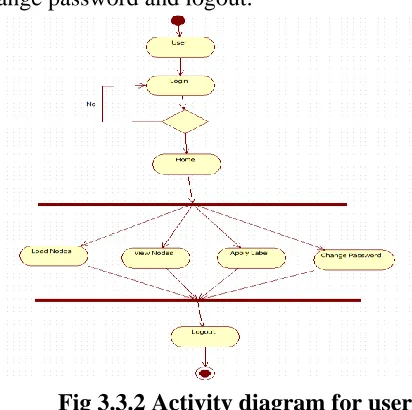
Fig 3.3.2 Activity diagram for user
In the above fig 3.4.5 the operation for user is login password, load nodes, view nodes, apply label, change password, logout.
Available online: https://edupediapublications.org/journals/index.php/IJR/ P a g e | 1492
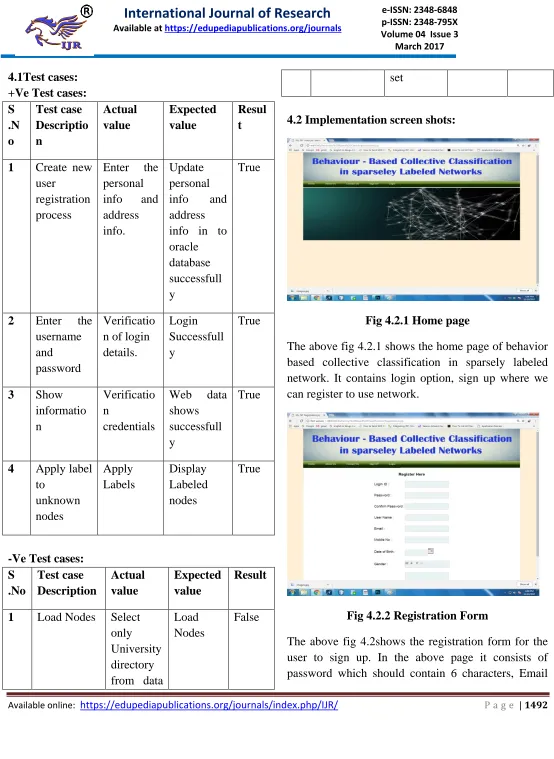
4.1Test cases: +Ve Test cases: S .N o Test case Descriptio n Actual value Expected value Resul t
1 Create new user
registration process
Enter the personal info and address info.
Update personal info and address info in to oracle database successfull y
True
2 Enter the username and password
Verificatio n of login details.
Login Successfull y
True
3 Show informatio n
Verificatio n
credentials
Web data shows successfull y
True
4 Apply label to unknown nodes Apply Labels Display Labeled nodes True
-Ve Test cases: S .No Test case Description Actual value Expected value Result
1 Load Nodes Select only University directory from data
Load Nodes
False
set
4.2 Implementation screen shots:
Fig 4.2.1 Home page
The above fig 4.2.1 shows the home page of behavior based collective classification in sparsely labeled network. It contains login option, sign up where we can register to use network.
Fig 4.2.2Registration Form
Available online: https://edupediapublications.org/journals/index.php/IJR/ P a g e | 1493 should be in the format [email protected] .It also
contains mobile number should be of 10 digits and It also consists of date of birth to be filled, address mentioned above should be authenticate.
Fig 4.2.3 User Home Page
The above fig 4.3 is the user home page where user can select a Network .There are course department, faculty, other, project , staff , student . user can choose any of the above mentioned based on the data he required.
Fig 4.2.4 Load nodes
In the above fig 4.2.4 the user have the following operation like load nodes in which the nodes on that network are loaded, user can view nodes which are
loaded and he can also remove all nodes initially loaded by other users.
Fig 4.2.5 Classify nodes
In the above Fig 4.2.5 shows the classification of nodes which are loaded from that network. Those are differentiated as labeled and unlabeled nodes .The data from labeled nodes can be extracted easily but the data from unlabeled nodes cannot be extracted.
Fig 4.2.6 Select Unlabeled nodes
Available online: https://edupediapublications.org/journals/index.php/IJR/ P a g e | 1494
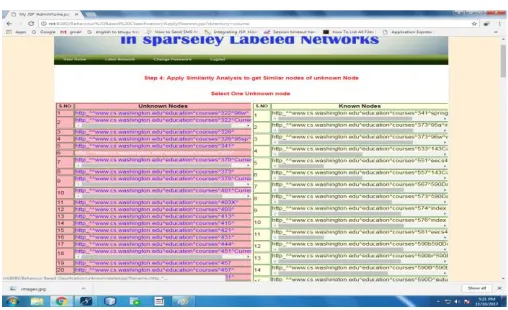
4.2.7 Select similar Labeled node
In the above fig 4.2.7 the user has to select any one of top k node to convert the unlabeled node into labeled node.so that the extraction of data from that node can be more.
Fig 4.2.8 Show status
In the above fig 4.2.8 it shows the status of the process after converting the unlabeled node to labeled node. It can be seen above that initially unlabeled node link cannot be opened, but now after it converting into labeled node can be opened because the link has converted into html format.
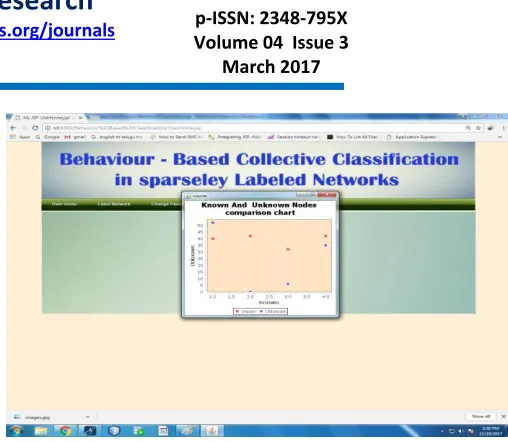
Fig 4.2.9 Show graph
In the above fig 4.2.9 after the status of the process it shows the chart comparison of known and unknown node.
CONCLUSIONS AND FUTURE WORK
In order to improve classification accuracy in sparsely labeled networks, we propose a novel behavior based collective classification method, BCC, in this study. In BCC, the behavior feature of nodes is extracted for classification, which has shown more discriminative ability to traditional methods. Then, instead of using all the labeled nodes, we screen the most-relevant nodes according to the calculation of correlation and similarity, which can overcome the effects of noise and imbalanced dataset. Finally, collective inference is introduced to utilize both labeled nodes and unlabeled nodes, which can relieve the sparse labeling problem effectively.
REFERENCES
Available online: https://edupediapublications.org/journals/index.php/IJR/ P a g e | 1495 [2] Andrea Dal Pozzolo, Olivier Caelen,
Yann-Aël Le Borgne, Serge Waterschoot, Gianluca Bontempi Learned lessons in credit card fraud detection from a practitioner perspectiveExpert Syst. Appl.2014
[3] M. Nejati, S. Samavi, and S. Shirani, “Multi-focus image fusion using dictionary-based sparse representation,” Inf. Fusion, vol. 25, pp. 72–84,Sep. 2015.
[4] L. Chen, J. Li, and C. L. P. Chen, “Regional multifocus image fusion using sparse representation,” Opt. Exp., vol. 21, no. 4, pp. 5182–5197,2013.
[5] S. Rayana and L. Akoglu. Collective opinion spam detection:Bridging review networks and metadata. In KDD, pages 985–994, 2015. [6] S. A. Macskassy and F. Provost, ``Suspicion
scoring based on guilt-byassociation, collective inference, and focused data access,'' in Proc. Int.Conf. Intell. Anal., 2005.
[7] B. Taskar, E. Segal, and D. Koller, ``Probabilistic classification and clustering in relational data,'' in Proc. Int. Joint Conf. Artif. Intell., vol. 17. 2001,pp. 870_878.
[8] L. Tang and H. Liu, ``Relational learning via latent social dimensions,'' in Proc. 15th ACM SIGKDD Int. Conf. Knowl. Discovery Data Mining, 2009, pp. 817_826
[9] B. Gallagher, H. Tong, T. Eliassi-Rad, and C. Faloutsos, ``Using ghost edges for classification In sparsely labeled networks,'' in Proc. 14th ACMSIGKDD Int. Conf. Knowl. Discovery Data Mining, 2008, pp. 256_264.
Ch.V.Gayathri is a student of b.tech fourth year in Computer science from Siddhartha Institute of Engineering and Technology. Her subjects of interest are Database science and security.
D. Saidan,pursuing PhD from Osmania University, Working as Assoc. Prof at CSE Dept In Siddhartha Institute Of Engineering And Technology, Ibrahimpatnam. His area of interests is Database Management System, Computer Programming, Data warehousing and Mining, Computer Networks and Software engineering.
N Yugesh kumar, M.Tech, working as Asst. Prof at