Data Analysis and Performance Evaluation
of Spray Dryer Pilot Plant
Pradeep Laghule 1
PG Student [Process Lab], Dep. of I&C, College of Engineering Pune, Maharashtra, Pune, India1
ABSTRACT: In the development of new processes, the design and operation of the pilot plant often run in parallel with the design of the future commercial plant and the results from pilot testing programs is the key to optimize the commercial plant performance. It is common in many cases where process technology has been successfully implemented on pilot plants and the savings at the commercial scale resulting from pilot testing significantly outweighs the cost of the pilot plant itself. To increase the efficiency we need to adjust a process so as to optimize some specified set of parameters without violating some constraint. To fulfil above goals it is essential to have the data related to process and for all the constraints. By performing data analysis we can understand the process more effectively and able to make better decisions. The main aim of the work is to make the Spray Dryer pilot plant run continuously with the help of PLC, OPC, and MATLAB while providing a platform to compare the energy efficiency of the pilot plant, applying various control strategies, data collection from different sensors installed on the pilot plant which form the foundation of my data analytics activity using the R platform.
KEYWORDS: Data analysis, MATLAB, OPC, Optimization, Pilot plant, PLC, R platform, Spray Dryer
I. INTRODUCTION
Spray drying is the conversion of liquid feed from a fluid state into a dried particles by spraying the feed into a hot drying medium. In the spray dryer the liquid to be dried is sprayed in the form of small droplets. The minute droplets are readily evaporated and gets converted into the solid particles, which fall to the bottom of the chamber. The vapours are transferred in to the separator where the fine dry particles which are carried along with the vapours are separated and collected. Spray dryers are available in many forms and deigns. A typical spray dryer consist of a drying chamber which is just like the cyclone separator, so as to ensure the good circulation of a air to facilitate heat and mass transfer and also to ensure that the dried solid particles are separated by the centrifugal action in the separation unit. The character of the particles depends on the liquid to be converted in the form of droplets.
Data analytics technologies and techniques are widely used in commercial industries to enable organizations to make more-informed business decisions and by scientists and researchers to verify or disprove scientific models, theories and hypotheses. The analytics process starts with data collection. Data from different source systems may need to be combined via data integration routines, transformed into a common format and loaded into an analytics system.
Every Pilot Plant has to measure and control various process parameters. For this purpose number of sensors are installed on each and every plant. Each sensor generates enormous amount of data. Having such amount of raw data creates an opportunity for the data analysis. Ultimately by performing data analysis on this available data we can evaluate the performance of plant as well as make better decision related to plant maintenance.
II. PROCESS DESCRIPTION
Fig.1: Spray Dryer pilot plant present at Advanced Process Lab College of Engineering, Pune
.
1. Atomization
Atomization is the most important operation in the spray drying process. The type of atomizer not only determines the energy required to form the spray but also the size and size distribution of the drops and their trajectory and speed, on which the final particle size depends. The chamber design is also incensed by the choice of the atomizer. The drop size establishes the heat transfer surface available and thus the drying rate. Three general types of atomizers are available. These are Rotary wheel atomizers, Pressure nozzle single fluid atomizers and Pneumatic two fluid nozzles.
2. Spray Air Mixing
Co-current contact occurs when the droplets fall down the chamber with the air owing in the same direction. It is the most common system with both wheel and nozzle atomization. The droplets come into contact with the hot drying air when they are the most moist. The final product temperature is lower than the inlet air temperature. General examples are milk powder, orange juice powder, several pharmaceutical drugs etc.
Counter-current contact is achieved when the drying air owes in opposite direction to the falling droplets. It is used for more heat sensitive materials that require coarse particles or special porosity or high bulk density. Nozzle atomization is usually used. The material is sprayed in the opposite direction of hot air. The hot air owes upwards and the product fall through increasingly hot air into the collection tray. The res dual moisture is eliminated and the product becomes very hot. This method is suitable only for thermally stable products. The final product temperature is higher than that of the exit air.
3. Product Recovery
III. METHODOLOGY
1. Local Domain
The Spray dryer pilot plant is locally controlled by Allen Bradley MicroLogix 1400 PLC. It is fully supported by perpetual licensed RSLogix 500 (ladder programming tool) & SCADA (RSView) software. The role of local PLC is to take care of the software interlocks and transferring I/O commands to the remote domains such as DCS, Contrologix PLC through the SCADA interface.
2. Remote Control from ControlLogix system 1756-L61
The ControlLogix system of series 1756-L61, is a chassis-based PLC and provides the option to configure a control system that uses sequential, process, motion, and drive control in addition to communication and I/O capabilities. RSLogix 5000 is the programming software for ControLogix PLC. It provides ladder logic, structured text, function block diagram and sequential function chart editors for program development as well as support for the S88 equipment phase state model for batch and machine control applications.
3. OPC
OPC is the interoperability standard which ensures reliable and secure transmission of information in between various devices. The architecture of the process is shown in Fig. 2
Fig.2: Architecture of the Process
It helps in interconnection of devices from different vendors for seamless flow of data. OPC is basically a client/server interface. The OPC Server collects data from the PLC and makes it available to the OPC client which connects it further to the SCADA, HMI etc. Kepware OPC has been used in the experiments in order to connect MATLAB and the Allen-Bradley PLC. Fig. 3 shows the configuration of OPC server.
4. Communication
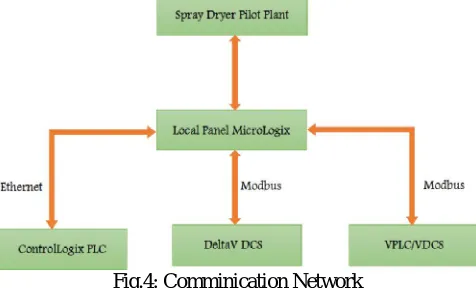
This section explains the communication details which we have implemented. Fig. 3 shows the configurarion of OPC server. Basically the Plant is operated with the help of MATLAB/Simulink. The OPC Server pulls in data from the PLC using MODBUS TCP/IP protocol and this data is allowed to be accessed by MATLAB by using internal OPC blocks that Simulink provides.
Fig.4: Comminication Network
Matlab provides the platform for the OPC tool to access data from Kepware OPC. The data from the OCP can be read, write and logged using the OPC tool. In this implementation, Kepware KEPServer V5 OPC server is used for communication with Allen-Bradley Micrologix1400b over Modbus TCP/IP protocol using the Modbus driver protocol. Fig. 4 shows the communication network.
5. Control Strategy
The control strategy is developed with the help of MATLAB simulink. We can perform various dicrete operations. To get the desired quality of milk powder, it’s of prime importance to maintain the temperature inside dring chamber at desired value. For that purpose, feedback loop is applied to electric heater. We can control the temperature of heater with the help of SCR
IV. DATA ANALYSIS USING R TOOL
Data is a set of values of qualitative or quantitative variables. Data analysis is an approach for summarizing and visualizing the important characteristics of a data set. Data analysis focuses on exploring data to understand the data’s underlying structure and variables, to develop intuition about the data set, to consider how that data set came into existence and to decide how it can be investigated with more formal statistical methods.
Data analytics helps organizations harness their data and use it to identify new opportunities. That, in turn, leads to smarter business moves, more efficient operations, higher profits and happier customers. Data analytics turns out to be one of the most trusted business tools in the market. To enhance a business is not an easy task. Complexities increase with the size of the business.
R is an open source software language and a software environment for statistical computing and graphics that is supported by the R Foundation for Statistical Computing. The R language is widely used among statisticians and data miners for developing statistical software and data analysis. R provides a wide variety of statistical (linear and nonlinear modeling, classical statistical tests, time-series analysis, classification, clustering etc) and graphical techniques and is highly extensible. Using R tool we extract data based insights from the data sets acquired from equipments & sensors like air velocity, temperature & SCR of the Spray Dryer pilot plant.
Fig.5: GUI of R Studio
1. Steps to Data Analysis Using Linear Regression in R
A. The data acquired from the sensors is usually stored in EXCEL format. We will first convert the .XLS into a CSV format to load it in the R tool
B. Once CSV file is ready we will load this file into R using the R Studio workbench
C. Once our data is successfully imported from the CSV file to R , it will reflect in the R script,R console & R environment windows
D. We will now run a code to generate results to find the correlation between the parameters depending upon the alpha value.The code to generate a linear regression model in R is given as follows:
model lm(parameter1 parameter2+parameter3,data = dataset.csv)
V. RESULT
1. Product
The objective of the spray drying process is to produce dried product of a desired quality regardless of the disturbances in the drying operation and variations in feed supply. In order to check the performance of spray dryer we have tested the plant on milk and got satisfactory results. The product quality was satisfactory.
2. Analysis of different parameters
There are various parameters which affects on the formation of dry powder.
a. Feed Rate
If it will exceed to particular limit then the temperature inside the drying chamber will drastically change (decreased or increased). And this will cause direct impact on the product. If temperature inside the drying chamber increased more than its set-point, then product will burned. And if temperature is much below the setpoint limit then liquid milk powder may come with product.
b. Temperature Transmitter -1
Air is use as a drying medium. We are using SCR control module for controlling this temperature at desired set-points.
Fig.7: Inlet temperature c. Temperature Transmitter -2
Its value shows us that weather we are getting desired output product or not.
d. Inlet Air Velocity
It decides the time which is available inside the drying chamber for liquid milk.
Fig.9: Inlet air velocity
e. ID fan speed
Fig.10: ID fan speed f. SCR Output
Plays important role in the maintaining drying air temperature.
VI. CONCLUSION
The results of the analysis allowed focusing on the critical variables. By performing data analysis on data obtained from various sensors installed on spray dryer plant we can determine the most important process parameters which affect the quality of end product. Also the knowledge obtained from data analysis can be useful for the predictive maintenance of the plant in near future.
REFERENCES
[1] P. Eichinski and P. Roe, Datatrack: An r package for managing data in a multi-stage experimental workflow, e-Science, 2016 IEEE 12thInternational Conference, 6 March 2017.
[2] Keith Masters, Applying Spray Drying to Costomized Powder Manufacture, Chinese J. Chem Eng., 12(6) 744-749 (2004).
[3] Afoakwah A. N., Adomako C., Owusu J., Engman N. F. and Hannah A. A., Spray Drying as an Appropriate Technology for the Food and Pharmaceutical Industries - A Review, Journal of Environmental Science, Computer Science and Engineering & Technology, JECET; September-November, 2012; Vol.1.No.3, 467-476.
[4] N. Naik, P. Jenkins, N. Savage, and V. Katos, Big data security analysis approach using computational intelligence techniques in r for desktop users, in Computational Intelligence (SSCI), 2016 IEEE Symposium Series on. IEEE, 2016, pp. 18.
[5] Meghana M. Santre and S. D. Agashe, Dynamics of spray dryer, International Conference for Convergence for Technology-2014, 23 April 2015.
[6] M. McCabe, J. Smith, and P. Harriott. Unit Operations of Chemical Engineering. McGraw- Hill, New York, NY, 6th edition, 2000
[7] Evangelos Tsotsas, Arun S. Mujumdar, Modern Drying technology-computational tools at different scales, vol.1.Wiley-VCH, pp.192-196, 2007. vol. 6, no. 1, pp. 100114, Jan. 2007.
[8] Li Xin Huanga,, Kurichi Kumarb, A.S. Mujumdarc ,A comparative study of a spray dryer with rotary disc atomizer and pressure nozzle using computational uid dynamic simulations Chemical Engineering and Processing 45 (2006) ; pages:461470, 3 November 2005
[9] V.S. Shabde and K. A. Hoo. Design and operation of a spray dryer for the manufacture of hollow micro particle.. Industrial and Engineering Chemistry Research, 2006
[10] OPC Interoperability [online].
Available:https://www.kepware.com/enus/products/kepserverex/