Automatic Coal Conveyor Control Using PLC
Sathish E, Anandkumar P, Vignesh K, Suresh J
Assistant Professor, Dept. of Electronics and Instrumentation Engineering, Erode Sengunthar Engineering College
Erode, India.
U.G. Student, Dept. of Electronics and Instrumentation Engineering, Erode Sengunthar Engineering College,
Erode, India.
U.G .student, Dept. of Electronics and Instrumentation Engineering, Erode Sengunthar Engineering College
Erode, India.
U.G. Student, Dept. of Electronics and Instrumentation Engineering, Erode Sengunthar Engineering College
Erode, India.
ABSTRACT: In order to ensure the belt conveyor operation safe and reliable, centralized monitoring and control is very necessary. The main objective of this proposal is to monitor and detect the fault occurring in the coal conveyor using PLC. Faults such as belt tear up faults, oil level reduction fault, fire occurrence faults in the belt conveyor are not identified properly and thus leading to serious damage to the belt conveyor. In order to avoid this type of serious conditions, we are applying here various types of sensors in their operations using PLC to provide proper protection for the belt conveyor in Thermal Power Plant. Manual control at present is more disadvantageous and is being the major reasons for frequent accidents. In order to reduce these accidents and for increasing further enhancements, automation is used. All parameters will be processed, controlled, and managed in the coal conveyor with help of sensors and plc.
KEYWORDS: Coal conveyor, Genie-NX PLC, Sensors.
I.INTRODUCTION
In this project automatic coal conveyor with PLC
( Programmable logic controller) is used. The Coal Handling Plant (CHP) is having number of conveyors. The control system used for these conveyors are important for operating the plant safely. The efficiency of CHP is depending upon availability and reliability of conveyor system. If a conveyor system is working well, it is almost invisible to the CHP. A single conveyor can run at close to 100% reliability, but as the number of conveyor increases, the reliability of the conveyor system is depends upon its control system. The control system should be capable to fulfilling the need of CHP operation. Existing systems is used only for control of the coal flow in manual mode. Whenever the temperature set point increases or decreases, according to set point of the temperature the LED indication are available. When the coal conveyor surrounding temperature increases, then the automatic drop water system gets activated and LED indications are available. Both the temperature and coal conveyor monitoring is controlled by PLC (Programmable logic controller).
II.OBJECTIVE
To detect and monitor the fault using PLC.
To monitor the coal feeding in a continuous manner.
Switching of conveyor during reliable and fail safety operation.
III.SYSTEM ANALYSIS
A.Existing System
The existing system has sensing device like zero speed sensing, receiving conveyor position sensing. It has the facility for selection to operate conveyor avoiding control system i.e. manual run mod. In some CHP there is facility of three type of selection. One is for start or stop plant with auto mode. In this mod each conveyor will operate sequentially after selecting the stream. Second which is in all CHP for start or stop of plant with manual mod. Third is operating the system without any protection or interlock.
a. Drawbacks
• If there are many causes in field instruments were not able to view to trends, stability, graphical view, system matching for other purpose.
• Accuracy and reliability less. Manual operation by Contactors.
B.Proposed System
This proposed system gives the efficient way of automating the belt conveyor using PLC for high reliability, and fast operation without delay. It consists of hardware and software modules to identify the belt conveyor faults. Automated drop water system is used in this project and it is controlled by relay system. Water wastage and man power was reduced.
IV.LITERATURE REVIEW
The following journal papers are referred to implement the project.
William J. Fleming-Overview of Automotive Sensors
The primary sensor technologies in use are reviewed and are classified according to their three major of automotive systems application – power train, chassis, and body. This subject is extensive. As described in this paper, for use in automotive systems, there are six types of rotational motion sensors, four types of pressure sensors, five type of position sensors, and three types of temperature sensors. Additionally, two types of mass air flow sensors, five types of exhaust gas oxygen sensors, one types of engine knock sensors, four types of linear acceleration sensors, four types of angular-rate sensors, four types of occupant comfort/convenience sensors, two types of near-distance obstacle detection sensors, four types of far-distance obstacle detection sensors, and ten types of emerging, state-of the –art, sensors technologies are identified.
Kuttalakkani .M, Natarajan.R, Amith Kumar Singh, Vijayakumar.J, Arunan.S, Sarojini.L- sensor Based Effective Monitoring of Coal Handling System (CHS)
Coal level detection is an important aspect to assess the performance of a coal-fired power plant. Coal has to be transported, via a coal handling system. The fuel in a coal-fired power plant is stored in silos, bunkers or stock piles. Coal is stored in silos is small plant, bunkers for handling a day’s operation and stock piling methods for large plants. So fuel handling had to done efficiently. To accurately sense the coal height, real-time feedback is deployed within the bunker or stock pile. The real time range information is then feedback to the control system. Of the different types of ranging sensors, radar based system is used. Also a real time temperature monitoring system is developed to protect the coal. The range and temperature data from sensors are sent to main system through GSM modem by means of SMS. The range information is used to start the conveyor belt to draw the coal yard. If the temperature exceeds the limit, the SMS will be sent through the software or it will call the respective person to monitor the process. A fire sensor is also used to extinguish the fire by initiating the water spraying system. A PLC is interfaced all the sensors for effective handling of thermal power plant.
Makarand M, Joshi –Development Of Condition Based Maintenance For Coal Handling Plant Of Thermal Power Stations
In the thermal power plants maximum requirements of fuel is a coal. The handling of this fuel is a great job. To handle the fuel i.e. coal, each power station is equipped with a coal handling plant. Almost all CHP these days implies reactive maintenance with cost competitiveness, effective maintenance management has been accepted as the key to corporate strategy for reduced costs. This has led to integration of maintenance management function with production and business problems, not just equipment problems. The failures of equipments have led to high maintenance and operation costs. Implementation of modern concept of condition based maintenance can appreciably reduce maintenance costs and enhance reliability of machine performance.
V.METHODOLOGY
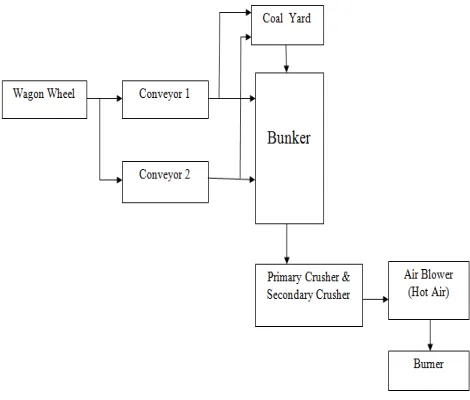
The overall working of the project is to monitoring the automatic coal conveyor using PLC. Overall representation of the project is shown in the Figure.
Fig. Block diagram of coal conveyor monitoring
A.Proximity Sensors
A proximity sensor is a sensor able to detect the presence of nearby objects without any physical contact. Proximity sensors can have a high reliability and long functional life because of the absence of mechanical parts and lack of physical contact between sensor and the sensed object.
B.IR Sensors
IR detectors are little microchips with a photocell that are tuned to listen to infrared light. They are almost always used for remote control detection - every TV and DVD player has one of these in the front to listen for the IR signal from the clicker. Inside the remote control is a matching IR LED, which emits IR pulses to tell the TV to turn on, off or change channels. IR light is not visible to the human eye, which means it takes a little more work to test a setup.
C. Relay
Relays are switching device. It is the heart of industrial electronic system. Every industrial electronic system required some type of switching device (or) relay. For the simplest photo-electric relay to the most advanced.
Depending up on the basic force available for relay contact closing and opening there is several types of relays. Some of them are listed below:
D. Buzzer
Passive Electromagnetic buzzer working principle is: through the exchange of signals around the stent on the line in support of the package have a core pillar of the alternating magnetic flux, and flux of alternating magnetic ring constant flux for overlay, so that Mo Tablets given to the exchange of signals with the frequency of vibration and sound cavity.
VI. COAL HANDLING SYSTEM USING PLC
This system will overcome the drawbacks of existing system by detecting faults using different types of sensors such as proximity sensor, IR sensor, temperature sensor and humidity sensor in the operation of PLC . In this method the tear up in the conveyor belt is detected using IR sensor, the increase in temperature is automatically detected by temperature sensor, the moisture content is measured by using humidity sensor, overloading of the conveyor belt is detected by proximity sensors, thus with the help of these sensor immediate fault detection is possible, so the damage occurring to the belt conveyor can be avoided. Therefore the proposed system gives the efficient way of automating the belt conveyor using delta series PLC along with for high accuracy, reliability, low power consumption and fast operation without delay. It consists of software modules to identify the belt conveyor faults.
VII.PROGRAMMABLELOGICCONTROLLER
Definition
A PROGRAMMABLE LOGIC CONTROLLER(PLC)
Is an industrial computer control system that continuously monitors the state of input devices and makes decisions based upon a custom program to control the state of output devices.
A. Hardware
Power Supply
This can be built into the PLC or be an external unit. Common voltage levels required by the PLC (with and without the power supply) are 24Vdc, 120Vac, 220Vac.
CPU
I/O (Input/Output)
• A number of input/output terminals must be provided so that the PLC can monitor the process and initiate actions.
• flexible and easy to maintain.
Indicator lights
These indicate the status of the PLC including power on, program running, and a fault. These are essential when diagnosing problems. The configuration of the PLC refers to the packaging of the components. Typical configurations are listed below from largest to smallest.
Rack
A rack is often large (up to 18” by 30” by 10”) and can hold multiple cards. When necessary, multiple racks can be connected together. These tend to be the highest cost, but also the most flexible and easy to maintain.
FEATURES
The main difference from other computers is that PLCs are armored for severe conditions (such as dust, moisture, heat, cold), and have the facility for extensive input/output (I/O) arrangements. These connect the PLC to sensors and actuators. PLCs read limit switches, analog process variables (such as temperature and pressure), and the positions of complex positioning systems. Some use machine vision. On the actuator side, PLCs operate electric motors, pneumatic or hydraulic cylinders, magnetic relays, solenoids, or analog outputs. The input/output arrangements may be built into a simple PLC, or the PLC may have external I/O modules attached to a computer network that plugs into the PLC.
VIII.CONCLUSION
Coal Conveyor belt fault detection in Thermal Power Plant are processed, controlled, and monitored with the help of Programmable Logic Controller and various types of sensors. In the point of reducing human errors, PLCs are important part to design with high-speed and highly reliable control operations for conveyor. PLC is used for the real time monitoring, thus proposed system gives better accuracy, time consuming, low power consumption, stable, highly reliable operation in Real-time where the human life is very important, it protects them from a major risk during fault condition. This proposal is automatic fault detector in the conveyor which is more effective and efficient one. By controlling and monitoring process the immediate fault detection is possible without any time delay to protect the coal conveyor belt tear up. Thus all the drawbacks of existing system are overcomed by the proposed system with the help of different types of sensors, PLC.
REFERENCES
[1]Chunsheng Yang; Dept. of Mech. & Electr. Eng., Jiangsu Coll. of Inf. Technol., Wuxi, China; Pingyuan Xi, “Dynamic simulation of the belt conveyor in neural network”, Computer and Automation Engineering (ICCAE), The 2nd International Conference, vol. 2, pp 748–751, Feb. 2010.
[2]Qing- kui Cao; Sch. of Econ. & Manage., Hebei Univ. of Eng., Handan, China ; Jun-hu Ruan ; Kai- di Liu, “Fuzzy evaluation on the safety of belt conveying system based on membership degree transformation new algorithm M(1,2,3)” Computing, Communication, Control, and Management, CCCM 2009. ISECS International Colloquium., vol. 4, pp 19–23.
[3]Popescu, N.; Fac.of Electr. Eng., Univ. of Craiova, Craiova, Romania; Dinu, R.C.; Mircea, I.,“ The coal conveyor celts functioning modelling of the energy block by 330 MW” IEEE trans., Applied and Theoretical Electricity, International Conference on Oct. 2012.
[4]You Chunxia; Phys. & Electron. Eng. Inst., Xuzhou Normal Univ., Xuzhou, China; Chen Si., “A new detection device of belt longitudinal rip based on pressure monitoring” International Conference on
Electronics, Communications and Control (ICECC), Sept. 2011.
[5]www.software.invensys.com/products/wonderware/hmi-and-supervisory-control/intouch/ [6]www.allaboutcircuits.com/vol_4
[7]www.elprocus.com