647 | P a g e
Smart Toilet– An IoT Solution
Sandeep Sangwan
1, Nikhil Chugh
2, Pradyumn Kumar Tiwari
3ABSTRACT
Aim of this paper is to analyze the benefits and need of regular health checkups tests and present an IoT solution architecture. Now a day’s people rarely get time to go for general health checkups. Everything is going smart however, we are still using conventionaltoilets. Medical conditions like kidney stone, pregnancy, etc. can very easily be detected by testing on human body waste. So, why can’t we have a smart toilet which will perform these very basic tests? We propose an IoT based smart toilet system which can easily test user body waste and help him to track and share reports to doctor to guide the user on how to improve his health. To maintain the privacy, user’s profile & sessions are maintained.
I. INTRODUCTION
There have been many cases identified in which patients get to know about the disease in the later stages. Their
conditions could be avoided if the tests were performed in earlier stages of the diseases. Doctors always insist on
getting regular checkups done to diagnose the disease at the earlier stages so as to avoid serious implications.
There are apps now which help you virtually meet your doctor and doctor can also take all your tests done on
the same platform. So, this avoids the regular visits to the doctors that patients had to do earlier. However, some
diseases or conditions that are very common are ignored by the people or are delayed in diagnosis. So, there
arises the need for a solution that helps people to diagnose these common diseases without interfering with the
daily chores of people. Because people rarely go for regular checkups like these and hence this prevents the
early diagnose of the disease or the medical condition. In order to solve this problem, we propose a smart toilet
system. This system can be used to track and to guide the user on how to improve his health. This smart toilet,
apart from providing a cleaner option to discard human body waste, also helps in performing some tests on the
body wastes and can even share the reports to the doctors on user’s consent. The smart toiles uses tests
performed on urine and stool to diagnose very basic and common medical conditions like pregnancy, kidney
stones, constipation, etc. Also, to protect the privacy of the user smart toilet has user profiles. A user can login
using his password or directly using the biometrics when entering the toilet.
According to the data shared by Nana Palkar Smruti Samiti, there has been continuous increase in the no. of
648 | P a g e
Figure 1. statistics of tests conducted during last 10 years in lab.Considering the health concerns, Govt. of India has also taken initiative in the Union Budget of 2016-17 to
provide insurance coverage to the economically weaker sections. Govt. of India is also running schemes that
help in development of toilets in rural areas.
According to the data shared by Dr. Lal Path Labs, one of India’s leading pathology laboratory chains, the size
of the diagnostics industry was around Rs. 377 billion in 2014-2015 and will continue to grow by a CAGR of
16%-17% over the next two years, to cross Rs 600 billion by 2017-2018. Dr. Lal Path Labs, on yearly basis,
adds 15-25 satellite labs to their network.
1.
Smart Toilet
We hereby present a plausible solution which is capable of maintaining user profiles and generalhealth
parameters of the users.
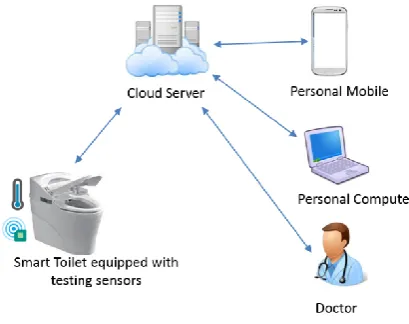
Figure 2.smart toilet solution using IoT
The user enters the toilet and automatically logs-in by the inbuilt fingerprint sensor on the door handle when he
opens the door. Now, as the toilet recognizes its user, it makes all the necessary changes like the ambient
lighting, music, seat temperature, water temperature, etc. for that particular user. A weighing machine is placed
near the toilet seat which calculates the weight of the user. As toilet already knows the age of the user from its
user-profile, it calculates the BMI value and records the same in its database. Now as the user completes the
natures call, the toilet has already collected a sample of its user’s body waste and has started the tests that can be
performed on that particular sample.
649 | P a g e
1.Urine:a.Kidney stone
b.Sugar level
c.Urinary tract infection
d.Pregnancy
2.Stool:
a.Fecal occult blood
b.Fecal pH / Acidity test
3.Spit:
a.Alcohol presence
II. FEASIBILITY STUDY
1.1.
Smart toilet bidet design
To discuss the design feasibility of toilet bidet here we want to present very basic architecture design& working.
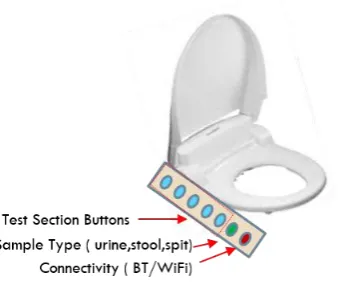
Figure 3. bidet design
To complement the purpose of collecting the sample, smart toilet can take use of existing technology like
vacuum toilet which uses suction power to remove urine and feces. In our case, we can use vacuum toilet to
flush the sample and collect in an apparatus. This will ensure no water is used before the sample reaches the
sample collecting apparatus. Toilet bidet has side control buttons.First of all user has to select the sample type
using the first sample selecting toggle button.Based on the sample type selected, relevant testing buttons will get
activated. For example, if user selects sample type as urine then below test optionwill be activated:
1.Kidney stone
2.Sugar level
3.Urinary tract infection
4.Pregnancy
Using the connectivity button user can turn-on/off the smart toilet connectivity to cloud server.To automatically
650 | P a g e
in/out from the system.Toilet bidet design can be modified & scaled as per testing requirement & technologyenhancement.
1.2.
Smart testing process
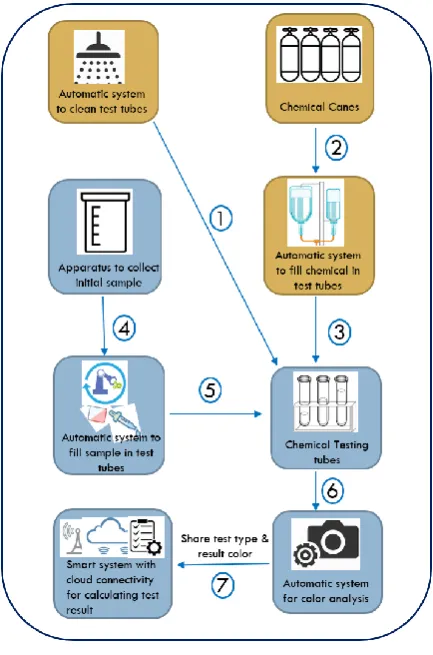
As shown in figure, initially it’s assumed that test tubes are washed and filled with required quantity of chemical
for testing. Now when testing is triggered by selecting the testing sample from button on side of bidet, sample is
collected in sample apparatus pot.Automatic system will take sample from Sample apparatus & fill the required
quantity of sample in the test tubes. Testing cycle will start and oncompletion, based on changed color, test
results will be calculated and shared to end user via cloud server. Afterperforming these tests, the toilet will be
automatically flushed.
Figure 4. smart testing process design
The user can then analyze this information on his personal computer or smartphone which will also enable him
to see the trend in his test report’s data. User may choose to share the test results with other users like family
members or can share it directly to his doctor.
1.3.
Testing feasibility
651 | P a g e
a) Sugar Test: -Sugar level can be measured from urine by chemical test, for example Benedict's reagent can beused to measure sugar level from green, yellow, or brick red precipitates formed.
b) Kidney Test: -Kidney diseases can be detected by the presence of Creatinine, Specific gravity and Protein in
the urine. Strips are available which can test Kidney function and based upon the color change kidney
functioning can be diagnosed.
c) Pregnancy Test: -Pregnancy can be easily confirmed with chemical test on urine sample which change color
if beta subunit of human chorionic gonadotropin (hCG) is present in the urine
d) Urinary tract infection Test: -Leukocyte esterase presence can be detected by chemical test. Positive test
confirm the white cells in the urine which indicates a urinary tract infection.
e) Fecal occult blood Test: -Blood presence can be detected by change in color with Hydrogen peroxide. From
this test blood loss in the gastrointestinal tract, anywhere from the mouth to the colon can be detected.
f) Fecal pH / Acidity test: - Acidity can be diagnoseby testing fecal sample with Nitrazine chemical and
comparing against a color scale.
g) Alcohol presence Test: -Alcohol presence can be easily detected by change in color with chemicals,
Tetramethylbenzidine (TMB) 0.12mg, Alcohol Oxidase 0.5 IU, Peroxidase 0.35 IU and Proteins 0.15mg.
Further in future with the enhancement of medical science & technology, it would be easy to cover more
diagnosis test using smart toilet.
III. RELATED WORKS
All the works done till now focus on one or the other aspects of this field. Toto Japanese Company) has
developed “Intelligence Toilet II” which is capable of basic functions like body temperature, blood pressure,
sugar levels, etc. But it is majorly used in Japan and exported to few countries like USA and China.
IV. CONCLUSION
As the saying goes - prevention is better than cure. By making use of the smart toilet, a user can get to know
about a lots of medical conditions without even visiting a doctor or a lab. This will give user the preliminary
diagnosis of a disease so that necessary actions or steps can be taken, more importantly at correct time, giving
users better opportunities to deal with that particular condition.
REFERENCES
[1] https://www.lalpathlabs.com
[2] www.npss.org
[3] http://www.toto.com/
[4] https://en.wikipedia.org
[5] https://www.ncbi.nlm.nih.gov/