681 | P a g e
NUMERICAL MODELING ANALYSIS AND
SIMULATION OF WAVE PROPAGATION IN FLAT
PANEL STRUCTURES USING TWO-DIMENSIONAL
TRIANGULAR SPECTRAL FINITE ELEMENT
1
Nishanth. J.K,
2Arun Kumar. Y.m
MTech in Structural Engineering, Department of Civil engineering,
MIT Manipal, Manipal Karnataka
Assistant Professor, Department of Civil engineering,
MIT Manipal, Manipal, Karnataka
ABSTRACT
TIn the recent years interest in the application of elastic wave propagation for Structural Health Monitoring (SHM) of structures has been significantly rising. This results from the fact that this method allows damage to be detected at early stages of its development, before it can endanger the safety of the structure. The idea behind the elastic wave propagation method involves generating elastic waves that would propagate in the investigated structure and registering their amplitudes as a function of time. After encountering discontinuities, waves reflect from them. Wave reflections provide the information on location, size and type of damage, this information is extracted from registered signals by appropriate algorithms. In various modeling and analysis associated with propagation of elastic waves, spectral finite element method is supposed to be most suitable modeling technique out of a variety of numerical methods used nowadays to solve wave propagation-related problems.
The spectral finite element method is a relatively new computational technique that basically combines two different numerical techniques that is Spectral methods and the Finite element method. Spectral methods are a special class of techniques employed for solving problems described by partial differential equations numerically. It decreases the computational error exponentially and also guarantees very fast convergence of the solution to exact solutions. The finite element method is employed to solve complex problems from various disciplines of physical sciences described by partial differential equations or integral equations. A characteristic property of the finite element method is discretization of the analyzed area into certain number of smaller sub areas called finite elements, within which one seeks solutions described by approximating polynomials over uniformly spaced nodes. The spectral finite element method is essentially a combination of both mentioned methods; it combines the properties of approximating polynomials of spectral methods and approach to discretizing the analyzed area particular to the finite element method.
682 | P a g e
formulation will be coded in MATLAB. A simple plate structure with possible damages introduced will be analyzed for Lamb wave propagation and the efficiency of the technique will be highlighted.
Keywords:
Shm, Sem, Fem, Matlab®, Lamb Waves
I. INTRODUCTION
Structural Health Monitoring (SHM) is one such technology that can supplement the limited and intermittent
inspection procedures by continuous, online, real-time and automated inspection. In SHM, the damage is
defined as changes to the material and/or geometric properties of a structural system, including changes to the boundary conditions and system connectivity, which adversely affect the system’s performance. An SHM
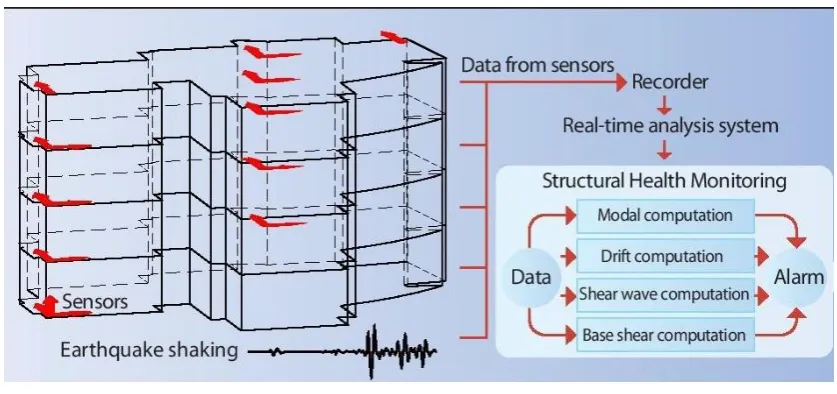
system consists of array sensors, distributed at different critical locations in the structure. The process of health diagnosis (Fig. 1.1) involves, sensor’s response measurement which are sampled periodically; extraction of damage sensitive features from the measurement responses; and finally statistical analysis of these features to
interpret the current state of system health.Continuous monitoring and early damage detection can efficiently
maintain the operational life and performance of the structure. SHM provides accurate and timely information
about the present condition and future performance of the system.
Fig. 1.1 Typical SHM procedure
The spectral finite element method is essentially a discretization method for approximate solution of
partial-differential equations expressed in a weak form and is based on high-order Lagrangianinterpolants used in
conjunction with particular quadrature rules.The spectral element method is a high-order finite element
technique that combines the geometric flexibility of finite elements with the high accuracy of spectral methods.
II.
MODELING METHOD
In this chapter, the distribution of 28-Fekete points for triangular shape, the construction of shape function,
stiffness, material model, kinematics and mass matrix are discussed. The central difference method for time
integration of wave propagation, amplitude modulation, and parameters associated with finite element for wave
683 | P a g e
2.1 Triangular SEM and Fekete points
In order to handle the highly complex geometries the use of triangular elements is generally favoured.. Just like
the SEM, the TSEM needs: (i) an orthogonal polynomial basis and (ii) a set of approximation points.However,
an essential remark is that in quadrilaterals Gauss–Lobatto points are also Fekete points, and that the Fekete
points may be defined in any geometry, especially in the reference triangle T. Given a polynomial basis,
say
n
j
1
, Fekete points are those which maximize the determinant of the Vandermonde matrix V. whoseelements are defined as
,
ij j i
V
y
with
y
i, i = 1,...,n; arbitrary points in T.…(2.1)
Thus, computing Fekete points, say
x n
i i
1,
requires solving an optimization problem: find theset
x n
i i
1
.
x n
i i
1,
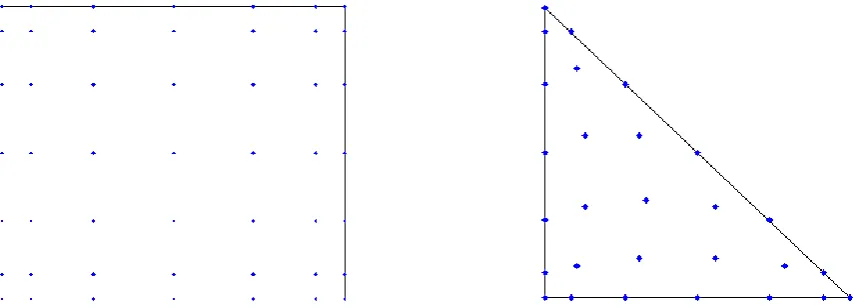
of points in T such that det(V)(x1,..,xn) is maximal. Finally on the sides of triangle(T), Fekete points coincide with Gauss–Lobatto points as shown in Fig (3.1), allowing for conforming meshes
of triangles and quadrilaterals.
Fig. 2.1 we compare the distributions of Fekete points, in T, and of Gauss–Lobatto points, in Q, for
N=6
Node numbering of Fekete triangle which was achieved from the above process is plotted in fig (3.2). The
684 | P a g e
Fig. 2.2, Distribution of Fekete points on a triangle
2.2 Shape functions
In finite element analysis using the displacement model, the variation of displacement within an element is
assumed since the true variation of displacement is unknown. Approximation of displacementsin terms of shape
functions is given by
*
u
N d
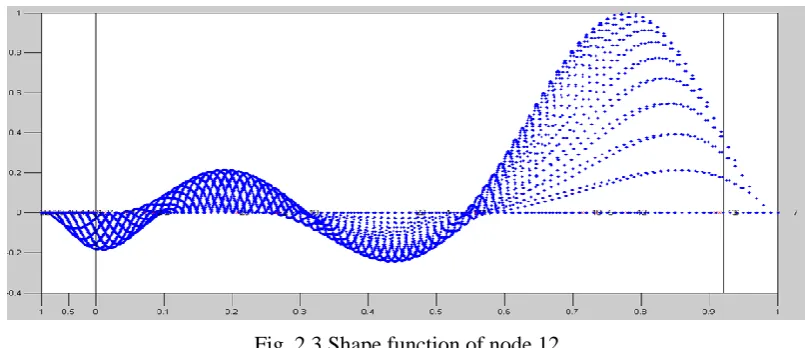
…(2.2)where N is shape functions, u is the displacements. In this thesis Fekete triangle consists of 28 points.
Shape functions of nodes 12 is as show in fig 2.3
Fig. 2.3 Shape function of node 12
2.3 Jacobian matrix
In quadrilateral element derivations we will need the Jacobian of two-dimensional transformations that connect
the differentials of Cartesian coordinates {x y} to those of natural coordinates{r s} and vice-versa. Jacobian
matrix is given by eqn
1 x J
y
…(2.3)
2.4 ElementStiffness Matrix
The stiffness matrix represents the system of linear equations that must be solved in order to establish an
approximate solution to the differential equation. Each column of stiffness matrix is an equilibrium set of nodal
force required to produce unit respective dof.
Stiffness matrix is formulated by considering the strain components in Mindlin plate theory and are shown in
685 | P a g e
xx yy xy yz xz
… (2.4) 0 0 0 xx yy xy x y xy xz yz
… (2.5) 28 1 2 28 1 2 28 281 1 2 2
28
1 2
1 2 28
28
1 2
1 2 28
0 0 0 0 0 0
0 0 0 0 0 0
0 0 . . 0
0 0 0
0 0 0
N
N N
x x x
N
N N
x x x
N N
N N N N
B
x x x x x x
N
N N
N N N
x x x
N
N N
N N N
x x x
1
0 0 0 1
0 0 0 1 0 0 0 0
1 0 0 0 0
1 0 0 0 0
xx xx yy yy xy xy yz yz xz xz C E E E E G G G
[ ] [ ][ ]
C
*
B d
…(2.6) …(2.7) …(2.8) …(2.9)Strain energy is given by
1 2
T
V
W
dv …(2.10)686 | P a g e
1
([ ] ) ( ) 2
T
A
W
B D d B d h dA …(2.11)where ‘h’ is the thickness of the plate.
1 2
T
A
W
d K d dx dy …(2.12)Thus element stiffness matrix [K] is given as eqn(3.33)
T
K
B D B h
…(2.13)1 1
1 1
T
K
B D B h d
d
…(2.14)Global stiffness matrix is assembled from all the element stiffness matrices according to connectivity and
boundary conditions are incorporated.
2.5 Gaussian Quadrature
In numerical analysis, a quadrature rule is calculation of definite integral of a function, usually stated as a
weighted sum of function values at specified points within the domain of integration.
1
1 1
( ) ( )
n
i i
i
f x dx w f x
…(2.15)Gaussian quadrature is very essential in converting infinite series into finite integrals which deduces the
computational effort and saves time. It converts the integral form to numerical calculation. This method use a
minimal number of sample points to achieve a desired level of accuracy.
2.6 Mass Matrix
A mass matrix is the matrix that organizes all the involved masses. The construction of the global mass matrix
[M] largely parallels with global stiffness matrix [K].
Kinetic energy V is given byeqn (2.29)
1 2
e
T
A
V
d I d dA …(2.16)Using energy functions and Hamilton’s principle,
1 2
T
d M d
…(2.17)
e
T
A
M
N I N dA
…(2.18)where, N is the element shape function matrix and ρ is mass density of element.
The diagonality of mass matrix, allows the triangular spectral elements to compete with quadrilateral spectral
elements in terms of both accuracy and efficiency while offering more geometric flexibility in the choice of
687 | P a g e
2.7Lamb wave Simulation and Propagation
The guided Lamb wave is widely acknowledged as one of the most encouraging tools for quantitative
identification of damage in composite structures. Lamb waves are high frequency wave propagation.Lamb
waves are prominently used as non-destructive evaluation (NDE) tool. Lamb wave’s Velocity of propagation
depends on the frequency (or wavelength), as well as on the elastic constants and density of the material which
exhibits velocity dispersion.
2.8 Central Difference Method
Central difference method is combines both forward and backward difference methods. In this method we take
the point ahead and behind of your point of interest and divides it by the two times the step size considered. It is
given by eqn(). If the function f (x) can be evaluated at values that lie to the left and right of x, then the best two-point formula will involve abscissas that are chosen symmetrically on both sides of x.
( ) ( ) '( )
2 f x h f x h f x
h
…(2.19)
where h is the step size.
III. RESULTS AND DISCUSSION
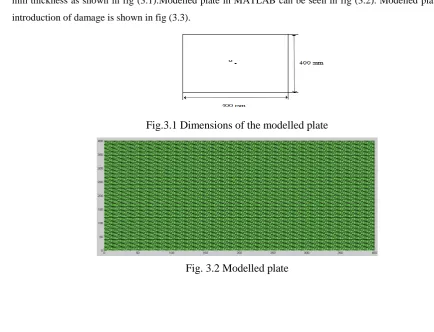
The present simulations were performed for aluminium plate specimen with 400×400 mm2 edge length and 1.5
mm thickness as shown in fig (3.1).Modelled plate in MATLAB can be seen in fig (3.2). Modelled plate after
introduction of damage is shown in fig (3.3).
Fig.3.1 Dimensions of the modelled plate
688 | P a g e
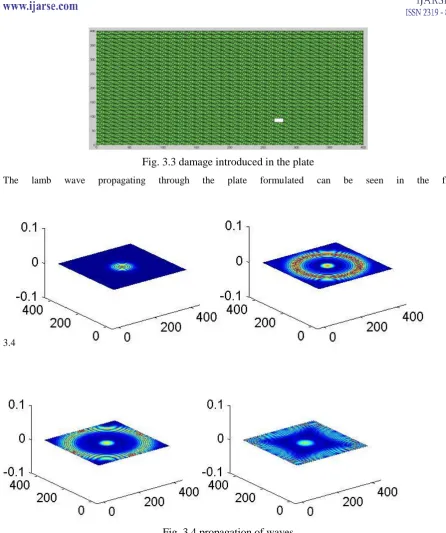
Fig. 3.3 damage introduced in the plate
The lamb wave propagating through the plate formulated can be seen in the fig
3.4
Fig. 3.4 propagation of waves
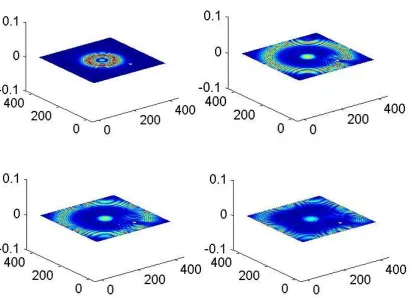
The main application of this thesis is to detect the damage on plate. The waves disperse outwards from the
actuator and propagate along the plate. As soon as the waves hit the damage they are reflected which can be
received and further analysis can be done. Here we shall see the pattern of the waves reflecting when damage is
689 | P a g e
Fig. 3.5 damage detection by waves propagated through the plate
IV. CONCLUSION
Thetriangular elements give more options for meshing in geometrically complex areas. Here in this thesis 3 set
of results are obtained. (1) Triangular element consisting of fekete points distributed in it for meshing purpose.
The displacement results obtained showed triangular elements are liable for meshing, as for isotropic media, the
spectral element method is known for its high degree of accuracy, its ability to handle complex model
geometries, and its low computational cost. (2) The waves propagated at frequency of 50 kHz can be clearly
seen dispersing along the plate which symbolizes the modeling of the plate is successful and can be applied to
detect damage.(3) The introduced damage was clearly detected by the dispersing lamb waves and reflected
which confirms the damage in the plate.The results clearly shows that this algorithm for modeling of triangular
element consisting of Fekete points distributed in it achieved through SEM can be used for propagation of lamb
waves through it and can be applied to detect damage.
The triangular element modeled can be remade using more number of points which results in higher accuracy
can be achieved. The element modeled can be used for meshing different shape of objects and propagation of
waves can be done in order to make sure triangular elements are better in geometrically complex areas. Lamb
waves of higher frequencies can be propagated in order to see better dispersion of curves and to propagate
waves to longer range.
690 | P a g e
1. Spectral element methods on triangles and quadrilaterals: comparisons and applications Richard Pasquetti,Francesca Rapetti * Laboaratory J.-A. Dieudonn_e, UMR CNRS 6621 and Universit_e de Nice-Sophia
Antipolis, ParcValrose, F-06108 Nice Cedex 02, France Received 13 October 2003; received in revised
form 15 January 2004; accepted 15 January 2004, Available online 21 February 2004
2. Wave propagation modelling in 1D structures using spectral finite elements P. Kudelaa,a, M. Krawczuka,
b, W. Ostachowicza, c, a. Institute of Fluid Flow Machinery, Polish Academy of Sciences, ul.
Fiszera 14, 80-952 Gdansk,Poland.b. Faculty of Electrical and Control Engineering, Technical University
of Gdansk, Narutowicza 11/12, 80-952 Gdansk, Poland. c. Gdynia Maritime University, Faculty of
Navigation, Al. Zjednoczenia 3, 81-345 Gdynia, Poland Received 16 September 2005, Revised 17 July
2006, Accepted 20 July 2006, Available online 28 September 2006
3. Wave propagation modelling in 1D structures using spectral finite elements P. Kudelaa, M. Krawczuka, b,
W. Ostachowicza, c,a. Institute of Fluid Flow Machinery, Polish Academy of Sciences, ul. Fiszera 14,
80-952 Gdansk, Poland b. Faculty of Electrical and Control Engineering, Technical University of Gdansk,
Narutowicza 11/12, 80-952 Gdansk, Poland c. Gdynia Maritime University, Faculty of Navigation, Al.
Zjednoczenia 3, 81-345 Gdynia, Poland Received 16 September 2005, Revised 17 July 2006, Accepted 20
July 2006, Available online 28 September 2006
4. Damage detection in composite materials using Lamb wave methods. Seth S Kessler1,3, S Mark
Spearing1 and Constantinos Soutis2Published 5 April 2002
5. Lamb wave mode decomposition for structural health monitoring. Ilwook Park, Yongju Jun, Usik Lee,
Department of Mechanical Engineering, Inha University, Incheon 402-751, South Korea. Received 24
January 2013, Revised 9 September 2013, Accepted 14 September 2013, Available online 9 October 2013
6. Stephen, Guided Lamb waves for identification of damage in composite structures: A review
7. A Diagonal Mass Matrix Triangular Spectral Element Method based on Cubature Points, F. X. Giraldo,
M.A. Taylor, Naval Research Laboratory, Monterey, CA 93943 zSandia National Laboratory, Albuquerque,
NM 87185
8. Guided waves in structures in SHM: the time domain spectral element method.W. Ostachowicz, P. Kudelaa,
M. Krawczuka, A Zak a. Institute of Fluid Flow Machinery, Polish Academy of Sciences, ul. Fiszera 14,
80-952 Gdansk, Poland b. Faculty of Electrical and Control Engineering, Technical University of Gdansk,
Narutowicza 11/12, 80-952 Gdansk, Poland