Firefly Algorithm Based SISO PID Controller
R.Sreeram1, P.Syed Ibrahim2, D.Sankaran3
Student, Dept. of EIE, St.Joseph College of Engineering, Chennai, Tamilnadu, India1&2
Assistant Professor, Dept. of EIE, St.Joseph College of Engineering, Chennai, Tamilnadu, India3
ABSTRACT: For the application of turning PID controllers for time delayed model with a specific stability analysis on the unstable phase of a Bio- reactor system, this paper proposes a detailed analysis of fire fly algorithm based PID controller. To find the best value of Kp, Ki and Kdand to compare the output of firefly algorithm with other types of
algorithm like PSO. After the analysis of PID controller response Kp,Ki,Kd values are fixed and find out which method is suitable for finding appropriate values for PID controller and Simulation results are displayed in this paper.
KEYWORDS: Firefly algorithm,PSO-Based PID Controller,BFO Algorithm, bio-reactor
I.INTRODUCTION
Despite important developments in advanced method management schemes like Model prognosticative management (MPC), Internal Model management (IMC), and slippery Mode management (SMC), PID controllers area unit still wide employed in industrial system wherever reference pursuit and disturbance rejection area unit a serious task. Proportional + Integral + spinoff (PID) controllers area unit wide utilized in industrial applications to produce optimum and strong performance for stable, unstable and non-linear processes. It may be simply implementable in analog or digital type. Further, it supports standardization and on-line retuning supported the performance demand of the method to be controlled. Open-loop unstable systems area unit principally discovered in chemical process industries and for economical and/or safety reasons, the activity loops to be operated in unstable steady state . For unstable systems, there exist a minimum and most values of controller gain, and the average of this limiting price is taken into account to style the controller to stabilize the system. the rise in time delay within the method narrows down the limiting price and it restricts the performance of the control system below control. additionally, these systems show uncommon overshoot or inverse response as a result of the presence of negative or positive zeros . The literature offers details regarding varied theoretical studies on fine standardisation of PID controllers for open loop unstable system . Most of the controller standardization approaches planned for unstable system might need an approximate initial or second order transfer perform model with delay. Further, for real time application, the model might not be promptly accessible in apply or is also ever-changing as a result of uncertainty . The model-based controller standardisation needs complex computations to spot the controller parameters. To overcome this, it's necessary to use soft computing based mostly model freelance controller auto-tuning strategies.
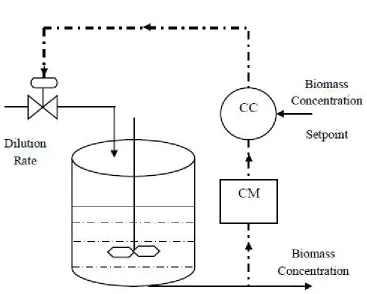
II. BIOCHEMICAL REACTOR
Fig. 1 Biochemical Reactor
III. CONTROLLER DESIGN 1. PID Controller
The flexibility and strength of the inflammatory disease controller makes it wide applied in several applications. The continuous management law of inflammatory isease controller is
Where e(t) is that the error signal between the setpoint and actual output, u(t) is that the controller output and Kp, Ki, Kd are the pelvic inflammatory disease controller gains. A basic pelvic inflammatory disease controller directly operates on the error signal and this could manufacture an outsized overshoot within the method response as a result of the proportional and spinoff kick The process is unstable and to beat the result of proportional and by-product kick, a modified inflammatory disease structure referred to as I-PD is taken into account . In I-PD structure, the integral term responds supported the error and also the P+D terms works supported the measured process output
2. Firefly Algorithm 2.1 Behaviour of Fireflies
of luminescence, and also he true functions of such sign systems square measure still debating. However, 2 basic functions of such flashes square measure to draw in mating partners (communication), and to draw in potential prey. additionally, flashing may additionally function a protecting warning mechanism. The syncopated flash, the rate of flashing and also the quantity of your time kind a part of the signal system that brings each sexes along. Females reply to a male’s distinctive pattern of flashing within the same species, whereas in some species like photuris, female fireflies will mimic the union flashing pattern of alternative species therefore on lure and eat the male fireflies World Health Organization could mistake the flashes as a possible appropriate mate. The flashing light-weight are often developed in such the simplest way that it's related to the objective operate to be optimized, that makes it potential to formulate new optimization algorithms. within the remainder of this paper, we'll initial define the fundamental formulation of the Firefly formula (FA) so discuss the implementation as well as analysis thoroughly.
2.2 Firefly Algorithm
Now we will idealize a number of the flashing characteristics of fireflies thus on develop firefly-inspired algorithms. For simplicity in describing our Firefly Algorithm (FA), we tend to currently use the subsequent 3 idealised rules: 1) all fireflies are androgynous so one firefly are going to be drawn to different fireflies despite their sex; 2) Attractiveness is proportional to their brightness, so for any 2 flashing fireflies, the less brighter one can move towards the brighter one. The attractiveness is proportional to the brightness and that they each decrease as their distance will increase. If there's no brighter one than a specific firefly, it will move randomly; 3) The brightness of a firefly is affected or determined by the landscape of the target operate. For a maximization downside, the brightness will merely be proportional to the worth of the target operate. Other forms of brightness may be outlined in a very similar thanks to the fitness operate in genetic formulas or the microorganism hunt algorithm (BFA).
In the firefly formula, there ar 2 vital issues: the variation of sunshine intensity and formulation of the attractiveness. For simplicity, we will invariably assume that the attractiveness of a firefly is set by its brightness that in turn is related to the encoded objective operate. In the simplest case for optimum improvement issues, the brightness I of a firefly at a selected location x is chosen as I(x) / f(x). However, the attractiveness is relative, it ought to be seen within the eyes of the person or judged by the opposite fireflies. Thus, it'll vary with the space rij between firefly i and firefly j. additionally, intensity level decreases with the space from its supply, and light-weight is additionally absorbed within the media, therefore we should always enable the attractiveness to vary with the degree of absorption. within the simplest kind, the light intensity I(r) varies consistent with the inverse sq. law I(r) = Is r2 where Is is that the intensity at the supply. For a given medium with a hard and fast lightweight absorption coefficient , the sunshine intensity I varies with the space r. That is
I = I0e−r
where I0 is the original light intensity.
As a firefly’s attractiveness is proportional to the sunshine intensity seen by adjacent fireflies, we are able to currently outline the attractiveness of a firefly by
β = β0e−r2
where β0 is the attractiveness at r = 0.
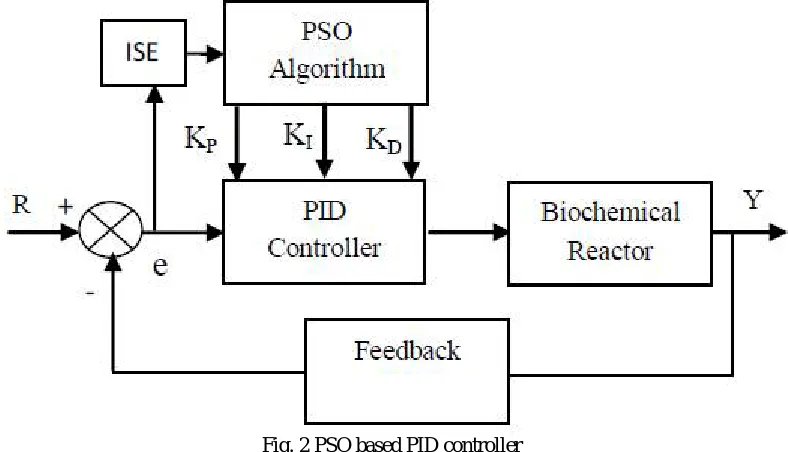
3. PSO-Based PID Controller Design
gbest . The updated velocity of every particle are often calculated victimisation the current velocity and therefore the distances from pbest and gbest.
Fig. 2 PSO based PID controller The mathematical expression for Velocity update
Vik - current velocity of particle i at iteration k, Vi(k+1) - updated velocity of particle i,
Wi - different inertia weight of particle i , C1, C2 - positive constants,
Sik - current position of particle i at inertia k, R1, R2 - random number between 0 and 1.
The new position will be changed mistreatment this position and updated swarm position is
Si
(k+1)= Si
k+ Vi
(k+1)The parameter Badger State is inertia weight that will increase the performance of PSO. The larger price of Badger State will favour higher ability for world search and lower price of Badger State implies the next ability
for native search. to realize a higher performance, the linearly reduced price of inertia is
W = W max –
Iter
x [(W max – W min) / (Iter max)]
Where Itermax is the maximum of iteration in evolution process, W max is maximum value of inertia weight , W min is
the minimum value of inertia weight, and Iteris current value of iteration.
4.
Bacterial Foraging Optimization algorithmThe BFO algorithmic program that mimics the on top of four mechanisms is gift Chemo taxis: Represents the step size of the bacterium
Swarming: Grouping of the microorganism that permits them to maneuver in a very concentric pattern.
Reproduction: Maintains the population in the swarm.
Elimination and Dispersal: The BFO formula makes some microorganism to urge eliminated
and distributed with chance to confirm that the microorganism don't get at bay into a neighborhood optimum rather than the world optima.
IV. SIMULATIONS AND RESULTS 1. fire fly algorithm
The stationary part of the bioreactor that has Associate in Nursing operation within the stable region, the simulations of the model that is devised within the MATLAB Simulink are coupled with the algorithmic rule and a nonstop iterations ar loped. the subsequent simulation results ar obtained for the hearth Fly algorithmic rule for the stationary part.
For the stationary section, the transfer operate of the bio-reactor as delineate higher than, a MATLAB based mostly simulation model is developed and every one the higher than mentioned algorithmic rules were enforced to unravel the improvement downside of that the hearth Fly (FF) algorithm established to be higher when put next with the opposite. attributable to house constraints we've got depicted the results of FF that is employed to get optimum values of Kp, Ki and Kd.
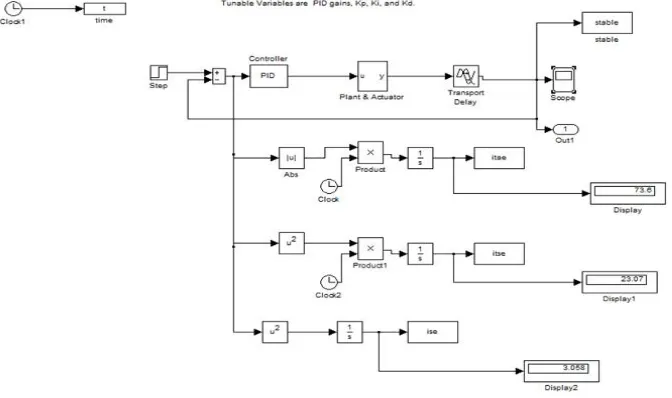
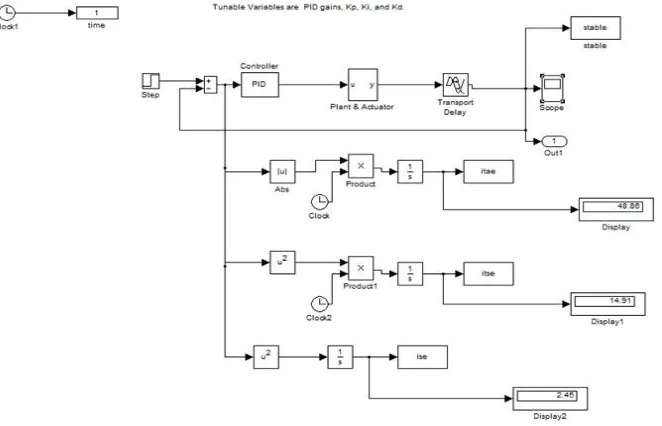
The simulation result of the fire fly algorithm is shown[4] and the output of the simulation are given as following fig.3 and Fig.4 .
Fig.4 output for firefly algorithm
2. PSO based algorithm
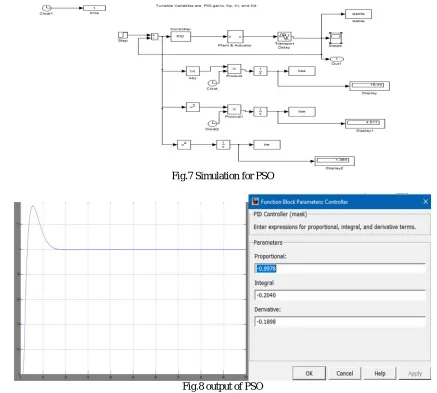
The stationary part of the bioreactor that has associate degree operation within the stable region, the simulations of the model that is devised within the MATLAB Simulink area unit joined with the formula and an eternal iterations area unit coiled. the subsequent simulation results area unit obtained for the PSO formula for the expansion part of the second order time delayed system. For the expansion part, the transfer operate of the bio-reactor as delineated on top of, a MATLAB based mostly simulation model is developed and every one the on top of mentioned formulas were enforced to unravel the optimisation drawback of that the PSO algorithm proved to be higher in comparison with the opposite. attributable to area constraints we've delineate the results of PSO solely that is employed to getoptimum values of Kp, Ki and Kd. in comparison with the opposite thought of algorithms.[1]
Fig. 6 Output for PSO algorithm
Based on the value in the reference [3] the simullation has been designed as shown in the Fig.7 and Fig.8 as follows
Fig.7 Simulation for PSO
V. CONCLUSION
Thus the kp, ki & kd values are determined by using firefly algorithm for a bio-reactor have been determined. The values obtained from firefly algorithm is compared with the other methods of algorithm. Placing appropriate values for PID controller will improve the response of system. These results are obtained from simulation and results are shown in above section. It will be simulated using MATLAB Software.
REFERENCES
[1] K. Latha,V. Rajinikanth, and P. M. Surekha,” PSO-Based PID Controller Design for a Class of Stable and Unstable Systems”, published in International Scholarly Research Network ,31 March 2013; Accepted 27 April 2013.
[2] V.Rajinikanth, K.Latha, Identification and Control of Unstable Biochemical Reactor,published in International Journal of Chemical Engineering and Applications, Vol. 1, No. 1, June 2010.
[3] Abhishek , Arul Ebenezer ,Stability Analysis And Design Of Algorithmic Tuned Pid Controller For Bio-reactor,published in International Journal of Research in Engineering and Technology
[4] Xin-She Yang, Firefly Algorithm, L´evy Flights and Global Optimization, Springer London, pp. 209-218 (2010). [5] A. O’Dwyer, Handbook of PI and PID Controller Tuning Rules, Imperial College Press, London, UK, 3rd edition, 2009.
[6] R. C. Panda, “Synthesis of PID controller for unstable and integrating processes,” Chemical Engineering Science, vol. 64,no. 12, pp. 2807–2816, 2009.
[7] M. A. Johnson and M. H. Moradi, PID Control: New Identification and Design Methods, chapter 2, Springer, London, UK, 2005. [8] R. Padmasree and M. Chidambaram, Control of Unstable Systems, Narosa Publishing House, New Delhi, India, 2006.
[9] B.W. Bequette, Process Control—Modeling, Design and Simulation, Prentice Hall, New Delhi, India, 2003.