OPTIMIZATION OF LEACH PROTOCOL IN
WIRELESS SENSOR NETWORK
S.Shanthi
1, K.Abirami
21
PG Scholar, Department of Electronics and Communication
Easwari Engineering College,Chennai, (India)
2Associate Professor, Department of Electronics and Communication
Easwari Engineering College,Chennai, (India)
ABSTRACT
Wireless sensor networks with thousands of tiny sensor nodes find wide-ranging applications and greater
deployment in the future, enabling reliable monitoring and analysis of the environment. In the proposed work, a
modification is made to a protocol known for sensor networks called Low Energy Adaptive Group Hierarchy
(LEACH, for its acronym in English) considering energy consumption. This is designed for sensor networks
where the end user remotely controls the environment. In this situation, the data of the individual nodes are sent
to a central base station, often located far from the sensor network, through which the end user can access the
data. The proposed MODLEACH protocol uses the random rotation of the cluster's local base stations, the
heads of the primary groups and the heads of the secondary groups. This allows a better distribution of the
energy load between the sensors of the network, especially when the density of the network is greater. LEACH
uses localized coordination to allow scalability and robustness.
Keywords-component; Low Energy Adaptive Clustering Hierarchy (LEACH), Modification of Low
Energy Adaptive Clustering Hierarchy (MODLEACH).
I. INTRODUCTION
The clustering routing protocol in WSN is to divide the network into many small areas, and each small area is regarded as a cluster. Each cluster consists of one cluster head and many non-cluster nodes(normal nodes) and many cluster heads make a higher level network, which can be divided into clusters again until there is only one node (sink node or base). Formation of clusters and selection of cluster heads is important task in clustering routing protocol. Cluster heads are responsible not only for collecting and integrating data, but also for sending the processed data among clusters or to the sink node or the base. Information collection, procession and transmission will consume much energy of cluster heads; hence their liability and stability will surely and greatly affect the network performance; while the formation of clusters is based on the energy of the node itself and the distance from the cluster head.
Data integration, which removes redundant data reduces the amount of sent data and therefore saves its energy. The function of nodes is very simple, and maintenance of complex routing information is not needed , thus lowering down the amount of network communication. In addition, the clustered network topology is simple and has many layers with better extensions. This function enables us to manage the network easily and make quick response to the system. LEACH protocol is the most typical and basic routing protocol in cluster based routing protocol.
A. CLUSTERING
Clustering is a fundamental problem that has been the focus of considerable researches in machine learning, pattern recognition and statistics. Clustering is an example of unsupervised learning which means there are no training samples from which to learn. Clustering automatically forms clusters of samples that all are closely related. Therefore, the similarities between those samples assigned to the same cluster tend to be bigger than those in different clusters. It is also called unsupervised classification, because it produces the same result as classification algorithms, but without having predefined classes. In a simple form, the goal of clustering algorithms is to take a dataset and find the distinct clusters that exist within it. Clustering is widely used algorithm in different areas such as psychology, business and retail, computational biology, social media network analysis, and etc. There are many types of clustering methods such as hierarchical, partitioning, grid and density based, each of which uses a different induction principle.
A general definition of clustering is organizing a group of objects that share similar characteristics. Clustering is an inductive learning task. It differs from classification by the lack of a predetermined target value to be predicted, which means that resulting clusters are not known before the execution of clustering algorithm. Clustering can be thought of as classification with autonomously discovered rather than predefined classes, which are based on similarity patterns identified in the data. The purpose of clustering is organizing data into clusters such that there is high intra-cluster and low inter-cluster similarity. The similarity of a cluster can be expressed by the distance function. Scalability, ability to deal with noisy data, ability to handle dynamic data and insensitivity to order of input records and high dimensionality are some of requirements for a clustering algorithm. The efficiency of a clustering algorithm is measured by its ability to find out some or all of the hidden patterns of data. A good clustering algorithm should be able to identify clusters irrespective of their shapes. Some typical reasons to perform clustering are finding internal structure of the data e.g. genes clustering; partitioning the data e.g. market segmentation.
B. HIERARCHICAL CLUSTERING
since the process of cluster hierarchy formation can be organized as a sequence of basic cluster merging or partitioning operations.
II. LEACH PROTOCOL IN WIRELESS SENSOR NETWORK
A. LEACH PROTOCOL
LEACH protocol refers to Low Energy Adaptive Clustering Hierarchy , which is designed as a routing protocol for Wireless Sensor Network. Generally speaking, there are three steps in cluster routing protocol: the generation of cluster heads, the formation of clusters and the communication among clusters. Hence, LEACH algorithm also includes these three steps, just merging the first two steps into one that is the establishment of clusters and the communication among clusters. Thus, LEACH protocol algorithm contains the set-up of clusters and stable data transmission.
As for the selection of cluster heads, LEACH adopts equal probability method, selecting cluster heads in a circle and random manner and distributing the energy of the whole network evenly on each node. Therefore, LEACH algorithm reduces the energy consumption, prolongs the lifetime of the network. The executive process of LEACH is periodical, and each period includes the establishment of clusters and data transmission, and period as a round. To conserve the energy, the duration of stable data transmission phrase is much longer than the time required for the establishment.
The specific process is as follows: During the set-up stage of clusters, nodes will generate a number randomly between 0 and 1(including 0 and 1). If the random number is smaller than the threshold T(n), then the node will be a cluster head in this round. The calculation method of T(n) is based on the following formula:
p
T(n
)={
_______________(1)
1-p[ rmod(1/p)], N € G
0 ,
otherwise
In the above formula, p represents the percentage of cluster nodes accounting in the total number of nodes, that is probability of nodes becoming cluster heads; r refers to the current number of rounds (periods), and N is the total number of nodes; G is the set of nodes that did not become cluster heads in the 1/p round. Nodes that selected as cluster heads then send the information that it is a cluster head to its neighbor nodes, and the remaining node will choose the cluster that it will join according to the strength of broadcast signal it receives and inform the related cluster head. After that, cluster heads create a TDMA, a timing gap created for each node in this cluster, and send this timing gap to them in form of broadcast.
Thus, each node can send data in its own timing gap, while in the other timing gap, the node will enter into a sleep state, hence saving energy. During the phrase of stable data transmission, member nodes (non-cluster nodes) in the cluster will transfer the monitored data to related cluster head in its given time gap. Stable transmission phrase can be divided into many frames and the length of each frame is decided by the number of nodes in the cluster. Data sent by each node in its own time gap is just a part of the frame. At the end of each round, cluster heads and clusters will be reelected, which need certain energy. To reduce the overhead of the system, duration of stable stage in each round is much longer that for the establishment of cluster. As for the cluster head, it always maintains communication status to receive the data from the nodes in its cluster at any time. Once received all data from its member nodes, then the cluster head will process the data such as data fusion to lower down the redundant data. Finally, the cluster head transmits the fused data to its own cluster head or the base node; as for non-cluster nodes, they send the data in its own time gap and during the other time, they turnoff their wireless communication module to conserve energy. Leach protocol takes into a number of assumptions:
i.All nodes can transmit with enough power to reach the base station if needed. Each node has computational power to support different MAC protocols
ii. Nodes always have data to send. Nodes located close to each other have correlated data
iii. All nodes begin with the same amount of energy capacity in each election round, assuming that being a CH consumes approximately the same amount of energy for each node.
B. ADVANTAGES AND DISADVANTAGES OF LEACH PROTOCOL
LEACH protocol adopts the method that selects cluster heads at random, which avoids the cluster head to be premature death due to the excessive consumption of energy and form the phenomenon of monitoring blind area. Besides, data fusion efficiently reduces the amount of data communication. Hence, compared with the general routing protocols and static routing protocols, LEACH protocol can prolong the lifetime of Wireless Sensor Network about 15%. A part from the advantages owned by cluster routing protocols. LEACH following advantages
a. LEACH protocol carries out data fusion during data transmission, which reduces the redundant data and conserves the energy.
b. LEACH protocol adopts the mechanism of MAC layer based on CDMA, effectively avoiding signal interference when transmitting data between clusters; while in the cluster, this protocol adopts the mechanism of MAC layer based on TDMA to avoid information conflict sent by nodes, making nodes to sleep when they are not in their own time gaps, so as to save energy.
c. LEACH protocol is proceeding at round. After each round, the protocol will reselect cluster nodes and form new clusters. Thus, each node in the network has the chance to be a cluster head, and the load of the whole network will evenly distribute on each node.
a. The selection of cluster heads is probability in LEACH protocol, and the remaining energy of a node into account. If a node with low energy is selected to be a cluster head, this will result in that collected data couldn’t be sent out.
b. With the time running, the value of T(n) will increase and the probability of the number generated by the nodes will increase too, so that more and more nodes to be cluster heads.
c. Cluster heads and clusters generated by LEACH protocol may not be even, leading to some nodes cannot join in the cluster, to be isolated nodes and waste the network resources. LEACH algorithm cannot address this problem well.
d. LEACH protocol didn’t consider the trust of the node when selecting cluster heads, which may result in some malicious nodes to be cluster heads thus distorting the data collected or sending false information.
C. IMPROVED LEACH ALGORITHM
LEACH protocol did not consider the residual energy of nodes when selecting cluster heads, which may lead to the nodes with very low energy to be cluster heads and premature death of clusters, affecting the lifetime of the whole network. The improved LEACH algorithm, use the same radio communication energy consumption model as used in LEACH protocol. This model consists of two parts transmitting energy consumption module and receiving energy consumption module. When sending data, nodes need to consume some energy, and its amplifier will consume some energy too; and when receiving data, nodes will consume energy too. Hence, total energy consumed is as the following formula:
E
total= E
send+ E
receiveAccording to the radio communication energy consumption model, when sending k bit data, sensor nodes will consume the below energy:
ETX (k,d) = ETX - elec(k) + ETX - amp (k,d)
= k X Eelec + k X ϵ fs X d 2
, d<do (2)
k X Eelec + k X ϵ amp X d4 , d>>do
The meaning of each symbol in the formula is as follows:
ETX(k,d): Energy consumed when sending k bit data by sensor nodes from d distance; ETx-elec(k): Energy consumed by transmitter distributor;
ETX - amp(k,d): Energy consumed by transmit power amplifier; K: The length of data package sent;
d:Data transmission distance;
Eelec: Energy consumed by radiating circuit when processing 1 bit data;
ϵ fs :Energy consumed by transmit power amplifier when sending 1 bit data to unit area in free space channel
model;
E
RX(k) = E
RX - elec(k) = k X E
elecThe meaning of each symbol in the formula is as follows: ERX - elec(k) : Energy consumed by the interface circuit; Eelec : Energy consumed by the interface circuit when processing 1 bit data;
The definition of d0 in formula (3) is as following:
d0 = (3)
The meaning of each symbol in the formula is as follows: E : energy consumed by transmission
h R : height of receiving antenna hr : height of transmit antenna
: wavelength
Put d0 into the formula (3), obtain its critical value:
d
0=
fs/
amp (4)(4.3)
When selecting cluster heads, LEACH protocol selects cluster heads according to the random number the node generates and the threshold, while the remaining energy into account, which may result in the node with low energy to be a cluster head, thus bringing premature death to clusters and affecting the lifetime of network. The introduce the remaining energy factor based on LEACH protocol, that is:
pi
T(i) = { ─────────────── (5) (4.4)
1-Pi × ( r × mod ( 1 / pi)) ,N G
0, otherwise
There into,
Pi = ( Ei ─ Er )2 ER (6)
Ei: Residual energy of each node in I round; Er : average energy of rest nodes in the I round; ER : total residual energy of rest nodes in the I round;
Calculating formula of average energy of rest nodes Er:
Er = ER × (1 ─ ri rmax) (7)
────────
ri : The current round
rmax : Maximum rounds of network simulation;
In the formula (6) and (7), if there is much residual energy of the node, then the value of Pi will increase, which demonstrates that this node has a high proportion of energy in the rest energy. With the increase of Pi , T (i) will increase too, thus the probability of this node being a cluster head is enlarged too. Therefore, considering the residual energy of nodes enable the nodes with higher remaining energy to be cluster heads, which can form an optimized cluster heads, avoiding premature death of the network lifetime and prolonging the network lifework.
III. SIMULATION AND RESULT
Improve LEACH algorithm, we have simulated and analyzed the LEACH protocol and improved LEACH protocol in terms of total data packages sent by nodes, network lifetime and energy consumption and made a comparison.
A. NETWORK SIMULATION ENVIRONMENT
network simulation environment, providing that 1) All nodes can communicate with sink node directly 2) All nodes do not have the feature of mobility
3) All nodes have the same and limited initial energy in the first round
4) Symmetric wireless channel, that is energy consumed from node 1 to node 2 equals the energy consumed from node 2 to node 1
5) The sink node has a fixed position, and has enough energy to supply, and has some distance from the network.
6) When the energy of node is 0, the node dies adopt C language to write programs and MATLAB to simulation. There are 100 nodes in the Wireless Sensor Network, deployed in the range 100 m x 100m randomly.
B. MODIFIED PROTOCOL FUNCTIONING
Therefore, the following modifications have been done in the
Low Energy Adaptive Clustering Hierarchy (LEACH) in order to improve efficiency and enhance network lifetime.For every round, protocol will check if energy of Cluster Head has fallen a defined threshold than it will undertake CH and cluster formation process. Else same CH will continue its operations.
1.In an adaptive clustering hierarchy, there can be three kinds of communications distances. i.Inter cluster
ii.Intra cluster
2.Basically,in MODLEACH, two modifications/enhancements are made. These enhancements are: a. Efficient cluster head replacement technique
b. Dual amplification power levels.
C. SIMULATION RESULTS AND COMPARISON
The parameters considered during simulation have their own significance for the better performances of the network. The important definitions in the WSNs related to this project are:
1.Packet delivery ratio
The ratio of number of packets sent from the source to the number of packets received at the destination. The greater the value of PDR means better performance of the protocol.
2.Network Lifetime
The time for the first node or a certain percentage of sensor nodes to run out of power or its time interval from the start of operation (of the sensor network) until the death of the first alive node.
3.Throughput
Average rate of successful packet delivery. The throughput is the most important parameter to analyze the performance of the network.
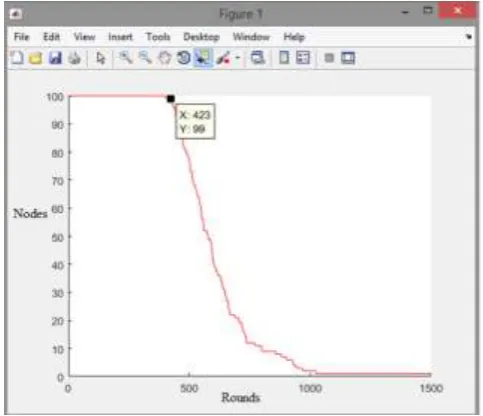
The following figure 1 is the data package comparison of leach protocol and its improved algorithm. From the figure 2, in the beginning, there is no much disparity about the amount of data package between the two protocols. However, with the time running, we found that the amount of data package sent by improved algorithm is gradually larger than that of LEACH protocol. Because the initial environment of nodes in both protocols are same, energy consumption of nodes isn’t large. But with the time by, the residual energy of nodes is varied.
Fig1.Reduction of energy during packet transformation
Fig 2. Increase of energy during packet transformation
IV. CONCLUSION
LEACH protocol is a typical routing algorithm in cluster based routing with many advantages but the residual energy of nodes in the selection of cluster heads which lead the premature death of clusters and waste network resource is not considered in the existing protocol. In the proposed MOD LEACH protocol , the energy of nodes and energy factor is considered during the selection of cluster heads thus avoiding nodes with low energy to be cluster heads. Simulation results show that the improved algorithm is superior to LEACH protocol in terms of network lifetime, stability, the amount of data package and energy utilization. There are few short comings in the algorithm such as the simulation environment needs to be too ideal and optimization of the selected cluster heads is trusted .
The proposed MODLEACH protocol can be implemented on Heterogeneous wireless sensor networks by considering sink mobility and to ensure successful delivery of data. The routing protocol can be modified if Cluster head expires before sending the data to the base station. Higher level of hierarchy and mobility can be included in the network.
REFERENCES
[1] R. C. Carrano, D. Passos, L. C. S. Magalhaes, and C. V. N. Albuquerque,``Survey and taxonomy of duty cycling mechanisms in wireless sensor networks,'' IEEE Commun. Surveys Tuts., vol. 16, no. 1, pp. 181_194, 1st Quart., 2014.
[2] Y. Zou, J. Zhu, L. Yang, Y.-C. Liang, and Y.-D. Yao, ``Securing physical- layer communications for cognitive radio networks,'' IEEE Commun.Mag., vol. 53, no. 9, pp. 48_54, Sep. 2015.
[3] Q. Wang, K. Xu, and K. Ren, ``Cooperative secret key generation from phase estimation in narrowband fading channels,'' IEEE J. Sel. Areas Commun., vol. 30, no. 9, pp. 1666_1674, Oct. 2012.
[4] A. D. Wyner, ``The wire-tap channel,'' Bell Syst. Tech. J., vol. 54, no. 8, pp. 1355_1387, Aug. 1975.
[5] Y. Zou, J. Zhu, X. Wang, and V. C. M. Leung, ``Improving physical-layermsecurity in wireless communications using diversity techniques,'' IEEE Netw., vol. 29, no. 1, pp. 42_48, Jan./Feb. 2015.
[6] A. Mukherjee, S. A. A. Fakoorian, J. Huang, and A. L. Swindlehurst,``Principles of physical layer security in multiuser wireless networks: A survey,'' IEEE Commun. Surveys Tuts., vol. 16, no. 3, pp. 1550_1573, 3rd Quart., 2014.
[7] A. Sendonaris, E. Erkip, and B. Aazhang, ``User cooperation diversity. Part I. System description,'' IEEE Trans. Commun., vol. 51, no. 11,pp. 1927_1938, Nov. 2003.
[8] Y. Zou, Y.-D. Yao, and B. Zheng, ``Opportunistic distributed space-time coding for decode-and-forward cooperation systems,'' IEEE Trans. Signal Process., vol. 60, no. 4, pp. 1766_1781, Apr. 2012.
[9] K. Islam, W. Shen, and X. Wang, ``Wireless sensor network reliability and security in factory automation: A survey,'' IEEE Trans. Syst., Man, Cybern. C, Appl. Rev., vol. 42, no. 6, pp. 1243_1256, Nov. 2012.
[11] A. Saifullah,Y. Xu, C. Lu, andY. Chen, ``End-to-end communication delay analysis in industrial wireless networks,'' IEEE Trans. Comput., vol. 64, no. 5, pp. 1361_1374, May 2015.
[12] K. Yu, J. Akerberg, M. Bjorkman, and M. Gidlund, ``Performance evalu-ations and measurements of the REALFLOW routing protocol in wireless industrial networks,'' IEEE Trans. Ind. Informat., to be published. [13] G. Li and D. Feng, ``Redundant cluster-based routing in wireless sensor networks,'' in Proc. WCICA,
2008,pp.1734_1737.
[14] J. Heo, J. Hong, and Y. Cho, ``EARQ: Energy aware routing for real-time and reliable communication in wireless industrial sensor networks,'' IEEE Trans Ind. Informat., vol. 5, no. 1, pp. 3_11, Feb. 2009.