1755 | P a g e
Effect of Polymer Concentration on the Interaction of
Mixed Micelles and Polymers
Paray Aijaz Ahmad
Department of chemistry,
University of Kashmir, Hazratbal, Srinagar J&K, (India)
A B S T R A C T
In this work we report the variation in the CAC (critical aggregation concentration) and CMC (critical micelle concentration) of Brij56+CTAB mixture with change in non-ionic semi-flexible polymer, hydroxypropylcellulose (HPC) using tensiometry,in aqueous medium. The tensiometric profiles of Brij56+CTAB mixture in the presence of HPC exhibit two breaks, one is at critical aggregation concentration (CAC) corresponding to onset of interaction of Brij56+CTAB with HPC and the second at C1 corresponding to
saturation of the polymere. The Brij56+CTAB show similar tensiometric profiles as shown by the individual surfactants with the same poymer. The CMC of Brij56+CTAB shows generally first increase with increase in polymer concentration and then shows decrease with further increase in polymer concentration. The change in the interactions of mixed micelles with polymers can be used to modify the properties of solutions for various industrial uses.
Keywords-Brij56, CTAB, CAC, CMC,
I. INTRODUCTION
The study of Polymer-Surfactant interactions [1,2]in aqueous solutions are becoming more and more important
due to their widespread applications in industries. The mixed micelles are considered to be more versatile than
single surfactants in view of their wide industrial applications and hence the evaluation of their physiochemical
properties has recently attracted a lot of attention. Most of the work on such properties of binary surfactant
systems has been focused in pure water only[3-6].
Mixed micelles are often used in technical, pharmaceutical and biological fields, since they work better than
pure micelles [7,8]. They have importance in industrial preparation, pharmaceutical and medicinal formulation,
enhanced oil recovery process, and so forth, by way of efficient solubilization, suspension, dispersion, and
transportation influenced by temperature, pressure, pH, nature of solvent, additives etc [9].
The binding of surfactant micelles to a flexible/semi-flexible non-ionic polymer has been demonstrated to
cause characteristic changes in the hydrodynamic properties of the polymer solution hence make them fit for
1756 | P a g e
II. MATERIALS AND METHOD
The cationic amphiphile cetyltrimethylammonium bromide CTAB used was a Sigma product. The non ionic
amphiphile polyoxyethylene(10)cetyl ether (Brij-56) surfactant was received from Fluka, and hydroxypropylcellulose
(HPC) was from Aldrich. All products were used as received. Stock solutions of Brij-56 and CTAB were prepared at
concentrations of 15mM and 25mM respectively. In case of hydroxypropylcellulose (HPC) a 0.5% stock solution
was prepared. The stock solutions were utilized to prepare the samples of various concentrations. All solutions were
prepared in triple distilled water and polymer solutions were prepared in weight by volume percentage.
III. DETERMINATION OF CMC AND CAC
The CMC and CAC values of surfactant solution were determined from the plot of surface tension (γ) vs.
logarithm of surfactant concentration (log Ct) as shown in Fig. 3.1. Surface tension measurements were made by
the ring detachment method using a Kruss-9 (Germany) tensiometer equipped with a thermostable vessel holder
that holds the vessel containing the experimental solution. Water at constant temperature from a thermostatic
circulatory bath is circulated through the double walled vessel holder to maintain the experimental solution at
constant temperature. 30 ml polymer solution was placed in the sample vessel and constant temperature water from
the thermostatic bath circulated into the vessel holder for 10 minutes to allow the sample to acquire the set
temperature. Surfactant mixture concentration was varied by adding with a Hamilton microsyringe small
instalments of the concentrated stock solution of known surfactant mixture concentration, not to affect the
concentration of the polymer in the sample vessel. Measurements were made after thorough mixing and
temperature equilibration at 25oC (±0.1oC) by circulating water from a thermostat through the vessel holder.
3.1 Surfactant-Polymer Interactions
3.1.1 Polymer with Binary Surfactant mixture Systems
Fig. 3.1 show the variation of surface tension of Brij56 + CTAB solution with surfactant mixture concentration
in presence of polymer (HPC). Two break points are prominent in tensiometric plots. The lower concentration
break corresponds to critical aggregation concentration (CAC) marking the start of formation of polymer-bound
micelles while the higher concentration break, C1 corresponds to the concentration at which saturation of polymer by the bound micelles occurs (also known as polymer saturation point, psp) and hence marks the
1757 | P a g e
-3.5 -3.0 -2.5 -2.0 -1.5 -1.0 -0.5 41
42 43 44 45 46 47 48 49 50
(m
N/
m
)
Log [Brij56+CTAB(mM)]
Brij56+CTAB [ 1:1 ratio ]
(a)
Figure 3.1: Plots of surface tension vs logarithm of surfactant concentration for binary Brij56 & CTAB
systems at [1:1] mole fractions in presence of 0.01% HPC.
γ remains almost constant signifying that Brij56 + CTAB cannot interact with the HPC adsorbed at the
air/solution interface. Therefore, CAC signifies the onset of interaction/displacement at the air/solution
interface. Above the CAC, γ decreases until the interface is saturated or the displacement process is complete to
yield C1. Decrease in γ can either be due to specific binding of Brij56 + CTAB with HPC, thereby increasing its hydrophobicity. Constancy in γ up to the CAC suggests the absence of specific interactions between Brij56 +
CTAB and HPC.
Further competitive adsorption not only depends on the nature of the surfactant mixture, but also on the
concentration of the surfactant mixture in the bulk [11]. This is because at low concentrations, the surface
activity of Brij56 + CTAB is lower than the surface activity of HPC, but above the CAC their surface activity
becomes higher than that of the polymer (Fig. 3.1), and hence are preferentially adsorbed at the interface. Below
1758 | P a g e
Table 3.1: Variation of CAC and CMC of binary Brij56+CTAB systems with polymer concentration.S. No.
Mole fraction
of Brij56 in the
mixture of
Brij56+CTAB
0.0%
HPC
0.01 % HPC
0.03% HPC
0.05% HPC
CMC
(mM)
CAC
(mM)
CMC
(mM)
CAC
(mM)
CMC
(mM)
CAC
(mM)
CMC
(mM)
1
0.1
0.095
0.102
0.838
0.116
1.199
0.104
0.436
2
0.3
0.038
0.028
0.073
0.0361
0.1513
0.060
0.134
3
0.5
0.017
0.016
0.080
0.006
0.038
0.017
0.086
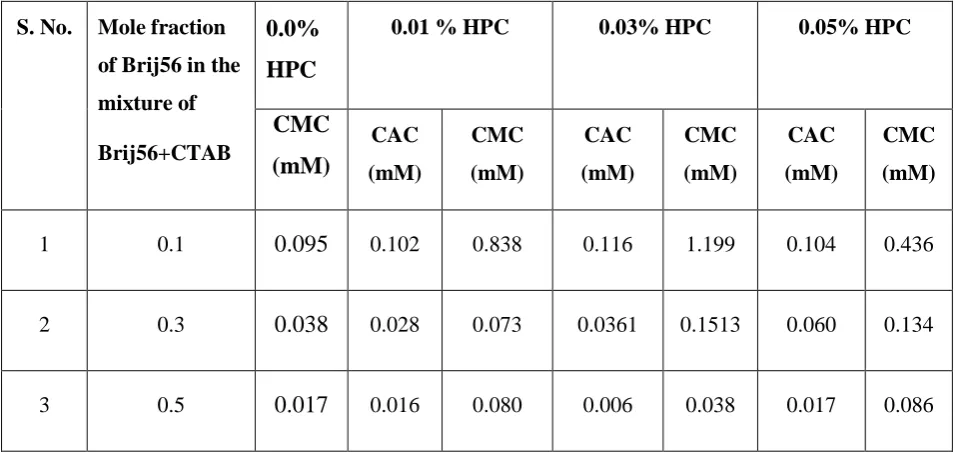
The CAC and CMC data of binary surfactant mixture + polymer systems are collected in Table 3.1. As seen by
comparison, the CMC of Brij56 + CTAB gets increased in presence of the polymer (HPC), this is probably
because in presence of polymer HPC, some Brij56 + CTAB concentration is used to saturate the polymer but
further increase in polymer concentration leads to decrease in CMC of Brij56 + CTAB mixture probably due to
decrease in surface area of polymers because of their aggregation.
IV.CONCLUSIONS
At lower surfactant mixture concentrations, Hydroxypropylcellulose predominantly occupies the surface,
indicating higher surface activity of the polymer.
The CMC of Brij56 + CTAB in presence of HPC is more compared to value obtained for the said surfactant
mixture in the absence of polymer when same surfactant mixture ratio is considered.
This study is expected to help us in understanding protein- surfactant interactions.
REFERENCES
[1] Goddard, E.D., Polymer Surfactant Interactions part 1st. Uncharged Water Soluble Polymer and Charged Surfactants, Colloids Surf. 1986, 19, 255.
1759 | P a g e
[3] Holland, P.; and Rubingh, D. Cationic Surfactants in Mixed Surfactant, Systems, in “Cationic Surfactants,”Holland, P.; and Rubingh, D. (Eds) Marcel Dekker, New York, 1991, vol. 37, chapter 4.
[4] Motomura, K.; and Aratono, M. Miscibility in Binary Mixtures of Surfactants, in “Mixed Surfactants Systems,” Ogino, K. and Abe, M. (Eds.) Marcel Dekker, Inc., New York, 1993, p. 100.
[5] Jonson, B.; Lindman, B.; Holmberg, K.; Kornberg, B. Surfactants and Polymers in Aqueous Solutions, John Wiley, 1998.
[6] Rubingh, D. N., Mixed Micelle Solutions, in “Solution Chemistry of Surfactants,” Mittal, K. L. (Ed.) Plenum, New York, 1979, vol. 1, p. 337.
[7] Scamehorn, J. F. in “Phenomena in Mixed Surfactant Systems,” Scamehorn, J. F., (Ed.); ACS Symposium Series 311; American Chemical Society: Washington, DC, 1989, p. 1.
[8] Holland P. M. in “Mixed Surfactant Systems;” Holland P.M. Rubing, D.N., (Eds.); ACS Symposium Series 501; American Chemical Society: Washington, DC, 1992, p. 31.
[9] Hill, R. M. in “Mixed Surfactant Systems;” Ogino, K.; Abe, M.; Eds.; Surfactant Science Series 46; Dekker: New York, 1993; Chapter 11.
[10] Mir, M. A.; Dar, A. A.; Amin, A.; Rather, G. M. J. Molecular Liquids2009, 150, 86.
[11] Mir, M. A.; Gull, N.; Khan, J. M.; Khan, R. H.; Dar, A. A.; Rather, G.
![Figure 3.1: Plots of surface tension vs logarithm of surfactant concentration for binary Brij56 & CTAB systems at [1:1] mole fractions in presence of 0.01% HPC](https://thumb-us.123doks.com/thumbv2/123dok_us/7784564.1287306/3.595.166.430.123.365/figure-surface-tension-logarithm-surfactant-concentration-fractions-presence.webp)