1877 | P a g e
INQUIRY BASED E-LEARNING SYSTEM USING
PERSONALIZED KNOWLEDGE SEARCH
Prof P Jayalakshmi
1, Prof M N Rajaprabha
2,
Prof R Vijay Anand
3, Prof K Venkatesan
4 1School of Information Technology & Engineering,VIT(India)
2School of Information Technology & Engineering,VIT(India)
3School of Information Technology & Engineering, VIT (India)
4Department of Engineering, Ibra College of Technology,(Sultanate of Oman)
ABSTRACT
E-learning refers to the use of technology in learning and education which includes different types of media that deliver animation, text, audio, video and so on. E-learning has revolutionized the traditional learning process to a technology based educational approach. Having known the advantages of e-learning, we still face problems due to insufficient personalization of the searching process. In order to overcome this limitation, in this paper, we propose an idea of ‘inquiry based e-learning system’ to support efficient use of resources. Through this, instant assistance and personalized learning environment can be attained which in turn enhances the learner’s learning interests and satisfy their requirements to the best.
Keywords used:E-Learning, Inquiry-Based Learning, Personalized Knowledge Search, Data
Mining.
I INTRODUCTION
Personalized knowledge search is used to make a new dimension to Internet searching and the search process.
The search must be what the user wish and not what user types. To know the process of search complexity, we
observed the vocabulary contradiction and mismatch problem existence during retrieval .A mismatch happens
only if the terms not present during the fetch. Many techniques have been proposed where all did not find an
alternate process. Hence we have proposed a technique called personalized search which overcomes the cited
shortcomings[3].
These features help an individual to retrieve and access his required information in a personalized manner. For
which we use the following modules like login module, look for module, personalized retrieval module,
monitoring module and feedback module. These modules are capable of providing optimized, authentic and user
1878 | P a g e
II LITERATURE REVIEW
Wang chunzhi and li qianqian[1] have proposed a work on “Study of the E-learning system based on the personalized knowledge search”. The aim of this paper is to attain the personalized knowledge search in the
E-learning systems. This paper emphasize the necessity for achieving the personal knowledge feature in E-E-learning
techniques because whenever the user enter his search text, the optimal result is not obtained due to the linear
models in which the information is isolated and duplicated[10]. This is solved by using ontology technique with
nutch search engine thereby improves the semantic study and the expected outcome [11].
Ji-Wei Wu, Judy C.R and Wen-Nung[2] have proposed a work on “A knowledge exploration assistant system for
inquiry based learning”. In this paper the authors have proposed a system that helps the students by providing
the suitable information materials and the proficient knowledge search while learning which removes the
students to view the irrelevant information from more websites by them [12]. The modules used in this paper likeweb search module, Q&A module and SSM modules are used to retrieve the search information from the
web search component and based on the search history [13]. With some datasets, after the learning process, examination is conducted to three groups of students [14] [15]. ANOVA is been used to find the significant difference between the students. It is proved that the student‟s learning realization is enlarged.
III PERSONALIZED KNOWLEDGE SEARCH
It is essential to achieve the personalized search in order to increase the learner‟s learning efficiency [7]
. When
the user enters his search text, only the relevant and expected data should be fetched rather than all possible
interest-related information. Consider the user types „Scripting language‟, the appropriate data should be
retrieved which includes all the scripting languages. Personalized search is intended to meet the individual
interest of their need. But sometimes the keywords are ignored which leads to the inferior results
The information can be climbed from the Internet and it generates grab list, parses the link and the updates the
links in the web-databases. This process is generally termed as crawling. Initially the data is converted to plain
texts, it preprocesses the text and the resultant data is stored in some index for future references. The queries of
users are parsed and invoked through user interface, by notch bean. If the notch runs on a server information is
transmitted to a Lucerne query. List of links from Lucerne helps to retrieve the result [1].
In general, the phrases that are shown to the users are fetched from thesauri or from the pre-defined documents
from the search results. If the searchers does not made available with key terms, theprobability of reaching the
results will be very low [8].
The behavior of the search engines is merely for learning, entertainment or to transmit the business transactions.
Although search engines have reached its success recently, it is still poor in helping a people to find exactly
what he needs. In some circumstances the user does not know exactly what he needs, in such cases search
engines cannot effectively help. But the model search engines are convenient which tries to get the best match
expected by the user and from the search index. Still it will not have complete knowledge of the text which will
1879 | P a g e
To make search process to be productive, the semantics are extracted from the search text. The questions are to
be developed in many ways like why type, yes or no type, some that deals with asking the opinion for particular
issue and interactive session can be useful in sharing and translating the information. Such things can make the
user more interested towards the search. So the observation of semantic relations is very important for better
search results [6].
For instance, the similarity between two words w1, w2 is measured by assigning values to it [4]. If the two
given words are from the same sense the value is assigned to 1. And weight of the word will be assigned to 0. In
contradiction, if there is no similarity between the given words, the total contradiction is set to 1. If both the
words partially contributed, then the semantic length will be 1. When the path length steps to 0, the sentence
similarity would be increased and vice-versa.
IV KNOWLEDGE DISCOVERY AND DATA MINING
Knowledge discovery is a process for identifying the new, valid, useful and understandable pattern in data. Data
mining is one of the steps involved in knowledge discovery process that searches patterns of interest of certain
representation.Data mining is the process of analyzing the data from various viewpoints and organizing them
into meaningful information.Ontology in data mining is defined as the (meta) data schemas, providing a vocabulary of concepts, with an explicitly defined and machine processable semantics. This is classified into
four types, upper (or top level) ontologies, domain ontologies, task ontologies, and application ontologies.
Ontologies sort out the domain knowledge and play an important role in the knowledge discovery process. It
codifies the mining process description and chooses the most appropriate task for the problem.
We use associative rule learning in the mining process. It is a method used for finding remarkable relations between variables in large size databases. It is proposed to recognize strong rules discovered in databases by
different measures. Association rules are used for discovering regularities between certain data. For
example, {c, c++} java, this rule indicates that if a student searches about c and c++, he is likely to search for
the java course also.We have used Apriori algorithm to generate associative rules which is the best-known
algorithm to find association rules. It uses a hash tree structure and breadth-first search strategy to count
candidate item sets efficiently. It generates candidate item sets of length k from item sets of length k-1.In order
to achieve the cited algorithm and techniques we adopt a framework called “ARIPSO” that is, Association Rule
1880 | P a g e
Fig. 1. Framework
The framework consists of two main parts, the knowledge base and post-processing.
Domain knowledge provides an outlook over the user expectations and prior user knowledge using rules.
The post-processing is used for performing a set of filters over the rules like pruning filters, minimum
improvement constraint filter and item-relatedness filter.
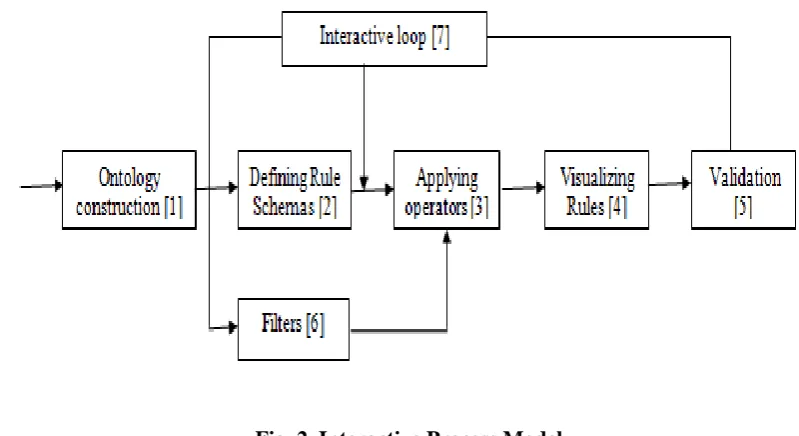
The working of Interactive Process as shown in the figure below,
1881 | P a g e
The following steps are being carried out,
A) Ontology construction
In this phase, initiating from the original database, and in the long run from the existing ontologies, the user
extends ontology on the database items. Ontology includes the features of taxonomies. Taxonomy is a
hierarchical categorization of items in a domain. On the other hand, ontology is a specification of several
characteristics of a domain, defined by an open vocabulary. In order to improve association rule selection, a rule
filtering model called the Rule Schemas is used (RS). It expresses that the user expects certain elements to be
related in the extracted association rules.
B) Ontology description
The user information of the database called the domain knowledge is described using ontologies. It offers a “is-a” relation subjected in taxonomy with the axioms that significant improvements that enhances the description
in the ontology.
C) Operations on Rule Schemas (RS)
Rule schema is applied by using three major operators pruning, conforming and unexpectedness. In pruning the
user can remove irrelevant rules. When this operator is applied over the rule scheme, it eliminates the
association rules over rule scheme. The conforming operator extracts the association rules matching the rules.
The unexpectedness operator drives theuser to discover new knowledge with respect to his his/her previous
knowledge.
D) Filters
To reduce the number of rules, filters are used. Three filters are framed namely minimum improvement
constraint filter, item relatedness filter and operators applied over rule schemas. The minimum improvement
constraint filter picks only the rules whose confidence is greater than any of its simplifications. Item relatedness
filter is used to find the association between item sets of different functionality from different domains. It
computes the minimum distance between the consequent items and condition items.
V OUR IDEA
The previous work [16] deals with supermarket items. We are going to apply the same ARIPSO framework to two
set of items. One is registered courses database and another one is user's personal search history.Also we have
classified the courses into the following categories - programming languages, scripting, tools etc so that we can
apply the algorithm easily.For instance,
In course registration database, the following transactions are carried out,
User1 {C, C++, VB}
User2 {VB, MATLAB}
1882 | P a g e
User4 {C, C++, JAVA}In the users‟ search history, when a user searches for „C‟ for the first time, our algorithm will generate the
following suggestions,
Initially, History1 {ϕ} Search („C‟) {“C, C++”}
When the same user performs a search for “VB” the second time, our algorithm will generate the following
suggestions,
History1 {“C, C++”}
Search („VB‟) {“C, C++, JAVA, VB”}
These suggestions are generated due to the recorded entries of the previous searches performed by the users, in
the history database.
VI MODULES
A) Student module
In student module, the student can log-in through his user name and password. Only registered students are
allowed to log-in. The registered users can login by providing their account information like user name and
password which is shown in Fig. 5. Each of these fields is validated.In addition to it, the administrator is
allowed to block a particular student. Any new users are given access only on the administrator‟s authorization.
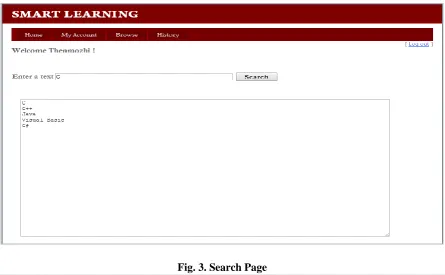
The student can register any courses that he wishes. He can also search his study materials of all faculties. He is
allowed to type a search text and on submitting the request as shown in Fig. 3, he is presented with his search
related information along with the web related search results.
1883 | P a g e
The personalized retrieval process has three components namely, registered courses, all courses and new
courses. The registered courses have the list of courses the user had registered. All courses consist of the list of
all courses available. In register course the user can register any course the he wishes.He is allowed to post the
feedbacks which can be viewed by both the faculty and the Administrator.
B) Faculty module
In Faculty module, each Faculty can login by providing their security information like user name and password,
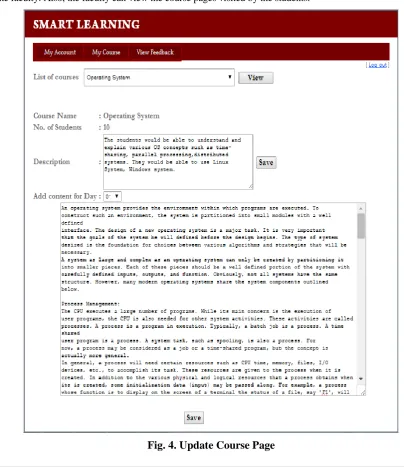
which are validated, as in Fig. 5.The faculty can edit or update the content of his courses on a daily basis as in
Fig. 4. The Faculty can also view their feedbacks given by the students. But the feedbacks are kept anonymous
to the faculty. Also, the faculty can view the course pages visited by the students.
1884 | P a g e
C) Administrator module
In Administrator module, the authorized administrator can log-in by supplying his credentials. Figure 5 shows
the log – in page.
Fig. 5. Login Page
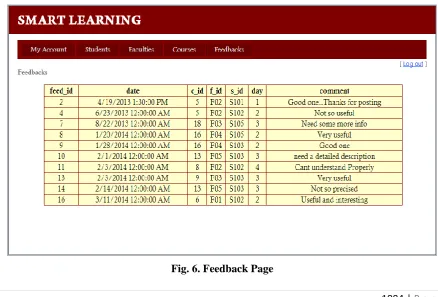
He controls all the activities of the students, faculty and manages the courses that they take up. He has the
privilege to block any student from accessing. In addition to it, he can view the feedbacks posted by the
students. Figure 6 shows the posted feedbacks.
1885 | P a g e
VII CONCLUSION AND FUTURE WORK
Our idea of E-Learning system is user-friendly and provides the most efficient learning environment. The users
are provided with greater flexibility, accuracy in data retrieval and authenticity. This helps the users to enjoy the
learning process in their own way. Also by implementing personalized search and inquiry based learning
features the e-learning system is able to achieve great heights in terms of user-perspective satisfaction and ease.
Also, as a future enhancement we can also implement video tutorials in the existing system which further
supports the learning process. In addition to it, an option for downloading the course materials can also be
implemented.
REFERENCES
[1] Wang chunzhi and li qianqian “Study of the E-Iearning System Based On the Personalized Knowledge Search”, The 8th International Conference on Computer Science &Education , Sri Lanka (ICCSE 2013)
April 26-28, 2013.
[2] Ji-Wei Wu, Judy C.R and Wen-Nung, “A knowledge exploration assistant system for inquiry based
learning”, IEEE, ISBN: 978-1-4673-5094-5/13/$31.00, 2013
[3] G. J. Hwang, P. S. Tsai, C. C. Tsai, and J. C. R. Tseng, “A novel approach for assisting teachers in
analyzing student web searching behaviors,” Computers & Education, vol. 51, no. 2, pp. 928-938, 2008.
[4] Y. Li, D. McLean, Z. Bandar, J. O'Shea, K. and Crockett, “Sentence similarity based on semantic nets and
corpus statistics”. IEEE Trans. Knowledge and Data Eng. 2006, 18:8.
[5] ZHOU Fa-guo, YANG Bing-ru, “New method for sentence similarity computing and its application in
question answering system”, Computer Engineering and Applications. 2008(01):165-178.
[6] E. Agirre, E. Alfonseca, K. Hall, J. Kravalova, M. Pasca, and A. Soroa, “A Study on Similarity and
Relatedness Using Distributional and WordNet-Based Approaches,” Proc. Human Language Technologies:
The 2009 Ann. Conf. North Am. Chapter of the Assoc. for Computational Linguistics (NAACL-HLT ‟09),
2009.
[7] Kang Wen-ning, Yang Zhi-iang, “Research and Application of Sentence Similarity Measurement in
Intelligent Answering System”, Computer Technology and Development. 2010(02):71-74.
[8] A Budanitsky and G Hirst, “Evaluating WordNet-based measures of semantic distance”, Computational
Linguistics, 2006, 32(1).
[9] QinQin Cui, “System developing and designing based on the Personalized Knowledge Search”, B.lTU,
2011
[10] Zhiran, Liu, “Personalized Knowledge Search based on the ontology indexing”, JiangSu University, 2010.
[11] Fuchun Peng , Nawaaz Ahmed , Xin Li , Yumao Lu, “Context sensitive stemming for web search”,
Proceedings of the 30th annual international ACM SIGIR conference on Research and development in
information retrieval, July 23-27, 2007, Amsterdam, The Netherlands
[12] M. Pedaste and T. Sarapuu, “Developing an effective support system for inquiry learning in a web-based
1886 | P a g e
[13] J. W. Wu, J. C. R. Tseng, and W. N. Tsai, “An efficient linear text segmentation algorithm using hierarchical agglomerative clustering”, 7th International Conference on Computational Intelligence and
Security, 2011, pp. 1081-1085.
[14] C. K. Chiou, G. J. Hwang, and J. C. R. Tseng, “An auto-scoring mechanism for evaluating problem-solving