Hybrid Feature Description with Probabilistic
Neural Network for Adaptive Face
Recognition with Angular Variance
Priya Thakur1, Rimanpal Kaur2
M.Tech Research Scholar, Department of CSE, CGCTC, Jhanjeri, Mohali, Punjab, India1 Assistant Professor, Department of CSE, CGCTC, Jhanjeri, Mohali, Punjab, India2
ABSTRACT: The features descriptors describe the data from the images in the form of the low level features, color based features, matrix quality or matrix representation thresholds, texture based feature or binary features over the input face database. The low-level feature descriptor has been utilized in the proposed model along with the Zernike Moments algorithm for the purpose of feature description. The Zernike moments feature has been used for the purpose of angular shift of the face samples in the input dataset. The Zernike moments describes the features by performing the evaluation over the given dataset in the form of angular shift of the face object in the horizontal and vertical domains. Also the low level features have been described over the input dataset to extract the important key points in the given image set. The fast retina key points (FREAK) over speeded up robust features (SURF) has been performed to obtain the low level features, which is further processed using the neural network for the feature classification and to produce the person recognition decision. The various experiments have been conducted over the input dataset and the results have been obtained in the various forms of statistical accuracy measures. The proposed model has been found efficient than the existing model in the terms of detection accuracy, which justifies the high performance of the proposed model in analysing and recognizing the faces.
KEYWORDS: Feature Descriptor, Speeded up robust features, Face Recognition, Neural network
.
I. INTRODUCTION
In Image Processing, Face recognition is the fundamental feature to acknowledge completely different individual’s. When there was not any system for face recognition, it was done by humans because at that time, a person was introduced to limited number of individual’s .Now a days a person comes in contact with many more number of individuals due to increased mobility facilitated by new modes of transport [2].so it has become difficult to recognize all new faces. Hence there arose the need to find some system to recognize right individual. Early Chinese used fingerprints in business transactions to recognize humans.
Face detection Methods:Face detection is a computer technology that automatically determines the locations and size of human in digital pictures [1] .It perceives facial components and overlooks whatever else, for example, structures trees and bodies. Face detection is a popular feature used in biometrics, digital cameras and social tagging. There are various types of face detection is available such as skin color model, Viola Jones algorithm etc.
Skin color model for face Detection: Skin color model is employed to detect the skin region of the different images. This model has been divided into three namely RGB color space, YCbCr color model and HSV color model [4]. RGB color space: RGB color model has all colors that can be had by using primary colors-Red, Blue and Green. Its form is like a three dimensional cube with these colors. This is made use of by most of computer graphics. This color model is not fully successful in a number of image processing algorithms[3][4].
weighted sum of RGB. By subtracting a reference from the blue component Cb can be computed. Similarly by minus a reference value from the red component can be determined.
“rgb2YCbCr” and “Ycbcr2rgb” are MATLAB functions for the transformations used during implementation [3].
HSV Color Space:HSV Color Space rests upon three color components. The color defining component is H, the hue component. S is the second component called saturation component and this component defines how pure the color is. The third component V. This color space is in the form of 3-dimensional hexacone. On a circular scale the value of H varies from 0 to 1.S also varies from 0 to 1. If the color purity is cent percent.it is represented by 1. Similarly the Values of V can change from o to 1.“rgb2hsv” and “hsv2rgb” are MATLAB functions for the transformations used during implementation.
II. RELATED WORK
III. EXPERIMENTAL DESIGN
The Zernike moments algorithm has been utilized for the detection and analysis of the position shift of the given object in the given image containing the face images. The multi-level polynomial values have been calculated under this simulation in order to recognize the face on the basis of the radial polynomial features. The Zernike moments over the given 2-D plane works on the basis of summation of the procedural computation for the object position analysis. The following equation defines the radial polynomial calculation over the input image:
Where c is the variance calculated with the polynomial vectors, whereas n givens the radial degree and m gives the azimuth degree. The c is calculated with the following equation:
(2)
Where n denotes the order of polynomial and the m denotes the order to repetition in the given equation. The value of n is always taken as the non-negative values which can be contain the zero. The primary conditions of the (n-|m|) and (|m|<=n) are tested in this simulation. The tested radial polynomials when satisfies the latter conditions, the repetitive index is returned and the value is returned to the user with the orthogonal properties calculated in the procedure.
Fast Retina Key Points:The fast retina key points (FREAK) method determines the binary features from the input image which are further utilized to calculate the similarity between the testing image and the training image.
FREAK is an important binary feature descriptor which can be applied over the hessian of Gaussians or overall difference of Gaussians. The FREAK is the major feature descriptor for binary feature based classification to compute the visual distance based upon the probabilistic or non-probabilistic classification:
Where the target image is given by f and the visual features are given by t. The object position are given as the (u, v) and the summation of the similarity between the two images is defined as (x, y).
IV. PROPOSED ALGORITHM
Proposed Face Recognition Model
The Proposed Methodology and flow chart of new face detection and Recognition system has described below:
Algorithm: Proposed Face Recognition Model
The steps of proposed algorithm of face detection and Recognition has following below:
Load the image into run time memory.
Acquire the image in the face detection program.
Apply the pixel by pixel evaluation by slide window fashion and to recognize the similar pixel regions.
To shortlist the similar pixel regions in the given image after the pixel by pixel evaluation and matching.
Measure and mark the areas containing the similar pixel regions.
To extract the face region from the marked regions and obtain the FREAK features from the input file
Pass on the extract feature to the recognized algorithm.
Acquire the image containing the extracted face region (ROI).
Test and Training image pre-processing.
Face features extraction in the form of angle/degree of face and length and width of phase
Apply correlation algorithm on the testing and training features.
Apply fuzzy-logic to short-list the matching training samples according to the face feature extraction and matching.
Apply pattern based neural network.
a. Create the feed forward network of the neurons.
b. Start the neural network training over the input training data.
c. Compute the template similarity using the neural network.
Compute the maximum matching sample and return in the decision logic.
V. RESULTS ANALYSIS
Elapsed Time: is defined as measurement of time completing an activity, duty or task. In other words, it is defined as difference between the finishing time and the starting time of the neural network.
Elapsed Time =Finishing Time –Starting Time.
Fig1:shows elapsed time graph of neural network. X-axes represent no of transactions and y-axes represent time in seconds. This graph shows two lines blue and red. Blue line show elapsed time of neural network .Red line represents mean time (average time) of elapsed time of the neural network. Some point of elapsed time is greater than average time of neural network and some point of elapsed time is below the average time of neural network.
Angular based accuracy of system:
The table1shows the results obtained from the proposed model over the samples between non-zero angles of 60 degree and -60 degree. The higher accuracy of more than 95% has been achieved with all of the given samples, which is considered state-of-art performance of the proposed model.
Table 1: The angle based accuracy analysis of the face recognition system
Person
Angles
1 2 3 4 5 6 7
60 10 9 10 10 9 9 10
45 9 10 10 9 9 9 9
15 10 10 10 10 10 10 10
-15 10 10 10 10 10 10 10
-45 10 10 10 10 9 10 8
-60 9 10 9 10 10 8 9
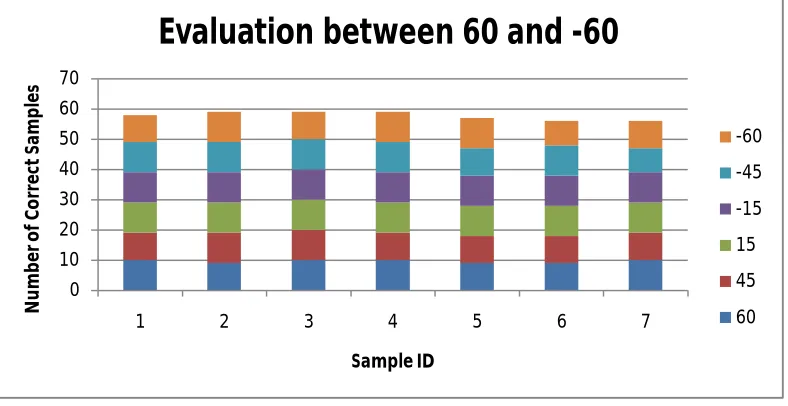
The fig2 shows the results obtained from the proposed model in evaluating the non-zero angles between the 60 and -60 degrees. The proposed model has been consistently found higher than the 95% accuracy over all of the samples. At y-axis represent the number of correct samples and x-y-axis represent the sample ID. In bar graph to show the number correct sample out of 10 samplesfor a single person.
Fig2: The evaluation of the correct results between the non-zero angles of -60 to +60 0
10 20 30 40 50 60 70
1 2 3 4 5 6 7
N
u
m
b
e
r
o
f
C
o
rr
e
ct
S
am
p
le
s
Sample ID
Evaluation between 60 and -60
-60
-45
-15
15
45
Table 2 has shown the effective results in the proposed model when individually evaluated in the terms of different angles or the testing samples. The proposed model has been found higher than the 92% is all of the transactions. The proposed model has been found higher than the average of the 95% in all of the transactions
Table 2: The total number of correct decision out of 60 in angle based accuracy analysis
Sample ID 60 45 15 -15 -45 -60 Overall Accuracy
1
10 9 10 10 10 9 96.672
9 10 10 10 10 10 98.333
10 10 10 10 10 9 98.334
10 9 10 10 10 10 98.335
9 9 10 10 9 10 95.006
9 9 10 10 10 8 93.337
10 9 10 10 8 9 93.33Total 67/70 65/70 70/70 70/70 67/70 65/70 Percentage 95.71 92.85 100 100 95.71 92.85
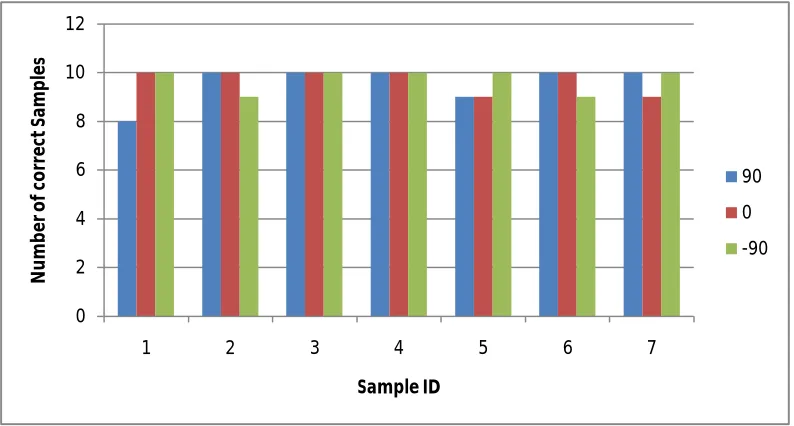
The fig3 clarifies the number of samples per angle obtained from the results of the angular rotation. The proposed model has been found effective when evaluated over the number of samples in the angles defined at 0,90degree and -90 degree in each direction.At y-axis represent the number of correct samples and x-axis represent the sample ID. In bar graph to show the number correct sample out of 10 samples for a single person.
Fig.3: The number of samples presented graphically over angle of 0,90 and -90 0
2 4 6 8 10 12
1 2 3 4 5 6 7
N
u
m
b
e
r
o
f
co
rr
e
ct
S
am
p
le
s
Sample ID
90
0
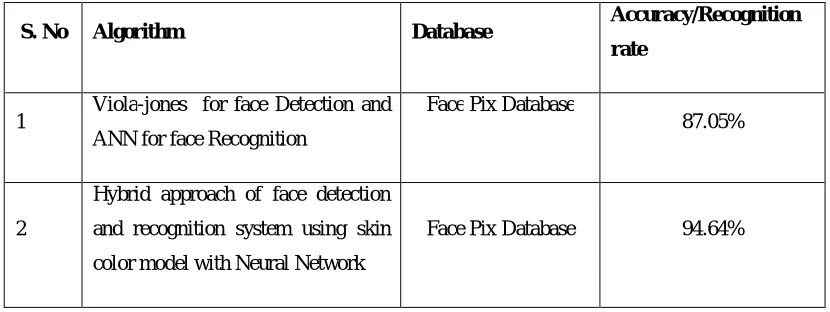
Comparison: Proposed technique show better result as compare to existing techniques, when we apply it on a large dataset of images. This technique allows recognition against pose variations and at any angle between -90 degree and +90 degree and provide better recognition rate. The comparison table of existing algorithms and proposed algorithm is as follows.
Table 3: Comparison of different algorithms
S. No Algorithm Database Accuracy/Recognition
rate
1 Viola-jones for face Detection and ANN for face Recognition
Face Pix Database
87.05%
2
Hybrid approach of face detection and recognition system using skin color model with Neural Network
Face Pix Database 94.64%
VI. CONCLUSION AND FUTURE WORK
The proposed work is based on face recognition system which will be helpful against poses and different angles of system. In this system skin color model is used for face detection, two methods are used for feature extraction which is Zernike Moments (ZMs) and FREAK to collect global features of image. Zernike Moments extract angle and amplitude of images and FREAK find similarities of images. Neural network is used for pattern classification and recognition with one input, one output and 10 hidden layers. Feature set extracted using ZMs and FREAK is used as the training set of neural network. Network will produce output for testing image from dataset and show identity of face. Neural network is an automatic system which can classify the training data according to target data, this classification is done by the hidden layers. When the results of proposed algorithm were compared with existing algorithms, it has found former performs better. FREAK is used in this algorithm to find more similar image. Proposed algorithm is trained and test on Face Pix database which contains 6956 face image of different 94 persons for face recognition, 74 face images of every person. Format of images is in .jpg. It was found that proposed system of face recognition provides better accuracy (94.64%) as compared to existing algorithm of Viola Jones for face detection and ANN for recognition (87.05%). Many techniques have been discussed in literature surveyed which provide good recognition rate for recognition but these all fail at many times in pose variation, makeup, light effects, age variation and other conditions. Future work will be done to improve the qualities of recognition system. Existing systems fail in low resolution images and system should be real time than images used for recognition. In future scope, Multi-detection and Recognition of new algorithm should be developed. Also new system would be used on real time application for authentication and security purpose. The proposed model can be enhanced to work with samples collected within low light. Also, the proposed model must be extended to refuse non-available samples in the training database to return the null result.
REFERENCES
1. Yang, M.H., Kriegman, D.J., Ahuja, N “Detecting faces in images: A survey”. IEEE Transactions on Pattern Analysis and Machine Intelligence, 24( 2002) 34–58.
2. Nurulhuda Ismail, Mas Idayu Md. Sabri, “Review Of Existing Algorithms For Face Detection and Recognition”, Recent Advances In Computational Intelligence, Man-Machine Systems And Cybernetics, Dec 16, 2009 ISBN: 978-960-474-144-1.
3. Hesham A. Alabbasi , et.al, ―Human face detection from images, based on skin color‖IEEE, Proceedings of the 18th International Conference
on System Theory, Control and Computing, Sinaia, Romania, October , 2014.
5. Zakaria Z and Sunandi S.A “Face dectection using combination of Neural Networks and Adaboost ”, IEEE, Volume 1, 2011, pp. 335-338. 6. Chandan Singh et.al, “Fusion of Zernike Moments and SIFT Features for Improved Face Recognition”, International Journal of Computer
Applications (IJCA), April,2012, pp. 26-31.
7. Divyarajsinh N. Parmar, Brijesh B. Mehta, “Face Recognition Methods & Applications”, International Journal of Computer Applications (IJCA),Vol 4, Issue 1, Jan-Feb 2013, pp 84-86.
8. Fernandez, Ma, D. Christina et.al," Simultaneous face detection and recognition using Viola-Jones Algorithms and Artificial Neural Networks for identity Verification", In Region 10 Symposium, 2014 IEEE, IEEE, 2014, pp 672-676.
9. HodaMarouf and KarimFaez ,”An Efficient feature extraction method With Pseudo-Zernike moment for facial Recognition of identical twins, International Journal of Computational Science and Information Technology (IJCSITY) Vol.2, No.1, February 2014.
10. Zahra Ahmadi-Dastjerdi and KarimFaez, “Local Region Pseudo-Zernike Moment- Based Feature Extraction for Facial Recognition of Identical twins” Advanced Computational Intelligence: An International Journal (ACII),Vol.1, No1, July 2014, pp.19-26.
11. JavadHaddadnia, MajidAhmadi, KarimFaez, “An Efficient Feature Extraction Method with Pseudo-Zernike Moment in RBF Neural Network-Based Human Face Recognition System”, EURASIP Journal on Applied Signal Processing, April 2003,pp.890-901.
12. NaoyukiNomoto, Yusuke Shinohara, Takayoshi Shiraki, Takumi Kobayashic and Nobuyuki Otsu, “A New Scheme for Image Recognition Using Higher-Order Local Autocorrelation and Factor Analysis”, IAPR Conference on Machine Vision Applications,Vol. 3 ,2004 pp1-7. 13. Reza Safabakhsh and Vida Movahedi , “Identification of human face profiles using auto correlaton coefficients and geometric features”, IJCA,
2006,PP 113-118.
14. Ying-Han Pang et.al, “A Discriminant Pseudo Zernike Moments in Face Recognition”, Journal of Research and Practice in Information Technology, Vol. 38, No. 2, May 2006,pp.197-211.
15. Chong-Yaw Wee, RaveendranParamesran,” On the computational aspects of Zernike moments”,ELSEVIER, Volume 25, Issue 6, 1 June 2007, PP.967–980.
16. Nabatchian, A.,Abdel-Rahee,, E and Ahmadi, M., “Human Face Recognition Using Different Moment Invariants: A Comparative Study”, IEEE, Volume:3, May 2008,pp. 661 – 666.
17. Omaima N. A. AL-Allaf, “Review Of Face Detection Systems Based Artificial Neural Networks Algorithms”, The International Journal of Multimedia & Its Applications (IJMA) Vol.6, No.1, February 2014,pp-1-16.
18. Seyed Mehdi Lajevardi, Zahir M. Hussain, “Higher order orthogonal moments for invariant facial expression recognition”, ELSEVIER, 2010,Volume 20, Issue 6, Dec 2010, PP. 1771–1779.
19. Chandan Singh, Rahul Upneja, “Fast and accurate method for high order Zernike moments computation”, ELSEVIER, Volume 218, Issue 15,1 April 2012, pp. 7759–7773.
20. Simon X. Liao and MiroslawPawlak, ” On the Accuracy of Zernike Moments for Image Analysis”, IEEE, VOL. 20, NO. 12, 1998, pp.1358-1364.
21. Nabatchian, A.,Abdel-Raheem, E and Ahmadi, M., “Human Face Recognition Using Different Moment Invariants: A Comparative Study”, IEEE, Volume:3, May 2008,pp. 661 – 666.
22. Sundus Y. Hasan,”Study of Zernike moments using analytical Zernike polynomials”, Advances in Applied Science Research, Volume 3 issue1, 2012, pp.583-590.
23. EvangelosSarıyanidi, VolkanDa˘gl, SalihCihanTek, BirkanTun, MuhittinG¨okmen, “Local Zernike Moments: A New Representation for Face Recognition”, IEEE, 2012.
24. Gholam Reza Amayeh, Ali Erol, George Bebis, and MirceaNicolescu, “Accurate and Efficient Computation of High Order Zernike Moments”, Lecture Notes in Computer Science, 2012, pp. 1-8.
25. Tran Binh Long, Le Hoang Thai, and Tran Hanh, “Facial Expression Classification Method Based on Pseudo Zernike Moment and Radial Basis Function Network”, International Journal of Machine Learning and Computing, Vol. 2, No. 4, August 2012 pp.402-405..
BIOGRAPHY
Priya Thakur received the B.E degree in Computer Science from Chitkara University, Himachal Pradesh, India, in
2014.Currently pursuing M.Tech in Computer Science from CGC Technical Campus, Jhanjeri, Mohali (affiliated to PTU).Her research interests are digital image processing.