Vol. 6, Issue 5, May 2018
An Ameliorated Methodology of
Implementing Task Scheduler on a Multi Core
Processor
Savitha P, Varunish P, Geeta S N
Professor., Dept. of Computer Science, Appa Institute of Engineering and Technology, Kalaburagi, India M.Tech, Dept. of Computer Science and Engineering, Bangalore Institute of Technology, Bangalore, India M.Tech Student, Dept. of Computer Science, Appa Institute of Engineering and Technology, Kalaburagi, India
ABSTRACT: Multi-core processors are more commonly used for parallel computation or increase the speed of execution, which has effect on performance. Essential parameter that is to be considered for multi-core processors is scheduling of tasks. There are many task scheduling algorithms and depending on the requirements and to complete the task they can be utilized from various criteria. But still these existing scheduling algorithms have drawbacks such as underutilizing processors and highly complexed. This report fairly describes task scheduling algorithm which can be utilized for multi-core processors. Proposed scheduling algorithm is designed with Directed Acyclic Graph (DAG) task model. Based on this DAG model parameters such as critical degree of a task, remainder of a task, execution time of a task and average communication costs required among tasks are provided as a task parameters for calculating priority of task. Task dispatching list is maintained to calculate priority based on inclusive analysis for each task. This scheduler also utilizes two strategies Interval Insertion and Task Duplication in order to schedule the task to the multi processors that provide advantages such as decreasing communication costs among the task on different multi processors, improve the underutilizing processors, and reduce the scheduling length. The research proves that proposed scheduling algorithm with effective utilization of processors and reduced scheduling length when compared with the scheduling algorithms that are currently utilized.
KEYWORDS: - Multiple Processors, Task Priority, Task Duplication, Interval Insertion, Controlled Scheduling Length.
I. INTRODUCTION
II. LITERATURE SURVEY
In paper [1] the authors explains about the message passing architecture for achieving higher performance with predictable communication overheads where the tasks are need to communicate with each other to exchange the data which are scheduled on different processors. For DAG task model the analysis of task duplication in compile time where the scheduling of task is done in parallel and also discuss the various task duplication algorithms and their advantages along with comparison with parameter such as scheduling length, processor utilization.In paper [2] authors represent the task scheduling by this DAG model for Multi-core processor. Authors makes a study among the List based Task scheduling algorithms which are static scheduling for the various factors like length of scheduling, speed up, efficiency, load balancing, controlled scheduling length. Different algorithms are compared from various factors such as scheduling length, processor speed, load balancing and normalized scheduling length.In paper [3] authors describes about the parallel processing based scheduling algorithms when equated through various metrics which provide better efficiency and also the decreased makespan time and maximum processor utilization rate.
IV. PROPOSED ALGORITHM
In this proposed system the task scheduling algorithm is based on the priority queue and task duplication according to this the tasks are scheduled to the processors and they use the resources to complete the tasks. This scheduling algorithm uses the Directed Acyclic Graph (DAG) task model to find the relations between the tasks and this model is used to know the tasks which are to be scheduled first and which are scheduled later. This model is used to represent the critical degree of task, execution time for the task, Remainder of the task and average communication time among the tasks and these all parameters are provided to assign the priority to each task. The order of the tasks are given and according to which they are scheduled. This scheduling involves two strategies that are used for mapping the tasks to the processors they are Interval Insertion and Task Duplication which are used to further reduce the communication costs among the tasks and increase the processor utilization rate that is even usage of processors and finally the scheduling length can be normalized.
3.1 DAG Task model
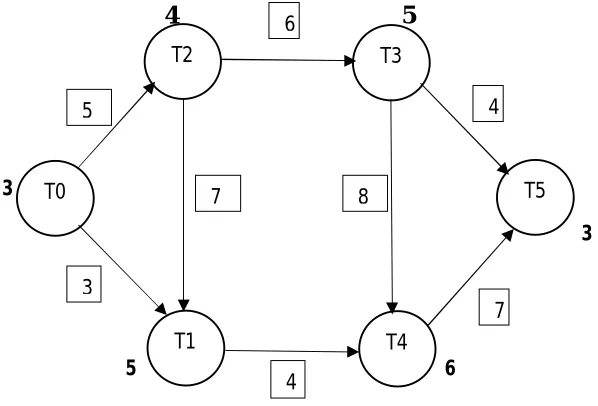
The relationships between tasks can be clearly described by DAG model, hence this model is used in this algorithm. This DAG model is denoted by five tuples G = (N, E, C, T, and D)
Where each tuple represents,
•N = the collection of vertices in graph, where the total number of tasks are represented in the graph.
•E = the collection of number of edges in the graph is represented, where the vertices order is given that is which vertex comes first before the other.
•C = the collection of the communication costs, where the communication costs between the tasks is given •T = the collection of tasks’ execution timeˈ where the time required for each task to complete is given.
Vol. 6, Issue 5, May 2018
DAG Task model for scheduling
4
5
3
3
5 6
Figure 1 : Directed Acyclic Graph (DAG)
3.2 DIRECTED ACYCLIC GRAPH (DAG)
A Directed Acyclic Graph (DAG) is a finite graph with directed edges with no directed cycles that is starting and ending vertex of a path are not same. It contains of finite number of vertices and edges where the edge is directed from one vertex to other vertex. Equivalently DAG is a graph that has Topological ordering, an order which gives the sequence of the vertices where each edge is directed from which vertex to start and which vertex comes after current vertex. DAG is used to represent the collection of events and their influence on one vertex over the other vertex.The longest path in the DAG represents the critical path of the job, the one which controls the total time for the job.
Block diagram
Figure 2: Block diagram of the DAG scheduling algorithm
The input is provided for scheduling where number of tasks are given and each task is provided with parameter such as task critical degree, communication costs, execution time for tasks, predecessor and successor tasks are all considered for scheduling then the DAG algorithm is performed foe each task priority is computed and higher order task is selected, then processor is selected where
T2
T0
T3
T1 5
4 3
4
T4
T5
7 6
8 7
Input
Process split
current task has earliest completion time as subsection known as Task mapping, that task is scheduled to that processor. Finally all the task are scheduled. The tasks can be considered as the programs for applications of user and also some of background programs which are to be executed. When these programs are executed then they become processes and resources are shared among these processes. The output is to provide minimum scheduling length, decreased communication costs and maximum utilization of processors. And also all tasks are scheduled with minimum time consumption.
Algorithm flow design
no
yes
Flow chart displaying the steps involved in the proposed algorithm that is scheduling algorithm based on DAG task model.
Start
Tasks to schedule
If Task in ready task in list
Compute priority for each task and select based on priority
Perform task mapping for each task as subsection
Select a processor on which current task has earliest
completion time
If all tasks are scheduled
Vol. 6, Issue 5, May 2018
Task mapping flow design
Flow chart to show how the tasks are scheduled among the processors. That is how the tasks are selected based execution time required by each task. The completion time of a task at three conditions is calculated and then the smallest completion time of a task on a particular processor.
TASK MAPPING
The strategies are employed which have advantages and disadvantages, this scheduler uses the task duplication strategy for scheduling of all tasks to advance the total time of completion. The basic goal of computing task’s completion time for different strategies and choose one which has earliest completion time to schedule the task to the processor. The task mapping involves following steps to be performed.
Step 1: Earliest completion time of a task i on processor Pi is calculated by EFT (i, Pi) = EFT (j, Pj) + C i, j + Wi
Where task j is task that has maximum costs (execution time and communication cost) among all its predecessor tasks and task j is mapped to processor Pj.
Start
Compute task earliest completion time on processor
When neither of strategies
used
If task duplication can be used If interval
insertion can be used
Select smallest among all above completion time to be task
executing processor
Step 2: If the task can be inserted on a free time interval of a processor say for task i on processor Pi calculated by EFT insert (i, Pi) = MAX {EFT (j, Pj) + C i, j, EFT all (i, Pi)} + Wi
Otherwise, it is set to ∞.
Step 3: Task i to be scheduled to the processor Pi, calculate waiting time of a task denoted by SPT (i, Pi). SPT (i, Pi) = EFT (i, Pi) – Wi - EFT all (i, Pi)
If the value is below than the threshold value, EFT copy (i, Pi) is set to ∞ and go to step 5.
Otherwise, check task j which is task i’s predecessor task with maximum sum of execution time and communication costs satisfy the condition or not.
Wj < SPT (i, Pi) EFT (j, Pi) < EST (i, Pi)
If the above condition is satisfied, then task duplication strategy can be used to duplicate the predecessor task on processor. And task j with maximum critical degree is chosen to be duplicated. Otherwise, EFT copy (i, Pi) is set to ∞
and go to step 5.
Step 4: EFT copy (i, Pi) is calculated
EFT copy (i, Pi) = EFT (c, Pc) + C i,k + Wi (Task c has not sent data to Task i after Task j is completed);
EFT copy (i, Pi) = EFT (j, Pi) + Wi
(Task has not sent data to Task i after Task j is completed);
Where task c is the second most prescheduling time in predecessor of task i and Pc is the processor to which task c is scheduled.
Let task j be the current task to be dispatched to Pi and go back to step 3.
Step 5: The scheduling strategy is chosen based on smallest value one among EFT (i, Pi),
EFT copy (i, Pi), EFT insert (i, Pi) to be the scheduling strategy for scheduling the task i to the processor.
V. PROPOSED METHODOLOGY
There are many scheduling algorithms and they are used based on constraints and applications in order to complete task. For this scheduling algorithm given some tasks and which is based on DAG task model, it is based on priority queue and task duplication. Based on execution time for each task and considering the communication cost in task model the overall time for completion of task and then comparing these results with employed one of the strategy hence proving that this algorithm has better results when compared with other algorithms.
1. STRATEGY TASK DUPLICATION
Vol. 6, Issue 5, May 2018
the task which is to be duplicated has to be selected and find the ideal time slots in order to provide sufficient space for those task nodes.
2. INTERVAL INSERTION STRATEGY
Processor idle time can be used if there are still tasks to be scheduled which can be used to decrease the execution time of the tasks. For this the condition to be satisfied is the free time interval of a processor should be greater than the task execution time.
VI. IMPLEMENTATION 6.1 MODULES
1. Check whether task graph is DAG or not
The task graph which is given as an input for the scheduling algorithm which is using DAG task model. The output is to display whether the graph is DAG or not. The task model which is given as an input, where each vertex and edge is visited and it is acyclic or cyclic is verified.
2. To know the order of the tasks or vertices in task graph
The given input which is considering the vertex and edges which are connected between them and the output is to display the order of the vertex. This order if DAG task model is known as Topological order in turn which specifies the in what order the tasks are to be scheduled.
3. Find the longest/critical path in the graph
The DAG task model which is considered and provided with edge weights which are considered as communication costs and the edges are traversed and the longest path in the graph is computed and critical path is considered from source to destination.
4. Task mapping
The completion time of the task is computed on a processor in three different situations first when neither of strategy is used, second, if there is possibility of using interval insertion then the completion time is computed, third, when the Task Duplication strategy can be used completion time is computed. Finally the minimum time for a task on a processor required to complete is selected, then the task is scheduled on the processor. Overall completion time for a task.
5. Strategy Task Duplication
The Task Duplication strategy is employed which reduces the communication costs from one task to other task and normalize the scheduling length by the effective utilization of the processors. By observing the predecessor constraints the task which is to be duplicated has to be selected and find the ideal time slots in order to provide sufficient space for those task nodes.
6. Interval insertion strategy
6.2 RESULTS
The existing task scheduling algorithms are studied and their advantages are considered for comparison with the proposed scheduling algorithm following data information is taken as example that is six tasks are taken based on different scheduling method they are distributed among the processors. Three algorithms are Task Duplication Scheduling (TDS), Critical Path Fast Duplication (CPFD) and proposed DAG scheduling algorithm and results are recorded as shown below. They are compared with parameters such as scheduling length, and number of processors utilized. Hence when all the scheduling algorithms are compared, DAG task scheduling algorithm has utilized minimum amount of time for scheduling and processors.
Algorithms Number of tasks given
Number of processors used
Scheduling length time required(sec)
TDS 6 6 30
CPFD 6 6 24
DAG 6 5 24
Table: displaying the comparison results
Figure: Chart shown based on above table
6.3 ADVANTAGES AND DISADVANTAGES
ADVANTAGES
1. Multitasking is supported where multi-threading also hyper threading can be provided in which more number of tasks can be executed within a particular time period.
2. Performance of present Multi-core processors can be increased in task executing among the processors.
3.Strategies that are employed for Multi processors are Task Duplication in order to decrease the communication costs among processors and other one is Interval Insertion that is for the utilizing the free time of any processor if available. 4.Tasks are executed more in number which is required less amount of time for completion of all the tasks.
Vol. 6, Issue 5, May 2018
6.Higher priority tasks can be attended in the mid of scheduling. This scheduling algorithm can be implemented in current Multi-core processors which can be used in completion of tasks.
DISADVANTAGES
1.Until current task is executed, the next task cannot be started.
2.Previously scheduler has to decide which task is to be duplicated and on which processor.
VII. CONCLUSION
Proposed scheduling algorithm for Multi-core processors is described using DAG task model.This paper represents the task scheduling algorithm for Multi processors and which is based on priority queue and task duplication concepts. This scheduling algorithm uses Directed Acyclic Graph (DAG) task model which provides the parameters like task critical degree, Remainder of the task, task execution time and average communication time for the completion of the tasks are provided as a metrics for assigning the priority to each tasks. The scheduling algorithm employs two strategies such as Interval Insertion that is if there is any idle processor time and Task Duplication where some tasks are to be duplicated on other processors and they are used to assign the task to the processors. These are further used to reduce the communication costs between the tasks, increase the processor utilization rate and the scheduling length can be reduced. The results shows that the proposed algorithm has better processor utilization rate which improves the performance and lower complexity when compared to existing scheduling algorithms.
VIII. FUTURE WORK
This DAG task scheduling algorithm, when given a specific task and then find the execution time to complete the task. Comparison of this DAG task model with other similar models and providing the same inputs and the execution time is displayed and compare the execution time with other parameters and results of both the models compared then the DAG algorithm should execute all the tasks in minimum amount of time when the other model takes maximum time to complete all the tasks. The execution time for proposed algorithm is to be compared when one of the strategy is used.
REFERENCES
1. Lan Zhou, and Sun Shi-Xin, “An Algorithm of Allocating Tasks to Multiprocessors Based on Dynamic Critical Task,” Chinese Journal of Computers, 2007.
2. Ahmad I, and Kwork Y, “On Exploiting Task Duplication in Parallel Programs Scheduling,” IEEE Transactions on Parallel and Distributed Systems, 1998.
3. Meng Xian-Fu, and Liu Wei-Wei, “A DAG Scheduling Algorithm Based on Selected Duplication of Precedent Tasks,” Journal of Computer-Aided Design & Computer Graphics, 2010.