A Survey on Multilevel Security Using Ear
and Face
Recognition
Sumit U. Mali, Prof. A. S. Narote
M.E Student, Dept, of I.T, SKN College of Engineering, Pune, India
Assistant Professor, Dept. of I.T., SKN College of Engineering, Pune, India
ABSTRACT: This is introduces an improved ear recognition approach based on 3D key-point matching and
combining local and holistic features. The 3D key-points are detected using the shape index image. The system consists of primary steps that are: i) ear image segmentation; ii) local feature extraction and matching; iii) holistic feature extraction and matching; and iv) combination of local and holistic features at the match score level. For the segmentation purpose, we use an efficient skin segmentation algorithm, to localize a rectangular region containing the ear. It is use K-SVD (LCKSVD)framework. As an effective supervised dictionary learning algorithm, LC-KSVD learns a compact discriminative dictionary for sparse coding and a multi-class linear classifier simultaneously. To use LC-KSVD, one key issue is how to extract feature vectors from 3D ear scans. To this end, we propose a block-wise statistics based scheme. Specifically, we separate between 3D ears ROI into blocks and extract a histogram of surface types from each block, Histograms from all blocks are concatenated to form the desired feature vector. The facial imagery usually at the disposal for forensics investigations is commonly of a poor quality due to the unconstrained settings in which it was acquired. The captured faces are typically non-frontal, partially occluded and of a low resolution, which makes the recognition task extremely difficult, the probabilistic linear discriminant analysis (PLDA) and data fusion based on linear logistic regression. We demonstrate the feasibility of our MODEST framework on the FRGCv2 and PaSC* databases.
KEYWORD: Face recognition, biometrics, ear recognition, multi-modal biometrics.
I.INTRODUCATION
Biometric authentication using ear image is new research area. Many unique features of human are explored but not many are used. This project focuses on one such area that is Authentication using ear image and also provide the Face image recognition.While sign up, user will provide user name, password, email id. Also user will register his ear and face image using High Definition camera. In this application, user will be authenticated, using user name, password and ear image as well as face image which is captured from camera. In 1st step of log in user will be authenticated based on user name and password. User will capture his ear Image it will be converted to 3D and this image will be saved in drive also user will capture his face images and saved into drive. In 2nd step of user will provide his ear image as well as face using High Definition camera, and authentication will be done by matching real time ear image and face image with the stored ear image and face image while sign-up.
nature of ear made it highly acceptable among users in many security applications. Ear biometric is very suitable for being applied in surveillance systems as well since it can be captured from distance.
Smartphones are rapidly becoming a key platform formany authentication processes in a large number of applications. However sensitive data on smartphones is at risk, if a smartphone is protected with methods providing an insufficient level of security. Since the advent of mobile phones, PIN and password authentication using a mix of alphanumericand symbols were the most commonly used methods for access control. In order to avoid the risk of short passwords, one can use cumbersome and long passwords with a mix of special characters at the cost of inconvenience. Most recent smartphones also offer an option to authenticate the owner based on a swipe pattern.
II. LITERATURE SURVEY
Lida Li and et al.In this contributions are mainly from two aspects. At first, we are the first to adapt the LCKSVD model to the application of 3D ear recognition. Secondly, we proposed an approach based on local histograms of surface types for feature extraction, which is quite effective and robust to small alignment errors. Experiments conducted on benchmark dataset demonstrate that LCKSVD LHST could achieve much higher recognition rate than the other competitors evaluated.
Kyong Chang and et al. Our previous experiments with ear and face recognition using the standard principal component analysis approach shows lower recognition and performance using ear images. We report results of similar experiments on larger data sets that are more thoroughly controlled for relative quality of face and ear images. We find that recognition performance is not significantly different between the face and the ear.
S. Algabary et al. The major advantages of ear identification instead of face recognition modeling is mainly due to the fact that the mathematical functions relate to the image reality of the viewing geometry and take into account all the mismatches generated in the image while face model parameters do not have any physical meaning.. It will be inspiring to discover which features that are the furthermost significant in determining ear recognition. Hereafter, itwill be able to weigh them properly in the process with different types of features. Classification is based on the MNN output between the input image feature, and all the images from the database.
R K Subramanian and et al.This is proposes a multimodal biometric recognition system that exploits two modalities, namely face and ear recognition. With multi-sampling and fusion at decision level, a recognition rate of 96 % was obtained. Currently, we are working to enhance the recognition rate under uncontrolled environment so that it can be applied to surveillance applications.
Akkas Ali and et al.A complete and fully automatic approach for human ear recognition system from 3D images is developed. This is done by matching three dimensional key points and combining local and holistic features. The efforts detailed in this research to exploit the sparse representation of local ear shape descriptors have illustrated superior performance for the automated ear recognition problem.
Padma Polash Paul and et al. The proposed a novel ear recognition method, which integrates automated occlusion estimation, adaptive feature selection and weighting, and rank fusion to handle uncertain occlusions during identification stage. The proposed methodology has been evaluated on a large publicly available ear database containing excessive amount of real-world occlusions. Similar to existing methods, the proposed ear recognition method is also evaluated on simulated occluded conditions. Our experimental results show that the proposed method is capable of obtaining reliable recognition performance under the presence of partial ear occlusions during operation time. Future research will look into incorporating more quality factors such as pose, alignment, illumination etc. as well as higher granularity quality classification to improve the recognition rate further.
coordinate, four different distances from matrix which contain Euclidean distance between every pixels in image. We tried to increase the distance values were taken to increase the feature vector which will be more representative. We not effect on the run time because the feature vector is still small but representative. K-nearest neighbour used for classification because this classifier gives higher accuracy. The experimental results showed that the proposed approach gives better results and obtained over all accuracy almost 98%.
Sayan Maity and et al.The presented a fully automated system for 3D ear segmentation and time-efficient recognition. Utilizing the tree structured graph model and active contour segmentation we proposed the first fully automated 3D ear-region segmentation algorithm from the range scan of the face profile. The segmented 3D ear ear-region is used for hierarchical categorization of the gallery based on the shape information and surface depth information, respectively. The rank one recognition results, and the computation times in Tables IV-VIII show the robustness and efficiency of our approach. We applied our algorithm on the largest available 3D ear database (UND database collection J2). The accuracy of the proposed segmentation approach outperforms the state-of-the-art 3D ear segmentation techniques. Compared with the results reported in the literature, the rank-one recognition accuracy obtained by the proposed approach is the highest on the UND database collection J2, and is faster than other automatic 3D ear recognition systems in the literature.
Bourouba Houcine,and et al. An automated human identification system using ear imaging based on bag-of-features model call “HSM-BoF” is proposed. The main contribution of the proposed method is extracting the discriminating ear histogram representation of the ear images using BoF and Kernel Discriminant Analysis. The experimental results show that the ear recognition algorithm proposed in this paper is effective and superior to the other similar methods in the recognition rate. Our future work will be focused on two aspects :(1) in the ear encoding stage, we need to improve the accuracy by using other encoding methods and (2) in the ear identification authentication stage, we need using other classifier and other larger dataset to testify the matching accuracy and the real-time performance of the proposed method.
Vitomir Strucand etal.That have presented a MODEST framework for face recognition that relies on probabilistic modeling of diverse feature sets to facilitate face recognition from real world-data. We have shown that the proposed framework ensures a recognition performance that is competitive with the existing state-of-the-art. As part of our future work, we plan to include an additional processing path to our framework that provides information on soft biometric cues and quality measures to the recognition system and improve the facie registration step, which seems to be crucial for the recognition performance.
Kiran B. Raja and et al. Secure applications such as financial transactions need strong authentication processes. In order to overcome the necessity of cumbersome passwords, one can use biometric characteristics. In this work, we have proposed a new smartphone based recognition system employing multi-modal biometric characteristics. The proposed system uses face, periocular and iris characteristics. An important contribution of this work is in implementing the open source iris segmentation algorithm - OSIRIS v4.1 to Android platform.
Durgesh Singh and et al. Ithave given a brief overview of the ear biometric recognition system anddifferent approaches for ear recognition were discussed. So newcomers can easily understand the ear biometrics recognition system process. We have considered detection stage and recognition stage of the two main stages in an ear recognition system. We have also separately discussed the 2D and 3D ear image detection and recognition technique in literature review. The ear biometrics can be used for passive identification. Till now the ear detection and recognition systems are limited to controlled indoor conditions. Must be the ear biometrics need to be tested outdoors.
III.PROPOSED SYSTEM
(One Time Password) but they have some drawback because grid or mobile phone goes missing at that time security issue is on top level but in this system we are providing login password with Ear and Face Recognition authentications.
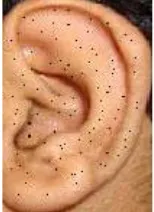
Figure I Key point’s detection
The system block diagram is sketched in Figure. The each term of the following block diagram are explained in the below. Skin detection is the process of finding skin colored pixels and regions in an image or a video. This process is typically used as a preprocessing step to find regions that potentially have human ear. Such regions detected are segmented and separated so that the possible area to find the ear can be reduced. The skin segmentation is done on the acquired color image of the side face. The output of the skin segmentation algorithm will be the skin segmented portion of the input image which acts as the input to the correlation matching. The most popular algorithm for skin detection is based on color skin information. Different color space information is required for the conversion of image in RGB to appropriate color to get a better result.
Figure II Proposed ear recognition system
IV. CONCLUSION
V. ACKNOWLEDGMENTS
For everything we get, the credit goes to all those who had helped us to complete this survey successfully. I am thankful to " Prof. A. S. Narote for guidance and review of this paper. I would also like to thanks, all faculty members of SKN College of Engineering".
REFERENCES
1. Lida Li, Lin Zhang_, Hongyu Li,‘3D EAR IDENTIFICATION USING LC-KSVD AND LOCAL HISTOGRAMS OF SURFACE TYPES’, vol
6 springer 2014
2. Kyong Chang, Kevin W. Bowyer, and SudeepSarkar, Barnabas Victor, ‘Comparison and Combination of Ear and Face ImagesIn
Appearance-Based Biometrics’, Ijirtvol 3 page no.3
3. KhamissMasaoud, S. Algabary, Khairuddin Omar, Md. Jan Nordin, SitiNorul Huda Sheikh Abdullah, ‘A Review Paper on Ear Recognition
Techniques: Models, Algorithms and Methods’ , Australian Journal of Basic and Applied Sciences, 7(1): 411-421, 2013
4. NazmeenBibiBoodoo, R K Subramanian, ‘Robust Multi-biometric Recognition Using Face andEar Images’ , International Journal of Computer
Science and Information Security,Vol. 6, No. 2, 2009.
5. Akkas Ali, Mohammad. Mahfuzul Islam, ‘A Biometric Based: 3-D Ear Recognition System Combining Local and Holistic Features’,
I.J.Modern Education and Computer Science, 2013, 11, 36-41 Published Online November 2013 in MECS.
6. Madeena Sultana, Padma Polash Paul, Marina Gavrilova, ‘A Novel Index-based Rank Fusion Method for Occluded Ear Recognition’, 2015
International Conference on Cyberworlds.
7. AsmaaSabet Anwar, Kareem Kamal A.Ghany, HeshamElmahdy, ‘Human Ear Recognition Using Geometrical Features Extraction’,
International Conference on Communication, Management and Information Technology(ICCMIT 2015).
8. SayanMaity, and Mohamed Abdel-Mottaleb, ‘3D Ear Segmentation and ClassificationThrough Indexing’, IEEE TRANSACTIONS ON
INFORMATION FORENSICS AND SECURITY, VOL. 10, NO. 2, FEBRUARY 2015.
9. BOUROUBA Houcine DOGHMANE Hakim, ‘Ear recognition based on Multi- bags-of-featuresHistogram’, ijir 2015.
10. VitomirStruc, JanezKrizaj, Simon Dobrisek, ‘MODEST FACE RECOGNITION’, IEEE 2015.
11. Kiran B. Raja R. Raghavendra Martin StokkenesChristoph Busch, ‘Multi-modal Authentication System for Smartphones Using Face, Iris
andPeriocular’, ICB 2015, 2015 IEEE, 978-1-4799-7824-3/15.
12. Durgesh Singh*, Sanjay K. Singh, ‘A Survey on Human Ear RecognitionSystem Based on 2D and 3D Ear Images’, OPEN JOURNAL OF