
Effects of high treatment levels in a dry-strength additive program based on deposition of polyelectrolyte complexes: How much glue is too much?
6
0
0
Full text
(2) DRY STRENGTH ADDITIVES. tion.The negatively charged CMC was attracted to the positively charged poly-DADMAC already adsorbed on the fiber surface. In other experiments, researchers explored the effects of adding polyDADMAC beyond the saturation levels for paper made from recycled fibers [4,9]. Results were consistent with the formation of polyelectrolyte complexes at high dosages. Polyelectrolyte complexes were formed by two basic techniques, sequential addition and pre-mixing. In sequential addition, an excess of poly-DADMAC is first added to the fiber slurry, beyond the amount that can be adsorbed onto the fibers, and the excess combines with CMC, added second. In the second technique, poly-DADMAC is mixed with CMC, and the mixture is added to the slurry. In both cases, the polyelectrolyte complexes were able to deposit onto the fibers, increasing strength properties. The strength properties for fibers that had been treated sequentially by oppositely charged polyelectrolytes were found to be greater than the strength properties for fibers when polyelectrolytes were pre-mixed. Experiments have also been conducted with glass micro-fibers [1]. Glass micro-fibers do not lose mass upon incineration, which makes it possible to evaluate the polymer uptake accurately by gravimetric analysis. Also, because paper sheets formed from untreated glass had almost zero strength, essentially all of the strength could be unambiguously attributed to polymer addition. Results showed that polyelectrolyte complexes provided better strength characteristics when formed by the sequential addition rather than by pre-mixing. Based on related studies, we can expect that there is an optimal range of charge ratio between the cationic and anionic polymers [2-14]. In the case of glass fibers, the range of optimal charge ratio was between 2:3 and 3:2 [1]. As mentioned, a particularly intriguing finding was that tensile properties increased without any apparent limit as polymer was added to a mass level of 10%, but 10% was the highest treatment level considered. In our study, we explored polymer addition levels greater than 10%.. 10 TAPPI JOURNAL. JUNE 2006. EXPERIMENTAL Bleached hardwood and softwood kraft fibers were used in a ratio of 70% to 30%.The fibers were repulped from dry-lap sheets of market pulp according to TAPPI T-200. The pulp mixture was refined in a laboratory Hollander beater (Valley Machinery Co., Appleton,WI) to a freeness of 400 mL CSF (TAPPI T-227). To make it easier to interpret data, we removed fines from the stock using a Bauer McNett classifier (TAPPI T-233). Since the goal was just to get rid of fines, we deviated from the TAPPI method somewhat.A 200-mesh stainless steel screen was placed in the final position of the classifier.After the water and agitators were turned on, the pulp slurry was poured into the final vessel of the device until it was three-quarters full. For each subbatch of fibers, the classifier was run for 15 min, allowing most of the fines to be removed. We tested the consistencies of the refined fiber batches again before preparing each handsheet series, with the consistencies adjusted to 0.3%. The electrical conductivity was adjusted to 1000 µS/cm with sodium sulfate, and the pH was adjusted to 7.0. Chemicals were added to the slurry and mixed, and the mixture was added to a handsheet mold, according to TAPPI T-205. The cationic polyelectrolyte used in the experiments was Alcofix® 169, a polymer of diallyl dimethyl ammonium chloride (poly-DADMAC) from Ciba Specialty Chemicals.The anionic polyelectrolyte was CMC 7M, a carboxymethylcellulose product with a content of 0.7 carboxyl groups per anhydroglucose unit (Aquasol division of Hercules). We evaluated results over a matrix of 35 experimental conditions. Independent variables included the ratio of the two oppositely charged polyelectrolytes, their manner of addition, and the net level of addition based on the dry mass of fibers.Three mass-ratios of the polyelectrolytes were selected, based on conditions that yielded near-optimum results in a previous study [1].We evaluated three polymer ratios, rather than just one,. because minor imbalances of colloidal charge could possibly have severe consequences at the high addition levels used. An initial series of handsheets was prepared according to the pressing procedure as set forth in TAPPI T-205, with drying on polished plates, held in rings. However, difficulties arose from the stickiness of the handsheets created at high dosage levels, and we modified the procedure to prepare additional handsheets. In this modification, instead of placing the damp sheets in the pressing device, we dewatered them with the roller, using two blotter sheets and a metal plate.The roller was passed back and forth five times. The damp sheets were labeled, peeled from the blotter sheets,and fed with the wire-side facing the heated surface into an Adirondack rotary drum dryer, (Model E-100, Adirondack Machine Corp.). The temperature setting was 76.7°C, and the speed was set to 11.After the first pass through the drier, each sheet was flipped over and passed through a second time. Sheets were allowed to equilibrate at 50% RH for 48 h before testing. Equilibrated handsheets were prepared for paper testing according to TAPPI T-494, which lays out the specifications for cutting test samples. Areas of the handsheet were chosen that were free of abnormalities. Six samples were cut to a width of 15 mm. We performed tensile tests with an Alwetron Th1 Autoline Compatible tester (Lorentzen and Wettre, Sweden) using the default settings.. RESULTS AND DISCUSSION Stickiness of the wet sheets In creating the initial set of handsheets, we noticed that the damp, undried sheets became sticky to the touch when the net addition of polyelectrolytes was over 10% based on fiber mass. At the three highest addition levels, 40%, 65%, and 100% on o.d. pulp, the paper became so adhesive that the blotter paper would become permanently incorporated into the sheet when we followed the TAPPI handsheet procedure. Individual handsheets were ranked on a stickiness scale of zero to three, with zero corresponding to the.
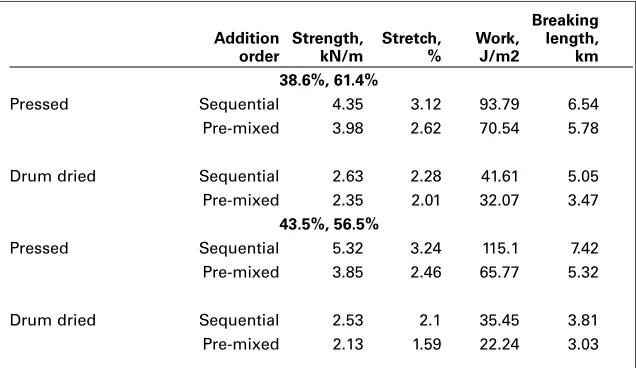
(3) DRY STRENGTH ADDITIVES. behavior of sheets formed from untreated fibers. A test sheet received a stickiness rank of 1 if no more than 25% of the test sheet was covered by the blotter paper as a result of delamination. A sheet was given a rank of 2 if 25–50% was covered with a layer from the blotter paper. A stickiness value of 3 indicates that more than half of the sheet was covered with a layer of the blotter paper. For the second drying method (rotary drum dryer), a rating of 1 indicates a few, isolated patches of orange fibers from the dryer felt.A rating of 2 indicates that sufficient felt fibers had transferred to affect the overall color of the test sheet.A rating of 3 indicates a high concentration of felt fibers, such that the test sheets were distinctly orange. The manner of addition of polyelectrolytes significantly affected the stickiness of the sheets. Tests carried out at the 10% level of net polymer addition resulted in a stickiness rating of 1 in cases where the two polyelectrolytes were pre-mixed before being added to the furnish. Sequential addition of the polymers yielded a rating of 0 at the same level of addition.The same ratings were obtained during handsheet preparation by each of the two addition sequence procedures. Table I shows the results of additional tests, all involving the polyelectrolytes sequentially added to stirred fiber suspensions.As shown, stickiness became more severe with increasing net dosages of polymer.. Dewatering rates As anticipated, high levels of drystrength polymers caused noticeable reductions in dewatering rates. At least part of the drainage rate reduction appeared to be caused by the accumulation of polymeric material on the forming screen. Thus, after each set of handsheets involving high levels of treatment, the forming screen was noticeably sticky and partly plugged. Similar observations have been described by others [15-16]. Kekkonen et al. found that at higher polyelectrolyte concentrations, sticky polyelectrolyte particles would precipitate out of solution [10]. With each successive preparation of a set of handsheets, polymeric. Polymer, % 0.0 0.2 0.5 1 2 5 10 20 40 65 100. 38.6% Press 0 0 0 0 0 0 0 0 0 2 3. Polymer Balances (DADMAC, CMC) 61.4%, 43.5%, 56.5% 48.5%, Drum Press Drum Press 0 0 0 0 0 0 0 0 0 0 0 0 0 0 0 0 0 0 1 0 1 0 1 0 1 0 2 0 2 1 2 0 2 1 3 1 3 2 3 2 3 3 3 3. 51.5% Drum 0 0 0 0 1 1 2 2 2 3 3. Ratings: Control = 0 . Most sticky = 3. Press drying by TAPPI T-205. Drum drying with a rotary drum dryer.. I. Stickiness ratings for handsheets produced by two kinds of drying methods at three polymer balances. Pressed. Drum dried. Pressed. Drum dried. Addition Strength, Stretch, order kN/m % 38.6%, 61.4% Sequential 4.35 3.12 Pre-mixed 3.98 2.62. Work, J/m2. Breaking length, km. 93.79 70.54. 6.54 5.78. Sequential 2.63 Pre-mixed 2.35 43.5%, 56.5% Sequential 5.32 Pre-mixed 3.85. 2.28 2.01. 41.61 32.07. 5.05 3.47. 3.24 2.46. 115.1 65.77. 7.42 5.32. Sequential Pre-mixed. 2.1 1.59. 35.45 22.24. 3.81 3.03. 2.53 2.13. II. The effect of addition order on handsheet properties.. material accumulated on the fabric. This build-up made it difficult for us to quantify the effects that individual dosages had on drainage.. Translucence Handsheets were markedly translucent when prepared at polymer treatments of 65% and 100% with pressing in blotter paper, according to TAPPI T205. Optical measurements were not possible in those cases, because the damp sheets were so sticky that they could not be separated from the blotter paper.The drum-dried handsheets, despite their lower levels of pressing,. also exhibited some translucency at high levels of polymer treatment. Tentatively, the reduced opacity was attributed to the filling in of void areas in the paper large enough to contribute to the scattering of light. Optical measurements were not attempted because the sticky sheets tended to pick up orange fibers from the dryer felt.. Strength test results Table II shows the results of four experiments in which the addition order was varied at two different polymers ratios while the net polymer VOL. 5: NO. 6 TAPPI JOURNAL. 11.
(4) DRY STRENGTH ADDITIVES. 1. Breaking length results for sheets prepared by sequential addition of poly-DADMAC and CMC at the mass ratios shown and at the given levels of total polymer on dry fiber, after TAPPI pressing and air drying.. addition level was kept constant at 10% on a fiber mass basis. In certain cases, the fiber slurries were first mixed with poly-DADMAC solution, then mixed with CMC. In other cases, the two polyelectrolyte solutions were mixed together first before being mixed with the fibers. As shown, the sequential addition of the polymers always resulted in greater strength gains. The relatively poor strength performance resulting from the pre-mixing of the polyelectrolytes was tentatively attributed to a poor distribution of additives in the furnish. Numerous polymer flocs could be seen during the creation of the handsheets in such cases. The polymer flocs also were evident in the dried sheets because of their translucent nature. The formation of polymer flocs is consistent with the findings of Kekkonen et al. [10]. The translucent spots were also stickier than the rest of the sheet, as evidenced by the adhesion between the blotter and felt fiber that occurred preferentially in these areas. Because of the lower strengths obtained with pre-mixing, along with the spotting that occurred, we used sequential addition for the rest of the experiments. For all but a few cases,the deviation of strength test results was less than 9%, with random scatter throughout the. 12 TAPPI JOURNAL. JUNE 2006. 2. Breaking lengths of sheets prepared by sequential addition of poly-DADMAC and CMC at the mass ratios shown and at the given levels of total polymer on dry fiber, after roller pressing and heat drying.. range of addition levels.These statistics allow relative certainty with regard to the trends. Figure 1 shows the tensile breaking length results for handsheets pressed and dried by the TAPPI method, and Fig. 2 presents the results for the drum drying method. As the vertical scales on the graphs reveal, sheets prepared with the TAPPI method had higher inherent strength at zero polymer treatment. The horizontal scale of Fig. 1 ends at 40% because the sheets prepared at higher levels of polymer treatment could not be separated from the blotters. As these figures show, paper strength rose most rapidly with increasing dosages up to 1% or 2% in all cases. Beyond that point, although breaking length values continued to rise, there was some divergence in the results, depending on the mass ratio of the oppositely charged polymers and on the methods used for pressing and drying. The most favorable mixing ratios of the two polymers yielded strong gains in dry strength with increasing polymer dosage up to about 40%, based on the dry mass of fiber. The increased strength was also apparent in the rattling sound made during the shaking of handsheets prepared at high polyelectrolyte additions.. A hypothesis to explain the dropoff in breaking length response is that no more polymer was able to deposit onto the fibers beyond 40%. To test this hypothesis, we consider the increases in mass. Figure 3 plots the mass of the handsheets corresponding to the strength results in Fig. 2.As shown, for two of the polymer ratios considered, the mass continued to rise in an almost linear manner from zero addition up to 100%, meaning that there was an equal net mass of polymers added, compared to the dry fiber mass. Thus, the hypothesis must be rejected. The fall off in breaking length at polymer additions above 40% might be attributed to an insufficient proportional content of fibers, compared to the optimum needed for strength development.The basis weight results also help to explain why the ratio of 0.385 cationic polymer to 0.614 anionic polymer gave inferior strength results in Fig. 2, at net polymer additions above 10%. Apparently the proportion of the cationic polymer was not sufficient in those cases to retain polymer complexes efficiently on the fibers, especially at the higher overall levels of treatment.. Stretch to breakage Figure 4 show the results of tests on the percentage of stretch to breakage..
(5) DRY STRENGTH ADDITIVES. 3. Basis weights for various levels of addition at dif4. Stretch results at different addition levels for drumferent ratios of poly-DADMAC and CMC for handdried handsheets. sheets made by the drum drying method. Trends were similar in most respects the highest addition levels studied. Aspects 76: 81(1993). to the breaking length tests shown in Such decreases were attributed to vis8. Decher, G., Science 277(5330): Fig. 2. Thus, in the case of the two ible plugging of the forming fabric. 1232(1997). Polymer treatment levels above most favorable polymer ratios, the 9. Nyström, R., Hedström, G., strength results rose strongly up to 40%, on a dry fiber basis, caused the Gustaffson, J., and Rosenholm, 40% net addition, based on dry fibers. paper to be translucent, consistent J.B., Colloids Surf. A 234(1–3): The increasing levels of stretch indi- with the filling in of void spaces by 85(2004). cate that the polymeric additives up the polymer. 10. Kekkonen, J., Lattu, H., and to that level increased the toughness Stenius, P., J. Colloid Interface Sci. and extensibility of the paper. ACKNOWLEDGEMENTS 234(2): 384(2001). This work was completed as part of an undergraduate research project by CONCLUSIONS 11. Chen, J., Heitmann, J.A., and Very high levels of dry strength were Maryn Heermann and Sara Welter at Hubbe, M., Colloids Surf. A achieved through the sequential addi- North Carolina State University. 223(1–3): 215(2003). tion of a cationic poly-DADMAC solu12.Dubas, S.T., and Schlenoff, J.B., tion and an anionic CMC solution to LITERATURE CITED Macromolecules 32(24): 8153(1999). bleached kraft furnish. Tensile break1. Hubbe, M.A., J. Pulp Paper Sci. 13.Mende, M., Petzold, G., and ing lengths continued to increase 31(4): 159(2005). Buchhammer, H.M., Colloid Poly. strongly up to a net content of 40% Sci. 280(4): 342(2002). 2. Gärdlund, L., Wågberg, L., and polymer, based on the dry mass of Gernandt, R., Colloids Surf. A 14. Schönhoff, M., Current Opinion fibers. Results were dependent on the 218(1–3): 137(2003). Colloid Interface Sci. 8(1): 86(2003). mass ratio between the two polymers. In addition to the high cost of very 3. Lofton, M.J., Moore, S.M., Hubbe, 15.Monte, M.C., Blanco, A., Negro, C., high levels of dry-strength chemicals, M.A., and Lee, S.Y., TAPPI J. 4(9): and Tijero, J., Chem. Eng. J. the development of stickiness in the 3(2005). 105(1–2): 21(2004). wet paper may set a practical upper 4. Hubbe, M.A., Moore, S.M., and 16.Song, Z., and Rys, L., Pulp Paper limit on treatment dosages.The onset Lee, S.Y., Industrial Eng. Chem. Intl. 46(12): 25(2004). of sticky behavior was observed Res. 44(9): 3068(2005). between 2% and 20% net polymer Received: February 22, 2006 5. Petzold, G., Buchhammer, H.M., addition, depending on the details of Accepted: March 18, 2006 and Lunkwitz, K., Colloids Surf. A sheet preparation and pressing. 119(1): 87(1996). Problems related to stickiness were This paper is also published on the least significant when the poly6. Hubbe, M.A., Jackson, T.L., and www.tappi.org meric additives were separately added Zhang, M., TAPPI J. 2(11): 7(2003). and summarized in the June, 2006 to a stirred suspension of fibers. 7. Buchhammer, H.M., Petzold, G, and Solutions! for People, Processes Decreased dewatering rates were Lunkwitz, K., Colloids and Surfaces and Paper magazine (Vol. 89 No. 6). observed after polymer treatment at A: Physiochemical and Engineering VOL. 5: NO. 6 TAPPI JOURNAL. 13.
(6) DRY STRENGTH ADDITIVES. INSIGHTS FROM THE AUTHORS We chose this topic because previous results looked intriguing, and we wanted to find out how far we could push the limits of this technology. The new results help to bring the earlier, somewhat fundamental research down to a practical level. The kind of system we have studied could have practical applications. In terms of the difficulties we faced, we didn’t know what to expect, so it was hard to define the best range of experimental conditions to evaluate. Also, procedures needed to be revised continually, since we encountered new issues that made accepted procedures ineffective. What surprised us most was the extremely high level of polymer addition that was reached before the strength benefits really fell off. Not every paper mill can benefit from the kind of system we studied. However, the technology offers a way to raise the bonding strength of paper to. much higher levels than can be achieved with conventional approaches. As with much work done at the laboratory level, the next step probably would involve mill trails. We hope that others are interested in various applications of the strategies we have investigated. Martin A. Hubbe is Associate Professor at North Carolina State University, Raleigh, North Carolina, USA. Maryn L. Heermann and Sara R. Welter are seniors in the Department of Wood and Paper Science, NC State University. Reach Hubbe at [email protected].. Heerman. Hubbe. Welter. Learn more about this topic with TAPPI PRESS Paper: An Engineered Stochastic Structure. Chemical Processing Aids in Papermaking: A Practical Guide. Written by M. Deng, Ph.D. and C.T.J. Dodson, Ph.D. Product Code: 0101R238 ISBN: 0898522838 Member Price: $57.00 Non-Member Price: $85.00. Edited by Kevin J. Hipolit Product Code: 0101R192 ISBN: 0898522560 Member Price: $80.00 Non-Member Price: $119.00. This book illustrates the application of experimental, computational, statistical and theoretical methods to the study of paper forming and its structural characterization. It also contains illustrative mathematical code to allow readers to generate numerical tabulations for selected functions, as well as a 50-page bibliography. 1994, 308 pages, soft cover.. This publication describes 14 of the most commonly used classifications of additives, their uses, and chemical and physical properties. It also covers safe handling and storage of materials. 1992. 240 pages, soft cover.. Dry Strength Additives Edited by W.F. Reynolds Product Code: 0102B044 ISBN: 0898520444 Member Price: $24.00 Non-Member Price: $36.00 This classic text provides a comprehensive study of the subject of dry strength additives. Includes information on surface applications, the use of natural gums as dry strength additives, cationic starch, acrylamide-based polymers and an exploration of dry strength additives practiced in Japan. 1980. 188 pages, hard cover.. www.tappi.org 14 TAPPI JOURNAL. JUNE 2006. Wet- and Dry-strength Additives-Application, Retention, and Performance Edited by Gavin G. Spence, Ph.D. Product Code: 0101R284 ISBN: 089852363X Member Price: $23.00 Non-Member Price: $33.00 This reference guide provides a brief discussion of the chemistry of various additives, while providing a great deal of data on the practical application of wet- and drystrength additives. 1999. 50 pages, soft cover.. Many other titles available—Order today! Contact TAPPI’s Member Connection Center at 1 800-332-8686 (US), 1 800-446-9431 (Canada), +1 770-446-1400 (Worldwide) or order online at www.tappi.org.
(7)
Figure


Related documents