Confederation of Autonomous System to
Reduce the Looping Problem
Smt. I. Kullayamma, D. Meghaswi
Assistant Professor, Dept. of ECE, S.V.U. College of Engineering, Tirupati, Andhra Pradesh, India
M.Tech Student, Dept. of ECE, S.V.U. College of Engineering, Tirupati, Andhra Pradesh, India
ABSTRACT: Border Gateway Protocol is one of most important protocols of the Internet, is a standard gateway
protocol used as to exchange routing information between different Autonomous Systems. In an Autonomous system BGP uses iBGP to exchange information, the protocol normally used as iBGP is OSPF for internal routing. BGP is having the techniques to avoid looping problems in Traffic Engineering. This looping problem will occur in the same Autonomous System, techniques were proposed to reduce the looping problem in existing methods like Local preference method. The approach introduced in this paper as improvement to existing methods is Confederation in IPv4. In this paper, the performances of two methods were discussed In GNS3 software based on the Packet loss and Round trip time, these results were tabulated. Based on these results conclusions were derived, which methodology is preferable based on traffic circumstances.
KEYWORDS: BGP, IPv4, Confederation, GNS3 software.
I. INTRODUCTION
The Internet, initially developed as an interconnection of small number of networks has now become essential in world with advancements like Broadcast services, faster communication, IPTV etc. Routers which are backbone components of Internet works based on different Routing protocols which guarantee communication between networks [1]. A routing table is the memory of router that keeps track of the routing information. The techniques which are using in the routing process are compared with the help of convergence comparison [2]. BGP is the protocol which is used to connect same or different autonomous systems is the key in Internet world. The importance of BGP is clear and operates internet in robust state and many of its behaviours are essential in Internet connectivity [4]. IPv4 address allocation of BGP on the routers for their identification on Internet will affects the BGP table growth, the address policies used will have better controlled with BGP table growth [5]. The routers which are directly connected in BGP for the traffic transmission in autonomous system are peer routers. The optimal path selection between routers which are neighbours is with the help of optimal path selection [6]. There will be link failures between routers which are caused by the disruptions in networks like Looping, which is due to the packet collision [7]. The Local preference is used to reduce the looping problem which is normally default in the configurations of the Autonomous Systems, the iBGP used is OSPF [3].
II. RELATED WORK
Figure 1.Looping problem in routing process
In the first updating process peering routers will exchange information with each other about their direct connected network information. In the first updating message router 4 has no knowledge about the networks connected to router 1. This information will be known with the help of peer routers which have knowledge about AS100, in the second updated message. In above network router 4 will receives the same message from router 2 and router 3 this will causes looping problem. This problem however, reduced with the help of full mesh connectivity in which all routers will exchange about all networks only in single update message. Here there is no need of second update in the case of full mesh connected networks. But this full mesh connectivity requires more resources, this leads more resources to be used in the network connectivity. This is not an appropriate solution where there is more resource utilization increases link cost which is not economical.
III.CONFEDERATION
The implementation of Confederation reduces the full mesh inside the Autonomous Systems by dividing single AS into multiple ASs and considering the whole group as single Confederation. Each confederated AS will have the full meshed and will have connections to other ASs inside the main confederation. Even though these ASs will have external peers to exchange information between ASs in Confederation, this will be treated as if the information is exchanging between Internal peers. In this way the confederation is preserving the metric and local preference as it is seen as single AS to the outside world. Even though routers in the sub ASs will have full connectivity for the information exchange the overall link cost has been reduced effectively.
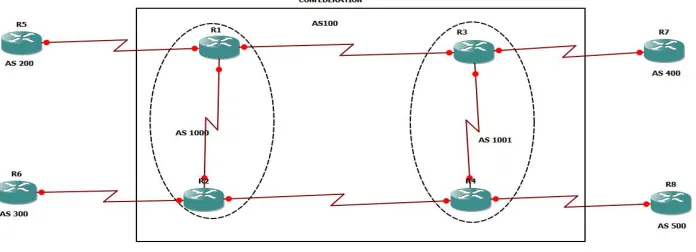
Figure 2.Confederation of Autonomous System 100
loss mainly occurred due to the fact that packet collision will occur in the transmission when there is change in the topology occur. This transmission is mainly in the same Autonomous System which is configured with the iBGP normally configured with OSPF.
IV.EXPERIMENTAL ANALYSIS
The experiments were carried in the Graphic Network Simulator (GNS3) software which is used to simulate the routers in the virtual environment, also to configure routers with various routing protocols. The topology is created using GNS3 emulation software based on BGP routing protocol environment in IPv4. The routers which were taken in the simulation were the CISCO priority routers of the series c7200 which supports all dynamic routing protocols in real environment. The interfaces used to connect the routers are the WAN links have the capacity 1.544Mbps to transfer the routing information between them.
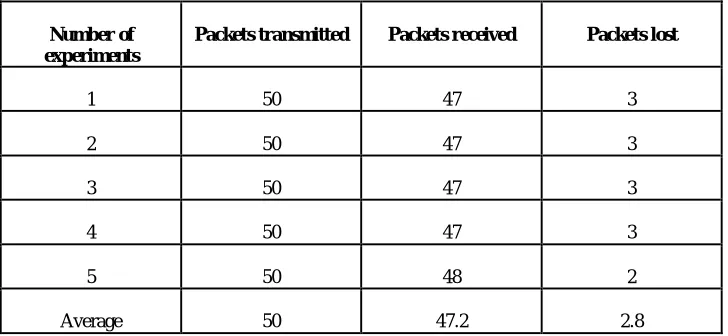
The existed results are also been tested with GNS3 software and the result were compared. The Local preference technique was used to reduce the packet loss which is due to the collision of packets, however the packet loss is reduced to 2.8 packets per link failure only.
Figure 3.Packet loss observation for local preference method
These experiments were repeated for 5 times and for each time the packet loss is measured after sending 50 ping packets each time. To verify the packet loss we use 50 ping packets from R1 to R2 using the ping command. During the pinging process we disconnect the link between R1 and R2, and then the traffic has to choose other path to reach to R3 via R2. The time taken to find alternate path is nothing but convergence time which is tabulated for 10 experiments in the following Table 1. We can observe that the average packet loss in the existing method is 2.8.
Number of experiments
Packets transmitted Packets received Packets lost
1 50 47 3
2 50 47 3
3 50 47 3
4 50 47 3
5 50 48 2
Average 50 47.2 2.8
The confederation process is shown in the below Figure 2. The Autonomous System is considered for confederation is AS100, and four routers were considered which are connected to external ASs through eBGP peers. Here the full mesh connectivity in AS100 is eliminated with the process of Confederation, by dividing AS into two Sub Autonomous Systems. The router 1 and router 2 were confederated as AS1000, and router 3 and router 4 were confederated as AS1001. In this sub AS the routers were connected each other with the help of WAN link. The performance of confederation is in terms of two parameters.
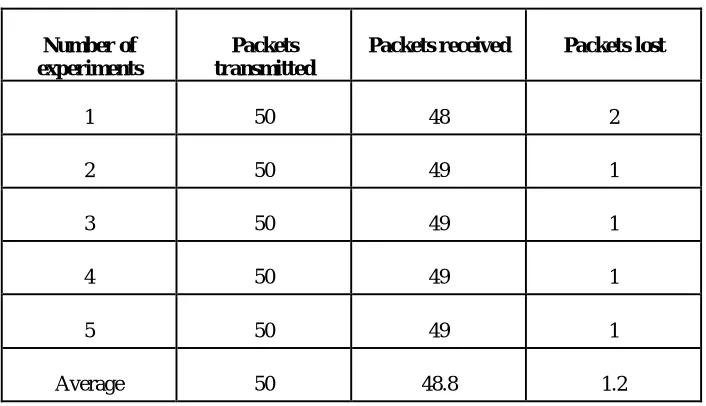
These experiments were repeated for Confederation technique, 5 times and for each time the packet loss is measured after sending 50 ping packets each time. To verify the packet loss we use 50 ping packets from R1 to R2 using the ping command. During the pinging process we disconnect the link between R1 and R2, and then the traffic has to choose other path to reach to R3 via R2. The time taken to find alternate path is nothing but convergence time which is tabulated for 10 experiments in the following Table 2. We can observe that the average packet loss in the existing method is 1.2.
Figure 4.Packet loss observation for Confederation method
Number of experiments
Packets transmitted
Packets received Packets lost
1 50 48 2
2 50 49 1
3 50 49 1
4 50 49 1
5 50 49 1
Average 50 48.8 1.2
V. RESULT COMPARISON
Packet loss is minimized in the Confederation approach as compared to the existing method which was local preference. The packet loss was not reduced after 2.8, but in our proposed method the technique is introduced to reduce the packet loss. In the proposed method by using the Confederation technique is used to reduce the packet loss to 1.2. The average packet loss for the two methods was tabulated in the Tables, the confederation is giving less packet loss 1.2 when compared to 2.8 and is tabulated in table 3.
iBGP TECHNIQUE Average Packet loss
Local Preference 2.8
Confederation 1.2
Table 3.Round trip time comparison for two BGP approaches
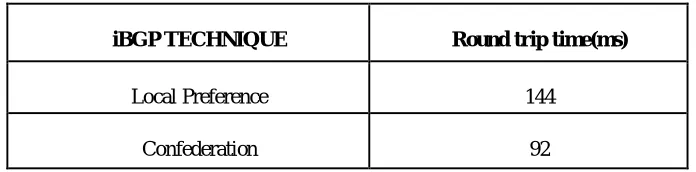
The round trip time is also calculated for each method, it is also improved as compared to the Local preference which was existed method. This round trip time for the proposed method is reduced to 92ms. The comparison of Round trip time for two methods is tabulated in below table 4.
iBGP TECHNIQUE Round trip time(ms)
Local Preference 144
Confederation 92
Table 4.Round trip time comparison for two BGP approaches
VI.CONCLUSION AND FUTURE WORK
The aim of this paper is proposing approaches to reduce looping problem, packet loss is used as a metric to estimate the effect of looping problem. With the proposed method which is Confederation the packet loss is considerably reduced as compared to existing methods. This approach was verified in GNS3 software with routers connected with both Ethernet and WAN interfaces. However BGP configuration with different approaches requires lot of knowledge on specific networks and also requires network management practice. This paper gives some detail about approaches to be used to avoid looping problems, and this is a wide research area that has just started exploring.
REFERENCES
1. Kin-Hon Ho, George Pavlou, Stylianos Georgoulas and Mina Amin, “A Route Deflection Approach to Minimize Routing Disruptions for Inter-AS Traffic Engineering,” in the context of FP6 Information Society Technologies AGAVE project, 2006.
2. Shalley Bakshi and Ms. Suman, “Opnet Based simulation foe route redistribution in EIGRP, BGP and OSPF network protocols,” IOSR Journal of Electronics and Communication Engineering, vol. 9, Issue 1, pp. 47-52, Jan. 2014.
3. Cristina-Loredana Duta, Laura Gheorghe and Nicolae Tapus, ‘Analyse OSPF Convergence Time in the Presence of Single and Multiple Failures’, The Seventh International Conference on Emerging Networks and Systems Intelligence, pp. 72-78, 2015.
4. D.Sankar and D.Lancaster, “Routing Protocol Convergence comparison using Simulation and Real Equipment,” Advances in a Communications, Computing, Network and Security 10, pp. 186-194, 2003.
5. Thomas C. Bressoud, Rajeev Rastogi and Mark A. Smith, “Optimal Configuration for BGP Route Selection,” IEEE INFOCOM, 2003.
6. Feng Wang, Jian Qiu and Jia Wamg, “On Understanding Transient Interdomain Routing Failures,”IEEE/ACM Transactions on Networking, pp. 740-751, July 2010. 7. Ahmed Elmokashfi and Amund Kvalbein, “On The Scalability of BGP: the Role of Topology Growth,” ACM International Conference on emerging Networking
Experiments and Technologies, pp. 1-12, 2008.