ABSTRACT
MOTT, BRADFORD WAYNE. Decision-Theoretic Narrative Planning for Guided Exploratory Learning Environments. (Under the direction of James C. Lester and R. Michael Young.)
Interactive narrative environments have been the focus of increasing attention in recent years. A key challenge posed by these environments is narrative planning, in which a
D
ECISION
-T
HEORETIC
N
ARRATIVE
P
LANNING FOR
G
UIDED
E
XPLORATORY
L
EARNING
E
NVIRONMENTS
BY
B
RADFORDW.
M
OTTA DISSERTATION SUBMITTED TO THE GRADUATE FACULTY OF
NORTH CAROLINA STATE UNIVERSITY
IN PARTIAL FULFILLMENT OF THE
REQUIREMENTS FOR THE DEGREE OF
DOCTOR OF PHILOSOPHY
COMPUTER SCIENCE
RALEIGH, NORTH CAROLINA
MARCH 2006
This work is dedicated to my wife, Seunghee, whose love and encouragement made it possible, to my children, Justin and Megan, whose enthusiasm inspired me to complete it,
Biography
Bradford W. Mott grew up in the rural town of Harrells, North Carolina where he attended the local elementary school and worked on the family farm. In middle school he developed a love of science and technology and received his first computer, an Atari 1200XL, as a Christmas gift. Thereafter, much of his time was spent developing video games and teaching himself to program in BASIC, 6502 assembly, Pascal, and C. While attending Union High School in Sampson County, he continued to develop his programming skills and published several original programs in national magazines.
After graduating from high school, he attended North Carolina State University to pursue a Bachelor of Science degree in Computer Science. He added Computer Engineering as a second major during his sophomore year at NC State. Throughout his undergraduate career, he significantly enriched his knowledge of Computer Science and Computer Engineering and gained valuable real-world experience working in the Cooperative Education Program for Nortel Networks and IBM. In 1992, he met his future wife, Seunghee, an undergraduate in the Department of Mathematics at NC State. In 1994, he earned Bachelor of Science degrees in both Computer Science and Computer Engineering.
Acknowledgments
First and foremost, I would like to thank my committee members, Patrick FitzGerald, James Lester, Rob St. Amant, and Michael Young for their support during my Ph.D. studies. Each of them has assisted me greatly over the years.
My co-advisors, Michael Young and James Lester, have provided me with tremendous support during my studies. Michael Young has been a great source of encouragement over the years and ensured that I continued to make progress while venturing out into the real world. James Lester has been a trusted advisor, an energetic mentor, and a good friend during the past seven years. I am forever grateful to Michael Young and James Lester for their tireless efforts to continuously go above and beyond the call of duty to help me be successful.
I have had the pleasure to study with and learn from a number of talented students while in the Computer Science Department at NC State including: Thomas Alspaugh, Tiffany Barnes, Zeynap Dayar, Marty Dulberg, Dan DuVarney, Laura Grochocinski, Jatin Hansotys, Laura Jackson, Greg Kaszycki, Carl Hobson, Ernest Pasour, Steve Sims, Brian Stone, and Brian Young. Within the IntelliMedia group at NC State, I have benefited greatly from working with an amazing group of students including: William Bares, Charles Callaway, Mike Cuales, Brent Daniel, Francis Fong, Ben Lee, Seung Lee, Sunyoung Lee, Alex Levy, Scott McQuiggan, Phil Motley, Dennis Rodriguez, Gary Stelling, Stuart Towns, Luke Zettlemoyer, and Wei Zhang. I have enjoyed the helpful assistance and insightful discussions with members of the Liquid Narrative group at NC State including: Leo Bae, Matt Baker, Pat Cash, Yuna Cheong, David Christian, Nick Darnell, Oliver Grey, Eunyoung Ha, Justin Harris, Arnav Jhala, James Niehaus, Mark Riedl, Jim Thomas, and Tommy Vernieri. There are numerous other students and professors at NC State that have been helpful over the years and their assistance is greatly appreciated.
Table of Contents
LIST OF TABLES...ix
LIST OF FIGURES...x
CHAPTER 1 INTRODUCTION...1
1.1INTERACTIVE NARRATIVE...2
1.2NARRATIVE-CENTERED GUIDED EXPLORATORY LEARNING...3
1.3INTERACTIVE NARRATIVE GENERATION...4
1.4CONTRIBUTIONS...5
1.5DISSERTATION ORGANIZATION...7
CHAPTER 2 NARRATIVE GENERATION ...9
2.1REVIEW OF NARRATIVE GENERATION SYSTEMS...10
2.1.1 Non-interactive Narrative Generation Systems ...11
2.1.1.1TALE-SPIN... 11
2.1.1.2UNIVERSE... 12
2.1.1.3MINSTREL... 13
2.1.1.4JOSEPH... 14
2.1.1.5AUTHOR... 14
2.1.1.6FABULIST... 15
2.1.2 Interactive Narrative Generation Systems ...17
2.1.2.1OZ PROJECT... 18
2.1.2.2DOGMATIC... 20
2.1.2.3TEATRIX... 21
2.1.2.4I-STORYTELLING... 22
2.1.2.5MISSION REHEARSAL EXERCISE PROJECT... 23
2.1.2.6MIMESIS... 23
2.1.2.7FAÇADE... 24
2.1.2.8IDA... 25
2.2DESIDERATA FOR INTERACTIVE NARRATIVE GENERATION...26
CHAPTER 3 DECISION-THEORETIC NARRATIVE PLANNING ...28
3.1U-DIRECTOR ARCHITECTURE...29
3.2HTNPLANNING FOR PLOT GRAPH CONSTRUCTION...30
3.3DECISION-THEORETIC DIRECTOR AGENT NETWORKS...32
3.3.1 Dynamic Decision Networks...32
3.3.2 Director Agent DDNs...33
3.4USER GOAL RECOGNITION...36
CHAPTER 4 NARRATIVE PLANNING FOR GUIDED EXPLORATORY LEARNING...41
4.1GUIDED EXPLORATORY LEARNING...42
4.2NARRATIVE-CENTERED GUIDED EXPLORATORY LEARNING...43
4.3GUIDED EXPLORATORY LEARNING ARCHITECTURE...46
4.3.1 Dual Planning Spaces...48
4.3.1.1 Tutorial Planning Space ... 49
4.3.2 Narrative-Centered Tutorial Planning ...50
CHAPTER 5 AN IMPLEMENTED NARRATIVE PLANNER ...52
5.1THE CRYSTAL ISLAND STORYWORLD...52
5.2THE OUTBREAK EPISODE...57
5.3IMPLEMENTATION...58
5.3.1 Interactive 3D Environment...58
5.3.2 Hierarchical Task Network Planner ...61
5.3.3 Director Agent Network ...63
5.3.4 Goal Recognition Corpus Acquisition ...69
5.4SAMPLE SCENARIO IN CRYSTAL ISLAND...71
CHAPTER 6 EVALUATION...73
6.1RUNTIME PERFORMANCE EVALUATION...74
6.2GOAL RECOGNITION EVALUATION...75
6.3STRUCTURED NARRATIVE EVALUATION...78
6.3.1 Method ...78
6.3.1.1 Participants and Design... 79
6.3.1.2 Materials and Apparatus... 79
6.3.1.3 Procedure ... 80
6.3.2 Results...82
6.3.3 Discussion...84
CHAPTER 7 CONCLUSION...85
7.1LIMITATIONS...86
7.2FUTURE WORK...87
7.3CONCLUDING REMARKS...88
REFERENCES ...90
APPENDIX A OUTBREAK SPECIFICATION ...103
A.1DOMAIN SPECIFICATION...103
A.2PROBLEM SPECIFICATION...108
List of Tables
TABLE 6-1:RESPONSE TIMES FOR BAYESIAN INFERENCE ALGORITHMS...74
TABLE 6-2:RESPONSE TIMES FOR BLOCKS WORLD HTNPLANNING...75
TABLE 6-3:GOAL RECOGNITION RESULTS...77
TABLE 6-4:PARTICIPANT INTERACTION TIME...82
TABLE 6-5:NUMBER OF PARTICIPANT ACTIONS IN THE ENVIRONMENT...82
TABLE 6-6:NUMBER OF MANIPULATIVE PARTICIPANT ACTIONS IN THE ENVIRONMENT...83
TABLE 6-7:NUMBER OF MOVEMENT-BASED PARTICIPANT ACTIONS IN THE ENVIRONMENT...83
List of Figures
FIGURE 2.1:ATALE-SPIN STORY...12
FIGURE 2.2:AUNIVERSE PLOT FRAGMENT...13
FIGURE 2.3:AMINSTREL STORY...14
FIGURE 2.4:THE AUTHOR ARCHITECTURE...15
FIGURE 2.5:AFABULIST NARRATIVE PLAN...16
FIGURE 2.6:THE OZ ARCHITECTURE...18
FIGURE 2.7:AN OZ PLOT GRAPH...19
FIGURE 2.8:THE OZ PROJECT WOGGLES IN THE EDGE OF INTENTION...20
FIGURE 2.9:DOGMATIC ARCHITECTURE...21
FIGURE 2.10:TEATRIX 3DCOLLABORATIVE ENVIRONMENT...22
FIGURE 2.11:FRAGMENT OF A HIERARCHICAL TASK NETWORK FOR AN I-STORYTELLING CHARACTER...23
FIGURE 2.12:AMISSION REHEARSAL EXERCISE PROJECT SCENE...24
FIGURE 2.13:THE MIMESIS SYSTEM ARCHITECTURE...24
FIGURE 2.14:FAÇADE USER INTERACTION...25
FIGURE 2.15:EXAMPLE IDA PLOT POINTS...26
FIGURE 3.1:U-DIRECTOR ARCHITECTURE...30
FIGURE 3.2:DIRECTOR AGENT DYNAMIC DECISION NETWORK...33
FIGURE 3.3:SELECTED ELEMENTS OF PLOT FOCUS AND PLOT PROGRESS SUB-NETWORKS...35
FIGURE 4.1:GUIDED EXPLORATORY LEARNING U-DIRECTOR ARCHITECTURE...46
FIGURE 5.1:CRYSTAL ISLAND RESEARCH STATION...53
FIGURE 5.2:CHARACTERS IN THE CRYSTAL ISLAND STORYWORLD...54
FIGURE 5.3:MAP OF THE CRYSTAL ISLAND STORYWORLD...55
FIGURE 5.4:CRYSTAL ISLAND STORYWORLD CAMP FACILITIES...56
FIGURE 5.5:BRYCE REID SICK IN HIS BEDROOM...57
FIGURE 5.6:CRYSTAL ISLAND CAMP CREATION WITH HAMMER...59
FIGURE 5.7:SAMPLE OUTBREAK DIRECTOR AGENT NETWORK...68
FIGURE 5.8:STORYWORLD GOAL RECOGNITION DOMAIN ELEMENTS...70
FIGURE B.1:KEYBOARD AND MOUSE CONTROL HANDOUT...111
FIGURE B.2:CRYSTAL ISLAND BACKSTORY HANDOUT...112
FIGURE B.3:CRYSTAL ISLAND CHARACTER HANDOUT...113
FIGURE B.4:MAP HANDOUT OF THE CRYSTAL ISLAND ENVIRONMENT...114
Chapter 1
Introduction
Recent years have witnessed a growing interest in narrative. Originally confined to frameworks developed by literary critics, narrative analysis is now being adopted by those seeking to extend the foundations of psychology (Bruner 1990; Bruner 1991), cognitive models of reading comprehension (Gerrig 1993), and film theory (Branigan 1992). Narrative experiences are powerful and seem to play a central role in memory by providing an organizing structure for new experiences and knowledge (Mandler 1984). It is becoming apparent that narrative can be used as an effective tool for exploring the structure and process of meaning making, whether the object of analysis be everyday life, the novel, or film.
In a parallel development, the AI community has become aware of the possibility that narrative may well have something to offer them as well (Mateas and Sengers 2003). By creating computational models of narrative processes, it becomes possible to create intelligent entertainment, education, and training systems that combine the benefits of narrative and interactivity (Bates 1992; Cavazza, Charles, and Mead 2002; Galyean 1995; Gordon et al. 2004; Hayes-Roth and van Gent 1996; Jhala and Young 2004; Laurel 1986; Loyall 1997; Magerko et al. 2004; Mateas and Stern 2005; Mott and Lester 2006; Nelson and
Mateas 2005; Riedl, Saretto, and Young 2003; Riedl and Young 2004; Seif El-Nasr and Horswill 2003; Swartout et al. 2001; Weyhrauch 1997; Young and Riedl 2003).
1.1
Interactive Narrative
Narrative plays a central role in communication and cognition. With the demand for increasingly sophisticated entertainment and education applications, recent years have witnessed significant growth in research on interactive storytelling environments that create engaging narrative experiences (Cavazza, Charles, and Mead 2002; Magerko et al. 2004; Mateas and Stern 2005; Swartout et al. 2001; Young and Riedl 2003).
One of the most intriguing possibilities raised by combining narrative and interactivity is the potential to create narrative-centered learning environments (Aylett et al. 2005; Johnson
et al. 2004; Machado, Brna, and Paiva 2001; Marsella, Johnson, LaBore 2003; Marshall, Rogers, and Scaife 2002; Mott et al. 1999; Mott et al. 2006; Prada, Machado, and Paiva 2000; Riedl et al. 2005; Robertson and Good 2003; Ryokai, Vaucelle, and Cassell 2003). By taking advantage of the inherent structure of narrative, narrative-centered learning environments could provide engaging worlds in which students are actively involved in “story-centric” problem-solving activities. Classically, intelligent tutoring systems (Carbonell 1970) were envisioned as essentially dialogue systems that would emulate the conversational give-and-take of tutorial discourse. In contrast, narrative-centered learning environments could revolve around compelling virtual worlds, believable characters, thought provoking themes, and rich stories.
Because of the motivational force of narrative, it has long been believed that story-based learning can be both engaging and effective. Many educational software packages have been devised for story-based learning. These systems include both research prototypes and a long line of commercially available software. However, these systems have primarily relied on scripted forms of narrative: they have employed either predefined linear plot structures or simple branching storylines. In contrast, one can imagine a much richer form of narrative learning environment that dynamically crafts customized stories for individual students at runtime.
educational software. This in turn has the potential to dramatically increase the time that children seek to spend with educational software. As a result, narrative-centered learning environments could produce follow-on gains in learning effectiveness from time-on-task effects.
1.2
Narrative-Centered Guided Exploratory Learning
Narrative could play an important role in exploration-based discovery learning (Bruner 1961), an approach to learning that emphasizes students’ active exploration of a subject matter. In stark contrast to didactic pedagogies that emphasize students’ memorization of facts from lectures and reading, discovery learning encourages students to learn by trial-and-error: they pose questions and answer them by conducting experiments, manipulating artifacts in physical or simulated environments, analyzing information, and systematically generating and testing their hypotheses (Bruner 1961; White and Fredricksen 1998).
It is widely believed that discovery learning offers much promise because students actively participate in problem-solving activities. For more than a decade, science education reform efforts by organizations such as the US National Research Council and the National Academy of Sciences have set forth standards promoting a greater emphasis on discovery learning (American Association for the Advancement of Science 1993; National Research Counsel 1996). However, it has been demonstrated that “pure” discovery learning in which students receive no guidance in the form of coaching and hints from a teacher or learning environment is ineffective (Mayer 2004). Thus, guided discovery learning (Shulman and Keisler 1966) and guided discovery learning environments (de Jong and van Joolingen 1998) have been the subject of increasing attention in recent years.
1.3
Interactive Narrative Generation
A critical requirement of narrative learning environments is devising effective computational models of interactive narrative (Aylett 1999; Cavazza, Charles, and Mead 2002; Magerko et al. 2004; Mateas 2002; Nelson and Mateas 2005; Riedl, Saretto, and Young 2003; Weyhrauch 1997). These models support narrative planners that dynamically direct a cast of believable virtual characters in rich 3D storyworlds with coherent narrative structures that play out interactively in real time.
Narrative planners for interactive storytelling environments operate on at least two distinct but interacting levels: They craft the global story arc, typically by traversing a plot graph (Bates 1992) that encodes a partial order of significant events in a story, and they plan the behaviors of the virtual characters and physical events in the world (Blumberg and Galyean 1995; Loyall et al. 2004). To create an engaging experience for the user, narrative planners must carefully balance character believability and plot coherence (Riedl and Young 2004), cope with deviations from a previously devised narrative structure caused by user actions (Magerko et al. 2004; Riedl, Saretto, and Young 2003), provide fine-grained character control (both dialogue and actions) (Mateas and Stern 2005), all the while creating stories that obey the author’s aesthetic, perhaps represented as an evaluation function that guides a search through a plot graph (Bates 1992; Nelson and Mateas 2005; Weyhrauch 1997). Narrative planners must also interface with believable agent functionalities supporting the story’s virtual characters (Gratch and Marsella 2004; Loyall et al. 2004; Si et al. 2005).
our predictions might be over very short periods, they become even less accurate as we attempt to predict effects farther into the future.
Despite recent advances in plan and goal recognition, narrative environments currently lack a key functionality that could significantly increase their ability to create compelling stories: they cannot recognize users’ goals as the users interact with virtual storyworlds. Providing narrative planners with the ability to accurately recognize users’ goals would enable planners to ascertain whether a user’s actions were threatening a plot (Riedl, Saretto, and Young 2003), take user goals into account in plot construction (Harris and Young 2005), and ensure that stories steadily progress (Magerko et al. 2004). However, narrative goal recognition is challenging because interactive narratives play out in highly dynamic virtual environments in which users have the freedom to explore complex storyworlds as they perform a broad range of actions in pursuit of their quests.
The high degree of uncertainty, together with the multiple factors affecting narrative planning, call for a principled decision-making framework that enables narrative planners to rationally choose among candidate storyworld actions. The framework must not only be able to effectively cope with uncertainty, it must be able to exploit the evidence available about the user and storyworld state to achieve the (possibly competing) narrative objectives, and it must be able to meet the real-time performance requirements of interactive environments.
1.4
Contributions
This dissertation makes a number of contributions which advance the state-of-the-art in interactive narrative generation:
decision-making framework allows the architecture to rationally choose among candidate storyworld actions.
• Inferring user goals for narrative planning: We present an inductive approach to predicting users’ goals in dynamic narratives by learning probabilistic goal recognition models. We report on two types of n-gram goal recognition models: unigrams and bigrams. The models, which exploit knowledge of narrative structure as well as locational and temporal information about users’ activities in the world, are induced from training data acquired from traces of users’ performing narrative quests in a storyworld.
• Integration of tutorial control and narrative planning: We develop a model of narrative planning which combines narrative planning and tutorial control via a hierarchical task network (HTN) planner operating in two coordinated planning spaces. In the tutorial planning space, the planner constructs tutorial plans to achieve pedagogical goals such as topic sequencing, problem introduction, problem solving, and advice generation. In the narrative planning space, the planner constructs narrative plans to achieve story goals such as how to direct the characters’ actions, how to devise coherent plots, and how to create engaging experiences for the student. The dual planning space approach achieves modularity for authoring and maintenance of plan operators, and it enables the planner to guide the student’s actions at both the pedagogical and narrative levels.
• An empirically studied model of user goal recognition for narrative planning: We report on the empirical evaluation of probabilistic goal recognition models in a narrative-centered environment. Experimental results suggest that probabilistic models can accurately predict users’ goals, and they converge on correct interpretations as observations of a user’s activities become available over time. Probabilistic goal recognizers are also sufficiently efficient to meet the real-time performance demands of interactive narrative.
useful guidance to users interacting in the virtual environment allowing them to successfully accomplish their goals within the story in fewer actions and in less time while not disrupting their narrative experience.
1.5
Dissertation Organization
The organization of the remainder of the dissertation is as follows. In Chapter 2, we summarize related narrative generation work. The task of interactive narrative generation is described along with various approaches that have been previously taken for narrative generation. We conclude this chapter by presenting the key issues and desiderata for interactive narrative generation.
We present the U-DIRECTOR narrative planning architecture in Chapter 3. First, we describe an HTN-based approach to plot graph planning. Second, we present our decision-theoretic director agent. Finally, we discuss an n-gram based approach to user goal recognition within a narrative environment.
Chapter 4 introduces guided exploratory learning and discusses the role of narrative in guided exploratory learning together with the potential effects on students’ motivation. The challenges faced by guided exploratory learning environments and the role that narrative can play in their creation are discussed. Finally, building on the architecture presented in Chapter 3, a narrative-centered architecture for guided exploratory learning is presented.
In Chapter 5, we introduce the CRYSTAL ISLAND storyworld along with the OUTBREAK episode situated within it. Details of the prototype narrative-centered guided exploratory learning environment are provided including a discussion of the implementation of the interactive 3D environment, the HTN-based plot graph planner, the decision-theoretic director agent, and the goal recognizers. The chapter concludes with an illustrated example of the planner’s behavior using a scenario.
Chapter 2
Narrative Generation
Narrative experiences are powerful, and there is growing awareness of narrative’s foundational role in psychology (Bruner 1990; Bruner 1991), cognitive models of reading comprehension (Gerrig 1993), and film theory (Branigan 1992). In Gerrig’s seminal work on comprehension (Gerrig 1993), he identifies two properties that readers experience. First, they are transported, i.e., they are somehow taken to another place and time in a manner that is so compelling it seems real. Second, they perform the narrative. Like actors in a play, they actively draw inferences and experience emotions as if the experiences were somehow real. Because narrative is compelling on many levels, interactive applications in entertainment, education, and training increasingly leverage narrative to create engaging experiences through rich virtual storyworld environments.
Learning environments may utilize narrative to their advantage both from a cognitive and motivational perspective. One can imagine narrative-centered learning environments that leverage a student’s innate metacognitive apparatus for understanding and crafting stories as well as narrative-centered learning environments that offer motivational benefits. Motivation
Listening to both sides of a story will convince you that there is more to a story than both sides.
is critical in learning environments, for it is clear that from a practical perspective, educational software that fails to engage students will go unused. In Malone’s classic work on motivation in computer games and educational software (Malone 1981a), he distinguishes between game playing experiences (and educational experiences) that are extrinsically motivating and those that are intrinsically motivating. In contrast to extrinsic motivation,
intrinsic motivation stems from the desire to undertake activities sheerly for the immediate pleasure to be derived from them. By emphasizing qualities such as challenge, curiosity, control, and fantasy, Malone argues that learning environments can create intrinsically motivating experiences (Malone 1981b). Hence, in addition to their potential cognitive benefits, narrative-centered learning also offers significant potential for providing intrinsic motivation.
Although significant potential exists for narrative-center environments, a critical component of realizing this potential is creating effective computational models of narrative (Aylett 1999; Cavazza, Charles, and Mead 2002; Magerko et al. 2004; Mateas 2002; Nelson and Mateas 2005; Riedl and Young 2004; Weyhrauch 1997). These models must be capable of dynamically directing a cast of believable virtual characters in rich 3D storyworlds with coherent narrative structures that play out interactively in real time.
Early work in computational models of narrative dates back to the 1970s when researchers began exploring the notion of stories and how to best represent them (Mateas and Sengers 1999). In “Notes on a Schema for Stories” (Rumelhart 1975), David Rumelhart suggests that stories have an internal structure, which is more than a simple sequence of sentences. To illustrate this point, he develops a context-free grammar which he claims accounts for the structure of a wide range of simple stories. The grammar consists of a set of syntactic rewrite rules as well as a set of semantic interpretation rules. After developing the grammar, he applies it to a set of Aesop’s Fables to discover their underlying structure. Since the 1970s, a large number of computational models of narrative generation have been proposed.
2.1
Review of Narrative Generation Systems
form of user interaction. Typically, these systems focus on the dynamic creation of narrative based on an initial story specification provided by the user and their output usually takes the form of narrative prose. On the other hand, the key distinguishing feature of interactive
narrative generation systems are their focus on immersing users in an unfolding narrative in which the users’ actions directly influence the course of the narrative. Typically, these systems explore techniques to manage the user interaction and subtly guide them in support of the narrative. The output of these systems usually occurs in an interactive 3D environment in which users play the role of a storyworld character.
2.1.1
Non-interactive Narrative Generation Systems
Many non-interactive story generation systems have been the subject of research over the past three decades. A review of the most relevant systems is provided below.
2.1.1.1
T
ALE-S
PIN2.1.1.2
U
NIVERSEUNIVERSE (Lebowitz 1984; Lebowitz 1985) is a story generation system that uses a planning
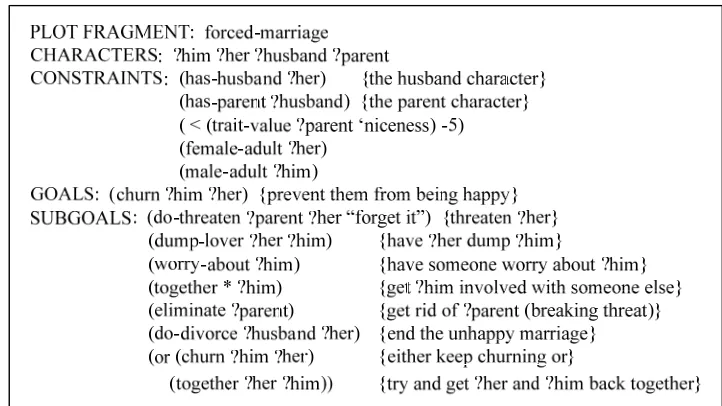
approach to generate open-ended “soap opera” style stories. It consists of two main components: a character generation system and a planning mechanism. The character generation system produces a cast of characters used by the planning mechanism during story creation. The planning mechanism creates a story by planning over plot fragments taken from the soap opera genre. For example, Figure 2.2 shows the forced-marriage plot fragment in which the protagonist is kept in an unhappy marriage, preventing her from being with her true love, by an evil parent-in-law (Lebowitz 1985, p. 487). One of the key distinctions between UNIVERSE and previous story generation systems is that the planning mechanism utilizes authorial goals instead of character goals. Lebowitz’s rationale for this is that stories produced solely by simulating character goals are not always interesting since characters tend to avoid conflict. Therefore, he advocates, using authorial goals that introduce conflict between characters and place them in situations they would not normally
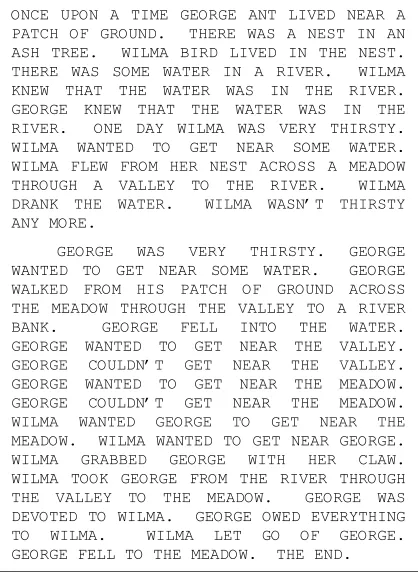
ONCE UPON A TIME GEORGE ANT LIVED NEAR A PATCH OF GROUND. THERE WAS A NEST IN AN ASH TREE. WILMA BIRD LIVED IN THE NEST. THERE WAS SOME WATER IN A RIVER. WILMA KNEW THAT THE WATER WAS IN THE RIVER. GEORGE KNEW THAT THE WATER WAS IN THE RIVER. ONE DAY WILMA WAS VERY THIRSTY. WILMA WANTED TO GET NEAR SOME WATER. WILMA FLEW FROM HER NEST ACROSS A MEADOW THROUGH A VALLEY TO THE RIVER. WILMA DRANK THE WATER. WILMA WASN’T THIRSTY ANY MORE.
GEORGE WAS VERY THIRSTY. GEORGE WANTED TO GET NEAR SOME WATER. GEORGE WALKED FROM HIS PATCH OF GROUND ACROSS THE MEADOW THROUGH THE VALLEY TO A RIVER BANK. GEORGE FELL INTO THE WATER. GEORGE WANTED TO GET NEAR THE VALLEY. GEORGE COULDN’T GET NEAR THE VALLEY. GEORGE WANTED TO GET NEAR THE MEADOW. GEORGE COULDN’T GET NEAR THE MEADOW. WILMA WANTED GEORGE TO GET NEAR THE MEADOW. WILMA WANTED TO GET NEAR GEORGE. WILMA GRABBED GEORGE WITH HER CLAW. WILMA TOOK GEORGE FROM THE RIVER THROUGH THE VALLEY TO THE MEADOW. GEORGE WAS DEVOTED TO WILMA. GEORGE OWED EVERYTHING TO WILMA. WILMA LET GO OF GEORGE. GEORGE FELL TO THE MEADOW. THE END.
find themselves in. In UNIVERSE, the lives of the characters are simulated based on the authorial goals taken from the plot fragments. Once a sufficiently large body of events has been planned out, that portion of the story is told. This approach allows UNIVERSE to produce a continuous sequence of events for a story that theoretically does not end.
2.1.1.3
M
INSTRELMINSTREL (Turner 1994) is a story generation system operating in the domain of King Arthur
and his Knights. It uses case-based reasoning to implement a computational model of creativity. Figure 2.3 shows a sample story generated by MINSTREL (Turner 1994, p. 9). In Turner’s system, story generation is modeled as author problem-solving using four types of authorial goals: thematic goals (i.e., theme the story should demonstrate), consistency goals (i.e., obeying expectations of how things in the storyworld should work), drama goals (i.e., suspense, tragedy, foreshadowing, and characterization), and presentation goals (i.e., how and when elements of the story are presented). The system begins with the top-level goal to “tell a story,” which is decomposed into sub-goals including adopting a theme, communicating the theme, applying drama goals, ensuring consistency, and achieving presentation goals. MINSTREL uses a case library of stories to solve problems by analogizing them with the current problem solving situation.
2.1.1.4
J
OSEPHJOSEPH (Lang 1997) is a story generation system that uses a definite clause story grammar to
create simple folktales. The model was developed to be independent of the process author’s use when writing stories, general enough to apply to folktales, and detailed enough to rule out the generation of non-stories. JOSEPH consists of a story grammar, a grammar interpreter, temporal predicates, a world model, and a template-based natural language output unit. It produces randomly generated narratives that conform to the story grammar using a depth-first iterative deepening algorithm searching for a sequence of rule applications representing a valid story.
2.1.1.5
A
UTHORAUTHOR (Callaway and Lester 2002) is a narrative prose generator which provides high
quality textual output for narratives. Unlike previous narrative systems which focused primarily on narrative generation via planning or story grammars and utilized simple template based approaches to generating their prose, AUTHOR’s focus is on using deep natural language generation techniques to construct narratives prose comparable to that of
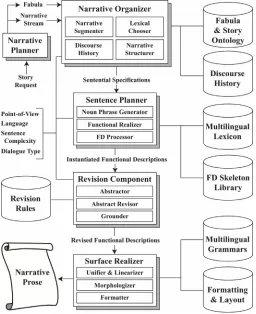
human authors. The input to the narrative prose generator is created using a simple augmented finite state automaton which generated narrative events in the domain of fairy tales. Figure 2.4 (Callaway 2000, p. 84) shows the AUTHOR architecture, which is based on a classic natural language generation pipeline approach consisting of a narrative organizer, a sentence planner, a revision component, and a surface realizer. A formal evaluation of the system with twenty test subjects concluded that the discourse history and revision components are extremely important while the lexical choice component sometimes makes a significant different.
2.1.1.6
F
ABULISTFABULIST (Rield 2004; Riedl and Young 2004) is a narrative generation system that focuses
on the construction of stories that carefully balance plot coherence (i.e., storyworld events are perceived to be meaningful and relevant to the story’s outcome) and character believability (i.e., character actions are perceived to be motivated by their traits and desires). It uses a
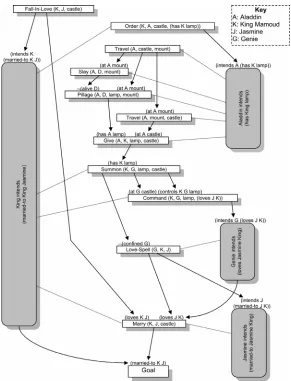
least-commitment planning system extended with an intention-recognition component and a model of character personality. The intention-recognition component ensures that the plan structures which are created are consistent with character intentions. The character personality model ensures that the character actions chosen by the planner are consistent with their personalities. Figure 2.5 (Reild 2004, p. 186) depicts a sample FABULIST generated narrative plan. Although these plans could be presented in a number of modalities, the media realizer used in Rield 2004 is a template-based generator that constructs textual representations of plans. An evaluation of the system indicates that the stories generated by
FABULIST have strong plot coherence and strong character believability.
2.1.2
Interactive Narrative Generation Systems
In the 1990s, a number of researchers began exploring the notion of interactive story generation. Inspired by ideas from successful commercial interactive fiction systems such as ZORK I (Infocom 1980), early non-interactive text based story generation systems (Meehan 1977; Leobowitz 1985), and the requirements of interactive drama (Laurel 1986), these researchers aimed to dynamically create immersive interactive stories taking the users’ actions in the storyworld into account to craft the unfolding narrative.
Approaches to interactive narrative generation can be roughly categorized into three broad groups:
• Script-Based Interactive Narrative: Early interactive narrative-based media were either partially or entirely scripted. All events were either completely linear or were ordered in a pre-determined branching structure (Bruckman 1990). However, the simplicity of the tree-like representations severely limited the level of interactivity that users could experience, and the combinatorics of highly interactive storyworlds could not be accommodated. The pre-scripted tradition lives on and thrives today; it is the approach used by most educational software and video games.
• Emergence-Based Interactive Narrative: Interactive narrative in this category relies on the dynamic interactions of the user and highly believable autonomous agents in a simulated world to construct a story from the emergent interactions. The autonomous agents in these environments typically act in a goal-directed manner and usually support reactive behaviors to cope with user interactions.
• Plan-Based Interactive Narrative: Plan-based interactive narratives dynamically reason about the actions of the user and characters to carefully piece together a story. They offer a promising alternative to pre-defined branching and emergent approaches. By allowing narratives to be created incrementally in response to users’ actions users can (legitimately) be made to believe that they are empowered as active participants in the story, thereby increasing their sense of agency and immersion (Murray 1997).
2.1.2.1
O
ZP
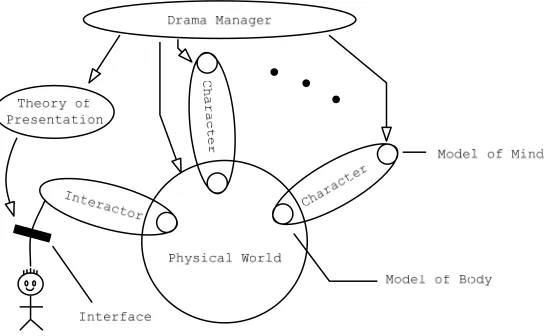
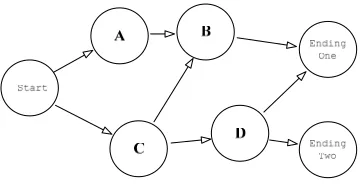
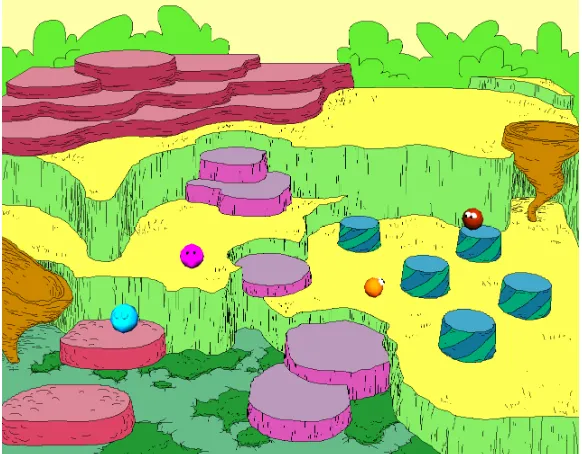
ROJECTThe members of the OZ Project at Carnegie Mellon University produced a large body of research related to interactive narrative generation during the 1990s. The ultimate goal of the project was to create computer-assisted writing environments for “high quality, artistically legitimate interactive fiction” (Smith and Bates 1989). The group members believed that to create artistically engaging experiences, the user must be able to “suspend disbelief” so that they can vividly imagine that the simulated world is in fact real. Based on preliminary experiments using live actors, they concluded that inconsistent behavior in characters is tolerable and that characters are the best agents for influencing the drama (Kelso, Weyhrauch, and Bates 1992). Thus, a significant amount of their research focuses on building believable animated agents such as the Woggles shown in Figure 2.8 (Loyall and Bates 1993). The OZ system architecture is shown in Figure 2.6 (Kelso, Weyhrauch, and Bates 1992, p. 2). It includes a simulated world, a cast of believable characters, the user’s interactor, and a drama manager. The drama manager uses plot graphs as depicted in Figure 2.7 (Kelso, Weyhrauch, and Bates 1992, p. 5) to model an interactive narrative’s plot. A plot graph is a directed acyclic graph modeling the major events of a story. The drama manager maintains a frontier of active nodes in the plot graph that can be currently achieved. Observing the actions of believable agents and the user in the storyworld, the drama manager continually decides if it should modify the behaviors of the believable agents or cause storyworld events to occur in order to keep the story progressing.
In order to create believable agents for the Oz Project, Bryan Loyall specified a set of requirements for believable agents and developed the HAP agent architecture (Loyall 1997). Loyall asserts that for an agent to be believable, it has to have a personality, emotions, self-motivation, undergo change, social relationships, consistency of expression, and the illusion of life. To address these requirements, Loyall created his agent architecture based on a RAP -like (Firby 1989) reactive planning language which provided personality-rich behaviors in real-time virtual worlds through goal decomposition.
Because appearing emotional and engaging in social interactions are important aspects of believable agents, Scott Reilly, one of the Oz Project members, developed the EM architecture (Reilly 1996) for building emotional agents with social behaviors. His architecture focuses on supporting the creation of agents in which the expression of emotions permeates the agent. The architecture creates the appearance of emotions by allowing certain events to generate emotion structures. These emotion structures, which are stored and decay over time, are used to generate behavioral features that affect specific aspects of the agent’s behavior. To validate the architecture, Reilly conducted user evaluations of both emotional and non-emotional agents. Based on the evaluations he concluded that EM was moderately successful at creating emotional characters.
Another Oz Project member, Peter Weyhrauch, developed a system to dynamically monitor and guide the experience of a user in an interactive narrative. The primary problem his system addresses is that, even though the author of an interactive narrative cannot control users’ actions, she still wants to ensure that users are exposed to a certain set of themes and ideas. To solve this problem, Weyhrauch developed the MOE architecture (Weyhrauch 1997), which uses adversarial search with an aesthetic evaluation function to guide the actions of a drama manager in an interactive narrative. The aesthetic evaluation function determines the
quality of an experience, so by searching over all the possible experiences, the highest quality experience can be found and the system can guide the user in its direction. Thus, by encoding the set of themes and ideas which are to be conveyed in the aesthetic evaluation function, the author guides the user’s experience in her preferred artistic direction. To judge the effectiveness of his architecture, Weyhrauch created an aesthetic evaluation function for a murder mystery inspired by Infocom’s text adventure game Deadline. Once the evaluation function was defined, it was subjectively rated based on how well it captured Weyhrauch’s desired aesthetic. Based on the results of the evaluation he concluded that it did in fact encode his aesthetic to a useful degree.
2.1.2.2
D
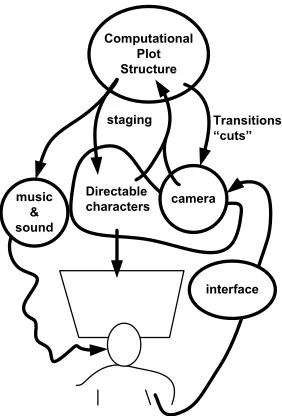
OGMATICIn Narrative Guidance of Interactivity (Galyean 1995), Tinsley Galyean advocates dividing narrative into two levels to produce interactive narrative: the plot level and the presentation level. The plot level represents the high level goals of the story while the presentation level
represents how the story is visually presented to the user. Galyean’s goal was to allow the user to participate in the narrative without disrupting the plot. To achieve this, he developed a narrative guidance approach where the system manipulates the presentation level to guarantee that the user is told the story regardless of their interaction. Thus at the plot level
every user experiences the same story, however, the exact details of the story vary from one user to another. Two interactive narrative systems were built using this approach: a museum exhibit, introducing visitors to virtual reality technology, and DOGMATIC, a short interactive story consisting of six scenes. Figure 2.9 (Galyean 1995, p 106) depicts the architecture used
in DOGMATIC. The plot is represented as a hierarchical collection of events whose selection
depends on story state variables, environmental sensors, and temporal relations between events. Parent events within the hierarchy temporally encompass their descendants and siblings are specified to either precede or be exclusive of one another; events can also specify whether they must happen or not. The system evaluates the events in the hierarchy each time step to identify which events are ready. The evaluation is accomplished by (1) selecting events based on their temporal constraints, (2) evaluating the sensor and state variable values associated with the selected events, and (3) determining if the sensor and state variable values are within event specified minimum and maximum thresholds. The system then chooses one of the ready events to execute and repeats until the end of the story is reached.
2.1.2.3
T
EATRIXTEATRIX is a prototype interactive learning environment that facilitates the collaborative
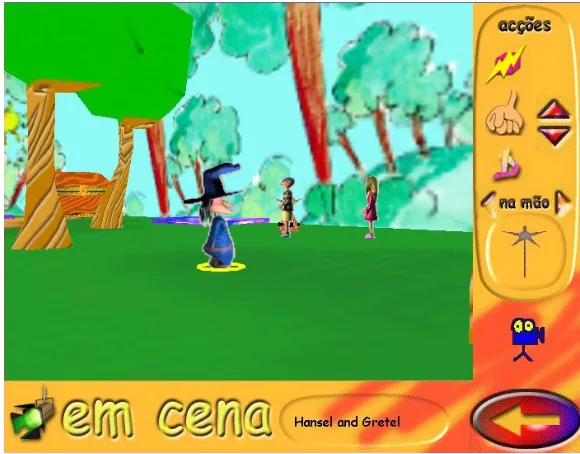
creation of fairy tales by students (Prada, Machado, and Paiva 2000). Students interact with one another in a distributed 3D environment playing the role of a character (Figure 2.10). In
Computational Plot Structure
music & sound
Directable
characters camera
Transitions “cuts” staging
interface
TEATRIX, a story is initially created by describing its starting state, including its scenes, characters, and world objects. Once the initial setup is complete, students enter the distributed 3D storyworld as one of the characters in the story. For characters not controlled by a student, the system automatically controls the character’s behavior in a goal directed manner based on its role. As students interact with each other in the environment through their virtual characters a story emerges. To help ensure that a coherent story emerges,
TEATRIX uses a director agent that has complete knowledge about the unfolding story, the
ability to direct agents in the storyworld, and manipulate objects in the world.
2.1.2.4
I-S
TORYTELLINGI-STORYTELLING is a prototype interactive narrative generation system that uses a
character-based approach to story generation for sitcom-like stories in which the plot is driven by the actions of characters (Cavazza, Charles, and Mead 2002). In I-STORYTELLING, the user is a spectator of the unfolding story having the ability to move around in the 3D storyworld, manipulate objects in the world (e.g., remove or change the location of objects), and provide advice to storyworld characters (e.g., “Ross, be nice to Monica”). The autonomous characters in the story are given goals and use hierarchical task network (HTN) planning to generate plans to achieve their goals. For example, Figure 2.11 (Cavazza, Charles, and Mead
2002, Figure 5) depicts part of the protagonist’s hierarchical task network for discovering information about one of the other characters. The network models the protagonist’s options of asking a friend about the character, borrowing the diary of the character, or talking with the character’s mother. In this case, the protagonist initially attempts to borrow the diary to learn more about the character; however, since the location of the diary changed, the protagonist was unable to pick it up and the system backtracks to attempt another option.
2.1.2.5
M
ISSIONR
EHEARSALE
XERCISEP
ROJECTThe MISSION REHEARSAL EXERCISE Project (Swartout et al. 2001) is a virtual reality training environment for teaching peacekeeping and disaster relief mission skills to Army personnel. The training environment revolves around an interactive story that unfolds in a rich 3D virtual environment depicted in Figure 2.12 (Swartout et al. 2001, Figure 1). The storyworld is populated with scripted and autonomous agents who act as both characters and coaches within the environment. To support both structured and unstructured interactivity, an approach to story generation call a StoryNet is employed. A StoryNet consists of nodes, in which users are given the freedom take control and make choices, and links between them, in which a scripted sequence of events occurs and the user remains passive. The links in the StoryNet contain conditions which must be achieved before the link can be followed to the next node in the net.
2.1.2.6
M
IMESISThe MIMESIS system (Young 2001; Young and Riedl 2003) is a two-tier architecture, Figure 2.13 (Riedl, Saretto, and Young 2003, Figure 1), in which user interaction is managed by the
Mimesis Unreal Tournament Server (MUTS) and adaptive narrative generation is preformed by the Mimesis Controller (MC). MIMESIS models narrative with a declarative plan structure, including causal link annotations, generated by a narrative planner. During an interactive session, the MUTS continuously monitors user actions to see if an exceptional action is attempted (i.e., an action which threatens a causal link in the narrative plan). If so, the system mediates the action (Riedl, Saretto, and Young 2003) by either accommodating the action (i.e., executing the action and restructuring the narrative plan to reestablish the causal link) or intervening (i.e., replacing the action with an alternate effect that does not break the causal link). In order to accommodate user’s exceptional actions, the MC opportunistically constructs mediation policies so that exceptional actions can be handled as quickly as possible.
2.1.2.7
F
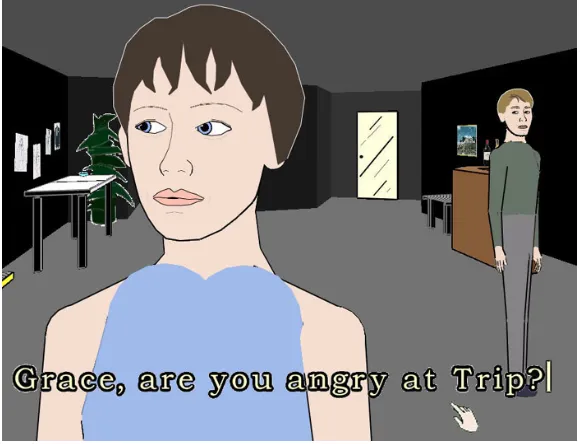
AÇADEFaçade (Mateas 2002; Mateas and Stern 2005) is a one-act interactive drama featuring tightly-coupled plot creation and character behavior in a dialogue-oriented interactive story. In Façade, the user visits her friends, Grace and Trip, and learns that their marriage is in serious trouble. Through her interactions—manipulating objects, navigating around the
Figure 2.12: A Mission Rehearsal Exercise Project Scene
apartment, and communicating via natural language dialog (Figure 2.14)—she affects the course of the unfolding drama. Façade uses a fine-grained drama manager, called a beat sequencer, which operates on plot elements called beats. Beats represent the smallest element of action that can move the story forward. They are written using a reactive behavior language based on Loyall’s HAP system (Mateas 2002). The drama manager sequences beats based on preconditions over the current story state and their potential for achieving a good story arc.
2.1.2.8
I
DAThe Interactive Drama Architecture (IDA) is being used to implement the Haunt 2 interactive storyworld (Magerko and Laird 2004; Magerko et al. 2004) in which the user plays a ghost in a murder mystery. IDA attempts to strike a balance between telling stories and providing users the ability to act freely in the storyworld. It employs an omniscient director agent that attempts to guide the user through a fully structured story. The director agent provides direction to storyworld characters to take actions to achieve plot elements based on its knowledge of the user’s actions and the plot’s progression. IDA models plot using a fully structured set of partially-ordered plot points, Figure 2.15 (Magerko 2005, Figure 2) which contain a set of preconditions (i.e., things which must be true for the plot point to be active) and a set of actions (i.e., things which happen when the plot point is active). A unique
feature of IDA is its use of a prediction mechanism to determine if user actions might threaten the plot. The prediction mechanism uses a simple rule-based model of user behavior to simulate future possible world states to determine if an active plot point will be achieved or not. The director agent uses this information to decide if it should provide assistance to the user or not.
2.2
Desiderata for Interactive Narrative Generation
Accomplishing the goal of creating dynamic interactive narrative is a challenging task because of the multiple sources of inherent uncertainty. First, it is difficult to precisely infer users’ goals, beliefs, and experiential attributes. It is difficult to accurately predict what effects changes in the storyworld may have on the user. Because it is important that users believe that their actions affect the ongoing story (Murray 1997), predicting the effects of narrative planning actions is further complicated by the fact that users are active participants in the narrative. Second, we do not have a complete theory of interactive narrative. We do not even have well defined theories of narrative for specific genres or particular storyworlds. Third, despite the episodic nature of narrative, however inaccurate our predictions might be over very short periods, they become even less accurate as we attempt to predict effects farther into the future.
The high degree of uncertainty, together with the multiple factors affecting narrative planning, call for a principled decision-making framework that enables narrative planners to rationally choose among candidate storyworld actions. The framework must not only be able
Chapter 3
Decision-Theoretic Narrative
Planning
A key challenge posed by narrative planning is coping with the significant uncertainty associated with the task. First, narrative planning must deal with unobservable aspects of the user. These include her beliefs about the storyworld, her goals, and her experiential state, such as her level of engagement. Being able to effectively reason about these user characteristics is essential for proper user-story mediation. For example, it is important to have an accurate picture of the user’s state to determine when and how to intervene or to accommodate the user’s actions (Harris and Young 2005; Magerko et al. 2004; Riedl, Saretto, and Young 2003). Second, we do not have available to us a formally represented theory of interactive narrative that supports sound and complete inference about story construction and its impact on the user. Further complicating the problems posed by uncertainty is the multitude of factors that bear on narrative decision-making activities. For example, narrative objectives such as ensuring plot progress and maintaining narrative coherence are affected by factors associated with the user’s state as well as activities in the storyworld, e.g., character
My task … is to make you hear, to make you feel—and, above all, to make you see. That is all and it is everything.
behaviors. Finally, narrative planning must weight all of these factors as it drives towards the goal of creating the best possible narrative experience at each juncture of the unfolding story. In short, narrative planning should satisfy the following requirement:
Narrative Rationality: Reasoning in a principled manner about narrative objectives, storyworld state, and user state, each with its own associated uncertainty, in the absence of a complete theory of interactive narrative, to rationally select actions that maximize expected narrative utility.
It is important to note that narrative rationality must be realized in real time to accommodate the demands of interactivity.
To address these requirements, we introduce U-DIRECTOR, a narrative planning architecture that utilizes a decision-theoretic director agent based on a dynamic decision network to achieve narrative rationality. Inspired by innovative decision-theoretic approaches to inference in intelligent tutoring systems (Conati 2002; Murray and VanLehn 2000; Murray, VanLehn, and Mostow2004), U-DIRECTOR’s director agent explicitly models the uncertainty in narrative objectives, storyworld state, and user state. In each decision-making cycle, it systematically evaluates the available evidence, updates its beliefs, and selects the storyworld action that maximizes expected narrative utility.
3.1
U-Director Architecture
executor and monitor. The plan executor and monitor send directives to the character behavior controller and the storytelling environment.
3.2
HTN Planning for Plot Graph Construction
Although the idea of using a planning based approach for plot representation is not new (Lebowitz 1985; Schank and Abelson 1977), recent years have seen significant growth in the use of AI planning approaches to dynamically construct narratives (Cavazza, Charles, and Mead 2002; Rield and Young 2004; Young 1999). Plan structures have been explored as a potential model of humans’ understanding of narratives within virtual environments (Christian and Young 2004). In much of this work, a planning domain is created which specifies the basic building blocks of the narrative. Given the planning domain, an initial world state, and a goal state, an AI planner constructs a plan (usually specified as a partially ordered sequence of storyworld actions) representing the story. This plan is then used to realize the story either in an interactive virtual environment (Riedl, Saretto, and Young 2003) or perhaps as input to a narrative prose generator (Callaway and Lester 2002).
Hierarchical task network (HTN) planners (Ghallab et al. 2004) have found broad use in fielded systems. If one has application-specific knowledge about a problem, then it can be incorporated into an HTN planner. Moreover, it has been proven that HTN planners are more expressive than classic STRIPS-style planners (Erol et al. 1994). HTN planners employ a problem reduction approach that supports reasoning about constraints, resolving interactions, and backtracking to alternate decompositions if necessary (Ghallab et al. 2004). HTN planning utilizes domain-dependent methods to decompose non-primitive tasks into lower level tasks; ultimately, non-primitive tasks are decomposed into primitive tasks, which are solved by operators. Methods and operators have preconditions, which are predicates on the world state. Operators have effects, which bring about changes in the world state. Because HTN planning can be very efficient with sufficient application knowledge – this is the case with both plot graph planning for narratives and tutorial planning (as described later) – the architecture utilizes an Hierarchical Task Network planning system based on SHOP2 (Nau et al., 2001).
In U-DIRECTOR, the high-level representation of narrative is the plot graph (Kelso, Weyhrauch, and Bates 1992). A plot graph consists of a partial order of plot points,
recognition (Huber, Durfee, and Wellman 1994) and automatically constructing Bayesian networks from problem solution graphs for student modeling (Conati et al. 1997).
3.3
Decision-Theoretic Director Agent Networks
The director agent has access to three principle knowledge sources: narrative objectives, storyworld state, and user state. The director agent continuously monitors and seeks to achieve the narrative objectives to ensure that steady progress is made through the plot (plot progress) and that global coherence is maintained (narrative flow) so that the story does not seem disjoint as a result of non-motivated actions occurring. Its storyworld state knowledge includes information about which plot points are currently active (plot focus), as well as basic knowledge of the storyworld and characters (physical state), e.g., the characters’ goals, behaviors, and current locations. Its user state represents knowledge about the user’s current goals, her beliefs about the storyworld, and experiential attributes, such as engagement, which are inferred from her actions in the storytelling environment. Details of knowledge source representation are discussed below. To cope with the uncertainty in narrative planning, the three sets of knowledge sources are integrated into a dynamic decision network (DDN) maintained by the director agent. The director agent evaluates the DDN to solve the decision problem in each cycle to select the next narrative action.
3.3.1
Dynamic Decision Networks
Dynamic decision networks (DDNs) extend decision networks, which in turn extend Bayesian networks. Bayesian networks (Pearl 1988) are composed of chance nodes with their associated conditional probabilities and influence arcs that collectively form a directed acyclic graph. Bayesian networks provide a compact representation of the full joint probability distribution and allow inferences to be made about any attribute within the network once priors, conditional probabilities, and available evidence have been specified.
the decision-maker while utility nodes model the decision-maker’s preferences. In a decision cycle, a decision theoretic agent chooses the action with the maximum expected utility.
Dynamic decision networks (Dean and Kanazawa 1989) provide a principled approach for agents to make rational decisions in the face of uncertainty within changing environments. To cope with time varying attributes, DDNs maintain a series of time slices to represent attributes at successive moments in time. An arc connecting an attribute in a previous time slice to an attribute in a later time slice encodes an influence on the attribute’s value from the previous attribute value. Dynamic decision networks provide a useful framework for modeling beliefs about the world, associating preferences with states of the world, and making decisions.
3.3.2
Director Agent DDNs
Narrative is fundamentally a time-based phenomenon. Director agents must therefore take into account the narrative history and be able to as accurately as possible predict (1) the effects of candidate actions on the user and (2) the effects of user’s actions on possible future courses of the narrative. Therefore, in each decision cycle, U-DIRECTOR considers candidate narrative actions to project forward in time the effects of the actions being taken and their consequent effects on the user. To do so, it evaluates its narrative objectives in light of the
current storyworld state and user state. Each decision cycle considers three distinct time slices (narrative statet, narrative statet+1, and narrative statet+2), each of which consists of
interconnected sub-networks containing chance nodes in the DDN (Figure 3.2). The three slices represent (1) the current narrative state, (2) the narrative state after the director agent’s decision, and (3) the narrative state after the user’s next action. The DDN’s director action is a decision node, the DDN’s user action is a chance node, and utilityt+2 is a utility node in the
DDN. Each time slice encodes a probabilistic representation of the director’s beliefs about the overall state of the narrative, represented with the following knowledge sources:
• Plot Progress: Models the storyworld’s plot graph, a representation of temporal relations that hold between storyworld events; identifies which elements in the plot graph are waiting, ready, or completed.
• Narrative Flow: Models thought flow (coherence of actions to support a particular goal, e.g., searching a room after being asked to do so) and location flow (coherence of actions within spatial constraints of the storyworld, e.g., discovering multiple physical clues within the same room, one after another) associated with plot point completion; thought flow and location flow are both represented by annotations on user actions, indicating the relative importance for particular plot points.
• Plot Focus: Models the plot points that are currently active to which (it appears to the director agent) the user is currently attending.
• Physical State: Models the current location of the user and characters in the storyworld, and models the user’s activity level as indicated by her character’s interactions with objects and characters in the storyworld.
• User Goals and Beliefs: Models the user’s knowledge about the salient facts of the story that she has learned through interactions with the environment and other characters, as well as her plot progress and focus (see above).
indicated by changes in her knowledge about the facts of the world and pacing information).
Representations of each of these knowledge sources are integrated directly into
U-DIRECTOR’s DDN. Each knowledge source is itself in fact a sub-network encoding many
beliefs about particular components of the narrative state. For example, Figure 3.3 depicts a portion of a plot focus network and its influences by a plot progress network. Nodes in the plot progress network are used to predict likely user actions as they make their way through the narrative. The director agent takes them into account during each decision-making cycle as described below.
Computation begins by considering the current beliefs about the narrative objectives, storyworld state, and user state, represented in narrative statet. U-DIRECTOR models
candidate director actions and how they influence the story using links from the director action to narrative statet+1. Example director actions include providing various levels of
hints to the user to guide them through the plot and instructing characters to perform actions that the user is either neglecting or does not seem to be capable of performing. To constrain
Plot Progress Sub-network
...
Plot Focus Sub-network
PP: Finds Bryce Sick PP: Crumbs found in Al’s Room PP: Insecticide
found in Al’s Room
PP: Shells found in Bryce’s Office
PP: Insecticide found in Bryce’s
Bedroom
PP: Shells & Crumbs found in
Teresa’s Room PP: Insecticide found in Teresa’s Room PP: Reports results; Learns
Jin did not ...
PP: Receives task to investigate Bryce’s ...
PP: Finds Jin and tells her about Bryce PP: Learns that
Teresa is sick
PP: Learns that Bryce’s and Teresa’s ... PP: Learns that
Al is sick PP: Receives
task to investigate ...
PP: Reports results regarding
Al to Jin
Director Action
PF: Finds Bryce Sick PF: Crumbs found in Al’s
Room PF: Insecticide
found in Al’s Room
PF: Shells found in Bryce’s Office
PF: Insecticide found in Bryce’s
Bedroom
PF: Shells & Crumbs found in
Teresa’s Room PF: Insecticide found in Teresa’s Room
PF: Finds Jin and tells her about Bryce PF: Learns that
Teresa is sick
...
the number of candidate actions to evaluate, U-DIRECTOR models abstract director actions (Nelson and Mateas 2005; Weyhrauch 1997) so that it does not in this step have to attend to the plethora of concrete storyworld actions. Next, it models how the user’s actions depend on the possible worlds encoded in narrative statet+1. In turn, it models how possible user
actions influence the story in narrative statet+2.
Finally, the director’s preferences over potential narrative states are modeled with links from narrative statet+2 to the utility node utilityt+2. Preferences provide a representation in
which authors specify the relative importance of salient features of the narrative state. Narrative utility serves a similar function in the director agent’s DDN as evaluation function serve in search-based narrative planning (Weyhrauch 1997). For example, the importance of “location flow” (Nelson and Mateas 2005) can be appropriately weighted to suit an author’s aesthetic when the DDN is created.
Once the director agent has fully updated the network, it selects the director action that maximizes the expected narrative utility, waits to see what action the user takes (if any) and updates its beliefs as necessary. It then begins the cycle over again, performing a “rollup” operation (also known as “filtering”), which usually involves the use of approximation techniques (Boyen and Koller 1998), to reduce the number of slices needed in memory at a given moment in time.
3.4
User Goal Recognition
Interactive narratives play out in highly dynamic storyworlds in which users perform numerous actions to achieve goals in the unfolding stories. An important source of evidence for narrative planner director agents is provided by determining the likelihood that users might be undertaking specific goals from their low-level actions in the storyworld.
accommodated by changes to the plot, or in which a narrative planner intervenes to thwart undesirable plot threats. User goal recognition could also contribute to proactive mediation (Harris and Young 2005), in which a narrative planner seamlessly fuses a user’s plan with the yet-to-be-executed narrative plan to steer clear of exceptional events. Moreover, it could support advice delivered by a narrator or by characters. In short, having a clear picture of the current narrative landscape by accurately inferring users’ intentions could support a broad range of interactive story creation techniques.
The problem of goal recognition (Lesh 1998; Blaylock and Allen 2003) is a restricted form of the plan recognition problem. For decades, the natural language, user modeling, and agents communities have grappled with the problem of plan recognition (Carberry 1990; Charniak and Goldman 1993; Huber and Hadley 1997). Given a sequence of actions, plan recognition seeks to infer the plans that an agent is attempting to execute. In narrative understanding, plan recognition is used to infer characters’ goals from their actions in stories (Charniak and Goldman 1993); in natural language processing, it is used to infer users’ task-related plans for dialogue systems (Carberry 1990). Recent work has explored plan recognition for a variety of tasks ranging from security and collaborative filtering to robotics and software assistants. Goal recognition is the special case of plan recognition that focuses on inferring an agent’s goals (Blaylock and Allen 2003), i.e., the specific objectives that the agent is attempting to achieve.
approach to plan recognition has been proposed (Mao and Gratch 2004), though evaluation results have not yet been reported. Another approach focused on compiling agents’ plans into Bayesian networks, which were subsequently used in plan recognition to support multi-agent coordination within a real-time multi-player arcade-style game (Huber and Hadley 1997).
Narrative goal recognizers, which infer users’ goals based an observed sequence of actions, can exploit three sources of information:
• Narrative State: Narrative goal recognizers have intimate knowledge of a rich representation of the narrative, including the plot (typically represented in a plot graph (Kelso, Weyhrauch, and Bates 1992; Weyhrauch 1997)) or narrative plan (Riedl, Saretto, and Young 2003; Riedl and Young 2004; Young 1999), the current focus of the story arc and its episodic structure, and the plans and goals of the synthetic agents who serve as (the other) characters in the story.
• User Actions: Narrative goal recognizers can observe users’ actions in the world; recognizers also have access to auxiliary information about the interactions, e.g., any artifacts manipulated such as which objects have been picked up or which doors have been opened, as well as the characters with which users have interacted.
• User Location: Narrative goal recognizers can bring to bear a broad range of knowledge about the location in which users’ actions are performed in virtual environments. In contrast to activity recognition in physical environments where recognizers must cope with noise and errors in sensors and perception (e.g., vision and speech), narrative goal recognition has access to precise locational information.
More formally, we define narrative goal recognition as follows: Given a sequence of n
observed user actions a1, a2, …, an in a narrative environment, their associated narrative
states n1, n2, …, nn and user locations l1, l2, …, ln, identify the most likely goal G* from a set
of candidate goals g1, g2, …, gm that accounts for the action sequence in the given context.
That is, given an observation sequence O1, O2, …, On, the objective of narrative goal