69:1 (2014) 59–65 | www.jurnalteknologi.utm.my | eISSN 2180–3722 |
Full paper
Jurnal
Teknologi
Plants in Antarctica: Current and Future Phytoremediation Potential
Fazilah Abd Manan*, Zaharah Ibrahim, Shafinaz Shahir
Department of Biological and Health Sciences, Faculty of Biosciences and Medical Engineering, Universiti Teknologi Malaysia, 81310 UTM Johor Bahru, Johor, Malaysia
*Corresponding author: [email protected]
Article history
Received :28 December 2014 Received in revised form : 8 May 2014
Accepted :15 June 2014
Graphical abstract
Abstract
As an extremely cold, dry and windy part of the world, Antarctica is a unique continent that can only be inhabit by limited number of organisms. For a long time, Antarctica was a pristine area. But nowadays, it has been invaded with many kinds of pollutants derived from human activities such as solid, liquid and metal wastes. To prevent further deterioration in Antarctic environment, remediation process is strongly needed. Phytoremediation is an environmentally clean technique to remove pollutants using plants. This is an alternative to the current physical and chemical remediation method. The success of phytoremediation technique is influenced by plant species and various environmental parameters. Unlike in the temperate and tropical region, an extremely low temperature in Antarctica does not permit the growth of many types of vegetations. Thus, phytoremediation process is scarce. Despite this limitation, there are growing interests among scientists to investigate the potential of phytoremediation to occur in tremendously harsh condition. This paper reviews current pollution problems in the Antarctic region and the possibility of phytoremediation technique to be implemented in this continent.
Keywords: Antarctica; pollution; phytoremediation
Abstrak
Sebagai kawasan yang amat sejuk, kering dan berangin, Antartika adalah benua unik yang boleh menampung kehidupan sebilangan organisma. Kawasannya yang dahulu bebas daripada pencemaran telah dirosakkan dengan pelbagai jenis bahan pencemar dari aktiviti manusia termasuk sisa pepejal, cecair dan logam. Bagi mengelakkan kerosakan berterusan terhadap kawasan Antartika, proses pemulihan perlu dijalankan. Fitoremediasi adalah teknik pemulihan menggunakan tumbuh-tumbuhan yang mesra alam. Ia menjadi alternatif kepada teknik yang digunakan sekarang iaitu pemulihan secara fizikal dan penggunaan bahan kimia. Kejayaan proses ini adalah bergantung kepada spesis tumbuhan tersebut dan pelbagai faktor alam sekitar yang lain. Tidak seperti di kawasan beriklim sederhana dan kawasan tropika, suhu sejuk melampau di Antartika tidak mengizinkan pertumbuhan pelbagai jenis pokok. Maka fitoremediasi tidak begitu menonjol. Namun begitu, minat mendalam para saintis untuk mengetahui potensi fitoremediasi di kawasan ekstrim ini telah meningkat. Artikel ini membincangkan tentang masalah pencemaran di Antartika dan potensi untuk membangunkan fitoremediasi di kawasan ini.
Kata kunci: Antartika; pencemaran; fitoremediasi
© 2014 Penerbit UTM Press. All rights reserved.
1.0 INTRODUCTION
Located at the most southern part of the world, the Antarctic continent is mainly covered with ice. There is just a small amount of ice-free area, hence only several robust vegetations are able to colonize this continent. Geographically, there are two distinct regions in the Antarctic, categorized by the climatic profiles. In the western side, it is known as “The Maritime Antarctic” and in the Eastern Antarctic Peninsula, it is known as “Continental Antarctic” (Figure 1). The Maritime Antarctic has milder temperatures and received more rain during summer, thus being a preferred home for terrestrial plants and small animals.
Figure 1 Map of the Antarctica adapted from NERC Science of the Environment [1]
To prevent further disruption and to conserve the environment in the Antartica, pollutant clean up is needed. Although the physical and chemical techniques are currently available, these approaches are often very costly. In addition, the use of chemicals will expose the environment to a lot of harmful effects. As an alternative, phytoremediation as a tool for the removal of pollutants is preferred since it is proved to be economical and environmental-friendly.
In this review, current pollution issues in the Antarctic are discussed, and plants that are potentially used for phytoremediation in this continent were identified based on several main biomonitoring programmes conducted by previous researchers. The potential of these plants to be used as phytoremediation agent is assessed by taking into consideration various challenges and limitations for these plants to survive harsh environment.
2.0 PLANTS IN ANTARCTICA
There are limited vegetations in the Antarctic. Only competent organisms that can tolerate extremely cold temperature, dehydration and windy conditions such as certain species of mosses, liverwort, and lichens can endure in this environment. Table 1 shows approximate number of species for each type of vegetation that have been identified in the Antarctica [2].
Table 1 Approximate number of plant species in Antarctica
Vegetation Approximate number of species
Lichens 350
Mosses 100
Liverworts 25 Microfungi 20 Algae >300 Vascular
plants
40
Amongst all, lichen constitutes the biggest population of vegetations in theAntarctica. Lichens are unique organisms with symbiotic blend of fungi and algae, thus giving them the ability
to survive in most extreme conditions. Usnea antarctica and Usnea aurantiacoatra are the species of lichens commonly found from rocks in Antarctica [3].
Besides that, other lower vegetations largely available in Antarctica are mosses [4]. Mosses are small, soft leafy plants without flowers or seeds that grow in clumps. Mosses need damp and shady area to flourish. Polytrichastrum alpinum, Sanionia georgico-uncinata, Bryum urbanskyi, Bryum pseudotriquetrum, and Pohlia cruda are common species of mosses in the Antarctic. In addition, more than 350 different species with about 700 taxa of marine and non-marine algae were identified in this continent [5].
Unlike lower vegetations, vascular plants are less abundant. Along the western side of Antarctic peninsula, warmer and wetter conditions permit the growth of two higher flowering species from the carnation family known as Antarctic hair grass (Deschampsia Antarctica) and Antarctic pearlwort (Colobanthus quitensis). These two species are the only vascular plants indigenously inhabit Antarctica. In the area of South Georgia, about 40 types of flora including alien species were identified [2]. Alien species mostly dominated by angiosperms [6] that grow from natural processes such as pollination or from the seeds transferred by animals. However, the presence of alien species via human who carry the seeds either intentionally or accidentally is more obvious [7]. Under conducive environment, the seeds of these alien vascular species would successfully colonize both Maritime and Continental Antarctic.
Due to the presence of alien species, number of plants in Antarctica is expected to increase. As an example, Poa annua is a non-indigenous vascular plant species widely found in this continent. Due to its extensive distribution, scientists have tried to determine the origin of the species using different approaches including the molecular techniques [8, 9]. Recently, flowering species originated from themountain area of Fuegian have been found at Deception Island, Antarctic [10].
The introduction of new species has increased people’s concerns on biodiversity and conservation issues [11]. To date, the pros and cons of introducing foreign plants to the Antarctica continent is still being debated. In a review by Robinson, 2003 [12], plant distributions in the Maritime Antarctic and Continental Antarctic were highlighted, and alteration of biodiversity due to global changes were discussed [12]. Although plant diversities in Antarctica could be improved by non-indigenous species, their presence might disturb the local ecosystem in the Antarctic due to increasing competition of nutrients and other requirements for survival [11, 13, 14].
3.0 POLLUTION IN ANTARCTICA
operating under the National Antarctic Program in the Antarctic Treaty Area, involving various research and explorations of about 30 countries, as in April 2012 [16].
Due to human activities, contaminants and wastes have been actively produced. These compounds are highly localized to the area near the buildup stations. Previously, human generated wastes were disposed in the form of snow pits, waste dumps, and open pit burning, while untreated sewage was discharged into the ocean. Hence, various organic and inorganic pollutants were detected in Antarctica atmosphere, snow, water and soil. The cleanliness of Antarctic atmosphere has been fouled with contaminants from emission of soot, noxious gaseous, heavy metals and organic compounds. These contaminants are usually generated from wastes of fuel burning activities [17]. Contamination from fuel is common with increasing shipping activities in the Antarctic. Thus more toxic and persistent organic pollutants including polychlorinated biphenyls (PCB) and chlorinated hydrocarbon were detected in Antarctica atmosphere. Recently, a group of researchers have measured PCB and polybrominated diphenyl ethers (PBDEs) by passive air samplers using polyurethane foam (PUF)-disk based in King George Island [18]. Emission without control, in addition to the effect of windy condition in Antarctica has possibly spread these pollutants to adjacent areas.
Besides that, land contamination has been detected many decades ago, mainly with the presence of heavy metals. In the beginning, only natural events such as volcanic and marine biogenic process contribute to the presence of heavy metals in the environment. Slowly, human activities in nearby region such as smelting have endowed to above background level of cadmium, copper and zinc [19]. Monitoring programmes revealed the presence of more elements including vanadium and uranium, for instance in Coat Land area [20]. In the study of Planchon and co-workers, comparison of heavy metals presence in Coat Land from mid 19-th to the late 20-th century were highlighted [20]. The occurrence of certain metal elements is currently reached alarming levels due to their quantities and potential of leaching to nearby vicinity [21].
Besides heavy metals, soil in Antarctica also has been contaminated with various organic pollutants, from locals or being transported from other parts of the world. Organic compounds derived from natural occasion such as volcanic eruption and forest fire, also combustion of fuel component and industrial wastes. The presence of compounds from other places outside the Antarctic such as traces of pesticides in snow [22] is also an alarming sign that the world pollution problem is getting worse.
As for water bodies, marine pollution is critical. It occurs due to disposing raw sewage into the sea. This promotes higher level of nitrogen and phosphorus, thus increase the possibility of eutrophication [23]. In Terra Nova Bay (Ross Sea), fecal pollution was detected near to the outfall of the sewage disposal plant [24].
In addition, human settlement, for example at the McMurdoch Station that are equipped with facilities such as docks for ships has increase the amount of tarry materials and chlorinated biphenyls in the sediments [25].
Vigorous oil spillage in Antarctica has contaminates water bodies with hydrocarbon compounds. These incidents were reported in many parts of the Antarctic continents including in Ross Dependency [26] and Scott Based area [27].
These are some of the cases that have been highlighted to at least, give an indication on environmental status in the Antarctica. Importantly, the consequences of this contaminated environment
are very much concerned and mitigation of the pollution problem in this continent is needed.
Currently, the Protocol on Environmental Protection is implemented for the Antarctic treaty regulatory. In this protocol, work sites cleaned up is required unless the pollutant removal caused further environmental deterioration. One of the initiatives that have been implemented by the Australian Antarctic Division is the establishment of a taskforce at the sites to assess and suggest better approaches to manage pollutants, specifically in Casey Station. This provides transition from previous waste-management practices such as disposal to tips, sea-icing and open burning to suitable clean-up options [28].
4.0 PLANTS FOR BIOMONITORING AND BIOREMEDIATION OF POLLUTANT
Literature to date reported quite a number of biomonitoring programmes in Antarctica. These programmes normally involve monitoring the level of pollutants in living organisms including plants to signify the severity of the polluted condition, the duration of these pollutants settled in the Antarctic and the means of these pollutants being transported or travelled through atmosphere, soil and water. In the temperate region, one of the strategies to monitor the level of pollutants is through biomonitoring using vascular plants. These plants have roots, leaf, stems and other parts that probably accumulate different level of pollutants.
Although flowering plants are good bioindicators for regional warming [29], the presence of these species in the Antarctic are rare, thus reports on higher plants for phytoremediation and biomonitoring is lacking. Accordingly, lower vegetations such as lichen and mosses have been widely used as biomonitoring agents in this continent. In fact, low amount of toxic substances can be concentrated by both mosses and lichens [30] due to their unique accumulating capacity. The nature of lichens with no roots permits nutrients absorption from surrounding air to the thallus. Simultaneously, contaminants from environs will be absorbed together with nutrients. Thus, lichens are suitable for biomonitoring of atmospheric pollutions especially heavy metals [31]. To date, advanced equipment such as Graphite Furnace Atomic Absorption Spectrometry (GFAAS) or Inductively Coupled Plasma Mass Spectrometry (ICP-MS) have been used to determine the level of pollutant, especially heavy metals in lichen matrix [32].
For mosses, the rhizoid structure will provide them with moisture and nutrients. Nutrient uptake from atmosphere is promoted by weakly developed cuticle and the presence of vascular bundles, hence allows better adsorption than vascular plants. Mosses are suitable for biomonitoring purposes as they could accumulate pollutants during their slow growth rate and minimal morphological changes during lifetime [33]. Mosses also have high cation exchange capacity to allow trace elements to be accumulated.
In addition, shorter length of biomonitoring programme can be conducted using algae, taking advantage of algae short life cycle and rapid reproduction system [34]. In the temperate region, algae have been extensively used for biomonitoring of stream water [35,36], lake [37], and estuaries [38].
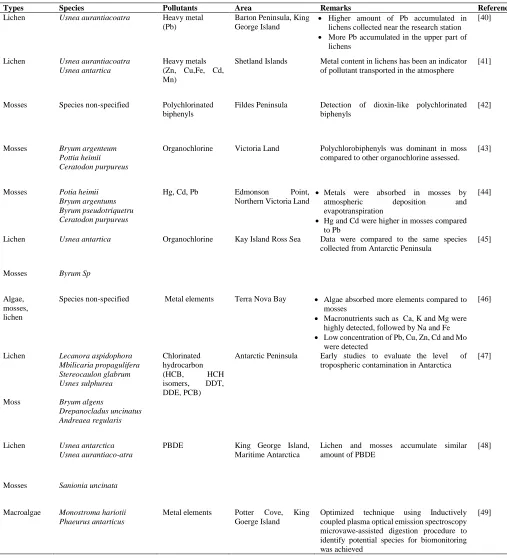
However, phytoremediation process in the tropics could be different from the one in the Antarctic due to distinct environmental conditions. This aspect is discussed further in the next section of this review. Focusing on biomonitoring in
Antarctica, several studies showing the capabilities of Antarctica vegetations to accumulate pollutants were highlighted in Table 2.
Table 2 Antartica vegetation and detection of pollutants
Types Species Pollutants Area Remarks Reference
Lichen Usnea aurantiacoatra Heavy metal (Pb)
Barton Peninsula, King George Island
Higher amount of Pb accumulated in lichens collected near the research station More Pb accumulated in the upper part of
lichens
[40]
Lichen Usnea aurantiacoatra Usnea antartica
Heavy metals (Zn, Cu,Fe, Cd, Mn)
Shetland Islands Metal content in lichens has been an indicator of pollutant transported in the atmosphere
[41]
Mosses Species non-specified Polychlorinated biphenyls
Fildes Peninsula Detection of dioxin-like polychlorinated biphenyls
[42]
Mosses Bryum argenteum Pottia heimii Ceratodon purpureus
Organochlorine Victoria Land Polychlorobiphenyls was dominant in moss compared to other organochlorine assessed.
[43]
Mosses Potia heimii Bryum argentums Byrum pseudotriquetru Ceratodon purpureus
Hg, Cd, Pb Edmonson Point, Northern Victoria Land
Metals were absorbed in mosses by atmospheric deposition and evapotranspiration
Hg and Cd were higher in mosses compared to Pb
[44]
Lichen Usnea antartica Organochlorine Kay Island Ross Sea Data were compared to the same species collected from Antarctic Peninsula
[45]
Mosses Byrum Sp
Algae, mosses, lichen
Species non-specified Metal elements Terra Nova Bay Algae absorbed more elements compared to mosses
Macronutrients such as Ca, K and Mg were highly detected, followed by Na and Fe Low concentration of Pb, Cu, Zn, Cd and Mo
were detected
[46]
Lichen Lecanora aspidophora Mbilicaria propagulifera Stereocaulon glabrum Usnes sulphurea
Chlorinated hydrocarbon
(HCB, HCH
isomers, DDT, DDE, PCB)
Antarctic Peninsula Early studies to evaluate the level of tropospheric contamination in Antarctica
[47]
Moss Bryum algens
Drepanocladus uncinatus Andreaea regularis
Lichen Usnea antarctica Usnea aurantiaco-atra
PBDE King George Island, Maritime Antarctica
Lichen and mosses accumulate similar amount of PBDE
[48]
Mosses Sanionia uncinata
Macroalgae Monostroma hariotii Phaeurus antarticus
Metal elements Potter Cove, King Goerge Island
Optimized technique using Inductively coupled plasma optical emission spectroscopy microvawe-assisted digestion procedure to identify potential species for biomonitoring was achieved
5.0 LIMITATIONS AND FUTURE PERSPECTIVES
In general, plants remove pollutants via rhizofiltration, phytostabilization, phytoextraction, or phytovolatilization. However, the success of phytoremediation process is determined by various factors, including plant species and the surrounding conditions.
Currently, studies focusing on phytoremediation in the Antarctic are scarce. However, the use of plants in various biomonitoring programmes in this continent has given positive indications on the potential of phytoremediation process to occur. As such, further investigation is needed to determine if vegetations in the Antarctic have the ability to convert pollutants into harmless compounds.
Phytoremediation process in the Antartic is limited mainly due to extreme surroundings and limited vegetations. Phytoremediation could be slower under certain circumstances and one of the factors is cold condition [50]. This is supported by Wright and co-workers who found that limited phytoremediation in low temperature can be enhanced at warmer temperature [51]. For plants, their root morphology could be influenced by soil temperature [52] hence their potential in bioremediation is compromized.
The behavior of compounds also depends on environmental condition. Under cold temperature, compounds such as petroleum can be easily solubilized in water and slowly evaporated [53]. Thus, the capabilities of microbes or plant-associated microbes to come into contact with these compounds are restricted. However, there are also some hydrocarbons that become less soluble in water at lower temperatures. Thus, greater biodegradation could be achieved due to less toxicity effects of these compounds with microbes in that area [54].
Advancement in microbial technologies offers alternatives for the microbial community to be applied in bioremediation. Microbes are more diverse in species and are adaptable to survive in extreme environment. It should be noted that phytoremediation process often includes microbes that are associated with plants. Vascular species have their own rhizosphere that anchors plant roots and soil to help in phytoextraction process. As in the temperate and the tropical region, Antarctica rhizosphere could be diverging from the rest of the soil. Rhizospheric bacteria have been isolated and identified from Antarctica flowering plant Deschampsia antarctica Desv. [55]. These microbial communities conceivably have certain capacity in phytoremediation, although further investigation is needed. Besides microbial assistance, addition of certain non-harmful chemicals is another way to improve phytoremediation process. As an example, the capacity of plants to absorb metals is decreasing at higher metal concentrations due to the saturation of metal binding sites [56]. In this case, metal chelation could be improved by applying suitable pretreatment with chemicals that help to increase biosorption capacity of metal ion [57, 58]. Kumar and Gaur (2011) in their work also proved that chemical pretreatment increase metal binding capacity due to increasing crosslinking between polymer chain of the exopolysaccharides [59]. Not only alkaline solution, acidification using HCl could also increase metal chelating capacity [60, 61]. This is however, required further investigations as the methods are currently applicable to phytoremediation using plants in the temperate region.
Differences in mechanisms of pollutant uptake for vegetations in harsh condition and temperate region create huge challenges for researchers to understand the issues. Nonetheless, it is interesting to explore the pathways involved using various molecular and biochemistry techniques. Available basic
information from phytoremediation studies conducted in temperate region could act as the step-stones for better approach to be used in the Antarctic. In future, suitable genes or enzymes for pollution remediation, whether from the tropics to cold temperature area or vice versa could probably be transferred via advanced techniques to improve the vegetations for phytoremediation purposes.
Due to the survival of several alien species in the Antarctic, the introduction of non-indigenous plants to colonize this vicinity might help in phytoremediation. However, this is subjected to the suitability and regulations as non-indigineous species and transgenic plants might cause negative impacts to the present environment. Overall, collaboration among scientists with various expertise including geologists, ecologist, biologist, chemist and other related field is required.
6.0 CONCLUSION
To conclude, more studies are needed for phytoremediation technique to be effectively implemented in this continent. If this is a success, it will benefit human and the environment as pollutants can be removed in cleaner and cheaper way. Taken as a whole, prevention is always better than cure. Perhaps rules and regulations on environmental issues need to be strengthened to ensure Antarctica will not be further deteriorated with pollutants from its locality or other parts of the world.
Acknowledgement
The authors would like to thank UTM-Antarctica Research and Sustainability Research Alliance, UTM for providing fund (Q.J130000.2445.00G98) and opportunity to study on biodiversity in Antarctica.
References
[1] NERC Science of the Environment. 2009. Scientists rethink sea level
rise from a melted89 west Antarctic. Planet on Earth Online. Retrieved from
http://planetearth.nerc.ac.uk/news/story.aspx?id=423&cookieConsent= A 15 May 2009. Accessed 25 November 2013.
[2] British Antarctic Survey. 2012. Plants of Antarctica Retrieved from
www.antarctica.ac.uk/about_antarctica/wildlife/plants Accessed 28 November 2013.
[3] Kappen, L. 2000. Some aspects of the great success of lichens in
Antarctica. Antarctic Science. 12(03): 314–324.
[4] Robinson, S. A. and L. J. Clarke. 2008. Understanding the Tolerance of
Antarctic Mosses to Climate Change. Faculty of Science. University of Wollongong Research Online.
[5] Broady, P. A., R. Garrick, and G. M. Anderson. 1996. Diversity,
distribution and dispersal of Antartic terrestrial algae. Biodiversity and
Conservation. 5(11): 1307–1335.
[6] Hill, R. S. and L. J. Scriven. 1995. The Angiosperm-dominated woody
vegetation of Antarctica-A review. Review of Palaeobotany and
Palynology. 86(3): 175–198.
[7] Whinam, J., N. Chilcott, D. M. Bergstrom. 2005. Subantarctic
Hitchhikers: Expeditioners as Vectors for the Introduction of Alien
Organisms. Biological Conservation. 121(2): 207–219.
[8] Mao, Q. and D. R. Huff. 2012. The Evolutionary Origin of Poa Annua
L. Crop Science. 52(4): 1910–1922.
[9] Chwedorzewska, K. J. 2008. Poa annua L. in Antarctic: Searching for
the Source of Introduction. Polar Biology. 31(3): 263–268.
[10] Lewis Smith, R. and M. Richardson. 2011. Fuegian Plants in Antarctica:
Natural or Anthropogenically Assisted Immigrants? Biological
Invasions. 13(1): 1–5.
[11] Smith, R. I. L. 1996. Introduced plants in Antarctica: Potential Impacts
[12] Robinson S. A., J. Wasley, A. K. Tobin. 2003. Living on the Edge- Plants and Global Change in Continental and Maritime Antarctica.
Global Change Biology. 9(12): 1681–1717.
[13] Chown, S. L., A. H. L.Huiskes, N. J. M. Gremmen, J. E. Lee, A. Terauds,
K. Crosbie, Y. Frenot, K. A. Hughes, S. Imura, K. Kiefer, M. Lebouvier, B. Raymond, M. Tsujimoto, C. Ware, B. Van de Vijver, D. M. Bergstrom. 2012. Continent-wide Risk Assessment for the
Establishment of Non-indigenous Species in Antarctica. Proceedings of
the National Academy of Sciences. 109(13): 4938–4943.
[14] Molina-Montenegro, M. A., F. Carrasco-Urra, C. Rodrigo, P. Convey,
F. Valladares, E. Gianoli. 2012. Occurrence of the Non-Native Annual Bluegrass on the Antarctic Mainland and Its Negative Effects on Native
Plants. Conservation Biology. 26(4): 717–723.
[15] International AssociationAntarctica Tour Operation. 2013. Retrieved
from iaato.org/frequently-asked-questions. Accessed 27 November 2013.
[16] Scientific Committee on Antarctic Research. 2012. Retrieved from
www.scar.org/information 20 August 2013. Accessed 1 November 2013.
[17] Boutron, C. F. and E. W. Wolff. 1989. Heavy Metal and Sulphur
Emissions to the Atmosphere from Human Activities in Antarctica.
Atmospheric Environment. 1967. 23(8): 1669–1675.
[18] Li, Y., D. Geng, F. Liu, T. Wang, P. Wang, Q. Zhang, G. Jiang. 2012.
Study of PCBs and PBDEs in King George Island, Antarctica, using
PUF Passive Air Sampling. Atmospheric Environment. 51: 140–145.
[19] Wolff, E. W., E. D. Suttie, and D. A. Peel. 1999. Antarctic Snow Record
of Cadmium, Copper, and Zinc Content During the Twentieth Century.
Atmospheric Environment. 33(10): 1535–1541.
[20] Planchon, F. A. M., C. F. Boutron, C. Barbante, G. Cozzi, V. Gaspari,
E. W. Wolff, C. P. Ferrari, P. Cescon. 2002. Changes in heavy metals in Antarctic snow from Coats Land since the mid-19th to the late-20th
century. Earth and Planetary Science Letters. 200(1): 207–222.
[21] Guerra, M. B. B., E. L. Neto, M. T. A. Prianti, E. R. Pereira-Filho, C. E.
G. R. Schaefer. 2013. Post fire study of the Brazilian Scientific Antarctic Station: Toxic Elements Contamination and Potential Mobility on the
Surrounding Environment. Microchemical Journal.110: 21–27.
[22] Kang, J. H, M. H. Son, S. D. Hur, S. Hong, H. Motoyama, K. Fukui, Y.
S. Chang. 2012. Deposition of organochlorine pesticides into the surface
snow of East Antarctica. Science of the Total Environment. 433: 290–
295.
[23] Hawes, I. 1990. Eutrophication and Vegetation Development in
Maritime Antarctic Lakes. In Antarctic Ecosystems. Springer Berlin
Heidelberg. 83–90.
[24] Bruni, V., and T. L. Maugeri, L. Monticelli. 1997. Faecal pollution
indicators in the Terra Nova Bay (Ross Sea, Antarctica). Marine
Pollution Bulletin. 34(11): 908–912.
[25] Risebrough, R. W, B. W. De Lappe, C. Younghans-Haug. 1990. PCB
and PCT Contamination in Winter Quarters Bay, Antarctica. Marine
Pollution Bulletin. 21(11): 523–529.
[26] Aislabie, J., M. McLeod, R. Fraser. 1998. Potential for Biodegradation
of Hydrocarbons in Soil from the Ross Dependency, Antarctica. Applied
Microbiology and Biotechnology. 49(2): 210–214.
[27] Saul, D. J., J. M. Aislabie, C. E. Brown, L. Harris, J. M. Foght. 2005.
Hydrocarbon Contamination Changes the Bacterial Diversity of Soil
from around Scott Base, Antarctica. FEMS Microbiology Ecology.
53(1): 141–155.
[28] Snape, I., M. J. Riddle, J. S. Stark, C. M. Cole, C. K. King, S. Duquesne,
D. B. Gore. 2001. Management and Remediation of Contaminated Sites
at Casey Station, Antarctica. Polar Record. 37(202): 199–214.
[29] Smith, R. I. L. 1994. Vascular Plants as Bioindicators of Regional
Warming in Antarctica. Oecologia. 99(3–4): 322–328.
[30] Liu, X., G. Zhang, K. C. Jones, X. Li, X. Peng, S. Qi. 2005.
Compositional Fractionation of Polycyclic Aromatic Hydrocarbons
(PAHs) in Mosses (Hypnum plumaeformae WILS.) from the Northern
Slope of Nanling Mountains, South China. Atmospheric Environment.
39(30): 5490–5499.
[31] Conti, M. E., and G. Cecchetti. 2001. Biological Monitoring: Lichens as
Bioindicators of Air Pollution Assessment — A Review. Environmental
Pollution. 114(3): 471–492.
[32] Guerra, M. B. B., D. Amarasiriwardena, C. E. G. R. Schaefer, C. D.
Pereira, A. A. Spielmann, J. A. Nobrega, E. R. Pereira-Filho. 2011. Biomonitoring of Lead in Antarctic Lichens Using Laser Ablation
Inductively Coupled Plasma Mass Spectrometry. Journal of Analytical
Atomic Spectrometry. 26(11): 2238–2246.
[33] Onianwa, P. C. 2001. Monitoring Atmospheric Metal Pollution: A
Review of the Use of Mosses as Indicators. Environmental Monitoring
and Assessment. 71(1): 13–50.
[34] Dora, S. L. 2010. Algae as an Indicator of River Water Pollution. The
Bioscan Special Issue. 2: 413–422.
[35] Whitton, B. A., and M. G. Kelly. 1995. Use of Algae and Other Plants
for Monitoring Rivers. Australian Journal of Ecology. 20(1): 45–56.
[36] Sekabira, K., H. O. Origa, T. A. Basamba, G. Mutumba, E. Kakudidi.
2011. Application of Algae in Biomonitoring and Phytoextraction of
Heavy Metals Contamination in Urban Stream Water. International
Journal of Environmental Science and Technology. 8(1): 115–128.
[37] Mahadev, J. and S. P. Hosamani. 2005. Algae for Biomonitoring of
Organic Pollution in Two Lakes of Mysore City. Nature, Environment
and Pollution Technology. 4(1): 97–99.
[38] Barreiro, R., L. Picado, C. Real. 2002. Biomonitoring Heavy Metals in
Estuaries: A Field Comparison of Two Brown Algae Species Inhabiting
Upper Estuarine Reaches. Environmental Monitoring and Assessment.
75(2): 121–134.
[39] Santiago, D. L., R. K. Maiti., J. L. H. Pinero, J. A. G. Oreja. 2004. Plant
based Bioremediation and Mechanisms of Heavy Metal Tolerance of
Plants: A Review. Proceedings of the Indian National Science Academy.
B70(1):1–12.
[40] Lim, H. S., Han, M. J., D. C. Seo, J. H. Kim, J. I. Lee, H. Park, J. S. Hur,
Y. H. Cheong, J. S. Heo, H. I. Yoon, J. S. Cho. 2009. Heavy Metal
Concentrations in the Fruticose Lichen Usnea aurantiacoatra from King
George Island, South Shetland Islands, West Antarctica. Journal of the
Korean Society for Applied Biological Chemistry. 52(5): 503–508.
[41] Poblet, A., S. Andrade, M. Scagliola, C. Vodopivez, A. Curtosi, A.
Pucci, J. Marcovecchio. 1997. The Use of Epilithic Antarctic Lichens (Usnea aurantiacoatra and U. antartica) to Determine Deposition
Patterns of Heavy Metals in the Shetland Islands, Antarctica. Science of
the Total Environment. 207(2): 187–194.
[42] Wang, Q., Y. Shi, J. Hu, Z. Yao, X. Fang, Y. Dong. 2012. Determination
of Dioxin-like Polychlorinated Biphenyls in Soil and Moss from Fildes
Peninsula, Antarctica. Chinese Science Bulletin. 57(9): 992–996.
[43] Borghini, F., J. O. Grimalt, J. C. Sanchez-Hernandez, R. Bargagli. 2005.
Organochlorine Pollutants in Soils and Mosses from Victoria Land
(Antarctica). Chemosphere. 58(3): 271–278.
[44] Bargagli, R., J. C. Sanchez-Hernandez, L. Martella, F. Monaci. 1998.
Mercury, Cadmium and Lead Accumulation in Antarctic Mosses
Growing Along Nutrient and Moisture Gradients. Polar Biology. 19(5):
316–322.
[45] Focardi, S., C. Gaggi, G. Chemello, E. Bacci. 1991. Organochlorine
Residues in Moss and Lichen Samples from Two Antarctic Areas. Polar
Record. 27(162): 241–244.
[46] Abollino, O., M. Malandrino, I. Zelano, A. Giacomino, S. Buoso , E.
Mentasti. 2012. Characterization of the Element Content in Lacustrine
Ecosystems in Terra Nova Bay, Antarctica. Microchemical Journal.
105: 142–151.
[47] Bacci, E., D. Calamari, C. Gaggi, R. Fanelli, S. Focardi, M. Morosini.
1986. Chlorinated Hydrocarbons in Lichen and Moss Samples from the
Antarctic Peninsula. Chemosphere. 15(6): 747–754.
[48] Yogui, G. T., and J. L. Sericano. 2008. Polybrominated Diphenyl Ether
Flame Retardants in Lichens and Mosses From King George Island,
Maritime Antarctica. Chemosphere. 73(10): 1589–1593.
[49] Farias, S., S. P. Arisnabarreta, C. Vodopivez, P. Smichowski. 2002.
Levels of Essential and Potentially Toxic Trace Metals in Antarctic
Macro Algae. Spectrochim Acta. Part B. 57(12): 2133–2140.
[50] McCutcheon, S. 1996. Phytoremediation of Organic Compounds:
Sceience Validation and Field Testing. In Kovalick W.W., R. Olexsay (eds) Workshop on Phytoremediation of Organic Contaminants. Fort Worth, Texas, December 17–19.
[51] Wright, A. L., R. W. Weaver, and J. W. Webb. 1997. Oil Bioremediation
in Salt Marsh Mesocosms as Influenced by N and P Fertilization,
Flooding, and Season. Water, Air and Soil Pollution. 95(1–4): 179–191.
[52] Pregitzer, K. S., and J. S. King. 2005. Effects of Soil Temperature on
Nutrient Uptake. In Nutrient Acquisition by Plants. Springer Berlin
Heidelberg. 277–310
[53] Heiser, D. 1999. Bioremediation of Petroleum Pollutants in Cold
Environments. Restoration and Reclamation Review. 5(2): 1–7.
[54] Margesin, R., and F. Schinner. 1999. Biological Decontamination of Oil
Spills in Cold Environments. Journal of Chemical Technology and
Biotechnology. 74(5): 381–389.
[55] Barrientos-Díaz, L., M. Gidekel, A. Gutiérrez-Moraga. 2008.
Characterization of Rhizospheric Bacteria Isolated from Deschampsia
antarctica Desv. World Journal of Microbiology and Biotechnology.
24(10): 2289–2296.
[56] Donmez, G., and Z. Aksu. 2002. Removal of Chromium (VI) from
Saline Wastewaters by Dunaliella Species. Process Biochemistry. 38(5):
[57] Singh, A., D. Kumar, J. P. Gaur. 2007. Copper (II) and lead (II) sorption
from Aqueous Solution by Non-living Spirogyra Neglecta. Bioresource
Technology. 98(18): 3622–3629.
[58] Singh, A., D. Kumar, J. P. Gaur. 2008. Removal of Cu (II) and Pb (II)
by Pithophora Oedogonia: Sorption, Desorption and Repeated Use of the
Biomass. Journal of Hazardous Materials. 152(3): 1011–1019.
[59] Kumar, D., J. P. Gaur. 2011. Metal Biosorption by Two Cyanobacterial
Mats in Relation to Ph, Biomass Concentration, Pretreatment and Reuse.
Bioresource Technology. 102(3): 2529–2535.
[60] Mehta, S. K., B. N. Tripathi, J. P. Gaur. 2002. Enhanced Sorption of Cu2+ and Ni2+ by Acid-pretreated Chlorella vulgaris from single and
binary metal solutions. Journal of Applied Phycology.. 14(4): 267–273.
[61] Kalyani, S., P. S. Rao, A. Krishnaiah. 2004. Removal of Nickel (II) from
Aqueous Solutions Using Marine Macroalgae as the Sorbing Biomass.
![Figure 1 Map of the Antarctica adapted from NERC Science of the Environment [1]](https://thumb-us.123doks.com/thumbv2/123dok_us/1323355.1165214/2.612.59.287.63.265/figure-map-antarctica-adapted-nerc-science-environment.webp)