EFFECT OF CETYLTRIMETHYLAMMONIUM BROMIDE ON THE PROPERTIES OF NICKEL OXIDE NANOPARTICLE BY SOL-GEL
METHOD
HAYMAN SAEED SALIH
EFFECT OF CETYLTRIMETHYLAMMONIUM BROMIDE ON THE PROPERTIES OF NICKEL OXIDE NANOPARTICLE BY SOL-GEL METHOD
HAYMAN SAEED SALIH
A dissertation submitted in partial fulfillment of the requirement for the award of the degree of
Master of Science (Chemistry)
Faculty of Science Universiti Teknologi Malaysia
iii
With lots of love and gratitude, I dedicate this to my beloved parents, my wife and my lovely daughter and closest friend.
Each of you always makes me feel special and thank you for
iv
ACKNOWLEDGEMENT
In the name of Allah, the Entirely Merciful, the Especially Merciful.
First of all, I would like to thanks Allah, for giving me the strength, patience
and health to go through all obstacles in order to complete this research.
With a deep sense of gratitude, I wish to express my sincere thanks to my supervisor, Professor Dr. Madzlan Aziz, who has been helpful and offered invaluable assistance, advice, guidance, and high level inspirations for me in completing this research. This thesis would not have been possible without the guidance and the help of several individuals who in one way or another contributed and extended their valuable assistance in the preparation and completion of my study.
Many thanks for librarian of UTM. Not to be forgotten to all labratories assistance and the staff of Department of Chemistry, thanks for every helps given.
My greatest appreciation goes to my beloved parents, Hajj Saeed Salih and Hajj Sabrya Mahmood, who have raised me with their greatest love to be the person I am today, I would thanks my beloved wife, Shokhan for supporting me spiritually throughout my studies. My special appreciation extends to my brothers and sisters.
v
ABSTRACT
Metal oxide semiconductors have been widely studied due to its wide properties and applications. Among them, nickel oxide (NiO) is an important metal oxide which contributes to a wide range of applications in gas sensors, fuel cell electrodes, catalysis and optoelectronic devices. In the present study, the critical micelle concentration (CMC) of CTAB surfatctant obtained was equal to 9×10⁻⁴ M. Nickel oxide nanoparticles was successfully prepared without and with CTAB surfactant by sol-gel method. Based on characterization techniques, the effect of different concentrations of cationic surfactant (cetyltrimethylammonium bromide,
vi
ABSTRAK
Semikonduktor oksida logam telah dikaji secara meluas oleh para penyelidik disebabkan oleh kepelbagaian sifat dan aplikasinya. Antaranya, nikel oksida (NiO) yang merupakan oksida logam penting yang menyumbang kepada pelbagai aplikasi dalam sensor gas, sel solar, pemangkin dan peranti optoelektronik. Dalam kajian ini, kesan kepekatan surfaktan (setiltrimetilammonium bromida, CTAB) atas sifat nanopartikel NiO telah dikaji. Kepekatan kritikal misel (CMC) bagi CTAB yang
vii
TABLE OF CONTENTS
CHAPTER TITLE PAGE
DECLARATION ii
DEDICATION iii
ACKNOWLEDGEMENT iv
ABSTRACT v
ABSTRAK vi
TABLE OF CONTENTS vii
LIST OF TABLES x
LIST OF FIGURES xi
LIST OF SYMBOLS / TERMS xiii
LIST OF ABBREVIATION xiv
LIST OF APPENDICES xv
1 INTRODUCTION
1.1 Introduction 1
1.2 Problem Statement 3
1.3 Objectives of study 5
1.4 Scope of the Study 5
1.5 Significance of Research 6
2 LITERATURE REVIEW
2.1 Introduction 7
2.2 Nickel oxide 7
2.3 Nickel oxide preparation methods 9
viii
a. Sol-gel processing 11
b. Advantage of sol-gel 13
c. Disadvantage of sol-gel 13
2.4 Particle size control principle 13
2.5 Surfactant theory 14
2.5.1 Properties of CTAB as surfactant 15
2.5.2 Critical Micelle Concentration (CMC) 16
2.5.3 Surfactant adsorption 17
2.5.4 Particle size control using surfactant 18
3 RESEARCH METHODOLOGY 3.1 Experimental Procedure 21
3.2 Chemical materials and apparatus 21
3.3 Determination of Critical Micelle Concentration of CTAB surafactant 23
3.4 Preparation of Nickel Oxide (NiO) nanoparticles 23
3.4.1 Preparation of Nickel Oxide (NiO) nanoparticles without surfactant 23
3.4.2 Preparation of Nickel Oxide (NiO) nanoparticles in the presence of CTAB with different concentration 24
3.5 Characterization Techniques 24
3.5.1 Structural information 25
3.5.2 Morphollogical studies 27
3.5.3 Molecular spectroscopy 28
3.5.4 Optical properties 29
3.5.5 Thermal analysis 30
4 RESULTS AND DISCUSSION 4.1 Critical Micelle Concentration (CMC) of Cetyltrimethy lammonium Bromide (CTAB) 31
ix
4.3 X-Ray Diffraction (XRD) Studies of Nickel oxide
Nanoparticles 34
4.4 FTIR Analyses of Nickel oxide nanoparticles 41 4.5 Field Emission Scanning Electron Microscope
(FESEM) Studies of Nickel oxide nanoparticles 43 4.6 UV-Vis-NIR Studies of Nickel oxide nanoparticles 46
4.7 Summary of CTAB effect 50
5 CONCLUSIONS AND SUGGESTIONS
5.1 Conclusions 51
5.2 Suggestions for Future Work 52
REFERENCES 53
x
LIST OF TABLES
TABLE NO. TITLE PAGE
2.1 Chemical and physical properties of NiO 9 4.1 Calculated particle sizes of each sample at 500°C from
xi
LIST OF FIGURES
FIGURE NO. TITLE PAGE
1.1 Crystal structures of cubic NiO 1
1.2 Schematic representation of nanoparticles
stabilization by (a) steric repulsion/interaction,
(b) electrostatic repulsion 4
2.1 Crystal structures of cubic NiO 8
2.2 Schematic diagram for sol-gel routes; preparation
of metal oxide gel through sol-gel method 12
2.3 Chemical structure of CTAB surfactant 15
3.1 Schematic exemplification of experimental procedure 22
3.2 General calculation of height halfway between
background and the peak maximum 26
4.1 Plot of conductivity against CTAB concentration 32
4.2 TG and DTA curves ofNiO 34
4.3 XRD diffractogram for the NiO nanoparticle prepared
without CTAB surfactant calcined at 500ºC 37
4.4 XRD diffractogram for the NiO nanoparticle calcined
at 500ºC for 1hr below CMC 38
4.5 XRD diffractogram for the NiO nanoparticle calcined
at 500ºC for 1hr at CMC 39
4.6 XRD diffractogram for the NiO nanoparticle calcined
xii
4.7 FT-IR spectra for the NiO nanoparticle calcined
at 500ºC: (a) without CTAB. (b) below CMC. (c) at CMC.
(d) after CMC. 42
4.8 FESEM micrographic for the prepared NiO nanoparticle
without CTAB 44
4.9 FESEM micrographic for prepared NiO nanoparticle
with CTAB (below CMC) 44
4.10 FESEM micrographic for prepared NiO nanoparticle
with CTAB (at CMC) 45
4.11 FESEM micrographic for prepared NiO nanoparticle
with CTAB (after CMC) 46
4.12 Bandgap energy of NiO NPs without CTAB 48
4.13 Bandgap energy of NiO NPs with CTAB (below CMC) 48
4.14 Bandgap energy of NiO NPs with CTAB (at CMC) 49
xiii
LIST OF SYMBOLS
eV - Electron Volt
ͦ
C - Degree Celcius
μm - Micrometer
nm - Nanometer
Å - Angstrom
g.mol-1 - Gram per mole
h - Hour
mol/L - Mole per liter
cm - Centimeter
K - Kelvin
min - Minute
θ - Angle Theta
% - Percentage
g - Gram
mL - Mili Liter
M - Molarity
mW - Milliwatt
xiv
LIST OF ABBREVIATION
CTAB - Cetyltrimethylammonium bromide
FTIR - Fourier Transform Infrared Spectroscopy
FESEM - Field Emission Scanning Electronic Microscope
XRD - X – Ray Diffractometer
MW - Molecular Weight
TG - Thermogravimetric
FWHM - Full-Width at Half Maximum
NP - Nanoparticle
TX-100 - Triton X-100
CMC - Critical micelle concentration
xv
LIST OF APPENDICES
APPENDIX TITLE PAGE
CHAPTER 1
INTRODUCTION
1.1 Introduction
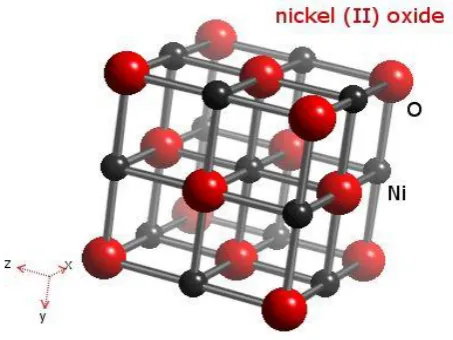
Nickel oxide (NiO) is a green and well characterized oxide that crystallises with the cubic structure and has a p-type wide band gap (3.6-4.0 eV) semiconductor [1]. Figure 1.1 shows the six coordination number both for nickel and oxygen atoms and NiO belongs to NaCl structure, so-called rock salt structure [2]. Nickel oxide is an important antiferomagnetic semiconductor with excellent properties such as gas-sensing, catalytic and electrochemical properties. NiO nanoparticles are widely used in different fields such as catalysis, electrochromic films and fuel cell electrodes due to ther mechanical, electronic, magnetic and optical properties [3].
2
Bulk NiO showed antiferromagnetic character below the neel temperature of 523 K and the magnetic properties can be modified with reduction of particle size. The
antiferromagnetic character of NiO is super paramagnetic (300 K) when the particle size reaches approximately 100 nm [4].
Various techniques can be used to synthesize NiO nanoparticle some of which including: sol–gel, laser ablation, hydrothermal, solvothermal, chemical vapor deposition, anodic plasma, precipitation, microemulsions technique, sonochemical and thermal decomposition [5, 6]. Among all the above mention techniques the sol
gel method is most suitable for the synthesis of nickel oxide nanoparticle because it offers several advantages over other methods. Some of the advantages of sol-gel method posses over other methods including: low processing temperature, better homogeneity, controlled stoichiometry, low processing cost, better control over the particle size of the crystallite, flexibility of forming dense monoliths and thin films, or nanoparticles.
Surfactants are used in the preparation of crystalline metal oxide in the nanoscale to control crystal growth and to provide solubility. Surfactants help to organize the
3
understood on a molecular level and as long as there is no detailed information available about how organic molecules bind and pack on nanocrystal surfaces [10].
The surfactants have to be removed firstly by washing the product with distilled water and then completely removed by burning the samples at higher temperature to improve thermal stability and the purity of the nickel oxide nanoparticle [11]. The main purpose of the present research is to study the influence of cationic surfactant (CTAB) on the nickel oxide nanoparticle properties such as particle size and morphology.
1.2 Problem statement
Semiconductor nanocrystals have unique properties of controlling size and shapes which contain thousands of atoms with the periodicity of bulk semiconductors among the other known molecular and solid-state regime materials. However, the structure of electronic levels and the resulting electrical and optical properties can be strongly modified as the physical dimensions of the nanocrystals confine the wave functions of electrons and gaps. Reduction of the nanocrystals size causes a characteristic blue shift of the band gap [12].
4
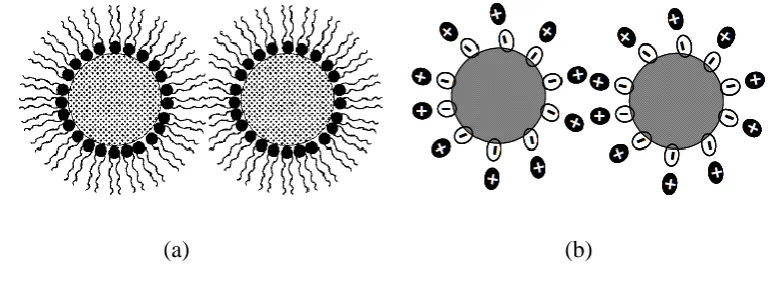
In the case of charge stabilized nanoparticles, an electric double layer is formed on the surface of the particle. This double layer acts as stabiliser due to electrostatic
repulsion between layers of different particles as shown in Figure 1.2b [13].
(a) (b)
Figure 1.2: Schematic representation of nanoparticles stabilization by: (a) Steric repulsion/interaction. (b) Electrostatic repulsion.
The wide band gap makes NiO an attractive matrix for electrically activated emission, since wide band gap semiconductors have higher excitation ionization energy [14]. Recently, it was found that small NiO nanoparticle has many defects such as oxygen vacancies because of a large area. This will lead to an increase in the trap of emission in the visible region [15]. These ideal surfaces do not exist in the case of nanoparticles, thereby increasing the number of unreconstructed surfaces, dangling bonds, and surface vacancies that induce acceptor or donor levels at the grain surface [16].
However, it was still difficult to control the size of nanoparticles. Recently, it has been noted that anionic, cationic and nonionic surfactants can be used to assist the formation of nanoscaled materials [17]. Hence, this study focuses on the study of nickel oxide nanoparticles properties with an organic compound, specifically the CTAB surfactant, because CTAB is a cationic surfactant and ionizes completely in aqueous solution. The resulted cations were a tetrahedron with a long hydrophobic tail. Therefore, ion-pairs between [Ni(OH)4]2– and CTA+ could form due to
5
In the crystallization process, surfactant molecules adsorbed on the crystal nuclei not only serve as a growth director but also as a protector to prevent from
aggregation of the product. As a result, NiO nanoparticles were produced. According to above results, the smallest sized and well-dispersed NiO nanoparticles were obtained successfully with cationic surfactant CTAB [19].
1.3 Objectives of study
The objectives of this study are:
1. To determine the critical micelle concentration (CMC) of cationic surfactant used.
2. To synthesize nickel oxide nanoparticle without and with CTAB surfactant.
3. To characterize the product using TGA, XRD, FTIR, FESEM and UV- visible spectroscopy.
4. To study the effect of CTAB concentration (below, at and after CMC) on the nickel oxide properties.
1.4 Scope of the Study
6
to study the structure and the size of crystals via Debye-Scherrer's equation, field emission scanning electron microscope (FESEM) for imaging the morphology of the
surface, fourier transformed infrared (FTIR) spectroscopy were employed to shows the type of chemical bonds are present in the sample and UV-Vis-NIR scanning spectrophotometer for studying optical properties.
1.5 Significance of Research
The importance of this study is to provide an alternative method of sol-gel preparation to produce nickel oxide nanoparticle, which have nanostructure grain in order to extend its application, furthermore to improve the properties of nickel oxide nanoparticle by the addition of surfactant at different concentration depending on the critical micelle formation. Micellization is observed in surfactant solution when concentration exceeds the critical micelle concentration (CMC), whereas the physicochemical properties of the aqueous solution change abruptly, different physical and chemical properties such as electrical conductivity, interfacial tension and detergency dramatically change. The solubility of hydrocarbons is greatly increased if the concentration of surfactant is above the CMC. At this concentration,
53
REFERENCES
1. Mohammadyani, D., Hosseini, S. A. and Sadrnezhaad, S. K. (2012). Characterization of nickel oxide nanoparticles synthesized via rapid microwave-assisted route. International Journal of Modern Physics: Conference Series. 5, 270-276.
2. http://www.webelements.com/compounds/nickel/nickel_oxide.html.
3. Patil, V., Pawar, S., Chougule, M., Godse, P., Sakhare, R., Sen, S. and Joshi, P. (2011). Effect of annealing on structural, morphological, electrical and optical studies of nickel oxide thin films. Journal of Surface Engineered Materials and Advanced Technology. (1), 35-41.
4. Alagiri, M., Ponnusamy, S. and Muthamizhchelvan, C. (2012). Synthesis and characterization of NiO nanoparticles by sol–gel method. Journal of Materials Science: Materials in Electronics. 23(3), 728-732.
5. Srivastava, N. and Srivastava, P. C. (2010). Synthesis and characterization of (single-and poly-) crystalline NiO nanorods by a simple chemical route. Physica E: Low-dimensional Systems and Nanostructures. 42(9), 2225-2230.
6. Pilban Jahromi, S., Nay Ming, H., Rasat Muhamad, M. and Hong Ngee, L. (2012). Green gelatine-assisted sol-gel synthesis of ultrasmall nickel oxide nanoparticles. Ceramics International. 39(3), 3909-3914.
7. Severin, K. and Abdel-Fattah, T. (1998). Supramolecular assembly of mesostructured tin oxide. Chemical Communications. 1471-1472.
54
9. Niederberger, M. (2007). Nonaqueous sol–gel routes to metal oxide nanoparticles. Accounts of Chemical Research. 40(9), 793-800.
10.Yin, Y. and Alivisatos, A. P. (2004). Colloidal nanocrystal synthesis and the organic–inorganic interface. Nature. 437(7059), 664-670.
11.Wang, Y. D., Ma, C. L., Sun, X. D. and Li, H. D. (2002). Preparation of nanocrystalline metal oxide powders with the surfactant-mediated method. Inorganic Chemistry Communications. 5(10), 751-755.
12.Millo, O., Katz, D. and Yun, W. C. and Banin, U. (2001). Tunneling and Optical Spectroscopy of InAs and InAs/ZnSe Core/Shell Nanocrystalline Quantum Dots. Physica Status Solidi (b). 224, 271–276.
13.Rao, C. N. R., Thomas, P. J. and Kulkarni, G. U. (2007). Nanocrystals: synthesis, properties and applications. Springer. 95, 3-4.
14.Hayakawa, T. and Nogami, M. (2005). High luminescence quantum efficiency of Eu3+doped SnO2–SiO2 glasses due to excitation energy transfer from
nano-sized SnO2 crystals. Science and Technology of Advanced Materials. 6(1), 66.
15.Arik, k., Simanta, K. and Amitava, P. (2011). Surface Defect-Related Luminescence Properties of SnO2 Nanorods and Nanoparticles. Journal of
Physics Chemistry C. 115, 118–124.
16.Raul, D. D. (2002). Tin Oxide Gas Sensors an Electrochemical Approach. Report Dissertation of Doctor in Chemistry. Barcelona University. Dubaray 16.
17.Gnanam, S. and Rajendran, V. (2010). Anionic, cationic and nonionic
surfactants-assisted hydrothermal synthesis of Tin oxide nanoparticles and their photoluminescence property. Digest Journal of Nanomaterials and Biostructures.5(2), 623.
18. Sun, X. M., Chen, X., Deng, Z. X. and Li, Y. D. (2003). A CTAB-assisted hydrothermal orientation growth of ZnO nanorods. Materials Chemistry and Physics. 78(1), 99-104.
55
solvothermal process. Nanoscience and Nanotechnology: An International Journal. 2(4), 24-29.
20.Li, E., Zhang, G., Dong, J., Zhou, X., Yan, X. and Lou, M. (2004). Estimation of critical micelle concentration of anionic surfactants with OSPR approach. Journal of Molecular Structure. 710, 119-126.
21.Chun, H. T., Zhen, J. H. and Xu, G. H. (2010). Rapid determination of surfactant critical micelle concentration in aqueous solutions using fiber-optic refractive index sensing. Analytical Biochemistry. 401, 144-147.
22.Sawatzky, G. A. and Allen, J. W. (1984). Magnitude and origin of the band gap in NiO. Physical Review Letters. 53(24). 2339.
23.http://www.chemexplore.net/ReO3-NiO.htm.
24.Wen, G., Hui, K. S. and Hui, K. N. (2012). High conductivity nickel oxide thin films by a facile sol-gel method. Materials Letters. 92, 291-295.
25.Kumar Rai, A., Tuan Anh, L., Park, C. J. and Kim, J. (2013). Electrochemical study of NiO nanoparticles electrode for application in rechargeable lithium–ion batteries. Ceramics International. 39, 6611-6618.
26.Avendano, E., Berggren, L., Niklasson, G. A., Granqvist, C. G. and Azens, A. (2006). Electrochromic materials and devices: Brief survey and new data on optical absorption in tungsten oxide and nickel oxide films. Thin Solid Films. 496(1), 30-36.
27.Bouessay, I., Rougier, A., Poizot, P., Moscovici, J., Michalowicz, A. and
Tarascon, J. M. (2005). Electrochromic degradation in nickel oxide thin film: A self-discharge and dissolution phenomenon. Electrochimica Acta. 50(18), 3737-3745.
56
29.Mohseni Meybodi, S., Hosseini, S. A., Rezaee, M., Sadrnezhaad, S. K. and Mohammadyani, D. (2012). Synthesis of wide band gap nanocrystalline NiO
powder via a sonochemical method. Ultrasonics Sonochemistry. 19(4), 841-845. 30.Soleimanpour, A. M. and Jayatissa, A. H. (2012). Preparation of nanocrystalline
nickel oxide thin films by sol–gel process for hydrogen sensor applications. Materials Science and Engineering. 32(8), 2230-2234.
31.Skandan, G. and Singhal, A. (2006). 2 Perspectives on the Science and Technology of Nanoparticle Synthesis. 1-15.
32.Wandstrat, M. M. (2006). Materials and Modification of Electrodes for the Detection of Biological Molecules (Doctoral dissertation, Miami University). 1.
33.Rao, M. S. and Dave, B. C. (1998). Selective intake and release of proteins by organically-modified silica sol-gels. Journal of the American Chemical Society. 120(50), 13270-13271.
34.Rao, M. S., Dubenko, I. S., Roy, S., Ali, N. and Dave, B. C. (2001). Matrix-assisted biomimetic assembly of ferritin core analogues in organosilica sol-gels. Journal of the American Chemical Society. 123(7), 1511-1512.
35.Rao, M. S. and Dave, B. C. (2006). Use of environmentally-responsive smart glasses in controlled release: Diffusion of molecules under applied stimuli. Journal of Sol-gel Science and Technology. 40(2-3), 241-251.
36.Bradley, D. C. (1989). Metal alkoxides as precursors for electronic and ceramic
materials. Chemical Reviews. 89(6), 1317-1322.
37.Segal, D. (1997). Chemical synthesis of ceramic materials. Journal of Material Chemistry.7(8), 1297-1305.
38.Beach III, E. R. (2009). Picoliter drop deposition of oxide nanoparticles: a route to high performance microsensor arrays. 41.
57
40.Rifaya, M. N., Theivasanthi, T. and Alagar, M. (2012). Chemical Capping Synthesis of Nickel Oxide Nanoparticles and their Characterizations Studies.
Nanoscience and Nanotechnology. 2(5), 134-138.
41.Wuled Lenggoro, I., Itoh, Y., Iida, N. and Okuyama, K. (2003). Control of size and morphology in NiO particles prepared by a low-pressure spray pyrolysis. Materials Research Bulletin. 38(14), 1819-1827.
42.Wang, Y. D., Ma, C. L., Sun, X. D. and Li, H. D. (2002). Preparation of nanocrystalline metal oxide powders with the surfactant-mediated method. Inorganic Chemistry Communications. 5(10), 751-755.
43.Wang, C. B., Gau, G. Y., Gau, S. J., Tang, C. W. and Bi, J. L. (2005). Preparation and characterization of nanosized nickel oxide. Catalysis Letters. 101(3-4), 241-247.
44.Ahire, D. V., Patil, G. E., Jain, G. H. and Gaikwad, V. B. (2012). Synthesis of nanostructured NiO by hydrothermal route and its gas sensing properties. In Sensing Technology (ICST), Sixth International Conference. 136-141.
45.Kostecki, P. T., Calabrese, E. J. and Bonazountas, M. (1992). Hydrocarbon Contaminated Soils: Analytical Methodologies, Site Assessment, Environmental Fate, Risk Assessment, Regulatory Considerations, Remediatio. (Vol. 2). CRC Press.
46.Thomas, S. P. (1996). Surfactant-enhanced electrokinetic remediation of
hydrocarbon-contaminated soils. M.Sc. Thesis in Biosystems Engineering, University of Manitoba, Winnipeg, Manitoba, Canada.
47.Kile, D. E. and Chiou, C. T. (1989). Water solubility enhancements of DDT and trichlorobenzene by some surfactants below and above the critical micelle concentration. Environmental Science and Technology. 23(7), 832-838.
58
49. Lai, H., Du, Y., Zhao, M., Sun, K. and Yang, L. (2014). CTAB assisted hydrothermal preparation of YPO4:Tb3+ with controlled morphology, structure
and enhanced photoluminescence. Materials Science and Engineering.179, 66-70.
50.Wang, Y. X., Sun, J., Fan, X. and Yu, X. (2011). A CTAB-assisted hydrothermal and solvothermal synthesis of ZnO nanopowders. Ceramics International. 37(8), 3431-3436.
51.Lokajová, J., Hruška, V., Tesařová, E. and Gaš, B. (2008). System peaks in micellar electrophoresis: I. Utilization of system peaks for determination of critical micelle concentration. Electrophoresis. 29(5), 1189-1195.
52. Kostecki, P. T. and Calabrese, E. J. (Eds.). (1993). Principles and practices for
petroleum contaminated soils. CRC Press.
53.Porter, M. R. and Porter, M. R. (1991). Handbook of surfactants. London: Blackie. 55-59.
54.Steinlin, A. (2006). Determination of the critical micelle concentration of an amphiphile by conductivity measurements. PCI, Praktikum Pharmazie. 1-11.
55.Vaidya, S., Rastogi, P., Agarwal, S., Gupta, S. K., Ahmad, T., Antonelli Jr, A. M. and Ganguli, A. K. (2008). Nanospheres, nanocubes, and nanorods of nickel oxalate: control of shape and size by surfactant and solvent. The Journal of Physical Chemistry C.112(33), 12610-12615.
56.Ranjan, R., Vaidya, S., Thaplyal, P., Qamar, M., Ahmed, J. and Ganguli, A. K. (2009). Controlling the size, morphology and aspect ratio of nanostructures using reverse micelles: a case study of copper oxalate monohydrate. Langmuir. 25(11), 6469-6475.
57.Ganguly, A., Ahmad, T. and Ganguli, A. K. (2010). Silica mesostructures: control of pore size and surface area using a surfactant-templated hydrothermal process. Langmuir. 26(18), 14901-14908.
59
59.Eastoe, J., Hollamby, M. J. and Hudson, L. (2006). Recent advances in nanoparticle synthesis with reversed micelles. Advancesin Colloid and Interface
Science. 128, 5-15.
60.Eastoe, J. and Sharpe, D. (1997). Properties of phosphocholine microemulsions and the film rigidity model. Langmuir. 13(13), 3289-3294.
61.Cason, J. P., Miller, M. E., Thompson, J. B. and Roberts, C. B. (2001). Solvent effects on copper nanoparticle growth behavior in AOT reverse micelle systems. The Journal of Physical Chemistry B. 105(12), 2297-2302.
62.Capek, I. (2004). Preparation of metal nanoparticles in water-in-oil (w/o) microemulsions. Advances in Colloid and Interface Science. 110(1), 49-74. 63.Gao, L., Wang, E., Lian, S., Kang, Z., Lan, Y. and Wu, D. (2004).
Microemulsion-directed synthesis of different CuS nanocrystals. Solid State Communications. 130(5), 309-312.
64.Paria, S. and Khilar, K. C. (2004). A review on experimental studies of surfactant adsorption at the hydrophilic solid–water interface. Advances in Colloid and Interface Science. 110(3), 75-95.
65.Gamboa, C., Barraza, R. and Olea, A. F. (2004). Interaction between anionic polyelectrolytes and ctab micelles: a potentiometric study. Journal of the Chilean Chemical Society. 49(4), 303-306.
66.Li, N., Liu, S. and Luo, H. (2002). A new method for the determination of the
first and second CMC in CTAB solution by resonance Rayleigh scattering technology. Analytical Letters. 35(7), 1229-1238.
67.Modaressi, A., Sifaoui, H., Grzesiak, B., Solimando, R., Domanska, U. and Rogalski, M. (2007). CTAB aggregation in aqueous solutions of ammonium based ionic liquids; conductimetric studies. Colloids and Surfaces A: Physicochemical and Engineering Aspects. 296(1), 104-108.
60
69.Wang, Y. D., Ma, C. L., Sun, X. D. and Li, H. D. (2002). Preparation of nanocrystalline metal oxide powders with the surfactant-mediated method.
Inorganic Chemistry Communications. 5(10), 751-755.
70.Qiao, H., Wei, Z., Yang, H., Zhu, L. and Yan, X. (2009). Preparation and characterization of NiO nanoparticles by anodic arc plasma method. Journal of Nanomaterials. 2.
71.Wongsaprom, K. and Maensiri, S. (2013). Synthesis and Room Temperature Magnetic Behavior of Nickel Oxide Nanocrystallites. Ciang Mai Journal of Science. 40(1), 99-108.
72.Farrukh, M. A., Tan, P. and Adnan, R. (2012). Influence of reaction parameters on the synthesis of surfactant-assisted tin oxide nanoparticles. Turk Jornal Chemistry. 1, 12.
73.Bryleva, E. Y., Vodolazkaya, N. A., Mchedlov-Petrossyan, N. O., Samokhina, L. V., Matveevskaya, N. A. and Tolmachev, A. V. (2007). Interfacial properties of cetyltrimethylammonium-coated SiO2 nanoparticles in aqueous media as studied
by using different indicator dyes. Journal of Colloid and Interface Science. 316(2), 712-722.
74. Kloprogge, J. T., Hickey, L. and Frost, R. L. (2004). FT‐Raman and FT‐IR spectroscopic study of synthetic Mg/Zn/Al‐hydrotalcites. Journal of Raman
Spectroscopy. 35(11), 967-974.
75. Ganachari, S. V., Bhat, R. and Deshpande, R. (2012). Synthesis and characterization of nickel oxide nanoparticles by self-propagating low temperature combustion method. Recent Research in Science and Technology. 4(4), 50-53.
76.Gajendiran, J. and Rajendran, V. (2011). Size controlled and optical properties of Zn-doped SnO2 nanoparticles via sol-gel process. Optoelectronics and Advanced Materials – Rapid Communication. 5, 44–48.
61
78.Dharma, J., Pisal, A. and Shelton, C. T. (2009). Simple Method of Measuring the Band Gap Energy Value of TiO2 in the Powder Form using a UV/Vis/NIR
Spectrometer. Application Note.
79.Barakat, A., Al-Noaimi, M., Suleiman, M., Aldwayyan, A. S., Hammouti, B., Hadda, T. B. and Warad, I. (2013). One Step Synthesis of NiO Nanoparticles via Solid-State Thermal Decomposition at Low-Temperature of Novel Aqua (2, 9-dimethyl-1, 10-phenanthroline) NiCl2 Complex. International Journal of
Molecular Sciences. 14(12), 23941-23954.
80.Indulal, C. R., Kumar, G. S., Vaidyan, A. V. and Raveendran, R. (2011). Effect of Thermal Annealing on the Structural and Optical Properties Nanostructured Cobalt‐Manganese and Cobalt‐Nickel Oxides Prepared by Co‐Precipitation.
In AIP Conference Proceedings. 1391, 564-566.
81.Fetzer, C. M., Lee, R. T., Stringfellow, G. B., Liu, X. Q., Sasaki, A. and Ohno, N. (2002). Effect of surfactant Sb on carrier lifetime in GaInP epilayers. Journal of Applied Physics. 91(1), 199-203.
82.Gleiter, H. (2000). Nanostructured materials: basic concepts and microstructure. Acta Materialia. 48(1), 1-29.