Energy Efficient Clustering Algorithm for
Decreasing Energy Consumption and Delay in
Wireless Sensor Networks (WSN)
Nirbhay K. Chaubey1, Dharti H. Patel2
Assistant Professor, Department of Computer Science, Institute of Science & Technology for Advanced Studies and
Research, Gujarat Technological University, Vallabh Vidyanagar, Gujarat, India1
M.E. Student (Wireless and Mobile Computing), P.G. School, Gujarat Technological University, Ahmedabad, Gujarat,
India2
ABSTRACT: In recent years, there has been increasing research interest in Wireless Sensor Networks (WSNs). WSN consist of small nodes with sensing, processing and wireless communications capabilities. Wireless Sensor network’s key issue is developing energy-efficient clustering Protocol. Hierarchical clustering algorithms increased network life time. The primary point in these algorithms is the cluster head selection. Overall simulation performance shows energy consumption is better than the existing algorithm. And with that delay consumption is decreased.
KEYWORDS: Wireless sensor network; energy efficiency; cluster head
I.INTRODUCTION
Wireless Sensor Networks (WSNs) is a great enabling technology that can revolutionize information and communication technology. In fact, it has the potential to significantly change the way we live – just like the Internet and World Wide Web – perhaps more so. WSN has opened up the challenge for distributed and cooperative computing and communication. A Wireless Sensor Network is a self-configuring network of small sensor nodes communicating among themselves using radio signals, and deployed in quantity to sense, monitor and understand the physical world. It is highly distributed networks of small, lightweight wireless nodes, deployed in large numbers and monitors the environment or system by measuring physical parameters such as temperature, pressure, humidity.
In flat networks, each node typically plays the same role and sensor nodes collaborate together to perform the sensing task. In this type of network, it is not possible to assign a global identifier to each node due to large number of nodes. Therefore, base station send queries to different part of the field and waits for the data from sensors in selected parts of the field. This consideration has led to data-centric routing. In data-centric routing, the sink sends queries to certain regions and waits for data from the sensors located in the selected regions. Some of routing protocols in this category are: SPIN [1] [2], Directed Diffusion [3] [4], Rumor Routing [5] and MCFA [6].
Hierarchical routing works in two layers, first layer is used to choose cluster heads and the other layer is used for routing. To make the WSN more energy efficient, clusters are created and special tasks (data aggregation, fusion) are assigned to them. It increases the overall system scalability, lifetime, and energy efficiency. In a hierarchical architecture, higher energy nodes can be used to process and send the information while low energy nodes can be used to perform the sensing in the proximity of the target. This means that creation of clusters and assigning special tasks to cluster heads can greatly contribute to overall system scalability, lifetime, and energy efficiency. Some of routing protocols in this group are: LEACH [7], SOP [8], and VGDRA [9].
The rest of paper is structured as follows: Section II discusses some related works and previous studies. Section III provides complete understanding of our proposed hierarchical clustering algorithm with the ability of cluster head selection. Section IVand Vprovides the simulation set up and result analysis respectively.Section VI gives concluding remarks and directions for future works.
II.RELATED WORK
AshishUpadhyay, et. al. [7] introduced a hierarchical clustering algorithm for sensor networks, called Low-Energy Adaptive Clustering Hierarchy (LEACH) is a classical clustering routing in wireless sensor networks .However the cluster-head selection in LEACH protocol is lack of balancing the whole network energy consumption, with the result that low energy nodes run out of energy prematurely and decline the network life. This paper analyses the effectiveness of LEACH protocol in cluster-head selection, and proposes an improved energy balanced clustering algorithm. In [12], authors proposed Energy Efficient Clustering Algorithm (EEAC)for WSN. This algorithm is based on static clustering concept and dynamic cluster heads selection technique, which divides the entire network area into a number of fixed regions. Cluster head (CH) is selected that it reduces communicating distance between nodes, for this reason energy consumption reduces while transmitting the data from one node to another and increases network efficiency as energy consumed. The proposed (EECA) algorithm gives better result than the LEACH, LEACH-C and DR scheme with respect to throughput and stability. Authors in [13] proposed Energy Efficient Clustering Scheme for Prolonging the Lifetime of Wireless Sensor Network with Isolated Nodes. A new regional energy aware clustering method using isolated nodes for WSNs, called Regional Energy Aware Clustering with Isolated Nodes (REAC-IN). In this algorithm cluster heads (CHs) are selected based on weight which is determined according to the residual energy of each sensor and the regional average energy of all sensors in each cluster and improves the cluster head selection process and solves the problem of node isolation, lifetime and stability of a network is more favorable.
III.PROPOSED A NEW HIERARCHICAL CLUSTERING ALGORITHM
In this section, our proposed a new hierarchical clustering algorithm with the ability of cluster head selection is described.
In proposed algorithm, some of the nodes have to select cluster heads that, in comparison to them, have a longer distance to the BS. These nodes send their data to a further location and then their data has to go through a long distance to reach the base station (BS). Such transmissions waste the network‘s energy and are called extra transmissions. In the proposed protocol, deploy all the sensor nodes into the distributed cluster environment and select the area into the different number of cluster. Every sensor selects one of the head nodes of that cluster, the entire cluster having their own cluster head (CH) for communication purpose and the entire cluster head communicated with the BS.
When the base station wants to communicated with the sensor nodes or sensor nodes want to communicate with the base they are able to communicate with the cluster head.
______________________________________________________________________________________ Algorithm 1 :Proposed Algorithm for WSN
_______________________________________________________________________________________
Step-1: Initialize:
Cluster Head node = CH Total number of clusters = Cn Nodes = i, j
Threshold energy = Eth
Step-2Cluster-head selection:
7. A node with maximum weight will be selected as CH for that round.
8. End
Step 3: All the sensor head or cluster head connected with the base station (BS). Step 4: The base station sends the advertising message to all the cluster head. Step 5: Each cluster head send the reply message to the base station.
Step 6: After that the transmission of data and message will start and every sensor nodes communicated with other nodes and base station.
Step 7: Process end.
Figure 1. Proposed Algorithm for WSN
IV.SIMULATION PARAMETERS
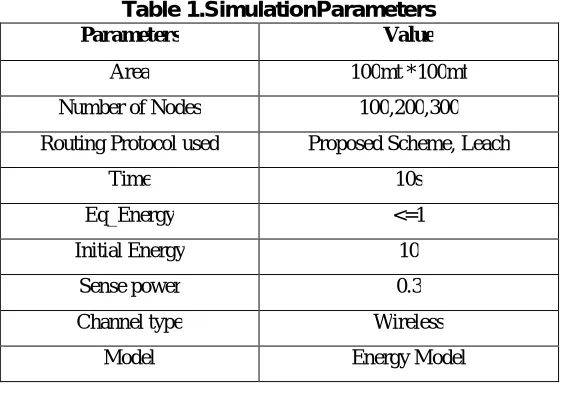
In this section, we evaluate the performance of our proposed algorithm via NS2 simulator. The simulation parameters are given in “Table. I”. Results obtained for Performance of proposed scheme in terms of energy consumption and consumption delay with different parameters performance.
This section explains the complete evaluation methodology along with simulation environment and performance metric in detail. Simulation was performed using NS2 simulator [14] to measure the performance of our proposed scheme and to be able to compare it with that of LEACH protocol under different network size varying the number of nodes from 100, 200 and 300. The simulation setup is summarized in Table 1
Table 1.SimulationParameters Parameters Value
Area 100mt *100mt
Number of Nodes 100,200,300
Routing Protocol used Proposed Scheme, Leach
Time 10s
Eq_Energy <=1
Initial Energy 10
Sense power 0.3
Channel type Wireless
Model Energy Model
V.SIMULATION RESULTS
Figure 2. Comparison of Energy Consumption
Figure 2 shows the result comparison of amount of energy consumed by CHs in our proposed scheme and that of LEACH protocol. The energy consumed by CHs per round in proposed algorithm is much lower than the LEACH, because in LEACH, CHs send their data to the BS via single hop communication; the energy consumption is much higher.
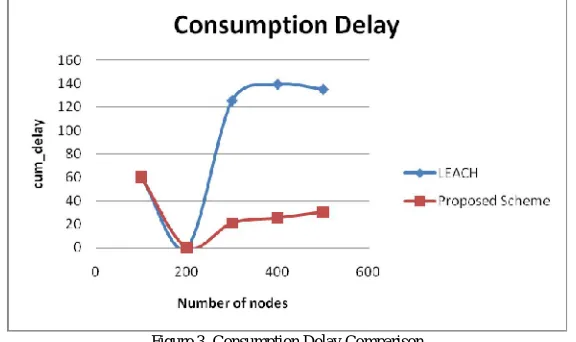
Figure 3. Consumption Delay Comparison
Figure 3 shows the result comparison of consumption delay in our proposed scheme and that of LEACH protocol. It is observed from the figure that at starting upto 100, 200 nodes in network, consumption delay is almost same in both protocols, however, consumption delay of our proposed scheme is always less than that of LEACH and it is still maintained when network size increases.
VI.CONCLUSION AND FUTURE WORK
REFERENCES
[1] JitenderGrover ,Mohit Sharma, Shikha,”Reliable SPIN in Wireless Sensor Network”, Pages: 1 - 6, DOI: 10.1109/ICRITO.2014.
[2] Geetu, Sonia Juneja,”Performance Analysis of SPIN and LEACH Routing Protocol in WSN”, International Journal of Computational Engineering Research (ijceronline.com) Vol. 2 Issue. 5.
[3] Jamal N. Al-Karaki Ahmed E. Kamal,”Routing Techniques in Wireless Sensor Networks: A Survey”, ICUBE initiative of Iowa State University, Ames, IA 50011.
[4] Vaishali Jain, Nayyar Ahmed Khan,” Simulation Analysis of Directed Diffusion and SPIN Routing Protocol in Wireless Sensor Network”, IEEE 2014.
[5] Mr.ChiranjibPatra, Dr.ParamaBhaumik and Ms.DebinaChakroborty,” Modified Rumor Routing for Wireless Sensor Networks”, IJCSI International Journal of Computer Science Issues, Vol. 7, Issue 4, No 9, July 2010.
[6] William D Henderson, Steven Tron,” Verification of The Minimum Cost Forwarding Protocol for Wireless Sensor Networks”, University of Northumbria School of Computing, Engineering & Information Sciences Newcastle upon Tyne.
[7] AshishUpadhyay, Raghvendra Kumar, Sujeet.K.Tiwari,”Modified LEACH Protocol for Sensor Network”, IEEE 2015, 1st International Conference on Futuristic trend in Computational Analysis and Knowledge Management.
[8] Zhao Han, Jie Wu, Member, IEEE, Jie Zhang, Liefeng Liu, and KaiyunTian,“A General Self-Organized Tree-Based Energy-Balance Routing Protocol for Wireless Sensor Network”, IEEE TRANSACTIONS ON NUCLEAR SCIENCE, VOL. 61, NO. 2, APRIL 2014.
[9] Abdul Waheed Khan, Abdul Hanan Abdullah, Mohammad AbdurRazzaque and JavedIqbalbangash, “VGDRA : A virtual Grid based Dynamic Routes adjustment Scheme for Mobile Sink based Wireless Sensor Networks”, IEEE Sensors Journal, Vol.0. No. 0, pp. 1-9, January
2014.
[10] MallanagoudaPatil, Rajashekhar C. Biradar,”A Survey on Routing Protocols in Wireless Sensor Networks”, IEEE 2012.
[11] Sachin Sharma,” Speed Aware Modified Span for Wireless Mobile Ad hoc Networks”, The Third International Conference on Digital Telecommunications, IEEE 2008.
[12] Prerna, Sanjay K umar,”Energy Efficient Clustering Algorithm for WSN”, IEEE 2015, 2nd International Conference on Signal Processing and Integrated Networks.
[13] Jenq-ShiouLeu ,Tung-Hung Chiang,” Energy Efficient Clustering Scheme for Prolonging the Lifetime of Wireless Sensor Network With Isolated Nodes”, IEEE COMMUNICATIONS LETTERS, VOL. 19, NO. 2, FEBRUARY 2015.
[14] “The Network Simulator-NS-2”, Home page, [Online]http://www.isi.edu/nsnam/ns/ns-build.html
BIOGRAPHY
Nirbhay Kumar Chaubey, Senior Member of IEEE, Member of ACM and LMCSI, currently working as an Assistant Professor and Head of Computer Science Department at Institute of Science & Technology for Advanced & Studies (ISTAR), Gujarat Technological University, VallabhVidyanagar, Gujarat, India. He obtained his PhD Degree in Computer Science from Gujarat University, Ahmedabad, India in year 2014. He has received IEEE Region 10 Outstanding Volunteer Award- Year 2015, IEEE Outstanding Branch Counselor Award- Year 2010, Gujarat Technological University (GTU) Pedagogical Innovation Awards (PIA) – Year2015, Best Paper Award in 5thInternational Conference on Advanced Computing & Communication Technologies (ACCT-2015).His main research interests are in Wireless Ad Hoc and Sensor Networks, MANETs, VANETs and Underwater Sensor Networks, Personal and Mobile Communications, distributed and parallel computing etc.