An Intelligent Self-Adjusting Sensor for Smart
Home Services Based on Smart Grid System-
A Review
Kalpana Shete1, Dr. Govind U. Kharat2
M.E. Student, Dept. of Electronics and Telecommunication, SPCOE, Savitribai Phule Pune University, India 1
Professor & Principal, SPCOE, Savitribai Phule Pune University, India 2
ABSTRACT: Smart grid has modernized the way electricity is generated, transported, distributed, and consumed by
integrating advanced sensing, communications, and control in the day-to-day operation of the grid. Electricity is a core utility for the functioning of society and for the services provided by information and communication technologies (ICTs). Several concepts of the smart grid, such as dynamic pricing, distributed generation, and demand management, have significantly impacted the operation of ICT services, in particular, communication networks and data centers. Ongoing energy-efficiency and operational expenditures reduction efforts in communication networks and data centers have gained another dimension with those smart grid concepts. In this paper, we provide a comprehensive survey on the smart grid-driven approaches in energy-efficient communications and data centers, and the interaction between smart grid and information and communication infrastructures. Although the studies on smart grid, energy-efficient communications, and green data centers have been separately surveyed in previous studies, to this end, research that falls in the intersection of those fields has not been properly classified and surveyed yet. We start our survey by providing background information on the smart grid and continue with surveying smart grid-driven approaches in energy-efficient communication systems, followed by energy, cost and emission minimizing approaches in data centers, and the corresponding cloud network infrastructure. Through a communication infrastructure, a smart grid can improve power reliability and quality to eliminate electricity blackout.
KEYWORDS: Smart grid, Data centers, distributed generation, energy-efficiency, ICTs, sustainability.
I. INTRODUCTION
The smart gird is the integration of the 20th century traditional electrical power grid with the most recent 21st
telecommunication and information technologies. Such integration enables efficient resource utilization to optimize energy consumption, install and manage distributed energy sources, as well as to exchange the generated power. In other words, the power flow and communications will be in two-ways. A smart grid delivers electricity between suppliers and consumers using two-way digital technologies. It controls intelligent appliances at consumers’ home or building to save energy, reduce cost and increase reliability, efficiency and transparency. A smart grid is expected to be a modernization of the legacy electricity network. It provides monitoring, protecting and optimizing automatically to operation of the interconnected elements. [2]-[4]. Many utility companies around the globe started to install renewable energy sources such as solar and wind energy nearby the consumption sites. Also, residential home owners started to install smart home appliances and renewable energy resources in their premises to generate and consume electrical power efficiently [7] [8]. Many technologies to be adopted by smart grid have already been used in other industrial applications, such as sensor networks in manufacturing and wireless networks in telecommunications, and are being adapted for use in new intelligent and interconnected paradigm. In general, smart grid communication technologies can be grouped into five key areas: advanced components, sensing and measurement, improved interfaces and decision support, standards and groups, and integrated communications.
automation integration systems [7]. Smart grids distribute electricity between generators (both traditional power generation and distributed generation sources) and end users (industrial, commercial, residential consumers) using bi-directional information flow to control intelligent appliances at consumers’ side saving energy consumption and reducing the consequent expense, meanwhile increasing system reliability and operation transparency. With a communication infrastructure, the smart metering/monitoring techniques can provide the realtime energy consumption as a feedback and correspond to the demand to/from utilities. Network operation center can retrieve those customer power usage data and the on-line market pricing from data centers to optimize the electricity generation, distribution according to the energy consumption.
Fig.1. Smart Grid Communication Infrastructures [4]
In a complex smart grid system, through wide deployment of new smart grid components and the convergence of existing information and control technologies applied in the legacy power grid, it can offer sustainable operations to both utilities and customers [5]. It can also enhance the efficiency of legacy power generation, transmission and distribution systems and penetrate the usage of clean renewable energy by introducing modern communication systems into smart grids.
I.SMART GRID COMMUNICATION PROTOCOLS
Fig.2. Smart grid communications protocols [7] [8].
II.RELATED WORK
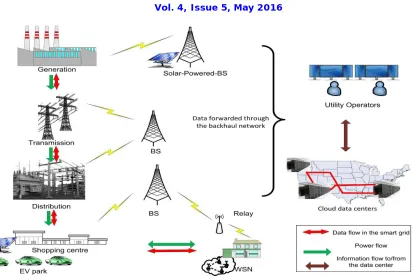
Implementation of wireless communications and data centers in connection with the smart grid is illustrated in Fig. 3, including the power flow in the grid. Electricity is transported to the consumers over the transmission and distribution system similar to the legacy grid, while in addition, consumers can become power generators and sell power the grid according to the novel distributed generation practices of the smart grid [1]. In the smart grid, all of the entities are connected through communications. In the figure only wireless technologies are presented but as will be discussed later on in this paper, using optical and wire line communications is also possible. In the figure, data collected from sensors and meters are fed into the utility headquarters and stored in cloud data centers.
ENERGY-EFFICIENT COMMUNICATIONS AND THE SMART GRID
Fig. 3. Smart grid, wireless wide area solutions and Internet data centers.
Energy-efficiency of battery-run, hand-held devices and Wireless Sensor Networks (WSNs) are beyond the scope of this survey since their energy-efficiency aims at increasing the lifetime of the network or the device considering their limited battery power. The smart grid can be roughly divided into three domains in terms of communication coverage and functionality; Smart Grid Home Area Network (SG-HAN), Smart Grid Neighborhood Area Network (SG-NAN) and Smart Grid Wide Area Network (SG-WAN). SG-HAN is a single residential unit with smart appliances, an energy display, power consumption control tools, storage, solar panels, small-scale wind turbines, electric vehicles and a smart meter. A SG-NAN corresponds to a group of houses possibly fed by the same transformer. Advanced Metering Infrastructure (AMI) collects smart grid data from the premises in a SG-NAN and aggregates the meter data before they are sent to SG-WAN which connects SG-NANs to the utility operator. From the utility perspective, besides metering, equipment in the field needs to be monitored and controlled. Hence the equipment in the field are managed by a separate network which is called as Smart Grid Field Area Network (SG-FAN). The geographical scale of a SG-FAN is similar to SG-NAN therefore similar communication technologies are applicable for both. These network domains can be implemented using a variety of communication technologies.
III. MOTIVATIONS
In this section, we briefly highlight the key motivations of communication infrastructures in smart grid systems. The motivations are related to system operation and environment aspects in emerging smart grid paradigm through communication infrastructures [9].
A. ENHANCED CUSTOMER EXPERIENCE:
B. INCREASED PRODUCTIVITY:
Intelligent performance information and tools will allow utilities to undertake their current duties in a more efficient manner, with longer term benefits coming from automating the smart grid. These gains in productivity will help to reduce deployment costs and operational costs in managing the smart grid system [11].
C. IMPROVED UTILIZATION:
The communication infrastructure in smart grid will provide detailed real-time data on distributed energy generation, electricity transmission, power consumption and market price. This information allows the utility operators to improve their decision making processes by identifying which components are likely to fail and the replacement strategy online [12].
D. LOWER CARBON FUEL CONSUMPTION/GREENHOUSE GAS EMISSION:
A smart grid has the potential to reduce electricity losses in the network and limit growth in demand, due to embedded monitoring of the high, medium and low voltage networks through communication infrastructures, therefore, lower carbon fuel consumption and greenhouse gas emission [13].
E. FACILITATED RENEWABLE RESOURCE GENERATION:
A smart grid will enable options for renewable generation and provide customers with the awareness and capabilities to reduce their energy consumption on carbon fuel based power [14].
F. ADHERENCE TO REGULATORY CONSTRAINTS:
New regulatory demands include provisions for increased levels of asset data tracking (cost justification), and greater reliability targeting the implementation of communication infrastructure in smart grid [15].
IV.CONCLUSION
In the proposed system, we present the background and motivation for smart grid communication infrastructures. We are going to show that a smart grid built on the technologies of sensing, communications, and control technologies offer a very promising future for utilities and users. We review several industrial trials and summarized the basic requirements of communication infrastructures in smart grid paradigm. Efficiency, reliability and security of interconnected devices and systems are critical to enabling smart grid communication infrastructures. Interoperability must be achieved while avoiding being isolated into noncompetitive technical solutions and the need for wholesale replace of existing power communication systems. Alignment behind technical standards must be balanced with creating an environment that encourages innovation so that the overall communication infrastructure may continue to evolve. Based on the above survey, we can focus on those challenges to smart grid communication infrastructures in both system design and operations to make it more efficient and secure.
REFERENCES
[1] G. Zimon, “Integrating distributed generation into the smarter grid,” IEEE Smart Grid, Dec. 2013. [Online]. Available: http://smartgrid.
ieee.org/december-2013/1013-integrating-distributed-generation-intothe- smarter-grid
[2] Anvari-Moghaddam, A., Monsef, H. and Rahimi-Kian, A. (2015) Optimal Smart Home Energy Management Considering
Energy Saving and a Comfortable Lifestyle. IEEE Transactions on Smart Grid, 6, 324-332. http://dx.doi.org/10.1109/TSG.2014.2349352
[3] Wu, Y., Lau, V.K.N., Tsang, D.H.K., Qian, L.P. and Meng, L. (2013) Optimal Energy Scheduling for Residential
Smart Grid with Centralized Renewable Energy Source. IEEE Systems Journal, 8, 562-576.
[4] Han, J., Choi, C., Park, W., Lee, I. and Kim, S. (2014) Smart Home Energy Management System Including Renewable
Energy Based on ZigBee. IEEE International Conference on Consumer Electronics (ICCE), Las Vegas, 10-13 January 2014, 544-545.
http://dx.doi.org/10.1109/icce.2014.6776125
[5] Garner, G. (2010) Designing Last Mile Communications Infrastructures for Intelligent Utility Networks (Smart Grids). IBM Australia Limited.
[6] Al-Omar, B., Al-Ali, A.R., Ahmed, R. and Landolsi, T. (2012) Role of Information and Communication Technologies in the Smart Grid. Journal
of Emerging Trends in Computing and Information Sciences, 3, 707-716.
[7] R. Yu, Y. Zhang, S. Gjessing, C. Yuen, S. Xie, M. Guizani, “Cognitive radio based hierarchical communications infrastructure for smart grid,” IEEE Network, vol.25, no.5, pp.6-14, September-October 2011.
[8] S. Massoud Amin and B. F. Wollenberg, “Toward a smart grid: power delivery for the 21st century,” IEEE Power and Energy Mag., vol. 3, pp. 34-41, 2005.
[10] R. Davies, “Hydro one’s smart meter initiative paves way for defining the smart grid of the future,” in Power & Energy Society General Meeting, 2009. (PES ’09),pp. 1-2, 2009.
[11] E. Santacana, et al., “Getting Smart,” Power and Energy Magazine, IEEE, vol. 8, pp. 41-48, 2010
[12] D. Sun, “The Utilization and Development Strategies of Smart Grid and New Energy,” in Proceedings of Asia-Pacific Power and Energy Engineering Conference (APPEEC 2010), pp. 1-4, 2010.
[13] C. Jaeseok, J. Park, M. Shahidehpour and R. Billinton, “Assessment of CO2 reduction by renewable energy generators,” in Innovative Smart Grid Technologies (ISGT), pp.1-5, 2010.
[14] F. A. Rahimi, “Challenges and opportunities associated with high penetration of distributed and renewable energy resources,” in Innovative Smart Grid Technologies (ISGT), 2010, 2010, pp. 1-1.
[15] G. Lorenz, “Regulatory framework to incentivise Smart Grids deployment - EURELECTRIC views,” The 20th International Conference and Exhibition on Electricity Distribution - Part 2, 2009. (CIRED 2009), pp. 1-26, 2009.
[16] D. Tuan, “The Energy Web: Concept and challenges to overcome to make large scale renewable and distributed energy resources a true reality,” in 7th IEEE International Conference on Industrial Informatics, pp.384-389, 2009.
[17] http://www.bchydro.com/planning regulatory/projects/ smart metering infrastructure program.html.
[18] W. Luan, D. Sharp, S. Lancashire, “Smart grid communication network capacity planning for power utilities,” 2010 IEEE PES Transmission and Distribution Conference and Exposition, pp.1-4, 19-22 April 2010.