Pseudonym Generation with Combining the
Identity based and Attribute based Encryption
with Outsourced Revocation in Cloud
Computing
Kirti Patil, Prof. Sonali Patil
M.E. Student, Dept. of Computer Engg , BSIOTR , Savitribai Phule Pune University, India Assistant Professor, Dept. of Computer Engg , BSIOTR , Savitribai Phule Pune University, India
ABSTRACT:Identity Based Encryption (IBE) simplifies public key management and certificate management at Public Key Infrastructure (PKI) with help of Private Key Generator (PKG). However,one of the main drawback of IBE is overheaded computation at PKG during user revocation. The use of Key update cloud service provider (KU-CSP) offloads most of key generation operations during key-issuing and key-update process leaving only a number of simple operations for PKG and users to perform locally.For this,we generate a hybrid private key for each user, in which an AND gate is used to connect and bound the identity component and time component.But KU-CSP is untrusted. So, we propose a Pseudonym Generation Scheme for Identity based Encryption and Outsourced Revocation in Cloud Computing. We generate pseudonym for each users to hide users original identity. along with this we increase the security by combining the techniques Identity Based Encryption and Attribute Based Encryption. also we use multiple KU-CSP for load balancing purpose. For integrity checking, we generate signature before uploading the data in cloud. Using this signature integrity of the file is verified.
KEYWORDS: Identity Based Encryption, Attribute Based Encryption, Pseudonym.
I. INTRODUCTION
Identity based encryption system allow any user to generate a public key from a known identity value such as an ASCII string. There is trusted third party, called the Private Key Generator (PKG), who generates the corresponding private keys. For encryption and decryption operations, PKG first publishes a master public key, and then generate the corresponding master private key (referred as master key). Using this master public key, any user can generate a public key corresponding to the identity by combining the master public key with the identity value. To get a corresponding private key, authorized user can use identity ID contacts PKG, which uses the master private key to generate private key for identity ID. As a result, user can encrypt messages with no prior distribution of keys between participants. This is very useful in cases where predistribution of keys is inconvenient because of technical restraints. However, for decryption of message, the authorized user must obtain an appropriate private key from PKG. In this approach the problem is that PKG must be highly trusted, as it has ability to generate any users private key and decryption of message without authorization. Because any user’s private key can be generated using third party’s secret, this system has inherent key assurance.
users grows. Many businesses large and small use cloud computing today either directly or indirectly instead of traditional onsite alternatives.
There are a number of reasons like Reduction of costs,Universal access and many more because of which cloud computing is so widely used among businesses today. Thus it require a new working paradigm for introducing cloud services into IBE revocation to fix the issue of efficiency and storage overhead. A naive approach is hand over the private key generators (PKG) master key to the Cloud Service Providers (CSPs). The CSPs then simply update all private keys by using the traditional key update technique and transfer the private keys to unrevoked users. However, this approach is based on an unrealistic assumption that CSPs are fully trusted and are allowed to access the master key for IBE system. But, in practice the public clouds are likely outside of the same trusted domain of users and are curious about users individual privacy. For this reason, a challenge is how to design a secure revocable IBE scheme so that we can reduce the overhead computation at PKG with an untrusted CSP is raised.
II. RELATED WORK
An Identity-Based Encryption (IBE) is an interesting alternative to public key encryption, which simplify key management in a certificate-based Public Key Infrastructure (PKI) with use of human-intelligible identities (e.g., unique name, IP address ,email address,, etc) as a public keys. D. Boneh and M. Franklin propose a fully functional identity-based encryption scheme (IBE). The scheme has chosen ciphertext security in the random oracle model assuming an elliptic curve variant of the computational Diffie-Hellman problem. System is based on the Weil pairing and give precise definitions for secure identity based encryption schemes and give several applications for such systems[1]. A. Sahai and B. Waters introduce a new type of Identity-Based Encryption (IBE) scheme that we call Fuzzy Identity-Based Encryption. In Fuzzy IBE an identity Is viewed as set of descriptive attributes. A Fuzzy IBE scheme allows for a private key for an identity, ID, to decrypt a cipher text encrypted with an identity, ID’ , if and only if the identities ID and ID’,are close to each other as measured by the set overlap distance metric[2]. The availability of fast and reliable Digital Identities is an essential ingredient for the successful implementation of the public-key infrastructure of the Internet. All digital identity schemes must include a method for revoking someone’s digital identity in the case that this identity is stolen (or canceled) before its expiration date (similar to the cancelation of a credit-cards in the case that they are stolen). W. Aiello, S. Lodha, and R. Ostrovsky proposed an elegant method of identity revocation which requires very little communication between users and verifiers in the system They reduced the overall CA to Directory communication, while still maintaining the same tiny user to vendor communication[3]..
III.IMPLEMENTATION DETAILS
A.Problem Statement
In this paper, we study how to secure revocable scheme to reduce the overhead computation at PKG with an untrusted KU-CSP in cloud computing environment and to ensure that the stored data is not compromised.
B.Existing System :
C.Proposed System :
The proposed system is Pseudonym Generation Scheme with Combining the Identity based encryption and Attribute-based Encryption with Outsourced Revocation in Cloud Computing. we use multiple KU-CSP for key updation. For data security, use an efficient encryption algorithm. For integrity checking, generate meta data before upload the data in cloud. Using the meta data the integrity of the file is verified. In proposed work, we design a method in which each user takes a different pseudonym when accessing cloud services. There is almost no relationship between a user identity and a corresponding pseudonym is provided, and no relationship is provided between the pseudonyms for a single. Pseudonym use will not affect users attestation also reduces the amount of input data representing private user information thus making it almost impossible for attackers to attack on users. In cloud data is stored remotely, user is not aware of any security threat. Data modification can done by the untrusted server ,unauthorized user or by some malicious activity. So user needs to be ensured that their data are intact. For this it is important to check integrity of data. for this proposed system generate meta data and using this meta data we examine the accuracy of data.
D.Proposed Algorithms :
Pseudonym Generation algorithm 1.User Identity ID is given as intial input.
2.check wether pseudonym is already generated or not. 3.If yes then give message pseudonym is already generated. 4.If not chose type of pseudonym Alpha/Numeric/Alphanumeric. 5.Use random function to generate random number.
6.Generate pseudonym using random number generated in step 5. 7.Return pseudonym.
Key Generation Algorithm
1.select randomly two large prime number p,q
2.Compute n=p*q. Where n is modulus used to generate public key and private key. 3.Compute the function as Ψ(n) = (p*1)(q*1).
4.Select any random number e between 1 and (n) the function value previously calculated in step 3 such that the number is co-prime to '(n) and is not divisor of Ψ (n).
5.Calculate d,which represent modular multiplicative inverse of e mod Ψ (n). i.e d should satisfy equation e*d mod Ψ (n) =1.
6.private key is represented by d calculated in step 5.
IV.SYSTEM ARCHITECTURE
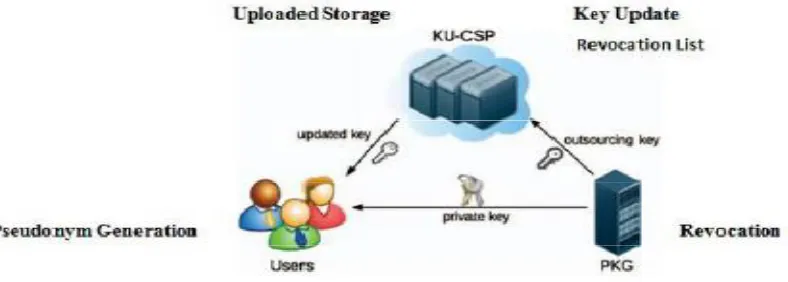
Fig. System Architecture
V . MODULE DESCRIPTION
In this section we present the Module description, how it works, practical results and environment.
Pseudonym Generation : we generate pseudonym for each user. It take users identity and provide pseudonym.Pseudonyms are usually taken or adopted to hide an individual ones real identity, for example writers’ pen names, or terrorists, and computer hackers fake names. Actors, musicians, and other performers sometimes uses stage names, for example, to hide their ethnic backgrounds. Here we use pseudonym for hide users real identity. Because KU-CSP is untrusted. So adversaries can use the data without permission based on users identity. So we generate pseudonym.
Key Generation : For each users private key request on identity ID, PKG firstly checks whether the request identity ID exists in revocation list RL, if so the key generation is aborted. then it generates Private Key (PK) and Outsourcig Key (OK).finally, it sends Private Key to user and Pseudonym with Outsourcing key to KU-CSP respectively.
Encryption : user wants to upload any file or message to KUCSP. But KU-CSP is untrusted. So encryption is compulsory.for security we use attribute based encryption with identity based encryption scheme.Here a user can encrypt a message M under Pseudonym P with attributes and time period Ti. This provides the ciphertext (CT). Then user can upload this ciphertext to KU-CSP.
Decryption : user wants to download any file or message from KU-CSP.user uses his private key send by PKG and decrypt the message. Here the ciphertext CT is encrypted under P with attributes and Ti, and the user has a private key PK, this provides original message M.
Revocation : If the private keys of some users get compromised, PKG must provide a mean to revoke such users from system.If users with identities in the set that are to be revoked at time period Ti, PKG updates the revocation list as RL as well as the time list TL through linking the newly created time period Ti+1 onto original list TL. Finally send a copy for the updated revocation list RL as well as the new time period Ti+1 to KU-CSP.
Key Updation : Upon receiving a key-update request on pseudonym, firstly KU-CSP checks whether ID exists in the revocation list RL, if so KU-CSP returns null and key-update is aborted. Otherwise it returns Updated Key (TK) and keyupdate is KU-CSP fetches the corresponding entry Id with outsourcing key in the user list UL.
VI . RESULTS
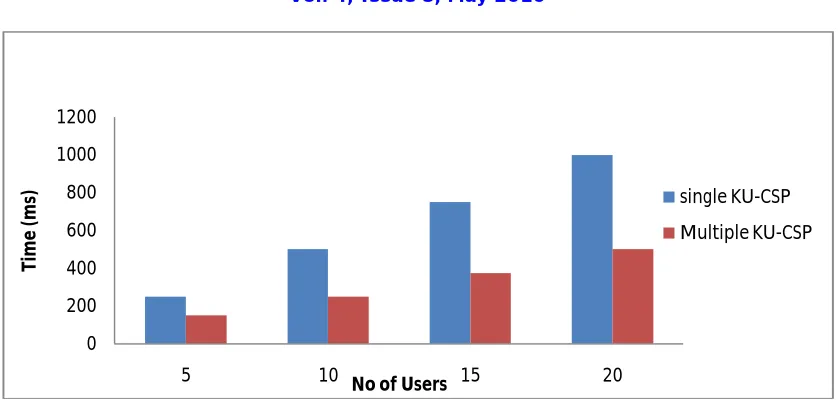
Fig. Comparison between Single and Multiple KU-CSP
The existing System uses single system to generate keys named CSP i.e central.So According to performance evaluation for about 20 Users time taken by single CSP is approx 1000(ms).In Proposed system we make use of multiple CSP i.e (2or3) .Expected time taken by 2 or more CSP for about 20 users is expected to reduce to 500 ms.
VII . CONCLUSION
Focusing on issue of identity revocation, we have introduced outsourcing computation into IBE and proposed a revocable scheme in which the revocation operations are delegated to CSP. User needs not to contact with PKG during key-update, in other words, PKG is allowed to be offline after sending the revocation list to KU-CSP. It do not require secure channel or user authentication during key-update between user and KU-CSP. Furthermore as KUCSP is untrusted we use pseudonym for each user so that adversary can not get real identity of user.we combine the Identity-based and Attribute-Identity-based Encryption which will provide more security to user.For integrity checking, generate meta data before upload the data in cloud. Using this meta data the integrity of the file is verified.
REFERENCES
1. Jin Li, Jingwei Li, Xiaofeng Chen, Chunfu Jia and Wenjing Lou,’Identity-based Encryption with Outsourced Revocation in Cloud
Computing’IEEE 2015.
2. D. Boneh and M. Franklin, Identity-based encryption from the weil pairing, in Advances in Cryptology CRYPTO 2001, Springer Berlin /
Heidelberg, 2001, vol. 2139, pp. 213 229.
3. A. Sahai and B. Waters, Fuzzy identity-based encryption, in Advances in Cryptology EUROCRYPT 2005 , Springer Berlin / Heidelberg,
2005, vol. 3494, pp. 557557.
4. W. Aiello, S. Lodha, and R. Ostrovsky, Fast digital identity revo-cation, in Advances in Cryptology CRYPTO98.Springer, 1998.
5. V. Goyal, Certificate revocation using fine grained certificate space partitioning, in Financial Cryptography and Data Security , Springer
Berlin / Heidelberg, 2007, vol.4886, pp. 247259.
6. F. Elwailly, C. Gentry, and Z. Ramzan, Quasimodo: Efficient certificate validation and revocation, in Public Key Cryptography PKC
2004 , ser. Lecture Notes in Computer Science, F. Bao, R. Deng, and J. Zhou, Eds. Springer Berlin/ Heidelberg, 2004, vol. 2947, pp. 375388.
BIOGRAPHY
Ms.kirti patil Received degree of BE from shivaji university, kolhapur in 2011 and pursuing ME Computer Engineering from Jspm’s BSIOTR, Savitribai Phule Pune University.
prof Mrs.sonali patil M. tech CSE, Phd pursuing from BSAU, Chennai. Asst.prof Department of Computer Engineering JSPM’S BSIOTR,WAGHOLI,PUNE
0 200 400 600 800 1000 1200
5 10 15 20
Ti
m
e
(m
s)
No of Users
single KU-CSP