University of Windsor University of Windsor
Scholarship at UWindsor
Scholarship at UWindsor
Electronic Theses and Dissertations Theses, Dissertations, and Major Papers
2011
Mining Multiple Related Tables Using Object-Oriented Model
Mining Multiple Related Tables Using Object-Oriented Model
Dan Zhang
University of Windsor
Follow this and additional works at: https://scholar.uwindsor.ca/etd
Recommended Citation Recommended Citation
Zhang, Dan, "Mining Multiple Related Tables Using Object-Oriented Model" (2011). Electronic Theses and Dissertations. 8059.
https://scholar.uwindsor.ca/etd/8059
This online database contains the full-text of PhD dissertations and Masters’ theses of University of Windsor students from 1954 forward. These documents are made available for personal study and research purposes only, in accordance with the Canadian Copyright Act and the Creative Commons license—CC BY-NC-ND (Attribution, Non-Commercial, No Derivative Works). Under this license, works must always be attributed to the copyright holder (original author), cannot be used for any commercial purposes, and may not be altered. Any other use would require the permission of the copyright holder. Students may inquire about withdrawing their dissertation and/or thesis from this database. For additional inquiries, please contact the repository administrator via email
Mining Multiple Related Tables Using
Object-Oriented Model
By
Dan Zhang
A Thesis
Submitted to the Faculty of Graduate Studies through the School of
Computer Science in Partial Fulfillment of the Requirements for the Degree
of Master of Science at the
University of Windsor
Windsor, Ontario, Canada
2011
1*1
Library and Archives CanadaPublished Heritage Branch
395 Wellington Street OttawaONK1A0N4 Canada
Bibliotheque et Archives Canada Direction du
Patrimoine de I'edition 395, rue Wellington Ottawa ON K1A 0N4 Canada
Your file Votre reference ISBN: 978-0-494-81744-5 Our file Notre r6f6rence ISBN: 978-0-494-81744-5
NOTICE: AVIS:
The author has granted a
non-exclusive license allowing Library and Archives Canada to reproduce, publish, archive, preserve, conserve, communicate to the public by
telecommunication or on the Internet, loan, distribute and sell theses
worldwide, for commercial or non-commercial purposes, in microform, paper, electronic and/or any other formats.
L'auteur a accorde une licence non exclusive permettant a la Bibliotheque et Archives Canada de reproduce, publier, archiver, sauvegarder, conserver, transmettre au public par telecommunication ou par I'lnternet, preter, distribuer et vendre des theses partout dans le monde, a des fins commerciales ou autres, sur support microforme, papier, electronique et/ou autres formats.
The author retains copyright ownership and moral rights in this thesis. Neither the thesis nor substantial extracts from it may be printed or otherwise reproduced without the author's permission.
L'auteur conserve la propriete du droit d'auteur et des droits moraux qui protege cette these. Ni la these ni des extraits substantiels de celle-ci ne doivent etre imprimes ou autrement
reproduits sans son autorisation.
In compliance with the Canadian Privacy Act some supporting forms may have been removed from this thesis.
Conformement a la loi canadienne sur la protection de la vie privee, quelques
formulaires secondaires ont ete enleves de cette these.
While these forms may be included in the document page count, their removal does not represent any loss of content from the thesis.
Bien que ces formulaires aient inclus dans la pagination, il n'y aura aucun contenu manquant.
1+1
DECLARATION OF ORIGINALITY
I hereby certify that I am the sole author of this thesis and that no part of this thesis has
been published or submitted for publication.
I certify that, to the best of my knowledge, my thesis does not infringe upon anyone's
copyright nor violate any proprietary rights and that any ideas, techniques, quotations, or
any other material from the work of other people included in my thesis, published or
otherwise, are fully acknowledged in accordance with the standard referencing practices.
Furthermore, to the extent that I have included copyrighted material that surpasses the
bounds of fair dealing within the meaning of the Canada Copyright Act, I certify that I
have obtained a written permission from the copyright owner(s) to include such
material(s) in my thesis and have included copies of such copyright clearances to my
appendix.
I declare that this is a true copy of my thesis, including any final revisions, as approved
by my thesis committee and the Graduate Studies office, and that this thesis has not been
ABSTRACT
An object-oriented database is represented by a set of classes connected by their class inheritance hierarchy through superclass and subclass relationships. An object-oriented database is suitable for capturing more details and complexity for real world data. Existing algorithms for mining multiple databases are either Apriori-based or machine learning techniques, but are not suitable for mining multiple object-oriented databases.
This thesis proposes an object-oriented class model and database schema, and a series of class methods including that for object-oriented join (OOJoin) which joins superclass and subclass tables by matching their type and super type relationships, mining Hierarchical Frequent Patterns (MineHFPs) from multiple integrated databases by applying an extended TidFP technique which specifies the class hierarchy by traversing the multiple database inheritance hierarchy. This thesis also extends map-gen join method used in TidFP algorithm to oomap-gen join for generating k-itemset candidate pattern to reduce the candidate itemset generation by indexing the (k-l)-itemset candidate pattern using two position codes of start position and end position codes tied to inheritance hierarchy level. Experiments show that the proposed MineHFPs algorithm for mining hierarchical frequent patterns is more effective and efficient for complex queries.
ACKNOWLEDGEMENT
I would like to give my sincere appreciation to all of the people who have helped me
throughout my education. I express my heartfelt gratitude to my father and mother for
their support throughout my graduate studies.
I am very grateful to my supervisor, Dr. Christie Ezeife for her continuous support
throughout my graduate study and also for numerous awards of research assistantship.
She always guided me and encouraged me throughout the process of this research work,
taking time to read all my thesis updates.
I would also like to thank my external reader, Dr. Mehdi S. Monfared, my internal reader,
Dr. Ziad Kobti, and my thesis committee chair, Dr. Robert Kent for making time to be in
my thesis committee, reading the thesis and providing valuable input. I appreciate all
your valuable suggestions and time, which have helped improve the quality of this thesis.
At last, I would express my appreciations to all my friends and colleagues in Dr. Ezeife's
TABLE OF CONTENT
DECLARATION OF ORIGINALITY Ill
ABSTRACT IV ACKNOWLEDGEMENT V
LIST OF CONTENT VI LIST OF FIGURES VIII LIST OF TABLES X 1. INTRODUCTION 1
1.1 Object-oriented data model 2 1.2 Object-oriented database schema 6
1.3 Assocication rule 17 1.4 Frequent Pattern Mining in Object-oriented model 17
1.5 Hierarchical Frequent Pattern 22
1.6 Thesis contribution 23 2. RELATED WORKS 25
2.1 Frequent Pattern Mining 25
2.1.1 Apriori 25 2.1.2 FP-Tree 27 2.1.3 TidFP 30 2.2 Mining Distributed Databases 33
2.2.1 Count Distribution 33
2.2.2 DMA 36 2.3 Mining multiple-level assocication rules 38
2.4 Frequent Pattern Mining in Object-oriented Model 41 2.4.1 Object-oriented approach to multi-level association rule mining 42
2.4.2 OR-FP 44 3. MINING OBJECT-ORIENTED MULTIPLE DATABASES 48
3.1 Problem Addressed in Mining Multiple Object Databases 50
3.2Mining Frequent Patterns for Each Class 51 3.2.1 Process flow and Algorithm for Mining Frequent Patterns for each class 51
3.2.2 Object-oriented Join (OOJoin) 53 3.3 Mining Frequent Patterns in Transaction(Root) Table 58
3.3.1 Definitions and Algorithms used in Method of Root Class 58
3.3.1.1 Inheritance Hierarchy Tree 59 3.3.1.2 Pre-order Traverse and Position Coding method 62
3.3.1.3 map-gen join of TidFP algorithm 65
3.3.1.4 oomap-genjoin 66 3.3.1.5 Transaction IDs Stored MHTree (TMHTree) 72
3.3.1.6 Linkage Built TMHTree (LTMHTree) 73
3.3.2 Insert Transactions into Root table 75 3.3.3 Mining Frequent Patterns in Root Table 80
TABLE OF CONTENT
3.3.3.4 Build Linkage for Multiple Inheritance Hierarchy Tree 91
3.3.3.5 Mining Hierarchical Frequent Patterns 94 4. IMPLEMENTATON AND EXPERIMENTS 101
4.1 Generate and process testing dataset 101 4.1.1 Generate Class Tables C, 101 4.1.2 Generate Root Tables 103 4.2 Algorithm implementation 104 4.3 Performance comparison 104 4.4 Time and Space Complexity Analysis I l l
4.4.1Time and Space Complexity of the Apriori algorithm I l l 4.4.2 Time and Space Complexity of the TidFP algorithm 113 4.4.3Time and Space Complexity of the MineHFPs algorithm 113
5. CONCLUSION AND FUTURE WORK 115
LIST OF FIGURES
Figure 1.1: is-a relationship 6 Figure 1.2: An example of object-oriented database 7
Figure 1.3: Example of class inheritance hierarchies for Computer object database 9
Figure 1.4: Multiple database inheritance hierarhcy tree 10
Figure 1.5: Concpet hierarhcy of milk product 21
Figure 2.1: Tree branch for Tl 28 Figure 2.2: Tree branch for T2 28 Figure 2.3: complete FP-tree 29 Figure 2.4:13 conditional FP-tree 29 Figure 2.5: Concept hierarchy 39 Figure 2.6: Concept hierarchy 43 Figure 2.7: Concept hierarchy 43 Figure 2.8: Class inheritance hierarchy for person, actor, and movie classes 45
Figure 3.1: Algorithm for method MineClassFPs 52 Figure 3.2: Process flow for mining each object database 53
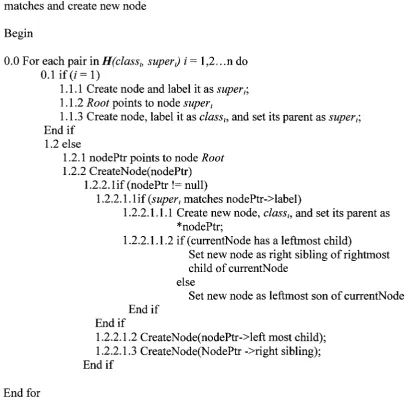
Figure 3.3: Algorithm for OOJoin 55 Figure 3.4: HTree for 3 class inheritance hierarhcy 60
Figure 3.5:Algorithm for creating HTree 61 Figure 3.6: Algorithm for pre-order traverse 62 Figure 3.7: Position codes assigned tree 63 Figure 3.8: Algorithm for assigning position codes 64
Figure 3.9: Algorithm for oomap-gen join 71
Figure 3.10: TMHTree 73 Figure 3.11: LTMHTree 74 Figure 3.12: Algorithm for method InsertTransactions 75
Figure 3.13: Process flow of private method InsertTransaction of Root class 76
Figure 3.14: Algorithm for InsertTrans 79 Figure 3.15: Algorithm for method MineRootFPs of Root class 81
Figure 3.16: Process Flow of private method MineRootFPs of Root Class 83 Figure 3.17: Algorithm for creating multiple inheritance hierarchy tree (MHTree) 85
Figure 3.18: MHTree of computer object databases example 86 Figure 3.19: Algorithm for storing transaction ids into tree 87
Figure 3.20: TMHTree store transaction ID 1 88 Figure 3.21: TMHTree store transaction ID 1, 2 89 Figure 3.22: TMHtree stores all transaction IDs 89 Figure 3.23: Algorithm for generating 1-item candidate patterns with transaction IDs... 90
Figure 3.24: Algorithm for BuildLinkage 92 Figure 3.25: Linkage built LTMHTree 94 Figure 3.26: Algorithm for MineHFPs 95 Figure 3.27: Algorithm for CheckSupp 96 Figure 4.1: CPU executing time on 125K dataset 106
Figure 4.2: Memory usage on 125K dataset 107 Figure 4.3: CPU executing time at the minimum support 10% 109
LIST OF FIGURES
LIST OF TABLES
Table 1.1: Object table of computer class in IBM database 13 Table 1.2: Object table of laptop class in IBM database 14 Table 1.3: Object table of desktop class in IBM database 14
Table 1.4: Example of Root class table 14 Table 1.5: result of object-oriented join Table 1.1 and Table 1.2 17
Table 2.1: Transaction Database 26 Table 2.2: Complete mining result of FP-tree 30
Table 2.3: Example Drug/Side Effects Database record 32 Table 2.4: Example Patient/Drugs Database records 32
Table 2.5: Distributed Databases 33
Table 2.6: 1-itemsets 34 Table 2.7: 1-itemsets and counts 34
Table 2.8: Large 1-itemsets and counts 34 Table 2.9: 2-itemsets and counts 35 Table 2.10: large 2-itemsets and counts 35 Table 2.11: Distributed Databases 36
Table 2.12: 1-itemsets 36 Table 2.13: Heavy 1-itemsets 37
Table 2.14: 2-itemsets 37 Table 2.15: heavy 2-itemsets 37 Table 2.16: heavy 3-itemsets 38 Table 2.17: Encoded transactions 39 Table 2.18: Encoded transactions 40 Table 2.19: level-1 large 1-itemset 40 Table 2.20: level-1 large 2-itemset 40 Table 2.21: Encoded transactions 40 Table 2.22: level-2 large 1-itemset 41 Table 2.23: level-2 large 2-itemset 41 Table 2.24: level-2 large 3-itemset 41 Table 2.25: level-3 large 1-itemset 41 Table 2.26: level-3 large 2-itemset 41 Table 3.1: result of "Computer" table cross product "Laptop" table 56
Table 3.2: result of selected rows 57 Table 3.3: Result table of OOJoin 58 Table 3.4: Object Table of Computer Class in IBM DB 78
Table 3.5: Objects table of Laptop class in IBM DB 78 Table 3.6: Objects table of Desktop class in IBM DB 78
Table 3.7: Result table of OOJoin 78 Table 3.8: Indexed Root table 80 Table 4.1: characteristics of the generated dataset 105
LIST OF TABLES
Table 4.3: Memory usage at 100K dataset 106 Table 4.4: CPU executing time at 250K dataset 107 Table 4.5: Memory usage at 250K dataset 107 Table 4.6: CPU executing time at 500K dataset 108 Table 4.7: Memory usage at 500K dataset 108 Table 4.7: Table 4.8 CPU executing time at the minimum support 10% 109
1. INTRODUCTION
Data mining is a process of extracting relevant and important knowledge from large data
to facilitate decision making. Data mining has attracted tremendous amount of attention
in database research because of its applicability in many areas, including decision
support, market strategy and financial forecast. The process of discovering interesting
information from huge set of data often employs different techniques and approaches.
Some of the approaches include: Classification, Clustering, Regression, and Association
rule mining. Agrawal and Srikant (1995) proposed the Apriori algorithm that mines
frequent patterns from a single database table by generating candidate itemsets and
scanning database to count the support of each candidate. The later research work such as
FP-tree proposed by Han and et al. (2004) also mines a single database table by
projecting the database into a compressed tree and mining frequent pattern by
pattern-growth technique. However, mining single database table is not enough to extract useful
information or answer more complex queries. Ezeife and Zhang (2009) proposed the
Apriori-based TidFP algorithm that not only improves the efficiency of mining a single
database table by intersecting transaction ids to avoid multiple scanning of the database,
but also mines multiple tables by a set of operations such as intersect, minus, or union.
The researchers have begun to work on mining multiple data sources about a decade ago.
The early research work of mining multiple data sources was applying hardware
techniques (e.g., Agrawal and Shafer (1996)), such as parallel computer or distributed
system, to separate data sources. Then they utilize multiple computing resources to mine
the data. The later research work on mining multiple data sources such as Sequential
applies machine learning techniques, such as clustering to discover both local patterns
and global patterns of each data source. Mining multi-level association rule (Han and Fu
(1995)) generalizes or specializes patterns to higher or lower concept hierarchy (class
hierarchy) to discover the frequent pattern in different hierarchy levels. There are also
research work that proposed frequent pattern mining methods for object-oriented
databases. Kuba and Popelinsky (2003) proposed the algorithm OR-FP that mines
frequent patterns that covers at least a given minimum number of objects in
object-oriented data. However, these algorithms are not designed for object-object-oriented multiple
database mining.
1.1 Object-oriented data model
Real world data are complex and good to be presented as objects (Dzeroski and Lavrac
(2001)). An object-oriented database is suitable for capturing more comprehensive and
detailed complexity of real world data, such as different products on a Business to
Customer (B2C) website, their histories, versions, price, images, or specifications. Data
captured from B2C websites are not suitable to store in a relational database, because of
the scalability of the relational database is limited. For example, changing the schema of
a relational database is a complicated process. Products sold on B2C websites are being
changed frequently. There are always new products coming. New products have their
new features and specification. For example, several years ago, B2C websites such as
Bestbuy™ or Futureshop™, were not selling one type of computer called "Pad". The new
product "Pad" is an extension of "laptop", but has its new features or specifications, such
as "CPU", "RAM", "LCD screen size". If we want to store the information of "Pad" in a
relational database, we need to modify the database schema of the table for Laptop, such
as adding more columns into the table for Laptop. Alternatively, we can create a new
database table for "Pad" which stores all features and specifications of "Pad". However,
this solution will be hard to show the relationship between "Laptop" and "Pad". In
addition, mining queries of the database also need to be modified due to the changes of
the database schema. Therefore, an object-oriented database schema is more suitable for
the complexity of Web data. All products are grouped into classes and show the
inheritance hierarchy relationships. For example, the new products "Pad" has its own
features and specifications, but it does have some common features or specifications as
"Laptop". In an object-oriented database, a new class called "Pad" can be added as a
subclass of "Laptop" class. The new class "Pad" inherits all features and specifications of
"Laptop", but has its own features and specifications as well. Also, the new class "Pad"
will have its own method to deal with mining queries.
An object-oriented data model is a logical organization of real world objects (entities), for
example, an object-oriented data model represents classes of computers (computer,
laptop, or desktop) about which a company wishes to hold information. There exist
constraints (for example, properties of a computer object, CUP, RAM, and Harddrive
must be valid to satisfy a computer object) and relationships (for example, there exists
inheritance hierarchical relationship between object "computer" and object "laptop")
implements the object-oriented data model. The object-oriented data model consists of
the following core concepts:
1) The object and object identifier
Real world entity such as a "computer" is represented as an object. In object-oriented
database, every instantiated object is associated with a unique object-oriented identifier,
also called OID. The object-oriented database system requires every instantiated object to
get a unique identifier at the object instantiation time and it has to be guaranteed that this
identifier remains unique throughout the lifetime of the object. Therefore, this
object-identifier is also called logical object object-identifier.
2) Attributes and methods
Attributes of an object, such as specifications of a computer object (for example, CPU,
RAM, or Harddrive specifications), have a set of values assigned to them, are the
properties that an object has. The values of attributes represent the state of the object. The
methods of an object (for example, a method of a computer object is getCPU) ar e
behaviors of the object. These behaviors operate on the state (for example, a state a
computer object having CPU = "2GHz", RAM = "2GB", and Hard_drive = "250GB") of
the object. For example, for Computer class, there is a computer object and its CPU type
is known. There is a class method, called getCPU() that returns this CPU type.
3) Class:
Class is an abstraction of all the instantiated objects (instances) which share the same set
of attributes and methods. An instantiated object must belong to only one class as an
instance of that class. A class may also be primitive (no attributes), e.g., integer, string,
Computerf
CPU: String RAM: String
Harddrive: String
private set MineComputerFPs (float minsupp) private int GetCountCPU(String cputype)
}
In the above example, the class Computer has the attributes: CPU, RAM, and Hard_drive
that are all string type. The class computer also has class methods
MineComputerFPs(float minsupp) and GetCountCPU(String cpu_type). The private
method MineComputerFPs(fioat min_supp) takes a percentage number for minimum
support as a parameter and mines the attributes of a computer class as frequent patterns.
For example, mine all frequent attributes of Computer class having minimum support of
50%. The private method GetCountCPU(String cputype) takes CPU type as a parameter
and return the number of CPU attributes of Computer class according to the specified
CPU types. For example, get the number of "2GHz" CPUs in the computer class.
4) Class Hierarchy and Inheritance
Class hierarchy in Computer Science is the classification of objects class type, which is a
set of classes and their inter relationships. Entities and objects with similar characteristics
are grouped together and described as a class type. Similar characteristics means that the
objects have the same structure and behaviours, or the same attributes and methods. If
objects slightly differ in their structure or behaviours, they should belong to different
class types. The relationship between the classes that host slightly different objects is
between all classes in the object database, which derives a new child class (subclass)
from an existing parent class (superclass). The subclass inherits all attributes and class
methods from the superclass, but also has its own attributes and methods. Subclass can
inherit from either one superclass or multiple superclasses. The general idea behind
inheritance is the is-a relationship between object types, as shown in Figure 1.1.
Computer
is-a
Laptop
Figure 1.1 is-a relationship
In Figure 1.1, Computer is a super type (superclass) and Laptop is a sub type (subclass).
Super type and sub type relationship represents the concept of generalization and
specification respectively. Computer is a generalization of Laptop and Laptop is a
specialization of Computer.
1.2 Object-oriented database schema
"An object-oriented database is a database management system in which information is
represented in the form of objects" (Wikepedia (2011)). The Object-oriented database
model has several advantages over a relational database model. The First Normal form
(INF) of the relational database model stipulates that there must be atomic values for
attributes in a tuple. It does not allow complex values, such as sets, lists, or other data
collection of types, such as, sets, lists, or some other data structure. The object-oriented
database model does not need additional tables to store the data represented in a
collection type. In a relational database model, procedures must be maintained outside of
the relational model itself. However, in an object-oriented database model, these
procedures can be considered as behaviors of the objects and can be maintained as
methods of the classes (Wikepedia (2011)). Some object-oriented databases are designed
to work with object-oriented programming languages such as Delphi, Ruby, Python, Perl,
Java, C#/Visual Basic.NET, C++, Objective-C and Smalltalk. The research/commercial
products of the object-oriented databases include EXODUS, Vodak, Gemstone, Gbase,
Objectivity/DB, ObjectStore, and etc. Figure 1.2 provides an example of an
object-oriented database model.
Object 3: Computer
' •^ computet K.1 ^ J
cpu I
1 ??nJ „ , . . .1 J
I cvmpw« unnic 1
Object 1: Sales transaction
1—•
tiaiisaetion id Computer Saks Staff
Date-Object 2: Sale
*>, staff id j "
s s
> age | 1 salan- 1 i name 1
tafl f
Figure 1.2 an example of object-oriented database model
In Figure 1.2, there are three objects, Sales transaction, Computer, and Sales staff. The
computer object and the sales staff object are attributes of the sales transaction object.
"An object-relational database is a database management system (DBMS) similar to a
inheritance are directly supported in database schemas and in the query language."
Compared with relational database model, the object-relational database supports
complex data types for the attributes of every tuple, type inheritance, and object
behaviors such as methods of the classes. The products of object-relational database
management systems include Illustra, PostgreSQL, Omniscience, and etc. The database
management systems such as IBM's DB2, Oracle database, and Microsoft SQL Server,
make claims to support the object-relational technology (Wiki (2011)).
An object-oriented database is represented by a set of classes connected by their class
inheritance hierarchy through superclass and subclass relationships (Kemper and
Moerkotte (1994)). Other hierarchies like object link or part-of hierarchies may also exist.
An object-oriented database consists of a set of classes, C„ with a class inheritance
hierarchy H. Each class is defined as an ordered relation Q = (K, T, S, A, M, O), where K
is the class identifier, T is the class type, S is the super type (superclass) of the class, A is
a set of attributes (Ezeife and Barker (1998)). M is a set of methods, O is a set of objects.
Class inheritance hierarchy H is used to depict superclass and subclass relationship
between classes in an object-oriented database and can be represented as a set of pairs of
class and superclass in the form of (class, superclass).
Example 1.1 (An object database class inheritance hierarchy): A computer
object-oriented database consists of three classes (computer, laptop, desktop), which are related
through class inheritance hierarchy H={(Laptop, Computer), (Desktop, Computer)}.
Database schema for this database is provided as:
C2 = (K2, Type, Super, {oid, Screensize, Batterylife}, 01,02,..., on);
C3 = (K3, Type, Super, {oid, Graphic}, 01,02,..., on);
Provide the class inheritance hierarchy for this computer object-oriented database.
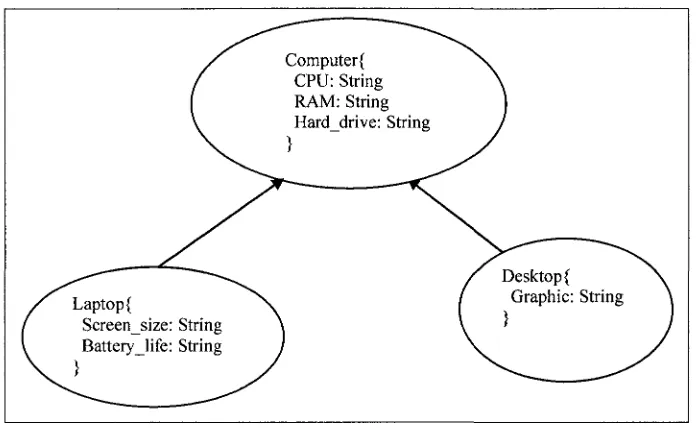
Solution 1.1: The class inheritance hierarchy of the computer object-oriented database
described above is shown in Figure 1.3.
/ Computer} N. / CPU: String \ ( RAM: String ) V Harddrive: String /
\ > y
^^~~ ~~~~-~^^ / Desktop} \ / L a p t o p } >v ( graphic: String \
I Screensize: String \ y > I y Battery life: String / \ /
V } y ^ ^ /
Figure 1.3 Example of class inheritance hierarchies for Computer object database
In Figure 1.3, class Computer is the super class of Laptop class and Desktop class.
Computer class has attributes CPU, RAM and Harddrive. Class Laptop and Desktop are
sublcasses of class Computer that inherit the class Computer and have inherited all
attributes from class Computer, but have their own attributes Screen size, Batterylife,
and Graphic.
Definition 1 (tree structure of multiple database class inheritance hierarchy): MHTree is
the tree structure representation of multiple databases inheritance hierarchy. For example,
three object-oriented computer databases for IBM, Dell, and HP are shown in Figure 1.3.
Example 1.2 (A multiple database class inheritance hierarchy): Inheritance hierarchy in
and HP. Every database consists of three classes (computer, laptop, desktop). MH is
represented in a set of pairs used to depict supperclass and subclass relationship.
MH={(IBM, Root), (Dell, Root), (HP, Root), (Computer, IBM), (Computer, Dell ),
(Computer, HP), (Laptop, Computer), (Desktop, Computer)}. Provide multiple database
inheritance hierarchy in a tree structure.
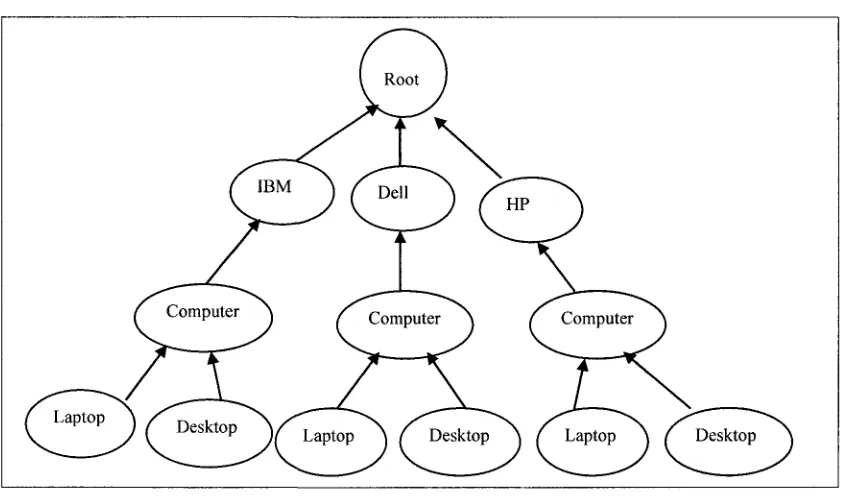
Solution 1.2: The multiple database inheritance hierarchy for three object-oriented
Computer databases having "Computer", "Laptop", and "Desktop" inheritance hierarchy
relationships for IBM, Dell, and HP can be represented as a tree structure in Figure 1.4.
Figure 1.4 Multiple databases inheritance hierarchy Tree (MHTree)
In Figure 1.4, the nodes "IBM", "Dell", and "HP" represent three companies that make
computers and also they represent three databases. Every database has Computer class
table and inherited by two other class tables "Laptop" and "Desktop". Computer, Laptop,
and Desktop class tables store the specification of all computers, such as CPU, RAM,
Definition 2 (database schema of Root table): Root(K, T, S, A, M, O). Root class table is
a transactional table which records the transactions, for example, sales transactions from
different object databases. K is the object id which stands for the transaction id. T is the
class type of the transaction (name of the database where the transaction comes from). S
is the super type of the transaction. A is a set of attributes which includes a set of
superjype S of C„ super, (number of super, depends on levels of hierarchy of C,) and all
attributes A of C,. M is a set of class methods which are behaviors of Root class, such as
updating Root table and mining patterns in Root table. O is a set of objects of transaction
(one object stands for one transaction). For example, a sale transaction of a purchased
desktop from IBM database recorded in Root table (sales transaction table) has object id
K which is a transaction id (an integer number), class type T which indicates the database
where the transaction comes from (database is "IBM" in this case), super_type S which is
"Root", the attributes A include two super type, superi and super2 (in computer object
database, there are two levels of hierarchy) and all attributes of C„ CPU, RAM,
Harddrive, Screen_size, batterylife and Graphic.
In an object-oriented database model, the instantiated objects (instance) are referenced
(retrieved) by following the object pointers, so do the inheritance relationships.
Therefore, it will be a problem to retrieve the information of inheritance hierarchy in an
object-oriented database model. Inheritance hierarchy can be represented by foreign keys
in a relational model. The relational database model provides a clear vision of all
attributes of a table including the information of inheritance hierarchy. However,
such as the join operation. In an object-oriented database model, there is no specific join
operation, because the instantiated objects are referenced by the object pointers. We will
provide the solution to address the problem of the join operation in section 3.2.2.
We can also define the object-oriented database as a relational database represented with
a set of tables (relations) connected through foreign key relationships where the foreign
keys in our object-oriented database model of C, = (K, T, S, A, M, O) and Root(K, T, S, A,
M, O) are realizing the inheritance hierarchy with the subclass and supperclass
relationships as defined in the T, S attributes of an object class.
In this thesis, we are dealing with data from different databases and or data captured from
different B2C websites. Different databases and websites may give different names to the
same product. For example, a laptop computer may be given the name of "Laptop" in one
database or website and "Notebook computer" in a different database or website.
Therefore, data from different database or websites must be cleaned. For example, we
should change all such names to be consistent across the databases. As an example the
name "Notebook computer" should be changed to the name "Laptop". This thesis is not
concerned with such as cleaning problems and assumes that data had been previous
cleaned such that all schemas from the different databases of the same domain are the
same.
Example 1.3 (object database represented with relational model): Provide relational
database and tables that represent the computer object database in Figure 1.2 and the Root
Solution 1.3:
Computer (comp id: string, type: string, super_type: string, cpu: string,
ram: string, harddrive: string);
Laptop dap id: string, type: string, superjype: string, screen_size: string,
batterylife: string);
Desktop (desk id: string, type: string, supertype: string, graphic: string);
Root (transaction id: integer, type: string, super_type: string, supers string,
super2: string, cpu: string, ram: string, hard_drive: string, screen_size: string,
battery_life: string, graphic: string)
In the above relational database schema, compjd is the primary key of the computer
table, lapjd is the primary key of laptop table, deskjd is the primary key of the desktop
table, and transaction id is the primary key of Root table. All class tables have the
composite foreign keys consisting of the two attributes type and supertype in each table.
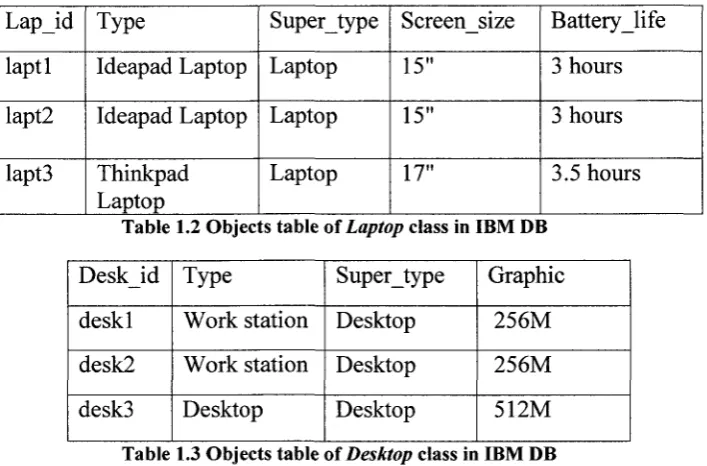
A sample computer object database owned by IBM company is shown in Table 1.1,
Table 1.2, and Table 1.3.
Comp_id compl comp2 comp3 comp4 comp5 comp6 Type Laptop Laptop Laptop Desktop Desktop Desktop Supertype Computer Computer Computer Computer Computer Computer CPU 2GHz 2GHz 3GHz 3GHz 3GHz 3GHz RAM 2GB 2GB 4GB 4GB 4GB 4GB Hard Drive 250GB 320GB 350GB 500GB 500GB 500GB Computername Ideapad laptop Ideapad laptop Thinkpad laptop IBM workstation IBM workstation IBM PC
L a p i d laptl lapt2 lapt3 Type Ideapad Laptop Ideapad Laptop Thinkpad Laptop Supertype Laptop Laptop Laptop Screen_size 15" 15" 17" Battery_life 3 hours 3 hours 3.5 hours
Table 1.2 Objects table of Laptop class in IBM DB
D e s k i d
deskl desk2 desk3 Type Work station Work station Desktop Super_type Desktop Desktop Desktop Graphic 256M 256M 512M
Table 1.3 Objects table of Desktop class in IBM DB
Table 1.1 is the Computer class table that stores the specifications of computers. Table
1.2 and Table 1.3 stores the specifications of laptop and desktop that inherit the computer
class. An example of Root class table that records all computers purchased from different
databases, such as IBM, Dell, or HP is shown in Table 1.4
Oid (Tid) 1 2 3 4 5 6 7 8 Type IBM IBM Dell HP HP Dell IBM HP Super Type Root Root Root Root Root Root Root Root superi computer computer computer computer computer computer computer computer super2 laptop laptop laptop desktop desktop desktop laptop laptop CPU 2GHz 2GHz 2GHz 3GHz 3GHz 3GHz 2GHz 3GHz RAM 2GB 4GB 2GB 4GB 4GB 4GB 2GB 4GB Hard Drive 250GB 320GB 350GB 500GB 500GB 500GB 320GB 350GB Computer Name Ideapad laptop Ideapad laptop Thinkpad laptop Media centre Media centre precision Thinkpad Laptop Media centre Screen Size 15" 15" 17" 15" 17" Battery Life 3hrs 3hrs 3.5hrs 3hrs 3.5hrs Graphic 256M 256M 512M
Table 1.4 example of Root class table integrated from tables of three databases IBM, HP, and Dell
Oid is the object id, K, which indicates the transaction id represented by integer number.
Type is the class type T which indicates the database where the computer comes from,
such as "IBM", "Dell", or "HP". Super type is S. A set of attributes of class Root, A
include:
1) super] and super2 are super types of the computer object database. In this example,
class Computer has subclasses Laptop and Desktop. There are 2 levels of hierarchy, so
there are 2 "super" attributes superiand super2. If there are n levels of hierarchy, there
will be superi, super2... and super,,
2) CPU, RAM, Harddriver, Screensize, Batterylife, Graphic are all attributes of
Computer, Laptop, and Desktop classes.
The Root class also has a set of class methods M:
private InsertTransactions();
private MineRootFPs (float minsupp);
The private method InsertTransactionsQ is used to insert computer purchase transactions
into the Root table. Such a transaction record contains the model and specifications of
the computer, and the company that made the computer. When the method is called, the
new purchase transaction will be inserted into the Root table. The private method
MineRootFPs(float min_supp) takes a percentage number representing the minimum
support as parameter and mines the attributes of a Root class as frequent patterns. For
example, this method can answer queries such as: What are the most popular hardware
component specifications (CPU, RAM, Hard drive, screen size, battery life, and
Graphics card) among the computer systems that have been sold (with a minimum
In the computer object database, there are three classes. Computer, Laptop, and Desktop
are shown in Figure 1.2. When a purchase is made, it specifies the purchase as laptop or
desktop. Therefore, the computer specifications need to be extracted from two object
tables, Computer and Laptop, or Computer and Desktop. A method, called
object-oriented join {OOJoin) needs to be defined to join two object tables which have
inheritance relationship.
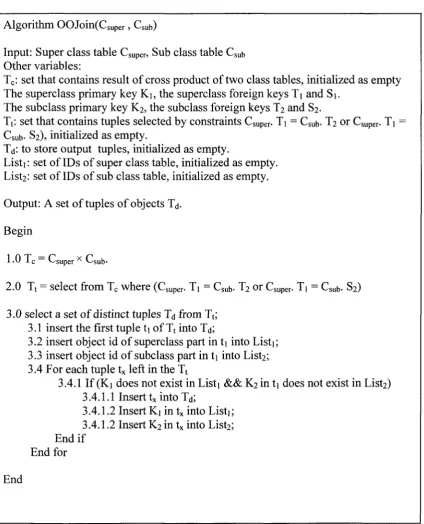
Definition 3 (join superclass and subclass tables): Object-oriented Join, OOJoin, is used
to join tuples in two object class tables, superclass table, CSUper and subclass table, Csub.
Every tuple in the object class table has the primary key K, foreign keys type Tand super
type S, and a set of other attributes A. OOJoin select a set of tuples based on distinct
Csuper-K and Csub.K from the result of Csuper M Csub where(Csuper.T = Csub.T or Csuper.T =
Csut,.S). For example, OOJoin algorithm joins the Computer class table and Laptop class
table and the resulting join will result in a table that contains all Laptop attributes with the
expanded attributes of the superclass Computer.
Example 1.5 (Object-oriented Join): Show the result oi object-oriented join of two object
tables, the Computer class table (Table 1.1) and the Laptop class table (Table 1.2). The
resulting table should contain all the attributes of the Laptop class and its superclass
Computer.
Solution 1.5: Table 1.5 is the result of object-oriented join of Table 1, the Computer class
ID compl comp2 comp3 Type Laptop Laptop Laptop Super Computer Computer Computer CPU 2GHz 2GHz 3GHz RAM 2GB 2GB 4GB Hard Drive 250GB 320GB 350GB Comp Name I laptop I laptop T laptop ID laptl lapt2 lapt3 Type Ideapad Laptop Ideapad Laptop Thinkpad Laptop Super Laptop Laptop Laptop Screen Size 15" 15" 17" Battery Life 3hrs 3hrs 3 5hrs
Table 1.5 result of object-oriented join Table 1.1 and Table 1.2
Details of the Object-oriented join algorithm will be discussed in section 3.2.
1.3 Association rule Mining
Frequent patterns are itemsets that appear in a data set with frequency (also called
support) no less than a user-specified threshold (also called minimum support). For
example, a set of items, such as milk, juice, and bread that appear frequently together in a
transaction dataset, forms a frequent itemset. Frequ ent pattern mining is the task of
discovering the frequent patterns from the transactional databases. Frequent pattern
mining is the essential step of association rule mining. Association Rule is an implication
of the form X => Y„ where X is a set of some items in the set of all items Y, and Y, is a
single item in 7 that is not present in X. In above example, frequently occurred items
milk, juice, and bread may lead to find association rules milk & juice => bread, which
means that the customers who purchase milk and juice may usually purchase bread.
1.4 Frequent pattern Mining in Object-oriented Model
Frequent pattern mining in a single relational database table is used to find the itemsets
whose frequencies are no less than a user-specified threshold (also called minimum
transaction is one row in the database table. Therefore, frequent patterns in traditional
database system are just items or combination of items (itemsets).
In an object table, every instantiated object can be considered as one row in a relational
database table. The attributes of the object can be considered as itemsets (pattern).
Mining the frequent pattern in an object table is used to discover an object attribute or
combination of object attributes that appear frequently in all objects. In Example 1.3,
Table 1.1, a Computer class table has attributes "CPU", "RAM", "Hard_drive". The
objects in Table 1.1 have attributes, such as <2GHz>, <3GHz>, <2GB>, <4GB>, or
<500GB>. These attributes can be considered as itemsets.
Based on Example 1.3 (sample of Computer database), some frequent pattern mining
queries can be answered:
Query 1: What are the most frequent hardware components (CPU, RAM, hard drive)
used by IBM in their computer model lineup? (with a minimum support of 50%)
Query 1 can be answered by calling the method MineComputerFPs(50%) of the class
Computer. The method can apply one of the frequent pattern mining algorithms, such as
the TidFP algorithm to Table 1.1.
Query 2: What are the most frequent hardware components (CPU, RAM, Screen size)
used by IBM in their laptop model lineup? (with a minimum support of 50%)
Query 2 cannot be answered by applying the TidFP algorithm on table 1.1. It involves
1.1 and Table 1.2. Following the join we need to apply a frequent pattern mining
algorithm on the joined table.
If we want to determine (mine) the most popular hardware components or hardware
component combinations among the computer systems that have been sold, we need to
mine the sales transaction table (shown in Example 1.5). Assuming that we want to
answer the query such as:
Query 3: What are the most popular hardware component specifications (CPU, RAM,
Hard drive, screen size, battery life, and Graphics card) among the computer systems
that have been sold (with a minimum support of 50%)?
If we apply the TidFP algorithm on Table 1.4, it returns the patterns in the following
format, <Tidlist, itemset>. Each pattern consists of a transaction id list and an itemset.
For example: <1,2,3,7, 2GHz>, <4,5,6,8, 3GHz>, <1,3,7, 2GB>, <2,4,5,6,8, 4GB>,
<1,3,7, 2GHz,2GB>, and <4,5,6,8, 3GHz,4GB>. Unfortunately, query 3 is not good
enough to discover patterns at different hierarchies for an informative database table such
as Table 1.4. For example in Table 1.4, 2GHz processors are not considered to be of a
significant enough of a frequency when both desktop and laptop computers are
considered, however, 2GHz processors are of a significant frequency when only laptop
computers are considered. This table integrates information of hierarchy from multiple
Therefore, we need an algorithm which can handle queries that not only mine the
frequent patterns in a table, but which also specify at what hierarchy level the pattern is
frequent. Examples of such queries are query 4 and query 5.
Query 4: What are the most popular hardware component specifications (CPU, RAM,
Harddrive, screen size, battery life, and Graphics card) among the computer systems
that have been sold by a particular company like Dell (with a minimum support of 50%)?
Query 5: What are the most popular hardware component specifications (CPU, RAM,
Harddrive, screen size, and battery life) among a computer system subgroup such as
laptops and sold by a particular company like Dell (with a minimum support of 50%)?
The algorithm for mining multi-level association rules (Han and Fu (1995)) can discover
a frequent pattern(s) at different concept hierarchy levels. In this algorithm, a pattern can
be generalized or specialized by a roll-up or a drill-down along the concept hierarchy
(class hierarchy). Then the pattern(s) will be replaced by another pattern from a higher or
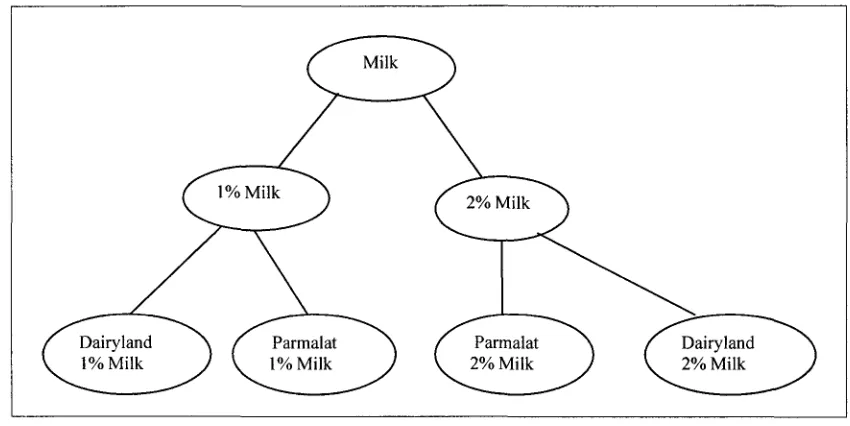
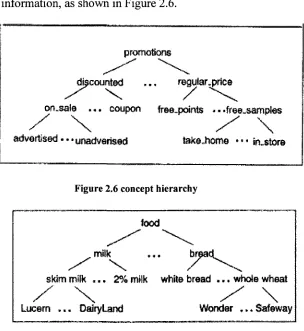
a lower concept hierarchy level. For example, two patterns <2%milk> and <l%milk> can
be replaced by the pattern <milk> from a higher concept hierarchy (class hierarchy) level
or <Dairyland l%milk> from a lower concept hierarchy (class hierarchy) level, as shown
Figure 1.5 Concept hierarchy (class hierarchy) of Milk product
However, the algorithm for mining multi-level association rules (Han and Fu (1995))
does not consider an instantiated class object as a pattern and does not consider the
attributes of such instantiated objects as pattern(s). For example, the milk, l%milk, and
Dairylandl%milk could be classes and have their attributes, such as Milk: {protein,
calories). 1% Milk:{ protein, calories, fat). Dairylandl%milk :{ protein, calories, fat,
brand). The attributes such as protein, calories, fat, or brand could be mined for frequent
patterns. The OR-FP algorithm (Kuba and Popelinsky (2003)) mines instantiated objects
and the attributes of such objects for frequent patterns using the query/mining class and
the objects in the subclasses of the query/mining class. In the milk example above, the
OR-FP algorithm can consider milk as the query/mining class. The instantiated mining
class object(s) could be frequent patterns, and the instantiated subclass objects such as
l%milk, Dairylandl%milk, along with attributes such as protein, calories, fat, or brand
could also be frequent patterns. However, the OR-FP algorithm does not specify at which
To answer the previously stated queries in this paper which were labeled as query 4 and
query 5 (queries for mining frequent patterns in a transactional table), an algorithm is
required which can mine the attributes of Computer, Laptop, and the Desktop class, and
in addition to also specify the hierarchy level at which the pattern is frequent at.
1.5 Hierarchical Frequent Pattern
As discussed in section 1.2, frequent patterns are itemsets that appear in a data set with a
frequency (also called support) of not less than a user-specified threshold (also called
minimum support). Therefore, the patterns are itemset, 7, which is a set of items. For
example, an itemset could be <a, b, d>, which means that itemset < a, b,d> are frequent
patterns. The TidFP algorithm (Ezeife and Zhang (2009)) proposed a method that mines
for frequent pattern(s) along with a transaction id list. Therefore, in TidFP, the frequent
patterns are not just itemsets, but a combination of itemsets and their transaction id lists,
77. T is a list of transaction ids, and 7 is a set of items. For example, an itemset with
transaction ids could be <7y, 7?, T4, a, b, d>, which means that frequent pattern <a, b, d>
appears in transaction Tj, T2, and T4. In this thesis, we introduce a new term, called
hierarchical frequent pattern. Because we are looking for the patterns that at different
class hierarchy levels, we need to specify which hierarchy level the pattern belongs to.
We will still mine the frequent patterns by their transaction ids. Therefore, our
hierarchical patterns are represented by the forms of <Tidlist, itemset, classj> (TIC). TI is
the frequent patterns with transaction ids, same as in the TidFP algorithm. C is the class
be <Tj, T2, T4, a, b, d, computer/IBM>, which means that the frequent pattern <a, b, d>
appears in transaction Tj, T2, T4 and belongs to class hierarchy IBM computer.
Definition 4 (Frequent patterns with specifying class hierarchy): Hierarchical Frequent
Pattern, HFP, is represented in the format of <Tidlist, itemset, classj> and is used to
indicate in which transactions and at which class hierarchy a frequent pattern appears.
Example 1.6 (hierarchical frequent pattern): Show a hierarchical frequent pattern of
computer object database that consists of transaction ids (Tidlist), itemset, and hierarchy.
Solution 1.6: <1, 3, 4, 2GHz, 2G, laptop/computer/IBM>. 1,3,4 are transaction
ids(Tidlist), 2GHz, 2GB are itemsets, and laptop/computer/IBM is the hierarchy.
1.6 Thesis Contributions
This thesis proposes a series of methods for mining frequent patterns from multiple data
sources and multiple tables in object-oriented model which include joining object
database tables, integrating multiple data sources, and mining hierarchical frequent
patterns.
This thesis argues that: 1) it is beneficial to capture multiple real life databases as
object-oriented databases and 2) to develop techniques to mine such multiple object-object-oriented
databases at different levels of inheritance hierarchy.
The following are main contributions of this thesis:
1. Define an object-oriented class model which has class attributes and class
schema as C, = (K, T, S, A, M, O), where K is object id, T is class type, S is super
type, A is a set of attributes, M is a set of class methods, and O is a set of class
objects.
2. Define the method called Object-Oriented Join {OOJoin) which joins super table
CSUper and sub class table Csub by selecting the tuples which have distinct object id
(K), Type (T), and Supertype (S), such that CSUper.^ and CSUb-^ from the result of
^super ^ ^sub Wnere(L/Super-•* — '--'sub--' OF '--super--' —' L-sub-'J.)'
3. Define the new term, hierarchical frequent patt ern, HFP, formed as <Tidlist,
Itemset, Hierarchy>, where Tidlist is a set of object id K, Itemset is a set of class
attributes A, and Hierarchy is a set of classes, C, (class,). Hierarchical frequent
pattern specifies at which hierarchy level the pattern is frequent and is an
extension of the TidFP's pattern <Tidlsit, itemset>.
4. Propose an algorithm called MineHFPs that mines Hierarchical frequent patterns
to answer frequent pattern mining queries and specify at which hierarchy level the
pattern is frequent by traversing multiple database hierarchy tree (MHTree) with
the 1-itemset candidate patterns and transaction IDs.
5. Propose a new method called oomap-gen join which is an extension of map-gen
join used in TidFP algorithm for generating k-itemsets candidate patterns during
the process of MineHFP algorithm to reduce the number of k-itemsets candidate
patterns and avoid unnecessary intersecting of transaction ids by indexing the
patterns by two position codes according to inheritance hierarchy, start position
and end position and checking the position code before generating k-itemsets
2. PREVIOUS/RELATED WORK
2.1 Frequent Pattern Mining
The early research work of frequent pattern mining is the Apriori algorithm (Agrawal and
Srikant (1994)). Apriori algorithm generates the candidate itemsets and check the support
of them by scanning the dataset. Han and et al. (2004) proposed the FP-tree algorithm,
and algorithm that projects the dataset into a compressed tree structure so that it avoids
multiple database scanning and candidate generation. Ezeife and Zhang (2009) proposed
an algorithm called TidFP that uses a bitmap to count the support of candidate itemset to
avoid multiple database scanning and also generate transaction ids of each frequent
patterns at the same time. The TidFP algorithm also mines multiple tables by applying set
operations on transaction ids.
2.1.1 Apriori
The Apriori algorithm was proposed by Agrawal and Srikant (1994). The algorithm is
used to find the frequent itemsets and association rule in a transaction database. The main
idea of the Apriori algorithm is generating candidate itemsets by apriori-join and
scanning the database to count the support for each candidate. The large itemset will be
the itemsets whose support count is equal to or greater than a given minimum support
(minsupp) and considered as frequent itemset. Given a transaction database D, {Ij, h, h,
I4J5} is a set of items. Table 2.1 is an example of a transaction database. From there, it is
known that items //, h, I5 appear in transaction 1. The task is to find all frequent itemsets
Transaction ID (TID)
1
2
3
4
Items
Ii, h, h
h,U
I2,I3
h, h, U
Table 2.1 Transaction Database
For instance, a given minimum support (minsupp) is 50%, all itemsets that appear in two
or more than two transactions need to be found as frequent or large itemsets. The Apriori
algorithm will first find frequent 1-itemset. All //, h, h, U J5 are candidate 1-itemset.
From scanning the database (Table 2.1.1), it is known that // appears in transactions 1 and
4. Its support count is 2. h appears in all 4 transactions. Its support count is 4.I4 appears
in transaction 2 and 4. Its support count is 2. I3 and I5 only appear in one transaction.
Therefore, the large itemsets are /;, I2, U. Next, candidate 2-itemsets need to be generated
by applying an apriori-gen join. The apriori-gen join of large itemset Lj with Lj joins
every itemset k of first Lj with every itemset n of second Lj where n > k and first (1-1)
members of itemsets k and n are the same. In this example, /; will join h and I4. h will
join I4, but /; will not join //, and h will not join I2. Candidate 2-itemsets are Iih, IiU and
I2I4. Support count of these three candidate 2-itemsets need to be checked by scanning the
transaction database. Iih and I2I4 are large 2-itemsets, since their support counts are 2
which equals to minimum support. Candidate 3-itemsets will be generated by large
2-itemsets that is hhU- The Support count of hhU is 1 which is less than minimum
itemset is an empty set. The problem with the Apriori algorithm is that large candidate
generation and multiple scanning of a database will be costly in CPU time.
2.1.2 FP-Tree
Apriori algorithms use the candidate set generation and test approach. Apriori algorithm
needs multiple scanning of a database, so it is very costly, especially when the dataset is
large and minimum support is low. Han and et al. (2004) proposed a frequent-pattern
tree (FP-tree) structure that projects the database to a compressed version to represent the
frequent items and stores it in a prefix tree in descending order with their supports. The
FP-tree is then mined using the FP-growth mining method. Table 2.1 will be used as an
example to demonstrate the FP-growth method.
1. In the first scan, the frequent 1-itemsets are obtained with their support count.
Keeping the same minimum support count of 2 as we used in previous section. The
set obtained in first scan is stored in descending order of the support count denoted by
L.
L = [12:7,1! :6,I3:6,I4:2,I5:2].
2. After the first scan, the FP-tree construction process begins with the creation of the
root node labeled 'null'.
3. After this the database is scanned for the second time, all of the items in each
transaction are processed in descending support count order and a branch is created
for each transaction.
4. Transaction Tl has three items "Ii, I2, I5". Its L order would be "I2.I1, Is"- The tree
Item ID Support Node-Link ^ n u l l»
. Count / ^ B
\
I / _ ^
h
II
I3
14
I5
7 6 6 2 2
-•v.
- - ^ " ^ i P
Figure 2.1 Tree branch for Tl
5. This completes the transformation of first transaction from the database to one of the
branches of the FP-tree.
6. Second transaction T2 consists of two items "I2,14"- Its L order would be "I2,14". I2
will be connected to the root and I4 will be connected to the node I2. The support
count for I2 will be incremented by 1 since this new branch shares the common prefix
(I2). Hence a new node I4 will be created as a child note of I2, this is shown in Figure
2.2.
Item ID Support Node-Link ^ n u l 1 »
. Count . ^ B
\ \
/
^s^
I2
II I3
I4
Is 7 6 6 2 2
-^
""" "*>l2ix
"•(Of ©
*& /
^ ^ — - » **
Figure 2.2 Tree branch for T2
7. The algorithm will run for all the transactions in the database and the resulting tree
Figure 2.3 Complete FP tree
8. Along with the FP-Tree data structure, this algorithm also maintains an item header
table. Each item from that table points to its occurrences in the FP-Tree using
node-links.
9. Once the FP-Tree construction is complete, the mining process starts with the
construction of the conditional pattern base from each frequent 1 -itemset. Let us
mine frequent patterns for I3.
10.13 has two branches in its conditional FP-tree as shown in Figure 2.4, which generates
the following set of patterns :{l2 I3: 4, Ij 13:2,12 Ii 13:2}.
Item ID Support Node-Link
. Count , ^ ^ n ul l { }
I2
I, 4 4
^*©-—
s
Figure 2.413 conditional FP Tree
Item
Is
I4
I3
Ii
Conditional pattern base
[(I2Ii:l),(I2Iil3:l)]
[(I2Ii:l),(I2:l)]
[(I2Ii:2),(I2:2),(Ii:2)]
[(1*4)]
Conditional FP-tree
(I2:2, Ii:2)
(I2:2)
(l2:4,I,:2),(Ii:2)
(I2:4)
Frequent patterns generated
I2 I5:2, Ii I5:2, I2 Ii I5:2
I2I4:2
I2 I3:4, Ii I3:2,12 I, I3:2
I2Ii:4
Table 2.2 Complete mining result of FP-tree
2.1.3 TidFP Algorithm
Ezeife and Zhang (2009) proposed the TidFP algorithm which mines the frequent
patterns with transaction ids. Mining patterns with transaction ids contributes in two
aspects. First, it improves the efficiency of the mining process. Second, it mines more
informative patterns not only from one database table, but also from multiple related
tables to answer more complex queries.
The TidFP algorithm proposed a map-join algorithm. In Apriori algorithm, the ap-gen
join of a large itemset Lj with Lj joins every itemset k of first Lj with every itemset n of
second Lj where n > k and first (1-1) members of itemsets k and n are the same. The
map-gen join performs the same operation on join of the itemset, however, it also intersects the
transaction id lists of candidate itemsets. Table 2.1 will be used as an example of a
transactional database. The first step of TidFP scans the database once and obtains all 1
-item candidate -itemsets with their transaction IDs in the format of a list a transaction IDs
and itemset. In the table 2.1, all 1-item candidate itemsets are:
The support count of the 1 -item itemset will be performed by counting the number of
transaction ids of every item. If we are looking for the frequent pattern having a
minimum support of 50%, the large 1-item itemsets are:
LI = {<1, 4> I,, <1, 2, 3, 4>I2, <2, 4>I4}
Candidate 2-item itemsets will be found by performing LI map-join LI: The parts of the
itemset will be obtained the same as ap-gen join and the transaction ids will be derived by
intersecting transaction ids. For example,
C2 = {<1, 4> I,I2, <4> hl4, <2, 4> I2I4}
The part representing transaction ids will be computed by counting the number of ids in a
transaction id list. Because we are looking for the frequent pattern having a minimum
support of 50%, the number of ids having less than 2 (out of 4) will be discarded. We
obtain the large 2-item itemsets:
L2 = {<1,4>I,I2,<2,4>I2I4}
Candidate 3-item itemsets will be found by performing a map-join:
C3 = {<4> I,I2I4}
By counting the transaction ids of IiI2I4, we can determine that itemset IiI2I4 is not a large
itemset. Finally, we obtain the large itemsets with their transaction ids:
L = {<1, 4> I,, <1, 2, 3, 4>I2, <2, 4>I4, <1, 4> I,I2, <2, 4> I2I4}
TidFP algorithm only needs to scan the database once and intersecting the id lists is
performed by a bitmap operation, which significantly improves the efficiency of
The TidFP algorithm can also mine more complex knowledge from multiple database
tables. For example, table 2.3 and table 2.4 are drug/side effects table and patient/drugs
table.
Patient Pi P2 P3 P4
Drug D1D2 Dl D2 D3 D3D4 Dl D2 D4 Tid (Drug)
Dl D2 D3 D4
Items (Side Effect) 1 3 4
2 3 5 1 2 3 5 2 5
Table 2.3 Example Drug/Side Effects Database Table 2.4 Example Patient/Drugs Database Records Records
The frequent patterns are discovered with their transaction ids in both tables, and then we
can apply set operation such as intersection, union, or minus, which is able to answer
queries as:
1. How many people have various patterns and frequent patterns of adverse effects
given minimum 50% total occurrence?
Solution: Mining frequent patterns with transaction ids from the Patient/Drugs database
records and mining frequent patterns with transaction ids from the Drug/Side Effects
database records. Intersect the foreign keys of frequent patterns with transaction ids.
2. How many people use frequent combinations of products having minimum
total occurrence of 50%?
Solution: Mine frequent patterns with transaction ids from the Patient/Drugs database
records and then count the distinct ids.
3. Which drugs have dangerous combinations of adverse effects?
Solution: Mining the frequent patterns with transaction ids from the Drug/Side Effects
2.2 M i n i n g Distributed Databases
This section reviews some of the algorithms for mining association rule from distributed
databases. These algorithms are based on Apriori algorithm and apply parallel and
distributed computing techniques. Also, these studies focus on less candidate generation
and less message exchange over the distributed system.
2.2.1 C o u n t Distribution (CD)
The algorithm CD was proposed by Agrawal and Shafer (1996). In the CD algorithm,
every node generates and counts its own local itemsets, and then broadcast its itemsets
with count to all other nodes. Every node will have identical candidate itemsets with the
same order. Therefore, only the count of each itemset needs to be broadcast over the
network. Table 2.5 is an example of distributed database. Consider mining the global
frequent itemsets with a minimum support of 50% over three sites and 12 transactions in
total.
TID 900 1000 1200 1300
Items ab e bd be ab d TID
500 600 700 800
Items
abf
bd be ab d TID
100 200 300 400
Items ab e bd be ab d
Site 1 Site 2 Site 3
Table 2.5 Distributed Databases
Ltemset a b c d e Count 2 4 1 2 1 Itemset a b c d
f
Count 2 4 1 2 1 Ltemset a b c d e Count 2 4 1 2 1Site 1 Site 2 Site 3
Table 2.6 1-itemsets
Every site broadcast its own 1-itemsets and their local counts, and then every site will
have identical candidate itemsets, as shown in Table 2.7 which are summed at each site to
get these global counts.
Ltemset a b c d e
f
Count 6 12 3 6 2 1 Ltemset a b c d ef
Count 6 12 3 6 2 1 Ltemset A B C D E F Count 6 12 3 6 2 1 Site 1 Site 2 Site 3Table 2.7 1-itemset and counts
Since the minimum support is 50%, the candidates whose global counts are less than 6
will be eliminated. The global large 1-itemsets is shown in Table 2.8.
Large Ltemset a b d Count 6 12 6 Large Itemset a b d Count 6 12 6 Large Itemset a b d Count 6 12 6 Site 1 Site 2 Site 3
Table 2.8 Large 1-itemset and counts
2-item candidates will be generated from every local site by apriori-gen join and count
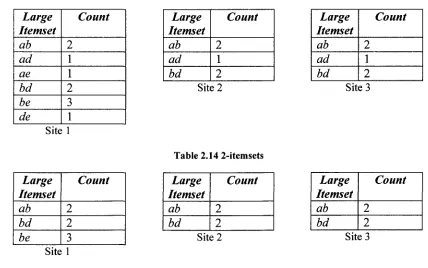
Large Itemset ab ad bd Count 2 1 2 Large Itemset ab ad bd Count 2 1 2 Large Itemset ab ad bd Count 2 1 2
Site 1 Site 2 Site 3
Table 2.9 2-itemset and counts
Since all candidates are identical and same ordered in every site, only a count of each
itemset needs to be broadcasted, as shown in Table 2.10.
Large Itemset ab ad bd Count 6 3 6 Large Itemset ab ad bd Count 6 3 6 Large Itemset ab ad bd Count 6 3 6
Site 1 Site 2 Site 3
Table 2.10 Large 2-itemset and counts
From table 2.10, it can be seen that ad is less than 6 and should be dropped and large
2-itemsets will be ab and bd. Then candidate 3-2-itemsets will be generated by apriori-join
locally on every site, which is abd. Count of abd is 1 on every site. After broadcasting
count of abd, the global count of abd is found to be 3. Therefore abd is not frequent.
Large 3-itemsets turned to be an empty set and algorithm will exit.
The CD algorithm will actually hash the itemsets and do the support counting by a vector
summation in order to save time for comparing and matching the itemsets. It only
broadcasts the count of each itemset, so that the message exchange over the network is