Security Performance and Analysis of
Rivest-Shamir-Adleman (RSA) Algorithm for ATM
Transactions
Dr. Pradeep B Dahikar, *Minakshi S. Tumsare
Associate Professor, Dept. of Electronics, Kamla Nehru Mahavidyalaya, Nagpur, India
*Assistant Professor, Dept. of Electronics and Computer Science, RTM Nagpur University, Nagpur, India
ABSTRACT: In the current scenario, Data Security is required to transfer confidential information over the network.
In inclusive range of applications, Security is also challenging. The cryptography is one of the useful techniques to transfer the unreadable data format by using public and private key. For data security Cryptographic algorithms play a vital role against spiteful attacks. In the popular performances of Public Key Infrastructures, RSA algorithm is extensively used. The Rivest-Shamir-Adleman (RSA) Asymmetric key algorithm is one of the most popular and secures public key encryption methods. The RSA cryptosystem is widely used in the world. It can be used in both public key encryption and digital signature. RSAuses two different but statistically linked keys, one public and one
private. In this paper the most standard encryption algorithms (RSA) are used to study the implementation of online
security and ATM transactions coming up with the best algorithm to be used for comparing the various parameters which will getthe results by using SPSS16 tool.
KEYWORDS: Cryptographic algorithms; Public Key; Private Key; digital signature.
I. INTRODUCTION
The Rivest-Shamir-Adleman (RSA) Asymmetric key algorithm is one of the most popular and secure public key encryption methods. RSA is the Thealgorithm capitalizes on the fact that there is no efficient way to factor very large (100-200 digit) numbers.RSA is an internet encryption and authentication system that uses an algorithm developed in 1977 by Ron Rivest, Adi Shamir, and Leonard Adleman. The RSA algorithm is the most commonly used encryption and authentication algorithm and is included as part of the web browsers from Microsoft and Netscape. The encryption system is owned by RSA security. The technologies are part of existing or proposed Web, Internet and computing standards.[1][2]
II. RELATED WORK
transaction signing), should more sophisticated content manipulation attacks become a real problem. In [9] author study Algorithm analysis of E-commerce describes some algorithm that can be used to implement the online payment transaction security services. In [10] Author contribution is to increase the security of ATM machine for the customer authentication for Securing Financial Transactions on ATM Terminal. The designing part hardware design and software design both were designed by the rules of embedded system. In[11] author focused on different data encryption methods which are used in Secure ATM Transactions. And study the comparisons between AES & triple DES encrypted algorithms. In [12] author introduces three factor authentication metrics in Biometric Strategy Measure for enhancing ATM Security. Author has proposed a combined technique i.e. ATM ID number, PIN number, and biometric fingerprint
III. RSA ALGORITHM
RSA RC4 is a Highly Secure, High Speed Algorithm The RC4 algorithm, developed by RSA Data Security Inc., has rapidly become the de-facto international standard for high -speed data encryption. Despite ongoing attempts by cryptographic researchers to "crack" the RC4 algorithm, the only feasible method of breaking its encryption known today remains brute-force, systematic guessing, which is generally infeasible. RC4 is a stream cipher that operates at several times the speed of DES, making it possible to encrypt even large bulk data transfers with minimal performance consequences. RC4_56 and RC4_128 RC4 is a variable key-length stream cipher. The Oracle Advanced Security option release 8.1.5 for domestic use offers an implementation of RC4 with 56 bit and 128 bit key lengths. This provides strong encryption with no sacrifice in performance when compared to other key lengths of the same algorithm. [3]
IV. SECURITY WITH QUANTITATIVE DATA
Quantitative data which is in numerical form is used for security and it is generated by mathematics. There are several types of Mathematical algorithms which convert plaintext(readable) messages into ciphertext(unreadable) messages known as encryption and its reverse process convert ciphertext into plaintext known as decryption. Process of encryption and decryption is known as cryptography. There are several algorithms used in cryptography. [4]
V. REVIEW OF THE RSA ALGORITHM
A) KEY GENERATION
For the RSA cryptosystem, we first start off by generating two large prime numbers, 'p' and 'q', of about the same size in bits. Next, compute 'n' where n = p q, and 'x' such that, x = (p-1) (q-1). We select a small odd integer less than x, which is relatively prime to it i.e. gcd (e, x) = 1. Finally, we find out the unique multiplicative inverse of e modulo x, and name it’d’. In other words, Ed = 1 (mod x), and of course, 1 < d < x. compute private exponent d= e-1 mod x Now, the public key is the pair (e, n) and the private key is d. [5]
B) RSA ENCRYPTION
Suppose Bob wishes to send a message (say 'm') to Alice. To encrypt the message using the RSA encryption scheme, Bob must obtain Alice's public key pair (e, n) at the time of key generation. The message to send must now be encrypted using this pair (e, n). However, the message 'm' must be represented as an integer in the interval [0, n-1]. To encrypt it, Bob simply computes the number 'c' where c = m ^ e mod n. Bob sends the cipher text c to Alice.
C) RSA DECRYPTION
D) Algorithm 1.3.4: RSA
Step 1: Choose two large prime numbers P and Q. Step 2: Calculate N = P*Q.
Step 3: Select the public key (encryption key) E such that it is not a factor of (P-l) and (Q-l).
Step 4: Select the private key (decryption key) D such that the following equation is true:(D*E) mod (P-I) * (Q-I) = 1 Step 5: Encrypt the plain text PT to form the cipher text CT as followsCT = PTEmod N
Step 6: Send CT as the cipher text to the receiver.
Step 7: Decrypt the cipher text CT to form the plain text PT as followsPT=CTDmodN
The crux of RSA is that factoring N to find P and Q is not at all easy but it is quite complex and time consuming. [6]
VI. MESSAGE TYPES AND OBSERVATIONS
The analysis done for following four message type based on defined eight parameters:
Pin Type Messagesends and receives PIN identification data of customer.
Transaction message work for transaction pattern means cash transfer, cash debit or purchase etc. after
satisfying above details.
Customer details would be send by server to ATM machine.
Operational details means transaction success or failure acknowledgement would be send and receive
between server and machine.
The following 8 parameters have been observed for each of the message type:
1. Time: Time to Process the message type in millisecond.
2. Energy Level: It is measured in decibel for the octave message type of the wireless data or frame which is
send to the server for processing.
3. Send Bytes: The number of data byte sends while processing each message type.
4. RCV bytes:The number of data byte received while processing each message type
5. Hop Count:It represents the count of repetitive data/ request send in case of failure of communication
acknowledgement between sending and receiving.
6. Attack generated: The attack generated while processing each message type.
7. Attack observed: The numbers of attacks observed while applying attack on each message type
8. Attack Defended:The percentage of attack defend in system after applying the attack
VII. STATISTICAL DESCRIPTION AND GRAPHICAL RESULTS
The following parameter graphical results observed for each of the message type for RSA algorithm. There are four message types:
1 Pin transaction Message 2 Transaction type Message 3 Customer data Message 4 Operational Message
1. PIN Transaction Type Message
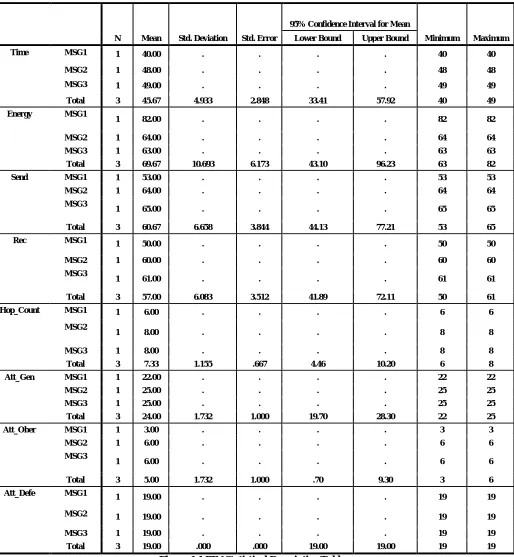
Figure 1.1 PIN Statistical Descriptive Table
Statistical Descriptive Table
N Mean Std. Deviation Std. Error
95% Confidence Interval for Mean
Minimum Maximum
Lower Bound Upper Bound
Time MSG1 1 40.00 . . . . 40 40
MSG2 1 48.00 . . . . 48 48
MSG3 1 49.00 . . . . 49 49
Total 3 45.67 4.933 2.848 33.41 57.92 40 49
Energy MSG1
1 82.00 . . . . 82 82
MSG2 1 64.00 . . . . 64 64
MSG3 1 63.00 . . . . 63 63
Total 3 69.67 10.693 6.173 43.10 96.23 63 82
Send MSG1 1 53.00 . . . . 53 53
MSG2 1 64.00 . . . . 64 64
MSG3
1 65.00 . . . . 65 65
Total 3 60.67 6.658 3.844 44.13 77.21 53 65
Rec MSG1 1 50.00 . . . . 50 50
MSG2 1 60.00 . . . . 60 60
MSG3
1 61.00 . . . . 61 61
Total 3 57.00 6.083 3.512 41.89 72.11 50 61
Hop_Count MSG1 1 6.00 . . . . 6 6
MSG2
1 8.00 . . . . 8 8
MSG3 1 8.00 . . . . 8 8
Total 3 7.33 1.155 .667 4.46 10.20 6 8
Att_Gen MSG1 1 22.00 . . . . 22 22
MSG2 1 25.00 . . . . 25 25
MSG3 1 25.00 . . . . 25 25
Total 3 24.00 1.732 1.000 19.70 28.30 22 25
Att_Ober MSG1 1 3.00 . . . . 3 3
MSG2 1 6.00 . . . . 6 6
MSG3
1 6.00 . . . . 6 6
Total 3 5.00 1.732 1.000 .70 9.30 3 6
Att_Defe MSG1 1 19.00 . . . . 19 19
MSG2 1 19.00 . . . . 19 19
MSG3 1 19.00 . . . . 19 19
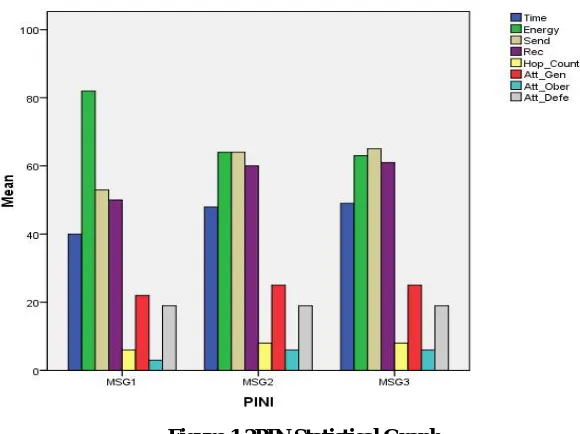
According to above parameter graph has been plotted mean against Msg type which shows the statistical graphical result.
Figure 1.2PIN Statistical Graph
2. Transaction Type Message
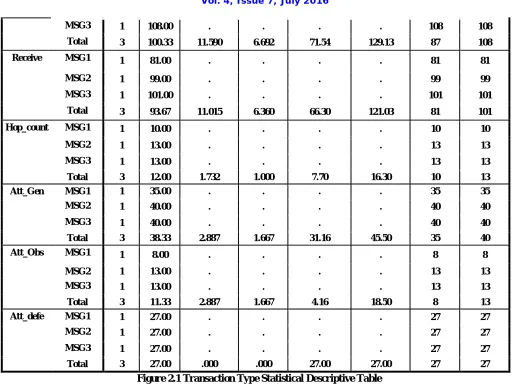
The one-way analysis of variance using SPSS16 Statistics is used to determine whether there are any significant differences between the means of two or more independent (unrelated) groups. The Transaction type message is processed and Descriptive table is generated based on the eight parameters against three messages which are shown in the below table. The mean, Std. Deviation and Std. Error other values of the descriptive table are derived for the eight parameters. It is observed that Standard Deviation and Standard Error are high for Time,Send and Receive and low for Attack Defended, Hop Count and Average values for Attack Generated and Attack observed.
Statistical Descriptive
N Mean Std. Deviation Std. Error
95% Confidence Interval for Mean
Minimum Maximum Lower Bound Upper Bound
Time MSG1 1 65.00 . . . . 65 65
MSG2 1 79.00 . . . . 79 79
MSG3 1 81.00 . . . . 81 81
Total 3 75.00 8.718 5.033 53.34 96.66 65 81
Energy MSG1 1 50.00 . . . . 50 50
MSG2 1 39.00 . . . . 39 39
MSG3 1 38.00 . . . . 38 38
Total 3 42.33 6.658 3.844 25.79 58.87 38 50
Send MSG1 1 87.00 . . . . 87 87
MSG3 1 108.00 . . . . 108 108
Total 3 100.33 11.590 6.692 71.54 129.13 87 108
Receive MSG1 1 81.00 . . . . 81 81
MSG2 1 99.00 . . . . 99 99
MSG3 1 101.00 . . . . 101 101
Total 3 93.67 11.015 6.360 66.30 121.03 81 101
Hop_count MSG1 1 10.00 . . . . 10 10
MSG2 1 13.00 . . . . 13 13
MSG3 1 13.00 . . . . 13 13
Total 3 12.00 1.732 1.000 7.70 16.30 10 13
Att_Gen MSG1 1 35.00 . . . . 35 35
MSG2 1 40.00 . . . . 40 40
MSG3 1 40.00 . . . . 40 40
Total 3 38.33 2.887 1.667 31.16 45.50 35 40
Att_Obs MSG1 1 8.00 . . . . 8 8
MSG2 1 13.00 . . . . 13 13
MSG3 1 13.00 . . . . 13 13
Total 3 11.33 2.887 1.667 4.16 18.50 8 13
Att_defe MSG1 1 27.00 . . . . 27 27
MSG2 1 27.00 . . . . 27 27
MSG3 1 27.00 . . . . 27 27
Total 3 27.00 .000 .000 27.00 27.00 27 27
Figure 2.1 Transaction Type Statistical Descriptive Table
According to above parameter graph has been plotted mean against Msg type which shows the statistical graphical result.
3. Customer Type Message
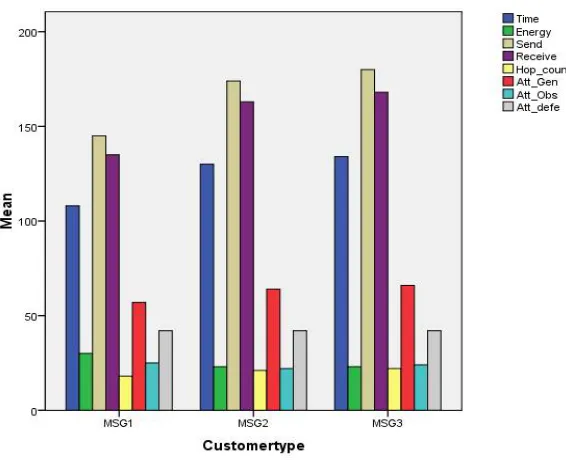
The one-way analysis of variance using SPSS16 Statistics is used to determine whether there are any significant differences between the means of two or more independent (unrelated) groups. The Customer Type Message is processed and Descriptive table is generated based on the eight parameters against three messages which are shown in the below table. The mean, Std. Deviation and Std. Error other values of the descriptive table are derived for the eight parameters. It is observed that Standard Deviation and Standard Error are high for Time, Send and Receive and low for Attack Defended, Hop Count and Average values for Attack Generated and Attack observed. According to below parameter graph has been plotted which shows the statistical graphical result in figure 3.2
Statistical Descriptive
N Mean Std. Deviation Std. Error
95% Confidence Interval for Mean
Minimum Maximum Lower Bound Upper Bound
Time MSG1 1 108.00 . . . . 1-08 108
MSG2 1 130.00 . . . . 130 130
MSG3 1 134.00 . . . . 134 134
Total 3 124.00 14.000 8.083 89.22 158.78 108 134
Energy MSG1 1 30.00 . . . . 30 30
MSG2 1 23.00 . . . . 23 23
MSG3 1 23.00 . . . . 23 23
Total 3 25.33 4.041 2.333 15.29 35.37 23 30
Send MSG1 1 145.00 . . . . 145 145
MSG2 1 174.00 . . . . 174 174
MSG3 1 180.00 . . . . 180 180
Total 3 166.33 18.717 10.806 119.84 212.83 145 180
Receive MSG1 1 135.00 . . . . 135 135
MSG2 1 163.00 . . . . 163 163
MSG3 1 168.00 . . . . 168 168
Total 3 155.33 17.786 10.269 111.15 199.52 135 168
Hop_count MSG1 1 18.00 . . . . 18 18
MSG2 1 21.00 . . . . 21 21
MSG3 1 22.00 . . . . 22 22
Total 3 20.33 2.082 1.202 15.16 25.50 18 22
Att_Gen MSG1 1 57.00 . . . . 57 57
MSG2 1 64.00 . . . . 64 64
MSG3 1 66.00 . . . . 66 66
Total 3 62.33 4.726 2.728 50.59 74.07 57 66
Att_Obs MSG1 1 25.00 . . . . 25 25
MSG2 1 22.00 . . . . 22 22
MSG3 1 24.00 . . . . 24 24
Figure 3.1 Customer Data statistical descriptive table
According to above parameter graph has been plotted mean against Msg type which shows the statistical graphical result.
Figure 3.2 Customer Data Statistical Graph
4. Operational Type Message
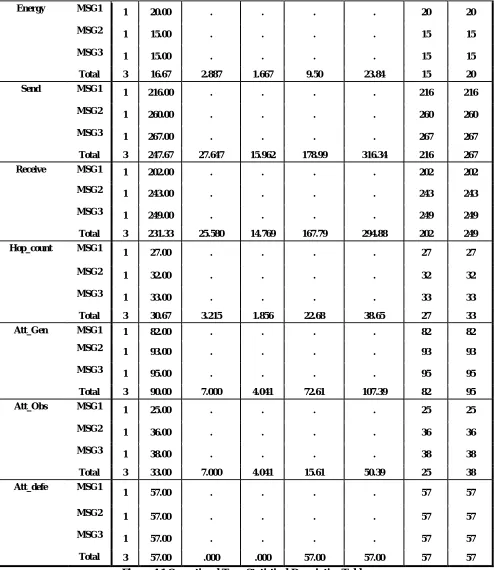
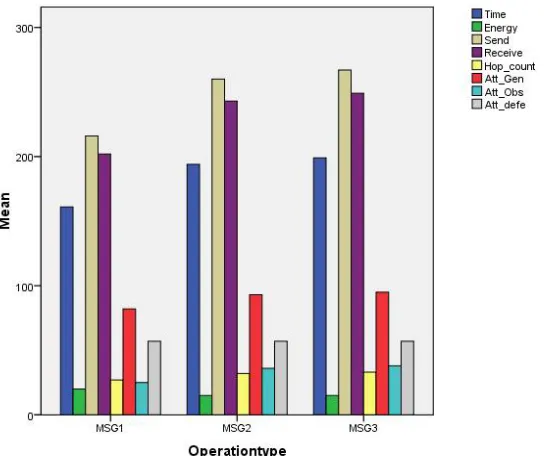
The one-way analysis of variance using SPSS16 Statistics is used to determine whether there are any significant differences between the means of two or more independent (unrelated) groups. The Operational Type Message is processed and Descriptive table is generated based on the eight parameters against three messages which are shown in the below table. The mean, Std. Deviation and Std. Error other values of the descriptive table are derived for the eight parameters. It is observed that Standard Deviation and Standard Error are high for Time, Send and Receive and low for Attack Defended, Hop Count and Average values for Attack Generated and Attack observed.
Att_defe MSG1 1 42.00 . . . . 42 42
MSG2 1 42.00 . . . . 42 42
MSG3 1 42.00 . . . . 42 42
Total 3 42.00 .000 .000 42.00 42.00 42 42
Statistical Descriptive
N Mean Std. Deviation Std. Error
95% Confidence Interval for Mean
Minimum Maximum Lower Bound Upper Bound
Time MSG1
1 161.00 . . . . 161 161
MSG2 1 194.00 . . . . 194 194
MSG3 1 199.00 . . . . 199 199
Figure 4.1 Operational Type Statistical Descriptive Table
Energy MSG1 1 20.00 . . . . 20 20
MSG2 1 15.00 . . . . 15 15
MSG3 1 15.00 . . . . 15 15
Total 3 16.67 2.887 1.667 9.50 23.84 15 20
Send MSG1 1 216.00 . . . . 216 216
MSG2 1 260.00 . . . . 260 260
MSG3 1 267.00 . . . . 267 267
Total 3 247.67 27.647 15.962 178.99 316.34 216 267
Receive MSG1 1 202.00 . . . . 202 202
MSG2 1 243.00 . . . . 243 243
MSG3 1 249.00 . . . . 249 249
Total 3 231.33 25.580 14.769 167.79 294.88 202 249
Hop_count MSG1
1 27.00 . . . . 27 27
MSG2 1 32.00 . . . . 32 32
MSG3 1 33.00 . . . . 33 33
Total 3 30.67 3.215 1.856 22.68 38.65 27 33
Att_Gen MSG1 1 82.00 . . . . 82 82
MSG2 1 93.00 . . . . 93 93
MSG3 1 95.00 . . . . 95 95
Total 3 90.00 7.000 4.041 72.61 107.39 82 95
Att_Obs MSG1 1 25.00 . . . . 25 25
MSG2 1 36.00 . . . . 36 36
MSG3 1 38.00 . . . . 38 38
Total 3 33.00 7.000 4.041 15.61 50.39 25 38
Att_defe MSG1
1 57.00 . . . . 57 57
MSG2 1 57.00 . . . . 57 57
MSG3 1 57.00 . . . . 57 57
According to above parameter graph has been plotted mean against Msg type which shows the statistical graphical result.
Figure 4.2Operational Types Statistical Graph
VIII. CONCLUSION AND FUTURE WORK
RSA algorithm is studied to understand how the message become secured by applying the key and how the encryption and decryption is done while sending and receiving the message. The RSA algorithm is studied for the four message typeof the ATM transaction processand analysis is done with different parameters.The analysis is done in SPSS and received the descriptive statistics for the parameter we analyzed and received the approximate significance level of the parameters.The descriptive statistics table of the messages shows the RSA is the significant algorithm for the ATM transaction process.The current analysis is done using eight parameters but this can be increased and can be used different statistical tool to get result.
REFERENCES
1. NentaweGoshwe, “Data Encryption and Decryption Using RSA Algorithm in a Network Environment”, IJCSNS, Vol.13 No.7,July 2013
2. Rivest, L. Shamir &Adleman L.“A method for obtaining digital signatures and public key cryptosystems”, communication of the ACM,vol.21,120-126. 3. RSA SecurID Authentication, a Better Value for a Better ROI.
4. Sneha Patel & Joshi “Mathematical Model Based Total Security System with Qualitative & quantitative Data of Human”, IJMSA, Vol.3, No.1, Jan-June 2013, ISSN No:2230-9888, www.journalshub.com,
5. William Stalling, Cryptography and Network Security text book, principles and practices.
6. Sheena Mathew, “Studies, Design and Development of Network security Enhancement Services Using Novel Cryptographic Algorithm”, Department of Computer
Science, June-2008
7. Afolabi, A.O & E. R. Adagunodo 2012, “Implementation of an Improved data Encryption Algorithm in a Web Based Learning System”, International Journal of Research and Reviews in Computer Science, Vol.3 No.1.
8. ALAIN HILTGEN, et al. “Secure Internet Banking Authentication”,Published ByThe IEEE Computer Society IEEE Security& Privacy24.
9. Barskar, Deen, Ahemed and Bharti, “The Algorithm Analysis of E-commerce Security Issues for Online Payment Transaction System in Banking Technology” IJCSIS, Vol.8, no.1, April 2010
10. PremKishan, Vishwanath, Nandigama, Khamuruddeen, Kasibhatla, D.Pavani, G.Sweth “Real Time SMS-Based Hashing Scheme for Securing Financial
Transactions on ATM Terminal” (IJRES) ISSN (Online): 2320-9364, www.ijres.org Volume 1 Issue 3 ǁ July. 2013 ǁ PP.27-33
11. CH. Krishna Prasad et al “Data Encryption Methods Used in Secure ATM Transactions” IJCSMC, Vol. 3, Issue. 6, June 2014, pg.230 – 233, Research Article, ISSN 2320–088X