Design of Object Detection System using
Wireless Camera
Sarala B. N, Jayanth C.
M. Tech Student, Dept. of Telecommunication Engg, DSCE, Bangalore, India
Assistant Professor, Dept. of Telecommunication Engg, DSCE, Bangalore, India
ABSTRACT: Visual analysis of human motion or motion of object of an interest is currently one of the most important research topics in computer vision. In which the moving body detection is the most important part of the object motion analysis, the purpose is to detect the moving human body from the background image in video sequences, and for the follow-up treatment such as the target classification, the human body tracking and behavior understanding, its effective detection plays a very important role. Human motion analysis concerns the detection, tracking and recognition of people behaviors, from image sequences involving humans. This paper presents a new algorithm for detecting moving objects from a static background scene to detect moving object based on background subtraction. We set up a reliable background to detect the object. After that, morphological filtering is initiated to remove the noise and solve the background interruption difficulty. Shape feature and Gabor feature of the object is extracted. The experiment results show that the proposed method runs rapidly, exactly.
KEYWORDS: Object detection, Gabor feature, shape feature.
I. INTRODUCTION (HEADING 1)
An important part of research in computer vision which has becoming a lot of importance [1] in the last few years is the understanding of human activity from a video. The rapidly increasing interest in object motion analysis is strongly motivated by recent improvements in computer vision area, the availability of low-cost hardware such as video cameras and a variety of new guaranteed applications such as individual identification and visual surveillance. It aims for automotive system to guess the motion of a person or a body part from monocular or multi-view video images. Human body motion analysis has been an interesting research for its various applications, such as military physical performance, evaluation, medical diagnostics, virtual reality, and human–machine interface.
There are various method can get the information regarding complete movement information and detect the moving object from the background better, however, a large quantity of calculation, sensitivity to noise, poor anti-noise performance, make it not suitable for real-time demanding occasions. The background subtraction method is one of the most effective simple algorithms, However, it can provide the most complete object information in the case of the background is known.
II. LITERATURE SURVEY
The importance and popularity of human motion analysis has led to several previous surveys. Neeti A. Ogale [2] discussed a agent sample of techniques for finding people using visual input. These techniques are classified with respect to the need for pre-processing, features used to describe human appearance, use of explicit body models.
XiaofeiJi, HonghaiLiu [4] provides a total survey of human motion detection with the variation on view-invariant expression, and detection of special facial expressions and proceedings. In order to help readers understand the incorporated development of visual analysis of human motion detection, this paper presents recent growth in human detection, view-invariant pose demonstration and estimation, and human performance understanding. Public available standard datasets are recommended. The last replace assesses the development so far, and outlines some observed issues and future guidelines, and solution to what is necessary to get the goals of total human motion examination. Murat Ekinci, EyupGedikli[5] presented a real-time background modeling and maintenance based human motion detection and analysis in an indoor and an outdoor environments for visual surveillance system is described. The system operates on monocular gray scale video imagery from a static CCD camera. In order to detect foreground objects, background scene model is statistically learned using the redundancy of the pixel intensities in a preparation stage, even the background is not completely stationary. This redundancy information of the each pixel is separately stored in an history map shows how the pixel intensity values changes till now.
Then the highest ratio of the redundancy on the pixel intensity values in the narration map in the training sequence is determined to have initial background model of the scene. A background maintenance model is also proposed for preventing some kind of falsies, such as, illumination changes, or physical changes. At the background modeling and maintenance, the consistency and computational costs of the algorithm presented are comparatively discussed with several algorithms. Based on the background modeling, candidate foreground regions are detected using thresholding, noise cleaning and their boundaries extracted using morphological filters. Hanzi Wang and David Suter[6] presented an effective and adaptive background modeling method for detecting foreground objects in both static and dynamic scenes. The proposed method computes sample consensus (SACON) of the background samples and estimates a statistical model per pixel. Sumer Jabri, Zoran Duric, Harry Wechsler, Azriel Rosenfeld [7] proposed a new method of finding people in video images is presented. Detection is based on a novel background modeling and subtraction approach which uses both color and edge information. We introduce confidence maps, gray-scale images whose intensity is a function of our confidence that a pixel has changed to fuse intermediate results and to represent the results of background subtraction. The latter is used to define a person's body by guiding contour collection to segment the person from the background. The method is understanding to scene clutter, slow illumination changes, and camera noise, and runs in near real time on a standard platform.
III. PROPOSED SYSTEM
A. Gabor Feature
The Gabor filter is generally utilized as a part of the image features. The Gabor filter wavelet is the type of sine wave adjusted by the Gaussian coefficient. The Gabor filter is helpful for extracting local and global data. The Gabor filter are tunable band pass channel, multiscale and multi resolution filter[5].
The Gabor filter eq. (1) is utilized as a part of texture segmentation, image representation. It offers ideal resolution in space and time domain. It gives better visual representation in the involved composition pictures. Be that as it may, the current gabor parameter requires additional time utilization for feature extraction. The Gabor filter works on the frequency, orientation and Gaussian kernel.
Gabor(x, y,θ,φ) = X. Y (1)
X = exp(−(x + y ) ÷σ ) (2)
Y = exp 2πθ(xcosθ+ ysinθ) (3)
The terms x and y (eq. 2 and eq. 3) is the position of the filter relative to the input signal [5]. The angular representation
of the filter is represented as ‘θ’. The angular orientation of the filter is represented as ‘∅’.
B. Shape feature
Shape is known as a vital sign for people to distinguish and perceive object, whose reason for existing is to encode straight forward geometrical structures, for example, straight lines in various direction. Shape feature extraction techniques can be comprehensively characterized into two gatherings, viz., contour based and area based methods.
Set of shape properties for each connected component in the binary image is extracted and stored. Properties like Area, Euler Number, Orientation, Bounding, Box, Perimeter, Centroid, Extremaand other properties are extracted.
C. SVM
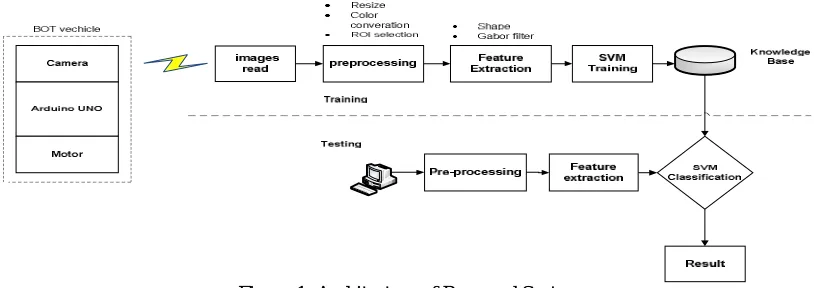
Once the feature extraction is done, features are trained using SVM and stored in knowledge base. Support vector machines (SVMs) are a binary classification method. The SVM [5] classifier is designed and it classifies the image based on the extracted parameters and identifies the image (face). The SVM maps the features to higher dimensional space and then uses an optimal hyper plane in the mapped space. This indicates that though the original features carry sufficient data for efficient classification, mapping to a higher dimensional feature space could potentially provide better discriminatory clues that are not present in the original feature space.
IV. HARDWARE IMPLEMENTATION
A bot vehicle and a camera is used for implementation of proposed system. A bot vehicle is a mechanical or virtual artificial agent, whose speed has to be reduced once the driver drowsiness is detected. It is a two wheeled bot vehicle constructed using two 100rpm motor, motor driver circuit L293D, ArduinoUNO, 12v battery, wireless RF transceiver.
A. Arduino UNO
Arduino Uno is used to control the speed of the vechicle.The Arduino UNO is a microcontroller board based on the ATmega328. It has 14 digital input/output pins (of which 6 can be used as PWM outputs), 6 analog inputs, a 16 MHz crystal oscillator, a USB connection, a power jack, an ICSP header, and a reset button. It contains everything needed to support the microcontroller; simply connect it to a computer with a USB cable or power it with a AC-to-DC adapter or battery to get started. Arduino UNO differs from all preceding boards because it does not use the FTDI USB-to-serial driver chip.
B. Motor driver circuit
Figure 2: Motor Circuit
V. RESULTS AND DISCUSSION
The video is given as a query input to the proposed system,the video frames are read frame wise .Figure 3 shows the input query video .
Figure 3:Video input
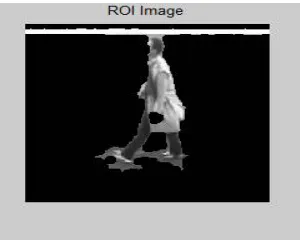
The video frames are preprocessed to remove noise and color conversion. Figure 4 shows objection detection.
Figure 4: Object detection
VI.CONCLUSION
In this paper for motion detection background subtraction is used. The Matlab software model is used for object detection. The image subtraction gives the good result of the moving object in the surveillance area. The resultant subtracted frame contains the information or data from both the input frames. It provides an effective way of detecting moving object and gives better information of the moving object in video as compared to other algorithms.
REFERENCES
[1] Rupali S.Rakibe, Bharati D.Patil,Background subtraction algorithm based Human motion detection. “Rupali S.Rakibe, Bharati D.Patil”,
International Journal of Scientific and Research Publications, Volume 3, Issue 5, May 2013.
[4] Xiaofei Ji, Honghai Liu, “Advances in View-Invariant Human Motion Analysis:A Review,”in IEEE Trans.on Systems,Man, Cybernetics,vol.40,no.1,2010.
[5] Murat Ekinci, “Silhouette Based Human Motion Detection and Analysis For Real Time Automated Video Surveillance,”in Turk J Elec
Engin,vol.13.
[6] Hazi Wang and David suter, “Background Subtraction Based on a Robust Consensus Method ,” Monash University, Clayton Vic. 3800,
Australia