An Effective Review on Fog Computing
using Virtualization
Rikvant Singh Rohila1, Renu Singla2
M. Tech Student, Dept. of CSE, Shri Ram College of Engg. & Mgmt, Palwal, Haryana, India 1
Asst. Professor, Dept. of CSE, Shri Ram College of Engg. & Mgmt, Palwal, Haryana, India.2
ABSTRACT: Fog computing is new buzz word in computing world after cloud computing. This new computing paradigm could be seen as an extension to cloud computing. There is a new platform that provides a new set of web services and applications to the end-subscribers, by exploring cloud platform. This new platform is known as Fog Computing and also called Fogging. Fog computing is a term generated by Cisco that refers to increasing cloud computing to the enterprise's network edge. Also called fogging or Edge Computing, fog computing provides the operation of storage, compute and networking services between cloud computing data centers and end devices. In this paper the virtualization technique and its types are in the Fog computing environment are well presented with the concept of the cloud service models. The role of virtualization process in fog computing with their advantages is documented and the different types of virtualizations are presented with some survey on the various fog computing simulation tools and the virtualization architecture.
KEYWORDS: Fog Computing, Virtualization, Cloud Computing, Hypervisor, Virtualization, and Data Centers
I. INTRODUCTION
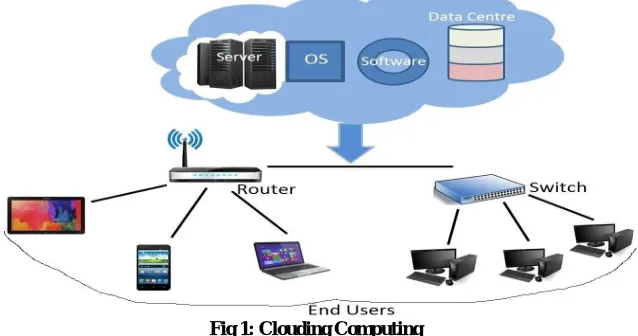
Cloud computing networks are huge groups of servers and cloud service providers that normally take benefit of low-cost computing technique, with particular links to distribute data-processing chores across them. This shared IT infrastructure consist large pools of systems that are connected together [3]. Virtualization methods are usually utilized to increase the cloud computing power. In cloud computing, the word cloud (also called as "the cloud") is utilized as a metaphor for "the Internet," so the phrase cloud computing implies "a kind of Internet-based computing," where several facilities i.e. storage, servers and applications are provided to an organization's devices and computers across the Internet [11].
Fig 1: Clouding Computing
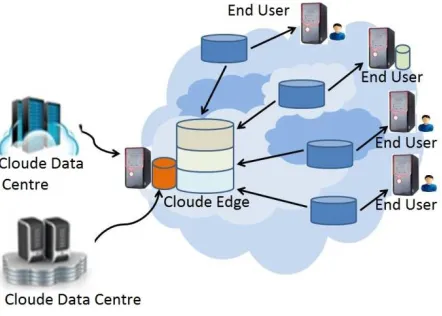
geo-distribution and mobility support in addition to low latency and location awareness characteristics. Thus, we required a new platform to fulfil all these needs. There is a new platform that provides a new set of web services and applications to the end-subscribers, by exploring cloud platform [14]. This new platform is known as Fog Computing and also called Fogging. Fog computing is a term generated by Cisco that refers to increasing cloud computing to the enterprise's network edge. Also called fogging or Edge Computing, fog computing provides the operation of storage, compute and networking services between cloud computing data centres and end devices [12].
Fig 2: Fog Computing
Cisco proposed its fog computing vision in January 2014 as a way of bringing cloud computing abilities to the network edge and as a result, nearer to the frequently increasing no. of linked applications and devices that consumes cloud facilities and produce increasingly massive amounts of data. By dealing with these services that build up the Internet of Things (IoT) at the edge of network, data can in several situations be processed more effectively than if it required to be forwarded to the cloud for processing [12, 14]. Cisco IOx brings the Cisco IOS and open source Linux network operating system together in a single networked device (initially in routers). The open application environment recommends more developers to bring their connectivity interfaces and own applications at the network edge. Fog computing offers data, storage, compute, and application facilities to end-subscribers. The distinguishing Fog features are its proximity to end-subscribers, its support for mobility and its dense geographical distribution. Services are hosted at the edge of network or even end devices i.e. access points and set-top-boxes. By doing so, Fog decreases service latency, and enhances Quality of Services (QoS), resulting in best subscriber-experience. Fog Computing provides support to developing Internet of Everything (IoE) applications that needs real-time/predictable latency (industrial automation, transportation, networks of actuators and sensors). Thanks to its broad geographical distribution the Fog paradigm is well located for real time analytics and real time big data. Fog provides support to densely distributed data collection points, thus adding a fourth axis to the usually specified Big Data dimension The important decrement in data movement throughout the network resulting in decreased cost and latency, congestion, cost and removal of bottlenecks resulting from centralized computing systems, enhanced security of encrypted data as it remains nearer to the end subscriber deceasing exposure to hostile elements and enhanced scalability raising from virtualized systems. Remove the core computing environment, thus decreasing a point of failure and a major block. Increases the security, as data are interpreted as it is moved towards the edge of network [12, 16]. Edge Computing, in addition to offering sub-second reply to end subscribers, it also offers high levels of reliability, scalability and fault tolerance and Consumes low band width.
Benefits of Fog Computing
Better security: secure your fog nodes utilizing the same scheme, procedures and controls you utilize in other parts of your IT environment. Utilize the same cyber security and physical security solutions.
Deeper insights, with privacy control: Examine sensitive data locally rather than forwarding it to the cloud for analysis. Your IT team can control and monitor the devices that gather, examine, and store data.
Lower operating expense: Conserve network bandwidth by processing chosen data locally rather than forwarding it to the cloud for analysis.
II. RELATED WORK
Nisha Peter et. al. [1]; Here, In this paper authors represent an Small computing works that locally processed and responses to the end users without the use of cloud. For the performance evaluation author had taken IOX platforms as a simulation tool. After the simulation result authors conclude that fog computing is entering an exciting time, where it can positively affect operational costs and it resolves problems related to congestion and latency. Fog computing also provides an intelligent platform to manage the distributed and real-time nature of emerging IoT infrastructures.
KC Gouda et. al.[2]; In this paper authors represent approach needs to be evaluate in different cloud platform for finding the cost effectiveness by using the virtualization. For this author use hypervisor and virtual platform simulation. After the simulation result authors conclude that the complexity and cost of owning and operating computer and network can be significantly reduced.
Ivan Stojmenovic et. al. [3]; In this paper authors investigate Fog computing advantages for services in several domains, such as Smart Grid, wireless sensor networks, Internet of Things (IoT) and software defind networks (SDNs). And examine the state- of-the-art and disclose some general issues in Fog computing including security, privacy, trust, and service migration among Fog devices and between Fog and Cloud. In this paper author applying six motivation scenarios for security and privacy issues every scenarios define different role. After the simulation result authors found that there was some innovations in compute and storage may be inspired in the future to handle data intensive services based on the interplay between Fog and Cloud.
Swati Agarwal et. al. [4]; Here Authors, proposed an efficient architecture and algorithm for resources provisioning in fog computing environment by using virtualization technique. For the performance evaluation author had taken Cloud Analyst as a simulation tool. In this paper author talking about intermediate layer of fog to make the architecture more efficient for better service in terms of network bandwidth, power consumption and response time as well as it reduces the traffic over the internet. After the simulation result authors conclude that the proposed strategy can be allocated resources in optimized way and better than existing algorithms in terms of overall response time, data transfer cost and bandwidth utilization in fog computing environment.
Clinton Dsouza et.al.[5]; In this paper authors proposes a policy-based management of resources in fog computing, expanding the current fog computing platform to support secure collaboration and interoperability between different user-requested resources in fog computing. For this author adopt extensible Access Control Mark-up Language (XACML). In this paper author comprises three core components for fog computing architecture and smart transportation system as an exemplary use-case. In this architecture fog node and fog instance communicate with physical devices and cloud computing data centre in parallel. For Policy-Driven Security Management define different module. After the simulation result author outline key characteristics of fog computing and identify challenges in policy management that are critical for supporting secure sharing, collaboration and data reuse in a heterogeneous environment.
III. APPLICATION AREAS OF FOG COMPUTING
According to CISCO the significant fields where fog computing would play an important role are the following
Connected car: Autonomous vehicle is the novel trend occurs on the road. Tesla is operating on software to add
with each other and so it builds safe for all. At some point in time, the linked car will begin saving lives by decreasing automobile accidents [4. 9].
Smart Grids: Smart grid is another application where fog computing has been utilized. Depending on demand for
energy, low cost and its achievability, these smart devices can switch to other energies i.e. winds and solar. The edge process the data gathered by fog collectors and produce control command to the actuators. The filtered data are consumed locally and the balance to the higher tiers for real-time reports, visualization and transactional analytics. Fog provides support to momentary storage at the lowest tier and semi-permanent storage at the highest tier.
Smart Traffic lights: Fog enables traffic signals to open lanes on observing flashing lights of the ambulance. It
determines the existence of bikers and pedestrian, and evaluates the distance and speed of the nearest vehicles. Sensor lighting turns on, on detecting movements and vice-versa. Smart lights supports as fog devices synchronize to forward warning signals to the nearby vehicles. The communication between vehicle and access points are improved with 3G, WiFi, road side units and smart traffic lights.
Self Maintaining Train: Another application of fog computing is self managing trains. A train ball-bearing monitoring
sensor will observe the changes in the temperature level and any disorder will automatically alert the train operator and build maintenance according to. Hence we can neglect dangerous disasters.
Wireless Sensor and Actuator Networks (WSAN) : The real Wireless Sensor Nodes (WSNs), were intended to increase
battery life by working at predominantly low power . Actuators work as Fog devices which manage the measurement mechanism itself, the consistency and the oscillatory nature by generating a closed-loop system. For instance, in the lifesaving air vents sensors on vents monitor air situations flowing in and out of mines and automatically change air-flow if conditions become harmful to miners. Most of these WSNs mean less energy, less bandwidth, very low processing power, operating as a sink in a unidirectional manner.
Decentralized Smart Building Control : In decentralized smart building control wireless sensors are set up to evaluate
humidity, temperature, or levels of several gaseous components in the building environment. Hence information can be exchanged between all sensors in the floor and the reading can be mixed to form reliable evaluations. Utilizing distributed decision building the fog devices react to data. The system prepares to work together to decrease the input fresh air, temperature and output moisture from the air or increase humidity. Sensors reply to the movements by switching off or on the lights. Observance of the outlook the fog computing are used for smart buildings which can manage basic requirements of conserving internal and external energy.
IoT and Cyber-Physical Systems (CPSs): Fog computing has an important role in CPSs and IoT. IoT is a network that
can interlink normal physical objects with identified address employing telecommunication and internet. The feature of CPSs is the integration of system’s physical and computational elements. The combination of IoT and CPSs will change the world with communication and computer-based control systems, physical reality and engineered systems. Fog computing is made on the embedded system concept in which computers and software programs embedded. Examples are linked vehicles, medical devices etc. The object is to combine the precision and concept of software and networking with the uncertain and vibrant environment. With the increasing cyber physical systems we will be capable to develop smart buildings, intelligent medical devices, agricultural and robotic systems.
Software Defined Networks (SDN): SDN is an increasing networking and computing concept. SDN concept integrated
with fog computing will eliminate the main problems in vehicular networks irregular collisions, connectivity and high packet loss rate. SDN provides support to vehicle to-vehicle with vehicle-to-infrastructure communications and main control. It separates control and communication layer, control is performed by central server and server selects the communication route for nodes.
Health Care: The cloud computing market for health care is measured to arrive $5.4 billion by 2017, according to
Markets and Markets report and fogging would permit this on a more confined level.
IV. VIRTUALIZATION
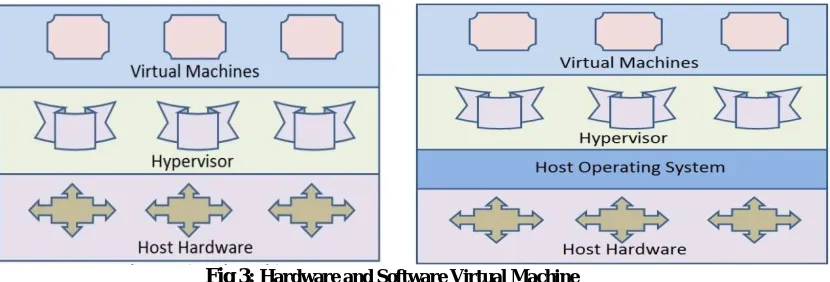
computer. Every virtual machine is known as a guest machine. The guest operating systems are shown by the hypervisor with a virtual operating platform. It maintains the guest operating systems execution.
Fig 3: Hardware and Software Virtual Machine
There are several kinds of virtualizations are talked about below.
Usually virtual servers play an important role in the cloud computing atmosphere. Virtual server attempts to encapsulate the server software away from the server hard ware. The virtual server contains the operating system, the application and the storage. If we are managing the virtual servers, these servers are serviced by one or more hosts and on host can manage greater than one virtual server. Same as conventional servers these also named with respect to their use. By managing the Virtual servers we can also decreased their services offering by them if the administrator observes that service offering by them crosses its limit then he will decrease it to specific level. And they will adjust them. For developing virtual servers, there are various templates so, that we can make several and similar virtual servers [20].
The main benefit of virtual servers they can be transitioned from one host to another host.
Server Virtualization: Building one server appears as many. Every virtual server may run the different or same
operating systems. For decreasing the server idle time a single physical server is virtualized to make several virtual servers. It can be concluded that the CPU usage is the main cause for server virtualization.
Desktop Virtualization: This permits to switch between several operating on the same operating systems, which builds
the task easier for software testers and other developer staffs. This decreases the requirement for duplicate hardware and has other economical views.
Virtual Network: These produce a illusion that a subscriber is linked directly to a company network and resources,
although no physical link may available. Virtual networks are sometimes known as VPN (virtual private network),utilizing a virtual private network the subscribers can link to a network and access the resources from any internet linked network Virtualization technique diverts the human’s point of view for using IT resources from physical to logical. The objective of virtualization is to collaboratively use the IT resources i.e. processor, storage and network to maximum level and to decrease the IT resources cost which can be obtained by combining several idle resources into shared pools and generating several virtual machines to perform multiple tasks at the same time. The resources can be assigned or altered dynamically. Subscribers should be aware of basic mechanism i.e. hypervisor,
emulation, para, full and hardware assisted virtualization while utilizing virtualization in cloud computing environment. Emulation: It is a virtualization mechanism which converts the nature of the computer hardware to a software program
and remains in the operating system layer which lies on the hardware. Emulation offers tremendous flexibility to guest operating system but the translation process speed is low in comparison of hypervisor and needs a high configuration of hardware resources to operate the software [12].
Virtual Machine Monitor or Hypervisor: a software layer that can virtualized and monitor the resources of a host machine conferring to the subscriber needs [13]. It is an intermediary layer between hardware and operating system. Generally, hypervisor is categorized as hosted and native [14]. The native based hypervisor operates directly on the hardware whereas host based hypervisor operates on the host operating system. The software layer generates virtual resources i.e. memory, CPU, storage and drivers.
efficiency. Accessing resources in Para virtualization [15] is better as compared to the full virtualization model however all resources must be competed in full virtualization model. The disadvantage of this mechanism is to modify the kernel of guest operating system utilizing hyper calls. This model is only appropriate with open source operating systems.
Full Virtualization: Hypervisor produces isolated atmosphere between the virtual server or guest and the server hardware or host. Operating systems directly access the hardware controllers and its peripheral devices without cognizant of virtualized atmosphere and need modifications [16].
V. PLACE OF VIRTUALIZATION IN FOG COMPUTING
Virtualization is one of the significant components of cloud computing that supports to growth of cloud computing. To understand cloud computing it is significant to understand the concepts such as storage virtualization or network virtualization. The main elements of virtualization in the cloud are virtual machines, because all of the applications and operating systems are inside them. They are like a container which is separated and isolated from each other, even in the similar physical host.
Virtualization function: With the development in existed compute power on embedded devices, there is a chance to push extra applications and intelligence to the network edge. The ability of running applications at the edge permits a new degree of virtualization to happen where a collection of virtual software based “devices can all operate within a single piece of hardware. The similar way virtualization has inspired the way Cloud scale servers run, Fog software platforms converge several functions into a single device that will consist various personalities/functionalities executing in parallel. Local Grid Fog Computing Platform enables various virtualized devices to co-exist on multiple supported hardware targets. Virtualization of functions and Multi-target support can decrease operational complexity, increase the life of available assets, and depending on the basic role of cloud as-pay-you-go, the vendors provide you that capability to access these offered virtual machines and in some situations they will build these virtual machines same as an actual computer and you can purchase them for a specified time and take benefit of this ability without any tensions about how they run. That thing you are purchasing is the existence of these services. Vendors in exchange promise to provide you these facilities without any interference that builds the existence in high level [20].
Virtualization Role in fog computing: Usually virtual servers play a significant role in the cloud computing environment. Virtual server attempts to encapsulate the server software away from the server hard ware. The virtual server contains the operating system, the application and the storage. If we are managing the virtual servers, these servers are facilitated by one or more hosts and on host can manage more than one virtual server. Same as conventional servers these also called according to their utilization. By managing the Virtual servers we can also decreased their facilities offering by them .if the administrator observes that facility offering by them exceeds its limit then he will decrease it to specific level. And they will adjust them. For developing virtual servers, there are many templates so, that we can make various and same virtual servers. The main benefit of virtual servers they can be transmitted from one host to another host [20].
VI. FOG SIMULATION TOOLS
Simulation software depends on mechanism of real phenomenon with a collection of mathematical formulae’s. This software offers the simulated environment that is same as real world atmosphere. Simulation software is made in a way so that result should be near to real world. Continuous simulation and discrete event are the two classes of simulation package. Discrete simulations are utilized to simulate statistical events i.e. customer reaching in bank; while continuous simulation is utilized in broad variety of physical process i.e. human respiration, ballistic trajectory and radio frequency data communication etc. Cloud environment can also be modelled with the support of simulation software. Some cloud simulators that can be employed for cloud simulations are as:
1. iCanCloud 2. OPNET 3. CloudAnalyst
be simulated and modelled. 2. Cloud broker schemes can be examined because of reliable hypervisor. 3. VM can model uni-core/multi-core systems. 4. A broad variety of storage options can be chosen ranging from remote storage systems like parallel file systems , Network file system (NFS) and redundant array of independent disk (RAID) systems and local storage systems. 5. Offers user friendly, easy graphical user interface (GUI) to simplify the generation and customization of huge distributed models. 6. Offers POSIX-based API and a compromised MPI, Library.7. Offers characteristic to add new component in iCanCloud repository to obtain more services.
B. OPNET: - OPNET’s is normally specialized for network development and research. It is reliably utilized for communication networks study, about protocols, devices and the applications. As this is commercial service supplier it has a good graphical interface for subscriber and the graphical interface is utilized to make the network topology application and entities from the system application layer to the physical layer. Here, the object oriented programming language is utilized to generate a mapping from the graphical interface for the real implementation. The diagram below represents the graphical representation of every network nodes and the graphical output. As it has a graphical aspect, the parameter can be varied and seen the result repeatedly very easily without much hard work. This modeller is famous for network research and industry for the development. The provided programming tools and GUI interface are very useful to make the system according to subscriber need and to model the system. OPNET has three important services as modelling, simulation and analysis. For modelling it offers good graphical interface to describe and generate all types of model protocol. For simulation it utilized different kind of advanced simulation technique to deal and address broad range of study aim. For analysis, the simulation results and data can be showed graphically in user friendly forms of graphs, charts and in statistics form for subscriber comfort.
C. Cloud Analyst: - Cloud Analyst was obtained from CloudSim and explores some of its abilities and characteristics introduced. Cloud Analyst distinguishes the simulation experimentation exercise from a programming exercise. It also enables a simulator to repeatedly do simulations and to carry out a set of simulation experiments with little parameters variations in a easy and frequent way. Cloud Analyst can be used to check the large scaled Internet application behaviour in a cloud environment. The significant issue that subscriber comes across while performing with CloudSim is that it is not at all graphical in behaviour, so to have better results of visualisation, subscriber can choose for Cloud Analyst. This environment supports in distinguishing the simulation environment from the programming environment [5]. This simulation tool is very easy to employ and has the capability to generate the output in graphical form.
D. Cloud Sim: - CloudSim is a toolkit (library) for Cloud and fog computing environments simulation evolved in the CLOUDS Laboratory at the Computer Science and Engineering Department of the University of Melbourne, Australia. CloudSim is generalized, new and extensible simulation toolkit that enables continuous simulation, modelling and experimentation of evolving cloud computing system, application and infrastructure environments for internetworked and single clouds. In simple words, CloudSim is a development toolkit for Cloud scenarios simulation. CloudSim is not a model as it does not offer a ready to utilize environment for execution of a whole scenario with a particular input. Instead, subscribers of CloudSim have to formulate the Cloud scenario it wants to measure, describe the needed output, and offer the input parameters CloudSim toolkit supports system and behaviour modelling of cloud system components i.e. virtual machines (VMs) data centers and resource provisioning schemes. It is significant to notice that CloudSim is not a ready-to-use solution where you adjust parameters and gather results for usage in your project. All the CloudSim components interact with each other via message passing.
E. Network Cloud: - Network Cloud is an extended version of CloudSim and is capable of enforcing network layer in CloudSim, reads a BRITE file and creates a topological network. Here, we have configuration file which consists the no. of nodes along with the several entities included in simulation [4].In this simulation tool, every entity is to be mapped to a single BRITE node so that network CloudSim can work appropriately. Network CloudSim can be utilized to model network traffic in CloudSim.
F. Network Simulator 2 (NS2): - NS2 is the most famous network simulators. This is a discrete event modeller mainly designed for the network researchers. NS2 is the second version of NS (Network Simulator) and NS was formulated in 1989. The latest version of NS2 is broadly utilized for academic research. After that lots of packages are contributed by some non-profit groups to enhance and build it much better.
integration of these two languages appears to be very efficient. Normally the C++ is employed to implement the detail simulation protocol and OTcl is employed for the subscriber to control the simulation and organize the events. The OTcl script is utilized to start the event scheduler, to establish the network configuration and to tell traffic source whether to forward or stop forwarding the packet from event scheduler. The view can easily change by the OTcl script. There is reliability that when a subscriber wish a new network object they can simply write the code utilizing the available object library and also plumb the data path from object.
G. OMNeT++: - OMNeT++ is a public source, a discrete event modeller with GUI support of component based network modeller. The primary application field of this simulator is the communication networks along with its reliable architecture it has other areas i.e. hardware architecture, IT systems, queuing network and also in business mechanism. Here the components are known as modules and programmed in C++ language. Its operating principal is same as that of Python in NS3 and OTcl in NS2. The smaller components are integrated into larger components and models utilizing high level language.
The OMNeT++ is intended particularly for the complex based architecture. Basically the reusable components are aggregated to build OMNeT++ module. The major characteristics of OMNeT++ are the modules are reusable and the modules are integrated in several ways. The key characteristic is the simulation kernel C++ class library which contains utility class and simulation kernel essential for simulation components. It has runtime subscriber environments and interface for simulation. OMNeT++ support multiple platform like it can operate on Unux, other Linux-like systems and on Windows systems.
H. Open Cirrus: - Open Cirrus is an open cloud and fog computing test bed sponsored by Inter, Hewlett-Packard (HP)and Yahoo! in cooperation with some other organizations. In accordance of [6] the Open Cirrus aspires to obtain the below objectives: Foster systems-level research in cloud computing. promote new cloud computing applications and applications-level research. provide a set of experimental datasets. formulate APIs and open -source stacks for the cloud. Open Cirrus offers a cloud stack consisting of virtual and physical machines, and global facilities i.e. monitoring, sign-on, job submission and storage.
I. CDOSim: - CDOSim is a cloud deployment option (CDO) Simulator which can model the SLA violations, response times and costs of a CDO. A CDO is a decisions relating simulator which takes decision about the choice of a specific runtime adaptation strategies, cloud provider, components deployment of virtual machine and its instances configuration. Component deployment to virtual machine instances involves the probability of making new components of already available components. Virtual machine instances configuration, relate to the instance type of virtual machine instances. CDOSim can model cloud deployments of software systems that were reverse engineered to KDM models. CDOSim has capability to represent the subscribers instead o the supplier’s point of view. CDOSim is a simulator that permits the combination of fine grained models. CDOSim is best instance for runtime reconfiguration plans comparison or for finding the tradeoff between performance and costs [13]. J. XEN HYPERVISOR: -The Xen hypervisor is a layer of software operating directly on computer hardware substituting the operating system thus permitting the computer hardware to run numerous guest operating systems concurrently. It Supports a variety of platform and other general operating systems as guests operating on the hypervisor as provided [3, 4]. A computer operating the Xen hypervisor consists three components. It involves Xen hypervisor that operates directly on the hardware and becomes the interface for all hardware requests. By distinguishing the guests from the hardware, the Xen hypervisor is capable to run several operating systems independently and securely. The Domain 0 Guest known as Dom0 is established by the Xen hypervisor during at the time of system start-up and can operate any operating system except Windows. The Dom0 has unique privileges to access the Xen hypervisor that is not assigned to any other Domain Guests. The Domain Guests known as DomUs are established and managed by the Dom0 and independently run on the system. These guests are either run with a particular altered operating system known as Para-virtualization or un-modified operating systems leveraging special virtualization hardware (Intel VT and AMD-V) known as hardware virtual machine (HVM). The setup which utilizes in our situation is Para virtualization.
VII. CONCLUSION
REFERENCES
[1] Nisha Peter, ”Fog Computing and Real time Application”, International Journal of Emerging Technology and Advanced Engineering, Vol. 5, Issue 6, pp 266-269, June 2015.
[2] Kc gounda, Anurag Patro, Dines Dwivedi and Nagaraj Bhat ”Virtualization approaches in cloud computing” International Journal of Computer Trends and Technology (IJCTT), Vol. 12, Issue 4, pp161-166, June 2014.
[3] Ivan Stojmenovic and Sheng Wen,” The Fog Computing Paradigm: Scenarios and Security Issues”, In the Proceedings of Federated Conference on Computer Science and Information Systems, Vol. 2, pp. 1–8, 2014.
[4] Swati Agarwal, Shashank Yadav and Arun Kumar Yadav,” An Efficient Architecture and Algorithm for Resource Provisioning in Fog Computing”, I.J. Information Engineering and Electronic Business, pp 48-61, January 2016
[5] Clinton Dsouza, Gail-Joon Ahn and Marthony Taguinod,” Policy-Driven Security Management for Fog Computing: Preliminary Framework and A Case Study”, IEEE IRI 2014, No. 13, pp 16-23, August 2014.
[6] K.P.Saharan and Anuj Kumar,” Fog in Comparison to Cloud: A Survey”, International Journal of Computer Applications (0975 – 8887), Volume 122 – No.3, pp 10-12, July 2015.
[7] T.Rajesh Kanna, M. Nagaraju and Ch.Vijay Bhaskar,” Secure Fog Computing: Providing Data Security”, International Journal of Research in Computer and Communication Technology, Vol 4, Issue 1, pp 53-55, January– 2015.
[8] D.C.Saste, P.V.Madhwai, N.B.Lokhande and V.N.Chothe,” FOG COMPUTING: Comprehensive Approach for Avoiding Data Theft Attack Using Decoy Technology”, International Journal Computer Technology and Application, Vol 5(5), pp 1768-1771, Sept.-Oct. 2014.
[9] Tom H. Luan, Longxiang Gao, Zhi Liz, Yang Xiang, Guiyi Wey, and Limin Sunz,” Fog Computing: Focusing on Mobile Users at the Edge”, arXiv:1502.01815v3 [cs.NI] , pp 1-11, 30 Mar 2016.
[10] Rajesh Bose, Murari Krishna Saha and Debabrata Sarddar,” Fog Computing Made Easy with the Help of Citrix and Billboard Manager”, International Journal of Computer Applications (0975 – 8887), Volume 121 – No.7, pp 19-23, July 2015.
[11] Viraj G. Mandlekar, VireshKumar Mahale, Sanket S.Sancheti and Maaz S. Rais,” Survey on Fog Computing Mitigating Data Theft Attacks in Cloud”, International Journal of Innovative Research in Computer Science & Technology, ISSN: 2347-5552, Volume-2, Issue-6, pp 13-16, November 2014.
[12] Graham Beauregard,”Fog Computing–Virtualizing Industry”,LocalGrid Technologies Inc., pp1-16, March 26, 2015.
[13] Kamyab Khajehei,” Role of virtualization in cloud computing”, International Journal of Advance Research in Computer Science and Management Studies, ISSN: 2321-7782, Volume 2, Issue 4, pp 15-23, April 2014.
[14] Thogaricheti Ashwini and Mrs. Anuradha.S.G,” Fog Computing to protect real and sensitivity information in Cloud”, International Journal of Electronics and Computer Science Engineering, ISSN- 2277-1956, Volume 4, Number 1, pp 19-29
[15] Divya Shrungar J, Priya M P and Asha S M,” Fog Computing: Security in Cloud Environment”, International Journal of Advanced Research in Computer Science and Software Engineering, ISSN: 2277 128X, Volume 5, Issue 8, pp 803-807, August 2015.
[16] http://blogs.cisco.com/perspectives/iot-from-cloud-to-fog-computing [17] http://www.webopedia.com/quick_ref/cloud_computing.asp
[18] Cisco, “Cisco delivers vision of fog computing to accelerate value from billions of connected devices,” Cisco, Tech. Rep., Jan. 2014. [19] Shanhe Yi, Cheng Li and Qun Li,” A Survey of Fog Computing: Concepts, Applications and Issues”, Mobidata’15, June 21, 2015.