University of Windsor University of Windsor
Scholarship at UWindsor
Scholarship at UWindsor
Electronic Theses and Dissertations Theses, Dissertations, and Major Papers
2010
On Murty's gravitational interior point method for quadratic
On Murty's gravitational interior point method for quadratic
programming
programming
Pooyan Shirvani Ghomi University of Windsor
Follow this and additional works at: https://scholar.uwindsor.ca/etd
Recommended Citation Recommended Citation
Ghomi, Pooyan Shirvani, "On Murty's gravitational interior point method for quadratic programming" (2010). Electronic Theses and Dissertations. 8050.
https://scholar.uwindsor.ca/etd/8050
This online database contains the full-text of PhD dissertations and Masters’ theses of University of Windsor students from 1954 forward. These documents are made available for personal study and research purposes only, in accordance with the Canadian Copyright Act and the Creative Commons license—CC BY-NC-ND (Attribution, Non-Commercial, No Derivative Works). Under this license, works must always be attributed to the copyright holder (original author), cannot be used for any commercial purposes, and may not be altered. Any other use would require the permission of the copyright holder. Students may inquire about withdrawing their dissertation and/or thesis from this database. For additional inquiries, please contact the repository administrator via email
O N M U R T Y ' S GRAVITATIONAL
I N T E R I O R P O I N T M E T H O D FOR QUADRATIC P R O G R A M M I N G
by
Pooyan Shirvani Ghomi
A Thesis
Submitted to the Faculty of Graduate Studies
through the Department of Mathematics and Statistics
in Partial Fulfillment for the Requirements of
the Degree of Master of Science at the
University of Windsor
Windsor, Ontario, Canada
2010
1*1
Library and Archives CanadaPublished Heritage Branch
395 Wellington Street OttawaONK1A0N4 Canada
Bibliotheque et Archives Canada
Direction du
Patrimoine de I'edition
395, rue Wellington Ottawa ON K1A 0N4 Canada
Your file Votre reference ISBN: 978-0-494-62731-0 Our file Notre reference ISBN: 978-0-494-62731-0
NOTICE: AVIS:
The author has granted a
non-exclusive license allowing Library and Archives Canada to reproduce, publish, archive, preserve, conserve, communicate to the public by
telecommunication or on the Internet, loan, distribute and sell theses
worldwide, for commercial or non-commercial purposes, in microform, paper, electronic and/or any other formats.
L'auteur a accorde une licence non exclusive permettant a la Bibliotheque et Archives Canada de reproduire, publier, archiver, sauvegarder, conserver, transmettre au public par telecommunication ou par I'Internet, prefer, distribuer et vendre des theses partout dans le monde, a des fins commerciales ou autres, sur support microforme, papier, electronique et/ou autres formats.
The author retains copyright ownership and moral rights in this thesis. Neither the thesis nor substantial extracts from it may be printed or otherwise reproduced without the author's permission.
L'auteur conserve la propriete du droit d'auteur et des droits moraux qui protege cette these. Ni la these ni des extraits substantiels de celle-ci ne doivent etre imprimes ou autrement
reproduits sans son autorisation.
In compliance with the Canadian Privacy Act some supporting forms may have been removed from this thesis.
Conformement a la loi canadienne sur la protection de la vie privee, quelques
formulaires secondaires ont ete enleves de cette these.
While these forms may be included in the document page count, their removal does not represent any loss of content from the thesis.
Bien que ces formulaires aient inclus dans la pagination, il n'y aura aucun contenu manquant.
Author's Declaration of Originality
I hereby certify that I am the sole author of this thesis and that no part of this
thesis has been published or submitted for publication.
I certify that, to the best of my knowledge, my thesis does not infringe upon
anyone's copyright nor violate any proprietary rights and that any ideas, techniques,
quotations, or any other material from the work of other people included in my
thesis, published or otherwise, are fully acknowledged in accordance with the standard
referencing practices. Furthermore, to the extent that I have included copyrighted
material that surpasses the bounds of fair dealing within the meaning of the Canada
Copyright Act, I certify that I have obtained a written permission from the copyright
owner(s) to include such materials in my thesis and have included copies of such
copyright clearances to my appendix.
I declare that this is a true copy of my thesis, including any final revisions, as
approved by my committee and the Graduate Studies office, and that this thesis has
Abstract
This thesis presents a modification of the gravitational interior point method for
quadratic programming [7]. Murty presented the algorithm as a generalization of his
gravitational method for linear programming [8]. Murty claims that this method is
matrix inverse free unlike other interior point methods, however convergence of his
algorithm is not guaranteed. This thesis introduces modifications in the centering
step of the algorithm and, using a MatlabR2009a implementation, demonstrates the
centering step.
Dedication
This thesis is dedicated to all Iranian students in jail, who have devoted their lives
to fighting for justice and freedom. Words alone cannot express the regret I have that
A c k n o w l e d g e m e n t s
First and foremost I would like to express my most sincere thanks to my supervisor,
Dr. Richard J. Caron, for his guidance throughout the course of this study. I am
grateful to Dr. Caron for his invaluable help which made this thesis possible and all
of his supports for in helping earn my Master's degree. I would like to acknowledge
my internal reader Dr. Tim Traynor and my external reader Dr. Yash P. Aneja.
I would like to give thanks to all the nice people I have met in the past two years
at Department of Mathematics and Statistics, University of Windsor.
I would like to acknowledge my sisters Pardis and Parmis. Last, but not least I
would like to thank my parents, Hossain and Azadeh, for their constant love, support
and encouragement.
Contents
Author's Declaration of Originality iii
Abstract iv
Dedication v
Acknowledgements vi
List of Figures ix
List of Tables x
Chapter 1. Introduction 1
1.1. Overview and Outline of Thesis 1
1.2. The Quadratic Programming Problem (QP) 3
1.3. Optimality Conditions 7
1.4. Concluding Remarks 11
Chapter 2. Spherical Method for LP 12
2.1. Introduction 12
2.2. Spherical Method concept 12
2.2.1. The Centering Step 14
2.2.2. Descent Direction 17
2.3. Convergence Proof 19
Chapter 3. Spherical Method for QP
3.1. Introduction
3.2. QP spherical method
3.2.1. Murty's Centering Step
3.2.2. General Iteration
3.3. Improvement in Procedure M
3.4. Conclusion
Chapter 4. A probabilistic procedure for approximation the
4.1. Introduction
4.2. Notes on properties of S(x)
4.3. Improving Hit-and-Run
4.4. determining 5(x) maximizer
4.5. Experimental Result
Chapter 5. Conclusion and Future work
Bibliography
Vita Auctoris
List of Figures
2.1 The centering step for LP. 15
2.2 The modified centering step for LP. 16
3.1 The QP centering step. 23
3.2 Murty's procedure failure. 28
List of Tables
1 Description of the First set of examples : Normal problems 40
2 Description of the Second set of examples : Highly redundant problems 40
CHAPTER 1
Introduction
1.1. Overview and Outline of Thesis
In this thesis we introduce a new inverse free interior point algorithm for solving
the convex quadratic programming problem (QP)
minimize Q(x) = cTx + \xTHx
(1.1)
subject to ajx < bi for i = 1 , . . . , m,
where x = (xi,X2, ...,xn)T is the column vector of variables, H is a symmetric n
by n positive definite matrix, c, O i , . . . , am are vectors of order n, and bi,..., bm are
scalars. The vector a^ is the gradient of the ith constraint function ajx. Without loss
of generality, we assume that for all i the aj have been normalized so that ||aj|| = 1,
where ||-|| is the Euclidean norm. We use I = {1, 2 , . . . , m) to index the constraint
set for (1.1).
The feasible region for the QP is denoted by TZ and is the set of all points x in En
that satisfy the constraints ajx < bi for all i EX. For simplicity we assume that 1Z
is bounded.
The point x is feasible for (1.1) if x G 7£ and infeasible otherwise. We say
con-straint i is active, inactive or violated if ajx = bi, ajx < bi or ajx > bi, respectively.
For any i G K , we define the set
that indexes the set of all constraints active at x. We assume that the feasible region
IZ has a non-empty interior 7Zo = {x EW1 \ ajx < bi, \fi e l } . That is, we assume
that there is a x E 71 with J{x) = 0.
Each iteration of our algorithm contains two steps. The first is a centering step
and it is followed by a descent step. In the centering step, we determine a feasible
solution that has the largest minimum distance to all the constraint boundaries and
that has an objective value less than or equal to that of the current interior feasible
solution. Let B(x,r) = {y G M"|(2/ — x)T(x — y) < r2} be the ball with center x
and radius r; and suppose that x is the current interior feasible solution. In the
centering step we are looking for a point x that will maximize r with B(x,r) € TZ
and Q(x) < Q(x). Let f be the radius of the ball corresponding to the centre x.
In the descent step we look for the minimum of the quadratic function subject to
the ball constraint. That is, we solve min {Q(x) \x G B(x,f)}.
The concept for this kind of algorithm was first introduced by Murty in 2006 [8] for
linear programming and then he extended it for convex quadratic programming [7].
The algorithm presented in this thesis overcomes some of the difficulties in Murty's
algorithm, yet it maintains the positive aspects, such as the avoidance of matrix
inverse operations, the major cost factor for standard interior point methods.
In chapter 2, we present Murty's algorithm for linear programming. Chapter 3 is
devoted to Murty's QP algorithm and it is here that we demonstrate its weaknesses
and suggest improvements. In chapter 4 we introduce our procedure for the centering
step and present our experimental results. First, we present background information
on quadratic programming.
1.2. The Quadratic Programming Problem (QP)
In this section we present material related to the QP (1.1). The gradient of Q(x)
at the point x is the vector of order n given by
8Q(x) dx\
VQ{x) =
8Q(x)
8X2
Ex.
8Q{x) 8xn
The Hessian matrix of Q(x) is the n x n matrix whose (i,j)th entry is
d2Q(x)
It follows that the Hessian matrix of Q(x) is H. In this thesis, we assume that H is
positive definite.
DEFINITION 1.2.1 (Positive Definite and Positive Semi-Definite). Let H e Rnxn
be symmetric. H is said to be positive definite if xTHx > 0 for all x € R" \ {0}.
Similarly, H is said to be positive semi-definite if xTH.x > 0 for all x 6 l " .
DEFINITION 1.2.2 (Convex, Strictly Convex and Concave Functions :) .
i) The function f is convex if and only if for any two points x, y in the domain
offandXe [0,1]
f(Xx + (l-X)y)<Xf(x) + (l-\)f(y).
ii) The function f is strictly convex if and only if for any two distinct points x,
y in the domain of f and A € [0,1]
f(Xx + (l-\)y)<Xf(x) + (l-X)f(y).
iii) The function f is concave if and only if for any two points x, y in the domain
offandXe [0,1]
f{Xx + (l-X)y)>Xf(x) + (l-X)f(y).
LEMMA 1.2.3. If the function f(x) is convex and differentiable, then f(x) >
f(x0) + Vf(x0)(x-x0)
P R O O F . Since f(x) is convex for any two points x ^ y and A 6 (0,1)
f(Xx +(l-X)y)- f(y) < Xf(x) - Xf(y).
Divide both sides by A to get
f(Xx + (l-X)y)-f(y)
X < / ( * ) - f(y)
Now let A —>• 0 then the definition left hand side is the gradient of f(x) in the direction
(x — y) at the point y and we have
Vf(y)T(x-y) + f(y)<f(x). (1.2)
4
The next theorem provide conditions that help us determine whether or not a
quadratic function is convex.
T H E O R E M 1.2.4. The Taylor's series for a quadratic function Q(x) about x0 is
Q(x) =Q (x0) + VQ(x0)T {x -x0) + -(x- x0)T H (x - x0). (1.3)
Furthermore, Q(x) is differentiable and
VQ{x) = VQ(x0) + E(x-x0). (1.4)
T H E O R E M 1.2.5. The function Q(x) = cTx + ^xTH.x is strictly convex if and only
if H is positive definite.
P R O O F . (—>) Let Q(x) be a strictly convex function, then the inequality Q(Xx +
(1 - X)y) < \Q(x) + (1 - X)Q(y) holds for all x ^ y and A with 0 < A < 1. Let s ^ 0
be a vector of order n and x be arbitrary, and A be such that 0 < A < 1. Replacing
y with x + s in the above inequality gives
Q(x + As) < \Q(x + s) + (1 - X)Q(x).
Now, expanding both Q(x + s) and Q(x + As) using Taylor's series we have
Q(x) + AVQ(x)Ts + J A V H S < XQ(x) + XVQ(x)Ts + ^sTEs + (1 - X)Q(x).
Simplifying, we have
but (1 — A)A is always bigger than 0 so that
sJEs> 0.
Since s was arbitrary, H is positive definite.
(<—) Suppose H is positive definite. Let z ^ y be any two points and A that
0 < A < 1. For simplicity, define u> = Xz + (1 — X)y. Now consider Taylor's series
(1.2.4). Since H is positive definite, (z — u)TE.(z — ui) is always positive, therefore the
following inequality holds
Q(Z)>Q(UJ) + VQ{U)T{Z-UJ). (1.5)
This inequality also holds when z is replaced by y, so we have
Q(y) > Q(u) + VQ(u)T(y - u). (1.6)
Multiplying (1.5) by A, (1.6) by (1 — A) and adding together, gives
XQ(z) + (1 - X)Q{y) > (A + 1 - X)Q{UJ) + WQ(u)T(Xz + (1 - X)y - u).
After simplifying, we have
XQ{z) + (1 - X)Q{y) > Q(Xz + (1 - X)y),
1.3. Optimality Conditions
We consider the model problem (1.1). A more compact form is
minimize {Q(x) \ Ax < b} , (1-7)
where AT = [ai,..., am] and b = [b\,..., bm] . Then the feasible region, i.e. 7Z, for
(1.7) is
U= {x | Ax < b} .
The point x* is an optimal solution (simply optimal) if x* G 7Z and Q(x*) < Q(x) for
all x e 71. The objective function for (1.7) is unbounded from below if there exists a
point XQ and direction s0 s u c n that XQ — 8SQ G 7Z for all S > 0 and Q(x0 — 5s0) -> — oo
when <5 —> oo.
DEFINITION 1.3.1 (Descent Direction). The direction s is said to be a descent
direction for Q(x) at the point x if Q(x — as) < Q(x) for all a where 0 < a < e for
some e > 0.
LEMMA 1.3.2. The direction —s is a descent direction for Q(x) at the point x if
VQ(x)Ts > 0.
DEFINITION 1.3.3 (Optimal Step Size). The value of a that minimizes Q(x — as),
a € R, is called the optimal step size and it is given by
« = ^ f ^ , s^Es^O. (1-8)
DEFINITION 1.3.4 (Extreme Point). For a given convex set S, x is said to be an
extreme point of S if it is not possible to represent x as linear combination of any
other two distinct points of S.
DEFINITION 1.3.5 (Maximum feasible step size). Let x e Tl and s e Rn, the
maximum value of a > 0 with x — as £ H is called the maximum feasible step size,
and it denoted by a.
LEMMA 1.3.6. If ajs > 0 for all i = 1 , . . . , m, the maximum feasible step size is
taken as +oo, otherwise
. (ajx-bi , T / n l
a = mm < = % = 1 , . . . , m, and a{ s < 0 > .
I ais J
Most linear programming algorithms, except interior point methods, are based on
the fact that the feasible region possesses a finite number of extreme points and at
least one of these extreme points is an optimal solution. In quadratic programming,
the analog to an extreme point is a quasistationary point.
DEFINITION 1.3.7 (Quasistationary point). The point xo £ 71 is a quasistationary
point for (1.7) if XQ is an optimal solution for
minimize {Q(x) \ ajx = bi,i E j7"(^o)} • (1-9)
It is obvious that every extreme point of TZ is a quasistationary point for (1.7)
and that any optimal solution for (1.7) is a quasistationary point since it is a strictly
convex QP. In general, (1.7) possesses many quasistationary points. For example if
there is a solution xX € TZ to
minimize {cTx + xTHx\aJx = bi, i € X0} , (1-10)
for some subset Zo of X = { l , . . . , m } , then XQ is a quasistationary point. It is
theoretically possible to find all quasistationary point and solve (1.7), but there are 2m
such subsets, so a rather large amount of computation is required. Many algorithms
iteratively determine a sequence of quasistationary point x\,..., Xj-i,Xj with
Q(XJ) < Q{XJ-I) < ... < Q(xi),
and locate an optimal solution for (1.7). The fact that a finite number of
quasista-tionary exists, implies that in a finite number of iterations, an optimal solution will
be found. As we know, Beale was the first one that used this argument to show finite
termination. Best in [4] shows under some assumption there are many QP methods
that produce the same sequence of quasistationary points.
A quadratic programming problem (1.1) is bounded from below if there is a
num-ber 7, such that for all x € TZ ,Q(x) > 7. In the other words there is not a direction
s with Q(x — as) —> —00 when a —> 00.
LEMMA 1.3.8. Suppose that Q(x) is convex and it is bounded from below on 1Z.
Let XQ be an arbitrary point in 1Z. Then there is a quasistationary point x with
Q(x) < Q(x0).
T H E O R E M 1.3.9 (Existence of an optimal solution for quadratic programming
x for
minimize { Q(x) | Ax < b}
and x is a quasistationary point.
P R O O F . There are finitely many quasistationary points. Each is associated with
a subset of { 1 , . . . ,rn}. Suppose that Let y is a quasistationary point. Associated
with this y is the quasistationary set
S(y) := {x | ajx = bufor alii G J{y),Q(x) = Q{y)}.
Since there are finitely many quasistationary points, there are a finite number, say p,
of quasistationary sets. Let Xi be a quasistationary point from ith quasistationary the
set. We choose x so that
Q(x) = min {Q(xi) | i = 1 , . . . ,p}.
Suppose x G 71. From Lemma (1.3.8) we know that there exists a quasistationary
point x with Q(x) < Q(x). But x G S(xi) for some % where 1 < i < p. So Q(xi) =
Q(x).But
Q(x) < Q(Xi) = Q(x) < Q(x).
So Q(x) < Q{x) for all x G 7Z and x is an optimal solution. •
T H E O R E M 1.3.10 (Optimality condition for quadratic programming problem).
The pointxo is an optimal solution for (1.1) if and only if there exist scalar u\,..., um
which together with XQ satisfy
(1) ajx0 < hi for alii = 1 , . . . ,m
(2) -VQ(x0) = uiai + . . . + umam, Ui>0,i = l,...,rn,
(3) Ui(ajx0 - bi) = 0, i = 1 , . . . , m.
P R O O F . See [6] page 68-69. •
These are the KKT conditions for quadratic programming.
1.4. Concluding Remarks
We established basic theorems of quadratic programming. Now we can discuss
algorithms. The next chapter is an overview of spherical method that Murty proposed
CHAPTER 2
Spherical Method for LP
2.1. Introduction
About 20 years ago, Chang and Murty in [12] developed new methods for Linear
Programming(LP), but in [13] Morin, Parbhu and Zhang showed that this algorithm
has worst case exponential growth as dose the simplex method. Murty, in [8],
devel-oped the new Spherical method, which it based on a "gravitational model". This new
method can be classified as an Interior Point Method (IPM). In the next section we
explain the concept behind this method and we try to clarify steps of this method to
gain insight about the challenges this method faces when it is adopted for QP.
2.2. Spherical Method concept
Consider the LP in the following form
maximize cTx
(2.1)
subject to ajx < bi fori e { 1 , . . . , m).
Suppose that we are given an x0 £ Ho, s o that there exists a ball with x0 as center
and radius r0 that is completely contained in 7Z. The gravitational method, traces
the path of the center as the ball drops under the gravitational force pulling it in the
direction —cT. After some initial descent, the ball will be blocked by a facet of 72..
After that the ball starts to move along the facets of 7Z. So the center of ball will
behave like boundary or active set methods. One way to improve the efficiency of
gravitational methods is to keep the center of ball far away from boundary of feasible
region. Therefore, we must try to maximize the radius of the ball. A benefit of this
strategy is that you can move inside the ball without any concern about violating
constraints or of getting stuck in corners. This improvement leads to the spherical
method,
Before we start a description of the algorithm we need some preliminary
defini-tions. Suppose point x e TZQ, since ||aj|| = 1, bi — ajx is Euclidian distance of the
point x to the boundary of constraint i. Now, let 8(x) = min {bi — ajx | % G J } , then
the biggest ball with x as center that can be inscribed inside the feasible region has
radius S(x). This ball is denoted by B(x, S(x)) and is defined as
B(x, 6(x)) := {y\(y- x)T(y - x) < S(x)2}.
Some of the constraint boundaries of the feasible region are tangent to B(x). The set
of such constraints is
T{x):={i\5(x) = bi-ajx, fori el}.
To determine the biggest ball that can be inscribed within the feasible region we
should maximize 5(x), or, in other words, maximize {min{6; — ajx | V i e 1} }. This
is a min-max problems and we can rewrite it as
maximize 8
(2.2)
subject to 8 + ajx < bi for % € X,
where (x, 5) is the vector of variables. But we want the objective function value not
increase. Suppose y is provided as the initial point for iteration j of the algorithm,
then all points to be considered for center of the ball must satisfy cTx < cTy. So,
in each iteration we want to the determine biggest ball that can be inscribed inside
the feasible and that has a center with an improved objective function value. We can
achieve this by solving
maximize 8
subject to 5 + ajx < ^ for i el, (2-3)
cTx < cTy.
The only difference between (2.2) and (2.3) is the constraint cTx < cTy. In figure
(2.1) we can see the biggest ball that can be inscribed in feasible region of the problem
(2.3).
Each iteration of the spherical method then consists of two main steps, the
cen-tering step and the descent step. We begin with an interior point. The cencen-tering
step is to solve (2.3). The descent step moves from the center to a point with smaller
objective value.
2.2.1. The Centering Step. It is a good question to ask how we should
deter-mine the solution of (2.3). Since (2.3) is an LP, we could use methods like simplex
method or interior point methods. This is quite counter productive since (2.3) must
be solved several times in order to determine the optimal solution of (2.1). The
spher-ical method will be practspher-ical only if there is a computationally inexpensive procedure
that can carry out the centering step, i.e. solve (2.3). Murty approach is to solve
maximize 5
subject to 5 + ajx < bi for i £ 1, (2-4)
cTx = cTy.
The difference is that cTx < cTy is replaced with cTx = cTy. Murty in [8] proposed a
procedure to get an approximation of the optimal solution of (2.4) and he claimed that
it was able to determine a good enough approximation of centering step. However,
his proof of convergence depended on of finding the exact solution. Now we describe
Murty's procedure. Suppose an interior initial point XQ is provided, the direction s is
what Murty calls a profitable direction at x if there exists a > 0 with 5(x — as) > S(x).
If x is an interior point, then T{x) is non-empty and |T(x)| > 1. In figure (2.2) we
can see the optimal solution to (2.4).
F I G U R E 2.2. The modified centering step for LP.
T H E O R E M 2.2.1. The direction s is a profitable direction at the point x if and only
ifmm{ajs | i E T(x)} > 0.
P R O O F . (—>•) Let s be a profitable direction. Then for sufficiently small a, x — as
is feasible and 8(x — as) > S(x). To increase S(x) we should move away from the
boundaries of the constraints in T(x). Thus, we want ajs > 0 for i G T(x). Hence,
min{a7s | i e T(x)} > 0.
(<—) Suppose min{ajs \ % G T(x)} > 0. So ajs > 0 for i G T(x), since for
sufficiently small enough a > 0, bi — ajx + aajs G TZQ Vi £ I \ T(X) and increase
5(x), since 5{x) + min{ajs \ i G T(x)}. Hence s is a profitable direction. •
Murty only considered the normal vectors of the constraints as candidates to
be profitable directions. Since each direction must lie on the plane cTx = cTx0,
normal vectors were projected onto the current objective plane. Murty considered
the directions s, = a^ — cTcai = (I — cTc)ai i € I. We denote the set of these
directions by D. Let Xj be the current point and suppose that s is a profitable
direction. We look for the step size a that will maximize
S(a)j = {bi — ajxj + aajs \ i G X}. (2.5)
This is a min-max problem and we can rewrite it as the following 2-variable LP
Maximize 6
Subject to S + aajs < bi — ajxj, i G X (2-6)
5>0,
where(S, a) are the variables. Murty used the primal simplex to solve (2.6). In chapter
4 we explain how to solve it using bisection. Here is a short description of Murty's
centering procedure
2.2.2. Descent Direction. Once the centering step is done, the spherical method
will complete several descent steps from the new center and will take the best point.
All of descent steps are computationally inexpensive. Let Xj be the approximation of
Algorithm 1 Murty's procedure for approximation of centering step
Let XQ be an initial feasible interior point. Set j := 0 and Xj = x0.
Dj = {±Sj = ± (I — cTc)a,i | i G T(XJ)} while exist a profitable direction in Di do
s G Dj and is a profitable direction
a = arg max {bi — ajxj + aajs | V % G 1}
3=3 + 1
update Dj and T(XJ)
end while
calculate the maximum feasible step size as follow
bt-ajxj-eo , , , ^ T , T
A = <^ -± ^ 5i | for i G 1 and a' s < 0 ^ .
« j S
Since we want the point Xj — As, to be an interior point, we use e0 > 0 in calculating
the maximum feasible step size. We list various descent directions can be used in
descent step
1 : s\ = — c. Prom Xj we take Si = — c
2 : s2 = Xj — x~k, 1 < k < j: — 1. From Xj we S2 = Xj — x"fc for 1 < k < j — 1,
where a^ denotes the ball center at iteration fcth .
3 : s3 = (I — a,ia[)c, i G T(x~j). From Xj direction S3 = (/ — aiaj)c for z G T{XJ)
is a descent direction and they are called gradient projection on touching
constraint or shortly GPTC. For more detail refer to [8].
(J - a,iaj)c
4 : s
4= £
For more directions refer to [8, 9]. After all these directions are tried, the best result
is output as the descent direction. In the next section we will discuss the convergence
proof.
2.3. Convergence Proof
In this section we provide the convergence proof for the spherical method under
the assumption that the centering step is carried to optimality. The First theorem is
about (2.3) and shows that always has feasible solution.
T H E O R E M 2.3.1. Consider following parametric formulation of (2.3) with the
pa-rameter t replacing cTx0.
5(t) = max 8
subject to 8 + ajx < bi fori el, (2-7)
cTx < t.
The function 8{t) is a concave.
P R O O F . Suppose that {x\,8\) and {x2,82) are optimal solutions of (2.3). Thus,
8i = S(ti) and 62 = 8(t2) when t = t\ and t = t2, respectively. Consider i =
Xti + (1 - X)t2, 0 < A < 1. We will first show that (x, 6), where x = Xxi + (1 - X)x2
and 8 = X81 + (1 — X)82, is feasible to (2.7) when t = i. We have, from feasibility of
(XJ, 8j), for t = tj, that
8 + ajx = XSi + (1 - X)82 + Xajxx + (1 - X)ajx2
= X{8X + ajxi) + (1 - A)(<$2 + ajx2)
< Xk + (1 - X)k
= h,
and
cTx = XcTx1 + (1 - X)cTx2 < Xh + (1 - X)t2 = t.
Since (x, 5) is feasible, then
S(t) >S = \5l + (l- X)S2 = AeJfo) + (1 - X)S(t2),
which establishes the concavity S(t). D
Since 8(t) is concave the existence of a maximum for t E [tmin, tmax] is guaranteed.
Therefore there exists biggest ball inside the feasible region.
Let lZ(t) denote the feasible region for (2.7), then for t\ < ^ w e have %{t\) C
7£(£2)- Since 5{t) is monotonically decreasing as t decreases, moving in a descent
direction leads to reductions in the objective value and the radius of biggest ball
inside the feasible region.
T H E O R E M 2.3.2. Starting from an interior point in the feasible region for (2.1),
if the centering step is carried to optimality, the spherical method converges to an
optimal solution of (2.1).
P R O O F . For detail of proof refer to [8, 12]. •
2.4. Conclusion
The spherical method looks like a promising method in theory, but convergence is
highly dependent on the centering step. The procedure that Murty proposed does not
give any information about the accuracy of the approximation. In the next chapter
we show that the strategy he proposed for QP has difficulties and may lead to points
that are not optimal.
CHAPTER 3
Spherical M e t h o d for Q P
3.1. Introduction
In this chapter we explain how to adapt the spherical method to QP. As mentioned
in the previous chapter, in the spherical method the most important step in each
iteration is the centering step. The centering step is computationally more expensive
than the descent step, so it is important to carry out the centering step quickly, yet
with good accuracy. Murty [7] proposed a procedure to get an approximation for the
centering step, but there is a fundamental difficulty in his procedure that makes it
inefficient. In the next section we try to explain the spherical method for QP, after
that in section three we try show its difficulty and suggest a change in the procedure
that makes it more efficient.
3.2. QP spherical method
We consider the QP (1.1) with H positive definite so that the QP is strictly convex.
The unconstrained minimizer of Q(x) is y* = —H_1c. If y* G 7Z, then the problem
is done. We assume that y* £ 7Z, since if it is feasible then solution of (1.1) is
y* and can be determined by Cholesky decomposition for solving a positive definite
linear system of equations or by any other algorithm that can solve unconstrained
minimization problems.
In the previous chapter we described the spherical method for LP. The spherical
the centering step is different and the descent directions are changed. The aim of the
centering step is to determine point within the feasible region that has most possible
distance from boundaries of feasible region and at same time has the objective value
less than initial point. Let y be the current feasible interior point for 71. The problem
of finding the largest ball inscribed within V, with objective value less than y, is the
min-max problem as follow
max { min{6j — ajx \ Q(x) < Q(y) and V % e X} }
which can be rewritten as the following non-linear problem
Maximize 8
subject to S + ajx < 6, i & I (3-1)
Q(x) < Q(y).
If (x, 5) is an optimal solution of (3.1), then the biggest ball inscribed within V, is
B(x) and its radius is equal to 5. The optimal solution x may not unique, but 5
is unique. As you can see, the centering step requires the solution of a non-linear
optimization problem. Since we must solve this type of model several times, like for
the LP, it is not rational to solve it exactly with contemporary methods for
non-linear optimization problem. To make this method efficient, a procedure should be
developed to get an approximation to the optimal solution of (3.1) without matrix
inversion.
F I G U R E 3.1. The QP centering step.
Suppose an approximation (x, 5) for centering step is available. Then in the
descent step we solve the problem
Minimize cTx + \xTYix
(3.2)
subject to (x — x)T (x — x) < 52.
This is a well known trust-region subproblem and efficient polynomial algorithms
exist for its solution, see [1, 5]. Let x be the optimal solution of (3.2). Then there
are two possible cases
(ii) x E TZo then si = (x — x) is a descent direction for Q(x).
In case (i), the optimal solution is found and we terminate, otherwise we do a line
search to minimize Q(x) on line segment {x = x — Asi | x € T^o}, we take A =
min {Xi, A2} where Ai is the optimal stepsize and A2 is maximum feasible step size.
If x — Xsi is a boundary point of 1Z, let index set J = {i e 1 1 hi = aj(x — Xsi) }. If
there exists a solution for the following system of equations (i.e. KKT condition for
(1-1))
—c — (x — As;i)TH = Yl UJiaj
j€j(x-\Sl) ( 3 3 )
ojj>0 Vj e J(x- Asi),
where Uj are corresponding Lagrange multipliers, then x — Xs^ is optimal solution
of (1.1) and terminate, otherwise move to xnew = x — (A — e0)si , where e0 is same
as chapter 2, and set it as output of descent step. Repeat centering step with xnew
as initial point. The algorithm runs until the stopping conditions are satisfied. The
stopping conditions can be the same as other interior point methods.
3.2.1. Murty's Centering Step. As mention before in chapter 2 and above,
to make the spherical methods efficient in theory and practice, we need a procedure
to carry out the centering step without using matrix inverses or current non-linear
optimization algorithms. Murty [7] proposed a procedure by using the concept he
used for LP (i.e. see [8, 9]). Now we describe this procedure in detail.
Suppose XQ G 72-0- Let 8(x) and the index set T(x) be the same as in chapter
2. The special structure of (3.1) leads to a strategy of moving perpendicular to the
facetal hyperplanes of 7£, so Murty just considers the normals of the constraints as
directions to move. Define D = {±aj | i € X}. For convenience, we refer Murty's
considered. Murty defines s to be a profitable direction at the point Xj if it satisfies
conditions
ci): VQ{x3)Ts > 0,
c2): 5{XJ — as) > 5(XJ) for some a > 0.
The first condition can be easily checked for each candidate direction, and by using
Theorem (2.2.1), the second condition also can be checked. Procedure M starts with
an interior point, uses conditions c\ and c2 to check whether or not a profitable
direction from D exists. If it determines no profitable direction, it terminates the
procedure and uses the current point as the new center. Otherwise, s G D is a
profitable direction for current point Xj. We need a step size to move from point Xj
in the direction Sj to next point. The step size is defined to be a = min {0:1,0:2}
where
ai = a rg m m {Q(xj ~ asj) I a > 0}
«2 = arg max {S(XJ — asj) | a > 0}.
Finding Oi is the minimization quadratic function in single variable and it is easily
calculated (i.e. ax = -fj. s°). To calculate o2 is a bit more complicated as we need
S- ti-Sj
to solve LP
maximize S
subject to 5 + aajSj < bi — ajxj fori € X (3-4)
5, a > 0,
where (S, a) are variables. This LP is the same as (2.6) in chapter 2. Once a i and o:2
are determined, set a = min {oi,o2} and move to the next point Xj+i = Xj — asj,
and repeat. In the next section we make suggestion to get a better approximation of
and repeat. In the next section we make suggestion to get a better approximation of
solution (3.1). The following theorem provides an existence proof for (3.1).
T H E O R E M 3.2.1. Consider following parametric formulation of (3.1) with
param-eter t replacing Q(x).
S(t) = max 5
subject to 6 + ajx < bi for i 6 X, (3-5)
Q(x) < t.
Then S(t) is a concave function oft.
P R O O F . The proof is same as (2.3.1). cTx replaced by Q(x), since Q(x) is convex.
See [14, 7] for complete proof. •
It can be concluded from (3.2.1) that there exists a biggest ball inside feasible
region for every t in the interval for what that problem has feasible solution. Also,
let R(t) denote feasible region of (3.5), it is obvious that for ti < t2, R(h) C i?(^).
Hence, 6(t) decrease monotonically as t decreases.
3.2.2. General Iteration. Here is a short description of spherical method.
Algorithm 2 Spherical Method for QP
Let XQ be an initial feasible point. Set j = 0 and Xj = x0.
Centering step
Get an approximation solution for (3.1), beginning with Xj as initial point. Let
Xj and 8(x) be the approximations. Update T(xf) and move to the descent step.
Descent step
Apply the described strategy with ball B(XJ,5(XJ)). If termination doesn't occur
in this step, let Xj denote the interior feasible point for 7Z0. Move to the next step. Next iteration
Check the stopping conditions. If they are satisfied set the optimal solution. Otherwise set Xj^-\ — Xj and j — j + 1. Go to centering step
3.3. Improvement in Procedure M
Convergence of spherical methods is proved under the assumption that in the
centering step the optimal solution is obtained. In [14] it was shown that when the
centering step is not carried out with good accuracy convergence does not hold and
is not guaranteed. Consider the following numerical example
max 8
subject to S — x < 0
S-y < 0
S + y < 1 (3-6)
S + 0.573x - 0.819?/ < 0.245
(x - 2)2 + (y - 2)2 < 4
5>0.
We start from point X\ = (1,0.5). The direction S\ = (0,1)T is a profitable direction as
it satisfies conditions C\ and c2. We move in the direction S\ to the point x^ = (1, 0.73)
with 6 = 0.27. The optimal solution to (3.6) is x* = (0.576,0.576) with 5* = 0.403.
There does not exist a direction that satisfies condition c\ and in that direction we
move from point x2 to x*. As you can see in figure (3.2) direction s± moves point x\
to a lower level set, so condition c\ will not be satisfied by any other direction and
it is not possible to move to optimal solution of (3.6). Any procedure is used in the
centering step, must determine as much as possible a good approximation for centering
step. In this section, we provide some suggestion that improve Murty's procedure. In
procedure M, the direction s should satisfy VQ(x)Ts > 0 to be a profitable direction,
F I G U R E 3.2. Murty's procedure failure.
Q(x) < Q{XQ) where 2:0 is initial point. So the optimal solution of (3.1) can have
the same objective function value as xo, but condition VQ(x)Ts > 0 says that for
the sequence Xj for j = 1,2... , Q(x\) > Qfa) > ••• > Q(xr) > ... which is
unnecessary. So condition c\ is too strict and we need an alternative way to prevent
violating Q(x) < Q(x0). Since Q(x) is a strictly convex function Q(x) < Q(XQ) is a
convex bounded region. Let x be an interior point of this region. For every direction
such s from x there exist two values of a with Q(x — as) = Q(xo), and more precisely
these two values, amin and amax, are
_ sTVQ(i)+v/(sTVQ(x))2-2(8THs)(AQ(x))
s Hs (3.7)
_ sTV Q ( x ) -v/ ( sTV Q ( x ) )2- 2 ( sTH s ) ( A Q ( x ) )
amin — sTHs
Now suppose direction s satisfy condition c2, then we need to determine step size
that maximize 5(x). Murty used (3.4) to calculate step size. Murty suppose that
step size is bigger that zero, but the only reason for that is to satisfy condition C2(i.e.
Q(x)s > 0). we need solve
max {mm{bi — aj(x — as) \ i £ X, amin < a < amax and x £ 71}},
which has same answer as following 2-variable problem
maximize 5
subject to 5 + aajs < bi — aTXj fori £ X
(3.8)
&min _ & — ^max
5>0.
By restricting a between amin and amax we are sure that the constraint Q(x) < Q{XQ)
is satisfied. So direction s is a profitable direction at point x if mm{ajs | i £ T(x)} >
0. After that if a profitable direction found, calculate upper and lower bound of step
size and solve corresponding (3.8) problem for finding step size.
3.4. Conclusion
Procedure M can determine an estimate for the centering step, but it is not
accurate enough, and also it will not provide how accurate is approximation. Murty's
procedure is good to find a warm-start initial point or as pre-procedure. It also can
provide a lower bound for 5. The main difficulty of procedure M is in the calculation
of stepsize for the profitable directions. To make spherical method a practical and
reliable algorithm, a computationally inexpensive procedure is needed to carry out
CHAPTER 4
A probabilistic procedure for approximation t h e center
4.1. Introduction
In the previous chapter we discussed Murty's method for QP. We supposed that
the feasible region is bounded , and by theorem (3.2.1,2.3.1) we showed that the
biggest ball inside the feasible region always exists. We are interested in the procedure
that without using matrix inversion get an accurate approximation of (3.1). As shown
in [14] and assumption of convergence proof, the centering step plays an important
part in convergence, so it is necessary to propose a procedure which be able to carry
out the centering step accurately and get a good approximation of solution (3.1). We
will use a probabilistic method to develop such a procedure. In the next section we
provided some interesting theorem and result about S(x). In the third section, we
explain the idea behind the probabilistic method, after that in section 4 we proposed
our procedure and at the last chapter we provide the numerical results from the
implementation of our procedure.
4.2. Notes on properties of S(x)
The function S(x) satisfies following properties
i) 8(y) = 0 if y is on the boundary of TZ;
ii) S(y) > 0 if y e ft0;
hi) W C Tl then 6(y)n> < Siy)^.
Q(x) < Q(xJ
F I G U R E 4 . 1 . Center are not unique.
So S(x) is a position function. Therefore, instead of the classic analytic center, one
can use a point that has the maximum value of S(x) and determine the biggest ball
can inscribed inside 1Z. From our assumption, we know that optimal solution of (1.1)
is not an interior point of 1Z and it must be quasistationary point, so when we are
at optimal point, the function S(x) become zero. The most important problem with
concept of biggest ball inside the feasible region is this ball can be non-unique, so
there will be different centers, and it is not possible to define path of center like
analytical center path. Therefore properties of it still are unknown. In figure (4.1)
you can see that all of line segment are the optimal solutions. But it is possible, by
putting some restriction, to define path of center. The following theorems help us to
T H E O R E M 4.2.1. Let S be the set of all feasible and optimal solutions to (2.2). Let
(x*,S*) be such that Q(x*) = min {Q(x) | (x,S) G S}. If Xj G H0 and Q(XJ) < Q(x*)
and if(x,8) is a solution to (3.1), then Q(x) = Q(XJ). Furthermore, (x,8) is unique.
P R O O F . Suppose that Q(x) < Q(xo). Then (x,S) satisfies optimally condition
J2 Ui = 1 Wi > 0
ie.T{x)
J2 oJiai = 0 i e T(x), I4-1)
i€T(x)
coi = 0 iel\T(x).
which is same as (2.2), therefore (x,5) is a solution for (2.2). Since Q(x) < Q(x*),
then x 7^ x*, which is contradiction. So, Q(x) = Q(x0). Suppose (x, 6) is not unique,
so there exists another solution (x, 5) where x ^ x. Since (3.1) is convex then
y = Ax + (1 - X)x, forX G [0,1],
(y,S) is a solution for (3.1). From above we know at optimal solution Q(y) = Q(x0),
but set of point on quadratic curve are not a convex set. Therefore x = x and optimal
solution is unique. •
DEFINITION 4.2.2. Center of Polyhedron If(x*,8*) is the unique optimal solution
to (2.2), we call x* the center of polyhedron.
Now if the initial point of procedure is equal center of polyhedron, we can define
path of center, since (x, S) are unique in each centering step by theorem (4.2.1). LP is
a special case of QP, so if in centering step we use (2.3) instead (2.4), (4.2.1) holds for
LP except that the optimal solution (x, 5) maybe is not unique, since the set of point
on straight line is convex, so we can not define path of center. Also if the optimal
solution of (2.2) is not unique we can define center of polyhedron corresponding to a
function like f(x) where f(x) is convex and scalar function.
4.3. Improving Hit-and-Run
Random Search algorithms offer powerful methods for optimization. Random
search methods walk around in feasible region and try to improve a solution.
Ex-amples of random search are Hit-and-Run, Hide-and-Seek, Pure Random Search. By
modification of these methods, new genres are derived. The differences between
var-ious random search methods are in how they sample the feasible region. These kinds
of methods widely used in global optimization where the chance of being trapped in
local optimum is high. To prevent from trapping in local maximal it is quiet common
to use a parameter ,called "Temperature". Usually in the beginning of a procedure,
the temperature is high and random search is almost unbiased. As the temperature
goes down, each iteration of simulated annealing more likely goes toward an optimal
solution. In other words, if next random generated point has worse objective value,
still there is a positive probability to move that point.
Now suppose we want to determine
minimize f(x)
x 6 S,
where S is a convex, compact, full dimensional subset of Rn, x a vector of order n and
f(x) is real value convex function on S. Since S is convex, every local optimum is a
Search algorithms for solving this problem is sequential random search method. The
concept of sequential random search methods is to generate next random point by
taking a random direction and move by a step size from previous point. The general
iteration in each step of algorithms, for i = 1, 2 , . . . , is
J Xi + atDi if f{X
i+ a
lD
i)<f{X
i),
Xi otherwise,
where Xi is current point, Dj is random direction obtained, not necessarily, by
sam-pling from a uniform distribution on the unit sphere and a* is the step size. The
method of choosing the step size is different in each algorithm.
Improving Hit-and-Run (IHR) proposed by Zabinsky [16], is a sequential
ran-dom search method that take advantage efficiency of HR(Hit-and-Run) [2, 3] and
PAS(Pure Adaptive Search) [10, 15] simultaneously. The difficulty of implementation
PAS is efficiently generating a uniform sample of feasible region. A good alternative
way to generates this sample is using HR algorithm in each iteration. The structure
of IHR is to generate a candidate point along a random direction with a random step
in that direction. If next point has better objective value accept it otherwise stay in
current point. A brief description of Improving Hit-and-Run is in algorithm 3 below.
It has been shown [16] for class of elliptical programs, IHR has search effort that
is polynomially bounded. Solis and Wets in [11] provide sufficient conditions for
convergence of random search methods to solution which are satisfied by IHR. In
next section we are going to use IHR to solve (3.1) and (2.3).
Algorithm 3 Improving Hit-and-Run
Step 0. Let XQ e S,Y0 = / ( X0) , and Set i := 0.
Step 1. Pick random direction A from uniform distribution on a unit sphere. Step 2. Generate a step size a* uniformly form L,, the set of feasible step sizes,
from current iteration point Xi in the Direction A , where
U = {A e K: Xi + AA G S } .
if Li = 0, then go step 1. Step 3. Update the new point as follow
/ ^ + Q<A «/ / ( ^ + « i A ) < / ( X i ) ,
Xj otherwise,
set yi + 1 = / ( Xi +i )
step 4. Check the stopping criterion, if stratifies,stop.Otherwise i = i + 1 and go to step 1.
4.4. d e t e r m i n i n g <5(x) maximizer
In this section, we present the modification of IHR to solve (3.1). Also at the end
of this section, we discuss how to modify this algorithm to solve (2.3). In each step
of procedure Murty proposed it should be check that for direction s at current point
x, As < 0 or As > 0 where AT = [a^, dj2,..., <ijk] for jk G T(x). Determining a
solution to satisfy this condition is equivalent to checking Gordan's Theorem, which
seems not efficient in every iteration. Instead solving As < 0, we pick a random
direction from uniform distribution on a unit sphere and we check whether or not it
is a profitable direction. If it is, we determine the optimum step size for it, otherwise
we pick another random direction and repeat it in same way. Let initial point xo be
provided. We are looking for a point that maximize S(x) and also has the objective
value less or at least equal to xo- Corresponding to each interior point x we have
index set T(x), so we can define matrix AT(X) a s follow
From theorem (2.2.1) we know that if AT(X)S > 0 at point x, then s is a profitable
direction. If s, we mean s or — s, satisfies condition, then we choose s otherwise
pick another random direction and check the condition and repeat until we find a
profitable direction. Since we pick the direction randomly uniform, if Ay > 0 has a
feasible solution, the probability of determining a feasible solution is greater than zero
and we will find a profitable direction. So we say direction s is profitable at point if
3 d € {s, —s} that satisfies Ar(x)d > 0. Now, suppose s is a profitable direction. Since
1Z is bounded, for direction s, there exist two numbers that x0 — as is on boundary
and are
ai = min{ '~y' X I for i = 1 , . . . , m and asT > 0}
a2 = max{ ' j * x \ for i = 1 , . . . , m and asT < 0}.
(4.2)
It is obvious that a?i > 0, a^ < 0 and for all number a2 < a < ai, x0 — as is feasible.
This line segment lying completely inside the feasible region. Also we need to satisfy
constraint Q(x) < Q(xo). Since we are inside the contour level Q(x0) and Q(x) is
strictly convex for each x inside the contour level and direction s there exist two value
that Q{XQ) = Q(x — as). These two values are
_ VQ(z)Ts+y/VQ(x)Ts-4sTHsA
; H s (4.3)
VQ(x)T S-T/VQ{X)T s-4sTHsA
a* ~ T^HS '
where A = Q(x) — Q{XQ). The step sizes a% and a^ should have different sign and
also az > «4, therefore a3 > 0 and a± < 0 but both can not be zero at a same time.
Now we choice step size as follow
Oimax = min{ai, a3} amin = 0 if s is profitable
(4.4)
cumin = max{a2,aA} amax = 0 if - s is profitable.
then the line segment x0 — as for amin < a < amax is feasible and satisfy constraint
Q(x) < Q(x0) at same time. Now suppose the feasible region reduce to this line
segment and we want to
maximize 5{x)
subject to x0 - as for amin < a < amax.
5(x) for the line segment is
min {b — aj(x0 — as) |for i = 1 , . . . , m and amin < a < amax}.
Let /3 and // are vectors of order m, also (3i = b — ajxo, //, = ajs. So we can rewrite
S(x) for line segment as a function of a as follow
5(a) = min{/5j + a^i \ for i = 1 , . . . , m} (4-5)
therefore for determining the maximizer of 5(x) on a line segment, we can solve the
following problem
maximize 5(a)
(4.6)
subject to amin < a < amax
where amin and amax are same as we mention above. 5(a) is a concave function and
to determine solution of (4.6) we can use any kind repetitive methods. It is good to
mention that /3 and /J, are calculated and used in determining the maximum feasible
step size, so we do not need to carry out another multiplication. We are able to
The general iteration in each step of procedure starts with point like Xj from
previous iteration, generate a random direction Si form uniform distribution on a
unit sphere, calculate step sizes amax and amin. Determine the optimum value of a
in (4.6) and set Xi+\ = Xi — as*. If the stop criterion satisfy stop, Otherwise repeat
these procedure. A brief version of procedure come as follow
Algorithm 4
Let XQ be an initial feasible point.
Set j = 0 and Xj = X0,T(XJ) = T(x0),Flag=FALSE.
while stopping criterion satisfy do
Pick random direction Sj from uniform distribution on a unit sphere . Check weather or not Sj is profitable. If yes,Flag=TRUE.
if Flag=TRUE then if AT(XJ)SJ > 0 then
calculate step sizes for Sj as follow
a\ = min < ^-^—- I for i = 1 , . . . , m and ajsj < 0 >
I ai Sj J
8lVQ{Xj)+y/{sl VQ(x,-))2-2(«! Hs3)(A<9(^))
Q3 = s^s3
Oimax = rnin{ai,a3} and amin = 0 else
calculate step size for — Sj as follow
« 2 = max < ^T-—- I for i = 1 , . . . , m and ajs > 0 > I ais3_ __!_ % J
_ sJVQ(Xj)-^/{s] VQ(aJ-))2-2(83! HSj)(AQ&~j)
amj „ = max{a2,a4} and amax = 0 end if
Set
a = arg max{X + aS\ amin <a< amax] .
Update T(XJ+I).
end if
3 = 3 +
1-end while
The stopping criterion can be certain number of iteration like mn or the variation
on last hundred iteration be less some arbitrary e0- Another good stopping criterion
is xt^t-xf* \ • This procedure exactly same as IHR expect the step size generation.
It is possible to choose step size randomly in each iteration, but the calculation on
optimum step size is easy and using optimum value of step size increase speed of
convergence.
To apply this procedure to determine solution of (2.3) just need to manipulate
o.max and OLmin- The only different between (3.1) and (2.3) is in the last constraint
(i.e. Q(x) < Q{x) and cTx < cTx0), So we just need to change the definition of a^
and Q;4 and at iteration zth there can be define as follow
«3 = cTx°rfXz a4 = - oo if cTSi < 0,
< ^ = CT* OT- C T XZ a 3 = + O Q if CTS. > Q ) ( 4 . 7 )
« 3 = + OO « 4 = — OO if CTSi = 0
k.
At each iteration of this procedure, we calculate maximum feasible step size. We
can use this information to find which constraint are necessary. For direction s,
we know the index of first constraint of direction s reaches, then that constraint is
necessary. Although you may not find all unnecessary and necessary condition, but
this information help to mange number of iteration or relax your problem to a problem
with necessary constraint.
4.5. Experimental Result
we implement our algorithm on Matlab 7.8 R2009a and tested it with randomly
generated examples using a Toshiba Satellite with Pentium processor (2.1GHz, 4 GB
RAM). Each matrix Hi = Hi Hi where Hi is non-zero matrix from order n sampled
from normal distribution using Matlab routine "randn". So H will be Positive
pick a random point x, and generated a random matrix A as coefficient matrix with
n columns and m rows. Suppose b = Ax + e where e is vector of order m and all of its
entries are 1, then Ax < b is a non-empty feasible region. The First 5 examples solved
are described in table 1. The columns give the example number, the dimension n of
the space, the number of constraints m, the minimum number of necessary constraint
N, the value of 5\ approximation that is found by our procedure, the value of 52 is
exact solution and last one is \S2 — <5i|
TABLE 1. Description of the First set of examples : Normal problems
Ex. 1 Ex. 2 Ex. 3 Ex. 4 Ex. 5 variables n 2 5 10 20 50 constraints m 7 15 30 60 300 Necessary Cons. TV 4 13 30 54 288 Approx. Si 0.934666 1.658348 1.218375 0.767861 1.487063 Exact sol. S2 0.93502 1.68496 1.254201 0.804017 1.515898
1 ^ 2 - ^ 1 0.0003 0.02 0.03 0.03 0.02
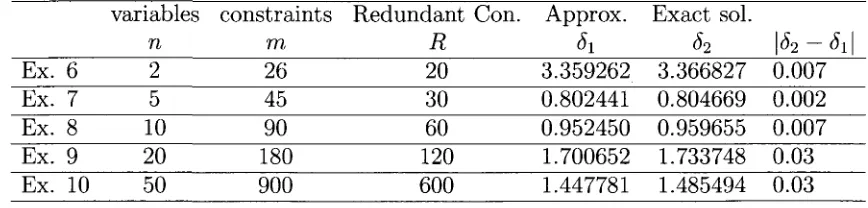
Redundancy sometimes cause the algorithm does not convergence to the optimal
solution. We test our procedure with a set of highly redundant problems. The Second
set contains of five highly redundant problems. The Second set examples solved are
described in table 2. The column R denote minimum number of redundant constraint.
As you can see our procedure can handel highly redundant problems.
TABLE 2. Description of the Second set of examples : Highly redundant problems
Ex. 6 Ex. 7 Ex. 8 Ex. 9 Ex. 10 variables n 2 5 10 20 50 constraints m 26 45 90 180 900 Redundant Con. R 20 30 60 120 600 Approx. Si 3.359262 0.802441 0.952450 1.700652 1.447781 Exact sol.
s
2 3.366827 0.804669 0.959655 1.733748 1.485494|<52-<5i|
CHAPTER 5
Conclusion and Future work
In this thesis we have analyzed Murtys proposed procedure for approximation the
centering step in QP. His procedure is not able to provide a good approximation in the
centering step, since it has difficulties in calculation of stepsize for profitable direction.
We suggested a modification in calculation of stepsize that can improve Murty's
procedure. Also we have introduced a new procedure for the centering step. This
new procedure guarantied the accuracy of the approximation. However the procedure
we proposed still must be improved. Also we discovered some of the properties of the
new centering strategy that Murty introduced. Murty said that sometimes it is not
possible to define the path of centers, but we determined assumptions that the path of
center exists and we proved the uniqueness of center. So we are able to define the path
of center. Further work should be aimed to developed a faster procedure for carrying
out the centering step. From theorem (4.2.1) we know that the optimal solution
always is on the quadratic surface, so new procedure should suggest a approach that
be able to search the surface quadratic to solve (3.1). Another further work that can
be done in this area is to prove that if S —> 0, then x —> x* where x* is optimal
Bibliography
[1] A N D R E W R. C O N N , NICHOLAS I. M. G O U L D , P . L. T. Trust-Region Methods. MPS-SIAM
Series on Optimization, 2000.
[2] C L A U D E J. P . BELISLE, H. E D W I N R O M E I J N , R. L. S. Hit-and-run algorithms for generating
multivariate distributions. Mathematics of Operations Research 18, 2 (May 1993), 255-266.
[3] H. C. P . B E R B E E , C. G. E. B O E N D E R , A. H. G. R. R. C. L. S. R. L. S. J. T. Hit-and-run
algorithms for the identification of nonredundant linear inequalities. Mathematical Programming
3, 2 (June 1987), 184-207.
[4] J. B E S T , M. Equivalence of some quadratic programming algorithms. Mathematical
Program-ming 30 (1984), 71-87.
[5] J. MORE, J., AND SORENSEN, D. C. Computing a trust region step. SI AM Journal on Scientific
and Statistical Computing 3 (1983), 553-572.
[6] MICHAEL J. B E S T , K. R. Quadratic Programming : Active set Analysis and Computer
pro-grams.
[7] M U R T Y , K. G. A new practically efficient interior point method for quadratic programming.
Mathematical Programming and Game Theory for Decision Making 1 (2006), 21-33.
[8] MURTY, K. G. A new practically efficient interior pointmethod for lp. Algorithmic Operations
Research 1 (2006), 3-19.
[9] MURTY, K. G. New sphere methods for linear programs. Tutorial In Operation Research (2009),
62-81.
[10] N. P A T E L , R.L. SMITH, Z. B. Z. Pure adaptive search in monte carlo optimization.
Mathe-matical Programming 43 (1988), 317-328.
[11] SOLIS, F . J., AND W E T S , R. J . - B . Minimization by random search techniques. Mathematics
of Operations Research 6, 1 (February 1981), 10-30.
[12] S.Y. C H E N G , K. M. The steepest descent gravitational method for linear programming.
Dis-crete Applied Mathematics 25, 3 (November 1989), 211-239.
[13] T. L. M O R I N , N. P R A B H U , Z. Z. Complexity of the gravitational method for linear
program-ming. Journal of Optimization Theory and Applications 108, 3 (March 2001), 633-658.
[14] VASILYEVA, V. An analysis of Murtys proposed interior point method for quadratic
program-ming. Master's thesis, University of Windsor, 2008.
[15] ZELDA B. ZABINSKY, R. L. S. Pure adpative search in global optimization. Mathematical
Programming 53, 1-3 (January 1992), 323-338.
[16] ZELDA ZABINSKY, ROBERT SMITH, F . M. E. R. D. K. Improving hit-and-run for global
Vita Auctoris
Mr. Pooyan Shirvani Ghomi was born in 1985 in the city of Tehran, Iran. He
graduated from the K.N.Toosi University of Technology where he obtained a B.Sc. in
Applied Mathematics in 2008. He expects to graduate from the University of Windsor
with a Master of Science degree in Mathematics in Summer 2010.