Comparative Analysis of Different Feature
Extraction Techniques used in Face
Recognition – A Review
Nisha #1, Maitreyee Dutta #2M. E Scholar, Department of ECE, NITTTR, Chandigarh, India#1
Professor, Department of CSE, NITTTR, Chandigarh, India#2
ABSTRACT: Face recognition has received important attention due of its various applications in security, access control, computer entertainment, surveillance, law enforcement and Internet communication. Besides its popularity, face recognition still faces issues on its accuracy. This paper provides an overview of face recognition and its applications in different fields. A literature review of various techniques of the face recognition is presented. In face recognition system, there are many techniques that are used for features extraction such as Independent Component Analysis (ICA), Principal Component Analysis (PCA), Support Vector Machine (SVM), Local Binary Pattern (LBP). Dimensionality is reduced by using the Eigen-faces approach or PCA. Local Binary Pattern (LBP) is a nonparametric descriptor used for extracting the information that is invariant to local gray-scale variations in the images. The aim of this work is to make a comparative study of different face recognition methods. The analysed methods are robust to incorrect alignment, variations in expressions and face occlusions, to a large degree. Local Binary Pattern (LBP) based methods are an outstanding performance in real time operations as well as high recognition rates.
KEYWORDS: Face Recognition, Feature Extraction, Local Binary Pattern, Principal Component Analysis, Support Vector Machine.
I. INTRODUCTION
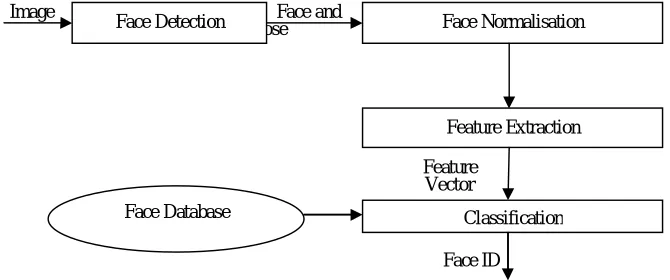
facial expressions, and under-sampling of training face images. Feature selection is of great importance in pattern recognition, data observations, multimedia, remote sensing, machine learning, and data mining applications. Face recognition method consists of three components i.e. face detection, feature extraction and classification are shown in Fig. 1.
Image
Face and pose
Feature Vector
Face ID
Fig. 1 Block diagram of a general face recognition system
Applications of face recognition:- There are many applications of face recognition such as 1. It used for person verification and to check criminal records.
2. It is used to identification documents (Driver’s license, Passports and ID cards) of any person.
3. Used for security purposes such as in airports, government offices, military bases, banking transactions etc. 4. It is used for Multimedia environments with adaptive human computer interfaces, Airplane-boarding gate.
5. Forensic applications, generally a forensic artist is used to draw a sketch of a guilty person with the help of information given by eye witness. With the help of this technique sketch is used to match with different images of criminals in order to find any match [5].
The algorithms that are used for face recognition are Principal component analysis, Independent component analysis [10], Linear discriminant analysis, Genetic Algorithms, Support Vector Machine, Back Propagation Neural Networks. Principal component analysis and linear discriminant analysis both are powerful algorithms used to reduce the dimensionality and extract the features from the image in face recognition technique. The major difference between these two methods is that PCA selects features essential for class representation and LDA selects features that are most helpful for class separability [6]. The major limitations of any face recognition systems are facial aging, pose invariant, lighting conditions, accidental face detection, wearing goggles, specs or another accessories that effect on the results. The rest of the paper consists of Section II summarizes feature extraction techniques. Section III demonstrates the related work in a summary of the literature reviews: Principal Component Analysis, Local Binary Pattern, Support Vector Machine. Section IV represents the comparative study of different techniques and conclusions are made in Section V.
II. FEATURE EXTRACTION TECHNIQUES
The primary stage in any face recognition system is the extraction of the feature matrix. In the face recognition system, the features are extracted such as nose, eyes, mouth and the extracted features are used as an input to an application for recognition. There are various features approaches in image processing that are used to extract the features from an image [7]. A classification on various categories of recognition algorithms are divided into following four categories:
Face Detection Face Normalisation
Feature Extraction
METHODS
Fig. 2 Different Types of Face Recognition Methods
A. Principal Component Analysis (PCA)
In 1991, Turk and Pentland developed one of the most popular method Principal Component Analysis (PCA)
that is used for image recognition with dimensional reduction. With Principal Component Analysis, all the training and test images are projected on to Eigen-space. PCA [3] is a de-correlation technique in statistical signal processing used in pattern recognition. It involves a mathematical procedure to generate principal components. These principal components are generally smaller number of uncorrelated variables obtained by transformation of number of possible correlated variables. A face image is processed to some Eigen-faces which are face templates and a set of features that describe the difference between face images. After obtaining a set of Eigen-faces, a facial image can be rebuilt using a weighted combination of the Eigen faces. Mathematically, Eigen-faces are the eigen-vectors of the covariance matrix, which represents the set of faces or principal components of the faces distribution [8]. However, Principle Component Analysis still has its disadvantages such as improper covariance matrix evaluation and insensitive in capturing variance. It also has problems in dealing with light and expression changes [9].B. Local Binary Pattern (LBP)
The LBP operator method is one of the great performing texture descriptors, introduced by Ojala et al. [11]. It has
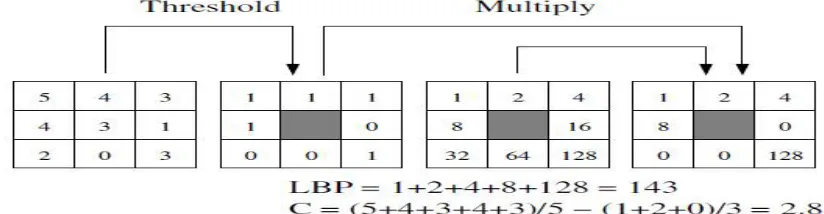
verified to be extremely discriminative and its major advantages such as its invariance to monotonic gray-level changes and computational efficiency [12]. LBP is defined as a gray-scale invariant texture measure and is a helpful tool to form texture images. The original LBP operator labels the pixels of an image by thresholding the 3 x 3 neighborhood of every pixel with the value of the central pixel and represented the results binomially to form a decimal number [13]. The center pixel value for every pixel is compared with 3 x 3 neighborhood eight pixel values using subtraction. These values are coded with binary coding in which negative values are coded into zero and all other values are coded with one and a binary number is generated.LBP code for a center pixel at coordinates (xc,yc) is given as follows:
(1) where gc and gp indicate a pixel intensity of a center pixel and its pth neighbour in the circular neighbourhood of radius
R. Parameter P indicates the total number of neighboring pixels. LBP methodology has been developed with large number of variations such as 1) improvement of its discriminative capability; 2) selection of its neighbourhood; 3) enhancement of its robustness; 4) extension to 3-D data for improved performance in face recognition [14]. LBP method has been used in many applications such as biometric identification, human-computer interfaces, expression analysis, face identification, surveillance etc.
Fig 3. Calculating the original LBP code and a contrast measure
Appearance based Method
Template Matching Method
Feature Invariant Method Knowledge based
III.RELATED WORK
Some of the brief surveys on face recognition analysis which uses different feature extraction methods such as PCA, ICA, LBP, LDP were given. Comprehensive survey of different techniques used for face recognition has been shown in this paper. Ahonen et al. [12] proposed a technique, namely as LBP histogram Fourier features (LBP-HF), to join the Local binary pattern and the discrete Fourier transform. The LBP-HF descriptor is formed by formulating an LBP histogram over the complete area, and afterwards they are constructing rotationally invariant features from the histogram with Discrete Fourier Transform. That means, rotation invariance is described globally and features are therefore invariant to rotations of the entire input signal. Sheela Shankar et al. [15] reviews some of the effective face recognition algorithms as well as proposed an optimized algorithmic chain that gives results optimal classification accuracy and lower execution time. It uses three chains for experimental performance evaluation with the help of AR database. Local binary pattern method used for extracting the features and SVM used as the classifier. Occlusions and expressions on face images can be tackled with portioning process. Number of features selected plays an important role in accuracy, execution time. Hassaballah et al. [2] critically explored the steps involved in face recognition and its various applications in security, surveillance etc. The target of this study is to focus on the most important challenges associated with different face recognition algorithms. The author have investigated the current development in the area of face recognition and discussed the major factors and challenges affecting performance of the system. Possible directions for the research is to improve the performance of system are also proposed. Moreover, this research exhibits the scientific and daily life applications of face recognition technology. Tolba et al. [1] presented a study on various algorithms designed for face recognition system. The main reason of this research is to give latest review of general trend in the research of face recognition area. They also have investigated the strengths and limitations of certain algorithms on specific face database. They have summarized the face recognition vendor test (FRVT) 2002, which describes the conclusion of large scale analysis of automatic face recognition system. In this research, authors have shown a comparative analysis of various research results. Di Huang et al. [14] Represents a detailed study of LBP technique. In this study, it shows that pixel intensity order is preserved in local neighbourhood using LBP operator which is constant to monotonic gray-scale transformations. LBP used for feature extraction for face recognition which consider both texture information as well as shape that are being used to represent face images. This method has been trained with prominent number of variations so that its performance can be improved in various applications. This technique is sensitive to noise. In order to overcome this problem, original LBP is extended with the help of three value codes which is called LTP (Local Ternary Pattern). It is concluded that Local binary pattern is most efficient descriptor to represent local structure but it is affected by noisy, blurred images and severe lighting changes.
IV.COMPARISION OF FEATURE EXTRACTION ALGORITHMS
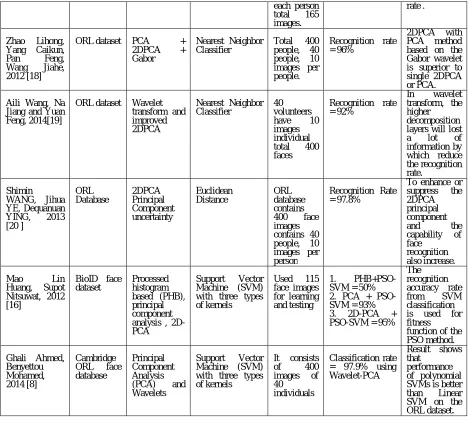
The comparative study of all feature extraction methods that are discussed above in this paper has been shown in tabulated in Table 1.
References Database
Feature Extraction Technique
Classifier Sample size Performance Important
marks
Jain Yang, David Zhang,
2004 [3]
ORL, AR, YALE Face
database
2DPCA Nearest Neighbor Classifier
1. ORL database contain 40 individuals 2. YALE face database contains 165 images.
ORL = 96% AR = 96.1% YALE = 84.24%
2DPCA is better than PCA in terms of recognition accuracy but was not efficient as in terms of storage requirements. Lin Ying, Yuan
Liang, 2011 [17]
YALE face database
Improved Modular 2DPCA
Nearest Neighbor Classifier
It contains 15 person 11 images
Recognition rate = 90.7 %
each person total 165 images.
rate .
Zhao Lihong, Yang Caikun, Pan Feng, Wang Jiahe, 2012 [18]
ORL dataset PCA + 2DPCA + Gabor
Nearest Neighbor Classifier
Total 400 people, 40 people, 10 images per people.
Recognition rate = 96%
2DPCA with PCA method based on the Gabor wavelet is superior to single 2DPCA or PCA. Aili Wang, Na
Jiang and Yuan Feng, 2014[19]
ORL dataset Wavelet transform and improved 2DPCA
Nearest Neighbor Classifier
40 volunteers have 10 images individual total 400 faces
Recognition rate = 92%
In wavelet transform, the higher decomposition layers will lost a lot of information by which reduce the recognition rate.
Shimin WANG, Jihua YE, Dequanuan YING, 2013 [20 ] ORL Database 2DPCA Principal Component uncertainty Euclidean Distance ORL database contains 400 face images contains 40 people, 10 images per person
Recognition Rate = 97.8%
To enhance or suppress the 2DPCA principal component and the capability of face
recognition also increase. Mao Lin
Huang, Supot Nitsuwat, 2012 [16]
BioID face
dataset Processed histogram based (PHB), principal component analysis , 2D-PCA
Support Vector Machine (SVM) with three types of kernels
Used 115 face images for learning and testing
1. PHB+PSO-SVM = 50% 2. PCA + PSO-SVM = 93% 3. 2D-PCA + PSO-SVM = 95%
The recognition accuracy rate from SVM classification is used for fitness function of the PSO method. Ghali Ahmed,
Benyettou Mohamed, 2014 [8]
Cambridge ORL face database
Principal Component Analysis (PCA) and Wavelets
Support Vector Machine (SVM) with three types of kernels
It consists of 400 images of 40
individuals
Classification rate = 97.9% using Wavelet-PCA
Result shows that
performance of polynomial SVMs is better than Linear SVM on the ORL dataset.
Table 1. A Summary of some face recognition system based on Different algorithm
V. CONCLUSION
improvements can be made in terms of training for achieving better generalization. LBP based methods are an outstanding descriptors if we need real-time processes as well as greater recognition rates.
REFERENCES
[1]. A. S. Tolba, A. H. El-Baz, and A. A. El-Harby, “ Face Recognition: A Literature Review”, International Journal of Computer, Electrical, Automation, Control and Information Engineering, Vol.2, No. 7, pp. 2556-2571, 2008.
[2]. M. Hassaballah and Saleh Aly, “Face Recognition: Challenges, Achievements and Future Directions”, IET Journals of Computer Vision, Vol.9, No.4, pp. 614-626, 2015.
[3]. Jian Yang, David Zhang and Jing-yu Yang, “ Two-Dimensional PCA: A New Approach to Appearance-Based Face Representation and Recognition”, IEEE Transactions on Pattern Analysis and Machine Intelligence, Vol. 26, No.1, Jan 2004.
[4]. V. N. Vapnik, “ Statistical learning theory ”, John Wiley & Sons, New York, 1998.
[5]. Brendan Klare, Zhifeng Li and Anil K. Jain, “ Matching forensic sketches to mug shot photos”, IEEE Transactions On Pattern Analysis and Machine Intelligence, Vol. 33, No. 3, pp. 639-646, Mar. 2011.
[6]. Gurpreet Kaur and Navdeep Kanwal, “ A Comparative Review of Various Approaches for Feature Extraction in Face Recognition”, IEEE International Conference on Computing for Sustainable Global Development , pp. 2705-2710, 2016.
[7]. Sanjeev Dhawan, Himanshu Dogra, “ Feature Extraction Technique for Face Recognition”, International Journal of Engineering, Business and Enterprise Applications, Vol. 2, No. 1, pp. 1-4, Aug 2012.
[8]. Ghali Ahmed, and Benyettou Mohamed, “Improving the Recognition of Faces Using PCA and SVM Optimized by DWT”, International Journal of Computer Applications, Vol. 107, No. 17, pp., Dec. 2014.
[9]. M Hakeem Selamat and Helmi Md Rais, “ Enhancement on Image Face Recognition Using Hybrid Multiclass SVM (HM-SVM)”, 3rd International Conference on Computer and Information Sciences, pp. 424-429, Aug 2016.
[10]. Keun-Chang Kwak and Witold Pedrycz, “ Face Recognition Using an Enhanced Independent Component Analysis Approach”, IEEE Transactions on Neural Networks, Vol. 18, No. 2, pp. 530-541, Mar 2007.
[11]. T. Ojala, M. Pietikainen, and T. Maenpaa, “ Multiresolution Gray-Scale and Rotation Invariant Texture Classification with Local Binary Patterns”, IEEE Transactions on Pattern Analysis and Machine Intelligence, Vol. 24, No. 7, pp. 971-987, July 2002.
[12]. T. Ahonen, A. Hadid, and M. Pietikainen, “ Face Description with Local Binary Patterns: Application to Face Recognition”, IEEE Transactions on Pattern Analysis and Machine Intelligence, Vol.28, No. 12, pp. 2037-2041, Dec. 2006.
[13]. B. Zhang, Y. Gao, S. Zhao and J. Liu, “ Local Derivative Pattern Versus Local Binary Pattern: Face Recognition with High-Order Local Pattern Descriptor”, IEEE Transaction On Image Processing, Vol. 19, No.2, pp. 533-544, Feb. 2010.
[14]. Di Huang, Caifeng Shan, Mohsen Ardabilian, Yunhong Wang, and Liming Chen, “Local Binary Patterns and Its Application to Facial Image Analysis: A Survey ”, IEEE Transactions On Systems, Man and Cybernetics, Vol. 41, No. 6, pp. 765-781, Nov. 2011.
[15]. Sheela Shankar, and V.R. Udupi, “ Recognition of Faces- An Optimized Algorithmic Chain”, ELSEVIER, International Multi-Conference on Information Processing, Vol. 89, pp. 597-606, 2016.
[16]. Mao Lin Huang, Sompong Valuvanathorn, and Supot Nitsuwat, “Multi-Feature Face Recognition based on PSO-SVM”, International Conference on ICT and Knowledge Engineering, pp. 140-145, 2012.
[17]. Lin Ying, Yuan Liang, “ A Human Face Recognition Method by Improved Modular 2DPCA”, IEEE International Symposium on IT in Medicine and Education, pp. 7-11, Jan 2012.
[18]. Zhao Lihong, Yang Caikum, Pan Feng, Wang Jiahe, “ Face Recognition Based on Gabor with 2DPCA and PCA”, IEEE Conference on Chinese control and decision, pp. 2632-2635, July 2012.
[19]. Aili Wang, NA Jiang and Yuan Feng, “ Face Recognition Based on Wavelet Transform and Improved 2DPCA”, IEEE International Conference on Instrumentation and Measurement, Computer, Communication and Control, pp. 616-619, Dec 2014.
[20]. Shimin Wang, Jihua Ye, Dequan Ying, “ Research of 2DPCA Principal Component Uncertainty in Face Recognition”, IEEE International Conference on Computer Science & Education, pp. 159-162, July 2013.
BIOGRAPHY
Miss Nisha: Miss Nisha is currently working as an Assistant Professor in SSIET, Derabassi, India since 2014. She is currently pursuing M.E (modular) National Institute of Technical Teachers Training and Research (NITTTR) Chandigarh, India. She has completed her B.Tech from SSIET, Derabassi. She is having 3.5 years of teaching experience.
Maitreyee Dutta is working as a Professor in the Computer Science and Engineering Department at NITTTR,
Chandigarh, India. She has a Ph.D. with specialization in Image Processingand M.E. in ECE fromPanjab University,