The Performance Analysis of Network Lifetime
Improvement in Wireless Sensor Network
Priyanka Balasaheb Kolhe1,Prof.Mahesh Kadam2
M.E Student, Department of Electronics and Telecommunication, Mumbai University, Mumbai,
Kalyan (Mumbai), India1
Assistance Professor, Department of Electronics and Telecommunication, Mumbai University, Mumbai, Nerul (Navi
Mumbai), India2
ABSTRACT: In wireless Sensor Network ,recently there has being advance technology in micro manufacturing technology which gives us low cost and low power required for doing the multiple function of sensor nodes. These wireless sensor network technique is used in various field such as surveillance battlefield, environmental monitoring etc.In this paper we will discuss how the transmission range of sensor node will be adaptively adjust to increase the lifetime of the node by using the EASR method along the MCP(Maximum Capacity path) technique.
KEYWORDS: EnergyAware Routing ,Mobile Sink ,Sink Relocation , Wireless Sensor Network
I. INTRODUCTION
In wireless Sensor Network the sensor devices are small sized consisting of limited battery power. when this sensor are placed fire in the sensing field it will sense the abnormal event (e.g. fire in the forest) or it can also used for the measuring the temperature or humidity of the environment .In the sensor node the detection process is done with the help of hop by hop technique by using a special node named as a sink node. The sink node will give the information to the supervisor by using internet.
In WSN the recharged or replaced of the battery is not possible because of sensory environment condition due to this reason, the power in batteries can be drain which can cause many problem such as communication hole problem or increasing coverage hole etch power consumption so several method are there to increase the battery life designing which can balance the power consumption or will increase the lifetime of the sensor by using the mobile sink. In this paper sink relocating scheme is used also have compare some traditional method with EASR method as routing method. The routing method is basically of two types static routing and dynamic routing .In static routing the path is fixed, it will work same in any condition and will not adjusting itself according to the various conditions. In dynamic routing the path is not fixed it will automatically adjust itself according to the input and will try to conserve the battery energy. So my comparing static routing and dynamic routing, the dynamic routing is more energy conserve as it adjust itself by conserving the power of battery.
There are some various approach used in mobile sensor so that we can adjust their region along their location from high level to low level. We have propose scheme named as sink relocation so that it can give information to the sink where to move to increase the battery of the sensor so that the lifetime will be increase some simulation have been conducted by using the EASR method which give us more network lifetime by doing comparison of different scenario we have been concluded that EASR method perform better as compared to other.
II.RELATEDWORK
power so consumption of power is there in the sleep node which creates the decrement in lifetime of the node. Also Luo and Hubaux have proposed (JMR) joint sink mobility and routing strategy for collection of data in a WSN.L.Sun ,Y.Bi and J.MA have proposed autonomous sink movement schemes, here the sink itself will be able to collect the related information of the nearby sensor nodes and will control the sink where to move so that it will control the sink relocation and will increase the lifetime of time of the WSN network.Y.Sun,L.sun,W.Huagfu and Y.Bin have proposed autonomous sink basically two type named as One-Step moving scheme and Multistep moving schemes so that it will also help to relocate the sink position and will try to increases the lifetime of the WSN network .
III.PROPOSED ALGORITHM
In this paper we are using the method EASR,the energy aware transmission range, if it sense that the battery energy is getting low at that time it will automatically tune the transmission range for small range so that the energy will be save and increase the lifetime of node. For this process it use the technique MCP raised the technique MCP routing putting protocol.
MCP uses dynamic roses dynamic routing .This routing consist of three step, the first step to layered a graph then the second step is to define the maximum capacity path for each sensor node and the last step is to perform the routing and residual energy is updated.The block diagram is as follows
.
Workload is high
Workload is normal Node 1-100
Source and destination pair are fixed
Found data transmission to send packet Sink node generated Verifying heavy workload node Check
Sink move near the node and find alternate node Encrypt data packet Forward the packet Destinate ion node receive the packet and start the decryption
In this WSNs network we have consider node for e.g. 1-100 nodes, in the above block diagram. The initial step is to fixed the source and destination then the source is considered as the place from where the message is being transmitted and destination is a place where we have to send the signal or message after initialising the source and destination ,the system find the Data transmission region to send the packet ,the next process is finding the transmission region the sink node is generated ,after this there is a verification process, verification involves about the workload is determine whether the work load is high or normal.
If the workload is found to be heavy then sink start relocating and it moves near to node and start finding the alternate node so this process goes on repeating till it find the alternate node which uses less energy as compared to others .If the workload is nominal then it start encrypting the data ,the encryption is a process in which the message is encoded in such a way that the only authorized parties will be able to read it .The encrypted data will prevent the message not to be read by an any unauthorized purpose so it is only used for the security purpose. For encryption purpose ,the encryption key is used there are various type of encryption key such as symmetric key ,encryption key ,public key. So that unauthorized party will be excluded .in this way the unauthorized party will not be able to read the encrypted information.
IV.SIMULATION RESULT
To implement this program we are using NS2 (Network simulator).It consist of two language named as It consist of two language named as C++ and OTCL. To increase the efficiency of simulation the detail of protocol it provided it uses the tcl component. OTCL is an object oriented language.
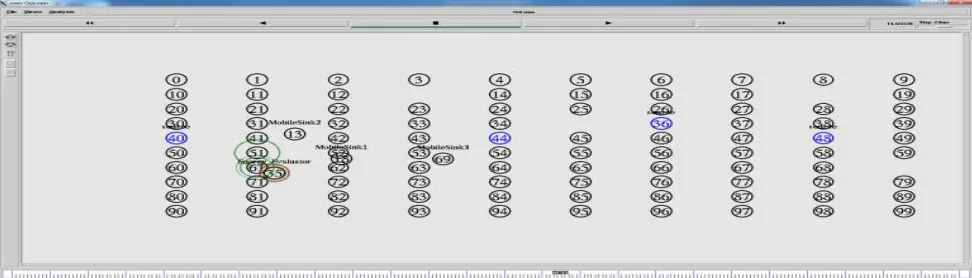
In this snapshot we have considered 100 nodes which will synchronize with each other to transmit or receive .
Fig 3Synchronisation is being process
In the above figure we can se the blue colour node are the sources i.e. node 40,44,36,48 are source node the mobile sink will receive the signal and will transmit to other node which require the information and also try to detect the abnormal event
Fig 4 The abnormal event 25 is being detected
REFERENCES
[1] G. S. Sara and D. Sridharan, “Routing in mobile wireless sensor network: A survey,” Telecomm. Syst., Aug. 2013.
[2] I. F. Akyildiz, W. Su, Y. Sankarasubramaniam, and E. Cayiric, “Wireless sensor networks: A survey,” Comput. Netw. vol. 38, no. 4, pp. 393– 422, Mar. 2002.
[3] Flavio Fabbri, Janne Riihijarvi, Chiara Buratti, Roberto Verdone and Petri Mahonen “Area Throughput and Energy Consumption for Clustered Wireless Sensor Networks” In IEEE Communications Society WCNC 2009 proceedings.
[4] C.-E CXliasserini and M. Garetto “Modeling the Performance of Wireless Sensor Networks” IEEE 2004.
[5]Fatma Bouabdallah, Nizar Bouabdallah, Raouf Boutaba. “On Balancing Energy Consumption in Wireless Sensor Networks” In IEEE Transactions on Vehicular Technology, Vol 58, No 6, 2009, pp 2909-2924.
BIOGRAPHY
Priyanka Balasaheb Kolheis a student of M.E in the ARMIET College (Sapgoan) in the department of Electronics and Telecommunication. She receive the Bachelor degree from KGCE College (Karjat),live in Kalyan,Maharashtra,INDIA