Abstract
MILLER, STUART ROBERT. DYNAMIC PROGRAMMING BASED APPROACH
TO SCHEDULING IN THE FIBER OPTIC CABLE INDUSTRY. (Under the direction
of Thom Hodgson, Steven Jackson, and, Russell King)
The purpose of this research has been to develop a scheduling tool for use in the
fiber optic cable industry by using a modified dynamic programming partition
problem or stock cutting problem based approach. Modifications include a
restructuring of the partition type matrix by ranking weights in descending, rather
than traditional ascending order, and a loosening of the criterion for optimality. The
application of this work would be to reduce the number of setups needed in an
early manufacturing phase by determining orders that can be combined together to
be manufactured in continuous runs. Any combinations that are decided upon must
be made in the context of the needs of complex downstream processes and
attributes of the physical system restrict the maximum length of any combination of
orders. The solution to this problem is a program, which has been developed in a
VB and FORTRAN environment, to automate the exploration of possible decisions.
Results obtained garner an overall 25% reduction in setup requirements compared
Biography
Stuart R. Miller was born and raised in upstate New York in the Elmira-Corning
area. He enlisted in the United States Navy in 1990 and served four years as an
active serviceman in the area of aviation supply and logistics. In 1994 he returned
to Corning Community College to complete his Associate of Science degree in
1995.
Since then, he moved down to North Carolina to pursue a Bachelor’s degree in
Industrial Engineering at North Carolina State University in Raleigh. He achieved
his goal in May of 2002, graduating Magna Cum Laude. He is a current member of
the Institute of Industrial Engineers and of Alpha Pi Mu, the honor fraternity of
industrial engineering, and is also a certified engineering intern.
During his time at school, he entered the cooperative education program and
worked with Corning Cable Systems, Winston Salem in work analysis and design
efforts during his first term. During his second term, he became involved in point of
use storage design and implementation in support of lean initiatives at the Winston
Stuart has taken advantage of an accelerated Master’s program offered through
the department of Industrial Engineering and seeks graduation in May 2003 with
Acknowledgements
I would like to thank Dr. Russell E. King for his open door policy, approachability,
and guidance throughout my educational endeavors. I would also like to thank Dr.
Steven D. Jackson for his insight into previous work done with Corning Cable
Systems scheduling and his assistance with a critical piece of Visual Basic code. I
would like to thank Reuben Cannon of Corning Cable for his help in defining the
system and providing the necessary data to be able to approach the problem.
Finally, I would like to thank Dr. Thom Hodgson as co-programmer and for his
Table of Contents
Index of Tables ... vi
Index of Figures ...vii
Introduction ... 2
Previous Work... 2
Manufacturing Phases ... 2
Overview ... 2
Fiber Receiving and Storage: Fiber Chamber ... 3
Coloring... 4
Buffering... 6
In-Process Testing ... 8
Extra Fiber Length Testing: EFL Testing... 9
Stranding... 9
Jacketing ... 12
Final Test ... 13
Cable Illustrations... 15
The Problem ... 18
Mathematical Modeling ... 22
Solution... 30
VB Program Outline ... 31
Fortran Program Outline... 32
Approximation ... 35
Results... 36
High Volume Scenario... 37
Lower Volume Scenario ... 38
Impact ... 40
Future Work ... 41
References ... 43
Appendices ... 44
FORTRAN Code ... 45
Index of Tables
Table 1: Industry Standard Colors ...5
Table 2: Example Matrix Partition ...25
Table 3: High Volume Order Comparison ...37
Index of Figures
Figure 1: Cross Sectional View Single Layer ...15
Figure 2: Cross Sectional View, Dual Layer...16
Figure 3: Layered View, Single Layer ...17
Figure 4: Breakdown Processing Schematic ...20
Introduction
The manufacture of fiber optic cable at Corning Cable Systems, Winston-Salem is
a multistage process that aggregates components into subunits and then
aggregates these subunits into a finished cable. Each stage of this complex
manufacturing process requires a number of setups to complete the required tasks.
This paper describes a method that may be undertaken which will reduce the
number of setups by advantageously combining orders at one of the earliest
manufacturing stages known as Buffering. This method must take into account all
stages of the manufacturing process before determining which orders should be
combined. Combined orders, or combos, will yield a benefit not only in the
Buffering department, but also in each of the subsequent manufacturing steps.
Previous Work
The problem of combining tube orders was approached by Anand Kosur, (2001) by
using a single-pass heuristic that looked at orders within eligible subsets and
ranked them in non-decreasing order by the number of tubes. Orders were then
the creation of a new combo, beginning with the order that exceeded the length
constraint. Opportunity for further optimization was missed because of the
single-pass nature of this heuristic. The approach taken here is to use dynamic
programming to determine the optimal way that orders should be combined.
Manufacturing Phases
Overview
The production of finished fiber optic cable is performed in several stages.
Individual fibers are colored and then grouped into tubes. Tubes are grouped
together to form a core that is then surrounded by layers of protective materials.
The overall process resembles a tree in nature with individual fibers as the leaves,
tubes as branches, and finally the core and protective materials represented by the
trunk of the tree. Any solution intended to group orders together into combos must
take into account the entire manufacturing process in order for it to be effective.
Fiber Receiving and Storage: Fiber Chamber
Optical fiber is the highest cost of the components that are part of a fiber optic
cable. As such, the on hand inventory is closely monitored for length, type, and
color of fiber in order to best allocate supply to demand. The Fiber Chamber
personnel, with direction from the Scheduling Department, perform this inventory
management.
The Fiber Chamber is the storage area for the on-hand inventory of optical fiber. In
general there are three groups of fiber stored within the chamber; new fiber, partial
spools of colored fiber, and partial spools of natural fiber. The difference between
these types lies in the amount of processing that the fiber has undergone.
New fiber consists of full spools that have been received from outside vendors or
from other divisions of Corning Incorporated. The length of new fiber is dependent
on vendor and fiber type but is mainly in 25,000-meter or 50,000-meter lengths
when received. New spools are logged electronically into a database and
physically stored in the Fiber Chamber for later retrieval to meet demand.
Partial spools of colored fiber are the remnants or scrap from previous orders. The
is returned to the Fiber Chamber to be returned to inventory to await future usage.
First, the updated length of the fiber is determined. Then, the new length and the
color are annotated in the database, and finally the fiber spool is physically stored
in the chamber.
Similarly, partial spools of natural fiber are those that have been previously
released to the manufacturing floor but then are returned without having been
colored. This is usually a result of a fiber break in the coloring process. Again, the
updated length is determined and the new information is entered in the database
prior to physical storage.
Coloring
Many constructions of fiber optic cable are designed in such a way that several
fibers will pass through a tight area such as an electrical duct. In order to facilitate
individual fiber identification, natural fiber undergoes a coloring process to make it
visually distinct from other nearby fibers. Additionally, coloring is done to provide an
opaque barrier from external light sources in order to preserve signal integrity.
The construction of ALTOStm fiber optic cable provides for the grouping of as many
may be applied to the outside of a fiber in the coloring chamber. These colors are
considered an industry standard and are as follows.
Table 1: Industry Standard Colors
1 Blue 7 Red
2 Orange 8 Black
3 Green 9 Yellow
4 Brown 10 Violet
5 Slate 11 Rose
6 White 12 Aqua
The coloring process is performed on high-speed machines that spool off the fiber
into a bath of colored acetate that is then baked onto the fiber with an ultraviolet
lamp. Occasionally it occurs that a fiber breaks during this process. In that event,
the pieces are then examined to determine if the colored length is enough to meet
any outstanding current orders, and if it does, the spool is released to the floor for
use in manufacturing. The remaining fiber that has not been colored, may at this
point, be returned to the fiber chamber for processing or colored for release to the
floor. This decision is dependent on length remaining on the spool and the length
All of the fibers that go into the manufacture of an individual tube are processed in
the Coloring department before they are released to the Buffering department. A
kanban program in pursuit of lean manufacturing governs the release of orders.
Buffering
The Buffering department manufactures the individual tubes that protect groups of
fibers. A group of fibers may be a single colored fiber or as many as 12 colored
fibers. The number of fibers in a group is specified by customer preference.
Groups of fibers pass through an extrusion process of polypropylene that
surrounds the fibers with the protective tube. The fibers are threaded through an
extruder crosshead where melted plastic is applied to the fibers in the form of a
tube. Immediately after passing through the crosshead, the tube then passes
through a water bath to cool the plastic into a semi-hard but flexible form. The
cross sectional diameter of this tube is constant regardless of the number of fibers
contained within and is continuously monitored for conformity using optical
measuring devices. A gel is added during the extrusion process that fills in any
extra area to act as a cushion from impact from outside the tube such as that
encountered during cable installation. The gel is also used to facilitate sliding of
Much like Coloring, tubes are manufactured in the standard colors cited in the
description of the Coloring department to facilitate individual identification of fibers.
However, since some cables require more than 12 tubes in their makeup, individual
colors may be augmented with a stripe, such as a blue tube with a black stripe or a
black tube with a white stripe. With this scheme, the Buffering department is able to
produce 24 uniquely colored tubes.
Individual tubes are taken up after the extrusion and cooling process into pans.
These pans are roughly large bowls 5 feet across and 1 foot deep. The center of
the pan is filled and cannot be used in the collection of the tube. Therefore the
actual storage area for the tube looks like half of a toroid. The pans have a limited
capacity in space for tube collection, which is approximately 13,000 meters. This
forms a constraint for the length of cable that may be manufactured in a single
stretch.
Because fiber lengths can be longer than 13,000 meters, it is sometimes possible
to produce several tubes from the same batch of fiber spools. After the production
of each order, the pan is removed from the take-up and replaced with an empty
pan. Movement of full pans requires the use of powered walkie stackers or platform
All tubes required for an order are grouped together in large carts before being sent
to in process testing. Because of the space required to assemble these tubes for a
single order, manufacturing efforts here are controlled under a kanban program to
manage work in process.
In-Process Testing
As a cable passes through individual manufacturing stages, more and more
investment in material is added to the construction of the cable. The In-Process
Testing department’s goal is to identify manufacturing deficiencies before the
further addition of these costs.
After a complete order has passed through the Buffering department, it is then
passed to the In-Process Testing personnel. Each fiber is tested to ensure no
breakage has occurred and that attenuation levels are still within process
specifications. If any individual fiber is found to be defective, the entire tube must
be processed for reject procedures which involves the location of the defect and
then determining where the tube should be cut to salvage as much good product
as possible. When an individual tube has been manufactured to meet the demand
of several orders, this cut will be done in such a way to meet as many of the order’s
Extra Fiber Length Testing: EFL Testing
The manufacture of a buffer tube requires the fiber to undergo a heating process
through extrusion and then a rapid quench to solidify the tube. Because of the
vagaries of the temperatures experienced during this process, fiber may expand or
contract in length. The EFL test is done to determine if this length variation is within
product tolerance.
EFL testing is performed once or twice a shift on each line that is manufacturing
product. To determine the amount of length deviation that has occurred, a sample
of product, 20 meters in length, is cut from one end of the tube. Individual fibers are
measured against this length and a determination of quality is made. Failure at this
stage necessitates scrap or salvage procedures.
Stranding
Once all the necessary tubes have been manufactured and passed EFL and
In-Process testing, they are grouped together in the Stranding department to form the
core of the fiber optic cable. The particular configuration of the stranding process is
dependent on cable requirements specified by the customer’s individual order. A
The innermost component of a Stranding core is the central strength member,
made from steel or a polyresin material, which adds tensile strength to the cable.
To avoid unwanted stresses on the fiber, the central member is used to pull the
finished cable through ductwork or over telephone poles. Central member stock
comes in 2 cross sectional sizes and may also have a layer of polyethylene
extruded around it to make it larger in diameter for geometrical fit purposes. This is
dependent on the number of tubes required for the order. Additionally, one or more
water swelling yarns are run along the central member.
The tubes required for the order are wrapped around the central member in an
oscillating pattern. The tubes are twisted around the central member in a clockwise
helical pattern for a number of turns and then the pattern is reversed into a
counter-clockwise helical patter. This is to allow the slack necessary to connect fibers to
switching components or signal repeaters.
At minimum, 5 tubes are used in the stranding process. If an order has
requirements for less than 5 tubes, filler tubes, which are empty natural colored
tubes, are used to occupy the extra tube spaces. Filler tubes may also be used to
complete the geometrical requirements of a core construction for higher fiber count
The tubes may then be covered with a water swelling tape that acts as protecting
agent from water entering breaches in the cable that may have occurred during or
after installation. When the water tries to penetrate the breach in the cable, the
tape absorbs the moisture and then swells to fill in the breach to cut off any more
water from entering. Finally, around the outside of the tubes and the water tape, if it
was applied during this process, are strands of yarn that wrap around the cable in
crossing, helical patterns which hold the tubes together and hold the water swelling
tape in place.
Some customers will ask for a special printing process to be added to the outside
of the finished cable that will identifies the location of the change in direction of the
oscillating tube twist pattern. The cables, called switchback cables, do not have the
water swelling tape applied during the Stranding process. Instead, the Jacketing
department uses a special optical detector to locate the switchback area before
applying the tape and coordinates its location with a print mark applied later in the
manufacturing process.
All Stranding orders are taken up on cable reels and then moved, to the Jacketing
Kanban area, with material handling equipment. If a kanban is full, a Stranding line
Jacketing
The final step that a cable undergoes is the jacketing process. In this stage,
materials added to the outside of the core that are designed to protect from outside
stresses and weather. The number of layers required for each cable is dependent
on customer specification of cable type.
Around each stranded core are added anywhere from 2 to 30 high tensile strength
strands of yarn. These yarns may be made of Kevlar or fiberglass, depending on
cable construction requirements. The yarns are wrapped around the cable in a
twisting pattern. If an order requires a switchback print mark, water tape is added
at the same time as the yarns after it has passed the switchback detector.
Some cables, used in outdoor applications, require a layer of corrugated steel to be
folded around the core. This protects the cable from more rigorous stresses
encountered outside as well as breaches in the cable from animals chewing on the
cables. Within the armor sheath two high strength cords are added that are
designed to allow the armor to be opened down the long axis of the cable when
they are pulled. This is much like opening a pack of gum using a pull string.
Around the outside, of the core and armor, an extruded layer of polyethylene is
stripes for the outside of the cable, which are added as part of the extrusion
process. Like Buffering, the cable passes through the crosshead attached to an
extruder and then the material enters a rapid water quench for solidification after
which the size and ovality of the cable cross-section are monitored. The cable may
then have lettering, or print applied to the outside of the cable for identification
purposes. These, typically, are customer names and units of measure for length, in
feet or meters of cable.
The cable is then taken up on another reel and may then pass through Jacketing
again for more layers of armor and polyethylene. Some cables may require as
many as 4 passes through Jacketing before being fully manufactured. Next to the
fiber itself, the Jacketing process is the most costly material stage per unit of
length.
Final Test
A cable that has been completed is then fully tested to determine if it meets
specifications. Any deviations discovered during these tests require some form of
Several different types of tests and quality checks are done. These include
verification of print information, a water penetration test, and a re-test of each
individual fiber contained in the cable.
Cables that fail any part of the testing process may have some form of rework done
such as reprinting or may require complete re-manufacturing. Efforts are made to
salvage as many sub-components as possible to defray reject costs. In some
cases, entire orders are saved, as is, to await a possible match with a future order.
Cables that pass Final Test are then moved to the packaging department to await
preparation procedures for shipment to the customer. This includes: separating
orders, re-spooling onto shipping reels, and the addition of protective shipping
Cable Illustrations
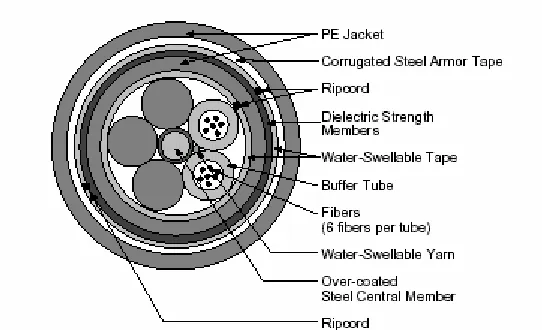
The following figure represents a cross section of a finished cable. The illustration
shown is of an armored cable with a total of twelve fibers. The fibers are grouped
into two tubes, six fibers each. Filler tubes have been used to occupy unused tube
spaces. This is a single layer cable.
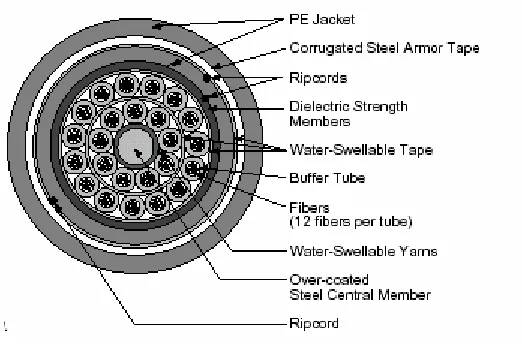
The following figure is a dual layer cable. This means that it has passed through
the Stranding department two times before being sent on to the Jacketing
department. The first pass is to assemble the inner layer of the core and the
second pass is to add the outer layer of tubes.
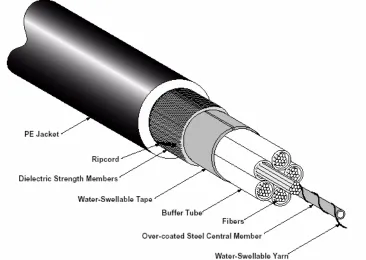
The following figure is an angled view of a single layer, five tube, and non-armored
cable.
The Problem
Any particular cable that is ordered requires a large number of setups in its
manufacture. Fiber components need one setup each in the Coloring department.
Each tube requires a setup for the tube and a setup for each fiber within that tube
in the Buffering department. Each fiber of each tube is then tested which requires a
setup for the tube and a setup for each fiber at the In-Process Testing department.
Cores need a setup for the core and a setup for each tube within each core in the
Stranding department. A setup is done for each pass through the Jacketing
department on each cable. Each setup that is performed throughout the
manufacturing process represents a loss of time and capacity.
The main purpose of this work is to determine the best way to combine orders in
the Buffering department to reduce setup requirements throughout the rest of the
manufacturing processes. Because of the nature of the required manufacturing
steps for any particular cable, combos that are made must take into account
requirements throughout the whole manufacturing process to capitalize on setup
savings. Additionally, because of raw material issues, the length of any combos
orders must be less than or equal to 13,000 meters. To accomplish this, several
First, cable orders must be divided in to groups called families. These families are
sets of orders that are identical in makeup, except for length and print. This must
be done because of the continuous nature of the extrusion process in Jacketing.
That is, once a run is started, the setup configuration cannot be changed until the
order(s) is (are) finished.
Second, within each family, smaller groups of orders, called subfamilies, must be
identified. A group of orders within a subfamily shares the same requirements from
the Jacketing perspective since they are taken from the same family. In addition, a
subfamily is composed of orders that share “equivalent” tube layouts. That is, both
tubes must be of the same diameter, the same color, and have the same number
of fibers within. Since some orders use filler tubes as a placeholder for lower tube
count orders, a filler tube may be considered equivalent to any other tube.
As an example, suppose there are two orders with five position cores. The first
order requires five tubes and the second only requires four tubes. The 5th position on the second order will be a filler tube. That filler tube is considered to be
equivalent to the 5th tube on the first order. Those cores may then be combined into one long order, provided the other four tubes are identical and that the sum of their
Third and finally, within each subfamily, combinations of orders must be explored to
determine the best possible way to meet order requirements while minimizing the
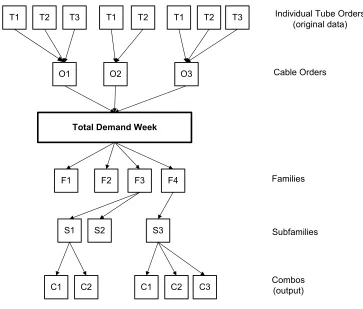
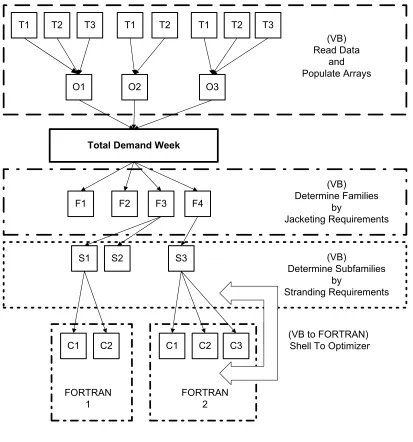
number of setups needed. An abbreviated schematic representation of the problem
has been included below.
T1 T2 T3 T1 T2 T1 T2 T3
O2 O3
O1
Total Demand Week
F1 F2 F3 F4
S1 S2 S3
C1 C2 C1 C2 C3
Individual Tube Orders (original data)
Cable Orders
Families
Subfamilies
Combos (output)
The figure above is a representation of the breakdown of processes that must be
performed on the data. Any real instance of data would entail thousands of tube
orders instead of the handful that are represented here. This is presented only as a
means to visually represent the transition between data processing stages.
At the top of the diagram are the raw, individual tube orders. Groups of these tubes
together are part of individual cable entries, which are represented with the second
row of boxes. The entire group of these cables makes up the total demand for a
manufacturing week. This group is then sorted into groups that share similar
manufacturing requirements in the Jacketing department, called families. Each
family is then further divided into subfamilies based on tube configuration, which is
important in the Stranding department. Finally within each subfamily, we will
explore combinations of orders in an effort to reduce setup requirements.
In summary, families are groups of orders with identical Jacketing department
requirements. Subfamilies are groups with identical requirements in the Stranding
department. Since we will only explore combinations for the Buffering department
within each subfamily individually, we have taken into account the manufacturing
Mathematical Modeling
To reduce setup requirements, orders should be combined wherever possible. In
other words, the number of individual combos, and therefore setups, created
should be minimized. To accomplish this as many orders as possible should be
grouped into combos. Those combos, however, must be restricted in length to a
maximum of 13,000 meters.
Let wi be the length of the ith order
N be the total number of orders that must be manufactured
W be the sum of the lengths of all N orders
Xij be 1 if order i is in combo j; 0 otherwise
J be the total number of combos created
L be the maximum length of a combo; 13,000 meters
The order of complexity for determining the best possible combo from N orders
with complete enumeration is O(2N) which represents the sum of all 1-order
combinations, 2-order combinations, 3-order, etc. up to N-order combinations. This
must be done at least W / L times for each subfamily. Because the number of
One basic formulation of this problem in the context of dynamic programming is as
a value independent linear knapsack problem or stock cutting problem. A stock
cutting problem may be stated as an integer linear program as follows.
j x L x w t s x w j n j j j n j j j ∀ = ≤
∑
∑
= = 1 , 0 . . max 1 1where: wi is the length of the ith order, L is the maximum allowable combo length,
and Xi is 1 if the ith order is used and 0 otherwise.
The traditional dynamic programming approach to a knapsack problem is to form
ratios of weight to volume or in this case weight to length. The items are then
selected in decreasing ratio order as long as is feasible. However, in this case,
because the ratios are identical for all orders, there is no clear distinction between
To overcome this difficulty, we elect to partition the problem as a series of modified
dynamic programming problems. Before introducing the modifications necessary
for this particular setting, the traditional partition problem formulation is explained.
As an example consider a 2-partition problem to determine whether a subset of
orders exists such that the sum of the weights of the subset is equal to exactly one
half the sum of the weights of the entire set of orders. The traditional formulation is
a true-false matrix where 1 indicates true and 0 indicates false.
Given a set of n orders
let:
Wi be the weight of the ith order
B equal the total weight of all n orders
L be half the weight of B: L = B/2 = B/n
k designate the index
v(i,k) = 1 if the subset sum equals k, 0 otherwise
To build the partition matrix, weights are ranked in non-decreasing order. The
iteration is initiated with
=
=
otherwise 0
w k if 1 k)
That is the first row of the matrix has a single non-zero entry in column k = w1. The
second row is created with the use of the following equation.
v(2,k) = max{ v(1,k-w2), v(1,k),v(2,w2)=1}
The second row consists of 1’s at k = w2, anyplace that 1’s exist in the row above,
in this case w1, and also w2 units positive offset from the 1’s in the previous row.
As a small example, assume w1 = 2 and w2 = 3. Then in row 1 the matrix is all 0’s
except column k = 2. In row 2, all entries will be zero except k = w2 = 3, or
wherever there is a 1 in the row above, in this case 2, and also offset from that
column 3 units, the weight of w2, to 5. These results are shown in tabular form.
Table 2: Example Matrix Partition
k 1 2 3 4 5 w1 = 2 1
w2 = 3 1 1 1
v(i,k) = max{ v(i-1,k-wi), v(i-1,k), v(i,wi)=1}
The procedure will terminate in one of two ways. If v(i,L) = 1 for any i then there
exists a partition. If v(i,L) = 0 ∀ i then no subset exists in which the sum of the
weights equals one half the sum of the entire set’s weights, i.e. no partition exists.
For the problem in this particular setting we are not interested in merely the
existence of a subset comprising half the total weight of the orders. Rather, we are
interested in finding subsets in which the sum of its weights is as close as possible
to L. As an integer linear program, the problem may be stated as follows:
j i x x L x w t s J ij J j ij n j ij i , 1 , 0 1 . . min 1 1 ∀ = = ≤
∑
∑
= =We wish to minimize the number of combos that are created, indicated by J. Any
meters. Any particular order must be assigned to a combo and may only be
assigned to a single combo. With this objective in mind, we can now introduce the
modifications to the traditional partition problem that are needed for our problem.
First we begin by forming subsets in the same manner as a partition problem
except we accumulate lengths in decreasing order instead of non-decreasing order
as in the unmodified partition problem.
This modification was discovered during the development phase of the combo
optimizer. We noticed that the first few combos formed were very good, that is
optimal or close to optimal. However, as the procedure continued, the remaining
combos were composed of single orders that were typically greater than 7,000
meters. Unfortunately there were no orders remaining that were short enough to
combine with these longer cables. We had “used up” all of the short orders. By
sorting the orders in decreasing lengths we were able to address this problem in a
test environment.
The DP terminates when either we have run through all the possible combinations
or when we find a subset that exactly equals L. In either case, the best combination
is annotated and the orders are removed from further consideration. In this context,
the best combination is the set that makes up the combo that is of a length as close
Once the orders making up a combo have been removed from the set under
consideration, a new DP is initiated. This cycle continues until all orders have been
assigned to combos. Each combo created with the DP corresponds to a particular
instance of j in the length constraint of the integer linear program above.
Finally there is one more level of complication that must be added to the problem to
fully represent the true system. Not only do we wish to minimize the number of
combos that must be made in order to minimize setups, we also must take into
account the number of tubes each of the individual orders represents. Therefore,
we rank cables in decreasing number of tube orders and then by decreasing
lengths within each group of orders with the same number of tubes. In this way we
stand to gain the greatest benefit of associating higher tube count orders with each
other before adding the consideration of lower tube count orders.
As an example, by combining 2 five-tube orders, 5 tube setups and one cable
setup are saved. Combining a five-tube order with a three-tube order saves 3 tube
setups and one cable setup. Therefore it is advantageous to maximize the
combination of orders with the higher number of tubes whenever possible.
That is not to say, however, that no combos will be made with different numbers of
only then will we consider the maximization of including lower tube count orders as
well.
The order of complexity for a partition based dynamic program is determined by the
number of elements in the set of orders and the size of the partition. In this
modified case, the number of orders is N, and the size of the partition desired is the
maximum length of a feasible combo, 13,000 meters. The DP must be repeated
until all orders have been assigned to combos. This is done a minimum of W/L
times, which is the total length of the orders in the subfamily divided by the
maximum combo length. W/L also forms a lower bound on the optimal number of
combos that can be determined by the modified DP. Therefore, the order of
complexity for each subfamily is O(NLW/L) = O(NW).
This order of complexity is a worst-case based assessment. To reach such
extremes, it must be true that at no time during the exploration of subsets, was
there ever a combination that met the optimality conditions. One example would be
if no two orders summed to less than 13,000 meters in length. Although this does
occur in subfamilies with small numbers of members, in larger groups of orders, the
probability of this occurring has been empirically observed to be negligible.
In summary, the approach we use to determine optimal combinations of orders is
determined by a single DP instance that corresponds to one length constraint in the
ILP. A series of dynamic programs will be used for each subfamily until all orders
are assigned to combos. Finally, each subfamily requires a series of dynamic
programs.
The amount of computation required precludes any use of a hand calculation
based approach. The determination of families alone is based on comparisons of
over a dozen attributes of cable orders with several million possible permutations.
Even constructing a single partition DP instance can quickly become cumbersome
if one is considering more than a few orders simultaneously. An automated solution
will be used.
Solution
We have developed a computer program that performs all the tasks necessary to
determine which orders should be combined to reduce setup requirements. This
program is composed of two parts. One is written in VB and acts as the front end,
data preparation tool, and output creator. The other is written in FORTRAN and
VB Program Outline
I. Read Data file
a. Initiate arrays with first tube order
b. Read next tube order
c. Determine if this is part of a cable order already processed
i. Yes: Append tube info
ii. No: Start a new cable entry
II. Determine Families
a. Initiate family count with first order
b. Check equivalency on rest of orders; mark as same family if
equivalent
c. Move to next unassigned cable and repeat
III. Determine subfamilies
a. Assign first cable as first subfamily
b. Check equivalency on rest of orders
i. Equivalent family
ii. Equivalent tube composition
1. Two live tubes identical
2. Single live paired with filler
c. Move to next unassigned cable and repeat
a. Sort by family: increasing
b. Sort by subfamily: increasing
c. Sort by number of tubes: decreasing
d. Sort by length: decreasing
V. Parse each subfamily to the Fortran Optimizer
a. Create Optimizer source file with first subfamily
b. Hold till Optimizer finishes
c. Read Optimizer results
d. Move to next undone subfamily and repeat
VI. Output Results
a. Sort Arrays by Combo
b. Create Final Output text file
Fortran Program Outline
I. Read temp data file (one subfamily, sorted)
a. Retain order info in arrays
i. Index
ii. Length
iii. Number of tubes
II. Build the partition DP
a. Start with highest number of tube orders
b. Accumulate lengths by building matrix rows for all orders of current
tube count
c. Determine if more orders are needed in the partition matrix
i. No: move on to backtrack
ii. Yes: move to next lower tube count and repeat
III. Backtrack
a. Determine the path of the best solution
i. Locate the best combo in lower right of matrix
b. Annotate the proper orders
i. Cycle back through partition using length of orders
1. Determine if order was used in combo
a. Yes: mark for removal
b. No: move to next order
IV. Move through marked orders
a. Attach current combo number to order
b. Write index number and combo number to temp output file
c. Collapse matrix by removing combo orders
V. Rebuild the partition matrix
a. Determine whether more orders need to be included in the matrix
ii. No: repeat backtrack
b. Continue cycle until all orders assigned
T1 T2 T3 T1 T2 T1 T2 T3
O2 O3 O1
Total Demand Week
F1 F2 F3 F4
S1 S2 S3
C1 C2 C1 C2 C3
(VB) Read Data
and Populate Arrays
(VB) Determine Families
by
Jacketing Requirements
(VB)
Determine Subfamilies by
Stranding Requirements
(VB to FORTRAN) Shell To Optimizer
FORTRAN 1
FORTRAN 2
We revisit the previous illustration in the modified figure above for clarification of
the optimizer objectives. The figure above illustrates the breakdown of data
progression throughout the stages of optimization and the areas of the procedure
that are controlled by each portion of the optimizer program. Each group of combos
created from a single subfamily represents a single invocation of the FORTRAN
coded DP. The subfamily information is passed to the optimizer and the results are
passed back to the VB shell upon completion of combo determination. This cycle
repeats until all subfamilies have been processed upon which time the VB program
will continues onto final output presentation.
Approximation
The FORTRAN optimizer does the required computations on information which
represents the original data in terms of the nearest 10-meter increment. An order of
8234.62 meters is rounded up to 8240 meters. This is then retained as 824
10-meters.
This rounding enables the reduction of memory and computational requirements
within the FORTAN optimizer by a factor of ten. This greatly speeds the
opportunity for a better optimization by rounding the data. However empirical
evidence indicates that this is not an issue of any realistic concern. The data used
during the development of the program was tested with both 10-meter and 1-meter
increments. The runtime increased but there was no observable difference in the
results between the two experiments on nearly 200 subfamilies.
Results
We have used two different types of scenarios to test the effectiveness of the tube
combo optimizer program. One is typical of a high volume demand level that
utilizes nearly all the available manufacturing capacity. The other is typical of a
lower demand level that is more representative of the current business situation.
The nature of the optimizer is such that as the number of orders is increased, the
potential for savings is also increased. This is due to the simple fact that with more
orders there will come more possible combinations of orders and therefore more
High Volume Scenario
First we look at a high demand level order week. Proprietary concerns prohibit the
presentation of actual order information. Instead a summary of results is presented
in the following table.
Table 3: High Volume Order Comparison
Individual Tube Orders (Original) 3947 Individual Tube Orders (Optimizer) 2189
Cable Orders (Original) 830 Cable Orders (Optimizer) 418
Tube Setups Saved vs. Original 1758
Cable Setups Saved 412
The optimizer was able to reduce the number of necessary tube setups by 45%.
Taking the total length within each subfamily and dividing it by the value of the
maximum combo length of 13,000 meters easily determines the absolute lowest
number of combos that could have been created. For example, one particular
subfamily totals 92939.62 meters in length. 92939.62 divided by 13,000 equals
7.14 which is then rounded up to 8. Therefore the theoretical best that can be done
with that subfamily is to combine all the orders into 8 combos. As it happens, the
optimizer did identify 8 combos.
Overall, the theoretical best for the entire high volume data set is 397 combos. The
optimizer created 418 combos, which represents only a 6% deviation from the
theoretical best result. It should be noted that the absolute worst-case scenario that
could happen with any subfamily is that there exists no combo possibilities. In that
case the number of setups would exactly equal the number of tube orders.
Lower Volume Scenario
A more recent data set was used as a basis for a direct comparison to actual
manufacturing efforts. This set is representative of a typical manufacturing week
under reduced demand loads as have been experienced recently. Even with the
reduction of demand levels, the optimizer was able to find considerable untapped
Table 4: Recent Demand Level Comparison
Individual Tube Orders (Original) 1454 Individual Tube Orders (Actual) 1180 Individual Tube Orders (Optimizer) 927
Cable Orders (Original) 297 Cable Orders (Actual) N/A Cable Orders (Optimizer) 179
Tube Setups Saved vs. Original 527 Tube Setups Saved vs. Actual 253 % Length increase vs. Original 46% % Length increase vs. Actual 25%
The term original in the table above is to denote quantities before any combo
determinations are made, i.e. raw data numbers. Actual is a term used to denote
what was actually run on the manufacturing floor by using their existing scheduling
tools and finally, optimizer is a term for what would have been possible if the tube
optimizer were used to determine combos. The optimizer was able to find a 22%
reduction in the number of necessary tube setup compared to what was
Impact
Reuben Cannon, our primary contact at Corning Cable Systems, Winston-Salem
has offered some comments concerning what the tube combo optimizer would be
able to contribute to their manufacturing efforts.
“The project, optimization of the order combos, was initiated to realize equipment capacity being consumed in set up times in order that overall plant capacity could be increased at a lower rate than the industry growth rate. In short this means that we found ourselves resource constrained and needed extra capacity from our existing equipment. We have also found that the benefits of the project when operating at less than rated capacity is a much better utilization of the operators with much more flexibility allowed in the production process. Based on the different benefits stemming from the same source, setup time reduction, I break down the benefits according to the business load.
High Load
In a heavily loaded business condition, the production machines become very heavily loaded and pushed to their rated capacity. Since the rated capacity
includes both set up and run time, we must reduce one or both of these in order to process more orders and reap the benefits. The run time is often a design feature of the process equipment and hence has very little variability or upside. This leaves us with the amount of time and resources lost to set up. The surest method of reducing a set up is by eliminating one and hence the benefits of the combo optimizer. By standardizing the combination process while at the same time reducing the time it takes for the solution to be generated, we allow the factory to schedule in smaller increments and consider more solution sets resulting in better flexibility to handle expedited orders and unplanned orders such as scrap and rework. The scheduler is now able to consider more solutions and find better combinations instead of finding one which falls into an acceptable group according to the rules.
Light Load
In a lightly loaded plant, the best utilization of operators is the key to success. The optimizer allows us to maximize the run lengths, minimize the set up times while at the same time searching through more solution sets to find a better match a single scheduling solution generation process will allow. Although the number of
The data comparisons reveal a 25% increase in combined order lengths. The comparisons were done between actual solutions generated in single processes and those created by the optimizer. This percentage of setup time is now directly applicable to other areas of focus in the plant or our ability to reduce variable labor cost.
Overall, the project has demonstrated great potential savings opportunities by further enhancing successful plant procedures. Rather than being limited to a single solution set, the optimizer makes many solutions available and provides that which provides us with the most beneficial run length for processing. The goal length also allows the plant to process closer to raw material lengths and hence reduces the material leftovers which impact scrap and setup time associated with reuse of such materials. Bottom line, the optimizer allows more schedules to be generated and analyzed with less resources for a cost savings in the resulting scheduling solutions.”
Future Work
The development of this program was a modular and iterative process. While
analyzing the results of early efforts in the FORTRAN module, we recognized the
deficiency of ranking orders in non-decreasing length arrangement. Although the
concept of better performance has been explored in a test environment, it has not
been fully implemented into the tube optimizer program. This would entail a
modular change of the FORTRAN portion of the package.
There will be some required changes in order to implement the optimizer with
legacy systems at Corning Cable Systems. Such efforts would include the addition
through appropriate database and/or file selection. This could allow a rolling
schedule based approach to manufacturing efforts.
The impact of the optimizer will not only affect downstream processes as
mentioned, but will also affect the required lengths for fiber supply. Ideally a system
such as this should incorporate current fiber inventory position into its decision
process to fully optimize the entire system performance. Some coordination of
information between the tube optimizer and fiber inventory status should be
References
Bellman, Richard E. and Dreyfus, Stuart E. (1962), Applied Dynamic Programming, Princeton University Press
Hodgson Thom J., Jackson, Steven D., Qu Peijun, Cannon, Reuben E. (2001), A Material Allocation Scheme for Optical Fiber Cable Manufacturing, submitted to International Journal of Production Research, Integrated Manufacturing Systems Engineering Institute, North Carolina State University
Kosur, Anand (2001) The Tube Combos Project, Unpublished ME in Integrated Manufacturing Systems Engineering, North Carolina State University, Raleigh
Nemhauser, George L. (1966), Introduction to Dynamic Programming, New York: John Wiley and Sons Inc.
http://www.corningcablesystems.com/web/library/litindex.nsf/Cable?OpenView&Sta
FORTRAN Code
************************************************************************ ** Corning Combo Scheduling System ** ** Programmed by: Thom Hodgson ** ** Stu Miller ** ************************************************************************ ** length (i) length of order i ** ** klen (i) length of order i used in dynamic program ** ** notubes(i) number of tubes in order i ** ** orderid(i) identification # of order i ** ** f (m,k) dynamic program function ** ** id(m,k) dynamic program index ** ** first(nt) pointer to first order with 'nt' tubes ** ** last (nt) pointer to last order with 'nt' tubes ** ** uniqueid(i) external identifier of order i ** ************************************************************************ integer length(1000),notubes(1000),first(24),last(24),
. klen(300),nindex(300),f(300,1301),uniqueid(1000), . id(300,1301),totlen
logical switch,used(1000)
open(1,file="Fcombosource.txt",status="old") open(2,file="Fcomboout.txt",status="unknown") maxlength = 1300
******read data********************************************************* do i = 1,10000
read(1,*,err=99,end=1) uniqueid(i),flength,notubes(i) length(i) = flength/10.+1.0
end do
1 n = i-1 ! n holds number of orders read
******set up pointers by #tubes***************************************** do i = 1,24
first(i) = 0 end do
do i = 1,n ! cycle thru orders, set up pointers (first, last) nt = notubes(i)
if(first(nt).eq.0) then !is this 1st order with 'nt' tubes? first(nt) = i ! hold order number in first and last last (nt) = i
end if end do
******do first heuristic, starting with largest #tubes****************** j = 0
ncombo = 0 totlen = 0
do nt = 24,1,-1 ! */*/*/*/*/*/* Big Loop if(first(nt).eq.0) cycle ! skip loop if no orders i1 = first(nt)
i2 = last (nt)
******get data for D.P.******
if(totlen.lt.maxlength) then ! room in the knapsack? do i = i1,i2 ! go thru all
j = j+1 ! hold number of orders under consideration klen(j) = length(i) ! hold length of individual totlen = totlen+klen(j) ! accumulate length nindex(j) = i ! pointer index end do
end if
if(totlen.lt.maxlength) cycle ! cycle out of Big Loop ******start D.P. ******
maxlength1 = maxlength+1 ! index shift to avoid zero row do while(totlen.ge.maxlength) ! */*/*/*/*/*/* Middle Loop ncombo = ncombo+1 ! hold current combo number minlen = 999999
do i = 1,j
if(klen(i).lt.minlen) minlen = klen(i) ! find min do k = 1,maxlength1
f (i,k) = 0 ! clear matrices id(i,k) = 0
end do end do
minlen1 = minlen+1 ! holds minimum of considered orders do k = klen(1)+1,maxlength1 ! initialize with first order f (1,k) = klen(1)
id(1,k) = 1 end do
if(j.gt.1) then ! more than one order under consideration? do m = 2,j
do k = 1,klen(m)
f(m,k) = f(m-1,k) ! copy prev. order values till length end do
do k = klen(m)+1,maxlength1
if(f(m,k).gt.f(m-1,k)) id(m,k) = 1 ! indicates usage end do
end do end if
******backtrack D.P.****** do i = 1,j
used(i) = .false. ! initialize with all as non-used end do
do k = maxlength1,1,-1
if(f(j,k).gt.0) exit ! find lower right with non zero value end do
totlen = 0 do m = j,1,-1
if(id(m,k).eq.1) then ! this order used in current optimal? k = k-klen(m) ! back through DP used(m) = .true. ! indicate that order on optimal path totlen = totlen+klen(m) ! accumulate length of combo end if
end do
******output combo****** do i = 1,j
if(.not.used(i)) cycle
write(2,*) uniqueid(nindex(i)), ncombo end do
******resetup active list****** k = 0
totlen = 0 do i = 1,j
do while(used(i+k))
k = k+1 ! counts used orders end do
if(i+k.gt.j) exit
totlen = totlen+klen(i) klen (i) = klen (i+k)
nindex(i) = nindex(i+k) ! collapse the pointers used (i) = used (i+k)
used(i+k) = .false. if(i+k.eq.j) exit end do
if(i+k.eq.j) then ! deal with last j = i
end do !*** End Middle Loop end do !****** End Big Loop ******final combo output******
if(j .ge. 1) then totlen = 0 do i = 1,j
totlen = totlen+klen(i)
write(2,*) uniqueid(nindex(i)), ncombo+1 end do
end if *************** stop
VB Code
Option Base 1 Option Compare Text
Private Sub Form_Load() ' */*/*/ start program
' *** variable definitions
' data fields
Dim ORDERNBR(1500) As String 'unique identifier Dim FONBR As String
Dim FOLINE As Single
Dim MARKUOM(1500) As String 'feet or meters Dim SHIPDATE(1500) As String 'due date ? Dim TUBESIZE As Integer
Dim COREOD(1500) As Single ' outer diameter of the core Dim JACKDESC(1500) As String 'armor, lite, duct etc
Dim FIRSTPASS(1500) As Single 'OD of cable after first pass Dim SECONDPASS As Single
Dim THIRDPASS As Single
Dim CMTYPE(1500) As String 'steel or grp
Dim CMSIZE(1500) As Single 'diameter of central member Dim STRIPECLR(1500) As String 'color of stripe on jacket Dim NBRSTRIPES(1500) As Integer '# of stripes on jacket Dim SBMARKREQD(1500) As String 'switchback/ROL cable flag Dim MFGDATE(1500) As String 'date cable enters manufacturing? Dim MAXFIBERS As Integer
Dim COLFIBTYP As String
Dim ORDERLENGH(1500) As Single 'length of cable required Dim FIBERCOUNT As Integer
Dim KANBANCELL(1500) As Integer 'kanban cell number cable is assigned to Dim KANBANSEQ As Integer
Dim FGPartNbr As String
Dim KS2FIBTYP(1500) As String 'identifies primary type of fiber used Dim SecondFiberType(1500) As String 'identifies secondary fiber type used Dim ITMID(1500, 24) As String 'code for color, material, size, fiber count of tube Dim ITMDESC As String
' add ons
Dim index(1500) As Integer 'array pointer index
Dim family(1500) As Integer 'keeps track of cable family number Dim subfamily(1500) As Integer 'keeps track of sub-family number Dim numberoftubes(1500) As Integer ' number of tubes required for order Dim combonumber(1500) As Integer
'temp holders
Dim tempFOLINE As Single Dim tempMARKUOM As String Dim tempSHIPDATE As String Dim tempTUBESIZE As Integer Dim tempCOREOD As Single Dim tempJACKDESC As String Dim tempFIRSTPASS As Single Dim tempSECONDPASS As Single Dim tempTHIRDPASS As Single Dim tempCMTYPE As String Dim tempCMSIZE As Single Dim tempSTRIPECLR As String Dim tempNBRSTRIPES As Integer Dim tempSBMARKREQD As String Dim tempMFGDATE As String Dim tempMAXFIBERS As Integer Dim tempCOLFIBTYP As String Dim tempORDERLENGH As Single Dim tempFIBERCOUNT As Integer Dim tempKANBANCELL As Integer Dim tempKANBANSEQ As Integer Dim tempFGPartNbr As String Dim tempKS2FIBTYP As String Dim temp2ndFiberType As String Dim tempITMID As String
Dim tempITMDESC As String
' flags and counters Dim flag As Integer Dim swap As Integer
Dim sameorderflag As Integer
Dim cables As Integer 'keeps track of number of cables in array Dim i As Integer
Dim j As Integer Dim k As Integer
Dim subfamilycounter As Integer 'keeps track of number of different subfamilies in array Dim familycounter As Integer 'keeps track of number of different families in array Dim sametubes As Integer 'keeps track of identical tubes between orders Dim numbersubfamily(1000) As Integer
Dim lengthsubfamily(1000) As Single Dim useflag(1000) As Integer
Dim combo As Integer Dim ordernumber As Integer Dim comboset As Integer ' *** end variable definitions
combonumber(i) = 0 Next i
'*** end initialize
'*** read data
cables = 1 'assuming here that file exists and has at least one entry
Open "C:\Documents and Settings\Owner\My Documents\allinone\VBsourcedata.txt" For Input As #10 'open and read first data line into arrays
Input #10, ORDERNBR(1), FONBR, FOLINE, MARKUOM(1), SHIPDATE(1), TUBESIZE, _
COREOD(1), JACKDESC(1), FIRSTPASS(1), SECONDPASS, THIRDPASS, CMTYPE(1), _ CMSIZE(1), STRIPECLR(1), NBRSTRIPES(1), SBMARKREQD(1), MFGDATE(1), MAXFIBERS, _
COLFIBTYP, ORDERLENGH(1), FIBERCOUNT, KANBANCELL(1), KANBANSEQ, FGPartNbr, _ KS2FIBTYP(1), SecondFiberType(1), ITMID(1, 1), ITMDESC
index(1) = 1 'setting first element indicates there is at least one cable
numberoftubes(1) = 1 'setting first element indicates that there is one tube so far
Do Until (EOF(10) = True)
sameorderflag = 0 'flag for order equivalency
Input #10, tempORDERNBR, tempFONBR, tempFOLINE, tempMARKUOM, tempSHIPDATE, _ tempTUBESIZE, tempCOREOD, tempJACKDESC, tempFIRSTPASS, tempSECONDPASS, _ tempTHIRDPASS, tempCMTYPE, tempCMSIZE, tempSTRIPECLR, tempNBRSTRIPES, _ tempSBMARKREQD, tempMFGDATE, tempMAXFIBERS, tempCOLFIBTYP,
tempORDERLENGH, _
tempFIBERCOUNT, tempKANBANCELL, tempKANBANSEQ, tempFGPartNbr, _ tempKS2FIBTYP, temp2ndFiberType, tempITMID, tempITMDESC
' read into temp holders
For i = 1 To cables 'loop through all previous entries
If (tempORDERNBR = ORDERNBR(i)) Then 'is new(temp) same as current(i)? numberoftubes(i) = numberoftubes(i) + 1 'increment # of tubes for order
ITMID(i, numberoftubes(i)) = tempITMID 'append the item ID on the end of the order sameorderflag = 1 'trip flag to escape long assignment block coming up
i = cables 'get out of this loop End If
Next i
If (sameorderflag = 0) Then 'means this is a new cable entry cables = cables + 1 ' increment the number of cables 'copy the temp holders into the array in the next position ORDERNBR(cables) = tempORDERNBR
FONBR = tempFONBR FOLINE = tempFOLINE
MARKUOM(cables) = tempMARKUOM SHIPDATE(cables) = tempSHIPDATE TUBESIZE = tempTUBESIZE
SECONDPASS = tempSECONDPASS THIRDPASS = tempTHIRDPASS CMTYPE(cables) = tempCMTYPE CMSIZE(cables) = tempCMSIZE
STRIPECLR(cables) = tempSTRIPECLR NBRSTRIPES(cables) = tempNBRSTRIPES SBMARKREQD(cables) = tempSBMARKREQD MFGDATE(cables) = tempMFGDATE
MAXFIBERS = tempMAXFIBERS COLFIBTYP = tempCOLFIBTYP
ORDERLENGH(cables) = tempORDERLENGH FIBERCOUNT = tempFIBERCOUNT
KANBANCELL(cables) = tempKANBANCELL KANBANSEQ = tempKANBANSEQ
FGPartNbr = tempFGPartNbr
KS2FIBTYP(cables) = tempKS2FIBTYP SecondFiberType(cables) = temp2ndFiberType
ITMID(cables, 1) = tempITMID 'new cable has only one ITMID so far ITMDESC = tempITMDESC
numberoftubes(cables) = 1 ' one tube so far
index(cables) = cables 'set the index to the current array position End If
Loop Close #10
' *** end read data
' *** itmid sorter: sorts itmid numbers for each cable: ascending For i = 1 To cables ' loop through all the orders
flag = 0
If (numberoftubes(i) > 1) Then 'if there's only one tube, no sort needed Do Until (flag = 1) ' finished?
flag = 1 ' assume finished For j = 1 To numberoftubes(i) - 1
If (ITMID(i, j + 1) < ITMID(i, j)) Then 'out of order? tempITMID = ITMID(i, j + 1)
ITMID(i, j + 1) = ITMID(i, j) ' swap positions ITMID(i, j) = tempITMID
flag = 0 ' not finished End If
Next j Loop End If Next i
' *** end itmid sorter
'
'from this point forward, elements are referenced and sorted with an indexed scheme '
flag = 1 ' assume finished For j = 1 To cables - 1
If (numberoftubes(index(j)) < numberoftubes(index(j + 1))) Then 'out of order? tempindex = index(j)
index(j) = index(j + 1) 'swap index positions index(j + 1) = tempindex
flag = 0 'not finished End If
Next j Loop
' *** end number of tubes sorter
' *** cable equivalency checker: checks each cable vs every other for same family type familycounter = 0 'initialize family counter
For i = 1 To cables - 1
If (family(index(i)) = 0) Then 'has this cable been done already? familycounter = familycounter + 1 ' increment family counter family(index(i)) = familycounter
'set current family to current count of distinct families
For j = i + 1 To cables 'loop though all other cables after current(i) If ( _
(family(index(j)) = 0) And _
(MARKUOM(index(i)) = MARKUOM(index(j))) And _ (COREOD(index(i)) = COREOD(index(j))) And _ (JACKDESC(index(i)) = JACKDESC(index(j))) And _ (FIRSTPASS(index(i)) = FIRSTPASS(index(j))) And _ (CMTYPE(index(i)) = CMTYPE(index(j))) And _ (CMSIZE(index(i)) = CMSIZE(index(j))) And _
(STRIPECLR(index(i)) = STRIPECLR(index(j))) And _ (NBRSTRIPES(index(i)) = NBRSTRIPES(index(j))) And _ (SBMARKREQD(index(i)) = SBMARKREQD(index(j))) And _ (KANBANCELL(index(i)) = KANBANCELL(index(j))) And _ (KS2FIBTYP(index(i)) = KS2FIBTYP(index(j))) And _
(SecondFiberType(index(i)) = SecondFiberType(index(j)))) Then 'same cable family? family(index(j)) = familycounter 'set equivalent cables to same family number End If
Next j End If Next i
If (family(index(cables)) = 0) Then 'check if the last order was done familycounter = familycounter + 1
family(index(cables)) = familycounter End If
' *** end cable equivalency checker
' *** tube equivalency checker: checks all cables vs every other for same tubes subfamily(index(1)) = 1 'initialize the first cable
subfamilycounter = 1 ' initialize the subfamily counter For i = 1 To cables - 1 ' outer loop
subfamily(index(i)) = subfamilycounter 'if it wasn't done it means it is a new subfamily End If
For j = 2 To cables ' inner loop
If (subfamily(index(j)) = 0 And family(index(j)) = family(index(i))) Then ' undone and same family as outer loop ?
sametubes = 0 'reset counter of same itmid() numbers
For k = 1 To numberoftubes(index(i)) ' loop thru itmid();assume #(i) >= #(j) If (ITMID(index(i), k) = ITMID(index(j), k)) Then 'identical tubes? sametubes = sametubes + 1 ' increment counter
Else
If (ITMID(index(j), k) <> "" And (ITMID(index(i), k) <> ITMID(index(j), k))) Then ' not a filler tube and not an identical tube
sametubes = 0
k = 99 ' arbitrary large number to jump out of loop End If
End If Next k
If (sametubes > 0) Then ' means combo possibility subfamily(index(j)) = subfamily(index(i))
End If End If Next j Next i
If (subfamily(index(cables)) = 0) Then 'check if the last order was done subfamilycounter = subfamilycounter + 1
subfamily(index(cables)) = subfamilycounter End If
' *** end tube equivalency checker
'*** 4 level sorter: family,subfamily,numberoftubes,orderlengh: ascending flag = 0 'initialize flag
Do Until (flag = 1) ' finished? flag = 1 ' assume finished For j = 1 To cables - 1 swap = 0 'assume in order
If (family(index(j)) < family(index(j + 1))) Then swap = 1 'out of order
Else
If (family(index(j)) = family(index(j + 1))) And _ (subfamily(index(j)) < subfamily(index(j + 1))) Then swap = 1 'out of order
Else
If (family(index(j)) = family(index(j + 1))) And _ (subfamily(index(j)) = subfamily(index(j + 1))) And _
(numberoftubes(index(j)) < numberoftubes(index(j + 1))) Then swap = 1 'out of order
Else
If (family(index(j)) = family(index(j + 1))) And _ (subfamily(index(j)) = subfamily(index(j + 1))) And _
End If End If End If End If
If (swap = 1) Then flag = 0 'not finished
tempindex = index(j) 'switch positions index(j) = index(j + 1)
index(j + 1) = tempindex End If
Next j Loop
' *** 4 level sorter
' *** output index accumulator: cycle orders, count & accumulate length by subfamily For j = 1 To subfamilycounter ' initialize counters and indexes
numbersubfamily(j) = 0 lengthsubfamily(j) = 0 Next j
For j = 1 To cables
numbersubfamily(subfamily(j)) = numbersubfamily(subfamily(j)) + 1 'count cables by subfamily
lengthsubfamily(subfamily(j)) = lengthsubfamily(subfamily(j)) + _ ORDERLENGH(j) 'accumulate length by subfamily
Next j
' *** output index accumulator
' *** ouput to Fortran optimizer loop comboset = 0
For i = 1 To subfamilycounter
Open "C:\Documents and Settings\Owner\My Documents\allinone\Fcombosource.txt" For Output As #20
For j = 1 To cables
If (subfamily(index(j)) = i) Then 'cable part of current subfamily?
Write #20, j, ORDERLENGH(index(j)), numberoftubes(index(j)) 'send to optimizer End If
Next j Close #20
comboset = comboset + 100
' *** Shell to optimizer: calls the fortran DP and halts VB process until it returns ChDir App.Path
frmRun.Visible = False frmRun.Show
frmRun.Hide Unload frmRun
' *** end Shell to optimizer
Open "C:\Documents and Settings\Owner\My Documents\allinone\Fcomboout.txt" For Input As #30 Input #30, ordernumber, combo 'read 1st optimizer result