• No results found

Improved Channel Capacity and Interference Reduction in ML-SFR for Wireless Communication Systems

N/A
N/A
Protected

Academic year: 2020

Share "Improved Channel Capacity and Interference Reduction in ML-SFR for Wireless Communication Systems"

Copied!
5
0
0

Loading.... (view fulltext now)

Full text

(1)

IJEDR1602254

International Journal of Engineering Development and Research (www.ijedr.org)

1425

Improved Channel Capacity and Interference

Reduction in ML-SFR for Wireless Communication

Systems

1Sanjeev Kumar, 2Sonia, 1Mtech Student, 2Assistant Professor, 1Electronics & Communication Engineering,

1Baba Banda Singh Bahadur Engineering College, Fatehgarh Sahib, India

Abstract - In this paper a new method using Particle Swarm Optimization (PSO) has been proposed to reduce the Inter Cell Interference. We formulated the work using the model presented in the base paper. Then we investigated the cell edge spectrum efficiency and Inter Cell Interference in the ML-SFR. After investigation we searched for the different algorithms to reduce the interference and increase the channel capacity. After that we proposed a Swarm Intelligence based Inter Cell Interference reduction algorithm. This has optimized the power of each cell with the adaptive resource allocation technique, which was the limitation of base paper and also this algorithm is adaptive with network traffic and path loss model. MATLAB has been used for the simulation of cell edge spectral efficiency and interference. The results have shown that the cell edge spectrum efficiency is increased by 23% of that ML-SFR.

Index terms - ML-SFR, PSO, ICI, OFDM

I. INTRODUCTION

To deal with the increased users endorsement of the new wireless communication services, the Third Generation Partnership Project (3GPP) has presented the Carrier Aggregation (CA) concept as one of the Long Term Evolution-Advanced (LTE-A) features in order to fulfill the 5th Generation (5G) requirements. The CA technology permits the aggregation of multiple LTE-supported carriers, known as component carriers, to form a greater carrier. This aggregation should be in a backward compatible way such that both LTE-A a capable user equipment (UE) and legacy LTE release 8 UE are served simultaneously.

One of the restraining factors that disturb the performance of the cellular LTE orthogonal frequency division multiplexing (OFDM) system is the inter-cell interference (ICI) between users in different cells being assisted in the same physical resource block. Although the aggressive spectrum reuse achieves the highest system capacity, it causes the largest degradation in signal-to-interference-plus-noise ratio (SINR) due to ICI, especially at the cell edge. This causes the difference to widen between the performance of cell-center and cell-edge users. Several interference management solutions are made to improve the cell edge throughput including the frequency reuse concept which reduces the interference levels significantly at the expense of the reduction in the available bandwidth. To strike a balance between the need of a high system throughput and sufficient cell edge spectral efficiency, the concept of soft frequency reuse (SFR) is presented. Using this concept, some of the available physical resource blocks are assigned to the cell-center users, whereas the rest are divided between the edge users of the adjacent cells. An ML-SFR scheme is introduced in that divides the resources between the cell-center and the cell-edge region not only by frequency sub-bands but into multi-level power density. The performance of SFR in communication networks under different load and power setups will be discussed in. In the presence of multiple carriers and users with different capabilities, CA deployed as a capacity-boosting.

(2)

IJEDR1602254

International Journal of Engineering Development and Research (www.ijedr.org)

1426

number of users simultaneously, therefore increasing the capacity of the system. While reusing the frequency, proper planning is required to overcome the effect of interference which is caused due to same frequency used in neighboring cells. SFR given bandwidth is divided in three parts, higher power density level frequency band, that is also called primary band which is used at cell edge and other two bands with low power density level are called secondary bands. At the cell centre whole available bandwidth is used and at cell edge high power density frequency bands are used. As primary bands are orthogonal to each other so interference at cell edge is minimum that will increase the overall throughput of system. In SFR 𝛾 which is the ratio of PDLs of secondary to primary band, is an important factor.

𝛾 =𝑃𝐷𝐿 𝑜𝑓 𝑠𝑒𝑐𝑜𝑛𝑑𝑎𝑟𝑦 𝑏𝑎𝑛𝑑

𝑃𝐷𝐿 𝑜𝑓 𝑝𝑟𝑖𝑚𝑎𝑟𝑦 𝑏𝑎𝑛𝑑

It can be seen that when we increase the γ it will decrease the capacity of the cell edge user and increase the capacity of cell center user and vice versa.

In the multi-level frequency reuse, it also defines a network-level framework for resource allocation in each cell. Generally, a UE can be assigned the resources in the frequency band that covers it. However, allocating resources is suggested to user equipment in the bands with the possible smallest coverage to optimize the system performances. First of all, a coverage area is determined for each of the frequency bands according to their PDLs. The relationship between the PDL and coverage is an implementation problem which operators would optimize based on the realistic scenarios.

II. LITERATUREREVIEW

In this paper, Philippe Godlewski, et al.[1] proposed the FFR and TLPC schemes with appropriate settings of inner region radius and power ratio provide the best performance when a scheduler fair in throughput is assumed. Syed Hussain Ali, et al. [2] proposed small to mediumcell and large grid sizes, the proposed scheme outperforms the traditional schemes. In this paper, the notion of difference-set with sectorization technique has been presented by AbdelhalimNajjar [3]. The FFR of 3/7, 4/7 and 2/3 have been applied and considered as a powerful technique to enhance the channel quality in the cell edge. In this paper, Mustafa M. M et al. [4] proposed the Reuse 3 scheme increases substantially user cell-edge performance, and is more immune to the increase of system loading when compared to a reuse 1 scheme. In this paper, A.K.M Fazlul Haque1 et al. [5] proposed the performances of frequency reuse schemes in mobile cellular environment have been simulated and evaluated. In this paper, Martin Taranetz et al. [6] proposed the compared to a conventional Reuse-1 scheme; simulation results show significant improvements in terms of average- and peak performance, while achieving a cell-edge performance comparable to a conventional Reuse-3 scheme. In this paper, Lei Chen et al. [7] proposed the For highly interference-sensitive cell edge zones, interference is minimized by sub-band isolation or power reduction, whereas for the other cell-edge zones more bandwidth is allocated if this leads to better performance. In this paper, ZhengXie et al. [8] proposed an enhanced frequency reuse scheme, the EFFR scheme, for ICI mitigation in OFDMA networks is developed and evaluated and obtained results show that significant cell capacity gains and increases at cell edge can be achieved with the deployment of the proposed EFFR scheme. In this paper, Chandra Thapa et al. [9] proposed the FFR provide better probability of coverage and probability of acceptance rate than Traditional frequency reuse 1 and reuse. In this paper, Xuezhi Yang et al. [10] proposed the ML-SFR methodology can achieve better interference pattern than SFR-2, further improving the cell edge and overall data rate. It can be used in the current LTE system and would be a candidate key technology for future 5G systems. Lei, Haipeng [12] In this paper, a novel frequency reuse scheme has been presented for multi-cell orthogonal frequency division multiplexing access (OFDMA) systems for co-channel interference reduction. Simulation results show that this scheme can bring higher system throughput and lower CCI, and it also can increase the data rate at the cell edge. Interference aware scheduling has been presented by Doppler, Klaus et al. [13]. This scheduling scheme is used for soft frequency reuse. In this paper M. Bohge [14] investigates the performance of different power mask configurations against the optimal case, in which a central entity optimally distributes power and resource blocks among the users of the network. Bin. Fan et al.[15] present a dynamic resource allocation algorithm, termed Dynamic Major group Allocation (DMA), based on Soft Frequency Reuse (SFR) which is an efficient method to mitigate inter-cell interference (ICI) in Orthogonal Frequency Division Multiple Access (OFDMA) systems.Simulation results demonstrate that the proposed DMA algorithm carries superior throughput performance of CEU over the traditional two-level resource allocation scheme (TLA) which simply combines SFR with PF.

III. METHODOLOGY

ML-SFR Algorithm

1) Start Design of ML-SFR.

2) Consider a cellular system contains 13 cells with the radius r. In this, ML-SFR scheme can be used the primary band of the Cell 0 which has also primary band of the Cell 7-12, and secondary band of Cell 1-6.

(3)

IJEDR1602254

International Journal of Engineering Development and Research (www.ijedr.org)

1427

3) A UE is located in Cell 0 and their place is restricted on straight line between base station and point A, intersection of Cell is 0,1, and 6. So, represent distance between UE and base station as

𝑟0= 𝛽0𝑟, where β0 is coefficient within (0,1]

4) Consider the SFR-2 scheme in downlink and assume 𝑝𝑛 is the transmit power density of base station of the Cell n, which is expressed by

𝑝𝑛= 𝑘𝑛𝑁0, 𝑛 = 0,1,………,12,

There, N0 can be the power density of the white noise in UE receiver. Suppose bandwidth is B.

Let N0 = -169 dBm/Hz, 𝑝0= 50/20 dBm/MHz,

5) Consider power of noise in UE receiver is

𝜎𝐴2= 𝑁0𝐵,

6) Consider the distance between base station of the Cell n and UE as dn and L(d) the path loss model, then received power

of UE from serving cell is

𝜎𝐵2= 𝑝0𝐵

𝐿(𝑑0)𝜎𝑧

2,

Where 𝐿(𝑑) = 128.1 + 37.6 log10(𝑑)

7) Interference power from the other cells is

𝜎𝐶2= ∑

𝑝𝑛𝐵 𝐿(𝑑𝑛)

= ∑ 𝑘𝑛

𝐿(𝑑𝑛) 𝜎𝐴2 12

𝑛=1 12

𝑛=1

,

8) Let 𝑘𝑛= 𝛾𝑘0, 𝑛 = 1,2,…..6, 𝑘𝑛= 𝑘0 𝑛 = 7,8,……,12 Where γ =PDL of secondary band

PDL of primary band

It means transmit power of all the primary bands is p0B, and all the secondary bands is 𝛾p0B, then

𝜎𝐶2= [𝛾 ∑ 𝑘0

𝐿(𝑑𝑛)+ ∑

𝑘0 𝐿(𝑑𝑛)

12 𝑛=7 6

𝑛=1 ] 𝜎𝐴2, [10]

SWARM OPTIMIZATION

9) Define Parameters.

10) maximum iteration (Tmax) = 40 where t =1, 2, . . . , Tmax;

11) swarm size (N) = 50 where i = 1, 2, 3, . . . , N;

12) initial velocity vi,d(0) = 0;

13) initial position xi,d(0) = Pf ∼ 2+U[0, 1];

14) inertial weight w= 0.01;

15) initial personal best position pBest i,d= xi,d;

16) acceleration constant c1=c2=0.7

17) Calculate pBest.

18) Calculate gBest.

For each iteration, the following parameters are evaluated:

19) 𝑣𝑖(𝑡) = 𝑤 ∗ 𝑣𝑖(𝑡) + 𝑐1∗ 𝑟1∗ (𝑝𝑏𝑒𝑠𝑡𝑖(𝑡) − 𝑝0) + 𝑐2∗ 𝑟2(𝑔𝑏𝑒𝑠𝑡(𝑡) − 𝑝0)

20) 𝑝0= 𝑝0+ 𝑣𝑖(𝑡)

21) 𝑘0=𝑔𝐵𝑒𝑠𝑡 𝑁0 , 22) Calculate optimized interference power

𝜎𝑃2= [𝛾 ∑ 𝑘0 𝐿(𝑑𝑛)

+ ∑ 𝑘0

𝐿(𝑑𝑛) 12

𝑛=7 6

𝑛=1

] 𝜎𝐴2,

23) Considering the intra-cell interference which is efficiently eliminated in OFDM systems, according to the Shannon’s law of the channel capacity, the increased spectrum efficiency can be expressed as

𝜂(𝛾, 𝛽0) = B log2(1 + 𝜎𝐵2 𝜎𝑃2+ 𝜎𝐴2

),

This is a function of γ and β0.

24) Plot the variation of spectral efficiency as a function of 𝛾.

25) Plot the variation of spectral efficiency as a function of 𝛽0.

26) END

IV. RESULTS

(4)

IJEDR1602254

International Journal of Engineering Development and Research (www.ijedr.org)

1428

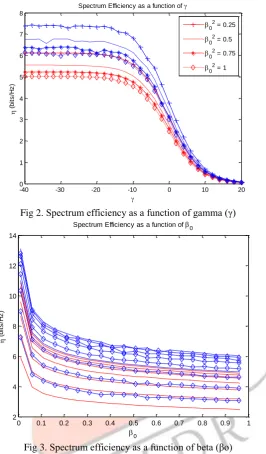
Fig 2. Spectrum efficiency as a function of gamma (γ)

Fig 3. Spectrum efficiency as a function of beta (βo)

The cell edge spectral efficiency as in the SFR-8 base method is found to be 2.475 dBm/Hz and for that of the proposed method, it is 3.057 which is a 23% improvement from the base method.

V. CONCLUSION

In this work, a new method for optimizing the Inter Cell Interference (ICI) to increase the channel capacity of the system or the throughput has been proposed. The proposed algorithm has higher channel capacity than the previous method without optimized inter Cell interference. This is because the proposed algorithm optimizes the loads into consideration when allocating resources to different cells and maximizes system throughput by reducing the effective interference. However, in SFR, the subcarrier and power allocation in each cell is pre-determined beforehand and not adapted to the changes in network traffic. This is because the proposed algorithm effectively reduces ICI by dynamically adjusting the major and minor subcarriers’ transmit power in each cell while in SFR-8 both inner and outer cell users experience the highest interference from adjacent cells. The results shown that the cell edge user performance of the two schemes. The proposed algorithm guarantees cell edge user data rate requirement when allocating resources. It adjusts the number of major subcarriers and transmit power according to cell edge data rate requirements. However in other scheme, the resource allocated to each cell region is predefined. When the cell edge traffic load is high the achieved system throughput in each iteration of the proposed algorithm for each cell region may not be enough to serve all its users which will lead to the outage of cell edge users. Therefore, the proposed can be a better option in order to reduce the ICI. The future work may involve the reduction in the complexity of the system. This is because the current system based on PSO may be a bit complex in terms of implementation because of the algorithm’s iterative structure. Hence, a further research can be to reduce the complexity and improve the timing performance of the algorithm.

-40 -30 -20 -10 0 10 20

0 1 2 3 4 5 6 7 8

(

b

it

s

/H

z

)

Spectrum Efficiency as a function of 

02 = 0.25

02 = 0.5

02 = 0.75

02 = 1

0 0.1 0.2 0.3 0.4 0.5 0.6 0.7 0.8 0.9 1

2 4 6 8 10 12 14

0

Spectrum Efficiency as a function of 0

(

b

it

s

/H

z

(5)

IJEDR1602254

International Journal of Engineering Development and Research (www.ijedr.org)

1429

REFERENCES

[1] Philippe Godlewski, MasoodMaqbool, Marceau Coupechoux, Jean-Marc Kélif “Analytical evaluation of various frequency reuse schemes in cellular OFDMA networks” October 2008 Athens, GREECE. 2008

[2] Syed Hussain Ali, Member, IEEE, and Victor C. M. Leung, Fellow, IEEE “Dynamic Frequency Allocation in Fractional Frequency Reused OFDMA Networks” August2009 IEEE transactionson wireless communications, vol. 8, no. 8.

[3] AbdelhalimNajjar, NoureddineHamdi, AmmarBouallegue, “Fractional Frequency Reuse scheme with two and three regions for multi-cell OFDMA systems” November 24-26, 2009. 17th Telecommunications forum TELFOR 2009

[4] Mustafa M. M. El-Tantawy, Mohamed AboulDahab, Hesham El-Badawy “Performance Evaluation of Frequency Reuse Schemes in LTE Based Network” November 23-25, 2010 18th Telecommunications forum TELFOR 2010

[5] A.K.M Fazlul Haque1, A.F.M. Shahen Shah, Md “High Performance Analysis of Frequency Reuse Schemes in Cellular Mobile Environment” March 2011 International Journal of Latest Trends in Computing (E-ISSN: 2045-5364) 29 Volume

[6] Martin Taranetz, Josep Colom Ikuno, Markus Rupp “Capacity density optimization by Fractional Frequency partitioning” 45th Annual Asilomar Conference on signals, system, and computers (ASILOMAR 2011)

[7] Lei Chen and Di Yuan “Generalizing and optimizin fractional frequency reuse in broadband cellular radio access networks” 2012 EURASIP Journal on Wireless Communications and Networking.

[8] ZhengXie, Bernhard Walke “Enhanced fractional frequency reuse to increase capacity of OFDMA system” Telecommunications forum 2010

[9] Chandra Thapa andChandrasekhar.C “Comparative evaluation of fractional Frequency reuse (FFR) and traditional Frequency reuse in 3gpp-lte downlink” August 2012, International Journal of Mobile Network Communications &Telemetric (IJMNCT) Vol.2, No.4.

[10] Xuezhi Yang, “A multi-level soft frequency reuse technique for wireless communication systems” arXiv:1406.2758 [cs.IT] 11 Jun 2014.

[11]Mao, Xuehong, Amine Maaref, and Koon HooTeo. "Adaptive soft frequency reuse for inter-cell interference coordination in SC-FDMA based 3GPP LTE uplinks." In Global Telecommunications Conference, 2008. IEEE GLOBECOM 2008. IEEE, pp. 1-6.

[12] Lei, Haipeng, Lei Zhang, Xin Zhang, and Dacheng Yang. "A novel multi-cell OFDMA system structure using fractional frequency reuse." In Personal, Indoor and Mobile Radio Communications, 2007. PIMRC 2007. IEEE 18th International Symposium on, pp. 1-5.

[13] Doppler, Klaus, Carl Wijting, and KimmoValkealahti. "Interference aware scheduling for soft frequency reuse."In Vehicular Technology Conference, 2009.VTC Spring 2009. IEEE 69th, pp. 1-5.

[14] Bohge, Mathias, James Gross, and Adam Wolisz. "Optimal power masking in soft frequency reuse based OFDMA networks." In Wireless Conference, 2009.EW 2009. European, pp. 162-166.

Figure

Fig 2. Spectrum efficiency as a function of gamma (γ)

References

Related documents

Rather, it is shown that the ratio between the time frame for total infection (days to completion) and the level of reseed required ( independence ratio ) is a more objective measure

column (I) and Table 3 column (V) respectively, but adding the aggregate population ratio variable used in the preliminary stage regressions; columns (III) and (IV) also

Sándor ILYÉS (Cluj-Napoca, 1976) He graduated from Babeş–Bolyai University Cluj-Napoca, Faculty of Letters, specialization Hungarian ethno- graphy and literature. Also followed an

If the rapid and reasonably accurate identifica- tion of poisonous plants is difficult fon physicians, the identification of mushrooms is virtually impos- sible. Because of the

change theories, narrative use by advocacy groups, and Canadian policy regarding women

The N-IG process is also, when its parameter measure is non-atomic, a special case of species sampling model, a family of random probability measures introduced by Pitman (1996)

FALL SEMESTER WEEKLY PROGRAM CLASSES I.. I) SWIMMING (ORKUN

In the first place, for the spatial autoregressive panel model, the rest of public capital, which includes social capital and other infrastructures, is not