THE STUDY OF EVOLUTIONARY COMPUTATION AND MACHINE LEARNING TECHNIQUES
K. Venu Gopal Rao1, Dr. Amit Jain2
Department of Electronics and Communication Engineering
1,2
OPJS University, Churu(Rajasthan) – India
Abstract
This paper discussedthe study of evolutionary computation and machine learning techniques.The standards of common determination and evolution have been embraced to acknowledge optimization algorithms, and the number of research regions and true applications to which they have been effectively connected is vast for sure. In the field of electromagnetism, specific consideration has been committed to Genetic Algorithms (GAs) and Differential Evolution (DE) plans, albeit intriguing outcomes have additionally been acquired by utilizing Microgenetic Algorithms (MGAs), Memetic Algorithms (MAs), Invasive Weed Optimization (IWO) and the Covariance Matrix Adaptation Evolutionary Strategy. The essential highlights of the previously mentioned optimization strategies will be talked about in the accompanying. The initial step performed in a GA algorithm is the encoding of every single parameter into a quality.
1. OVERVIEW
Several evolutionary algorithms (EAs) have risen in the previous decade that copy the
conduct and evolution of biological
substances propelled essentially by Darwin's hypothesis of evolution and its normal choice mechanism. The investigation of evolutionary algorithms started in the 1960s.
Several analysts freely created three
standard evolutionary algorithms, in
particular, the genetic algorithms[1],
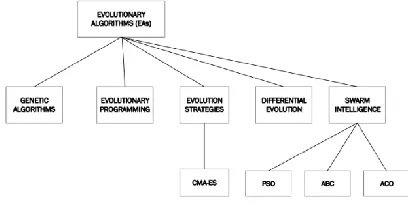
evolutionary programming [2] and evolution strategies. EAs are generally utilized for the arrangement of single and multi-target optimization issues and Figure 1 portrays a portion of the fundamental algorithmic families. Swarm Intelligence (SI) algorithms are additionally an exceptional sort of EAs. The SI can be characterized as the aggregate conduct of decentralized and self-sorted out swarms.
SI algorithms include Particle Swarm
Optimization (PSO), Ant Colony
Optimization [3] and Artificial Bee Colony (ABC). PSO mirrors the swarm conduct of fowls rushing and fish tutoring. The most well-known PSO algorithms include the established Inertia Weight PSO (IWPSO) and the Constriction Factor PSO (CFPSO). The PSO algorithm is anything but difficult to actualize and is computational productive; it is ordinarily utilized just for genuine esteemed issues. A choice to grow PSO for discrete-esteemed issues likewise exists. Other SI algorithms include:
(i) Artificial Bee Colony (ABC), which models and simulates the behaviors of honey bees foraging for food; and
(ii)Ant Colony Optimization (ACO), which
A Monthly Double-Blind Peer Reviewed Refereed Open Access International e-Journal - Included in the International Serial Directories
Differential evolution (DE) is a
population-based stochastic global
optimization algorithm, which has been used in several real-world engineering problems utilizing several variants of the DE algorithm. An overview of both the PSO and DE algorithms, hybridizations of these algorithms along with other soft computing tools can be found.
Other evolutionary techniques applied to antenna problems include the recently
proposed Wind Driven Optimization
(WDO); Biogeography-based optimization (BBO); Invasive Weed Optimization (IWO); Evolutionary Programming (EP); and, the Covariance Matrix Adaptation Evolution Strategy (CMA-ES).
Figure 1 A Diagram Depicting Main Families of Evolutionary Algorithms
A critical theorem which is relevant to the execution of optimization algorithms is the purported 'No Free Lunch' (NFL) theorem, which relates to the normal conduct of optimization algorithms over given spaces of optimization issues. It has been appeared in that when found the middle value of overall conceivable optimization issues characterized over some hunt space 𝑋, no algorithm has an execution advantage over
some other. Moreover, the creators
demonstrate that it is hypothetically difficult to have a best broadly useful widespread optimization procedure, and the main route for one technique to be better than the others is the point at which it centreson a specific class of issues.
2. GENETIC ALGORITHM
GAs, the most popular EAs, is inspired by Darwin’s natural selection. GAs can be real or binary coded. In a binary-coded GA each chromosome encodes a binary string. The
most commonly used operators are
crossover, mutation and selection. The selection operator chooses two parent chromosomes from the current population according to a selection strategy. Most popular selection strategies include roulette wheel and tournament selection. The crossover operator combines the two parent chromosomes in order to produce one new child chromosome. The mutation operator is
applied with a predefined mutation
probability to a new child chromosome. A search in the Scopus database shows that there are 65762 conference papers and 94510 journal papers related with GAs from 1977 to 2016. The number of papers related to GAs and antennas over the last 15 years. Additionally, the search in the same database using the keywords GAs and Antennas reveals a total number of 2807 papers (both journal and conference).
Modern communication, sensing, and radar systems are described by a consistently expanding system multifaceted nature and
various challenges on performance
measurements that must be met, either by the system or by a solitary device. Keeping in mind the end goal to address the undertaking of outlining another device or subsystem with a progression of yield necessities, we can embrace an approach, in light of a parametric investigation, by thinking about the impacts of changing the most essential parameters of an underlying conjecture, which can be either a current plan or another one that seems promising. In any case, regardless of whether the number of parameters surpasses only a couple; this approach may require a huge number of assessments to decide the performance of the device for every arrangement.
Microgenetic Algorithm and Memetic Algorithm
Microgenetic Algorithms (MGAs) and Memetic Algorithms (MAs) represent other interesting optimization strategies. In MGA, small-size populations evolve to locate promising areas in the search space. Since the population dimension is smaller than that of the GA, the MGA migrates into the near-optimal regions with less iteration. It is evident that a small population cannot provide the necessary diversity in the genetic pool; therefore, the population has to be restarted after some generations to explore the available search space, keeping only one or more of the best individuals, and thus avoiding the interim convergence into a local minimum, which is undesirable. In MGA the population evolves by employing
the recombination of the two chromosomes for the generation of an offspring but the mutation is absent. This mutation inhibition is related to the frequent restart of the population which guarantees a suitable exploration of the search space.
Circuits Optimization based on Evolutionary Computation Techniques
The microelectronics market patterns exhibit a regularly expanding level of many-sided quality with uncommon accentuation on the creation of complex blended flag systems-on-chip. Strict economic and configuration weights have driven the advancement of
new strategies and devices for
computerizing the similarity configuration process. In spite of the evolution checked in the previous couple of years, the vast majority of the architect exertion is as yet
devoted to computerize the circuit
estimating process since, similar to design and topology age undertakings, circuit measuring is viewed as an extremely tedious process. Relationship plan issue is ordinarily an over compelled issue with numerous
degrees of freedom and numerous
performance necessities and it is still described by the absence of a special and organized outline stream definition.
4. POSITIONING OF EVOLUTIONARY COMPUTATION
A Monthly Double-Blind Peer Reviewed Refereed Open Access International e-Journal - Included in the International Serial Directories actively influenced the course of evolution
in other species by choosing which plants or animals should survive or mate. Thus
humans have successfully exploited
evolution to create improved food sources or more useful animals, even though the mechanisms involved in the transmission of traits from one generation to the next were not understood.
Figure 2The principal diagram of evolutionary algorithms
5.EVOLUTIONARY ANALOGY IC
DESIGN OPTIMIZATION TOOL
The EVOLUTION venture goes for
investigating new design computerization strategies by consolidating cutting edge
demonstrating and looking methods.
GENOM is a design optimization device, coming about because of the EVOLUTION venture, which consolidates a changed genetic calculation bit with SVM models.
GENOM Optimization Kernel
Another hybrid optimization calculation has been produced joined with a design
philosophy, which builds the proficiency on the simple circuit and system design cycle.
GENOM Tool
The consequence of design procedure and optimization strategy is appeared in a tool, GENOM. The proposed design optimization tool speaks to a mechanized contrasting option to the customary design stream, robotizing a few stages of the design procedure.
6.CONCLUSION
In this manner, on the off chance that we can characterize artificial wellness based on a measure grounded in the issue to be
comprehended then the evolutionary
algorithm will tend to discover arrangements that improve the wellness values, or possibly surmised them. This suggests evolutionary algorithms can be utilized to take care of optimization issues and, thus, any issue that can be changed into an equal optimization assignment. This includes most issues in outline and those associated with building or taking in models from information. By and by, it is vital to comprehend that
evolutionary algorithms are not
optimizers[4], however, approximates, and they are not ideal since we won't know whether the wellness of the best-advanced
arrangement is in reality the most
astounding value conceivable.
ST5 shuttle, consequently turning into the primary computer-developed equipment in space. This undertaking additionally exhibits a particularly preferred standpoint of evolutionary over the manual plan. The evolutionary algorithms created and tried a huge number of totally new arrangements; numerous with abnormal structures that master radio wire planners would be probably not going to deliver. Evolutionary algorithms have likewise been fruitful in numerous other aeronautical, and aviation design tries. Normally in evolutionary computing there is a three-step evaluation chain: genotype to phenotype to fitness. For robots the chain is four-step: genotype to phenotype to behaviour to fitness. In this four-step chain the robots morphology and controller form the phenotype.
REFERENCES
[1].H. G. Beyer and H. P. Schwefel,
"Evolution strategies: A
comprehensive introduction,"
Natural Computing, vol. 1, pp. 3-52, 2002.
[2].D. Karaboga and B. Basturk, "A powerful and efficient algorithm for
numerical function optimization:
Artificial bee colony (ABC)
algorithm," Journal of Global Optimization, vol. 39, pp. 459-471, 2007
[3].S. Das, A. Abraham, and A. Konar, "Particle swarm optimization and differential evolution algorithms: Technical analysis, applications and hybridization perspectives," in
Studies in Computational
Intelligence vol. 116, Y. L. Liu, A. S. Sun, E. P. L. Lim, H. T. L. Loh, and W. F. L. Lu, Eds., ed, 2008, pp. 1-38.