University of South Carolina
Scholar Commons
Theses and Dissertations
2018
Bayesian Semiparametric Methods for Analyzing
Panel Count Data
Jianhong Wang
University of South Carolina
Follow this and additional works at:https://scholarcommons.sc.edu/etd Part of theStatistics and Probability Commons
This Open Access Dissertation is brought to you by Scholar Commons. It has been accepted for inclusion in Theses and Dissertations by an authorized
administrator of Scholar Commons. For more information, please [email protected].
Recommended Citation
Wang, J.(2018).Bayesian Semiparametric Methods for Analyzing Panel Count Data.(Doctoral dissertation). Retrieved from
Bayesian Semiparametric Methods for Analyzing Panel Count Data
by
Jianhong Wang
Bachelor of Mathematics Henan University, China 1997
Master of Applied Mathematics
PLA University of Science and Technology, China 2000
Master of Statistics
University of South Carolina 2013
Submitted in Partial Fulfillment of the Requirements
For the Degree of Doctor of Philosophy in
Statistics
College of Arts and Sciences
University of South Carolina
2018
Accepted by:
Xiaoyan Lin, Major Professor
David Hitchcock, Committee Member
Lianming Wang, Committee Member
Linyuan Lu, Committee Member
c
Copyright by Jianhong Wang, 2018
Acknowledgments
I would like to acknowledge all those who have helped me during my doctoral
study. First of all, I am especially indebted to my esteemed advisor, Dr. Xiaoyan (Iris)
Lin, for her critical inspiration and continuous support. Her infectious enthusiasm
and continuous encouragement have always been the major driving force through
my study and research. It is impossible to complete this dissertation without her
generous guidance. I also extend my gratitude to the members of my exceptional
doctoral committee: Drs. Lianming Wang, David Hitchcock, Linyuan Lu for their
continuous support and insightful comments on my work.
Many professors in the Department of Statistics have assisted and encouraged
me in various ways during my graduate study. I would like to express my deep
gratitude to Dr. Hanson and Dr. Tebbs as graduate chairs for their valuable advice
about taking courses as well as their encouragement. I would also like to express my
appreciation to Drs. John Grego, Xianzheng Huang, David Hitchcock, Edsel Pena,
Liangming Wang and Tim Hanson, for all the courses they have offered from which I
have learned so much. I am very appreciative and thankful for the great support of
Maureen Petkewich who has always kindly allocated all my teaching assignments by
providing me with more chance and more experience to be a much better teaching
assistant.
Finally, I am particularly grateful to my family for their love, support and sacrifices
Abstract
Panel count data commonly arise in epidemiological, social science, medical
stud-ies, in which subjects have repeated measurements on the recurrent events of interest
at different observation times. Since the subjects are not under continuous
moni-toring, the exact times of those recurrent events are not observed but the counts
of such events within the adjacent observation times are known. Panel count data
can be considered as a special type of longitudinal data with a count response
vari-able in the literature. Compared to the frequentist literature, very limited Bayesian
approaches have been developed to analyze panel count data. In this dissertation,
several Bayesian estimation approaches are proposed for analyzing panel count data
under different semiparametric regression models.
Chapter 1 of this dissertation provides some description of panel count data,
liter-ature review on existing methods, and background knowledge of related tools used in
the proposed methods. Chapter 2 proposes a Bayesian estimation approach under the
Poisson proportional mean model, in which we model the baseline mean function with
the monotone splines of Ramsay (1988) [1]. An efficient Gibbs sampler is proposed,
all parameters can be either sampled directly from their full conditional distributions
in standard forms or updated through automatic adaptive rejection sampling. Our
proposed method is evaluated through extensive simulations and compared with two
exiting methods. Our method is applied to a bladder cancer data set for illustration.
Chapter 3 proposes a new Bayesian estimation approach for analyzing panel count
data when there is heterogeneity in the population (that cannot be described by the
the unobserved gamma frailties representing the heterogeneity among the subjects.
Simulation studies suggest that our method not only has a good performance when
such frailty exists but also provides robust estimation when there is no frailty. The
bladder cancer tumor data is analyzed for illustration. Chapter 4 investigates the
robustness of our proposed Bayesian approaches in Chapter 2 and Chapter 3 through
simulations. We draw the conclusion that our proposed Bayesian methods still have
Table of Contents
Acknowledgments . . . iii
Abstract . . . iv
List of Tables . . . viii
List of Figures . . . xii
Chapter 1 Introduction . . . 1
1.1 Recurrent Data . . . 1
1.2 Analysis of Panel Count Data . . . 5
1.3 Counting Process . . . 7
1.4 Mean Cumulative Function . . . 9
1.5 Deviance Information Criterion . . . 12
Chapter 2 Bayesian Semiparametric Proportional Mean Model for Panel Count Data . . . 15
2.1 Introduction . . . 15
2.2 Notation and Model . . . 19
2.3 Modeling U0(t) with Monotone I- splines . . . 20
2.4 Likelihood Augmentation with Poisson Latent Variables . . . 21
2.6 Simulation Studies . . . 25
2.7 A Real Data Example . . . 38
2.8 Discussion . . . 41
Chapter 3 Frailty Effect on Panel Count Data . . . 43
3.1 Introduction . . . 43
3.2 Proportional Mean Model with Frailty Effect . . . 47
3.3 Likelihood and Augmentation . . . 50
3.4 Prior Specification and Posterior Computation . . . 52
3.5 Simulation . . . 54
3.6 Real Data Analysis . . . 61
3.7 Summary . . . 69
Chapter 4 Robustness Study of our Proposed Bayesian Approaches . . . 71
4.1 Introduction . . . 71
4.2 Small Size Situation . . . 71
4.3 Relaxing Nonhomegenous Poisson Process Assumption . . . 73
4.4 Observation Times Dependent on Covariates . . . 87
4.5 Informative Observation Process . . . 91
4.6 Conclusion . . . 98
Chapter 5 Future Plan . . . 102
List of Tables
Table 1.1 Numbers of new tumors at each visit for selected subjects with
placebo treatment and Thiotepa treatment . . . 4
Table 1.2 Visit times in weeks and observed counts of episodes of nausea
for some patients with floating gallstones in the National
Coop-eration Gallstone Study . . . 5
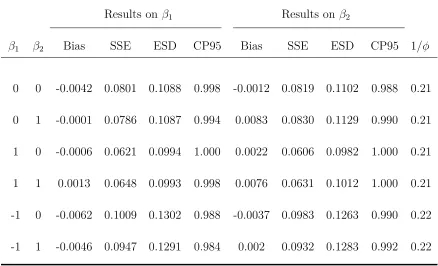
Table 2.1 Estimation of regression parameters for scenario 1 based on 500
simulated data sets from the proposed Bayesian method, para-metric method and Rosen algorithm method. Bias refers to the difference between the average of the 500 point estimates and the true value, ESD refers to the average of the 500 posterior standard deviations, SSE refers to the sample standard devia-tion of the 500 point estimates, and CP95 is the 95% coverage
probability. . . 29
Table 2.2 Estimation of regression parameters for scenario 2 based on 500
simulated data sets from the proposed Bayesian method, para-metric method and Rosen algorithm method. Bias refers to the difference between the average of the 500 point estimates and the true value, ESD refers to the average of the 500 posterior standard deviations, SSE refers to the sample standard devia-tion of the 500 point estimates, and CP95 is the 95% coverage
probability. . . 30
Table 2.3 Comparison MSE of baseline mean functions for differentβamong
the proposed, parametric and Rosen methods for scenarios 1 and 2 35
Table 2.4 The results from three different methods: proposed method,
Rosen method and paramatric method for bladder tumor can-cer data. Variables: X1 and X2 represent the number and the largest size of bladder tumors at beginning of the trial, respec-tively. X3 and X4 are indicators for pyridoxine pill and thiotepa
installation, respectively. . . 39
Table 2.5 Results about regression parameters for different knots with
Table 3.1 Estimates of regression parameters for scenario 1, when fitting
model with frailty effect for frailty data . . . 55
Table 3.2 Estimates of regression parameters for scenario 2, when fitting
the model with frailty effect for frailty data . . . 58
Table 3.3 Types of Misspecification . . . 59
Table 3.4 Estimates of regression parameters for scenario 1, when fitting
the model with frailty effect for no frailty data . . . 60
Table 3.5 Estimates of regression parameters for scenario 2, when fitting
the model with frailty effect for no frailty data . . . 61
Table 3.6 Estimates of regression parameters for scenario 1, when fitting
the model with no frailty effect for frailty data . . . 64
Table 3.7 Estimates of regression parameters for scenario 2, when fitting
the model with no frailty effect for frailty data . . . 65
Table 3.8 Results about regression parameters for different knots with
de-gree=2 and 3 . . . 68
Table 3.9 The estimates of covariate coefficients for Bladder tumor data
from different methods. WZ method: Wellner and Zhang (2007).
YWH method: Yao, Wang and He (2016) . . . 69
Table 4.1 Estimation of regression parameters for scenario 1 based on
500 simulated data sets withsample size 50from the proposed
Bayesian method in Chapter 2. Bias refers to the difference
between the average of the 500 point estimates and the true value, ESD refers to the average of the 500 posterior standard deviations, SSE refers to the sample standard deviation of the
500 point estimates, and CP95 is the 95% coverage probability . . 72
Table 4.2 Estimation of regression parameters for scenario 2 based on
500 simulated data sets withsample size 50from the proposed
Bayesian method in Chapter 2. Bias refers to the difference
between the average of the 500 point estimates and the true value, ESD refers to the average of the 500 posterior standard deviations, SSE refers to the sample standard deviation of the
Table 4.3 Estimation of regression parameters forscenario 1based on 500
simulated data setsfor the negative binomial event process.
Bias refers to the difference between the average of the 500 point estimates and the true value, ESD refers to the average of the 500 posterior standard deviations, SSE refers to the sample stan-dard deviation of the 500 point estimates, and CP95 is the 95%
coverage probability . . . 78
Table 4.4 Estimation of regression parameters forscenario 2based on 500
simulated data setsfor the negative binomial event process.
Bias refers to the difference between the average of the 500 point estimates and the true value, ESD refers to the average of the 500 posterior standard deviations, SSE refers to the sample stan-dard deviation of the 500 point estimates, and CP95 is the 95%
coverage probability . . . 79
Table 4.5 Estimation of regression parameters byusing the frailty model
approach for scenario 1 based on 500 simulated data sets
under the negative binomial event process. Bias refers to
the difference between the average of the 500 point estimates and the true value, ESD refers to the average of the 500 pos-terior standard deviations, SSE refers to the sample standard deviation of the 500 point estimates, and CP95 is the 95%
cov-erage probability . . . 83
Table 4.6 Estimation of regression parameters byusing the frailty model
approach for scenario 2 based on 500 simulated data sets
under the negative binomial event process. Bias refers to
the difference between the average of the 500 point estimates and the true value, ESD refers to the average of the 500 pos-terior standard deviations, SSE refers to the sample standard deviation of the 500 point estimates, and CP95 is the 95%
cov-erage probability . . . 84
Table 4.7 Estimation of regression parameters forscenario 1based on 500
simulated data setswhen the observation times depend on
covariates. Bias refers to the difference between the average of
the 500 point estimates and the true value, ESD refers to the average of the 500 posterior standard deviations, SSE refers to the sample standard deviation of the 500 point estimates, and
Table 4.8 Estimation of regression parameters forscenario 2based on 500
simulated data setswhen the observation times depend on
covariates. Bias refers to the difference between the average of
the 500 point estimates and the true value, ESD refers to the average of the 500 posterior standard deviations, SSE refers to the sample standard deviation of the 500 point estimates, and
CP95 is the 95% coverage probability . . . 88
Table 4.9 Estimation of regression parameters for scenario 1 based on
500 simulated data sets for the informative observation
times. Bias refers to the difference between the average of the
500 point estimates and the true value, ESD refers to the average of the 500 posterior standard deviations, SSE refers to the sample standard deviation of the 500 point estimates, and CP95 is the
95% coverage probability . . . 93
Table 4.10 Estimation of regression parameters for scenario 2 based on
500 simulated data sets for the informative observation
times. Bias refers to the difference between the average of the
500 point estimates and the true value, ESD refers to the average of the 500 posterior standard deviations, SSE refers to the sample standard deviation of the 500 point estimates, and CP95 is the
95% coverage probability . . . 94
Table 4.11 Estimation of regression parameters for scenario 2 using the
frailty model approach based on 500 simulated data sets
under the informative observation process. Bias refers
to the difference between the average of the 500 point estimates and the true value, ESD refers to the average of the 500 posterior standard deviations, SSE refers to the sample standard deviation of the 500 point estimates, and CP95 stands for the 95% coverage
probability . . . 98
Table 4.12 Estimation of regression parameters for scenario 2 using the
frailty model approach based on 500 simulated data sets
under the informative observation process. Bias refers
to the difference between the average of the 500 point estimates and the true value, ESD refers to the average of the 500 posterior standard deviations, SSE refers to the sample standard deviation of the 500 point estimates, and CP95 stands for the 95% coverage
List of Figures
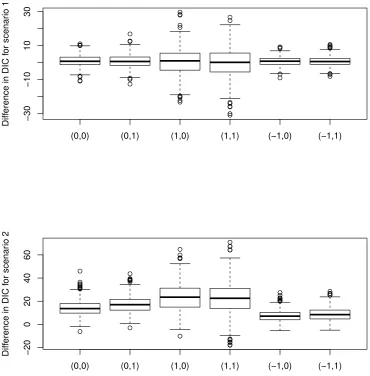
Figure 2.1 Boxplots of DIC difference between degree 2 and degree 3 based
on 500 simulated data sets for the six (β1,β2) configurations for
scenario 1 and scenario 2, respectively. . . 27
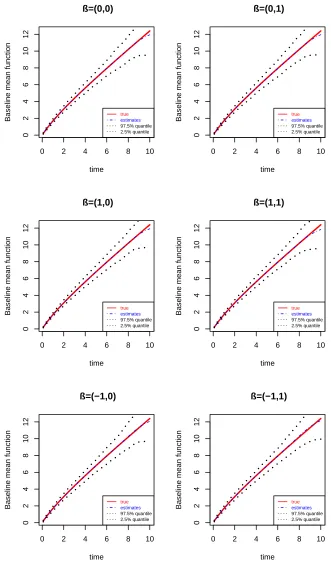
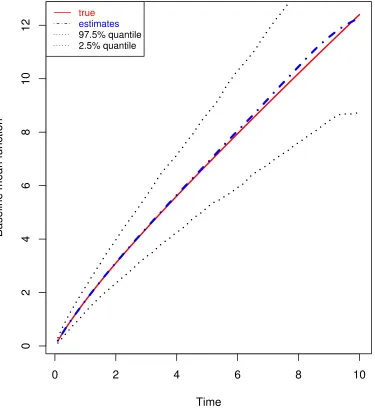
Figure 2.2 Estimates of baseline mean functions for differentβ in scenario 1 32
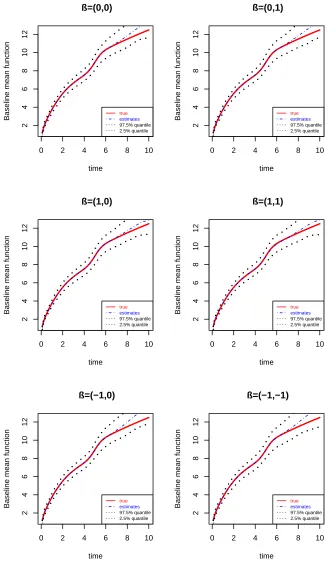
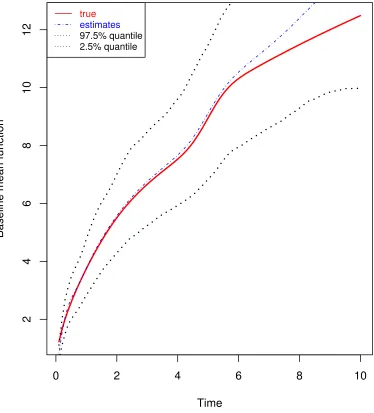
Figure 2.3 Estimates of baseline mean functions for differentβ in scenario 2 33
Figure 2.4 Comparison among the true and estimates of cumulative
base-line mean functions among the proposed method, parametric
method and Rosen method for β= (−1,1) for scenario 1 . . . . 36
Figure 2.5 Comparison among the true and estimates of cumulative
base-line mean functions among the proposed method, parametric
method and Rosen method for β= (−1,1) for scenario 2 . . . . 37
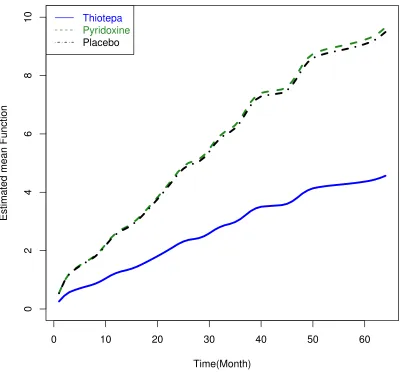
Figure 2.6 Plot for estimated mean function for different treatments . . . 40
Figure 3.1 Estimates of baseline function withβ=(-1,1) for scenario 1 . . . . 56
Figure 3.2 Estimates of baseline function withβ=c(-1,1) for scenario 2 . . . 57
Figure 3.3 Boxplots of DIC differences between frailty and no frailty
mod-els for scenario 1 . . . 62
Figure 3.4 Boxplots of DIC differences between frailty and no frailty
mod-els for scenario 2 . . . 63
Figure 3.5 The estimator of baseline mean function for bladder tumor
ex-ample under the proportional mean model with frailty . . . 66
Figure 3.6 The estimated mean functions for different treatments for
blad-der tumor example unblad-der the proportional mean model with
Figure 4.1 Estimates of baseline mean functions for differentβinscenario
1 for sample size 50 . . . 74
Figure 4.2 Estimates of baseline mean functions for differentβinscenario
2 for sample size 50 . . . 75
Figure 4.3 Estimates of baseline mean functions for differentβinscenario
1 for the negative binomial event process . . . 80
Figure 4.4 Estimates of baseline mean functions for differentβinscenario
2 for the negative binomial event process . . . 81
Figure 4.5 Estimates of baseline mean functions for differentβinscenario
1 using the frailty model fitting the data from negative
binomial event process . . . 85
Figure 4.6 Estimates of baseline mean functions for differentβinscenario
2 using the frailty model fitting the data from negative
binomial event process . . . 86
Figure 4.7 Estimates of baseline mean functions for differentβinscenario
1 when observation times depend on covariates. . . 89
Figure 4.8 Estimates of baseline mean functions for differentβinscenario
2 when observation times depend on covariates . . . 90
Figure 4.9 Estimates of baseline mean functions for differentβinscenario
1 for the informative observation process . . . 96
Figure 4.10 Estimates of baseline mean functions for differentβinscenario
2 for the informative observation process . . . 97
Figure 4.11 Estimates of baseline mean functions for different β in
sce-nario 1 using the frailty model fitting the data from the
informative observation process . . . 100
Figure 4.12 Estimates of baseline mean functions for different β in
sce-nario 2 using the frailty model fitting the data from the
Chapter 1
Introduction
1.1 Recurrent Data
1.1.1 Introduction
Recurrent data arise in a lot of areas such as epidemiology, econometrics,
crim-inology, social sciences, reliability and clinic trial study. Recurrent data consist of
times to repeated events for each sample subject. In other words, all these subjects
in the study could experience recurrences of the same event at different times. For
example, in a clinic study, recurrent episodes of a disease in patients appear multiple
times, such as repeated heart attacks, cancer tumors recurrence even after previous
tumors are removed etc.. In a reliability study, when a unit breaks down, it can
be put back into service after being repaired. This situation could occur multiple
times with warranty claims for some particular unit. More examples were given by
Kalbfleisch and Lawless (1981, 1985)[2] [3], Thall and Lachin (1988) [4], and Sun and
Kalbfleisch (1995) [5].
One typical type of recurrent study is the history study of the event of interest.
Since the subjects experience event of interest multiple times, the resulting data are
usually classified as event history data. Generally there are two types of event history
data. One type is the data that can be collected at a continuous time period. We
name this type of data recurrent event data (Byar 1980 [6], Gail 1981 [7], Pepe and
Cai 1993 [8], Lin et al. 2000 [9]), which record the times of all occurrences of events.
only the number of occurrences of the event between observation times is known. The
exact time of the occurring event of interest is never known. They are often referred
to as panel count data (Kalbfleisch and Lawless 1985 [2], Thall and Lachin 1988 [4],
Sun and Kalbfleisch 1995 [5]).
Recurrent event data are frequently encountered in longitudinal follow-up studies
such as epidemiological and medicinal studies. The observation of the recurrent events
can be terminated at or before the end of the study. For instance, the recurrent events
can have multiple occurrences of hospitalizations, and will be terminated by patients
who loss to follow-up, a fatal event such as death, or the end of the study.
Panel count data are often encountered in periodic follow-up studies. It may
be due to being impractical, too expensive, or not realistic to keep subjects under
continuous observation over the entire study period. The number of observation
times usually varies from one subject to another subject, and the observation times
also vary from subject to subject. In practice, when there is only one observation
time for the event of interest, such as death or onset of disease, the panel count data
are often referred to as current status data (Dinse and Lagakos 1983 [10], Diamond
and McDonald 1992 [11], Jewell and van 1996 [12], Sun and Kalbfleisch 1995 [5]).
Interval censored data can also be viewed as a special case of panel count data.
We are going to mainly focus on panel count data study for this dissertation,
and two examples are presented to further illustrate the basic concepts and general
structures of panel count data.
1.1.2 Examples
(1) Bladder Cancer Tumor Study
Table 1.1 gives a set of panel count data about the bladder cancer study. This
study was conducted by the Veterans Administration Cooperative Urological Research
superficial bladder tumors when they entered the study. For the first time visit,
the number of the tumors were counted, and the initially largest tumor size was
measured and all the initial tumors were removed transurethrally. Then each patient
was randomly assigned to one of the three treatment groups: placebo, pyridoxine
pill and thiotepa instillation. At each follow-up visit for each patient, the same
procedure was followed: the number of the new tumors was counted, then all of
them transurethrally removed, and then each patient was given the same treatment
as before. Usually a lot of patients had multiple follow-up visits, and had recurrence
tumors through the entire study. In all three treatment groups, the average follow-up
time was about 31 months, but some patients may have been followed as long as
five years. The objective of the study was to determine if the treatments, especially
thiotepa instillation, reduced the recurrence of bladder tumors. The treatment effects
have been analyzed by many authors such as Wei, Lin and Weissfeld (1989) [14],
Wellner and Zhang (2007) [15], Lu, Zhang and Huang (2007, 2009) [16] [17].
(2) National Cooperative Gallstone Study (NCGS)
One of the major interests was to study the safety of the drug chenodiol for the
treatment of cholesterol gallstones. This is a 10-year, multicenter, doubleblinded,
placebo-controlled clinical trial on the use of the natural bile acid chenodeoxycholic
acid, cheno, for the dissolution of cholesterol gallstones (Sun and Zhao 2013 [18]).
There were a total of 916 patients who were assigned one of three treatments:
high-dose (750 mg per day), low-high-dose (375 mg per day), or placebo. One of the primary
objectives of the study was to assess the impact of the treatments on the incidence
of digestive symptoms commonly associated with gallstone disease. The symptoms
could be nausea, vomiting, dyspepsia etc. For example, episodes of nausea vomiting
was viewed as a very common symptom associated with gallstone diseases and very
important for the investigators to determine whether there exists a significant
Table 1.1: Numbers of new tumors at each visit for selected subjects with placebo treatment and Thiotepa treatment
Patient Start Numbers of new tumors at following months
ID Size 0-10 11 -20 21-30
1 3 1 0 . . . .
2 1 2 0 . . 0 . . 0 . . . .
12 3 3 . . 1 . . 0 . . 1 0 . . 0 . 0 . 0 . . 0 8 . 0 . . . .
17 4 1 . 4 . . . 0 . . . 8 . . . .
23 5 1 . 4 . . . 0 . . . 2 . . . 4 0 . . . . 0 .
Thiotepa group
48 3 1 0 . . . .
50 1 8 . . . . 8 . . . .
79 4 1 0 0 0 0 0 0 0 0 0 0 0 0 0 0 0 0 0 0 0 0 0 0 0 0 0 0 0 0
81 1 4 . . . 1 . . . 0 . . . . 0 . . . 0 . . 1 . . . .
85 3 1 0 0 0 0 0 0 0 0 0 0 0 0 0 0 0 0 . 0 . 0 0 0 . 0 0 0 0 0 .
The symptoms were observed shortly after they achieved maximal dose, since it was
believed that any treatment had an effect right after taking the doses, and the effect
might later begin to dissipate. During the study, the patients were scheduled to
re-turn for clinic observations for each follow-up visit. For the first year, they were asked
to return at 1, 2, 3, 6, 9, and 12 months, and to report the total number of each type
of symptom that had occurred between successive visits such as the number of the
incidences of nausea. However, the actual visit times varied from patient to patient.
For example, some patients may visit more often at the first half a year than the later
half a year, some patients may drop off the study. Table 1.2 is a selected data subset
which has visit times in weeks and observed counts of episodes of nausea for patients
with floating gallstones. The whole data set has been studied in many references (Wei
Table 1.2: Visit times in weeks and observed counts of episodes of nausea for some patients with floating gallstones in the National Cooperation Gallstone Study
Patient Visit times and episodes of nausea
ID t1 N1 t2 N2 t3 N3 t4 N4 t5 N5 t6 N6 t7 N7 t8 N8 t9 N9
High-dose chemo group
1 4 0 8 0 13 0 26 0 38 0 51 0 69 0 . . . . 10 4 0 9 0 13 0 17 0 22 0 26 0 38 0 43 0 62 0 32 3 1 9 3 13 0 26 0 38 0 52 0 70 0 . . . . 50 3 0 8 0 13 0 25 8 37 20 53 0 73 0 . .
Placebo group
64 4 0 8 0 12 0 25 0 38 0 52 0 68 0 . . . . 70 4 0 8 0 13 0 24 0 37 0 50 0 67 0 . . . . 103 4 3 . . . . 111 4 0 9 0 14 0 25 0 . . . .
1.2 Analysis of Panel Count Data
As we know the study subjects in panel count data are monitored at discrete time
points, and the observable information is the event counts for each subject
corre-sponding to the time interval between two adjacent time points, but the exact times
of the event is not observable. Moreover, the observation times for each subject are
not often the same, which makes the counts among subjects not directly comparable.
Based on the incomplete and unbalanced nature of observed information, to
ana-lyze recurrent event data, it is common and convenient to characterize the occurrences
of recurrent events by counting process (Andersen et al. 1982 [21]) and to model the
intensity process of the counting process. On the other hand, for the analysis of panel
count data, it is usually more convenient to work directly on the mean function of
the counting processes conditional on covariate processes (details in Sun and Zhao
parametric Poisson processes or mixed parametric Poisson processes. For example,
Lawless (1987) [22] provided a thorough parametric analysis of the proportional
in-tensity Poisson process model, where subject-specific gamma random effects and a
Weibull baseline intensity function were assumed. Thall (1988) [4] developed some
regression approaches for mixed Poisson. There are quite a few methods for panel
count data with the assumption of nonhomegeneous Poisson process. For example,
Wellner and Zhang (2000) [23] studied nonparametric maximum pseudolikelihood and
nonparametric maximum likelihood estimators based on a nonhomogeneous Poisson
process. They showed that the maximum pseudolikelihood estimator was exactly the
one proposed by Sun and Kalbfleisch (1995) [5]. They also discussed the asymptotic
properties of the maximum pseudolikelihood and maximum likelihood estimators.
Compared with maximum pseudolikelihood estimator, the maximum likelihood
esti-mator is much more efficient, but its computation is more difficult.
Many investigators have studied spline estimation of a hazard function for panel
count data. Whittemore and Keller (1986) [24] used step functions and linear splines
to obtain non-parametric estimates of the baseline hazard function. Etezadi-Amoli
and Ciampi (1987) [25] applied quadratic splines to obtain smoother estimates.
Rosen-berg (1995) [26] modeled the hazard function as a linear combination of cubic-splines
and obtained maximum likelihood estimates. Lu, Zhang and Huang (2007, 2009)
[16] [17] proposed nonparametric spline likelihood-based estimators using monotone
polynomial splines and semiparametric monotone B-splines, respectively.
In some cases, panel count data may show a higher incidence of zero counts than
expected if the data were Poisson distributed. Zero-inflated Poisson regression
mod-els are a useful class of modmod-els for modeling such data, but parameter estimates
may be seriously biased if the nonzero counts are overdispersed in relation to the
Poisson distribution. Ridout et al. (2001) provided zero-inflated negative binomial
testing zero-inflated Poisson regression models against zero-inflated negative binomial
alternatives.
In the rest of these sections, we provide a review about counting process, the mean
cumulative function and regression models for panel count data, respectively.
1.3 Counting Process
We know that panel count data study is a special type of event history study.
The observation counts are inevitably involved in the study. The counting processes
have been playing an essential and important role in the development of statistical
models and inferential procedures for this kind of event history analysis. Especially,
it is widely applied in analyzing panel count data. Some of the early and
signifi-cant contributions to this were provided by Aalen (1975, 1978) [27] [28], Andersen
and Borgan (1985) [29], and Liaw (1995) [30]. They established the connection
be-tween the counting process and the event history analysis, and provided the theory of
counting processes and a general framework for event history analysis. In particular,
Andersen and Gill (1982) [21] proposed the Cox type intensity model for counting
processes, developed the partial likelihood estimation procedure for regression
param-eters, and established the large sample theory for the resulting estimators. Andersen
et al. (1993) [31] gave more details about counting processes.
Let (Ω,F,P) be a probability space and T = [0, τ) a continuous time interval,
where τ is a given terminal time, 0 < τ ≤ ∞. A stochastic process X is a family of
random variables {X(t) : t ∈ T}. A filtration or history {Ft : t ∈ T} is an
increas-ing right-continuous family of sub σ-algebras of F, it contains all the information
generated by the stochastic process X on [0, t]. If X(t) is Ft-measurable for every
t ∈ T, then the stochastic process X is said to be adapted to the filtration. If X(t)
is known given the history Ft− generated by {X(s) : 0≤ s < t}, then the stochastic
count-ing process is a stochastic process {N(t) : t ≥ 0} with almost surely such that the
path is right-continuous with probability one, piecewise constant, and has only jump
discontinuities with jumps of size plus 1.
Usually we use the intensity to model a counting process, it could be defined by
P{N(t+dt)−N(t) = 1|Ft}=λ(t)dt+o(dt)
and
P{N(t+dt)−N(t)≥2|Ft}=o(dt)
with λ(t) being a left-continuous function. If the counting process is Poisson process
N(t), based on the definition above, we can see that the Poisson process N(t) only
has at most one jump over a small time interval and does not depend on its history.
A non-homogeneous Poisson process ( Karlin and Taylor 1981 [32]) is a very common
and widely applied special counting process. If λ(t) is a constant, the process is
usually called a homogeneous Poisson process. For a Poisson process {N(t) : t ≥0}
at each t, we have thatN(t) follows the Poisson distribution.
Among all counting processes, the Poisson process {N(t) : t ≥ 0} as the most
commonly used one has been shown a large contribution to queuing theory, risk
theory and a lot of types of the application in model building area for our real life.
There are a lot of examples of phenomena that can be modeled by Poisson processes
with many kinds of ways. In traffic processes in networks such as computer systems,
machine repair shops etc, traffic flows within the network are postulated as Poisson
processes in Melamed (1979) [33]. A compound Poisson process had been used to
model cumulative energy release of main shocks in the Balkan region for Balkan
earthquake sequences by Gospodinov and Rotondi (2001) [34].
Landfalling hurricanes recorded along the U.S. Gulf and Atlantic coasts between
1900 and 2010, and their associated maximum wind speed and damages were studied
by modeling the sequence of nonhomogeneous density functions in Xiao et al. (2015)
We will discuss and study our models about panel count data based on the
non-homogeneous Poisson process in the following chapters.
1.4 Mean Cumulative Function
Recurrence data consist of the times to any number of repeated events for each
sample unit, for example, times of new bladder tumor observed in patients or times
of repair of warrantied product. Sometimes the data are censored due to different
ends of histories or study. Panel count data contains the counts of repeated events
till particular observation times. After Cox (1972) [36] provided the proportional
hazards model, Lawless and Nadeau (1995) [30] and Lin et al. (2000) [9] described
proportional rates and proportional means regression models for recurrence data.
The mean cumulative function for the number of the events usually contains the
information of interest in the analysis of panel count data. Actually in many cases,
the mean function is of more interest and modeling it directly is desirable. And we
know that the aim of fitting a Cox model to time-to-event data is to estimate the
effect of covariates on baseline hazard function, the aim of fitting proportional mean
models is very smaller to it, i.e, the aim is to estimate the effect of covariates on
the baseline mean cumulative function. Since the baseline hazard function is not
itself estimated, there is no big risk of misspecifying the baseline distribution. how to
construct or define the baseline function depends on one’s perspective on what else
effects will be considered in the models, and depends on how to combine it with the
covariates in practice in order to get the ideal results in study.
The proportional mean model is as follows:
U(t|X) =E{N(t)|X}=U0(t)exp(X0β), (1.1)
where {N(t), t > 0} is a counting process, X is a vector of invariant covariates.
nondecreasing function, β is a p x 1 vector of the regression coefficients.
In practice, if we obtain the mean cumulative function, it is easy to get information
not only from the quantity of it, but also from the plot visually. For example, by some
timet, whether the rate of occurrence of events is increasing, decreasing, or constant,
and whether several groups differ significantly in expected number of events can be
explained by the mean cumulative function. In Chapters 2, 3 and 4, we will adopt
the proportional mean models to analyze the panel count data.
1.4.1 I-Splines
A spline is a real function which was introduced by Schoenberg (1964) [37] in
connection with smooth, piecewise polynomial approximation. It has been developed
from different purposes in terms of B-splines, G-splines, smoothing splines, I-splines,
etc.. In the following, we will briefly introduce how to construct splines, and then
mainly focus on introduce monotone I-splines, which will be used as an approximation
for the baseline mean cumulative function in our models.
Let’s start with M-splines. First, two crucial components are needed in order to
construct M-splines. One is the degree of the polynomial, and the other is the knots
which partition an interval into a number of subintervals. Let’s choose the degree d
and set up m interior knotsξ1 <· · ·< ξm within the interval [a, b].
M-spline can be written as the formf =Pn
i=1ciMi, whereMi is the basis functions
constructed by the following recursive formulas, andci is coefficient of basis function.
Set s1 = a, s2 =ξ1,· · · , sm+1 = ξm, and sm+2 = b, then for i = 1,2, . . . , m+ 1, and
d= 1,
Ml(t|1) =
1
sl+1−sl, sl ≤t < sl+1,
0, otherwise;
for d ≥ 2, let s1 = · · · = sd = a, sd+1 = ξ1,· · · , sd+m = ξm, and sm+d+1 = · · · =
Ml(t|d) =
[(t−sl)Ml(t|d−1)+(sl+d−t)Ml+1(t|d−1)]
(k−1)(sl+d−sl) , sl ≤t < sl+d,
0, otherwise.
Note that eachMl(·|d) is a piecewise polynomial with nonzero only within [sl, sl+d)
forl = 1, . . . , m+d, andR
Ml(x)dx= 1. The reason is that this partition points only
affect the change of the coefficient ai within this interval. Also we can see that the
individual polynomials always have the same degree and connect smoothly at join
points (knots).
Based on M-splines, one can construct two specific splines: B-spline and I-splines.
The B-splines can be constructed in the form: f = Pq
i=0ciBi, where Bi is the basis
functions constructed by Bi = (ti+k−ti)Mi/d. q needs to be specified. The I-splines
are the integrated functions of M-splines defined as follows:
Il(t|d) =
Z t
L
Ml(u|d)du. (1.2)
Specifically, for t ∈[sj, sj+1). Il(t|d) takes the following form,
Il(t|d) =
1, l < j−d+ 1,
Pj
h=1(sh+d+1−sh)
Mh(t|d+1)
d+1 j −d+ 1≤l ≤j,
0, l > j.
(1.3)
The I-splines can be constructed in the form:
g(t) =
k
X
i=0
ciIi(t),
where Ii(t) is the basis functions as (1.3), I0(t) = 1 for any t. ci is coefficient of
basis function, it has to be nonnegative eo ensure thatg is nondecreasing. Similar to
B-splines, two crucial components are needed to specify the I spline basis functions:
the knots and the degree. The placement of the knots determines the shape, and
are totally determined after the knots and the degree are specified. The number of
spline basis functions k equals the number m of interior knots plus the degree d of
the splines. We refer to Ramsay (1988) [1] where more details about I splines were
provided.
In general, the shape of a spline function is robust to knot placement. We will
discuss more about how to choose the number of the interior knots and the degree of
the splines in the following chapter.
1.5 Deviance Information Criterion
In Bayesian method study, The deviance information criterion, Akaike
informa-tion criterion and Bayesian informainforma-tion criterion are widely used to get deviance
information in model selections. There are many literitures that can be found about
their application. Comparative performance of Bayesian and AIC-based measures
of phylogenetic model certainty was studied in Alfaro and Huelsenbeck (2006) [38].
Wang (2009) [39] developed a generalized Bayesian information criterion for regression
model selection. Ando (2007) [40] discussed about Bayesian predictive information
criterion for the evaluation of hierarchical Bayesian and empirical Bayes models.
Er-ven and Grunwald (2012) [41] proposed a predictive approach to adaptive estimation
with an application to the AIC-BIC dilemma.
The deviance information criterion (DIC) is a hierarchical modeling generalization
of the Akaike information criterion (AIC) and Bayesian information criterion (BIC).
It is very similar to AIC and BIC, since it is also an asymptotic approximation as
the sample size becomes large. Claeskens and Hjort (2008) [42] showed that the
DIC is large-sample equivalent to the natural model-robust version of the AIC. It is
particularly useful in Bayesian model selection problems, especially, for some model
selections, and the posterior distributions can be easily obtained by Markov chain
Define the deviance asD(θ) =−2log(p(x|θ))+C,wherexis the data,θis unknown
parameter of the model and p(x|θ) is the likelihood function. C is a constant, it will
not be necessary to know, because it will be cancelled out in all the calculations when
comparing different models.The expectation ¯D = Eθ[D(θ)] is a measure of how well
the model fits the data; the smaller it is, the better the model fits.
In order to get DIC, some calculations have to be made. There are two ways
that can be considered for getting the effective number of parameters included in the
model. The first way, as described in Spiegelhalter et al. (2002) [43], is to calculate
pD = ¯D−D(¯θ),
where ¯θ is the expectation of θ.
The second one, as described in Gelman et al. (2004) [44] is to get pD by calculating
the varivances as follows,
pD =pV =
1
2var (d D(θ)).
The larger the effective number of parameters is, the easier it is for the model to fit
the data, and so the deviance needs to be penalized. The formula for calculating the
deviance information criterion is
DIC =pD+ ¯D,
or equivalent to
DIC =D(¯θ) + 2pD.
or
DIC = 2 ¯D−D(¯θ). (1.4)
The advantage of DIC over other criteria in the case of Bayesian model selections
chain Monte Carlo simulation. AIC and BIC require calculating the likelihood at its
maximum over θ,which is not readily available from the MCMC simulation. But to
calculate DIC, as long as one can find the likelihood function, then simply compute
¯
Das the average of D(θ) over the samples of θ,and D(¯θ) as the value of D evaluated
at the average of the samples of θ, then just take some calculations by the formula
of getting the DIC. In the following chapters, DIC is used as one of criteria for the
Chapter 2
Bayesian Semiparametric Proportional Mean
Model for Panel Count Data
2.1 Introduction
Panel count data often arise in epidemiological studies, industry reliability,
long-term clinic trials, and animal experiments. Kalbfleisch and Lawless, Gaver and
OMuircheataigh, Thall and Lachin, Thall, Sun and Kalbfleisch, and Wellner and
Zhang etc. have been studying in the area a lot. By panel count data, it means
that it is not feasible or not practical to continuously observe each subject, but the
event of interests has a property of recurrence, and the study subjects are monitored
periodically. For such studies, since the subjects are not under continuous
monitor-ing, the exact time of each recurrent event is not observed but the count of such
events between any two adjacent observation times is known. For example, in the
bladder cancer study (Byar 1980 [6]), the famous example in the literature of panel
count data, the number of new tumors is counted for each follow-up visit after the
old tumors are removed at each visit. The observation times, i.e., the times at clinic
visits, are different for different subjects, which makes the counts among subjects not
directly comparable. Panel count data often can be considered as a special type of
longitudinal data with a count response variable (sun and Zhao 2016 [45]).
Poisson models are commonly used for analyzing count data. However, the regular
Poisson models ignore the longitudinal property of panel count data. To incorporate
a counting process is usually assumed and the observed counts are assumed to be
collected at discrete time points from the counting process. Earlier research on panel
count data focused on the estimation of the mean function of the counting process
when there are no covarites. For example, Sun and Kalbfleisch (1995) [5] applied
the isotopic regression method and proposed a nonparametric estimate of the mean
function. Wellner and Zhang (2000) [23] proposed both a nonparametric
pseudo-maximum likelihood estimator and the full pseudo-maximum likelihood estimator of the
mean function based on a non-homogeneous Poisson process. Hua and Zhang [46]
discussed a semiparametric analysis of panel count data within the framework of
GEE, assuming the proportional mean model as in Wellner and Zhang (2007) [15]
and Lu et al. (2009) [17].
Spline techniques have been widely used to approximate unknown functions in
statistics literature. For modeling panel count data, Lu et al. (2007) [16] adopted
monotone B-splines to model the mean function in the nonparametric setting and
showed that their spline likelihood estimators outperformed the estimators proposed
by Wellner and Zhang (2000) [23] in terms of convergence rate and finite sample
performance. Lu et al. (2009) [17] then extended the work of Lu et al. (2007)
[16] to the regression setting and used the monotone cubic B-splines to approximate
the logarithm baseline mean function. Hua and Zhang (2012) [46] adopted the same
spline specification and obtained the estimates of the regression parameters and spline
coefficients by projecting the GEE estimates into a feasible domain under the
pro-portional mean model. In this chapter, we assume the propro-portional mean model for
the panel count data and use monotone I-splines (Ramsay 1988 [1]) to model the
baseline mean function. Our spline coefficients only require being nonnegative to
ensure the monotonicity of the baseline mean cumulative function. Furthermore, the
monotone I-spline specification and the nonnegative restriction naturally fit in the
Compared to the flourish work in the frequentest literature, Bayesian approaches for
panel count data seem to be very limited. Chib and Greenberg (1998) [47] conducted
Poisson regression on correlated count data with the correlation among the counts
modeled by multivariate normal latent effects. Sinha and Maiti (2004) [48] proposed
a Bayesian approach for the analysis of panel count data with a dependent
termi-nation following a discreet Cox model. However, Sinha and Maiti (2004) [48] made
restrictive assumptions that the observation times are the same for three all subjects
and that the termination times only take values of the observations times.
In many applications, the effects of covariates on the panel count are of interest.
Wellner and Zhang (2007) [15] extended their two likelihood-based methods (Wellner
and Zhang 2000 [23]) by incorporating covariates under a proportional mean
regres-sion model (2.1) associated with the assumption of a non-homogeneous Poisson
pro-cess.Their methods are shown to be robust against misspecification of the underlying
counting process, as long as the proportional mean model 2.1 holds. The likelihood
estimator is more efficient than the pseudolikelihood estimator, but its computation
is very intensive. And also it can be very inefficient when the distribution of the
number of observations times is heavily tailed, which is shown in an ex-ample given
by Wellner, Zhang and Liu (2004) [49]. In Wellner and Zhang (2007) [15], a
substan-tial amount of computation was required in the bootstrap semiparametric inference
procedure. Therefore it is desirable to develop some methods that not only maintain
good statistical properties, but also are less computationally intensive.
Generally, various methods of panel count data and recurrent timed data were
developed with mainly putting high emphasis on partially specified models. In suck
work, the models and associated inferential procedures depend on the particular
un-derlying inferential objective. These can be of the following four types as mentioned
in Sinha and Maiti (2004) [48]. (1) Inference about the event count under the
time; (2) Marginal inference about event count unconditional on past history of event
; (3) Inference about observation time given the covariate information or the history
of event count; and (4) Inference about the termination modulation process (Ghosh
and Lin 2003 [50]). For example, Sinha and Maiti (2004) [48] developed and analyzed
a fully specified stochastic model of the joint distribution of the nonfatal events and
the termination time through the likelihood of their model and associated Bayesian
methods for analysis under the assumption of a compound nonhomogeneous Poisson
process.
In this chapter, we provide a very flexible Bayesian approach for analyzing panel
count data, where the dependent termination is not considered, but the number and
the sequence of observation times are allowed to be different across subjects. The
proposed Bayesian approach provides an accurate estimation of both the regression
parameters and the baseline mean function. Beside, our approach is computationally
efficient and easy to implement.
The remainder of this chapter is organized as follows. First the details of data
structure are given in Section 2.2. The specification of monotone splines is presented
in Section 2.3. Section 2.4 augments the likelihood function under the Poisson process
assumption about the panel count of interest. Prior specification and an efficient
algorithm of Gibbs sampler are presented in Section 2.5. Section 2.6 presents the
simulation results of the estimates of regression parameters and the estimates of
baseline function for two scenarios, respectively. Model selections in terms of the
number of knots and degrees of the splines are discussed in Section 2.6 as well. The
comparison about the estimates of regression parameters and baseline mean function
is provided with two other existing methods in Section 2.6.4. A real data set is
illustrated by our proposed method in Section 2.7. Finally, the conclusion and some
2.2 Notation and Model
Panel count data is to record the counts of recurrent events between every two
visit times for each subject. In practice, it can be treated as cluster data, and all the
observations from the same subject can be thought of as a cluster. Suppose we have
n independent subjects (clusters) for a set of panel count data, for each subjecti, the
data are collected at Ki random time points 0 < ti1 < ti2 < . . . < tiKi, where Ki is
a random variable that takes positive integer values, and tiKi is the last observation
time of subject i. DenoteNi(t) as the number of events observed before and at time
t for subject i, then Ni(t) is a counting process for cluster i. So the panel counts for
the counting process Ni(t) are Ni = (Ni(ti1), Ni(ti2), . . . , Ni(tiKi).
Without loss of generality, we assume initial counts Ni(ti0) = 0 for i= 1, . . . , n.
We have the whole set of observed panel count data denoted byDi ={tij, Ni(tij), Xi,
for i = 1, . . . , n, j = 1, . . . , Ki}, where Xi is a p-dimensional vector of covariates.
Denote D = (D1, . . . ,Dn). Assume that the counting process Ni(·) is independent of
the number Ki of the observation times and the sequence of the observation times
ti1, ti2, . . . , tiKi. Then we have the following proportional mean model:
E(Ni(t)|Xi) =U0(t)exp(Xi0β), (2.1)
for i = 1, . . . , n, where U0(t) is the baseline mean cumulative function and β is a
vector of covariate effects. Model (2.1) has been widely studied in semiparametric or
parametric analysis, for instance, in Balshaw and Dean (2002) [51], Huang, Wang and
Zhang (2006) [52], Lu, Zhang and Huang (2007) [16], and Wellner and Zhang (2007)
[15]. Let Zij be the count of recurrences within the jth time interval [ti,j−1, tij), then
Zij will be written asZij =Ni(tij)−Ni(ti,j−1), for j = 1, . . . , Ki. In this chapter, we
assume thatNi(t) follows a nonhomogeneous Poisson process, thenZij independently
follows the Poisson distribution as follows:
Zij|Xi ∼ P
n
U0(tij)−U0(tij−1) o
exp(Xi0β) !
The whole set of observed data can also be denoted by D = {tij, Zij, Xi, for i =
1, . . . , n, j = 1, . . . , Ki}.
2.3 Modeling U0(t) with Monotone I- splines
Monotone I-splines (Ramsay 1988 [1]) have recently been widely applied in
semi-parametric survival models such as in Wang and Dunson (2011) [53], Wu et al. (2012)
[54], and Lin et al. (2015) [55]. Monotone I-splines are often adopted to approximate
unknown nonnegative and nondecreasing functions. In this dissertation, monotone
I-splines (Ramsay 1988 [1]) are also adopted to approximate the unknown nonnegative
and nondecreasing function U0(t). The formula is as follows:
U0(t) =
L
X
l=1
rlIl(t|d), (2.3)
whereIl(·|d) i monotone I-spline basis function with degree d and each is
nondecreas-ing from 0 to 1, andrls are nonnegative spline coefficients to ensure the monotonicity
of the nonnegative function U0(t). The detailed formulation of the basis function
Il(·|d) is provided in Chapter 1, and more details can be found in Ramsay (1988)
[1] and Lin et al. (2015) [55]. The degree d and the knot placement are two crucial
components to determine the basis functions. The numberLof the basis functions is
equal to the degreed plus the numberm of interior knots and plus 1. In general, the
degreed controls the smoothness of the splines and taking degree as 2 or 3 is usually
enough to ensure the smoothness. The placement of knots controls the shapes of
the basis splines, and as a consequence, they effect the shape of the final fitted
func-tion. Usually, the more knots in a region, the greater the flexibility of the function
in that region; the more data points between a pair of knots, the better fitted the
curve in that interval (Lawless 1987 [22]). According to Cai et al. (2011) [56] and
Wang and Dunson (2011) [53], in general, using 10 to 30 knots can provide adequate
equally-spaced knots or quantile-based knots, which depends on data itself.
More-over, Bayesian model comparison criteria such as the deviance information criterion
(DIC) (Spiegelhalter et al. 2002 [43]) and log pseudo marginal likelihood (LPML)
(Ibrahim et al. 2001 [57]) would also be useful to help with selection of the best setup
of the degree and the number of knots.
In this chapter, we use the comparison criterion of deviance information criterion
( DIC) (Spiegelhalter et al. 2002 [43]) to determine the best setup of I-splines in the
simulation part in Section 2.6 and the real data analysis in Section 2.7.
2.4 Likelihood Augmentation with Poisson Latent Variables
Since{Ni(t), t >0}follows a non-homogeneous Poisson process, andZij is defined
as the count difference between time pointsti,j−1andti,j,i.e.,Zij =Ni(tij)−Ni(ti,j−1),
for i = 1, . . . , n, and j = 1, . . . , Ki. Based on the properties of a nonhomogenous
Poisson process, Zij independently follows Poisson distribution conditionally on the
covariates Xi,
Zij|Xi ∼ P
n
U0(tij)−U0(tij−1) o
exp(Xi0β) !
.
Under the nonhomogenous Poisson process assumption (givenX), the observed
like-lihood function is
L(θ|D) =
n
Y
i=1
Ki
Y
j=1
exp "
−nU0(tij)−U0(tij−1) o
exp(Xi0β) #
" n
U0(tij)−U0(tij−1) o
exp(Xi0β) #Zij,
Zij!, (2.4)
whereθ is a vector of all unknown parameters including β and r= (r1, . . . , rL).Note
that for the notation convenience, we omit degree din the basis functions. Under the
monotone I-spline approximation to U0(t), U0(t) = PLl=1rlIl(t), then the likelihood
L(θ|D) = n Y i=1 Ki Y j=1 exp " −n L X l=1
rlIl(tij)− L
X
l=1
rlIl(tij−1) o
exp(Xi0β) #
×
" nXL
l=1
rlIl(tij)− L
X
l=1
rlIl(tij−1) o
exp(Xi0β) #Zij,
Zij!. (2.5)
This likelihood function is very complex, especially for the term
" nXL
l=1
rlIl(tij)− L
X
l=1
rlIl(tij−1) o
exp(Xi0β) #Zij
. (2.6)
This term makes sampling eachrl very difficult. To facilitate the computation,
inde-pendent Poisson latent variables Zij1, . . . , ZijL are introduced to decompose Zij such
that Zij = PLl=1Zijl. By the additivity property of Poisson random variable, each
single Zijl independently follows a Poisson distribution as follows:
Zijl|Xi ∼ P
n
rlIl(tij)−rlIl(tij−1) o
exp(Xi0β) !
,
for i= 1, . . . , n, j = 1, . . . , Ki,and l= 1, . . . , L.
Then the augmented likelihood function with Zijl0 s is
Laug = n Y i=1 Ki Y j=1 L Y l=1 exp "
−nrlIl(tij)−rlIl(tij−1) o
exp(Xi0β) #
×
" n
rlIl(tij)−rlIl(tij−1) o
exp(Xi0β) #Zijl,
Zijl!. (2.7)
The augmented likelihood function (2.7) gets rid of all the summation signs in the
term of (2.6), and adds another of multiplication in front of the whole expression of
the likelihood function. As a result, each parameter rl can be easily factored out,
which is much helpful for obtaining their full conditional distributions and ease the
2.5 Prior Specification and Posterior Computation
For Bayesian posterior computation, we need to assign priors for the unknown
parameters β and rl. For βm, m = 1, . . . , p, we assign conventional independent
vague normal priors with mean zero and large varianceσ2
m such as 100. This leads to
a log-concave full conditional posterior distribution for eachβm, and can be sampled
easily using the adaptive rejection sampling (ARS) (Gilks and Wild 1992 [58]). For
rl, l= 1, . . . , L,we assign independent exponential exp(λ) priors with a Gamma hyper
prior G(aλ, bλ) for λ with mean aλ/bλ and variance aλ/b2λ. This prior specification is
appealing from the computational perspective because it leads to conjugate forms
for each of the conditional posterior distributions of rl0s and λ. Theoretically, such a
prior specification is closely related to Bayesian Lasso (Park and Casella 2008 [59])
and is equivalent to the penalized likelihood approach withL1 penalty on those spline
coefficients, in whichλserves as a tuning parameter. This prior specification penalizes
large values of the coefficients rls and functions to shrink the coefficients of those
unnecessary spline bases towards zero. This property allows us to use many knots
to provide adequate modeling flexibility but does not cause over-fitting problems. In
the penalized likelihood approach, selecting a properλvalue requires much additional
work using cross-validation method. In contrast, our approach treats λ as random
and assigns the Gamma hyper prior for λ to allow for automatic tuning with much
less computational efforts. Our simulations show that our approach is very robust to
the choice of the hyperparameters in the Gamma hyper prior of λ. Here we choose
aλ = 1 and bλ = 1.
Gibbs sampling (Geman and Geman 1984 [60], Gelfand and Smith 1990 [61]) is
one of the most popular MCMC algorithm (Casella and robert 2004 [62]) for
sam-pling the joint posterior distribution. We adopt Gibbs samsam-pling for samsam-pling the
joint posterior distribution. Typically, it requires sampling all the unknown
the MCMC chains converge, the samples can be considered from the target joint
pos-terior distribution. Based on the augmented likelihood function (2.7) and the above
specified prior distributions, the Gibbs sampler is derived with the four sets of the
full conditionals as below:
1. Sample rl from a Gamma distributions G(Al, Bl), forl = 1, . . . , L, where
Al = n X i=1 Ki X j=1
Zijl+ 1,
Bl = n
X
i=1
n
Il(tiKi)−Il(ti0)
o
exp(Xi0β) +λ.
2. Sample βm by using the adaptive rejection sampling (ARS) (Gilks and Wild 1992
[58]) method, form = 1, . . . , p, because the full conditional distribution of each
βm is proportional to
exp " − n X i=1 L X l=1 rl n
Il(tiKi)−Il(ti0)
o
exp(Xi0β)
+ n X i=1 Ki X j=1
(Xi0β)Zij −βm2/(2σ
2)
#
,
which is a log-concave function of βm. This readily available software program
for the adaptive rejection sampling method (Gilks and Wild 1992 [58]) has been
widely used to sample from these log-concave densities such as Sinha and Maiti
(2004) [48], Yao and Wang (2016) [63] etc.
3. Sample Zijl, for i= 1, . . . , n, j = 1, . . . , Ki and l = 1, . . . , L. It is from a
multino-mial distribution with parameters Zij and Pij, denoted by M(Zij,Pij), where
Pij = (pij1,· · · , pijL) with PLl=1pijl = 1, and
pijl=
rl{Il(tij)−Il(ti,j−1)} PL
l=1rl{Il(tij)−Il(ti,j−1)}
,
4. Sample λ from a Gamma distribution G(aλ+L, bλ+PLl=1rl).
The above developed Gibbs sampler is very efficient and easy to implement, because
all the full conditional distributions either have closed forms or they are log-concave.
2.6 Simulation Studies
2.6.1 Data Generation
An extensive simulation study is conducted to evaluate the proposed approach.
Data sets are generated as follows. The event count of each subject i is assumed to
follow a nonhomogeneous Poisson process with the mean function modeled as (2.1),
E(Ni(t)|Xi) =U0(t)exp(Xi0β),
where covariatesXi = (Xi1, Xi2) withXi1generated from Bernoulli(0.5) andXi2from
N(0,0.5). Each subject is repeatedly observed at a random number Poisson(6) + 1
of times and the counts of event are collected, and the gap times between any two
adjacent observation times are drawn from an exponential distribution with mean 0.5.
We set up the true regression coefficients β1 = 0,1, or −1 and β2 = 0 or 1, resulting
in 6 combinations of regression coefficients. For the true baseline mean function U0,
we choose two scenarios:
Scenario 1, U0(t) =t+ log(1 +t), which is approximately linear.
Scenario 2, U0(t) = 0.5Φ(t,1,1) + 0.5Φ(t,5,0.5) +t0.5, where Φ(·) is the cumulative
distribution function of the standard normal distribution. It is clear that for this
scenario, U0(t) is curvilinear and has multiple reflection points.
We totally perform 12 simulation setups. For each setup, 500 data sets are
sim-ulated and each data set has 150 subjects. The proposed Gibbs sampler in Section
5 is implemented for each simulated data set. All the summarized results are based
on 5000 iterations of the Gibbs samples after discarding the first 1000 iterations as a