Incremental Predictive Value of Longitudinal Axis Strain and Late Gadolinium Enhancement Using Standard CMR
Imaging in Patients with Aortic Stenosis
Lucia Agoston-Coldea1,2,* MD, PhD, FESC; Kunal Bheecarry1 MD, Carmen Cionca2, MS; Cristian Petra1, MD; Lelia Strimbu3,
MD, PhD; Camelia Ober3, MD; Silvia Lupu4, MD, PhD; Daniela Fodor1, MD, PhD; Teodora Mocan5 MD, PhD
1
2nd Department of Internal Medicine, Iuliu Hatieganu University of Medicine and Pharmacy, Cluj-Napoca; 2
Hiperdia Diagnostic Imaging Center, Cluj-Napoca, Romania; 3
Niculae Stancioiu Heart Institute, Cluj-Napoca, Romania; 4
5th Department of Internal Medicine, University of Medicine and Pharmacy of Tirgu Mures, Romania; 5
Department of Physiology, Iuliu Hatieganu University of Medicine and Pharmacy, Cluj-Napoca, Romania
Corresponding author: Lucia Agoston-Coldea MD, PhD, FESC Iuliu Hatieganu University of Medicine and Pharmacy
2-4 Clinicilor, 400006, Cluj-Napoca, Romania
Telephone: +40264591942; Fax: +40264599817
E-mail: [email protected]
2
Abstract
To analyze the predictive ability and incremental value of left ventricular longitudinal axis strain (LAS) and late gadolinium
enhancement (LGE) using standard cardiovascular magnetic resonance (CMR) imaging for the diagnosis and prognosis of
severe aortic stenosis (AS) in patients with an indication for aortic valve replacement. We conducted a prospective study on 128
patients with severe AS and 52 volunteers. The evaluation protocol included standard biochemistry tests, novel biomarkers of
myocardial fibrosis, 12-lead electrocardiograms and 24-hour Holter, the 6-minute walk test and extensive echocardiographic
and CMR imaging studies. Outcomes were defined as the composite of major cardiovascular events (MACEs). Among AS
patients, most (n=17, 77.2%) of those who exhibited LGE at CMR imaging had MACEs during follow-up. Kaplan-Meier
curves for event-free survival showed a significantly higher rate of MACEs in patients with LGE (p< 0.01) and decreased LAS
(p< 0.001). In Cox regression analysis, only reduced LAS [hazard ratio 1.33, 95%CI (1.01 to 1.74), p< 0.01] and the presence
of LGE [hazard ratio 11.3, 95%CI (1.82 to 70.0), p< 0.01] were independent predictors for MACEs. The predictive value increased if both LGE and reduced LAS were added to LVEF. None of the biomarkers of increased collagen turnover exhibited
any predictive value for MACEs. LAS by CMR is an independent predictor of outcomes in patients with AS and provides
incremental value beyond the assessment of LVEF and the presence of LGE.
3
1.
Introduction
Aortic stenosis (AS) is currently the most often encountered valvular heart disease in adults. The overall prevalence of this
condition has recently increased as a consequence of progressive ageing of the population, reaching a maximum in patient’s ≥75 years of age (2.8% of the general population) [1]. Severe AS is associated with changes in left ventricular (LV) geometry
and function induced by increased afterload [2-3]. In the early stages, the constant exposure to elevated afterload leads to
progressively increasing LV wall thickness, a compensatory change that temporarily relieves wall stress. At this point, LV
systolic function is preserved. In later stages, compensatory mechanisms are overwhelmed by the constant exposure to
increased afterload, leading to maladaptive remodelling and impaired LV systolic function [4-5]. Chronic inflammation,
osteoblast activation, active valve mineralization, valvular and myocardial fibrosis occur due to the continuous exposure to
increased pressure overload and are important factors in the evolution of AS [6]. Myocardial cell apoptosis [7] and the secretion
of excess extracellular matrix proteins [8] favour the development of myocardial fibrosis and lead to systolic and diastolic LV
dysfunction and increased ventricular stiffness [9]. Such changes are associated with a higher risk of major adverse
cardiovascular events (MACEs) [10-11] and poorer outcomes in terms of clinical status and long-term survival after aortic
valve replacement [12]. Changes in LV mechanics usually occur before the overt impairment of the LV systolic function, as
assessed by the left ventricular ejection fraction (LVEF). Moreover, LVEF has a high inter- and intra-observer variability (14%)
[13] and only becomes impaired in the late stages of the disease [14]. By contrast, global longitudinal strain has increased
reproducibility, and is altered from the early stages of severe AS [15-16]. Although echocardiography is valuable, it has some
limitations, and additional imaging techniques may provide incremental value for diagnostic and prognostic purposes in severe
AS patients. Cardiac magnetic resonance (CMR) imaging is widely accepted as the non-invasive modality of choice for
visualizing and quantifying myocardial fibrosis by late gadolinium enhancement (LGE) techniques [17]. A mid-wall pattern of
fibrosis has been observed in the myocardium of up to 38% of patients with moderate or severe AS and has been associated
4
Recently, left ventricular longitudinal axis strain (LAS) by CMR imaging has been validated as a fast and reliable method for
quantifying global LV longitudinal function [18], which does not require additional pulse sequences and off-line processing
using dedicated software tools. The aim of the current pilot study was to assess the incremental value of LAS and LGE using
standard CMR images for the diagnosis and prognosis of patients with severe AS undergoing aortic valve replacement.
2. Material and Methods
2.1.Study patients
We conducted a prospective study on 128 patients with severe AS undergoing aortic valve replacement and who were examined
in the 5th Department of Internal Medicine of the Iuliu Hatieganu University of Medicine and Pharmacy, Cluj-Napoca,
Romania, between March 2016 and August 2018. Severe AS was defined as (1) peak aortic jet velocity ≥4 m/s, and/or (2) mean
transvalvular gradient ≥40 mmHg, and/or (3) aortic valve area (AVA) ≤1.0 cm2 [19-20].
Patients who had contraindications for CMR (including incompatible metallic devices, significant chronic renal disease with
estimated glomerular filtration rate <30 mL/min/1.73m2, or claustrophobia), other significant valvular disease, rheumatic or post-irradiation AS, history of previous myocardial infarction with or without coronary revascularization by percutaneous
coronary intervention and/or bypass, previous surgery for valvular disease, active inflammatory, infectious diseases, or
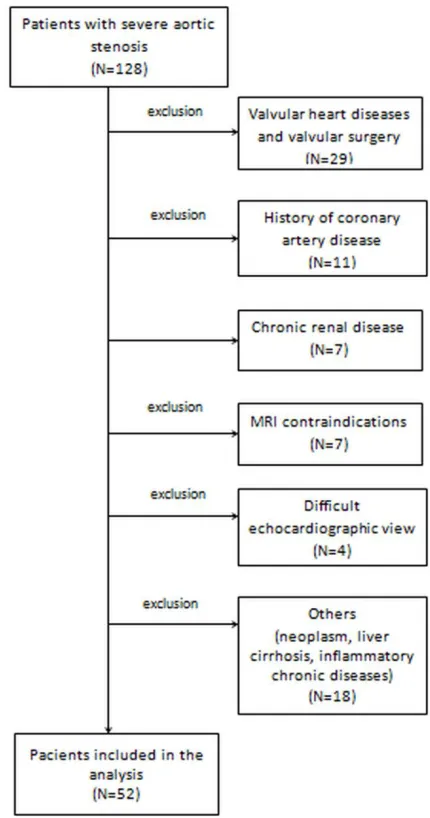
neoplasia, cirrhosis, pulmonary fibrosis, poor echocardiographic window or those who did not agree to participate were
excluded. The total number of excluded patients was 76 (Figure 1). Finally, 52 patients with severe AS (test group) were
compared to 52 volunteers (control group), matched for age and sex, who responded to a query excluding any history of chronic
heart disease, other than systemic arterial hypertension, without ongoing symptoms, normal clinical examination and normal
electrocardiogram, chest radiographs, echocardiography, Holter ECG monitoring for 24 hours and CMR imaging. Volunteers in
5
The current study was approved by the Ethics Committee of the Iuliu Hatieganu University of Medicine and Pharmacy,
Cluj-Napoca. The research was conducted in compliance with the Declaration of Helsinki. All patients were informed about the
investigation protocol and signed a written consent form before being assigned to either the test or control group. Each patient
underwent the same investigation protocol, including medical history, clinical examination, the recording of a 12-lead
electrocardiogram, 24-hour Holter monitoring, 6-minute walk test (6MWT), biochemical analysis, echocardiography and CMR
imaging, which were all performed during the same hospital visit.
2.2.Medical history and clinical examination
We recorded the medical history and cardiovascular risk factors of all enrolled subjects, including active smoking, systemic
arterial hypertension, dyslipidemia, diabetes, and obesity. Coronary artery disease was considered present if myocardial
infarction, angina pectoris, or revascularization (by either angioplasty or coronary artery by-pass) were performed. The New
York Heart Association (NYHA) functional classification was used to assess the severity of dyspnoea. Patients with severe AS
were considered symptomatic if they experienced dyspnoea, angina and/or syncope. A 12-lead electrocardiogram was recorded at enrolment and 24-hour Holter monitoring was performed. The 6MWT was performed in the presence of adequately trained
medical personnel following the American Thoracic Society guidelines, and the 6-minute walk distance (6MWD) was reported.
The risk of mortality after cardiac surgery was assessed by the EuroScore II [21] software available on www.euroscore.org.
2.3.Biochemical analysis
Two peripheral venous blood samples were collected at enrolment from each participant and serum was separated by
centrifugation. One sample was used for standard biochemistry tests, including high sensitive C reactive protein (hs-CRP)
measurements, with a Beckman Coulter AU480 Chemistry Analyzer. The other serum sample was preserved at -80°C until the
6
propeptide (PIIINP) and N-terminal pro-Brain Natriuretic Peptide (NT-proBNP) levels. All biomarker levels were determined
by the Sandwich ELISA technique according to the manufacturer’s instructions (Elabscience Biotechnology Co., Ltd.) For
determining PICP, we used Human PICP ELISA Kits, Elabscience Biotechnology Co. PIIINP was determined using Human
PIIINP ELISA Kits, and for NT-proBNP levels, Elabscience Biotechnology Co., Ltd, kits were used. Measurements were
performed by a single investigator who was blinded to all clinical and imaging data. Renal function was estimated by the
glomerular filtration rate (eGFR), using the Chronic Kidney Disease Epidemiology Collaboration equation, considering age,
race, gender, and plasma creatinine concentration. Renal function was considered impaired at eGFR <60 mL/min/1.73m2.
2.4.Echocardiography
Transthoracic echocardiography was performed in all participants to the study using a General Electric Vivid E9 (GE Health
Medical, Horten, Norway) echocardiograph with a M5S 1.5/4.6 MHz active matrix-phased array transducer. Examinations were
performed by two physicians (L.S. and C.O.), each with more than 10 years of experience in the field, and blinded to all clinical
and laboratory data. Echocardiography data was collected and reported according to guidelines from the European Association of Echocardiography and the American Society of Echocardiography [19-20] [22-23]. The severity of AS was quantified by
continuous wave Doppler measurements of peak aortic flow velocity and mean transaortic gradients; AVA was calculated
using the continuity equation and indexed to body surface area (BSA). LV systolic function was quantified by the LVEF (bi-plane Simpson’s modified rule). LV diastolic function and right chambers dimensions and functions were assessed following
global recommendations.
2.5.Cardiac Magnetic Resonance Imaging
All CMR imaging examinations were performed by two experienced examiners, one cardiologist and one radiologist (L.A.C.
7
on a 1.5 T MR scanner (Magnetom Symphony, Siemens Medical Solutions, Germany) with a dedicated surface coil for radio
frequency signal detection. Standard localized views and contiguous short-axis and 4-chamber cine views covering both
ventricles from base to apex were first acquired by ECG-gated steady-state free precession (SSFP) sequences, in apnea (Figure
2). Pre-contrast imaging parameters were selected at the beginning of the study and a standard protocol was applied for each
examination: repetition time 3.6 ms; echo time 1.8 ms; flip angle 60°; slice thickness 6 mm; field of view 360 mm; image
matrix of 192 x 192 pixels; voxel size 1.9 x 1.9 x 6 mm; 25-40 ms temporal resolution reconstructed to 25 cardiac phases. The
imaging plane of the aortic valve was defined by the acquisition of a systolic three-chamber view and an oblique coronal view
of the aortic valve and proximal aorta. Post-contrast, standard LGE images were acquired 10 minutes after intravenous injection
of 0.2 mmol/kg gadolinium contrast agent (Gadoterated imeglumine or Dotarem, Guerbet) in long- and short axis-views, using
a segmented inversion-recovery gradient-echo sequence. Inversion time was adjusted to optimize nulling of apparently normal
myocardium. Brachial blood pressure was monitored during CMR SSFP acquisitions. LV end-diastolic volume (LVEDV) and
end-systolic volume (LVESV), LVEF and end-diastolic LV mass (LVM) were measured on short-axis cine-SSFP images.
Epicardial and endocardial borders were traced semi-automatically at end-diastole and end-systole using specialized software (Argus, Siemens Medical Solutions). AVA was measured on cross-sectional planimetric images during systole by drawing the
region of interest. LV longitudinal function was assessed by LAS, defined as the difference in mitral annular displacement at
end-systole vs. end-diastole, and expressed in percentages. The presence and distribution of LGE in the LV were assessed from
short-axis images, using the 17-segments model, recommended by the American Heart Association [24].The pattern of LGE
distribution was characterized as mid-wall, subepicardial, focal or diffuse.
2.6.Clinical Outcomes
Patients were followed-up over a median time interval of 386 days (interquartile range: 60 to 730 days) by completing a query
8
end-point was a combination of major adverse cardiac events (MACE), including sudden cardiac death, non-fatal myocardial
infarction, sustained ventricular arrhythmias, third-degree atrioventricular block and hospitalization for heart failure. If more
than one event occurred, the most severe was selected. Hospitalizations due to non-cardiac causes were not considered in the
analysis. The duration of follow-up was determined from the CMR study date until the occurrence of a MACE. The last
evaluation of patient survival status was performed in August 2018 (the follow-up closing date). Complete follow-up was
available for all patients.
2.7.Statistical analysis
The normal distribution of data was tested by the Kolmogorov-Smirnoff test. Data were reported as mean and standard
deviation, or median and interquartile range (IQR). Relative frequencies for categorical variables were reported as percentages.
The Chi-square or Fisher’s exact tests were used to compare variables between the two groups. Multiple comparisons were
made using one-way ANOVA variance analysis or the Kruskall-Wallis test. Univariable and stepwise multivariable logistic
regression analyses were performed to determine the association between LAS and LGE, and other variables derived from imaging modalities. The hazard ratio (HR) for the prediction of events was calculated for each of the outcomes using a Cox
regression model. For each outcome of interest, we considered all of the significant variables in the univariate analysis and
sought the best overall multivariate models for the composite end point, by stepwise-forward selection, with a probability to
enter set at p <0.05 and to remove the effect from of regression at p <0.05. Event-free survival (time to first event) was
generated by the Kaplan–Meier method and statistical significance was determined by the log-rank test. Receiver operating
characteristic curve analysis was performed to study the predictive ability of LAS and LVEF for adverse cardio-vascular events.
Results were considered statistically significant for p <0.05. Cohen’s Kappa inter- and intra-observer coefficient calculation
9
variation according to sample size. The statistical analysis was performed using the MedCalc Software, version 16.1.2
(Mariakerke, Belgium).
3. Results
3.1.Baseline characteristics
The present study was designed as a pilot study to serve as data for sample size calculation. Based on LAS numeric values and
considering the threshold of alpha=0.05, our estimation of type II beta risk stands below 0.05. However, in order to ensure the
best power for inter-group tests, we have calculated a minimum necessary sample of 50 subjects /group (for type I alpha =0.05).
The study will be continued up to this limit for enabling us to decrease the type II error up to 0.05 (95% power).
All baseline characteristics of patients with AS and healthy volunteers are reported in Table 1. There were no statistically
significant differences in age, gender, body surface area, systemic artery pressures, active smoking or presence of diabetes
between the two groups. Patients in the test group had a poorer exercise capacity as assessed by the 6MWT.
Patients in the AS group had significantly higher levels of PICP (p< 0.001), PIIINP (p< 0.01), hs-CRP (p< 0.001) and NT-proBNP (p< 0.001) than patients in the control group.
The cause of AS in test group patients was calcification of a trileaflet valve (n=39), presence of a bicuspid aortic valve (n=6),
rheumatic disease (n=4), or undetermined (n=3). 47 (90%) patients with AS were symptomatic. LVEF was preserved in most
test group patients (n=38; 73%). Indexed LVM was increased ≥92 g/m2 in 28 patients (53.8%) and reduced LAS < -18% was
documented in 20 patients with AS (38.4%). LGE was found in 30 patients with AS (57.7%). LGE was distributed mid-wall in
12 patients (23%), in the sub-epicardial myocardium in 5 patients (9.6%), was focal in 10 patients (19.2%), and diffuse in 3
patients (5.7%).
10
CMR measurements were repeatedly performed on the same set of images, acquired from all patients in the study group.
Intra-and inter-observer reproducibility of LVEF Intra-and LAS measurements, Intra-and the assessment of LGE by CMR were excellent. The
kappa coefficients of agreement were 0.89 reader) and 0.91 (intra-reader) for the assessment of LGE, and 0.93
(inter-reader) and 0.96 (intra-(inter-reader) for LAS.
3.3.Survival analysis
During a median follow-up period of 386 (60 to 730) days, 22 patients (42.3%) had MACEs: non-fatal myocardial infarction
(n=2), sustained ventricular arrhythmias (n=2), third-degree atrioventricular block (n=3) and hospitalization for heart failure
(n=14). In three patients, MACEs (ventricular tachycardia and hospitalization for heart failure, respectively) occurred before
surgery. 19 other patients experienced MACEs after aortic valve replacement. Most patients (n= 17, 77.2%) with LGE on CMR
imaging had MACEs during follow-up.
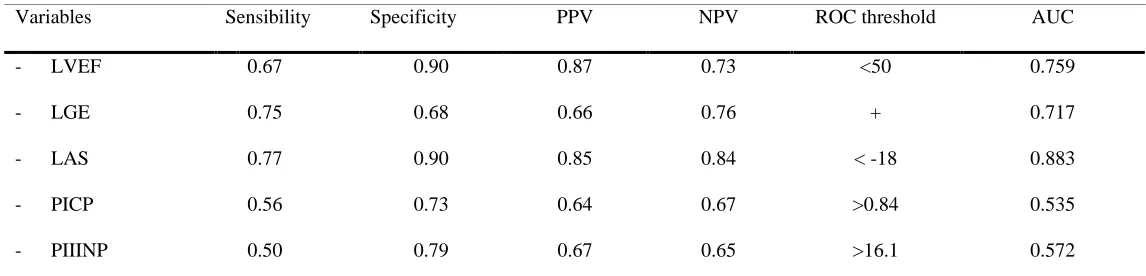
The discriminative performance of additional markers for MACEs was calculated by receiver operating characteristic curve
analysis for the combined end-point:LVEF (optimized cut-off value, < 50%; AUC, 0.759; p<0.01) and LAS (optimized cut-off value, <-18%; AUC, 0.883; p<0.0001) (Table 2). Interestingly, the biomarkers for enhanced collagen turnover had no
discriminative ability for MACEs in severe AS patients.
Kaplan-Meier curves for event-free survival showed a significantly higher rate of MACEs in patients with LGE (p< 0.01) and
decreased LAS (p< 0.001) at CMR imaging (Figure 2).
3.4.Uni- and multivariate analysis
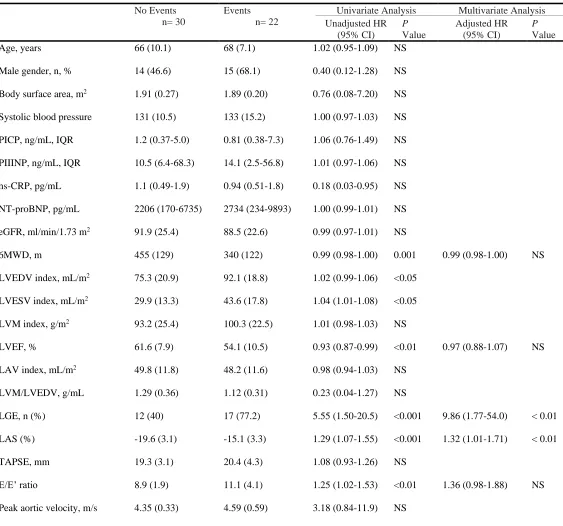
Several clinical parameters were predictors for the combined end-point in univariate analysis: the 6MWD, E/E’ ratio, LVEDV
11
In multivariate Cox regression analysis, only LGE and LAS (adjusted HR=9.86, 95%CI 1.77 to 54.0, p< 0.01, respectively,
HR=1.32, 95%CI 1.01-1.71, p< 0.01) remained independent predictors for MACEs (Table 3).
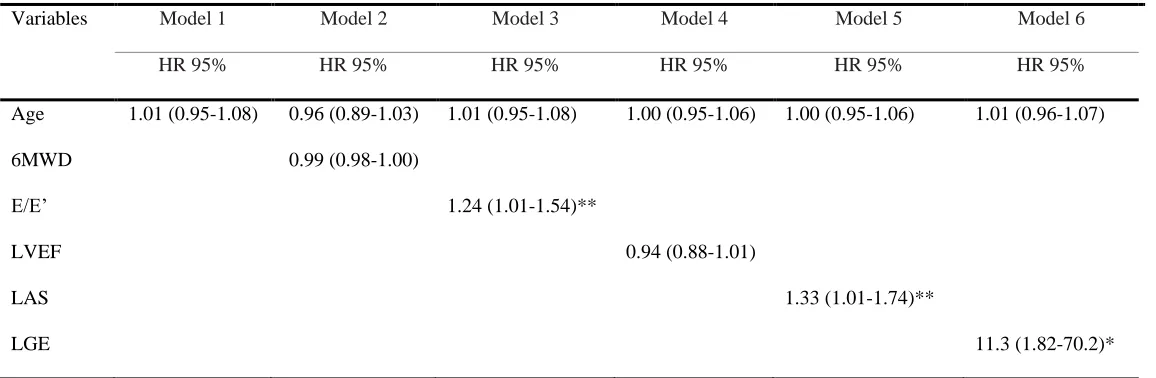
Subsequently, a stepwise multivariate Cox regression model was constructed, including age, 6MWD, E/E’ratio, LVEF, LAS
and the presence of LGE. Only reduced LAS [HR 1.33 (95% CI 1.01-1.74; chi-square: 15.1, p< 0.001] and LGE [HR 11.3
(95% CI 1.82-70.2); chi-square: 24.3, p< 0.001] were independent predictors for the combined end-point (Table 4).
3.5.Incremental predictive value for the combined end-point
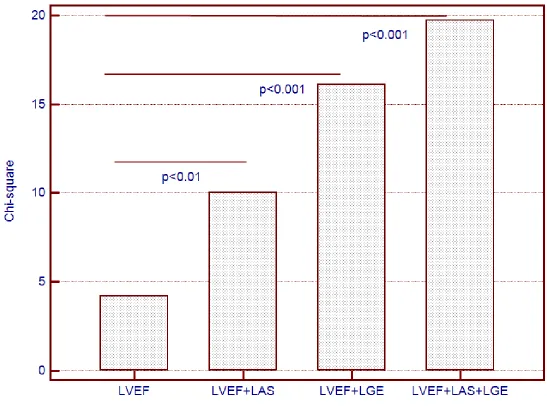
Sequential Cox proportional-hazards models yielded significantly increased predictive power for the combined end-point of
MACEs when both LGE and LAS were used in addition to LVEF (chi-square=19.74, one degree of freedom). Neither LGE, nor
LAS provided incremental predictive power when used alone, in addition to LVEF (Figure 3).
4. Discussion
In this prospective pilot study, we aimed to establish whether advanced CMR imaging techniques provide additional value in
identifying patients with severe AS at risk for MACEs.
We have shown that both LAS and the presence of LGE are more reliable than LVEF for predicting MACEs in patients with
severe AS, and that their combined use, in addition to LVEF, provided incremental value to any marker used alone.
Earlier echocardiography-based studies have demonstrated that global longitudinal strain is a reliable marker of cardiovascular
events in different categories of patients [25-26] and is superior to traditional measurements of LVEF for predicting MACEs in
patients with cardiovascular diseases [27].
Two relatively recent studies confirmed that CMR feature tracking with SSFP is a robust method for assessing LV mechanics
12
showing that impaired myocardial strain at CMR identifies ventricular function impairment in preclinical arrhythmogenic right
ventricular dysplasia [30] and light chain amyloidosis, even if LVEF is preserved [31]. Considering these findings, myocardial
strain assessment by CMR might become a val-uable tool for the early identification of myocardial impairment.
Currently, data on the use of strain assessment by CMR in patients with AS is scarce. Al Musa et al. reported that strain by
CMR is significantly decreased in patients with severe AS and preserved LVEF by comparison with healthy volunteers, and is
even more impaired if patients are symptomatic [32]. To our knowledge, there is currently no other published data on the
prognostic use of LAS in such patients, and our research is the first to address the relation with cardiovascular events.
By contrast, the presence of LGE has already been validated by previous studies as a marker of poor prognosis in severe AS.
The presence of LGE was associated with poorer outcomes after aortic valve replacement, including the lack of improvement in
symptoms and increased mortality [12] [33]. Moreover, in the study by Dweck et al., LGE provided incremental value to LVEF
for survival in patients with moderate to severe AS [10]. The quantitative assessment of LGE also seems useful for predicting
functional improvement and all-cause mortality after aortic valve replacement [10].
Although LGE assessment is obviously a valuable tool for risk stratification, in our study the predictive power for MACEs was increased when LAS was added to the model. By contrast, PCIP and PIIINP did not contribute at all, which is consistent with
previously published research [34]. Considering the results of our research and previously published data, LAS might become
an important part of LV function assessment at CMR, particularly considering that it does not require contrast administration.
Further research is needed to validate this hypothesis.
Firstly, the study was conducted in a single institution and has the inherent limitations of that approach. Secondly,
endomyocardial biopsies were not performed during surgery to assess the presence or absence of myocardial fibrosis in AS
patients. Also, we were unable to acquire T1 mapping sequences, and therefore extracellular volume and diffuse myocardial
13
Finally, LAS, as a marker of longitudinal contractile function, is an independent predictor of outcomes in patients with AS and
provides incremental value beyond the assessment of LVEF and the presence of LGE.
Authors’ contributions: LAC, DF - conceived and designed the study; LAC - acquisition, analysis and interpretation of data;
statistical methods and statistical interpretation of results; drafting of the manuscript; agreement to be accountable for all
aspects of the work in ensuring that questions related to the accuracy or integrity of any part of the work are appropriately
investigated and resolved; project administration. KB, CC; CP, LS, CO - acquisition, analysis and interpretation of data;
critical revision of the manuscript for intellectual content. SL - analysis and interpretation of data; original draft preparation;
critical revision of the manuscript for intellectual content. TM - analysis and interpretation of data; statistical methods and
statistical interpretation of results; critical revision of the manuscript for intellectual content;final approval of the version to be
published. All authors read and approved the manuscript.
Acknowledgments: This work was supported by internal institutional grant no. 4994/1/2016 from the Iuliu Hatieganu
University of Medicine and Pharmacy of Cluj-Napoca.
Conflicts of Interest:The all authors declare that they have no competing interests.
References
1.
Thaden, J.J.; Nkomo, V.T.; Enriquez-Sarano, M. The global burden of aortic stenosis. Prog. Cardiovasc. Dis. 2014, 56,565-571.
2.
Ng, A.C.; Delgado, V.; Bertini, M.; Antoni, M.L.; van Bommel, R.J.; van Rijnsoever, E.P.; et al. Alterations inmultidirectional myocardial functions in patients with aortic stenosis and preserved ejection fraction: a two-dimensional
14
3.
Nucifora, G.; Tantiongco, J.P.; Crouch, G.; Bennetts, J.; Sinhal, A.; Tully, P.J.; et al. Changes of left ventricular mechanicsafter trans-catheter aortic valve implantation and surgical aortic valve replacement for severe aortic stenosis: A tissue-tracking cardiac magnetic resonance study. Int. J. Cardiol. 2017, 228, 184-190.
4.
Kupari, M.; Turto, H.; Lommi, J. Left ventricular hypertrophy in aortic valve stenosis: preventive or promotive of systolicdysfunction and heart failure? Eur. Heart J. 2005, 26, 1790-1796.
5.
Cioffi, G.; Faggiano, P.; Vizzardi, E.; Tarantini, L.; Cramariuc, D.; Gerdts, E.; et al. Prognostic effect of inappropriatelyhigh left ventricular mass in asymptomatic severe aortic stenosis. Heart 2011, 97, 301-307.
6.
Natarajan, D.; Prendergast, B. Aortic stenosis - pathogenesis, prediction of progression, and percutaneous intervention. J. R.Coll. Physicians Edinb. 2017, 47, 172-175.
7.
Gallego, I.; Beaumont, J.; López, B.; Ravassa, S.; Gómez-Doblas, JJ.; Moreno, M.U.; et al. Potential role of microRNA-10bdown-regulation in cardiomyocyte apoptosis in aortic stenosis patients. Clin. Sci. (Lond). 2016, 130, 2139-2149.
8.
Alvarez-Llamas, G.; Martín-Rojas, T.; de la Cuesta, F.; Calvo, E.; Gil-Dones, F.; Dardé, V.M.; et al. Modification of thesecretion pattern of proteases, inflammatory mediators, and extracellular matrix proteins by human aortic valve is key in
severe aortic stenosis. Mol. Cell Proteomics 2013, 12, 2426-2439.
9.
Kamimura, D.; Suzuki, T.; Fox, E.R.; Skelton, T.N.; Winniford, M.D.; Hall, M.E. Increased leftventricular diastolic stiffness is associated with heart failure symptoms in aortic stenosis patients with preserved ejection
fraction. J. Card. Fail. 2017, 23, 81-88.
10.
Dweck, M.R.; Joshi, S.; Murigu, T.; Alpendurada, F.; Jabbour, A.; Melina, G.; et al. Midwall fibrosis is an independentpredictor of mortality in patients with aortic stenosis. J. Am. Coll. Cardiol. 2011, 58, 1271-1279.
11.
Barone-Rochette, G.; Piérard, S.; De Meester de Ravenstein, C.; Seldrum, S.; Melchior, J.; Maes, F.; et al. Prognosticsignificance of LGE by CMR in aortic stenosis patients undergoing valve replacement. J. Am. Coll. Cardiol. 2014, 64,
15
12.
Milano, A.D.; Faggian, G.; Dodonov, M.; Golia, G.; Tomezzoli, A.; Bortolotti, U.; et al. Prognostic value of myocardialfibrosis in patients with severe aortic valve stenosis. J. Thorac. Cardiovasc. Surg. 2012, 144, 830-837.
13.
Thavendiranathan, P.; Grant, A.D.; Negishi, T.; Plana, J.C.; Popović, Z.B.; Marwick, T.H. Reproducibility ofechocardiographic techniques for sequential assessment of left ventricular ejection fraction and volumes: application to
patients undergoing cancer chemotherapy. J. Am. Coll. Cardiol. 2013, 61, 77-84.
14.
Thavendiranathan, P.; Popović, Z.B.; Flamm, S.D.; Dahiya, A.; Grimm R.A.; Marwick, T.H. Improved interobservervariability and accuracy of echocardiographic visual left ventricular ejection fraction assessment through a self directed
learning program using cardic magnetic resonance images. J. Am. Soc. Echocardiogr. 2013, 26, 1267-1273.
15.
Delgado, V.; Tops, L.F.; van Bommel, R.J.; van der Kley, F.; Marsan, N.A.; Klautz, R.J.; et al. Strain analysis in patientswith severe aortic stenosis and preserved left ventricular ejection fraction undergoing surgical valve replacement. Eur.
Heart J. 2009, 30, 3037-3047.
16.
Naji, P.; Shah, S.; Svensson, L.G. Gillinov, A.M.; Johnston, D.R.; Rodriguez, L.L.; et al. Incremental prognostic use of leftventricular global longitudinal strain in asymptomatic/minimally symptomatic patients with severe bioprosthetic aortic
stenosis undergoing redo aortic valve replacement. Circ. Cardiovasc. Imaging. 2017, 10, pii:e005942.
17.
Azevedo, C.F.; Nigri, M.; Higuchi, M.L.; Pomerantzeff, P.M.; Spina, G.S.; Sampaio, R.O.; Tarasoutchi, F.; Grinberg, M.;Rochitte, C.E. Prognostic significance of myocardial fibrosis quantification by histopathology and magnetic resonance
imaging in patients with severe aortic valve disease. J. Am. Coll. Cardiol. 2010, 56, 278-287.
18.
Arenja, N.; Riffel, J.H.; Fritz, T.; André, F.; Aus dem Siepen, F.; Mueller-Hennessen, M.; et al. Diagnostic and prognosticvalue of long axis strain and myocardial contraction fraction using standard cardiovascular MR Imaging in patients with
16
19.
Nishimura, R.A.; Otto, C.M.; Bonow, R.O.; Carabello, B.A.; Erwin, J.P. 3rd; Guyton, R.A.; et al. 2014 AHA/ACCGuideline for the management of patients with valvular heart disease: executive summary: a report of the American College of Cardiology/American Heart Association Task Force on Practice Guidelines. Circulation 2014, 129, 2440-2492.
20.
Baumgartner, H.; Falk, V.; Bax, J.J.; De Bonis, M.; Hamm, C.; Holm, P.J.; et al. 2017 ESC/EACTS Guidelines for themanagement of valvular heart disease: The Task Force for the management of valvular heart disease of the European
Society of Cardiology (ESC) and the European Association for cardio-Thoracic Surgery (EACTS). Eur. Heart J. 2017, 38,
2739-2791.
21.
Paparella, D.; Guida, P.; Di Eusanio, G.; Caparrotti, S.; Gregorini, R.; Cassese, M.; et al. Risk stratification for in-hospitalmortality after cardiac surgery: external validation of EuroSCORE II in a prospective regional registry. Eur. J.
Cardiothorac. Surg. 2014, 46, 840-888.
22.
Nagueh, S.F.; Smiseth, O.A.; Appleton, C.P.; Byrd, B.F. 3rd; Dokainish, H.; Edvardsen, T.; et al. Recommendations for theevaluation of left ventricular diastolic function by echocardiography: An update from the American Society of
Echocardiography and the European Association of Cardiovascular Imaging. J. Am. Soc. Echocardiogr. 2016, 29, 277-314.
23.
Lang, R.M.; Badano, L.P.; Mor-Avi, V.; Afilalo, J.; Armstrong, A.; Ernande, L.; et al. Recommendations for cardiacchamber quantification by echocardiography in adults: an update from the American Society of Echocardiography and the
European Association of Cardiovascular Imaging. J. Am. Soc. Echocardiogr. 2015, 28, 1-39.
24.
Cerqueira, M.D.; Weissman, N.J.; Dilsizian, V.; Jacobs, A.K.; Kaul, S.; Laskey, W.K.; et al. American Heart Associationwriting group on myocardial segmentation and registration for cardiac imaging. Standardized myocardial segmentation and
nomenclature for tomographic imaging of the heart. A statement for healthcare professionals from the
Cardiac Imaging Committee of the Council on Clinical Cardiology of the American Heart Association. Circulation 2002,
17
25.
Motoki, H.; Borowski, A.G.; Shrestha, K.; Troughton, R.W.; Tang, W.H.; Thomas, J.D.; et al. Incremental prognostic valueof assessing left ventricular myocardial mechanics in patients with chronic systolic heart failure. J. Am. Coll. Cardiol. 2012, 60, 2074-2081.
26.
Stanton, T.; Leano, R.; Marwick, T.H. Prediction of all-cause mortality from global longitudinal speckle strain: comparisonwith ejection fraction and wall motion scoring. Circ. Cardiovasc. Imaging 2009, 2, 356-364.
27.
Kalam, K.; Otahal, P.; Marwick, T.H. Prognostic implications of global LV dysfunction: a systematic review andmeta-analysis of global longitudinal strain and ejection fraction. Heart 2014, 100, 1673-1680.
28.
Obokata, M.; Nagata, Y.; Wu, V.C.; Kado, Y.; Kurabayashi, M.; Otsuji, Y.; et al. Direct comparison of cardiac magneticresonance feature tracking and 2D/3D echocardiography speckle tracking for evaluation of global left ventricular strain.
Eur. Heart J. Cardiovasc. Imaging 2016, 17, 525-532.
29.
Onishi, T.; Saha, S.K.; Delgado-Montero, A.; Ludwig, D.R.; Onishi, T.; Schelbert, E.B.; et al. Global longitudinal strainand global circumferential strain by speckle-tracking echocardiography and feature-tracking cardiac magnetic resonance
imaging: comparison with left ventricular ejection fraction. J. Am. Soc. Echocardiogr. 2015, 28, 587-596.
30.
Bourfiss, M.; Vigneault, D.M.; Aliyari Ghasebeh, M.; Murray, B.; James, C.A.; Tichnell, C.; et al. Feature tracking CMRreveals abnormal strain in preclinical arrhythmogenic right ventricular dysplasia, cardiomyopathy: a multisoftware
feasibility and clinical implementation study. J. Cardiovasc. Magn. Reson. 2017, 19, 66.
31.
Li, R.; Yang, Z.G.; Xu, H.Y.; Shi, K.; Liu, X.; Diao, K.Y.; et al. Myocardial deformation in cardiac amyloid light-chainamyloidosis: assessed with 3T cardiovascular magnetic resonance feature tracking. Sci. Rep. 2017, 7, 3794.
32.
Al Musa, T.; Uddin, A.; Swoboda, P.P.; Garg, P.; Fairbairn, T.A.; Dobson, L.E.; et al. Myocardial strain and symptomseverity in severe aortic stenosis: insights from cardiovascular magnetic resonance. Quant. Imaging Med. Surg. 2017, 7,
18
33.
Weidemann, F.; Herrmann, S.; Störk, S.; Niemann, M.; Frantz, S.; Lange, V.; et al. Impact of myocardial fibrosis in patientswith symptomatic severe aortic stenosis. Circulation 2009, 120, 577-584.
34.
Kupari, M.; Laine, M.; Turto, H.; Lommi, J.; Werkkala, K. Circulating collagen metabolites, myocardial fibrosis and heart19
Figure Legends
20
Figure 2: Cardiovascular magnetic resonance (CMR) imaging in AS patients. (A) cine-SSFP imaging of a stenotic bicuspid
aortic valve; (B) coronal left ventricular outflow tract view acquired through-plane showing the aortic valve leaflet tips and
restricted leaflet motility and resultant high velocity jet; (C) 3-chamber view acquired through-plane showing the aortic valve
leaflet tips, restricted leaflet mobility, and high velocity jet; (D and E) 4-chamber view at end-diastole and end-systole acquired
for longitudinal axis strain (LAS); (F) late gadolinium enhancement (LGE) in short-axis views of left ventricle showing focal
21
Figure 3: Kaplan-Meier curves for event-free survival for (A) Longitudinal Axis Strain (LAS); (B) Late gadolinium
24
Figure 4: Incremental predictive value of longitudinal axis strain (LAS) and late gadolinium enhancement (LGE) added to left
25
Table 1: Baseline characteristics of patients in the test and control group
Test group Control group p-Value
Clinical characteristics n = 52 n = 52
- Age, years 66 (7.5) 66 (7.8) NS
- Male gender, n (%) 29 (55.7) 29 (55.7) NS
- Body surface area, m2 1.90 (0.24) 1.97 (0.13) NS
- Body-mass index, kg/m2 28.5 (4.1) 30.2 (4.9) NS
- Heart rate, bpm 73 (11.6) 72 (8.6) NS
- Systolic blood pressure, mmHg 132 (18.1) 133 (20.3) NS
- Hypertension, n (%) 37 (71.1) 28 (53.8) NS
- Diabetes mellitus, n (%) 22 (42.3) 14 (26.9) <0.01
- Dyslipidemia, n (%) 35 (67.3) 24 (46.1) NS
- Smoking, n (%) 19 (36.5) 13 (25) NS
- 6MWD, m 406 (138.1) 592 (103.9) < 0.001
- Coronary artery disease, n (%) 18 (32.6)
- Chronic obstructive lung disease, n (%) 7 (11.5)
- Peripheral vascular disease, n (%) 27 (51.9)
- NYHA functional class ≥III, n (%) 15 (28.8)
- Logistic EuroScore, % 3.8 (1.3-5.9)
Medications
- β-blockers, n (%) 40 (76.9) 14 (26.9) < 0.001
- ACEIs or ARBs, n (%) 45 (86.5) 10 (19.2) <0.001
26
- Statins, n (%) 38 (73) 15 (28.8) < 0.001
- ASA or other antiplatelet therapy, n (%) 32 (61.5) 13 (34.6) < 0.01
- Diuretics, n (%) 37 (71.1) 5 (9.6) < 0.001
Echocardiography
- Peak aortic velocity, m/s 4.45 (0.47) 1.31 (0.36) < 0.001
- Peak transaortic gradient, mmHg 82.1 (17.9) 7.2 (2.7) < 0.001
- Mean transaortic gradient, mmHg 52.9 (14.7) 3.6 (0.75) < 0.001
- AVA index, cm2/m2 0.52 (0.08) 2.9 (0.08) < 0.001
- E/E’ ratio 9.8 (3.2) 6.5 (0.8) < 0.001
- DT, ms 223 (52.2) 185 (8.8) < 0.001
- sPAP, mmHg 33.4 (7.3) 26.2 (7.2) NS
Cardiovascular magnetic resonance
- LVEDV index, mL/m2 82.4 (21.6) 61.8 (15.0) < 0.001
- LVESV index, mL/m2 35.7 (16.6) 20.9 (5.8) < 0.001
- LVM index, g/m2 96.2 (24.3) 62.1 (16.5) < 0.001
- LVEF, % 58.4 (9.7) 66.1 (4.7) < 0.001
- LVM/LVEDV, g/mL 1.22 (0.35) 1.04 (0.29) <0.01
- LAV index, mL/m2 49.1 (11.6) 25.5 (3.7) < 0.001
- LAS (%) -17.7 (3.9) -20.5 (1.5) < 0.001
- TAPSE, mm 14.9 (2.5) 19.8 (3.6) <0.001
- LGE, n (%) 30 (57.7)
Biomarker levels
- PICP, ng/mL, IQR 1.2 (0.37-7.3) 0.42 (0.38-4.6) < 0.001
27
- hs-CRP, pg/mL, IQR 1.1 (0.49-1.9) 0.74 (0.16-1.1) < 0.001
- NT-proBNP, pg/mL, IQR 1960 (170-9893) 210 (60-390) < 0.001
- eGFR, ml/min/1.73 m2 88.1 (24.1) 89.2 (19.6) NS
Abbreviations: n, number of patients; IQR, interquartile range; NYHA, New York Heart Association; NT-proBNP, N-terminal pro-Brain Natriuretic Peptide; hs-CRP, high
sensitive C reactive protein; PICP, procollagen type I C-terminal propeptide; PIIINP, procollagen type III N-terminal propeptide; eGFR, estimated glomerular filtration rate;
ACEI, angiotensin converting enzyme inhibitor; ARB, angiotensin receptor blocker; ASA, acetylsalicylic acid; LAS, left ventricular longitudinal-axis strain; LGE, left
ventricular late gadolinium enhancement; LVEDV, left ventricular end-diastolic volume; LVESV, left ventricular end-systolic volume; LVM, left ventricular mass; LVEF, left
ventricular ejection fraction; LAV, left atrial volume; E, peak mitral flow velocity; E’, early diastolic peak myocardial velocity; DT, early diastolic filling deceleration time;
sPAP, systolic pulmonary artery pressure; 6MWD, six minute walk distance; TAPSE, tricuspid annular plane systolic excursion; AVA, aortic valve area. Data are reported as
28
Table 2: Predictive ability of biological markers and imaging parameters for outcomes in severe AS patients considered for aortic
valve replacement surgery
Variables Sensibility Specificity PPV NPV ROC threshold AUC
- LVEF 0.67 0.90 0.87 0.73 <50 0.759
- LGE 0.75 0.68 0.66 0.76 + 0.717
- LAS 0.77 0.90 0.85 0.84 < -18 0.883
- PICP 0.56 0.73 0.64 0.67 >0.84 0.535
- PIIINP 0.50 0.79 0.67 0.65 >16.1 0.572
Abbreviations: PICP, procollagen type I C-terminal propeptide; PIIINP, procollagen type III N-terminal propeptide; LAS, left ventricular longitudinal axis strain; LGE, left
29
Table 3: Univariate and Multivariate Cox Analysis testing between studied parameters and MACEs
No Events n= 30
Events n= 22
Univariate Analysis Multivariate Analysis Unadjusted HR (95% CI) P Value Adjusted HR (95% CI) P Value
Age, years 66 (10.1) 68 (7.1) 1.02 (0.95-1.09) NS
Male gender, n, % 14 (46.6) 15 (68.1) 0.40 (0.12-1.28) NS
Body surface area, m2 1.91 (0.27) 1.89 (0.20) 0.76 (0.08-7.20) NS
Systolic blood pressure 131 (10.5) 133 (15.2) 1.00 (0.97-1.03) NS
PICP, ng/mL, IQR 1.2 (0.37-5.0) 0.81 (0.38-7.3) 1.06 (0.76-1.49) NS
PIIINP, ng/mL, IQR 10.5 (6.4-68.3) 14.1 (2.5-56.8) 1.01 (0.97-1.06) NS
hs-CRP, pg/mL 1.1 (0.49-1.9) 0.94 (0.51-1.8) 0.18 (0.03-0.95) NS
NT-proBNP, pg/mL 2206 (170-6735) 2734 (234-9893) 1.00 (0.99-1.01) NS
eGFR, ml/min/1.73 m2 91.9 (25.4) 88.5 (22.6) 0.99 (0.97-1.01) NS
6MWD, m 455 (129) 340 (122) 0.99 (0.98-1.00) 0.001 0.99 (0.98-1.00) NS
LVEDV index, mL/m2 75.3 (20.9) 92.1 (18.8) 1.02 (0.99-1.06) <0.05
LVESV index, mL/m2 29.9 (13.3) 43.6 (17.8) 1.04 (1.01-1.08) <0.05
LVM index, g/m2 93.2 (25.4) 100.3 (22.5) 1.01 (0.98-1.03) NS
LVEF, % 61.6 (7.9) 54.1 (10.5) 0.93 (0.87-0.99) <0.01 0.97 (0.88-1.07) NS
LAV index, mL/m2 49.8 (11.8) 48.2 (11.6) 0.98 (0.94-1.03) NS
LVM/LVEDV, g/mL 1.29 (0.36) 1.12 (0.31) 0.23 (0.04-1.27) NS
LGE, n (%) 12 (40) 17 (77.2) 5.55 (1.50-20.5) <0.001 9.86 (1.77-54.0) < 0.01
LAS (%) -19.6 (3.1) -15.1 (3.3) 1.29 (1.07-1.55) <0.001 1.32 (1.01-1.71) < 0.01
TAPSE, mm 19.3 (3.1) 20.4 (4.3) 1.08 (0.93-1.26) NS
E/E’ ratio 8.9 (1.9) 11.1 (4.1) 1.25 (1.02-1.53) <0.01 1.36 (0.98-1.88) NS
30
Peak aortic gradient, mmHg 78.7 (12.9) 86.9 (22.6) 1.02 (0.99-1.06) NS
Mean aortic gradient, mmHg 51.5 (12.5) 54.7 (17.4) 1.01 (0.97-1.05) NS
AVA index, cm2/m2 0.52 (0.08) 0.51 (0.08) 0.17 (0.08-0.98) NS
Abbreviations: n, number of patients; NT-proBNP, N-terminal pro-Brain Natriuretic Peptide; hs-CRP, high sensitive C reactive protein; eGFR, estimated glomerular filtration
rate; PICP, procollagen type I C-terminalpropeptide; PIIINP, procollagen type III N-terminal propeptide; LAS, left ventricular longitudinal-axis strain; LGE, left ventricular
late gadolinium enhancement; LVEDV, left ventricular end-diastolic volume; LVESV, left ventricular end-systolic volume; LVM, left ventricular mass; LVEF, left ventricular
ejection fraction; LAV, left atrial volume; E, peak mitral flow velocity; E’, peak myocardial velocity at the mitral valve annulus; DT, early diastolic filling deceleration time;
31
Table 4: Stepwise Multivariate Proportional Hazard Model for the Combined End Point
Variables Model 1 Model 2 Model 3 Model 4 Model 5 Model 6
HR 95% HR 95% HR 95% HR 95% HR 95% HR 95%
Age 1.01 (0.95-1.08) 0.96 (0.89-1.03) 1.01 (0.95-1.08) 1.00 (0.95-1.06) 1.00 (0.95-1.06) 1.01 (0.96-1.07)
6MWD 0.99 (0.98-1.00)
E/E’ 1.24 (1.01-1.54)**
LVEF 0.94 (0.88-1.01)
LAS 1.33 (1.01-1.74)**
LGE 11.3 (1.82-70.2)*
Abbreviations: 6MWD, six minute walk distance; E, peak mitral flow velocity; E’, peak myocardial velocity at the mitral valve annulus; LAS, left ventricular longitudinal-axis
strain; LGE, left ventricular late gadolinium enhancement; LVEF, left ventricular ejection fraction.