• No results found

Fully Secure Anonymous Hierarchical Identity-Based Encryption with Constant Size Ciphertexts

N/A
N/A
Protected

Academic year: 2020

Share "Fully Secure Anonymous Hierarchical Identity-Based Encryption with Constant Size Ciphertexts"

Copied!
17
0
0

Loading.... (view fulltext now)

Full text

(1)

Fully Secure Anonymous Hierarchical Identity-Based

Encryption with Constant Size Ciphertexts

Jae Hong Seo and Jung Hee Cheon

Department of Mathematical Sciences and ISac-RIM, Seoul National University, Seoul, 151-747, Korea {jhsbhs0,jhcheon}@snu.ac.kr

Abstract. Efficient and privacy-preserving constructions for search functionality on encrypted data is important issues for data outsourcing, and data retrieval, etc. Fully secure anonymous Hierarchical ID-Based Encryption (HIBE) schemes is useful primitives that can be applicable to searchable encryptions [4], such asID-based searchable encryption,temporary searchable encryp-tion[1], andanonymous forward secure HIBE [9]. We propose a fully secure anonymous HIBE scheme with constant size ciphertexts.

keywords.Hierarchical Based Encryption (HIBE), Anonymous Hierarchical Identity-Based Encryption, Public-key Encryption with Keyword Search (PEKS)

1 Introduction

Shamir introduced the notion of Identity-Based Encryption (IBE) which is a public-key cryp-tosystem being able to use any string, such as e-mail, as a public key [20], and Boneh and Franklin proposed the first IBE scheme using pairing [5]. Hierarchical Identity Based Encryp-tion (HIBE) is an extension allowing high level users to delegate their key generaEncryp-tion ability to the low level users [16, 15]. Abdalla et. al. introduced the notion of anonymous IBE and anonymous HIBE that satisfy an additional privacy requirement such that no adversary can obtain information for the recipient’s identityIDfrom ciphertexts if she do not have a private key ofIDor its ancestors’ [1]. Both anonymous IBE and anonymous HIBE is useful primitives that can be applicable to encryption systems allowing search functionality on encrypted data [4, 1, 9, 7, 21].

The first realization of an anonymous HIBE scheme is proposed by Boyen and Waters [9]. Since Boyen and Waters’ anonymous HIBE, several approaches to build an anonymous HIBE scheme are introduced [22, 19, 14]. However, all previous anonymous HIBE schemes proved their securities in theselective security model that restricts the adversary to commit the target ID before that public parameters are generated by the challenger in the secu-rity game. Selectivesecurity notion does not reflect real adversaries’ behaviors sufficiently. In contrast to selective security model, full security model allows the adversary to be able to choose the target identity after obtaining public system parameters and private keys which are adaptively chosen by the adversary. Therefore, full security is stronger security notion than selective security, and it reflects real world adversary well. We propose a HIBE scheme satisfying following properties together,fullsecurity, anonymity, and constant size ciphertexts.

(2)

combine techniques in two schemes. Seo et. al.’s ideas to obtain anonymity are blinding public parameters and ciphertexts, and adding re-randomization subkeys into private keys. In their scheme, adding re-randomization subkeys into private keys does not impact the security proof since re-randomization subkeys do not contain the master secret key used to decrypt. More precisely, in the security proof ofselective model, the simulator know the target ID∗ before he generates public parameters, so that he can generate public parameters to allow to be able to generate all private keys except for the targetID∗. That is, when the simulator generates public parameters, the element hard to compute in the underlying hard problem is embedded to the private key forID∗. Hence the simulator can generate almost all elements except the private key for targetID∗ and its ancestors’, and so he can easily generate re-randomization subkeys for all private keys. However, this strategy cannot apply to the full security model directly. Since the simulator cannot see targetID∗ before generating public parameters, the simulator should be able to generate all private keys to reply key extraction queries. There-fore, adding re-randomization subkeys to private keys is not an easy work contrast to the scheme in [19].

We construct the scheme in bilinear groups of composite order of four primes, and give the provable security of our construction under six new static assumptions. Even though our con-struction use composite order group of four primes, we claim that our concon-struction is practical in comparison with other anonymous HIBE schemes. All selective secure (H)IBE scheme can be transfered to the full secure scheme by increasing group size [2]. This transformation in-creases, however, the group size exponentially according to the maximum hierarchical depth, eventually resulting schemes are very inefficient compare to our construction. Moreover, as-sumptions used to prove confidentiality and anonymity of our scheme are static (but not standard). I.e. assumptions are independent from the maximum number of the adversary’s private key queries.

(3)

2 Definitions

In this section we define anonymous HIBE scheme and give their security models.

2.1 Anonymous HIBE scheme

Every user of HIBE scheme has an ID consisting of a vector as a public key such as ID = [I1,· · ·, Ik] where k means user’s position in the hierarchy. We sometimes denote ID|k to emphasize the length of ID instead of ID when the length of ID is k. The root node of hierarchy means Private Key Generator (PKG), denoted byID|0.

Definition 1. A HIBE scheme consists of four probabilistic algorithms, Setup, KeyGen, Enc

andDec algorithms as follows.

Setup(λ, `) → {params,MSK}. Setup takes the security parameter λ and the maximum hierarchical depth`as input, and it generates public system parameters, denoted by params and the master secret key, denoted by M SK = P vkID|0. params includes the message

space M, the ciphertext space CT and the identity space I. M SK is kept by PKG as secret values.

KeyGen(P vkID|τ, ID|k)→ {P vkID|k}.KeyGengenerates the private keyP vkID|k of the iden-tityID|k using the private key P vkID|τ for the identityID|τ where τ < k andID|τ is an ancestor identity of ID|k.

Enc(params, ID, M)→ {CT}. Enc outputs a ciphertext CT ∈ CT for a message M ∈ M

and a recipient identityID∈ I.

Dec(P vkID, CT)→ {M}. Dec returns the message M ∈ M.

Enc and Dec have to satisfy the consistency constraint such that for every identity ID ∈ I

and the corresponding private keyP vkID generated byKeyGenand every message M ∈ M,

Dec(P vkID,Enc(params,ID,M)) =M

where the probability goes over all randomness used in all algorithms above.

2.2 Security Models

We deal with two kinds of security notions, the confidentiality and the anonymity. Confi-dentiality means that ciphertexts does not leak information about corresponding plaintexts, and the anonymity means recipient’s privacy. Both of security notions are defined by games between an adversaryAand a challengerC, IND-ID-CPA game for confidentiality and ANON-ID-CPA game for anonymity.

IND-ID-CPA Game:

Setup.C runsSetupand givesApublic system parameters and retains the master secret key as secret values.

Query Phase 1. A adaptively issues identities ID. C generates P vkID by running KeyGen, and sends P vkID toA.

Challenge. A outputs two equal length messages M0, M1 and a target identity ID∗. The

(4)

Query Phase 2.RepeatQuery Phase 1. The only restriction isAcannot query for the target identityID∗ and its prefixes.

Guess.Aoutputs a guess β0 ofβ, and then wins ifβ =β0.

The advantage of A in the above game is defined as the absolute value of the difference between the probability of β =β0 and 1/2.

Definition 2. We say that an HIBE scheme is IND-ID-CPA secure if for any polynomial time adversary, its advantage in IND-ID-CPA game is negligible.

ANON-ID-CPA Game:

Setup.C runsSetupand givesAthe public system parameters and retains the master secret key as secret values.

Query Phase 1. A adaptively issues identities ID. C generates P vkID by running KeyGen, and sends P vkID toA.

Challenge.Aoutputs messageM and two target identities ID∗0 and ID∗1. Both of two target identities and their prefixes have not queried before. Then, C flips a random coin β and makes the challenge ciphertext,Enc(params,ID∗β,M). Then sends it to the adversary.

Query Phase 2.RepeatQuery Phase 1. The only restriction isAcannot query for the target identities and their prefixes.

Guess.Aoutputs a guess β0 ofβ, and then wins ifβ =β0.

The advantage ofAin ANON-ID-CPA game is defined as the absolute value of the difference between the probability of β =β0 and 1/2.

Definition 3. We say that an HIBE scheme is ANON-ID-CPA secure if for any polynomial time adversary, its advantage in ANON-ID-CPA game is negligible.

We can extend the above security notions to the CCA security notions, IND-ID-CCA and ANON-ID-CCA by allowing the adversary to use the decryption oracle in Query Phases of both games. CCA security can be achieved from CPA security by using techniques that are method of transforming from CPA-secure (`+ 1)-level HIBE to CCA-secure`-level HIBE, for example [3, 8]. Therefore in this paper we only focus on CPA security notions.

3 Background in Mathematics and Complexity Assumptions

3.1 Bilinear Groups of Composite Order

We will use a bilinear group of composite order n =p1p2p3p4. Bilinear groups of composite

order were introduced by Boneh, Goh, and Nissim [6]. Many literatures make cryptographic schemes over composite order bilinear groups [6, 7, 17, 22, 23, 19, 18].

Let G be a group generating algorithm that takes a security parameter λas a input and outputs a tuple

(p1, p2, p3, p4,G,GT, e)

wherep1, p2, p3and p4 are distinct primes,GandGT are cyclic groups of ordern=p1p2p3p4,

ande:G×G→GT is a non-degenerate bilinear map; i.e.,esatisfies the following properties: 1. (bilinear) For∀g1, h1∈Gand ∀a, b∈Z,e(ga1, hb1) =e(g1, h1)ab.

(5)

3. (efficiently computable) There exists an efficient algorithm that computes bilinear mape

in polynomial time with respect toλ.

We assume that group operations in Gand GT are all computable in polynomial time with respect to λ. Furthermore, we assume that descriptions of G and GT contain generators as well as identity elements 1G, 1GT ofG andGT, respectively.

We will use a notationGpi to denote a subgroup ofGof orderpi. ThenGis a direct product ofGpi’s,Gp1 ×Gp2 ×Gp3 ×Gp4. We use notationsGpipj and Gpipjpk to denote subgroups of order pipj and pipjpk, respectively. Since G has a composite order n=p1p2p3p4, subgroups

with order as a factor ofN exist, hence such notations make sense.

If X is a generator of G, then Xp2p3p4, denote to X1, is a generator of Gp1. Similarly Xp1p3p4,Xp1p2p4,Xp1p2p3 are generators of

Gp2,Gp3,Gp4, respectively, and denote toX2,X3, X4, respectively. We note that e(Ri, Rj) = 1 for distinct i and j, and all random elements

Ri ∈ Gpi, Rj ∈ Gpj. This is followed from the fact that e(Ri, Rj) = e(X a

i, Xjb) for some integersa, b∈ZN, ande(Xia, Xjb) =e(X

p1p2p3p4 pi a, X

p1p2p3p4

pj b) =e(X, X)p1p2p3p4 p1p2p3p4

pipj ab = 1

since i6=j.

3.2 Complexity Assumptions

We need six complexity assumptions to prove the security of our anonymous HIBE construc-tion. Our assumptions are not standard assumptions, however, these guarantee the security against adversarial strategy that does not use the properties of group representation if the finding nontrivial factors of the group order is hard. The hardness of our assumptions relies on the theorems of Katz, Sahai, and Waters [17].

Assumption 1:

For a given group generatorG, let the following distribution beP1(λ).

(p1, p2, p3, p4,G,GT, e) R

← G(λ), n←p1p2p3p4,

g←R Gp1, X3

R

←Gp3, X4

R ←Gp4

D←(G, n, g, X3, X4), T0

R

←Gp1p2p4, T1

R ←Gp1p4,

β← {R 0,1}, T ←T0·(1−β) +T1·β.

Give (D, T) to the adversary B. Then B outputs β0, and succeeds if β = β0. We define the advantage of the adversary B above, denote to Adv1G,B(λ), in group generated by G to be

the absolute value of the difference of the success probability of the adversary and 1/2, where the probability is over the distribution P1(λ) and the random coins ofB.

Definition 4. We say that a group generator G satisfies Assumption 1 if Adv1G,B(λ) is a

negligible function of λ for any polynomial time adversaryB.

Assumption 2:

For a given group generatorG, let the following distribution beP2(λ).

(p1, p2, p3, p4,G,GT, e) R

← G(λ), n←p1p2p3p4,

g, X1

R

←Gp1, X2, Y2

R

←Gp2, X3, Y3

R

←Gp3, X4

R ←Gp4

D←(G, n, g, X1X2, X3, Y2Y3, X4), T0

R

←Gp1p2p3, T1

(6)

β← {R 0,1}, T ←T0·(1−β) +T1·β.

Give (D, T) to the adversary B. Then B outputs β0, and succeeds if β = β0. We define the advantage of the adversaryBabove, denote toAdv2G,B(λ), in group generated byG to be the

absolute value of the difference of the success probability of Band 1/2, where the probability is over the distribution P2(λ) and the random coins ofB.

Definition 5. We say that a group generator G satisfies Assumption 2 if Adv2G,B(λ) is a

negligible function of λ for any polynomial time adversaryB.

Assumption 3:

For a given group generatorG, let the following distribution beP3(λ).

(p1, p2, p3, p4,G,GT, e) R

← G(λ), n←p1p2p3p4,

X1

R

←Gp1, Y2

R

←Gp2, X3, Y3, Y

0

3

R

←Gp3, X4

R ←Gp4

D←(G, n, X1, Y2Y3, X3, X4), T0←Y2Y

0

3, T1

R ←Gp2p3,

β← {R 0,1}, T ←T0·(1−β) +T1·β.

Give (D, T) to the adversary B. Then A outputs β0, and succeeds ifβ =β0. We define the advantage of the adversaryBabove, denote toAdv3G,B(λ), in groups generated byGto be the

absolute value of the difference of the success probability of Band 1/2, where the probability is over the distribution P3(λ) and the random coins ofB.

Definition 6. We say that a group generator G satisfies Assumption 3 if Adv3G,B(λ) is a negligible function of λ for any polynomial time adversaryB.

Assumption 4:

For a given group generatorG, let the following distribution beP4(λ).

(p1, p2, p3, p4,G,GT, e) R

← G(λ), n←p1p2p3p4,

X1

R

←Gp1, Y2

R

←Gp2, X3

R

←Gp3, X4, Y4

R ←Gp4

D←(G, n, X1, Y2Y4, X3, X4), T0

R

←Gp2p4, T1

R ←Gp4,

β← {R 0,1}, T ←T0·(1−β) +T1·β.

Give (D, T) to the adversary B. Then A outputs β0, and succeeds ifβ =β0. We define the advantage of the adversaryBabove, denote toAdv4G,B(λ), in groups generated byGto be the

absolute value of the difference of the success probability of Band 1/2, where the probability is over the distribution P4(λ) and the random coins ofB.

Definition 7. We say that a group generator G satisfies Assumption 4 if Adv4G,B(λ) is a negligible function of λ for any polynomial time adversaryB.

Assumption 5:

For a given group generatorG, let the following distribution beP5(λ).

(p1, p2, p3, p4,G,GT, e) R

← G(λ), n←p1p2p3p4,

g, X1, Y1

R

←Gp1, X2, Y2, Z2

R

←Gp2, X3, Z3

R

←Gp3, X4

R ←Gp4

D←(G, n, g, X1X2, X3, Y1Y2, Z2Z3, X4),

T0←e(X1, Y1), T1

(7)

Give (D, T) to the adversary B. Then B outputs β0, and succeeds if β = β0. We define the advantage of the adversaryBabove, denote toAdv5G,B(λ), in groups generated byGto be the

absolute value of the difference of the success probability ofBand 1/2, where the probability is over the distributionP5(λ) and the random coins ofB.

Definition 8. We say that a group generator G satisfies Assumption 5 if Adv5G,B(λ) is a negligible function of λ for any polynomial time adversaryB.

Assumption 6:

We uses Assumption 6 to prove the anonymity of our anonymous HIBE construction. For a given group generatorG, let the following distribution beP6(λ).

(p1, p2, p3, p4,G,GT, e) R

← G(λ), n←p1p2p3p4,

X1, Y1, W1

R

←Gp1, Y2, Z2, W2, W 0

2

R

←Gp2, Z3

R ←Gp3,

X4, Z4, W4, W40

R ←Gp4

D←(G, n, X1X4, Y1Y2, Z2, Z3, Z4, W1W2W4),

T0←W1W

0

2W

0

4, T1

R

←Gp1p2p4,

β← {R 0,1}, T ←T0·(1−β) +T1·β.

Give (D, T) to the adversary B. Then B outputs β0, and succeeds if β = β0. We define the advantage of the adversaryBabove, denote toAdv6G,B(λ), in groups generated byGto be the

absolute value of the difference of the success probability ofBand 1/2, where the probability is over the distributionP6(λ) and the random coins ofB.

Definition 9. We say that a group generator G satisfies Assumption 6 if Adv6G,B(λ) is a

negligible function ofλ for any polynomial time adversaryB.

4 Construction

In this section we proposed a fully secure anonymous HIBE with constant size ciphertexts. We build a scheme in bilinear groupsGof composite order of product of four primes,n=p1p2p3p4.

We utilize subgroupsGp1,Gp2,Gp3,Gp4 ofGfor different usage. All meaningful information

are embedded in a subgroupGp1. SubgroupsGp3 and Gp4 are respectively used private keys

and public parameters to look like random. SubgroupGp2 is not appeared in real scheme. We

useGp2 only for security proof.

All public parameters and ciphertexts are blinded by random elements of Gp4, so

cipher-texts does not leakID information. If the private key does not have blinding factors inGp4,

blinding factors of ciphertexts will be removed during paring operation in the decryption procedure. HIBE schemes usually use public parameters to re-randomize children’s key in delegation algorithm, however, if public parameters have blinding factors, we cannot use pub-lic parameters to re-randomize children’s key. If then, decryption algorithm will not work correctly. Therefore we need to add re-randomization subkey to the private key. We now de-scribe our construction with keeping this idea in mind.

Setup(λ, `): First, the setup algorithm runs group generator G and obtains (p1, p2, p3, p4,

G,GT, e). Next, it chooses random elements g, h, u1,· · · , u`, w,∈ Gp1,X3 ∈Gp3,X4 ∈Gp4, R4,g, R4,h, R4,u1, · · ·, R4,u` ∈ Gp4. It then, sets n = p1p2p3p4, G = gR4,g, H = hR4,h, U1=u1R4,u1,· · ·, U`=u`R4,u` and E=e(g, w), and

(8)

Lastly, it publishes theparams and retain the M SK as secret values.

Enc(params,ID,M): ParseIDto [I1,· · · , Ik].Encpicks a random integers∈Znand random elements ¯R4,R¯04 ∈ Gp4. A random element of Gp4 can be chosen by raising X4 to random

exponents from ZN. Next, it sets

CT ←[ C0 =M Es, C1= (H

Qk i=1U

Ii

i )sR¯4, C2 =GsR¯04 ] ∈GT ×G3.

KeyGen(M SK, ID): ParseIDto [I1,· · · , Ik].KeyGenalgorithm picks random integersr1, r2 ∈

ZN and random elements

R3(d), R03(d), R(kd+1) ,· · ·, R(`d), R3(r), R03(r), R(kr+1) ,· · · , R`(r)∈G2(p3`−k)+4.

The private keyP vkIDconsists of two subkeysP vk(IDd)∈G`p−1pk3+2 andP vk

(r)

ID∈G`

−k+2

p1p3 .P vk

(d)

ID is used for decryption and delegation, and P vk(IDr) is used for re-randomization. It sets

P vkID(d)← [K1(d)=gr1R(d)

3 , K (d) 2 =w(h

Qk i=1u

Ii i )r1R

0(d) 3 , E

(d)

k+1 =u

r1

k+1R (d)

j+1,· · · , u

r1

` R

(d)

` ].

P vkID(r) ←[K1(r) =gr2R(r)

3 , K (r)

2 = (h

Qk i=1u

Ii i )r2R

0(r) 3 , E

(r)

k+1=u

r2

k+1R (r)

j+1,· · · , u

r2

` R

(r)

` ].

KeyGen(P vkID|k−1, ID|k): Given a private keyP vkID|k−1 for 2≤k≤`, this algorithm derives

the private key for ID|k. Parse P vkID|k−1 to P vk

(d)

ID|k−1 = [K

(d) 1 , K

(d)

2 , E

(d)

k ,· · · , E

(d)

` ] and

P vkID(r)|

k−1 = [K

(r) 1 , K

(r) 2 , E

(r)

k ,· · ·, E

(r)

` ]. This algorithm consists of two steps, Delegate step and Re-randomize step. In Delegate step, it generates the private key for child, ID|k. The result of Delegatestep is sufficient to decrypt the ciphertext for ID|k, however, the random-ness of these keys are associated with parents keys. It means that distributions of private keys generated by Delegate step are different from private keys generated by M SK. We set two distributions to be same by carrying outRe-randomizestep after Delegatestep.

Step 1 (Delegate Step): for∀i∈[k+ 1, `],

[K10(d), K20(d), Ei0(d)]←[K1(d), K2(d)(Ek(d))Ik, E(d) i ],

[K10(r), K20(r), Ei0(r)]←[K1(r), K2(r)(Ek(r))Ik, E(r) i ].

Step 2 (Re-randomize Step): Choose two random integers s, t∈ZN and random elements ¯

R3(d),R¯03(d),R¯(kd+1) ,· · ·, ¯R(`d), ¯R3(r),R¯03(r),R¯(kr+1) ,· · · ,R¯(`r) from Gp3. Random elements inGp3 can

be generated by raising X3 to random exponent from Zn. P vkID(d)|k and P vk

(r)

ID|k are respec-tively re-randomized as follows:

[K10(d)(K10(r))sR¯(3d), K20(d)(K20(r))sR¯03(d), Ei0(d)(Ei0(r))sR¯(id)],

(9)

Dec(P vkID, CT): ParseID,CT andP vkdIDto [I1,· · ·, Ik], [C0, C1, C2] and [K1(d),K (d) 2 ,E

(d)

k+1,

E`(d)], respectively. ThenDec outputs

M ← C0·

e(K1(d), C1)

e(K2(d), C2)

We can easily check the correctness of theDecalgorithm for a valid ciphertext so that we omit details.

5 Security Analysis

To prove the security of our anonymous HIBE scheme, we take the proof methodology of [23, 18]. In other word, we first define semi-functional ciphertexts and semi-functional keys, and we will show that the real security game is computationally indistinguishable from a game that all query results are semi-functional ones. In the real game, the simulator can always check whether the challenge ciphertext is valid or not by generating the corresponding private key himself. Therefore it is uneasy to make reduction to the hard problem. If the simulator, however, can only generate semi-functional ones (ciphertexts and keys), he cannot check by himself the validity of the ciphertexts since functional keys cannot decrypt the semi-functional ciphertext except for the special case. Therefore it is possible to make reduction to the hard problem. Semi-functional ciphertexts are of the form

C0 =C00, C1 =C10g

xzc

2 , C2=C20g2x

whereC00, C10, C20 are the result of Enc algorithm,g2 ∈Gp2, andx, zc

R

ZN. Semi-functional keys are of the form

K1(d)=K10(d)g2γ, K2(d) =K20(d)gγzk

2 , E

(d)

i =E

0(d)

i g

γzi

2 ,

K1(r) =K10(r)g2γ0, K2(r)=K20(r)gγ

0z0

k

2 , E

(r)

i =E

0(r)

i g

γ0zi0

2 ,

for∀i∈[j+1, `], whereK10, K20, Ej0+1,· · ·E`0 are the result ofKeyGenalgorithm,g2∈Gp2, and γ, γ0, zk, zj+1,· · ·, z`

R

ZN. Since elements of Gp2 are used in the semi-functional ones, Dec

algorithm will remove elements ofGp2 if it takes semi-functional keys and normal ciphertexts,

or normal keys and semi-functional ciphertexts. However, Dec algorithm outputs the result multiplied by additional term e(g2, g2)xγ(zc−zk) if it takes functional keys and

semi-functional ciphertexts. Ifzk=zc, then the additional term is 1GT, so that decryption will be correct.

We uses a hybrid argument to prove the confidentiality. The first game is the real IND-ID-CPA game, denote toGameReal. The second gameGameRestrictedrestricts that the adversary cannot query for the private key for identities which are prefixes of the challenge identity mod-ulus p2, and remains others are same to GameReal. Next, we defineq+ 1 number of games,

Gamekwhere 0≤k≤q, andqis the number of key extraction queries made by the adversary. InGamek, the adversary is given semi-functional ciphertext as the challenge ciphertext, and the firstk key extraction results are also semi-functional keys, and others are remained like

(10)

GameM hiding, so that his advantage is information theoretically zero in GameM hiding. The security proof consists of the proofs of indistinguishability between each sequential games.

Theorem 1. Our HIBE scheme is IND-ID-CPA secure if the group generator G holds As-sumption 1, 2, 3, 4 and 5.

Lemma 1. If a group generatorGsatisfies Assumption2,3and4, there is no adversary such that the difference of the advantage in betweenGameReal andGameRestrictedis non-negligible. proof.Suppose thatAoutput identitiesID0andID1such thatID06=ID1mod nandID0=

ID1 mod p2. Then simulator S can compute a nontrivial factor of n by taking gcd(ID0−

ID1, N). Let gcd(ID0 −ID1, N)=a, and b = Na. Then we consider the following two cases:

(Three cases cover all possibilities.)

1.p1 dividesb

2.p3 dividesb

3.p4 dividesb.

In case 1,S will break Assumption 2. Given instance of Assumption 2, g, X1X2,X3, Y2Y3, X4

and T, S simulates using g, X3, and X4, and then obtains b from A. (Given g, X3, X4 S

can simulate with the adversary A.) S checks p1|b by testing gb = 1. Next, S computes

e((X1X2)b, T). Ife((X1X2)b, T) is the identity ofGT, thenT ∈Gp1p3. Otherwise,T ∈Gp1p2p3.

In case 2, S will break Assumption 3. Given instance of Assumption 3.X1, Y2Y3, X3, X4

andT,S simulates usingX1, X3 andX4, and then obtainsb.S checksp3|bby testingX3b = 1.

Next, S checks e((Y2Y3)b, Y2Y3) = e(Tb, Y2Y3). If the equality holds, then Gp2 part of T is

same toY2. Otherwise, Gp2 part ofT is random.

In case 3, S will break Assumption 4. Given instance of Assumption 4.X1, Y2Y4, X3, X4

andT,S simulates usingX1, X3 andX4, and then obtainsb.S checksp4|bby testingX4b = 1.

Next, S checks whether e((Y2Y4)b, T) = 1GT or not. If the equality holds, then T is chosen

fromGp4. Otherwise, T is chosen fromGp2p4.

Lemma 2. If a group generator G satisfies Assumption 1, there is no adversary such that the difference of the advantage in betweenGameRestricted and Game0 is non-negligible.

proof.SimulatorS is given the instance of Assumption 1 ,G, n, g, X3, X4 and T.

Setup: S chooses random integers b, a1,· · ·, a`, α ∈ Zn and random elements R4,g, R4,h,

R4,u1,· · ·, R4,u` ∈ Gp4. (S can compute random elements in Gp4 from randomly exponents

ofX4.) It sets and sends params ← [G,n,G =gR4,g,H =gbR4,h,U1 =ga1R4,u1,· · · ,U` = ga`R

4,u`, X3,X4,E =e(g, g

α)] toA. Keep [g=g, h=gb, u

1 =ga1,· · · , u`=ga`, w=gα]

Query Phase:S returns to private query for ID= [I1,· · · , Ik]. Since S knowsM SK, he can generate all private keys.

Challenge:S is givenID∗ = [I1∗,· · · , Ik∗] and two messagesM0,M1 fromA.S tosses a random

coinβ ∈ {0,1}, and returns

CT = [C0 =Mβe(T, gα), C1=Tb+

Pk

i=1aiIi∗R0

4,C2 =T R400]

whereR04 andR004 are random elements inGp4. IfT is a random element from Gp1p4, thenCT

distributes as a normal ciphertext inGameRestricted. If T is a random element from Gp1p2p4,

thenCT distributes as a semi-functional ciphertext withzc=b+Pki=1aiIi∗ inGame0. Since

zc mod p2 is not correlated withb mod p1 and ai mod p1, Gp2 part of T

zc is independently

random fromparams and T.

(11)

Lemma 3. If a group generator G satisfies Assumption 2, 3, there is no adversary such that the difference of the advantage in betweenGamek−1 andGamek is non-negligible.

To prove Lemma 3, we use hybrid steps, too. We define a sequence of gamesGame˜ (0)k ,Game˜ (1)k ,

· · ·,Game˜ (k`+1)which locate between Gamek−1 and Gamek. InGame˜

(0)

k ,Gp2 parts ofP vk

(d)

are same to P vk(r) of k-th key query result, and others are remained like Gamek−1. In

˜

Game(kτ),Gp2 parts of firstτ components ofP vk

(d) are independent from firstτ components

of P vk(r), and others are remained like Game˜ k(τ−1). Then, Game˜ (k`+1) is identically equal to

Gamek.

Lemma 4. If a group generator G satisfies Assumption 2, there is no adversary such that the difference of the advantage in between Gamek−1 andGame˜

(0)

k is non-negligible.

proof. SimulatorS is given the instance of Assumption 2 ,G, n, g, X1X2, X3,Y2Y3, X4 and T.

Setup: S chooses random integers b, a1,· · ·, a`, α ∈ Zn and random elements R4,g, R4,h,

R4,u1,· · ·, R4,u` ∈ Gp4. (S can compute random elements in Gp4 from randomly exponents

ofX4.) It sets and sends params ← [G,n,G =gR4,g,H =gbR4,h,U1 =ga1R4,u1,· · · ,U` = ga`R

4,u`,X3,X4,E =e(g, g

α)] toA. Keep [g=g, h=gb, u

1 =ga1,· · · , u`=ga`, w=gα]

Query Phase: Since S knows M SK, he can generate all normal private keys. For first i-th (i < k) queries, S generates normal private keys, and multiplies a random power of Y2Y3 to

every component of keys, and then he returns to the adversary. These keys are distributed as semi-functional keys. For i > k case, S returns normal keys. For k-th query for ID = [I1,· · ·, Ij], S chooses a random integer t∈ Zn and random elements R(3d), R

(d)

3,j+1,· · ·, R (d) 3,`,

R(3r),R(3r,j)+1,· · ·, R(3r,`)∈Gp3 and respectively setsP vk

(d)

ID and P vk

(r)

ID as follows:

P vkID(d) = 

 

 

K1(d) ← T,

K2(d) ← wTb+Pji=1aiIiR(d)

3 ,

Ei(d) ←TaiR(d)

3,i], ∀i∈[j+ 1, `]

P vkID(r) =   

 

K1(r)← Tt, K2(r)← Tt(b+Pji=1aiIi)R(r)

3 ,

Ei(r)← TtaiR(r)

3,i ∀ i∈[j+ 1, `].

IfT ∈Gp1p3 above is a normal key in Gamek−1. IfT ∈Gp1p2p3, then eachGp2 part of P vk

(d)

is independently random fromparams and T sinceb+Pji=1aiIi mod p2 and ai mod p2

fori∈[j+ 1, `] are independently random fromparams andT.Gp2 part of P vk

(r) is same to

P vk(d), so that this is a key inGame˜ (0)

k . Note thatzk=b+Pji=1aiIi.

Challenge:S is givenID∗ = [I1∗,· · · , Ik∗] and two messagesM0,M1 fromA.S tosses a random

coinβ ∈ {0,1}, and returns the challenge ciphertext

[Mβe(X1X2, w), (X1X2)b+

Pk

i=1aiIi∗R0

4, (X1X2)R004]

where R04 and R004 are chosen at random from Gp4. Note that zc = b+

Pk i=1aiI

i. Since for all ID queried by A, ID mod p2 is not equal to ID∗ mod p2, zc mod p2 is independent

random fromzk mod p2, and ai mod p2 fori∈[j+ 1, `] used in the k-th key query. Hence,

(12)

randomness used in the game. IfS generates the corresponding semi-functional ciphertext of

k-th key query, and tests whetherk-th key is semi-functional key, then decryption will always work without respect to that thek-th key is semi-functional key or not sincezc=zk.

Guess:S transfers output of A.

Lemma 5. If a group generator G satisfies Assumption 3, there is no adversary such that the difference of the advantage in betweenGame˜ (0)k andGame˜ (1)k is non-negligible.

proof.SimulatorS is given the instance of Assumption 3 ,G, n, g, X1, Y2Y3, X3,X4 and T.

Setup:S chooses random integers b, a1,· · · , a`, αand random elements R4,g, R4,h,R4,u1,· · ·, R4,u` ∈ Gp4. (S can compute random elements in Gp4 from randomly exponents of X4.) It

sets and sendsparams ← [G,n,G =gR4,g,H =gbR4,h,U1 = ga1R4,u1,· · · ,U` =g

a`R

4,u`,

X3,X4,E=e(g, gα)] toA. Keep [g=g, h=gb, u1=ga1,· · · , u` =ga`, w=gα]

Query Phase: Since S knows M SK, he can generate all normal private keys. For first i -th (i < k) queries, S generates normal private keys, and multiplies a random power of

Y2Y3 to every component of keys, and then he returns to the adversary. These keys are

distributed as semi-functional keys. Fori > k case,S returns normal keys. Fork-th query for

ID= [I1,· · · , Ij],S chooses random integersr1, r2, t, tj+1,· · ·, t`∈Zn and random elements

R3(d), R(3d,j)+1,· · ·, R3(d,`), R(3r), R(3r,j)+1,· · ·, R(3r,`)∈Gp3 and respectively setsP vk(IDd) andP vk(IDr) as follows:

P vkID(d) =   

 

K1(d)← gr1(Y

2Y3),

K2(d)← w(hQji=1uai

i )r1(Y2Y3)tR3(d),

E(id)← ur1ai

i (Y2Y3)tiR(3d,i), ∀ i∈[j+ 1, `]

P vk(IDr) =   

 

K1(r) ← gr2T, K2(r) ← (hQji=1uai

i )r2(Y2Y3)tR

(d) 3 ,

Ei(r) ←ur2ai

i (Y2Y3)tiR(3r,i). ∀ i∈[j+ 1, `] IfT =Y2Y30,Gp2 part of each component ofP vk

(r) is same to

Gp2 part of the corresponding

component ofP vk(d), so that this is a key inGame˜ k(0). IfT is random element inGp2p3, then

above is a key inGame˜ (1)k .

Challenge:S is givenID∗ = [I1∗,· · · , Ik∗] and two messagesM0,M1 fromA.S tosses a random

coinβ ∈ {0,1}, and returns the challenge ciphertext

[Mβe(g, gα)s, (h j Y

i=1

uai i )

s(Y

2Y3)s 0

R04, gs(Y2Y3)s 00

R004]

whereR04 and R004 are random elements in Gp4 and s, s 0, s00

Zn are random integers.

Guess:S transfers output of A.

Similarly we can prove indistinguishability betweenGame˜ k(τ) andGame˜ k(τ + 1) forτ ∈ [1, `]. Simulator can generate all normal keys, semi-functional keys, the challenge ciphertext, andP vk(IDd) fork-th query forID using the instance of Assumptions 3 as in Lemma 5. Then,

S computes the (τ+ 1)-th component of P vkID(r) using T for itsGp2p3 part. Since there is no

technical difference from the security proof of Lemma 5, we give following lemma without proof.

(13)

Lemma 4, 5 and 6 imply Lemma 3.

Lemma 7. If a group generator G satisfies Assumption 5, there is no adversary such that the difference of the advantage in betweenGameq andGameM hiding is non-negligible. proof. Simulator S is given the instance of Assumption 5 ,G, n, g, X1X2, X3, Y1Y2, Z2Z3, X4

andT.

Setup: S chooses random integers b, a1,· · ·, a`, α ∈ Zn and random elements R4,g, R4,h,

R4,u1,· · ·,R4,u` ∈Gp4. (S can compute random elements inGp4 from randomly exponents of X4.) It sets and sends params ← [G,ns,G = gR4,g,H = gbR4,h,U1 = ga1R4,u1,· · · ,U` = ga`R

4,u`,X3,X4, E =e(g, X1X2)] to A. Keep [g=g, h =g b, u

1 = ga1,· · ·, u` =ga`]. Then an unknown master secret keyw isX1.

Query Phase:S returns to private query forID= [I1,· · ·, Ij].Schooses random integersr1,t,

tj+1,· · ·,t`,r2,s,sj+1,· · ·,s`∈Zn and random elementsR(3d),R

0(d)

3 ,R

(d)

3,j+1,· · · ,R (d) 3,`, R

(r) 3 ,

R03(r),R(3r,j)+1,· · ·,R(3r,`)∈Gp3.X3 can be used for generating random elements inGp3. He sets

a semi-functional keyP vk(IDd) and P vk(IDr) as follows:

P vkID(d) = 

 

 

K1(d)← gr1(Z

2Z3)tR(3d),

K2(d)← X1X2(hQji=1u

Ii i )r1R

0(d)

3 ,

Ei(d)← ur1

i (Z2Z3)tiR

(d)

3,i, ∀ i∈[j+ 1, `]

P vk(IDr) = 

 

 

K1(r)← gr2(Z

2Z3)sR(3r),

K2(r)← (hQji=1uIi

i )r2(Z2Z3)R

0(r) 3 ,

Ei(r)← ur2

i (Z2Z3)siR

(d)

3,i, ∀i∈[j+ 1, `]

S sends these to A.

Challenge:S is given ID∗=I1∗,· · · , Ik∗ and two messagesM0,M1 from A.S tosses a random

coinβ ∈ {0,1}, and returns the challenge ciphertext

[MβT, (Y1Y2)b+

Pk

i=1aiI∗iR0

4, Y1Y2R004]

where R04 and R004 are random elements in Gp4. Since b+

Pk i=1aiI

i mod p2 is independent fromai mod p2 fori∈[1, `] andb modp2,Gp2 parts ofC1 andC2 are independent random

elements fromparams. IfT is a random element fromGT, thenCT distributes as a ciphertext inGameM hiding. If T =e(X1, Y1), thenCT distributes as a semi-functional ciphertext with

zc=b+Pki=1aiIi∗ inGameq.

Guess:S transfers output of A.

Proof of Theorem 1

InGameM hidingthe adversary cannot get information about the challenge messages since the

challenge message is multiplied by a random element in the challenge ciphertext. Therefore the advantage of the adversary inGameM hiding is information theoretically zero. By Lemma

1, 2, 3 and Lemma 7, theorem is completed. ut

We also uses a hybrid steps for proving the anonymity. Similarly to the proof of the confidentiality we define a sequence of gamesGameReal,GameRestricted,Game1,· · ·,Gameq,

GameM hiding. Additionally we defineGameRandomthatC1andC2in the challenge ciphertexts

(14)

adversary inGameRandom cannot get any information about the identity from the challenge ciphertext, so that his advantage is information theoretically zero. We can show that these games are indistinguishable step by step.

Theorem 2. Our HIBE scheme is ANON-ID-CPA secure if a group generator G holds As-sumption 1, 2, 3, 4, 5 and 6.

Lemma 8. If a group generatorGsatisfies Assumption1,2,3,4and5, there is no adversary such that the difference of the advantage in between GameReal and GameM hiding is non-negligible.

The proof of Lemma 8 is basically same to the proof of Theorem 1. We defined GameReal

and GameM hiding as ANON-ID-CPA games. The differences among a sequence of games as

ID-CPA is essentially same to the differences among a sequence of games as ANON-ID-CPA. Therefore the proof of Theorem 1 essentially implies Lemma 8.

Lemma 9. If a group generator G satisfies Assumption 6, there is no adversary such that the difference of the advantage in betweenGameM hiding andGameRandom is non-negligible.

proof.Suppose that there exists an adversary A such that the difference of the advantage in betweenGameM hidingandGameRandomis non-negligible. Now we describe that the simulator

S breaks Assumption 6 by usingA with non-negligible advantage.S receives the instance of Assumption 6,X1X4,Y1Y2,Z2,Z3,Z4,W1W2W4, and T.

Setup.It chooses random integers a1,· · ·, a`, b ∈Zn and random elements Z4,h, Z4,ui ∈Gp4.

It sets params = [G, n, G = X1X4, H = (X1X4)bZ4,h, U1 = (X1X4)a1Z4,u1, · · ·, U` =

(X1X4)a`Z4,u`,Z3,Z4,E =e(X1X4, Y1Y2)] and sends it toA. Then unknown secret elements are [g=X1, h=X1b, u1 =X1a1,· · · , u` =X1a`, w=Y1].

Query Phase1. When A queries the private key for ID = [I1,· · · , Ik], S chooses random integersr1, r2 ∈ZN and random elements Z20(d),Z

00(d)

2 , Z

(d)

2,k+1, · · ·,Z (d) 2,`, Z

0(r)

2 ,Z

00(r)

2 ,Z

(r) 2,k+1, · · ·,Z2(r,`) ∈Gp2,Z

0(d)

3 ,Z

00(d)

3 ,Z

(d)

3,k+1,· · ·,Z (d) 3,`,Z

0(r)

3 ,Z

00(r)

3 ,Z

(r)

3,k+1,· · ·,Z (r)

3,` ∈Gp3 to generate

semi-functional key forID|k. It sets P vkID(d) and P vk(IDr) as follows:

K1(d)←(Y1Y2)r1Z

0(d)

2 Z

0(d)

3 ,

K2(d)←(Y1Y2)((Y1Y2)bQki=1(Y1Y2)aiIi)r1Z200(d)Z

00(d)

3 ,

Ei(d)←(Y1Y2)air1Z2(d,i)Z

(d)

3,i ∀i∈[k+ 1, `].

K1(r)←(Y1Y2)r2Z

0(r)

2 Z

0(r)

3 ,

K2(r)←((Y1Y2)bQki=1(Y1Y2)aiIi)r2Z200(r)Z300(r),

Ei(r)←(Y1Y2)air2Z2(,ir)Z3(r,i) ∀i∈[k+ 1, `]

Then the above keys are well-formed with randomness as if ¯r1 = r1logX1Y1 for P vk

(d)

ID, ¯

r2 =r2logX1Y1 forP vk

(r)

ID.

Challenge. A gives a message M and two identities ID(0) = [I1(0),· · · , Ik(0)

0 ] and ID

(1) =

[I1(1),· · ·, Ik(1)

1 ] to S.S chooses a random coinβ∈ {0,1}, and random elementsZ 0

2, Z200∈Gp2, Z30 ∈Gp3,Z400∈Gp4,R∈GT, and then it sets the challenge ciphertext as follows:

[R, (W1W2W4)b+

Pkβ

i=0aiIi(β)Z00

2Z

00

(15)

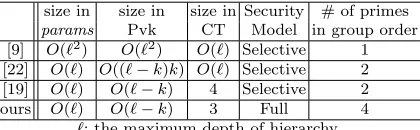
Table 1.Anonymous HIBE schemes

size in size in size in Security # of primes

params Pvk CT Model in group order

[9] O(`2) O(`2) O(`) Selective 1 [22] O(`) O((`−k)k) O(`) Selective 2 [19] O(`) O(`−k) 4 Selective 2

ours O(`) O(`−k) 3 Full 4

`: the maximum depth of hierarchy,

k: a depth of a corresponding identity,

A random element inGT can be generated by raisinge(X1X4Z20Z30, X1X4Z20Z30) to a random

integer inZn.

If T = W1W20W40 then CT distributes as in GameM hiding. Otherwise, since W1W2W4 is

chosen independent at random,CT distributes as in GameRandom.

Query Phase 2.Aadaptively issues key extraction queries and S replies as Query Phase1.

Guess.Aoutputs a bitβ0, thenS also return the same bitβ0 as its guess.

Proof of Theorem 2

In GameRandom the adversary cannot get information about the challenge ID since the

challenge ciphertext distributes as random. Therefore the advantage of the adversary in

GameRandom is information theoretically zero. By Lemma 8 and Lemma 9, theorem is

com-pleted. ut

6 Related Works-Anonymous HIBE

The concepts of anonymous HIBE scheme were introduced by Abdalla et. al. [1]. A first realization of anonymous HIBE scheme was proposed by Boyen and Waters [9]. They attained anonymity under the decisional linear assumption. Shi and Waters proposed a delegatable hidden-vector encryption (dHVE) whose definition is a generalization of anonymous HIBE [22]. First anonymous HIBE scheme with constant size ciphertexts was proposed by Seo et. al.[19]. They embedded Boneh, Boyen, and Goh’s HIBE scheme with short ciphertexts to the subgroupGp of the composite order bilinear groupGp×Gq, and blindsID information using random elements of subgroupGq. Recently Ducas proposed new constructions for anonymous HIBE using asymmetric pairing [14]. All prior anonymous HIBE schemes, however, were proved only in the weaker selective security notion, that is, the adversary should select the target ID before she see the system parameters. We give comparisons with our construction in the table 1. Recently, Caro et al. [12] proposed a fully secure anonymous HIBE scheme with constant ciphertexts, which attains the same performance as our HIBE scheme. We should note that this paper and [12] are definitely independent results.

7 Conclusion

(16)

group under simple assumptions, such as the bilinear Diffie-Hellman assumption and linear assumption as an interesting open problem.

References

1. M. Abdalla, M. bellare, D. Catalano, E. Kiltz, T. Kohno, T. Lange, J. Malone-Lee, G. Neven, P. Paillier, and H. Shi. Searchable encryption revisited: Consistency properties, relation to anonymous ibe, and extensions. InCRYPTO 2005, volume 3621 ofLNCS, pages 205–222. Springer-Verlag, 2005.

2. D. Boneh and X. Boyen. Efficient selective-id identity based encryption without random oracles. In

EUROCRYPT 2004, volume 3027 ofLNCS, pages 223–238. Springer-Verlag, 2004.

3. D. Boneh, R. Canetti, S. Halevi, and J. Katz. Chosen-ciphertext security from identity-based encryption. InSIAM J. Comput., volume 36, pages 1301–1328, Philadelphia, PA, USA, December 2006. Society for Industrial and Applied Mathematics.

4. D. Boneh, G. D. Crecenzo, R. Ostrovsky, and G. Persiano. Public-key encryption with keyword search. InEUROCRYPT 2004, volume 3027 ofLNCS, pages 506–522. Springer-Verlag, 2004.

5. D. Boneh and M. Franklin. Identity-based encryption from the weil pairing. In CRYPTO 2001, volume 2139 ofLNCS, pages 19–23. Springer-Verlag, 2001.

6. D. Boneh, E. Goh, and K. Nissim. Evaluating 2-dnf formulas on ciphertexts. InTCC 2005, volume 3378 ofLNCS. Springer-Verlag, 2005.

7. D. Boneh and B. Waters. Conjunctive, subset, and range queries on encrypted data. InTCC 2007, volume 4392 ofLNCS, pages 535–554. Springer-Verlag, 2007.

8. X. Boyen, Q. Mei, and B. Waters. Direct chosen ciphertext security from identity-based techniques. In

ACM Conference on Computer and Communications Security-CCS 2005. ACM Press, 2005.

9. X. Boyen and B. Waters. Anonymous hierarchical identity-based encryption (without random oracles). In

CRYPTO 2006, volume 4117 of LNCS, pages 290–307. Springer-Verlag, 2006.

10. J. Camenisch, M. Kohlweiss, and C. Soriente. An accumulator based on bilinear maps and efficient revocation for anonymous credentials. In PKC 2009, volume 5443 of LNCS, pages 481–500. Springer, 2009.

11. R. Canetti, S. Halevi, and J. Katz. A forward-secure public-key encryption scheme. In EUROCRYPT 2003, volume 2656 ofLNCS. Springer-Verlag, 2003.

12. A. D. Caro, V. Iovino, and G. Persiano. Fully secure anonymous hibe and scert-key anonymous ibe with short ciphertext. InPairing, volume 6487 ofLNCS, pages 347–366. Springer, 2010.

13. D. Davis, F. Monrose, and M. K. Reiter. Time-scoped searching of encrypted audit logs. InICICS 2004, pages 532–545, 2004.

14. L. Ducas. Anonymity from asymmetry: New constructions for anonymous hibe. InCT-RSA 2010, volume 5985 ofLNCS, pages 148–164. Springer, 2010.

15. C. Gentry and A. Silverberg. Hierarchical id-based cryptography. InASIACRYPT 2002, volume 2501 of

LNCS, pages 149–155. Springer-Verlag, 2002.

16. J. Horwitz and B. Lynn. Towards hierarchical identity-based encryption. InEUROCRYPT 2002, volume 2332 ofLNCS, pages 466–481. Springer-Verlag, 2002.

17. J. Katz, A. Sahai, and B. Waters. Predicate encryption supporting disjunctions, polynomial equations, and inner products. InEUROCRYPT 2008, LNCS. Springer-Verlag, 2008.

18. A. B. Lewko and B. Waters. New techniques for dual system encryption and fully secure hibe with short ciphertexts. InTCC 2010, volume 5978 ofLNCS, pages 455–479. Springer, 2010.

19. J. H. Seo, T. Kobayashi, M. Ohkubo, and K. Suzuki. Anonymous hierarchical identity-based encryption with constant size ciphertexts. In G. Tsudik and S. Jarecki, editors,PKC 2009, volume 5443 ofLNCS, pages 215–234. Springer-Verlag, 2009.

20. A. Shamir. Identity-based cryptosystems and signature schemes. InCRYPTO 1984, LNCS, pages 47–53. Springer, 1984.

21. E. Shi, J. Bethencourt, H. T.-H. Chan, D. X. Song, and A. Perrig. Multi-dimensional range query over encrypted data. InIEEE Symposium on Security and Privacy, pages 350–364. IEEE Computer Society, 2007.

22. E. Shi and B. Waters. Delegating capabilities in predicate encryption systems. InICALP 2008, volume 5126 ofLNCS, pages 560–578. Springer-Verlag, 2008.

(17)

24. B. Waters, D. Balfanz, G. Durfee, and D. Smetters. Building an encrypted and searchanle audit log. In

NDSS 2004, 2004.

Figure

Table 1. Anonymous HIBE schemes

References

Related documents