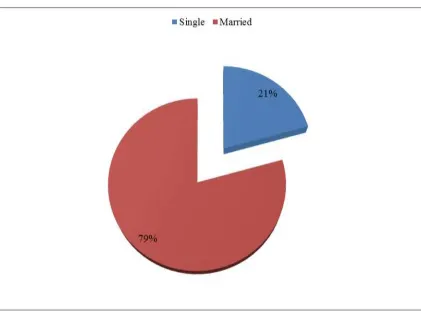
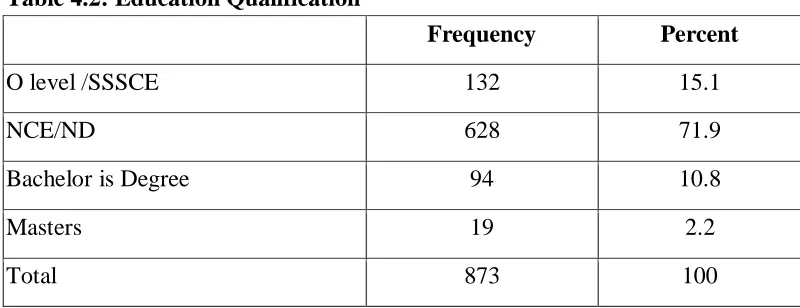
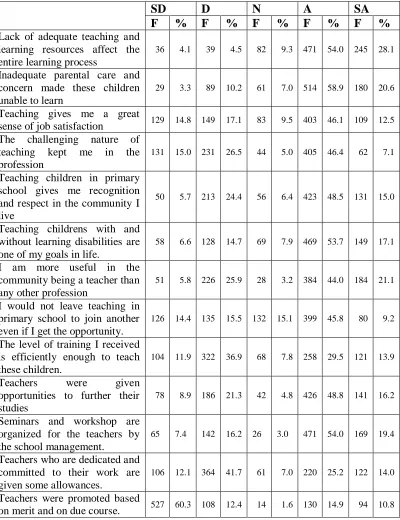
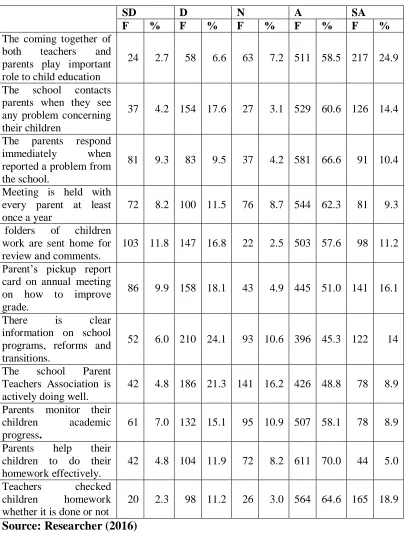
DETERMINANTS OF ACADEMIC PERFORMANCE
AMONG CHILDREN WITH LEARNING
DISABILITIES IN PUBLIC PRIMARY SCHOOLS IN
BAUCHI STATE, NIGERIA
BY
AUWAL MUHAMMAD TUGGAR E83F/29136/2014
A RESEARCH THESIS SUBMITTED IN FULFILLMENT OF THE DEGREE OF DOCTOR OF PHILOSOPHY (SPECIAL NEEDS
DECLARATION
I declear that this research thesis is my original work and has not been presented
in any other institution for consideration of any certification.
Signature……… Date………..
Auwal Muhammad Tuggar
E83F/29136/2014
SUPERVISORS: This thesis has been submitted for appraisal with our approval
as University Supervisors.
Signature……… Date………..
Dr Mary Runo
Department of Special Needs Education,
Kenyatta University
Signature……… Date………..
Dr Jessina Muthee
Department of Special Needs Education,
DEDICATION
I dedicated this work to my parents, brothers, sisters and our entire family. I
appreciate the role my late father played in my educational life. I appreciate my
family for bearing with me during the many times I have been away not being
able to give them the attention they deserve. Lastly I appreciate the financial and
moral support of Bauchi State University Gadau given to me during my studies,
ACKNOWLEDGEMENT
First and foremost, I give glory, honour and praise to the Almighty God for His
divine guidance. I also wish to express my sincere thanks to my supervisors Dr
Mary Runo and Dr Jessina Muthee who gave me the benefits of insight, guidance
and supervision throughout my entire research writing period. Their patience,
thoroughness, understanding, advice, guidance, continuous support and
encouragement enabled me to complete the process of this research work. Their
stern guidance, leadership, and expertise, greatly inspired the completion of this
thesis work.
My appreciation also goes to all lecturers and staff of the Department of Special
Needs Education in Kenyatta University as well as my colleagues for their
support and encouragement in the course of my study. I also expressed my sincere
appreciation to Bauchi State University Gadau for their moral and financial
support given to me in the course of my study.
Last but not least I would like to give special thanks to my dear Brothers, who
have continuously supported me during the study, giving me a conducive
atmosphere at home, thus allowing me to have peace of mind. To God be the
TABLE OF CONTENTS
DECLARATION... ii
DEDICATION ... iii
ACKNOWLEDGEMENT ... iv
TABLE OF CONTENTS ... iii
LIST OF TABLES ...vii
LIST OF FIGURES ... viii
ABBREVIATIONS AND ACRONYMS ... ix
ABSTRACT ... x
CHAPTER ONE: INTRODUCTION AND BACKGROUND TO THE STUDY ... 1
1.0 Introduction ... 1
1.1 Background to the Study ... 1
1.2 Statement of the Problem ... 6
1.3 Purpose of the study ... 7
1.4 Objectives of the Study ... 7
1.5 Research Questions ... 8
1.6 Significance of the Study ... 8
1.7 Limitations and Delimitations ... 9
1.7.1 Limitation of the Study ... 9
1.7.2 Delimitation of the Study... 9
1.8 Theoretical and Conceptual Framework ... 9
1.8.1 Theoretical Framework... 9
1.8.2 Conceptual Framework... 11
1.9 Operational Definition of Key Terms ... 12
CHAPTER TWO: RELATED LITERATURE REVIEW ... 16
2.0 Introduction ... 16
2.2 Parents’ Perception on the Children with Learning Disabilities and Academic
Performance ... 20
2.3 Teachers Motivation and Children Academic Performance... 23
2.4 Teacher -Parent Collaboration on Children with Learning Disabilities and Academic Performance ... 27
2.5 Summary of the Literature Reviewed ... 30
CHAPTER THREE: RESEARCH DESIGN AND METHODOLOGY ... 32
3.0 Introduction ... 32
3.1 Research Design ... 32
3.2 Study Variables ... 33
3.2.1 Independent Variable (IV) ... 33
3.2.2 Dependent Variable (DV) ... 33
3.3 Study Location ... 33
3.4 Target Population ... 34
3.5 Sampling Techniques and Sample size ... 34
3.5.1 Sampling Techniques ... 34
3.5.2 Sample Size ... 34
3.5.3 Sampling of Schools ... 35
3.5.4 Sampling of Teachers ... 35
3.5.5 Sampling of Parents... 36
3.6 Research Instruments ... 36
3.6.1 Checklist ... 37
3.6.2 Questionnaire for Teachers ... 37
3.6.3 Interview Schedule for Parents ... 37
3.7 Piloting of the Instruments ... 38
3.8 Validity of instruments ... 39
3.9 Reliability of the Instruments ... 39
3.10 Data Collection Technique ... 40
3.11 Data Analysis ... 40
3.12 Logistical and Ethical Considerations ... 41
3.12.2 Ethical Considerations ... 41
CHAPTER FOUR: PRESENTATION OF FINDINGS, INTERPRETATION AND DISCUSSIONS ... 42
4.0 Introduction ... 42
4.1 Rate of Returns on Research Instruments... 43
4.2 Demographic Information ... 43
4.2.1 Gender for Teachers ... 43
4.2.2 Age Group for the Teachers ... 45
4.2.3 Marital Status of Teachers ... 45
4.2.4 Educational Qualification of Teachers ... 46
4.3 Teachers’ Perception on Children with Learning Disabilities ... 47
4.4 Parents’ Perceptions on their Children with Learning Disabilities ... 52
4.4.1 Parents Knowledge on Children with Learning Disabilities ... 53
4.4.2 Parents Response on how to Identify Children with Learning Disabilities .. 58
4.4.3 Causes of Learning Disabilities as Reported by Parents ... 63
4.5 Teachers’ Motivation when teaching Children with Learning Disabilities ... 70
4.5.1 Parents Report on Teachers Motivation ... 76
4.5.2 Parents Report on Demotivation ... 83
4.5.3 Parental Response on the Type of Support given to the Children ... 91
4.6 Influence of Teacher- Parent Collaboration ... 96
4.6.1 Parents Report on the Influence of Teacher-Parent Relationship ... 101
4.6.2 Levels of Teacher-Parent Collaboration ... 108
CHAPTER FIVE: SUMMARY, CONCLUSIONS, AND RECOMMENDATIONS ... 115
5.0 Introduction ... 115
5.1 Summary of the findings ... 115
5.2 Conclusions ... 117
5.3 Recommendations ... 118
5.3.1 General Recommendations ... 118
5.3.2 Ministry of Education ... 119
5.4 Recommendations for further studies ... 120
REFERENCES... 121
APPENDICES ... 131
Appendix I: Checklist for identifying children with learning disabilities ... 131
Appendix II: Teachers survey questionnaire ... 132
Appendix III: Parent interview schedule ... 135
Appendix IV: Map of Nigeria showing the 36 states and indicating Bauchi state ... 136
Appendix V: Map of Bauchi state, indicating the area of research study ... 137
Appendix VI: Teacher’s perception on learners with learning disabilities ... 138
Appendix VII: Teacher’s Motivation when Teaching Children with Learning Disabilities ... 139
Appendix VIII: Report on the Influence of Teacher- Parent Collaboration... 140
Appendix IX: Approval Letter for Data Collection ... 142
Appendix X: Approval of Research Proposal from Kenyatta University ... 143
Appendix XI: Research Authorization from Kenyatta University ... 144
LIST OF TABLES
Table 3.1 Indicating Target Schools, Teachers and their sample size ... 35
Table 4.1: Teachers Age Bracket ... 45
Table 4.2: Education Qualification ... 47
Table 4.3: Teachers’ Motivation when teaching Children with Learning
Disabilities ... 71
LIST OF FIGURES
Figure 1.1 Conceptual Framework ... 11
Figure 4.1: Gender ... 43
Figure 4.2: Marital Status ... 46
ABBREVIATIONS AND ACRONYMS
AC : Academic Performance
ASAC : African and South African Countries BSME : Bauchi State Ministry of Education DV : Dependent Variables
EFA : Education for All
IDEA : Individuals with Disabilities Education Act. IV : Independent Variable
LD : Learning Disability
MOEO : Ministry of Education Ontario NCE : National Certificate in Education
ND : National Diploma
NPE : National Policy on Education
OECD : Organisation for Economic Coporation and Development PRR : Policy Research Report
SCT : Social Cognitive Theory SNC : Special Needs Children
SSSC : Senior Secondary School Certificate U.S.A : United State of America
UAE : United Arab Emirates
UN : United Nation
ABSTRACT
CHAPTER ONE
INTRODUCTION AND BACKGROUND TO THE STUDY 1.0 Introduction
This chapter focused on the background to the study, statement of the problem,
purpose of the study, objectives, research question, and significance of the study.
The chapter further highlighted limitation and delimitation of study, theoretical
and conceptual framework and operational definition of terms.
1.1 Background to the Study
Learning disability signifies difficulties and abnormalities faced by children in
schools in the area of reading, writing, and arithmetic or to grasp and comprehend
what is being taught to them by their teachers, and inability to process information
within short period of time. According to IDEA (2014) disorder in one is more of
psychological processes which involved lack of understanding or using language,
spoken or written. It is a disorder that manifests itself in imperfect ability to listen,
think, speak, read, write, spell, or do mathematical calculations (IDEA, 2014)
Ontario Ministry of Education Canada (2014) defines Learning disability as one
of the neurodevelopment disorders that persistently affects the ability to learn and
use academic achievement and other skills. It affects the ability to perceive or
process information, result in academic underachievement that is inconsistent
with the intellectual abilities of the student. It also results to difficulties in
development and use of skills in one or more area of reading, writing,
British Columbia Ministry of Education (2011) indicates that Arithmetic disorder
is characterized by difficulty in learning and comprehending in mathematics.
Children experience problems in organizing, keeping number line up, confusing
in calculation signs and operations. While writing disorder is characterized by
distorted writing in spite of thorough instruction, the students experience
inconsistency and illegible writing. It consists of mixing print and cursive, upper
and lower case, irregular sizes, shapes or slant of letters, and fine motor difficulty.
Furthermore, reading disorder is characterized by difficulty in alphabet, word
recognition, decoding, spelling and comprehension. Learning disabilities in
children includes social cue disorder where by childrens experience difficulties in
logical reasoning and actions, inappropriate to be accepted socially and low
frustration tolerance, Auditory and processing disorder in which children are
unable to process information and understand what is said, unable to listen and
recall what they are taught, visual and processing problem, sensory processing
and organizational disorder problems which were all experienced by children as
indicated by British Ministry of Education.
A study was carried out by Saludes and Dante (2008) in the region of Philippines,
New York and United State on parents’ perception towards children learning
disabilities. The findings indicated that parents in the region of Philippines have
little knowledge on the children while teachers have partial knowledge. Parents in
New York and United States of America have partial knowledge while teachers
have moderate knowledge and awareness on the children. The both regions
services for children with learning disabilities. Kataoko, Kraayenourd, and Elkins
(2004) investigated teachers perception on children with learning disabilities in
Japan, the results indicated inadequate parental and family support, lack of
awareness by the parents, teachers inadequate knowledge to support children with
learning disabilities, and the government curriculum guidelines are too difficult
and do not regard basic academic skills as important. In addition, teachers are too
busy and have too much pressure on them; they hardly find time for individual
student.
Singh (2004) examined parents’ perception on children with learning disabilities
among Asian- Indian and Caucasian cultural perspectives. The Asian Indian
places a negative social stigma attached to having children with learning
disability, they were less knowledgeable about learning disabilities. The
Caucasian parents had positive perception towards the children with learning
disabilities. And they were more knowledgeabled in identifying such children and
they seek for assessment and diagnoses to intervention (Singh, 2004). Bano,
Dogar, and Azeem (2012) investigated general and special teacher perception on
children with learning disablities in Pakistan. Their findings revealed that the
special education teachers understand children with learning disabilty in a better
way than general education teachers. Both indicated the need for proper training
for general education teachers, and the need for special education materials to aid
teachers toward meeting the need of childrens with learning disabilities in both
Similarly, Lopes, Monteiro, Sil, Rutherford and Quinn (2004), investigated
general and special education teachers’ perception on children with learning
disablities in Portugal. Eighty percent of the general and special education
teachers indicate that resources are limited for them to teach these students, and
more than ninety percent of the teachers indicate that inclusive education is a set
of services and not a specific place. They suggested that even with collaboration
with special education teachers, general education teachers do not see much
improvement in the academic performance of the childrens. Stone, Bradley, and
Klemer (2002) pointed out that parents of children with learning disabilities
attribute the children success to luck and their failure to low ability. They treat
these children more negatively than the normal children.
Runo (2010) researched on reading disabilities among children in standard five in
Kenya. The study indicated that teachers term these children as lazy, tensed up,
dull, slow readers, cannot read fluently, lack interest, depressed, shy and
withdrawn. Chireshe (2011) revealed that in Zimbabwe, teachers believed that the
present curriculum cannot meet the need of special need children, inclusion affect
the teaching method one uses, regular class teachers have problems adapting the
programme of accommodating special need children. Similarly Swain (2014)
investigated teachers perception on children with special needs in Cameroon
secondary schools. Finding reveals that majority of the teachers were willing to
teach these children but lacked the needed skills, knowledge to support the
Similarly, Ocloo and Subbeya (2008) carried out research study on the placement
of children with disabilities in general education classroom in Ghana. The result
indicated that teachers have the will to provide for the children with disabilities,
but inadequate resources were the challenge to implement the inclusion properly.
In Nigeria, National Policy on Education (NPE) is a policy introduced in the year
1977 to cater for the need of all children irrespective of their category including
special need children. In pursuance of this objective, the state governments, at the
intermediate level, have ministries in all the State of the federation while in the
local level units and sub department of social welfare are established to take care
of children with special needs. This policy of equalization of educational access
was revised in 1981, 1998 and 2004 but children’s with special needs have been
left behind all through. Most of the children in the public primary schools have
poor writing skills, unable to read fluently and compute arithmetically which lead
them to poor academic performance. The children usually finish primary school
without basic skills of literacy and numeracy as confirmed by Obani (2006) that
the population of children with learning disabilities is at 50% of the total number
of children with special needs in Nigeria. This had been earlier claimed by
Education for All (2000) who asserted that 40% of children are unable to copy a
single word or pronounce a mark correctly from a five line passage.
Oluko and Eke (2015) examined the management of children with learning
disabilities in classroom in Nigeria. The findings revealed that handling or dealing
adapt or prepare the curriculum in such a way that the needs of all children with
learning disabilities are sufficiently met. So also, Oluko and Okorie (2014)
investigated teacher’s perception towards children with learning disabilities. The
study found that the teachers had negative feelings over the children due to the
fact that they were difficult to manage.
1.2 Statement of the Problem
Despite the introduction of National Policy on Education NPE in (1977) by the
government of Nigeria which is expected to provide the need of children with
special needs. These children are still not adequately provided for. Obani (2006)
confirmed that in Nigeria, the population of children with learning disabilities is
at 50% of the total number of children with special needs.this had been earlier
claimed by Education for All (2000) who pointed out that 40% of the children
were unable to copy a single word or pronounce a mark correctly from a five line
passage. Furthermore, in the whole northern part of the country (Bayero
University Kano & University of Jos) are the only Universities that offer special
needs education as course of study. They train teachers more in the area of
visually impaired and hearing impaired despite the fact that children with learning
disability were also among the category of children with special needs. In 2013,
Bauchi State Ministry of Education confirmed that twenty eight percent of
children had learning disabilities in the public primary schools. This had been
earlier found by USAID (2009) that in Bauchi State, after years of primary
instruction, only 6 % of the children were able to read simple narrative text. The
education system in the country. Most of the studies in Nigeria focused on
Innovative strategies for improving special needs for students with learning
disabilities in Nigerian schools, managing of children with learning disabilities in
classrooms in Nigeria; the ones carried out are very limited when compared with
the prevelance of the problem. Hence this research study investigated the
determinanats of academic performance among children with learning disabilities
in public primary schools in Bauchi State, Nigeria.
1.3 Purpose of the study
The purpose of the study was to examine the determinants of academic
performance among children with learning disabilities in public primary schools
in Bauchi State, Nigeria.
1.4 Objectives of the Study The objectives of the study were:
1) To investigate teachers’ perception on children with learning disabilities in
Bauchi State, Nigeria.
2) To determine parents’ perceptions on their children with learning disabilities.
3) To investigate teachers’ motivation when teaching children with learning
disabilities
4) To establish the influence of teacher- parent collaboration in supporting
1.5 Research Questions
1) What are the teachers’ perceptions on children with learning disabilities in
Bauchi State, Nigeria?
2) What are the parents’ perceptions on the children with learning disabilities
in Bauchi State, Nigeria?
3) What are the motivation given to the teachers when teaching children with
learning disabilities in Bauchi State, Nigeria
4) What are the influences of teacher-parent collaborations as a means of
supporting children with learning disabilities in Bauchi State, Nigeria?
1.6 Significance of the Study
This study investigated the determinants of academic performance among
children with learning disabilities in public primary schools. The findings of this
study explored a problem that would be communicated to both teachers and
parents on the cause of the problems in order to prevent reoccurrence of the
disabilities in children. The study would help educational administrators in
ensuring measures towards providing necessary services for the children,
curriculum development planners in making consideration when planning
educational curriculum for all children and policy makers toward ensuring policy
that would benefits the children in enhancing their life in their academic
pursuance. The report would also serve as information that would be used in
literature reviews on related studies in the State and local government libraries
1.7 Limitations and Delimitations 1.7.1 Limitation of the Study
The data collected from the parents was done in Hausa language, their mother
tongue, because not all parents attended formal schools and then translated into
English; some teachers had to inquire very well before giving the needed
information thinking that you would be paid for the study. And some of the
parents thought the study wanted to expose their children with such disabilities to
the public. The researcher faced difficulties where some parents after making an
appointment they failed to keep time; this forced to fix another time for the
interview reschedule to take place again.
1.7.2 Delimitation of the Study
Children with learning disabilities were found in all primary schools. But due to
time and financial constraints, the study is delimited to involve only public
primary schools in Bauchi State Nigeria. The state is subdivided into three
geo-political zones, each with its number of local government and primary schools.
However, the study was restricted to public primary school teachers and parents
in the area, selected to represent the entire state population under study in order to
have proper accessibility, coverage and more reliable information.
1.8 Theoretical and Conceptual Framework 1.8.1 Theoretical Framework
The study was guided by Social Cognitive Theory (SCT) of Bandura (1986).The
influences or by internal dispositions. The theory points out that interaction
between the individual thought, point out their action, expectations, beliefs,
self-perceptions, goals and intentions give shape and direction to behaviour. What
people think, believe and feel affects how they perceive and behave. The theory is
relevant to this study as it can be applied to generate the determinants of academic
performance of children from both teachers and parents. Childrens with learning
disabilities are across all individual families; lower, middle or upper class
irrespective of one’s cultural beliefs, customs and tradition in all societies. The
1.8.2 Conceptual Framework
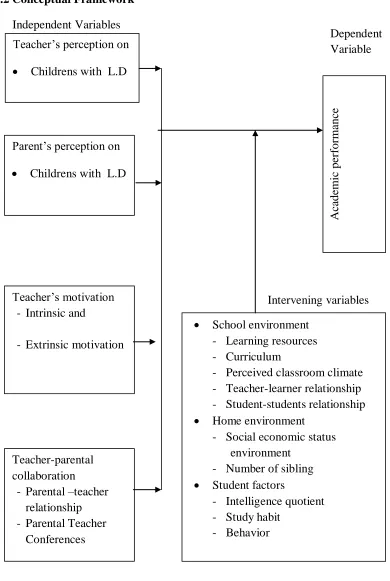
Figure 1.1 Conceptual Framework Source; Researcher, 2016 Teacher’s perception on
Childrens with L.D
Parent’s perception on
Childrens with L.D
Teacher’s motivation - Intrinsic and
- Extrinsic motivation
Teacher-parental collaboration
- Parental –teacher relationship - Parental Teacher
Conferences
School environment - Learning resources - Curriculum
- Perceived classroom climate - Teacher-learner relationship - Student-students relationship Home environment
- Social economic status environment
- Number of sibling Student factors
- Intelligence quotient - Study habit
- Behavior
1.9 Operational Definition of Key Terms
Academic performance (AC) is the extent to which student achieved their short or long- term educational goals (Wikipedia).
Academic performance means the performance of
children with learning disabilities in a given
primary school. It is either the children perform
well or not performing well when given an
examination or test. Academic performance is
also stands as the dependent variable of the study.
Attitudes Attitudes is a human expression that is made of three interrelated component. Beliefs, feelings, and behaviour and it manifest on
individual when form an opinion about the attitudes objects (Ozoji,
2005). These are internally generated feelings and behaviour of
teachers and parents over the children who experirnced certain
difficulties in learning and the attachment they give to the certain
behaviour best known to them.
Determinants An element that identifies or determines the nature of something or that fixes or conditions an outcome (Merriam Webster). It is also a
factor which decisively affects the nature or outcome of some thing
(Oxforddictionary). According to the this study determinants
means an idicators or predictors that teachers and parents feeled or
Learning disability Learning disability is a disorder in one or more of the basic psychological processes involved in
understanding or in using language, spoken or
written, that may manifest itself in the imperfect
ability to listen, think, speak, read, write, spell, or
do mathematical calculations, including
conditions such as perceptual disabilities, brain
injury, minimal brain dysfunction, dyslexia, and
developmental aphasia (IDEA, 2004 PL. 105-17).
This is the inability of a child to perform a certain
task in relation to reading, writing, spelling,
spoken, listening, calculation and comprehension.
Learning disability are the learning problems
being experienced by the children in the course of
their learning at primary school.
Parenting Is the process of developing and utilizing the knowledge and skills appropriate to planning and providing care for
the offspring (Marrison, 1978). A parent in the study means
persons whose care, responsibility and upbringing of these
children lies on their hands. More specifically their
educational career and any problem they may experience in
Perception perception is the set of process by which an individual becomes aware of and interprets information about the environment
(Merriam- Webster). Perception in this study refers to the
information, knowledge and opinions given by both parents and
teachers on how to handled or deal with children with learning
disability.
Special Need Child (SNC):Children with special needs are those generally referred to as exceptional persons and are
comprised of children, youths and adults with one
form of disability or learning difficulty or the
other (Kanu, 2008). This refers to children who
have sort of learning problems who deviate from
the normal, either below or above to such an
extent that Special Programme is necessary for
them to benefits. Special needs child is a child
that needs attention or to be taken careup as a
result of some certain condition or situation
encountered for adjustment to cope.
Teacher Teacher is an expert who is capable of imparting knowledge that helps learners to build, identity and to
acquire skills that will be used to face the challenges in life.
according to Mbise (2008) a teacher is a person who has
knowledge, skills, and special trainings in teaching,
explaining and educating. The teacher is the person who is
capable of creating behavioural change in terms of
cognitive, psychomotor as well as affective domain.
Teacher in the study refers to the person who teaches the
children with the problems of learning disability in the
CHAPTER TWO
RELATED LITERATURE REVIEW 2.0 Introduction
The chapter reviewed the literature related to the objectives of the study which
includes: Teachers perception on children with learning disabilities and
performance, parents perception on children with learning disabilities on
children’s’ academic performance, teachers motivation on children with learning
disabilities, and the influence of teacher-parent collaboration as a means of
supporting children with learning disabilities.
2.1 Teachers’ Perception on Children with Learning Disabilities and Academic Performance
Teachers are responsible for teaching children with or without learning problem,
their perception and understanding towards these children differ. Swain (2014)
indicated that teachers cannot teach the children without acquiring proper training
and knowledge, seventy five percent of teachers are willing to teach the children,
but they lack the skills to provide for their need. Desimone and Parmar (2006)
examined teachers’ perceptions in teaching children with learning disabilities in
inclusive settings. The majority of the general education teachers believe that they
are primarily responsible for modifying the instruction for children with learning
disabilities and for ensuring their success in general education settings. Fifty
percent of these teachers indicated partially comfortable or not comfortable in
suggest that although general teachers seem to be willing to take responsibility of
providing instruction to childrens with learning disabilities in general education
settings, they are less comfortable about their inability to meet childrens’ needs.
Additionally, Leser and Tappendorf (2001) examined teachers’ perception
towards the inclusion of children with disabilities into the general education
classroom. They indicated teachers experience and experience of children with
disabilities as very significant for one to teach in an inclusive class. General
education teachers view special education childrens as inappropriately placed in
the general education classroom (Carter, Prater & Dychers, 2009). Bunch and
Finnegan (2000) believed that inclusive education contributes to the academic
achievement of childrens with or without disabilities. Schulte, Obsorne, and
Erchul (1998) noted that teachers lack skills and time available for instructional
planning and difficulty in implementing individualized and or small group
instruction within a large group. These form the biggest problem when teaching
children with learning difficulties in regular settings. Runo (2010) revealed that
teachers view children with learning disabilities in regular classrooms as
unteachable, hard to teach, lazy, slow learners, cannot read fluently, daydreamers,
careless and stupid or foolish.
Bano, Dogar and Azeem (2012) confirmed that differences exist between general
and special education teachers, the general teachers indicate inadequate training
on how to support such childrens. And adequate materials to aid these children
(2004) pointed out that teachers do not have awareness of children with learning
disabilities, they have less knowledge and inadequate manpower to support the
children, and the government curriculum guideline are too difficult for them.
Henriques (2013) investigated teachers’ perception on assistive technology for
childrens with learning disabilities in North Carolina. The results revealed that
teachers understood the importance of using assistive technology but felt
unprepared to effectively use devices because of lack of resources, limited time
planning, inadequate technical support, disjointed professional development,
uncertainty of how to use assistive technology within their content area, and poor
infrastructure. Oluko and Eke (2015) study in Nigeria indicated that handling or
dealing with the children differences form the biggest challenges faced by
teachers in the classroom whereby teachers have to adapt or prepare a curriculum
that will suit the needs of these children otherwise the person will end up wasting
time with no achievement of the set goals.
Similarly in Nigeria, Oluko and Okorie (2014) indicated that most of the teachers
hardly accept children with learning disabilities due to the fact that are difficult to
manage them. The teachers believe that no matter the effort the pupils lack the
ability and they would fail classroom activities. Chireshe (2011) in Zinbabwe
found that both the male and female teachers viewed the curriculum used cannot
meet the needs of special need children, the inclusion model affecting the
teaching method they used and the teachers have problem of adapting and
accommodating childrens with special learning needs. The review reveals that
main problem which hinders them from providing for the children with learning
disabilities. This study would find out whether Nigeria is facing same problem
being experienced by this countries or it varies. And then if varies what bring the
2.2 Parents’ Perception on the Children with Learning Disabilities and Academic Performance
Attitude and perception of parents towards children with learning disabilities may
not be same to all parents. Parents of children with learning disabilities attributed
their Children educational success to luck and child’s failure to low ability (Stone,
Bradley & Kleiner, 2002). They view and treat these children negatively than the
parents of normally developing children. Taylor (2000) pointed out that parents
were not accepting the problem because of fear of shame from community
reactions, guilt, and self-blame wishing the child not born. Similarly, Harry
(1992) indicated that parents of these children were not accepting the problems
being experienced by their children.
Adachi and Geva (1999) examined immigrant parents of children with learning
disabilities in Canada. The parents confirmed that the teachers who teach their
children are to blame for not trying hard enough in teaching their children which
result in their children inability to learn at school. Arasa (2004) study in Nairobi
parents indicated that the cause of disabilities among children includes lack of
reading materials, poverty, lack of pre-school education, lack of parental
involvement and interest in children school work, lack of trained and qualified
teachers. Similarly, Abasi (2007) carried out study in Botswana. The finding
pointed out that poor school reforms, poor classroom management, and lack of
qualified teachers in school, traditional beliefs, lac kof teaching materials,and lack
Gallagher, Rhrodes, and Darling (2004) concluded that parents expressed their
worries regarding social isolation and negative peer attitudes which decreased
self-confidence in children, poor quality teaching and inadequate teacher training
and support for the children. Chadha (2001) noted that twenty percent of children
learning disabilities have at least one parent who has that form of disability and
about two to ten percent of learning disabilities among children were as a result of
hereditary traits to the children (National Centre for Learning Disabilities, 2001).
According to Paanannen, Aro, and Ahenon (2009) in Zambia that home
environment plays role on childrens learning; it affects the children either
positively or negatively. Parents’ literacy level, poverty, lighting system, lack of
parent’s guidance and community support lead to difficulties in children learning
in school. Ojanen (2007) noted that learning disabilities in children are due to
inadequate teaching by the teachers and parental support for the children.
Furthermore, Runo (2010) study in Kenya showed that learning disabilities
among children were attributed to inability for the children to communicate in
English, mother tongue interference, lack of parental support, parents’ literacy
level, and children being lazzy. Frozen (1990) pointed out that in some
communities in Kenya and Zimbabwe these children got less attention, less
stimulation, less nourishment and fewer upbringings compared to the normal
children. Most of the parents indicated that inadequate teaching, fear of
community stigma; poverty and lack of proper support by the parents were the
perception of parents towards children disabilities in school. In view of this, the
their children, what do they think were behind the cause of the problem and to
2.3 Teachers Motivation and Children Academic Performance
The term “motivation” is a Latin word “movers” which means to move.
Motivation means a process of arousing the interest of individual to take a move
towards a certain goal. Ryan and Deci (2000) defined motivation as what drives
peopleto take an action and is basically of two types: intrinsic and extrinsic
motivation. Waitley (1998) sees motivation as the inner drive which prompts
people to act in a certain way. Motivations in Education have several effects on
how students learn and their behavior towards subject matter. Motivation of
teachers in teaching and learning process have direct impact towards particular
goals which leads to cognitive processing, increase initiation and persistence in
activities, determine what consequences are reinforcing to improved performance.
Motivation is of two types: intrinsic motivation and extrinsic motivation.
Intrinsic motive refers to motivation which is driven by interest or enjoyment in
task itself and exists in the individual rather than relying on pressures or desires.
While extrinsic motivation comes from outside of the individual which are
external forces. It includes rewards such as money or grades for showing desired
behavior. Teacher motivation has to do with teacher’s attitude to work, teachers
desire to participate in children processes within the school environment, and it
has to do with teacher’s interest in childrens discipline and control particularly in
classroom (Ofoegbu, 2004). Hayden and Stephanie (2011) examined teacher's
motivation and children achievement in middle school in the United States. The
findings indicated that motivation affected childrens’ achievement and it plays a
achievement is linked to salaries increases; it motivates teachers to work, which
lead to improved children academic achievement. Aacha (2010) investigated
performance of primary school teachers in Uganda. The findings revealed that the
performance of teachers was good despite the fact that their motivation was
inadequate. A significant positive relationship between intrinsic motivation and
performance of teachers was found to exist in primary schools. Furthermore, a
positive relationship was revealed between extrinsic motivation and performance
in Uganda. The study recommended increase of salary of primary school teachers,
provision of accommodation, strengthening of supervision as well as instituting
awards for good performance.
Mwanza (2010) examined teacher de-motivation in Zambia among school
teachers. The findings indicated that teachers’ de-motivation resulted to large
absenteeism, indulgence in secondary employment, and transmission of negative
ideas. Poor salaries, poor conditions of service demotivate teachers in performing
their duties effectively. The research recommends teachers’ salaries and condition
of service to be significantly improved as a way of motivating teachers; their
promotions should strictly be made on merit. Hardship and other allowances
should be regularly paid and increased, teachers appointed as head and deputy
heads should be trained in human relation.
Bennell and Akyeampong (2007) investigated twelve African and South Asia
Countries (ASAC), the findings revealed that the commitment of teachers is one
of the most important determinants of learning outcomes. In many developed
low teacher motivation leads to negative educational outcomes. Moreover,
Bennell and Akyeampong (2007) further stated that low motivation resulted to
absenteeism, underutilization of class time, professional misconduct, reliance on
traditional teaching practices and poor preparation. Volunteer service overseas (
VSO, 2002) examined teacher motivation in Zambia, Papua New Guinea, and
Malawi, the findings revealed that low motivation of teachers is responsible for
high attrition rates, lack of confidence, varying levels of professional commitment
and feelings of helplessness to either improve children outcomes or teachers own
situation.
Patrick (2012) examined motivational packages and its effects on performance of
teachers in secondary schools in Ghana. The results indicated that job security,
good working conditions and authority and independence are strong motivational
ways that affect teacher performance. However, lack of accommodation,
inadequate teaching and learning materials, poor supervision by heads lead to
poor performance of teachers. The study recommends that teachers should be
given an opportunity to further their studies, promotions and accommodation in
order to enhance performance and increase productivity. Bennell (2004) examined
Sub-Saharan African teachers, the result indicated that teachers were not given
incentive which affects their job performance.
Wanyama, Nassiuma and Zakayo (2014) investigatd the impact of motivation
bundle on the performance of teachers in public school in Bungoma Kenya. The
findings indicated that motivation as bundles positively and significantly
and Adedotun (2013) investigated teachers’ motivation on children performance
in mathematics in Nigeria. The findings showed that conditions of service of
teachers increase children academic performance in mathematics, teachers’ Fringe
benefit has influence on childrens’ academic performance in mathematics and
also teachers ‘promotion of in-service training has direct impact on the academic
performance of childrens in mathematics as indicated by Adeyinka et al (2013).
The review on teachers motivation indicated that teachers sense of job
satisfaction, provision of basic necessities of life and other allowances, learning
materials, teacher training motivate them to work effectively. This study filled the
gaps by investigating the ways and how teachers in Bauchi State are being
motivated. The study would also find out wether the type of motivation given
were inline with the findings of previous studies carried out. Despite the time,
location and belief practices were these studies conducted were not the same.
2.4 Teacher -Parent Collaboration on Children with Learning Disabilities and Academic Performance
There is no single profession that has all the knowledge and skills to meet the
unique and complex needs of children with learning disability. The learning team
of children, teacher, and parent is mostly effective with the school support; they
foster cooperative problem solving (Deshler, Hock & Catts, 2006). They stated
that collaboration beyond school level is recognized as important; the school
alone cannot meet all the childrens’ needs, particularly for children with learning
disability who have social, emotional and mental health concerns. Parental
participation in children education increase childrens success. The children with
parental support earn higher grades, completed primary school successfully and
move to secondary school irrespective of their socio-economic status. (USDE
2004).
Bryan and Burstein (2004) pointed out that parent involvement on children
achievement studies from 1980 to 1990 lead to higher academic achievement,
improved school attendance, increase cooperative behaviour and lowers dropout
rates. Historical approaches to special education viewed teacher as expert and
parent as a passive participant, Parent roles of education moves from passive
recipient to knowledgeable consumer as indicated by Bryan and Burstein (2004).
Christenson and Sheridan (2001) posited that teachers and parents partnership
enhances children learning opportunities, promote educational progress and
school academic success, social, emotional and behavioural domains. Similarly,
have a positive contribution to children academic achievement. (Handerson,
Mapp 2002, Esptein & Sheldon 2006).
Sandlers and Sheldon (2009), Stated that schools become successful when strong
positive relationship between parents and teachers has been established and
maintained. When parents and teachers co-operate, the childrens have more
experience and academic success. (Mucott, Szezesiul, Berk, Staub, Hoover &
Perry -Chisholn 2008). Relationship among teachers and parents, respect for one
another, believes in the ability of other stakeholdres and willingness to fulfilled
their responsibilities enhances children performance in school. Gutman and
Mcloyd (2000) carried out research with the aim of ascertaining the parental
behavior. They investigated two groups of children these were typical successful
children and comparing them with children who were encountering behavioural
and academic problems in United State. The findings indicated that parents of
academically successful childrens used more specific ways in assisting the
children with school work; they had more supportive communication with their
children than the less academically successful children. They frequently checked
children progress by contacting school, indicated positive contacts with school
staff, whereas, the parents of less achieving children did not.
Rafiq, Fatima, Sohail, Saleem and Khan (2013) examined parental involvement
in school activities in Pakistan. The study found that parents involvement have a
significant effect on the academic performance of children. Obeidat and
education does not improve their academic performance alone but also improve
children behavior and other social skills. Bennet and Hay (2007) identified the
family characteristics that promote the development of social skills in children
with disabilities in Australia. The results indicated that high levels of parental
involvement provided a safe and sound foundation for children to explore their
social environment. Al-Shamari (2000) investigated the degree to which parental
involvement impacts students’ levels in special education in Kuwait. The findings
showed that parents of special needs children do involve in classroom activities
and other school responsibilities. More than seventy percent of parents engaged
themselves in children education which helps in developing children performance.
Makgopa and Mokhele (2013) examined teacher’s expectation of parental
involvement in primary schools in South Africa. The result indicated that teachers
need the assistance of parents to teach them well, and the parents are also keen to
extend a helping hand for the betterment of their children. The findings also
showed that the teachers and parents blame each other, when childrens do not
perform well at the end of the year. The teachers blame parent for not helping the
children with their homework, while the parents blame teachers for not doing
their work effectively. Grace, Jethro, and Aina (2012) examined parental roles
and children academic performance in primary schools in Nigeria. The result
indicated that school work together with families to support learning; children
tend to succeed not just in schools but throughout life. Parental involvement in
research recommends that parents should serve as teachers, as supporters,
advocates, and decision makers.
Similarly, in Nigeria Kutelu and Olowe (2012) examined levels of parental
involvement in primary schools education. The result indicated that level of
parental involvement in public primary school education in the areas of provision
of instructional materials, curriculum implementation and administration is
inadequate. The study recommends for government and other concerned
organizations to organize training for head teachers, teachers, parents, and should
be involved in primary education policies. Teacher-parent partnership towards
children education enhances and ensures children academic performance and even
other social skills have been pointed out in the literature. Therefore, the present
study investigates the influence of the partnership between teachers and parents in
the provision for the children with learning disabilities in Bauchi State, Nigeria.
The study would know the paremetres at which they collaborate, when and how
such partnership is being done, who among contacts most or less and the
influence they derived from taking parts in the collaboration processes when
educating the children with learning disabilities.
2.5 Summary of the Literature Reviewed
The literature reviewed concerning teachers perception on children with learning
problems revealed that children with learning disabilities are very difficult to
teach, the teachers need proper and adequate training to support the children
that parents pointed out children learning disabilities were due to genetic and
inheritance, poverty, lack of adequate teaching by the teachers, limited resource
materials, lack of parental support resulted to children disabilities.
The literature on teacher’s motivation indicated several effects on how children
learn and their behaviors’ toward the subject matter. Teacher’s motivation plays a
significant role in ensuring children performance in school. The issue of teacher-
parent collaboration pointed out in the literature showed that the partnership
among teacher-parent ensures and promotes educational performance of children
with learning disabilities. Looking at the literature reviewed, it is clear there is a
dearth of literature in Nigeria in the area of children with learning disabilities with
regard to their academic performance in public primary schools and particularly
in Bauchi State. Most of the studies conducted are one sided research whereby
only teachers or parents were the subject while this research study covers both the
teachers and the parents, geographical location where these researches were
conducted differ, cultural practices differs, beliefs were not the same, and
people’s status were not the same. In view of these diversities, hence the present
study focuseed on the determinants of academic performance among children
CHAPTER THREE
RESEARCH DESIGN AND METHODOLOGY 3.0 Introduction
The chapter consists of research design, study variables, study location, target
population, sampling techniques and sample size, research instruments, validity,
reliability, data collection technique, data analysis and logical and ethical
considerarions.
3.1 Research Design
The study adopted descriptive survey research design and both quantitative and
qualitative approaches were used. Descriptive research concerns about the
phenomena in terms of conditions, beliefs practices, processes, relationships or
trends (Best & Khan 2007). According to Aggarwal (2008) descriptive research
entails gathering of information on prevailing conditions or situations for the
purpose of description and interpretation. It does not simply involve tabulating
facts but includes proper analysis, interpretation, comparison, identification of
trends and relationships. The study used descriptive research to describe the
feelings, aspirations utterances and opinion of both teachers and parents with
regard to their perceptions on children with learning disabilities in school and
home. The use of both quantitative and qualitative in combination provides a
better understanding of the research problem and question than either method by
3.2 Study Variables
Variables are characteristics or attribution of an individual or an organization that
the researcher measures or observes and varies among individuals or
organizations studied. They are the key ideas that the researcher seeks to collect
information to address the purpose of the study (Cresswell, 2012).
3.2.1 Independent Variable (IV)
Independent variable is an attribute or characteristic that influence or affect an
outcome or dependent variable (Creswell, 2012). The independent variables of
this study are teacher’s perception on children with learning disability, parent
perception on children with learning disability, teacher’s motivation while
teaching children with learning disability and teacher-parent collaboration.
3.2.2 Dependent Variable (DV)
Dependent variable is an attribute or characteristics that is dependent or
influenced by the independent variable or consequence variable (Creswell, 2012).
The dependent variable of this study is academic performance.
3.3 Study Location
The research study was conducted in Bauchi State of Nigeria. Bauchi State is one
of the thirty six States in Nigeria located in the North- eastern part of the country.
It shares boarders with Yobe State in the North West, Gombe State in the South
West, Plateau State in the South East and Jigawa State in the North East. Bauchi
State has three geo-political zones. It comprises of Bauchi North, Bauchi Central
and Bauchi South each with local government area councils. The inhabitant
ethnic and socioeconomic groups. The dominant languages are the Hausa,
Fulfulde, and Kanuri. Agriculture, small scale business, fishery, hunting, animals
rearing and civil service is the economic sources of the people in the State. The
State was selected because there were a lot of complains from the government,
parents and teachers about the rate of children failure in public primary school
(Bauchi State Ministry of education, 2013). And the only way to know the actual
prevalence of the problem is to venture in to research study to find out and come
up with a workable and lasting solution.
3.4 Target Population
The target population of the study comprised 910 Schools, 8,747 teachers, and
103 parents.
3.5 Sampling Techniques and Sample size 3.5.1 Sampling Techniques
The study used purposive sampling and simple random technique.
3.5.2 Sample Size
The sample size for the study comprised 91 Schools, 873 teachers, and 20 parents
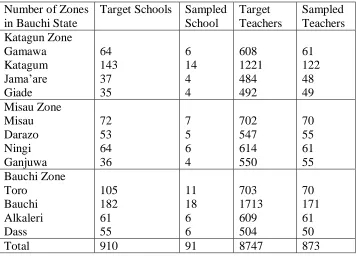
from public primary Schools in Bauchi State, Nigeria. This was indicated in table
3.1 below which were sampled from the three geo-political zones that represent
Table 3.1 Indicating Target Schools, Teachers and their sample size Number of Zones
in Bauchi State
Target Schools Sampled School Target Teachers Sampled Teachers Katagun Zone Gamawa Katagum Jama’are Giade 64 143 37 35 6 14 4 4 608 1221 484 492 61 122 48 49 Misau Zone Misau Darazo Ningi Ganjuwa 72 53 64 36 7 5 6 4 702 547 614 550 70 55 61 55 Bauchi Zone Toro Bauchi Alkaleri Dass 105 182 61 55 11 18 6 6 703 1713 609 504 70 171 61 50
Total 910 91 8747 873
3.5.3 Sampling of Schools
The schools were sampled based on 10% of the target population of both schools
across the three selected zone which reperesent the entire population of the study.
Names of all schools were written in a piece of paper folded and then put in a
container, shake and then picked up to the required number of schools indicated in
table 3.1.
3.5.4 Sampling of Teachers
The teachers were sampled using purposive sampling technique whereby each
teacher has an equal chance of being included in the sample. Teachers were
This was also indicated in table 3.1 which showed the proposion of each teacher
selected in each school in Katagun, Misau and Bauchi zone.
3.5.5 Sampling of Parents
The parentswere sampled through an adopted checklist for identifying children
with learning disabilities and supplement of their academic profils records of
three years class. The academic records of class 2- 4 and the currents class on the
following subject areas: English, Mathmatics, Handwritting and social studies.
The children were identified using the instrument mention above with the help of
head teachers, teachers and the class coordinators in primary five in all the
primary schools selected. Furthermore random table number was used, out of 103
children 5th number was being picked from the entire population which gives the
total numbe of 20 children out of the target population. These children were
chosen in order to get the parents who were targeted as the respondents of the
study. The parents were of both gender, but only three females were included in
the sample due to religion inclanation where males were regarded as the only
head of house and any information required comes from the father not the wife
unless on certain condition with the consent of the father.
3.6 Research Instruments
The checklist used in the study was adopted from Chadha (2001). Questionnaires
and interview scheduled was adapted from Epstein (2001) and then modified
results of the study and for collecting comprehensive data (Altricher, Feldman,
Posch & Somekh, 2008).
3.6.1 Checklist
The checklist was use in identifying children with learning disabilities in the
various public primary schools. The checklist entails information that
characterized an element or symptoms of how childrens with learning disabilities
can be identified and fished out from their peers based on academic performance
in the class room setting. It is adopted from Chadha (2001). See appendix (1)
3.6.2 Questionnaire for Teachers
The questionnaire for the teachers were organized based on the study objectives;
they were designed in closed ended form with multiple options of likert scale
format. It constituted the respondents bio-data, questions about teacher
perceptions on children with learning disabilities, parent perceptions on the
children with learning disabilities, teachers motivation, and lastly questions on the
influence of teacher and parent collaborations in supporting children with learning
disabilities which were adapted and modified from Okolo (2001), Aacha (2010)
and Espteim (2001). See appendix (2)
3.6.3 Interview Schedule for Parents
The parents were interviewed in their various houses, while few among them
were interviewed in schools. This arrangement was made with the parent’s choice
rather than the person conducting the study. The interview was conducted in
had the opportunity to attend school. The interview scheduled were an open-
ended questions that comprised only eight questions. See appendix (3)
3.7 Piloting of the Instruments
The piloting was conducted in Udubo central primary school; teachers and the
parents of children with learning disabilities were the respondents for the pilot
study. It comprised of 25 teachers and 10 parents. This was done in two different
time span with interval of twoweeks between the first test and the second test. The
first test was identify with few ambiguities wthin the questionnaire which were
simplified in a more understanding form for the teachers,and these give more
clearity in the second test with out any problem being experienced by the
respondent. Udubo central primary was chosen because they have required
number of teachers and parents of children with the specific form of the
disabilities for the study.
According to Amin (2005), a pre-test of the instruments should be carried out in
order to identify any ambiguities, misunderstanding or inadequacies in the
instruments. Piloting is also used in order to review and restructure the tools for
the data collection in order to get information that channels on the research
questions and to develop an in-depth understanding of the situation to be studied.
Research must practice the tools for data collection that would be used in carrying
out research before conducting the actual research to help the researcher
3.8 Validity of instruments
Validity is the extent to which the instruments used measure the issues intended to
measure (Amin, 2005). To ensure validity of the instruments, both the
questionnaire and the interview schedule were adapted and the questions were set
based on the objectives and the themes of the research study under the guidance
of professional and experts in the area of learning disabilities in children. The
experts examined and view the content and validated it for research to be carried
out. These panels of experts were lectures in the Universities who are professional
in the fied of learning disabilities among children.
3.9 Reliability of the Instruments
According to Orodho (2009), reliability is the extent to which the questionnaire,
test, observation or any other measurement produces the same results on repeated
trials. To ensure reliability for the tools, the researcher used test and retest method
which was administered to the sample subjects twice in different time span, and
Correlation Coefficient of 0.8.26 was found which indicates reliability. Mugenda
and Mugenda (2003) indicate that the time frame between the first test and the
second test is two weeks. Pearson Product Moment Correlation Coefficient of 0.8
3.10 Data Collection Technique
With the help of the research assistants, the research areas were visited to interact
with the head teachers and teachers in the various primary schools. Arrangements
were made to schedule the interview the parents, to administer the questionnaires
to the teachers and when to collect back the questionnaires. The questionaires for
teachers was administered and collected within the period of three month from the
91 sampled public primary schools in Bauchi State, Nigeria, while the parents
were interviewed wthin the period of two month across the entire sampled parents
in Bauchi State, Nigeria. The questionaires were distributed according the
proposional number of the teachers assigned in each school, the same with the
parents where they were interviewed in their various household while some in
school compound. Parents information was taken in a note form and those who
permitted their voice was being recoreded which was later used in compiling the
information.
3.11 Data Analysis
Both quantitative and qualitative techniques were used to analyze the data.
Quantitative data was used in analyzing the questionnaire using Statistical
Package for Social Science Research (SPSS) while the qualitative data were
analyzed according to the study objectives in a form of percentages based on the