On the Design of Trivium
Yun Tian, Gongliang Chen, Jianhua Li
School of Information Security Engineering,
Shanghai Jiaotong University, China
ruth [email protected], [email protected], [email protected]
Abstract. eSTREAM called for new stream ciphers designed for niche areas such as
exceptional performance in software and hardware where resources are restricted. This project provides an open platform to discuss these ciphers. Trivium is one of the promis-ing new ciphers submitted to it. Until now, no attack has been successfully applied to it. This paper illustrates new design principles of stream ciphers based on the structure of Trivium and introduces the definition of𝑘-order primitive polynomials. New designs of Trivium are also given according to the principles in this paper.
Key words: eSTREAM, Trivium, design principles of stream ciphers
§
1
Introduction
The ECRYPT Stream Cipher Project[1], abbreviated eSTREAM, is a multi-year effort to identify new stream ciphers potentially suitable for widespread adoption. In late 2004 eSTREAM announced a call for new stream cipher proposals and no less than 34 different stream cipher proposals were submitted in two performance profiles, software oriented and hardware oriented. Now the project has selected a portfolio of 7 promising new stream ciphers.
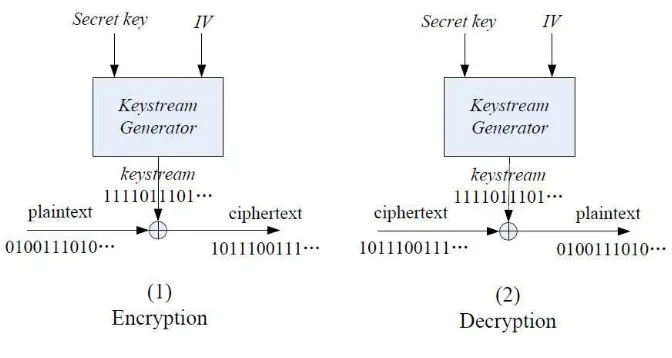
A stream cipher is a symmetric encryption algorithm which takes a stream of plaintext, a secret key and an IV as input and then operates the plaintext with key stream generated by the key and IV, typically bit by bit. The general framework of a stream cipher is shown in Figure 1.
Figure 1 A Stream Cipher
Although block ciphers seem to be perfectly adequate for use in nearly all areas, stream ciphers are still desirable in a few niche areas, which is pointed out by Adi Shamir at the first ECRYPT State of the Art of Stream Ciphers workshop in October 2004[5]. These niche areas were identified as: 1) Exceptional encryption performance in software, where the luxury of additional hardware is not available to speed up encryption; 2) Any reasonable kind of encryption performance in hardware environments where the available resources such as gate count or power might be heavily restricted. The extreme example of this is provided by simple RFID tags. eSTREAM provides such a platform that scientists and researchers can exchange the design strategies of stream ciphers and find possible attacks on stream ciphers submitted to the project. Trivium[2] is one of the promising new stream ciphers in the hardware oriented profile. It has got high scores in evaluation due to its good performance and high security. Its simplicity and clarity perfectly demonstrate a new way to design secure stream ciphers. The idea of design of Trivium can be found in [3].
This paper focuses on the new design principles of stream ciphers and tries to find out better con-structions and more application of Trivium. These principles are given based on the structure of Trivium. Section 2 describes the stream cipher Trivium and Section 3 discusses its security and efficiency. Section 4 introduces Trivium-model stream ciphers and 𝑘-order primitive polynomials in order to illustrate the new design principles. Section 5 shows new constructions of Trivium based on the principles in Section 4 and Section 6 draws the conclusion.
§1.1 Notation
(𝑠𝑚, . . . , 𝑠𝑛) the internal state of (𝑚−𝑛+ 1) bits
𝑠𝑖 the𝑖𝑡ℎ state or bit in the shift registers
𝑧𝑡 the bit of keystream generated at time𝑡
+ addition over𝐺𝐹(2), i.e. XOR ⋅ multiplication over𝐺𝐹(2), i.e. AND
{𝑎, 𝑏, 𝑐} notation of one round in Trivium by its active bits: 𝑎𝑡ℎ bit,𝑏𝑡ℎ bit and𝑐𝑡ℎ bit
§
2
Trivium
Trivium is designed to generate up to 264 bits of key stream from an 80-bit secret key and an 80-bit
the key and the IV, then the state is repeatedly updated and used to generate key stream bits. There are 288 bits in the internal state.
A complete description of the generation keystream phase is given by the following simple pseudo-code: for 𝑖= 1 to 𝑁 do
𝑡1←𝑠66+𝑠93
𝑡2←𝑠162+𝑠177
𝑡3←𝑠243+𝑠288
𝑧𝑖←𝑡1+𝑡2+𝑡3
𝑡1←𝑡1+𝑠91⋅𝑠92+𝑠171
𝑡2←𝑡2+𝑠175⋅𝑠176+𝑠264
𝑡3←𝑡3+𝑠286⋅𝑠287+𝑠69
(𝑠1, 𝑠2, . . . , 𝑠93)←(𝑡3, 𝑠1, . . . , 𝑠92)
(𝑠94, 𝑠95, . . . , 𝑠177)←(𝑡1, 𝑠94, . . . , 𝑠176)
(𝑠178, 𝑠179, . . . , 𝑠288)←(𝑡2, 𝑠178, . . . , 𝑠287)
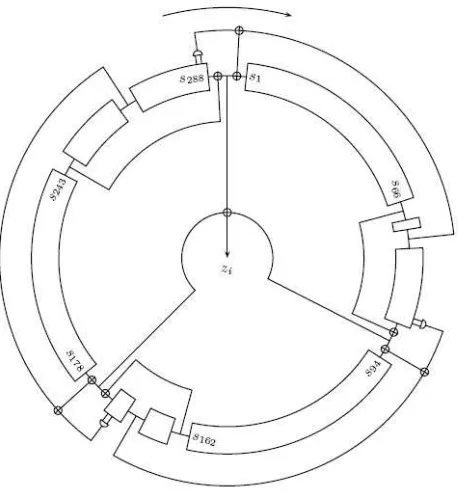
Figure 2 shows the structure of the algorithm.
Figure 2 Structure of Trivium
The initialization phase operates exactly the same as the keystream generation phase except that it doesn’t generate keystream. The state is rotated over 4 full cycles after the loading of key and IV. 4 full cycles means 4∗288 = 1152 clock cycles.
Key and IV are loaded as following:
(𝑠1, 𝑠2, . . . , 𝑠93)←(𝐾3, . . . , 𝐾80,0, . . . ,0)
(𝑠94, 𝑠95, . . . , 𝑠177)←(𝐼𝑉1, . . . , 𝐼𝑉80,0, . . . ,0)
§
3
Security and Efficiency of Trivium
Trivium is designed to be both secure and efficient. The following sections discuss the two properties of Trivium.
§3.1 Security
[3] classifies attacks against stream ciphers into two categories as follows:
-Key recovery attacks, the goal of which is to recovery part or the whole key by observing the key stream.
-Distinguishing attacks, the goal of which is to detect that the key stream bits are not completely unpredictable.
It is obvious that the objective of distinguishing attacks is weaker than that of key recovery attacks. So it is easier to apply and harder to protect against. Design of Trivium focuses particularly on linear correlations and the main design objective is to keep the largest correlations below safe bounds. Other important properties, such as a sufficiently long period, are considered afterwards.
Until now, no attack has been successfully applied to Trivium. One attempt is to find out attacks on reduced version of Trivium and try to extend them to the original cipher. In [12], two attacks on Trivium are studied. These attacks are state recovering and statistical tests. Although the analysis applied to Bivium (a reduced version of Trivium from 3 rounds to 2 rounds) is quite successful, the results on Trivium are not good since the attacks are no faster than exhaustive search. [6] applies the SAT solver attack and the BDD attack on Bivium and optimizes them. The attacks are of good speed, but the extension of the attacks to Trivium was left as an open question. Another reduced version of Trivium, 2-round Trivium, is proposed in [15]. Matsui’s linear cryptanalysis is applied to this 2-round Trivium and a linear approximation with bias 2−31 is given.
Another attempt is to exploit the initialization part of Trivium. Results of statistical analysis of Trivium can be found in [14], which include key/key stream correlation test and IV/key stream correlation test. [8] demonstrates a key recovery attack on reduced initialization version of Trivium by chosen IV statistical analysis. But evidence is given that the analysis is not applicable on Trivium with full IV initialization. [4] develops a new technique, called cube attack, which is a major improvement over several previously published attacks of the same type and applies it to Trivium with a reduced number of initialization round. The speed of this attack is faster than that in [8]. Evaluation on implementation of Trivium for low-power application in RFID system is given in [7] with comparison to AES-128. Synthesis result of Trivium is better than that of AES-128 except for the large amount of clock cycles needed in the initialization phase. [12] analyzes the completeness property of the initialization function and proposes a new input to the initialization of Trivium that has better diffusion properties.
§3.2 Efficiency
and maximum throughput to area ratio, by a factor of at least two.
§
4
Design Principles of Trivium-model Stream Ciphers
Trivium is successfully designed to meet the need in the niche area where resources of hardware envi-ronment such as gate count or power might be heavily restricted. Besides efficiency, Trivium also resist all the known attacks. Based on the low linear correlations and high efficiency of Trivium, this paper tries to find out design principles of secure stream ciphers.
Let’s focus on the operation of state and the pseudo-code is given bellow:
𝑡1←𝑠66+𝑠93+𝑠91⋅𝑠92+𝑠171
𝑡2←𝑠162+𝑠177+𝑠175⋅𝑠176+𝑠264
𝑡3←𝑠243+𝑠288+𝑠286⋅𝑠287+𝑠69
Index numbers of active bits in this part are rewritten in Table 1.
3𝑢1 3𝑢2 3𝑛1 3𝑢3 3𝑢4 3𝑛2 3𝑢5 3𝑢6 3𝑛3
66 = 3⋅22 69 = 3⋅23 93 = 3⋅31 162 = 3⋅54 171 = 3⋅57 177 = 3⋅59 243 = 3⋅81 264 = 3⋅88 288 = 3⋅96
Table 1 Numbers of original Trvium
There are 93 bits in the first round of Trivium, (177−93) = 84 bits in the second round and (288−177) = 111 bits in the third round. Here, the first round is noted by its active bits as{66,69,93}. Thus , the second round can be written as {162,171,177}, and {243,264,288}for the third round. It is not difficult to find that each number in Table 1 has a factor of 3.
§4.1 Description of Trivium-model Stream Ciphers
In order to discuss the design of Trivium, the algorithm can be generalized into a model. By changing the exact index numbers of active bits into variables, we can get a generalized algorithm of Trivium. These variables can be seen as the parameter of this Trivium-model stream cipher. Trivium-model stream cipher can be noted as
{3𝑢1,3𝑢2,3𝑛1}, {3𝑢3,3𝑢4,3𝑛2}, {3𝑢5,3𝑢6,3𝑛3},
where 𝑢𝑖 (𝑖= 1,⋅ ⋅ ⋅,6), 𝑛𝑖 (𝑖= 1,2,3) are parameters and𝑢1 < 𝑢2< 𝑛1 < 𝑢3< 𝑢4< 𝑛2 < 𝑢5< 𝑢6 < 𝑛3.
𝑛1, 𝑛2, 𝑛3 also represent the degree of the corresponding characteristic polynomials. We will discuss more
details about this in the following sections.
for 𝑖= 1 to 𝑁 do
𝑡1←𝑠3𝑢1+𝑠3𝑛1
𝑡2←𝑠3𝑢3+𝑠3𝑛2
𝑡3←𝑠3𝑢5+𝑠3𝑛3
𝑧𝑖←𝑡1+𝑡2+𝑡3
𝑡1←𝑡1+𝑠3𝑛1−2⋅𝑠3𝑛1−1+𝑠3𝑢4
𝑡2←𝑡2+𝑠3𝑛2−2⋅𝑠3𝑛2−1+𝑠3𝑢6
𝑡3←𝑡3+𝑠3𝑛3−2⋅𝑠3𝑛3−1+𝑠3𝑢2
(𝑠1, 𝑠2, . . . , 𝑠3𝑛1)←(𝑡3, 𝑠1, . . . , 𝑠3𝑛1−1)
(𝑠3𝑛1+1, 𝑠3𝑛1+2, . . . , 𝑠3𝑛2)←(𝑡1, 𝑠3𝑛1+1, . . . , 𝑠3𝑛2−1)
(𝑠3𝑛2+1, 𝑠3𝑛2+2, . . . , 𝑠3𝑛3)←(𝑡2, 𝑠3𝑛2+1, . . . , 𝑠3𝑛3−1)
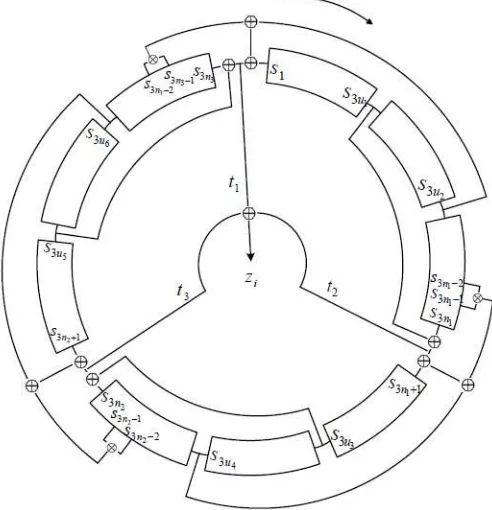
This is the general model of Trivium. The structure of this model is given by Figure 3.
Figure 3 Structure of a Trivium-model stream cipher
A Trivium-model stream cipher consists of 3 rounds and each round operates nearly the same as the other two. In order to get design strategies of Trivium-model stream ciphers, the following discussion breaks the cipher into smaller parts, reconstructs these parts and gives an extension.
§4.1.1 Univium: A 1-round Trivium-model Stream Cipher
Univium is a 1-round Trivium-model stream cipher. It can be noted as
{3𝑢1,3𝑢2,3𝑛1},
where𝑢1, 𝑢2, 𝑛1 are parameters, and𝑢1< 𝑢2< 𝑛1. 𝑛1 also denotes the degree of the characteristic
Pseudo-code of this cipher is given below: for 𝑖= 1 to 𝑁 do
𝑡1←𝑠3𝑢1+𝑠3𝑛1
𝑧𝑖←𝑡1
𝑡1←𝑡1+𝑠3𝑛1−2⋅𝑠3𝑛1−1+𝑠3𝑢2
(𝑠1, 𝑠2, . . . , 𝑠3𝑛1)←(𝑡3, 𝑠1, . . . , 𝑠3𝑛1−1)
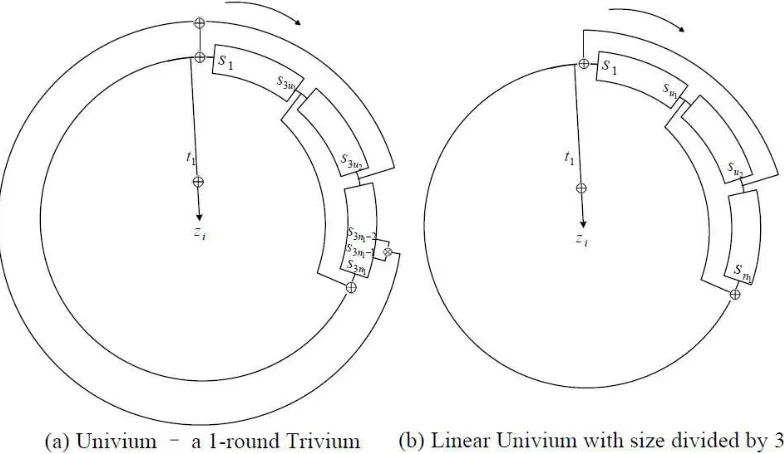
Figure 4(a) shows the internal states of Univium. If the sequences of internal state are of uniform distribution,𝑃 𝑟𝑜𝑏[𝑠𝑚3−2⋅𝑠𝑚3−1 = 0] = 0.75. This means that the non-linear part of the algorithm can be
neglected with a probability of 0.75. Figure 4(b) shows the internal states of Univium with non-linear part omitted and all the parameters divided by 3. Design principles discussed below are based on this model.
Figure 4 Univium
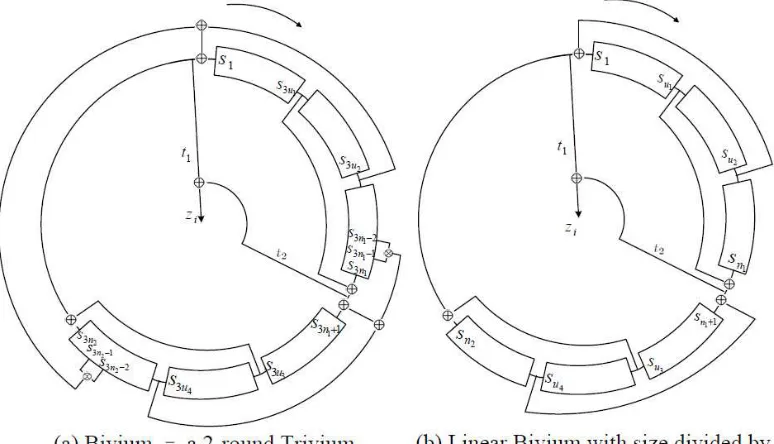
§4.1.2 Bivium: A 2-round Trivium-model Stream Cipher
Bivium is a 2-round Trivium-model stream cipher. It can be noted as
{3𝑢1,3𝑢2,3𝑛1}, {3𝑢3,3𝑢4,3𝑛2},
where𝑢𝑖(𝑖= 1,⋅ ⋅ ⋅,4),𝑛1, 𝑛2 are parameters and𝑢1< 𝑢2< 𝑛1< 𝑢3< 𝑢4< 𝑛2. 𝑛2 also denotes the degree
for 𝑖= 1 to 𝑁 do
𝑡1←𝑠3𝑢1+𝑠3𝑛1
𝑡2←𝑠3𝑢3+𝑠3𝑛2
𝑧𝑖←𝑡1+𝑡2
𝑡1←𝑡1+𝑠3𝑛1−2⋅𝑠3𝑛1−1+𝑠3𝑢4
𝑡2←𝑡2+𝑠3𝑛2−2⋅𝑠3𝑛2−1+𝑠3𝑢2
(𝑠1, 𝑠2, . . . , 𝑠3𝑛1)←(𝑡2, 𝑠1, . . . , 𝑠3𝑛1−1)
(𝑠3𝑛1+1, 𝑠3𝑛1+2, . . . , 𝑠3𝑛2)←(𝑡1, 𝑠3𝑛1+1, . . . , 𝑠3𝑛2−1)
Figure 5(a) shows the internal states of Bivium. If the sequences of internal state are of uniform distribution, the non-linear part of the algorithm can be neglected with a probability of 0.752. Figure 5(b)
shows the internal states of Bivium with non-linear part omitted and all the parameters divided by 3. Design principles discussed below are based on this model.
Figure 5 Bivium
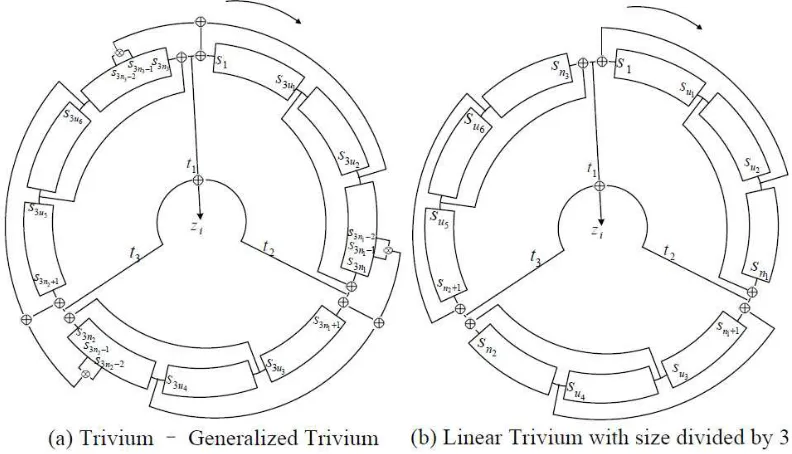
§4.1.3 Trivium: A 3-round Trivium-model Stream Cipher
Here, we still use ’Trivium’ to denote a 3-round Trivium-model stream cipher. A 3-round Trivium-model stream cipher can be noted as
{3𝑢1,3𝑢2,3𝑛1}, {3𝑢3,3𝑢4,3𝑛2}, {3𝑢5,3𝑢6,3𝑛3},
where 𝑢𝑖 (𝑖= 1, . . . ,6), 𝑛𝑖 (𝑖= 1,2,3) are parameters and𝑢1 < 𝑢2< 𝑛1 < 𝑢3< 𝑢4< 𝑛2 < 𝑢5< 𝑢6 < 𝑛3.
𝑛3 also denotes the degree of the characteristic polynomial of Trivium.
Pseudo-code of this cipher is the same as that in Section 4.1.
shows the internal states of Trivium with non-linear part omitted and all the parameters divided by 3. Design principles discussed below are based on this model.
Figure 6 Trivium
§4.1.4 Extension: k-round Trivium-model Stream Ciphers
After the description of Univium, Bivium and Trivium, it is not difficult to extend the Trivium-model stream cipher to arbitrary rounds. Each round still contains feedback part, feed forward part and non-linear part.
§4.2 𝑘-order Primitive Polynomial
In order to discuss criterion to determine the parameters of the stream ciphers described in the above sections, a new definition, 𝑘-order primitive polynomial, is introduced here. First, we would like to review the definition of primitive polynomial.
Definition 4.2.1 A polynomial 𝑓(𝑥) with coefficients in𝐺𝐹(𝑝) =𝑍/𝑝𝑍 is a primitive polynomialif it has a root𝛼in 𝐺𝐹(𝑝𝑚) such tha t{0,1, 𝛼, 𝛼2
, 𝛼3
,⋅ ⋅ ⋅, 𝛼𝑝𝑚
−2} is the entire field𝐺𝐹(𝑝𝑚), and moreover, 𝑓(𝑥) is the smallest degree polynomial having𝛼as root.
Based on definition 4.2.1 and let𝑝= 2, an extensive definition,𝑘-order primitive polynomials, is given below.
Definition 4.2.2 Given𝑓(𝑥) =
𝑛 ∑ 𝑖=0
𝑎𝑖𝑥𝑖, 𝑛 > 𝑘, 𝑎𝑖∈𝐺𝐹(2), 𝑖= 0,1,⋅ ⋅ ⋅, 𝑛, 𝑓(𝑥) is called a 𝑘-order
primitive polynomial if𝑓(𝑥) = (𝑥+ 1)𝑘⋅𝑔(𝑥), where𝑔(𝑥) is a primitive polynomial.
Remark Definition 4.2.2 is an extension of definition 4.2.1 because 0-order primitive polynomial is
Example 4.2.1 𝑓1(𝑥) =𝑥28+𝑥5+𝑥2+ 1 = (𝑥+ 1)(𝑥27+𝑥26+𝑥25+𝑥24+𝑥23+𝑥22+𝑥21+𝑥20+
𝑥19+𝑥18+𝑥17+𝑥16+𝑥15+𝑥14+𝑥13+𝑥12+𝑥11+𝑥10+𝑥9+𝑥8+𝑥7+𝑥6+𝑥5+𝑥+ 1) is a 1-order
primitive polynomial.
Example 4.2.2 𝑓2(𝑥) =𝑥31+𝑥9+𝑥8+ 1 = (𝑥+ 1)2(𝑥11+𝑥10+𝑥6+𝑥5+𝑥3+𝑥+ 1)(𝑥7+𝑥+
1)(𝑥11
+𝑥10
+𝑥7
+𝑥3
+ 1) is not a 1-order primitive polynomial.
Example 4.2.3 𝑓3(𝑥) =𝑥96+𝑥73+𝑥70+𝑥67+𝑥47+𝑥44+𝑥41+𝑥29+𝑥24+𝑥20+𝑥18+𝑥15+𝑥14+𝑥9+
𝑥5
+1 = (𝑥+1)3
(𝑥93
+𝑥92
+𝑥89
+𝑥88
+𝑥85
+𝑥84
+𝑥81
+𝑥80
+𝑥77
+𝑥76
+𝑥73
+𝑥72
+𝑥70
+𝑥68
+𝑥67
+𝑥44
+𝑥43
+
𝑥41
+𝑥39
+𝑥38
+𝑥35
+𝑥34
+𝑥31
+𝑥30
+𝑥27
+𝑥25
+𝑥23
+𝑥20
+𝑥19
+𝑥17
+𝑥14
+𝑥13
+𝑥12
+𝑥9
+𝑥8
+𝑥6
+𝑥4
+𝑥+1) is a 3-order primitive polynomial.
§4.3 Design Principles of Trivium-model Stream Ciphers
Design principles introduced in this section mainly relates to the linear part of Trivium-model stream ciphers. The objective of these principles is to determine parameters in the algorithms described above, i.e. Univium, Bivium, Trivium and so on. k-order primitive polynomials are used to illustrate the principles.
If we want to construct a Trivium-model stream cipher, we can first determine the rounds of the cipher. Here, we suppose that we still need a 3-round cipher, i.e. Trivium. It is noted as
{3𝑢1,3𝑢2,3𝑛1}, {3𝑢3,3𝑢4,3𝑛2}, {3𝑢5,3𝑢6,3𝑛3},
where𝑢𝑖 (𝑖= 1, . . . ,6),𝑛𝑖 (𝑖= 1,2,3) are parameters and𝑢1< 𝑢2< 𝑛1< 𝑢3< 𝑢4< 𝑛2< 𝑢5< 𝑢6< 𝑛3.
Next, we determine the unknown parameters under the following principles.
Principles Construct a 3-round Trivium, denoted by{3𝑢1,3𝑢2,3𝑛1},{3𝑢3,3𝑢4,3𝑛2},{3𝑢5,3𝑢6,3𝑛3},
such that
1) The characteristic polynomial of{𝑢1, 𝑢2, 𝑛1}is a 1-order primitive polynomial;
2) The characteristic polynomial of{𝑢1, 𝑢2, 𝑛1}, {𝑢3, 𝑢4, 𝑛2}is a 2-order primitive polynomial;
3) The characteristic polynomial of{𝑢1, 𝑢2, 𝑛1}, {𝑢3, 𝑢4, 𝑛2}, {𝑢5, 𝑢6, 𝑛3} is a 3-order primitive
poly-nomial.
According to the principles, we can omit the non-linear parts (AND operations) and use Figure 4(b), 5(b), 6(b) to determine parameters𝑢𝑖 (𝑖= 1, . . . ,6) and𝑛𝑖 (𝑖= 1,2,3).
If we want to construct a𝑘-round Trivium-model stream cipher, then the characteristic polynomial of the𝑖𝑡ℎ-round (𝑖= 1,2,⋅ ⋅ ⋅, 𝑘) of the linear part should be an𝑖-order primitive polynomial.
§
5
Improvement on Trivium
Based on the design principles given above, we would like to give better parameters than those of the original Trivium. In this paper, we only consider the condition under which the characteristic polynomials are calculated from the state 𝑆1, i.e. the first internal bit. Setting different internal state bit as starting
We choose the parameters divided by 3 according to the description in Section 4. Trivium has 288-bit internal state, so we set𝑛3= 288/3 = 96. It can be noted as
{3×22,3×23,3×31}, {3×54,3×57,3×59}, {3×81,3×88,3×96}.
We found that the characteristic polynomial of the original Trivium is 3-order primitive, but the charac-teristic polynomial of the corresponding Univium is not 1-order primitive. Neither is that of the corresponding Bivium.
After lots of research, we found out some suitable parameters according to the discussion above. Sections below describes new constructions of Trivium-model stream ciphers.
§5.1 Improvement On the Original Trivium
This algorithm is the improvement on original Trivium. 𝑛1, 𝑛2, 𝑛3are the same as the original algorithm
and 𝑢𝑖 (𝑖 = 1,⋅ ⋅ ⋅,6) are adjusted so as to satisfy the principles discussed in Section 4.3. Thus, not only
the characteristic polynomial of the whole algorithm is a 3-order primitive polynomial, but also those of the Univium and Bivium are 1-order and 2-order primitive polynomials respectively. This improved construction is noted as
{3×10,3×22,3×31}, {3×36,3×48,3×59}, {3×65,3×85,3×96}.
The complete description of the generation keystream phase of this algorithm is given by the following simple pseudo-code:
for 𝑖= 1 to 𝑁 do
𝑡1←𝑠30+𝑠93
𝑡2←𝑠108+𝑠177
𝑡3←𝑠195+𝑠288
𝑧𝑖←𝑡1+𝑡2+𝑡3
𝑡1←𝑡1+𝑠91⋅𝑠92+𝑠144
𝑡2←𝑡2+𝑠175⋅𝑠176+𝑠255
𝑡3←𝑡3+𝑠286⋅𝑠287+𝑠66
(𝑠1, 𝑠2, . . . , 𝑠93)←(𝑡3, 𝑠1, . . . , 𝑠92)
(𝑠94, 𝑠95, . . . , 𝑠177)←(𝑡1, 𝑠94, . . . , 𝑠176)
(𝑠178, 𝑠179, . . . , 𝑠288)←(𝑡2, 𝑠178, . . . , 𝑠287)
§5.2 A New Trivium of 384 Bits
Based on the principles in Section 4.3, we can also construct a new Trivium-model stream cipher with internal states of 384 bits. This Trivium-model stream cipher can be noted as
{3×10,3×22,3×31}, {3×36,3×48,3×59}, {3×65,3×72,3×128}.
The characteristic polynomial of{10,22,31}is a 1-order primitive polynomial. That of{10,22,31},{36,48,59} is a 2-order primitive polynomial. That of{10,22,31}, {36,48,59}, {65,72,128}is a 3-order primitive poly-nomial.
for 𝑖= 1 to 𝑁 do
𝑡1←𝑠30+𝑠93
𝑡2←𝑠108+𝑠177
𝑡3←𝑠195+𝑠384
𝑧𝑖←𝑡1+𝑡2+𝑡3
𝑡1←𝑡1+𝑠91⋅𝑠92+𝑠144
𝑡2←𝑡2+𝑠175⋅𝑠176+𝑠216
𝑡3←𝑡3+𝑠382⋅𝑠383+𝑠66
(𝑠1, 𝑠2, . . . , 𝑠93)←(𝑡3, 𝑠1, . . . , 𝑠92)
(𝑠94, 𝑠95, . . . , 𝑠177)←(𝑡1, 𝑠94, . . . , 𝑠176)
(𝑠178, 𝑠179, . . . , 𝑠384)←(𝑡2, 𝑠178, . . . , 𝑠383)
§5.3 Another New Trivium Designed for 32-bit OS
Considering 32-bit OS, we also found another construction of Trivium listed below.
{3×5,3×20,3×32}, {3×33,3×42,3×64}, {3×65,3×84,3×96}.
The complete description of the generation keystream phase of this algorithm is given by the following simple pseudo-code:
for 𝑖= 1 to 𝑁 do
𝑡1←𝑠15+𝑠96
𝑡2←𝑠99+𝑠192
𝑡3←𝑠195+𝑠288
𝑧𝑖←𝑡1+𝑡2+𝑡3
𝑡1←𝑡1+𝑠94⋅𝑠95+𝑠126
𝑡2←𝑡2+𝑠190⋅𝑠191+𝑠252
𝑡3←𝑡3+𝑠286⋅𝑠287+𝑠60
(𝑠1, 𝑠2, . . . , 𝑠96)←(𝑡3, 𝑠1, . . . , 𝑠95)
(𝑠97, 𝑠98, . . . , 𝑠192)←(𝑡1, 𝑠97, . . . , 𝑠191)
(𝑠193, 𝑠194, . . . , 𝑠288)←(𝑡2, 𝑠193, . . . , 𝑠287)
§
6
Conclusion
References
[1] http://www.ecrytp.eu.org/stream.
[2] C. De Canni`ere & B. Preneel. TRIVIUM Specifications. eSTREAM, ECRYPT Stream Cipher Project, Report 2005/001, 2005. http://www.ecrypt.eu.org/stream.
[3] C. De Canni`ere & B. Preneel. TRIVIUM A Stream Cipher Construction Inspired by Block Cipher Design Principles. In Workshop onStream Ciphers Revisited (SASC2006), 2006.
[4] I. Dinur & A. Shamir. Cube Attacks on Tweakable Black Box Polynomials. http://eprint.icar.org/2008/385.
[5] ECRYPT Network of Excellence in Cryptology. In Workshop on The State of the Art of Stream Ciphers (SASC2004), 2004.
[6] T. Eibach, E. Pilz & S. Steck. Comparing and Optimising Two Generic Attacks on Bivium. In Workshop on
The State of the Art of Stream Ciphers (SASC2008)pages 57-68, 2008.
[7] M. Feldhofer. Comparison of Low-Power Implementations of Trivium and Grain. In Workshop onThe State of
the Art of Stream Ciphers (SASC2007)pages 236-246, 2007.
[8] S. Fischer, S. Khazaei & W. Meier. Chosen IV Statistical Analysis for Key Recovery Attacks on Stream Ciphers. In Workshop onThe State of the Art of Stream Ciphers (SASC2008)pages 33-42, 2008.
[9] K. Gaj, G. Southern & R. Bachimanchi. Comparison of Hardware Performance of Selected Phase II eSTREAM candidates. In Workshop onThe State of the Art of Stream Ciphers (SASC2007) pages 225-235, 2007.
[10] T. Good, W. Chelton & M. Benaissa. Review of Stream Cipher Candidates from a Low Resource Hardware Perspective. In Workshop onStream Ciphers Revisited (SASC2006), 2006.
[11] F. K. G¨urkaynak, P. luethi, N. Bernold, R. Blattmann, V. Goode, M. Marghitola, H. Kaeslin, N. Felber
& W. Fichtner. Hardware Evaluation of eSTREAM Candidates. In Workshop on Stream Ciphers Revisited (SASC2006), 2006.
[12] A. Maximov & A. Biryukov. Two Trivial Attacks on TRIVIUM. In Workshop onThe State of the Art of Stream
Ciphers (SASC2007)pages 1-16, 2007.
[13] M. Rogawski. Hardware Evaluation of eSTREAM Candidates. In Workshop onThe State of the Art of Stream
Ciphers (SASC2007)pages 215-224, 2007.
[14] M. S. Turan, A. Do˘ganaksoy & C¸ . C¸ alik. Statistical Analysis of Synchronous Stream Ciphers. In Workshop on
Stream Ciphers Revisited (SASC2006), 2006.