Linear Cryptanalysis of
PRINTcipher
— Trails and Samples Everywhere
Martin ˚Agren and Thomas Johansson
Dept. of Electrical and Information Technology, Lund University, P.O. Box 118, 221 00 Lund, Sweden
Abstract. PRINTcipher is a recent lightweight block cipher designed by Knudsen et al. Some noteworthy characteristics are a burnt-in key, a key-dependent permutation layer and identical round keys. Independent work on PRINTcipherhas identified weak key classes that allow for a key recovery — the obvious countermeasure is to avoid these weak keys at the cost of a small loss of key entropy. This paper identifies several larger classes of weak keys. We show how to distinguish classes of keys and give a 28-round linear attack applicable to half the keys. We show that there are several similar attacks, each focusing on a specific class of keys. We also observe how some specific properties of PRINTcipher
allow us to collect several samples from each plaintext–ciphertext pair. We use this property to construct an attack on 29-round PRINTcipher
applicable to a fraction 2−5 of the keys.
Keywords: cryptanalysis, block cipher, linear cryptanalysis, finding sam-ples, key bit distinguisher
1
Introduction
Over the last few years, a number of hardware-efficient block ciphers have been proposed. Some noteworthy examples are HIGHT [6], PRESENT [3], and KATAN and KTANTAN [5]. One of the most recent designs to appear is PRINTcipher[8]. It is designed by Knudsen et al. and is quite similar to the well-studied PRESENT. All rounds use the same key and differ only by a round counter. The linear layer is partly key-dependent and as a result, 48-bit PRINTcipher uses keys of 80 bits, while 96-bit PRINTcipheruses 160-bit keys. We will focus exclusively on PRINTcipher-48 in this paper, noting that very similar results can be derived for PRINTcipher-96.
bits to do partial encrypting and decrypting, we eventually reach 29 rounds of 48.
Two recent attacks are similar to our work in that they identify classes of weak keys. As a fundamental idea behind PRINTcipheris that the key is burnt into the device, it is straightforward to protect against these attacks by avoiding the weak keys. Avoiding the 252 keys attacked in [9] the size of the key space shrinks from 280 to 280−252≈280 so the entropy is still 80 bits in a practical sense. Similarly, to protect against the attack in [4] the number of keys needs to be lowered to approximately 279.8 so there is a loss of one fifth of a bit. In this independent paper, we find several classes that are very probable (e.g., proba-bility one half), and even avoiding only the largest classes leads to a key space of size approximately 278, meaning two bits of the key entropy are effectively lost. This makes our observations very interesting compared to the previously published results.
This paper is organized as follows: Section 2 describes PRINTcipher. Sec-tion 3 introduces linear cryptanalysis and discusses the importance of finding many samples. Some initial, basic observations are given in Section 4, before Sec-tion 5 gives our fundamental observaSec-tion: a key bit distinguisher on 23 rounds of PRINTcipher. Section 6 then derives attacks on 27 and 28 rounds of PRINT-cipher. In Section 7, we extend our observation to show that several classes of weak keys exist, making the attack very general, and to show how one can find many samples. In Section 8, we use our ability to find many samples to provide an attack on 29-round PRINTcipher. Section 9 concludes the paper.
2
A Description of
PRINTcipher
We focus entirely on PRINTcipher-48, which uses blocks of 48 bits and 80-bit keys.
The 48-bit plaintext is loaded into the state, where we denote the 48 bit positions as (b, c), 0≤b <16,0≤c <3. The leftmost bit, also referred to as the most significant bit (msb), is (15,2) while (0,0) is the least significant bit (lsb). There are 48 rounds where each round uses a round constant RCi, i =
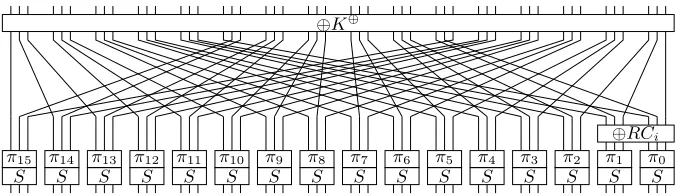
0, . . . ,47 (see Table 1), a 48-bit xor-key K⊕ (the same in all rounds) and a 32-bit permutation keyKπ(the same in all rounds). Each round consists of key
addition, standard permutation, round constant addition, key-dependent per-mutation and an S-box, see Fig. 1. The S-box is given in Table 2 and takes input (x2, x1, x0) to produce output (y2, y1, y0).
Table 1.The round constantsRCi.
i 0 1 2 3 4 5 6 7 8 9 10 11 12 13 14 15 16 17 18 19 20 21 22 23 RCi01 03 07 0F 1F 3E 3D 3B 37 2F 1E 3C 39 33 27 0E 1D 3A 35 2B 16 2C 18 30
⊕K⊕
⊕RCi
π0 S π1
S π2
S π3
S π4
S π5
S π6
S π7
S π8
S π9
S π10
S π11
S π12
S π13
S π14
S π15
S
Fig. 1.One round of PRINTcipher.
Table 2.The S-box as valuesS(x) =y= (y2, y1, y0) corresponding tox= (x2, x1, x0). As an example,S(1,0,0) =S(4) = 7 = (1,1,1).
x 0 1 2 3 4 5 6 7 S(x) 0 1 3 6 7 4 5 2
We denote the plaintextP =p47, . . . , p0 and the ciphertext (state) after r rounds of encryption (0< r≤48) byCr=cr
47, . . . , cr0.
2.1 The Key
We split the keyK=K⊕||Kπ= (k⊕ 47, . . . , k
⊕
0)||(k31π, . . . , k0π) into an xor-keyK⊕ (48 bits) and a permutation keyKπ (32 bits).
2.2 The Standard Permutation Π
A “large” permutationΠ is applied to the state of PRINTcipher. Each bit, at position (b, c), is moved to (tmod 16,bt/16c) wheret= 3b+c. The permutation is given in Appendix A and can also be seen in Fig. 1.
2.3 The Key-Dependent Permutation π
A “small” permutationπbis applied to each (disjoint) triplet of bits in the state of
PRINTcipher. The new positions of bits (b,2),(b,1),(b,0) are (b, c2b),(b, cb1),(b, cb0), respectively, where (cb
2, cb1, cb0) are determined by the two key bits (k2πb+1, k
π
2b).
This mapping is given in Table 3. Note in particular how one of the permuta-tions is trivial while the others fix one bit while switching the two remaining bits. Thus, the two permutations that shift the three-bit word cyclically have been excluded from PRINTcipherand can not be selected by the key.
2.4 Other Notation
LetIr=rmod 2 indicate whetherris even or odd. Partial encryption in rounds
r1, . . . , r2−1 is denoted by φr1,r2. Similarly, partial decryption in rounds r2−
1, . . . , r1is denoted φ−1
Table 3.The key-dependent permutation. The bits at positions (b,2),(b,1),(b,0) are moved to positions (b, cb2),(b, cb1),(b, cb0), respectively where (cb2, cb1, cb0) are determined by (kπ
2b+1, k2πb).
(k2πb+1, kπ2b) (cb2, cb1, cb0) (0,0) (2,1,0) (0,1) (1,2,0) (1,0) (2,0,1) (1,1) (0,1,2)
2.5 Existing Work on PRINTcipher
Abdelraheem et al. have given a differential attack on 22-round PRINTcipher[1]. Using the entire code book, they study the single-bit differentials in order to learn how the bits are permuted through the entire cipher, i.e.,rrounds. Finding the rth root of this permutation then gives them the single-round permutationπ◦Π and thusKπ.
We note that it is straightforward to invert the last S-box upon retrieving a ciphertext (it is present only to make hardware implementations smaller as it does not require any special logic for the last round as in e.g., AES). Thus, an attacker can extend the 22-round attack to 23 rounds at very low cost: the S-box only has to be inverted if the three bits in its output are the only bits that have a difference.
Two very recent publications reach further than 22 rounds. At CRYPTO, Leander et al. [9] showed how an “invariant subspace attack” allowed for a class of 252keys to be distinguished regardless of the number of rounds, so in particular for the full PRINTcipher. At SAC, Karako¸c et al. [4] combined differential and linear cryptanalysis to reach 29 rounds on 4.54% and 31 rounds on.036% of the keys.
3
Linear Cryptanalysis
Originally introduced by Matsui [11], linear cryptanalysis has since been applied to a large number of cryptographic primitives in many different fashions. In the original form, the goal is to find some biased linear relation on bits in the progressing state of the cipher. If key bits involved in partially encrypting and/or decrypting are guessed correctly, the bias should be observable, while for wrong guesses, the bias should not appear. As a result, the partial key guess can be verified and the rest of the key found through an exhaustive search. The end result is an attack faster than exhaustive search, but the cost is that one needs to access many plaintext–ciphertext pairs (see Section 3.1).
While it is common to study trails on linear combinations of bits in plaintext and ciphertext,
where α, β, γ are bitmasks, the most simple case is to study single-bit trails such as
P(p47=c47) = 1 2 +.
This paper will exclusively deal with single-bit trails, possibly involving the xor of one bit of key, although it is no doubt possible to find many more trails by using multiple-bit trails. The reason we do this is that the single-bit trails appear very naturally in PRINTcipher.
We refer to as thebias of the trail, and an attacker will naturally try to find relations with as large bias as possible. In the PRINTcipher specification, the designers show that the optimal linear trails overrrounds of PRINTcipher have probability 1
2+ 2
−r−1, i.e., bias 2−r−1. In this paper, we will exclusively
look at such optimal trails.
The piling-up lemma [11] tells us how the bias diminishes over more rounds. In our context it means that piling two optimal trails on r1 and r2 rounds into one trail on r=r1+r2 rounds, results in a bias of 2−r−1= 2−r1−r2−1. This is
not surprising: piling two optimal trails results in an optimal trail.
Every time we look at (e.g.,) p47⊕c47, we actually look at asample, a bit that is picked from some distribution. By looking at sufficiently many samples, we can make a sufficiently good guess on which distribution we are dealing with.
3.1 On the Importance of Finding Many Samples
In order to distinguish between two distributions on{0,1}, one with Prob(1) = 1
2+and one with Prob(1) = 1
2, it is commonly accepted [11, 2] that one needs −2 samples. One actually needs α−2 samples, but the constant α is small enough to be ignored: this allows for easier analysis and comparisons of crypt-analytic results. In this paper, we will always need to obtain 22r+2samples.
An attacker can only access 248different plaintext–ciphertext pairs on PRINT-cipher, which seems to indicate that only 248 samples can be found and that only 23-round trails can be used, i.e., less than half the number of rounds. If we want to use a trail on (23 +s) rounds, we need to obtain 22(23+s)+2 = 248+2s
samples, i.e., 22ssamples per plaintext–ciphertext pair.
In this paper, we will note how some particular features of PRINTcipher al-low us to find trails where we can access several samples per plaintext–ciphertext pair. We also see how these samples are independent (enough) to make them us-able in a cryptanalytic setting.
We will only consider iterated trails, i.e., trails beginning and ending at a common bit position. This is for simplicity: iterated trails can be used to trivially create trails on larger numbers of rounds. One can also see that by using iterated trails, the number of distinctπbinvolved in the trail is kept to a minimum, which
keeps the involved number of key bits decently small.
Recall that a samplesj is a bit obtained by comparing a plaintext bit to a
ciphertext bit (more generally, linear combinations). Crucial in linear cryptanal-ysis is counting how many samples are 1 resp. 0, i.e., deriving the sumS=P
jsj.
that involve the exact same key bits, i.e., the same bitmaskγ, so that one can get several counts Si =P
js i
j, one can use a weighted sum of these counts Si
— this measurement has the same expected value but a smaller variance. In particular, when the bias is the same for all linear approximations, the weighted sum is simply the average, which up to a multiplicative constant is the same as the overall number of samples that are 1, i.e.,P
i,js i
j. It is then natural to think
of the different si
j (with varying i and j) as different samples from the same
underlying distribution.
4
Some Initial Observations
4.1 The S-Box
Some single-bit trails are available on the S-box and through the remainder of this paper, we will focus on these three:
Prob(y2=x2) = Prob(y1=x1) = Prob(y0=x0⊕1) = 1 2+ 2
−2.
They are conveniently all from xi to yi, which is not strictly necessary but
simplifies the presentation of the subsequent observations and attacks.
4.2 The Permutation πb and the S-box
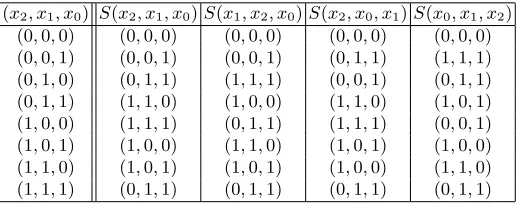
Table 4.The S-box evaluated for all possible permutations on the input. (x2, x1, x0) S(x2, x1, x0)S(x1, x2, x0)S(x2, x0, x1)S(x0, x1, x2)
(0,0,0) (0,0,0) (0,0,0) (0,0,0) (0,0,0) (0,0,1) (0,0,1) (0,0,1) (0,1,1) (1,1,1) (0,1,0) (0,1,1) (1,1,1) (0,0,1) (0,1,1) (0,1,1) (1,1,0) (1,0,0) (1,1,0) (1,0,1) (1,0,0) (1,1,1) (0,1,1) (1,1,1) (0,0,1) (1,0,1) (1,0,0) (1,1,0) (1,0,1) (1,0,0) (1,1,0) (1,0,1) (1,0,1) (1,0,0) (1,1,0) (1,1,1) (0,1,1) (0,1,1) (0,1,1) (0,1,1)
One can quite easily see that with (y2, y1, y0) =S(x2, x1, x0) and (y02, y01, y00) = S(x2, x0, x1), we always have y2 =y20, see Table 4. This means that if we are only interested in tap 2 out of the S-box, it does not matter ifx1, x0are swapped or not before entering the S-box.
As a consequence, if we
– know three bits that enterS◦πb,
– want to knowy2out of the S-box, and
then we only need to make three guesses onπb.
The same property shows up on y0 also, but not on y1, see Table 4. We will use this observation to reduce the amount of guesswork we need to perform during partial encryption. We will use the notation π3
b to mark that we only
guess a ternary digit, a trit, forπb due to these properties.
Similarly, when we guess for a partial decryption, we often do not need to guess the whole permutation πb, i.e., two bits, but only how it permutes one
particular bit. We will (e.g.,) use the notation πb(2) to indicate that we only
guess how the bit 2 is permuted byπb.
5
A Key Bit Distinguisher
5.1 General Attack Idea
We will use a variant of linear cryptanalysis: we study single-bit trails that are biased for certain classes of keys and biased for other keys. As a very non-detailed example, consider a trail from the left-most bit to the left-most bit. It is readily apparent from Fig. 1 that such a trail exists and that it is iterated (although it is of course not obvious from the figure that it has a bias). We claim that we can distinguish individual bits ofKπ using this trail: it is biased for half the keys and non-biased for the other half. Thus, if we can distinguish between these two distributions (i.e., if the bias is large enough and we have sufficiently many samples) we can determine the value of this key bit.
The sample trail considered here is “simple” as it is apparent to the naked eye, but it is possible to find several such trails over considerable numbers of rounds. As a consequence, there exist many classes of weak keys in PRINTcipher.
5.2 A Detailed Example
We now describe how to distinguish between two distributions: one wherekπ
30is zero, and one where it is one. This allows for a partial-key recovery, i.e., learning one bit of the key, faster than brute force.
Note thatΠ(15,2) = (15,2), and that for two of four keys,π15(2) = 2. This happens precisely whenkπ
30= 0 (see Table 5).
Table 5.How the individual bits (2,1,0) are moved by the key-dependent permutation πb, and for which keys (kπ2b+1, k
π
2b) it happens.
Bit Move Possible Keys Bit Move Possible Keys Bit Move Possible Keys 0→0 (0,0),(0,1) 1→0 (1,0) 2→0 (1,1) 0→1 (1,0) 1→1 (0,0),(1,1) 2→1 (0,1)
0→2 (1,1) 1→2 (0,1) 2→2 (0,0),(1,0)
Thus, with kπ
have
Prob(c147=p47⊕k47⊕) = 1 2 + 2
−2.
For two rounds, we have
Prob(c247=p47) = 1 2 + 2
−3
as the key xors cancel and with the use of the piling-up lemma. Generalizing to any even number of rounds, we have
Prob(cr47=p47) = 1 2 + 2
−r−1.
For PRINTcipheron 22 rounds, we would need almost the entire code book, 246plaintext–ciphertext pairs.
We can also use the full code book, of size 248, to attack 23 rounds. We then have an odd number of rounds, and the key bitk47⊕ shows up, so we utilize the relation
Prob(cr47=p47⊕k⊕47) = 1 2+ 2
−r−1, (1)
with r= 23. Things then get slightly more tricky, as we learn more about the key but need to distinguish between three distributions:
1. cr47=p47 with probability 12, implyingkπ30= 1. 2. cr
47=p47 with “high” probability, implyingkπ30= 0 andk ⊕ 47= 0. 3. cr
47=p47 with “low” probability, implyingkπ30= 0 andk⊕47= 1.
5.3 More Linear Trails on One Round of PRINTcipher
There are in total four iterated single-round trails, and we list them in Table 6. Some constants arise as the S-box flips bit 0 with probability 3
4 rather than preserves it, and as bits ofRCi enter.
Table 6.The iterated single-round trails on PRINTcipher, extended to several rounds. All trails have bias 2−r−1
.
Trail Requirement
cr
0 =p0⊕k ⊕
0Ir⊕dr kπ1 = 0
cr23=p23⊕k23⊕Ir (k15, kπ 14π) = (0,1) cr
24=p24⊕k ⊕
24Ir⊕Ir (k17π, k16π) = (1,0) cr47=p47⊕k
⊕
47Ir kπ30= 0 dr=
r+ 1 +P
0≤i<rRCi
23 rounds
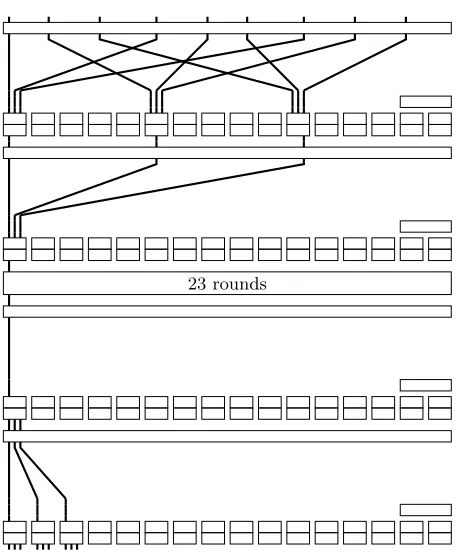
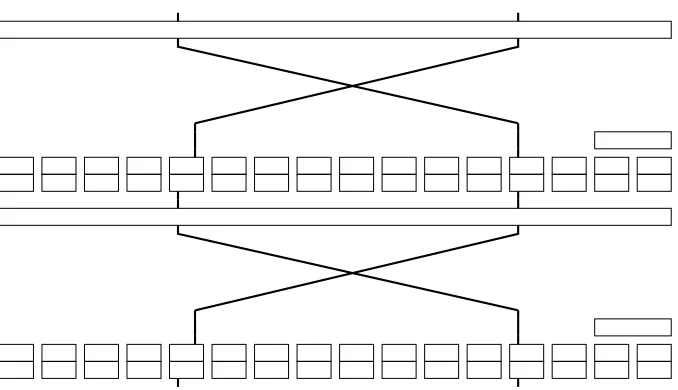
Fig. 2.Performing two rounds of partial encryption and decryption to access the bits at position (15,2).
6
Guessing Keybits for Partial Encryption and
Decryption
The above observation can be used as-is to mount an attack on 23-round PRINT-cipher, recovering up to three bits of the key, but it is straightforward to derive an even more powerful attack on 27 rounds of PRINTcipher: if a guessed partial key is correct, we should observe the bias, while if the guess is bad, the behaviour should be (more) random.
First, we assume thatkπ30= 0, meaning our attack only works for a fraction 2−1 of the keys. Then, we aim to decrypt two rounds at the end and encrypt two rounds at the top of PRINTcipher. Thus, we need to guess the bits and trits listed in Table 7. There are in totalN = 213·33≈217.8guesses. See Fig. 2 for an overview of the partial calculations.
Due to the property observed in Section 4.2, we do not need to guesskπ
31. We have assumedkπ
Table 7. The bits and trits required for encryption, decryption, and both, when en-crypting/decrypting two rounds to access the bits at position (15,2).
Encryptionk⊕42,k ⊕ 37,k
⊕ 31,k
⊕ 26,k
⊕ 21,k
⊕ 15,k
⊕ 10,k
⊕ 5,π10,π
3 5
Decryptionk⊕46,k⊕45,π14(2),π13(2)
Both k⊕47
bits in the plaintext and nine in the ciphertext. For a plaintext–ciphertext pair (P, C) we can collect these bits into an eighteen-bit wordw= (p47, p31, . . . , c39). We describe the attack: Acquire all 248 plaintext–ciphertext pairs (Pj, Cj).
Categorize them according to the active bits, i.e., for each possible wordw, count how often it appears. Denote these countersRw. This is the data collection part
of the attack.
We then begin analyzing the data. For each plaintext–ciphertext pair and for each guess of key material, denoted byGi, 0≤i < N, we will calculate two
rounds of encryption and decryption, ˆPj = φ
0,2(Gi, Pj), ˆCj = φ−251,27(Gi, Cj),
and count how often ˆcj47 = ˆpj47⊕k47⊕i. This is done using N counters Si. An
efficient way of doing this [10] is to use the countersRw. For each wordw and
each keyguess Gi, we do the partial calculations ˆPi,w = φ0,2(Gi, Pw), ˆCi,w =
φ−251,27(Gi, Cw). Pw (Cw) is some plaintext (ciphertext) which has the correct
active bits as determined byw. If ˆci,w47 = ˆpi,w47 ⊕k⊕47i, we add R
w toSi.
By sorting allSi, we can get a ranking of the different guesses. We pick the
most likely guess, brute force all non-guessed bits and hopefully recover the key. Otherwise, we pick the second most likely guess, etc. The exact number of bits that need to be brute forced will be different for different guesses: where we guessed a trit (e.g.,)π14(2), we will have recovered one or two bits of (k29π, k28π). As long as the correct guess is ranked on the upper half of the sorted list of counters, the entire key will be found faster than what can be expected from a brute force (278).
The countersRw are used for saving time [10]. Several other improvements
can be made, also from [10]: We should not make 218·N partial encryptions and decryptions. First, the plaintext and ciphertext operations can be separated com-pletely, so that we only need to make 29·N+29·Nencryptions/decryptions. Sec-ond, since the overlap in encryption and decryption with respect to the guessed bits is very small, we only need to perform 29·N
e+29·Ndencryptions/decryptions
whereNe (Nd) is the number of key guesses that actually affect the encryption
(decryption). Third, doing two complete PRINTcipher rounds in both direc-tions is unneccessary as we only need to perform “partial rounds”, i.e., use some small number of S-boxes.
6.1 Experimental Results
partial encryptions, but that the bias is larger so that it is feasible for us to perform many attacks in order to gather statistics.
It turns out that over 213 different weak keys, the attack works with proba-bility 0.78. That is, almost four times out of five, the correct key ranks on the upper half of the sorted list ofSi.
6.2 Analyzing the Attack Complexity
The attack consists of data collection and data analysis. The latter in turn con-sists of 1) deriving two sets of counters,Nefor encryption andNdfor decryption,
and 2) combining these to find N counters. If the number of active bits in the plaintext (ciphertext) is denoted ae (ad) and the number of active S-boxes in
encryption (decryption) is denotedAe (Ad), the time complexities are given by
Tcollect=−2,
Tcount= 2
aeN
eAe+ 2adNdAd
16·r ,
Tcombine= 2ae+adN.
The first two measurements are normalized to r-round PRINTcipher evalua-tions, while the last describes the number of “simple” bit and integer operations needed to calculate the countersSi.
For the specific attack detailed above, we haveNe= 211·3 andNd= 23·32.
Since (ae, ad, Ae, Ad) = (9,9,4,4), the complexities turn out at
Tcollect = 22·24= 248,
Tcount=2
9·211·3·4 + 29·23·32·4
16·27 ≈2
15,
Tcombine = 29+9·N= 218·213·33≈236.
This suggests that the most time consuming part is the data collection where we need to generate and look at 248 plaintext–ciphertext pairs.
6.3 Reaching the Limit: 28 Rounds
We note that in the attacks on 27 rounds, guessing and encrypting is more expensive than guessing and decrypting: during decryption, we first invert S, and then only need to control one bit in some πb. On the other hand, during
encryption, we need to fully control the permutation, so that we can calculate all three bits that go into the S-box. This leads to more expensive guesswork on πb and especially on K⊕. Thus, the natural approach for extending the attack
by one round is to add another round in the partial decryption.
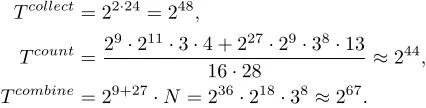
partitioned asNe= 211·3 andNd= 29·38. With (ae, ad, Ae, Ad) = (9,27,4,13),
we have
Tcollect= 22·24= 248,
Tcount=2
9·211·3·4 + 227·29·38·13
16·28 ≈2
44,
Tcombine= 29+27·N = 236·218·38≈267.
28 rounds seems to be the best we can do: using a single trail, we have not been able to go beyond 28 rounds while keeping the attack costs below exhaustive search.
Table 8. The bits and trits required for encryption, decryption, and both, when en-crypting/decrypting two/three rounds to access the bits at position (15,2). Note the overlap inπ10.
Encryptionk37⊕,k ⊕ 31,k
⊕ 26,k
⊕ 21,k
⊕ 15,k
⊕ 10,k
⊕ 5,π10,π
3 5
Decryptionk ⊕ 46,k
⊕ 45,k
⊕ 44,k
⊕ 43,k
⊕ 41,k
⊕ 40,k
⊕
39,π14(2),π13(2), π12(2),π11(2),π10(2),π9(2),π8(2),π7(2)
Both k42⊕,k ⊕ 47
7
On More Rounds of
PRINTcipher
: Complementary
Trails
We generalize our observation slightly and give an example two-round trail: with (kπ23, kπ22, kπ6) = (1,1,0),
Prob(c211=p11⊕k⊕11⊕k⊕35) = 1 2+ 2
−3.
Note in particular how there is a complementary trail,
Prob(c235=p35⊕k⊕11⊕k⊕35) = 1 2+ 2
−3,
see Fig. 3. The complementary trail depends on the exact same key configura-tion and allows us to collect two samples with every plaintext–ciphertext pair. We show in Section 8.1 that this works, i.e., the samples can be considered as independent.
Fig. 3. Two complementary trails on two rounds of PRINTcipher. Both trails are activated by (kπ
23, k22π, kπ6) = (1,1,0).
Table 9.The number of iterated trails over various number of rounds. #Rounds #Trails #Rounds #Trails #Rounds #Trails #Rounds #Trails
1 4 5 154 9 5806 13 138662
2 16 6 424 10 13366 14 283810
3 28 7 1040 11 30430 15 560608
4 96 8 2584 12 65808 16 1075000
As a particular four-round trail that we will use later, we give
Prob(c437=p37⊕k37⊕ ⊕k17⊕ ⊕k⊕4 ⊕k12⊕ ⊕1) = 1 2 + 2
−5, (2)
which is activated by (kπ
25, kπ24, kπ10, kπ9, kπ3) = (1,0,0,0, k2π).
The total number of iterated trails over various number of rounds are given in Table 9.
7.1 More Attacks on 27/28 Rounds
We can use basically any trail on 23 rounds to create attacks on 27/28 rounds. Do note that the trail on bit (15,2) is very nice as the partial encryptions and decryptions involve few bits ofK⊕andKπ, due to S-box reuse. Most other trails
involve more guesswork. As an example, using (2) 5.75 times yields
Prob(c2512=c237⊕k⊕12⊕1) = 1 2+ 2
from which we can build an attack on 28 rounds. We haveN = 227·36≈236.5, Ne= 214·3,Nd= 213·37 and (ae, ad, Ae, Ad) = (9,27,4,13). The complexities
are
Tcollect= 22·24= 248,
Tcount= 2
9·214·3·4 + 227·213·37·13
16·28 ≈2
46 ,
Tcombine= 29+27·N = 236·227·36≈273.
The bits and trits guessed are listed in Appendix B.
7.2 On False Positives
By piling the single-round trail on the left-most bit, we see that e.g., Prob(c10 47= p47) = 12+2−11whenk30π = 0. However, there are several other ways of obtaining this distribution.
All in all, there are 102 different trails from (15,2) to (15,2) over ten rounds, each corresponding to a different class of keys. This means that a biased distri-bution can be explained by any of these trails, and thus any of these classes. Due to this, an attacker will prefer to use short, iterated trails involving few bits of Kπ.
8
Using Complementary Trails to Distinguish on
24-Round Trails
We will now construct 24-round trails with bias 2−25. By using trails that allow four samples per plaintext–ciphertext pair, we can get in total 250 samples, allowing us to distinguish the distribution.
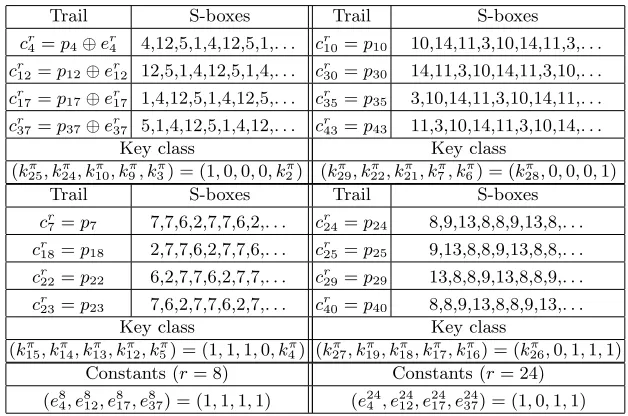
The best iterated trails on 24 rounds are given in Table 10. They are “best” in the sense that they use a small number of key bits (5), yet allow four comple-mentary trails each, so that we can get the required number of samples. In fact they are constructed from iterated four-round trails, that we have piled in order to cancel the bits that appear fromK⊕ (cf. Section 5.2).
8.1 Samples are Independent (Enough)
The connection between the biasand the required number of samples−2relies on the independence of the samples, and it is not obvious that the samples we pick are independent. Most cryptanalysis simply assumes that the samples are independent, or at least independent enough for the attacks to still be possible. Verifying the independence through simulation is common, at least on a smaller number of rounds or reduced-size versions of the algorithm (“PRINTcipher -12”), where it is practically possible.
Table 10. The iterated trails on eight rounds (r = 8) composed from four-round iterated trails, depending only on five bits ofKπ. All trails have bias 2−r−1, and the constants er
j arise from the round constants RCi. The trails are easily extended to
e.g., 24 rounds (r= 24), in which case only the constants need to be rechecked. (The symmetrically inclined reader have ample reasons to admire this table.)
Trail S-boxes Trail S-boxes
cr4=p4⊕er4 4,12,5,1,4,12,5,1,. . . cr10=p10 10,14,11,3,10,14,11,3,. . . cr
12=p12⊕er12 12,5,1,4,12,5,1,4,. . . cr30=p30 14,11,3,10,14,11,3,10,. . . cr17=p17⊕er17 1,4,12,5,1,4,12,5,. . . cr35=p35 3,10,14,11,3,10,14,11,. . . cr37=p37⊕er37 5,1,4,12,5,1,4,12,. . . cr43=p43 11,3,10,14,11,3,10,14,. . .
Key class Key class
(kπ25, kπ24, kπ10, kπ9, k3π) = (1,0,0,0, kπ2) (kπ29, kπ22, kπ21, kπ7, k6π) = (k28,π 0,0,0,1)
Trail S-boxes Trail S-boxes
cr7 =p7 7,7,6,2,7,7,6,2,. . . cr24=p24 8,9,13,8,8,9,13,8,. . . cr
18=p18 2,7,7,6,2,7,7,6,. . . cr25=p25 9,13,8,8,9,13,8,8,. . . cr22=p22 6,2,7,7,6,2,7,7,. . . cr29=p29 13,8,8,9,13,8,8,9,. . . cr23=p23 7,6,2,7,7,6,2,7,. . . cr40=p40 8,8,9,13,8,8,9,13,. . .
Key class Key class
(kπ15, k14, kπ 13, kπ 12, kπ 5π) = (1,1,1,0, kπ4) (kπ27, kπ19, kπ18, kπ17, k16π) = (k26,π 0,1,1,1)
Constants (r= 8) Constants (r= 24)
(e84, e812, e817, e837) = (1,1,1,1) (e244 , e2412, e2417, e2437) = (1,0,1,1)
calculations behind the four samples have affected each other, and it is not impossible that samples obtained from the same plaintext–ciphertext pair are so dependent that they do not contribute (much) more than one sample from an information-theoretic point of view. If this is the case, we would not be able to exploit any bias smaller than (about) 2−23.
Thus, we have done the following on eight-round PRINTcipher: We use 218plaintext–ciphertext pairs to derive equally many samples on bit (1,1), and from this we guess whether the key is in the upper-left class from Table 10 by comparing the number of samples that are 1 to some pre-defined threshold derived to yield a 50% success rate. This gives false positives/negatives with probabilities 0.03/0.50, respectively. Similar probabilities are observed for the three complementary trails, when used one on one.
If we instead use only 216plaintext–ciphertext pairs, but pick 22samples from each pair, we are able to carry out the attack with seemingly unchanged success: The probabilities of false positives/negatives are 0.02/0.50. These results have been obtained by attacking 214keys from each class and are listed in Table 11.
8.2 Partial Encryption and Decryption for 29 Rounds
Table 11.The attack in Section 8.1 was carried out on 214 different keys using either one sample per plaintext–ciphertext pair or four samples per pair but fewer pairs. “True Pos. Ratio” shows how frequently a key belonging to the keyclass was identified as such. Similarly, “True Neg. Ratio” shows how often a key not belonging to the keyclass was correctly excluded.
Trail Pairs Samples/Pair True Pos. Ratio True Neg. Ratio c8
4=p4⊕1 218 1 0.50 0.97
c812=p12⊕1 218 1 0.50 0.97
c817=p17⊕1 218 1 0.51 0.97 c8
37=p37⊕1 218 1 0.51 0.97
all four 216 22 0.51 0.98
a 28-round attack using a 23-round trail. Now, using the 24-round trails, we reach 29 rounds. Again, we use the upper-left key class in Table 10.
The key observation is that we can divide all of the work, so that we deal with the four trails completely independently. If we number the trails j = 1,2,3,4, we will have time complexities
Tjcollect=−2,
Tjcount= 2
aj eNj
eA j e+ 2
ajdNj dA
j d
16·r ,
Tjcombine= 2 aj
e+a j dN.
for producing the four different lists of counters Sij. In order to combine all countersSij intoN-many countersSiwe need to doN rather simple operations.
Note that we have made related, but not identical, guesses on the permutations, e.g., by guessingπ14(2) when using trail 1 and π14(0) when using trail 2. Some care must be taken here, but it does not affect the cost of this step, which remains atTf inalize=N quite simple operations.
Specific guesses are listed in Appendix B. All (aj
e, ad,j, Aje, A j
d) = (9,27,4,13).
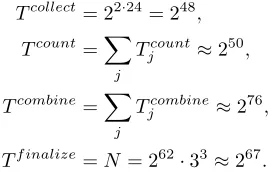
The total attack complexities are
Tcollect= 22·24= 248,
Tcount=X
j
Tjcount≈250,
Tcombine=X
j
Tjcombine≈276,
Tf inalize=N= 262·33≈267.
Let us briefly comment on the possibility of using 25-round trails with bias 2−26: if we can get 16 samples per plaintext–ciphertext pair, we have the nec-essary 252 samples. As we need to involve all π
b, we would put restrictions on
at least 16 bits of the key. This puts the brute force cost at 264or lower, which seems to be too low for the attack to be meaningful. Another obstacle to this attack is that the complementary trails are not completely identical, as different bits ofK⊕ will appear.
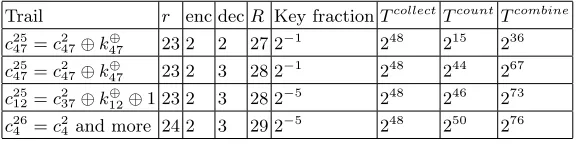
Table 12.A summary of the explicit attacks on 27-, 28- and 29-round PRINTcipher
presented in this paper.r denotes the length of the trail(s) used, andRdenotes that R-round PRINTcipheris attacked. ’Enc’ (’dec’) tells how many rounds are partially encrypted (decrypted).Tcount andTcombine are rounded to the nearest integer power of two.
Trail r enc decR Key fractionTcollectTcountTcombine
c2547=c 2 47⊕k
⊕
47 23 2 2 27 2
−1
248 215 236
c2547=c247⊕k ⊕
47 23 2 3 28 2
−1
248 244 267 c25
12=c237⊕k ⊕
12⊕1 23 2 3 28 2 −5
248 246 273
c264 =c24and more 24 2 3 29 2−5 248 250 276
9
Conclusion
Table 12 summarizes the attacks on 27–28 rounds of PRINTcipheroutlined in this paper. Several more attacks are available for several more key classes.
We note some particular observations that all arise from the structure of PRINTcipherand the use of the exact same round key throughout the cipher:
– When there is a non-decomposable, iteratedr-round trail there are in factr complementary trails, allowingrsamples per plaintext–ciphertext pair. – When we guess for a partial encryption/decryption, there is overlap between
the bits that activate the trail and those we need for encryption/decryption.
With this work, linear cryptanalysis has reached 28 rounds of PRINTcipher. We have used weak key classes which means that we need to carry out several attacks in parallel in order to have a high probability of success. However, we have seen that there are many large key classes and in particular several of them only depend on one or two bits of the key. This means our results “invalidate” several more keys than previous results on PRINTcipher. The exception is the differential attack which worked on all keys but only reached 23 rounds.
suggest that the linear hull of PRINTciphercan behave in unexpected ways. It might be possible to cause peculiar effects to arise, e.g., by fixing more bits of the key, in order to reach further into PRINTcipherwith linear cryptanalysis. As a further research direction, we note that by inverting the (S◦πb) whereπb
is (partly) assumed, the number of active bits could be reduced. The technique would apply to all attacks in this paper, but the full gain of this remains to be determined.
The complementary trails that arise in PRINTcipher are very interesting, and allowed us to add one round to the attacks, albeit for a smaller class of keys. It would be very interesting to see if this complementary property could lead to more observations on PRINTcipher.
Acknowledgment
This work was supported by the Swedish Foundation for Strategic Research (SSF) through its Strategic Center for High Speed Wireless Communication at Lund. The authors wish to thank the anonymous reviewers whose comments helped improve the paper.
References
1. M. A. Abdelraheem, G. Leander, and E. Zenner. Differential cryptanalysis of round-reducedPRINTcipher: Computing roots of permutation. In A. Joux, ed-itor, Fast Software Encryption 2011, Lecture Notes in Computer Science, pages 1–17. Springer-Verlag, 2011.
2. T. Baign`eres, P. Junod, and S. Vaudenay. How far can we go beyond linear crypt-analysis? InAdvances in Cryptology—ASIACRYPT 2004, volume 3329 ofLecture Notes in Computer Science, pages 432–450. Springer-Verlag, 2004.
3. A. Bogdanov, L. R. Knudsen, G. Leander, C. Paar, A. Poschmann, M. J. B. Rob-shaw, Y. Seurin, and C. Vikkelsoe. PRESENT: An Ultra-Lightweight Block Cipher. InCryptographic Hardware and Embedded Systems—CHES 2007, volume 4727 of
Lecture Notes in Computer Science, pages 450–466. Springer-Verlag, 2007. 4. F. Karako¸c, H. Demirci, and A. E. Harmancı. Combined differential and
linear cryptanalysis of reduced-round PRINTcipher. In Selected Areas in Cryptography—SAC 2011, To be published in Lecture Notes in Computer Science. Springer-Verlag, 2011.
5. C. De Canni`ere, O. Dunkelman, and M. Kneˇzevi´c. KATAN and KTANTAN — a family of small and efficient hardware-oriented block ciphers. In Crypto-graphic Hardware and Embedded Systems—CHES 2009, volume 5747, pages 272– 288. Springer-Verlag, 2009.
6. D. Hong, J. Sung, S. Hong, J. Lim, S. Lee, B.-S. Koo, C. Lee, D. Chang, J. Lee, K. Jeong, H. Kim, J. Kim, and S. Chee. HIGHT: A New Block Cipher Suitable for Low-Resource Device. InCryptographic Hardware and Embedded Systems—CHES 2006, volume 4249 ofLecture Notes in Computer Science, pages 46–59. Springer-Verlag, 2006.
8. L. Knudsen, G. Leander, A. Poschmann, and M. Robshaw.PRINTcipher: A block cipher for ic-printing. In S. Mangard and F-X. Standaert, editors,Cryptographic Hardware and Embedded Systems—CHES 2010, volume 6225 of Lecture Notes in Computer Science, pages 16–32. Springer, 2010.
9. G. Leander, M. A. Abdelraheem, H. AlKhzaimi, and E. Zenner. A cryptanalysis of
PRINTcipher: The invariant subspace attack. In P. Rogaway, editor,Advances in Cryptology—CRYPTO 2011, volume 6841 ofLecture Notes in Computer Science, pages 206–221. Springer-Verlag, 2011.
10. M. Matsui. The first experimental cryptanalysis of the Data Encryption Stan-dard. In Y. Desmedt, editor,Advances in Cryptology—CRYPTO’94, volume 839 ofLecture Notes in Computer Science, pages 1–11. Springer-Verlag, 1994. 11. M. Matsui. Linear cryptanalysis method for DES cipher. In T. Helleseth,
edi-tor,Advances in Cryptology—EUROCRYPT’93, volume 765 of Lecture Notes in Computer Science, pages 386–397. Springer-Verlag, 1994.
A
The Standard Permutation
Table 13 lists the key-independent permutation in PRINTcipher.
Table 13. The standard permutationΠ in PRINTcipher. Bits at positions ’In’ are moved to positions ’Out’.
In Out In Out In Out In Out
B
Bits Involved in Given Attacks
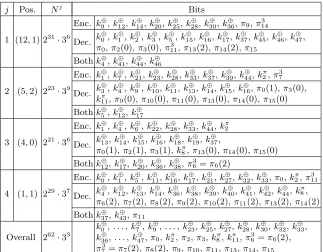
Tables 14 and 15 lists what key material is guessed for the attacks on 28 and 29 rounds using the four-round trail 5.75 and 6 times.
Table 14. The bits and trits required for encryption, decryption, and both, when encrypting/decrypting two/three rounds to access the bits at position (12,1)/(4,0).
Encryptionk⊕46,k⊕44,k41⊕,k⊕30,k⊕28,k25⊕,k⊕9,k4⊕,π3 14,π9,
Decryptionk ⊕ 38,k
⊕ 37,k
⊕ 19,k
⊕ 18,k
⊕ 17,k
⊕ 16,k
⊕ 15,k
⊕ 13,k
π
8,π15(0), π14(0),π13(0),π12(0),π6(1),π3(1),π2(1),π0(1)
Both k⊕36,k ⊕ 20,k
⊕ 14,k
⊕ 12
Table 15. The bits and trits guessed in the attack on 29-round PRINTcipher by encrypting/decrypting two/three rounds.
j Pos. Nj Bits
1 (12,1) 231·36
Enc. k⊕9,k12⊕,k⊕14,k⊕20,k25⊕,k⊕28,k⊕30,k36⊕,π9,π3 14
Dec. k ⊕ 0,k
⊕ 1,k
⊕ 2,k
⊕ 3,k
⊕ 5,k
⊕ 15,k
⊕ 16,k
⊕ 17,k
⊕ 37,k
⊕ 45,k
⊕ 46,k
⊕ 47, π0,π2(0),π3(0),π311,π13(2),π14(2),π15
Bothk⊕4,k ⊕ 41,k
⊕ 44,k
⊕ 46
2 (5,2) 223·39
Enc. k⊕1,k7⊕,k⊕21,k⊕23,k28⊕,k⊕33,k⊕37,k39⊕,k⊕44,kπ
2,π73
Dec. k ⊕ 3,k
⊕ 4,k
⊕ 9,k
⊕ 10,k
⊕ 11,k
⊕ 13,k
⊕ 14,k
⊕ 15,k
⊕
16,π0(1),π3(0), kπ11,π9(0),π10(0),π11(0),π13(0),π14(0),π15(0) Bothk⊕5,k
⊕ 12,k
⊕ 17
3 (4,0) 221·36
Enc. k⊕1,k4⊕,k⊕6,k22⊕,k28⊕,k⊕33,k⊕44,kπ
2
Dec. k ⊕ 13,k
⊕ 14,k
⊕ 15,k
⊕ 16,k
⊕ 18,k
⊕ 19,k
⊕ 37,
π0(1),π2(1),π3(1),k8π,π13(0),π14(0),π15(0) Bothk⊕12,k
⊕ 17,k
⊕ 20,k
⊕ 36,k
⊕ 38,π
3
6 =π6(2)
4 (1,1) 229·37
Enc. k⊕0,k1⊕,k5⊕,k⊕11,k16⊕,k⊕17,k⊕21,k27⊕,k⊕32,k⊕33,π0,kπ
2,π113
Dec. k ⊕ 4,k
⊕ 12,k
⊕ 13,k
⊕ 14,k
⊕ 36,k
⊕ 38,k
⊕ 39,k
⊕ 40,k
⊕ 41,k
⊕ 42,k
⊕ 44,k
π
8, π6(2),π7(2),π8(2),π9(2),π10(2),π11(2),π13(2),π14(2) Bothk⊕37,k
⊕ 43,π11
Overall
k⊕0, . . . ,k ⊕ 7,k
⊕ 9, . . . ,k
⊕ 23,k
⊕ 25,k
⊕ 27,k
⊕ 28,k
⊕ 30,k
⊕ 32,k
⊕ 33, 262·33 k⊕
36, . . . ,k ⊕ 47,π0,k
π