On Achieving the “Best of Both Worlds” in Secure
Multiparty Computation
∗Yuval Ishai† Jonathan Katz‡ Eyal Kushilevitz† Yehuda Lindell§
Erez Petrank†
Abstract
Two settings are traditionally considered for secure multiparty computation, depending on whether or not a majority of the parties are assumed to be honest. Protocols designed un-der this assumption provide “full security” (and, in particular, guarantee output delivery and fairness) when this assumption holds; unfortunately, these protocols are completely insecure if this assumption is violated. On the other hand, protocols tolerating an arbitrary number of corruptions do not guarantee fairness or output delivery even if only asingleparty is dishonest. It is natural to wonder whether it is possible to achieve the “best of both worlds”: namely, a single protocol that simultaneously achieves the best possible security in both the above settings. Here, we rule out this possibility (at least for general functionalities) but show some positive results regarding whatcan be achieved.
Keywords: Theory of cryptography, secure computation.
∗This is the full version of [18, 19]. This research was supported by grant 36/03 from the Israel Science Foundation,
US-Israel Binational Science Foundation grant #2004240, and NSF CAREER award #0447075
†Department of Computer Science, Technion, Israel. Email: {yuvali,eyalk,erez}@cs.technion.ac.il
‡Department of Computer Science, University of Maryland, USA. Email: [email protected]. Portions of this
work were done while the author was visiting the Institute for Pure and Applied Mathematics (IPAM), UCLA.
§Department of Computer Science, Bar-Ilan University, Israel. Email: [email protected]. Portions of this
Contents
1 Introduction 1
1.1 Our Results . . . 2
1.2 Future Directions . . . 3
2 Preliminaries and Definitions 4 2.1 Overview . . . 4
2.2 Defining Security . . . 5
3 Impossibility Results 7 3.1 Reactive Functionalities . . . 7
3.2 Non-Reactive Functionalities . . . 9
3.2.1 Ruling out Security with Abort . . . 10
3.2.2 Ruling out Privacy . . . 13
4 Positive Results 14 4.1 Achieving the “Best of Both Worlds” for Suitable Thresholds . . . 15
1
Introduction
Protocols for secure multiparty computation (MPC) [22, 11, 4, 8] allow a set of mutually distrusting parties to compute a function in a distributed fashion while guaranteeing (to the extent possible) the privacy of the parties’ inputs and the correctness of their outputs. Security is typically formulated by requiring that a real execution of a protocol be indistinguishable from an ideal execution in which the parties hand their inputs to a trusted party who computes the function and returns the outputs to the appropriate parties. Thus, whatever security is implied by the ideal model must also be guaranteed in a real-world execution of the protocol.
The vast body of research in this area can be divided into two, almost disjoint, lines of work: one dealing with the case when a majority of the parties are assumed to be honest, and the other dealing with the case when an arbitrary number of parties may be corrupted. These settings differ not only in the approaches that are used to construct secure protocols, but also in the results that can be achieved (and hence in the ideal models thus defined). In further detail:1
• Secure computation with an honest majority. When a majority of the participants are honest, it is possible to obtain the strongest level of security one could hope for (i.e., “full security”) [11]. Fully secure protocols ensure not only privacy and correctness but alsofairness (namely, if one party receives its output then all parties do) and guaranteed output delivery (i.e., honest parties are guaranteed to successfully complete the computation). In the presence of an honest majority, full security can even be obtained unconditionally [4, 8, 2, 20, 10].
• Secure computation with no honest majority. Results of Cleve [9] imply that full security (for general functionalities) is only possible when an honest majority is present. Specifically, while privacy and correctness are still attainable without an honest majority, it is impossible (in general) to guarantee fairness or output delivery. Thus, when no honest majority is assumed (which includes two-party computation as a special case) a relaxed notion of security (“security with abort”) is used where privacy and correctness still hold but the adversary is allowed toabort the computation after obtaining its own outputs. Unconditional security is no longer possible in this setting (for general functionalities), but protocols realizing this notion of security for any number of corrupted parties can be constructed based on the existence of enhanced trapdoor permutations or oblivious transfer [22, 11, 3, 13, 14].
An unfortunate drawback of existing protocols for each of the above settings is that they do not provide any security beyond what is implied by the definitions. Specifically, existing protocols designed for the case of honest majority arecompletely insecureonce half (or more) of the parties are corrupted: e.g., honest parties’ inputs are entirely revealed, and even correctness may be violated. On the other hand, known protocols that achieve security with abort against an arbitrary number of corruptions do not guarantee fairness or output delivery even if only asingle party is corrupted. To get a sense for the magnitude and importance of this problem, consider trying to decide which type of protocol is more appropriate to implement secure voting. Since we would like privacy of individuals’ votes to hold regardless of the number of corruptions, we are forced to use a protocol of the second type that provides only security with abort. But then a single corrupted machine (in fact, even one which simply fails in the middle of the election) can perform a denial-of-service attack that prevents all honest parties from learning the outcome. Neither option is very appealing.
1Here and in the rest of the paper, we refer to the standard model of MPC over a synchronous network of secure
The above state of affairs raises the following natural question:
To what extent can we design a single protocol achieving the “best of both worlds” re-gardless of the number of corruptions; i.e., a protocol that simultaneously guarantees full security in case a majority of the parties are honest, and security with abort otherwise?
To the best of our knowledge, the above fundamental question has not been studied previously. This constitutes a major gap in our current understanding of the feasibility of secure computation.
1.1 Our Results
In this paper, we initiate the study of the above question. Our main results settle the question in the negative, showing that (in general) it is impossible to construct a single protocol that achieves the best possible security regardless of the number of corruptions. The strength of these negative results depends on whether we consider standard functionalities, which receiveninputs and deliver
n outputs in one shot, or reactive functionalities which can receive inputs and deliver outputs in multiple phases and maintain a secret state information between phases. (See Section 2 for definitions of these and other standard terms we use.) Specifically, we show:
Theorem 1.1 Let t+s≥nwith 1≤t≤s. Then there exists a standard (non-reactive) function-ality f for which there is no n-party protocol computing f that is simultaneously (1) fully secure when t parties are corrupted, and (2)secure with abort when sparties are corrupted.
In fact, our negative results are even stronger than indicated above. Fix s, t, nas above. For non-reactive functionalities, it is impossible (in general) to simultaneously achieve full security against
t fail-stop corruptions and privacy against s fail-stop corruptions. For reactive functionalities we show an even stronger result: one cannot (in general) simultaneously obtain full security againstt
fail-stop corruptions andprivacy againstssemi-honest corruptions.
In light of the above, we are led to explore what security guaranteescanbe achieved with regard to different corruption thresholds. Considering the natural relaxations, we show two incomparable positive results in this regard. First, we show that whent+s < n (andt < n/2) then the “best of both worlds” is, indeed, possible. That is:
Theorem 1.2 Assume the existence of enhanced trapdoor permutations, and let t+s < n and
t < n/2. Then for any (reactive or non-reactive) functionalityf, there exists a protocol computing
f that is simultaneously (1)fully securewhentparties are corrupted, and (2)secure with abortwhen
s parties are corrupted.
We also show that in the case of non-reactive functionalities, the optimal security thresholds are obtainable if we restrict to semi-honest adversaries when there is no honest majority:
Theorem 1.3 Assume the existence of enhanced trapdoor permutations, and let t < n/2 and
s < n. Then for any non-reactive functionality f there exists a protocol computing f that is simultaneously (1) fully secure against tmalicious corruptions, and (2) fully secure againsts semi-honest corruptions.
Standard Reactive functionalities functionalities Privacy against s < nsemi-honest Yes No parties and security against
t < n/2 malicious parties Theorem 4.2 Theorem 3.1
Privacy against s < nmalicious No No
parties and security against
t < n/2 malicious parties Theorem 3.5 Theorem 3.1
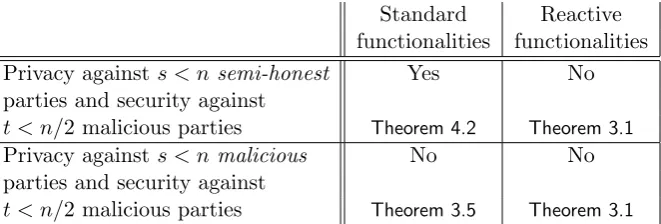
Table 1: Corollaries of our results: the existence and non-existence of protocols that simultaneously guarantee security againstt < n/2 malicious parties and privacy againsts < n malicious or semi-honest parties.
1.2 Future Directions
The stark negative results in this paper, coupled with the fact that it can be difficult to determine what security bounds are appropriate to assume in practice, suggest looking for other ways to obtain “best of both worlds”-type results besides those already discussed in the previous section. We briefly mention two possibilities that have been explored previously, and then highlight some promising directions for future work.
Two interesting feasibility results have been investigated in prior work. Ishai et al. [18] show a protocol for any non-reactive functionality f that provides full security against t < n/2 mali-cious parties, and also ensures the following guarantee againsts < nmalicious parties (informally): the malicious parties achieve (and learn) no more than they could achieve in s invocations of an ideal party evaluating f, where they may use different inputs in different invocations. For cer-tain functionalities (with voting serving as a prime example), this provides a meaningful notion of security. In another direction, Katz [19] (following [18]) explored what is possible in the case of a non-rushing adversary or, equivalently, under the assumption of simultaneous message trans-mission. Katz shows, for any non-reactive functionality f and any polynomial p, a protocol that is fully secure against t < n/2 malicious parties, as well as “1p-secure with abort” for any num-ber of malicious corruptions. Roughly speaking, this latter notion means that the actions of any real-world adversary can be simulated by an ideal-world adversary (who has the ability to abort the protocol) such that the resulting outcomes cannot be distinguished with probability advantage better than O(1/p). (The protocol provides additional security guarantees as well; we refer the reader to [19] for details.)
With regard to future work in this area, several directions seem promising:
• Non-rushing adversaries. We currently have only a partial answer to what can be achieved if a non-rushing adversary is assumed. The results of Katz [19] leave open the possibility of protocols in this model that achieve the true “best of both worlds”: simultaneous full security against t < n/2 corruptions, and security with abort against s < n corruptions. (However, it is known that there are no constant-round [18] or even logarithmic-round [19] protocols of this sort.) Alternatively, it might be possible in this model to obtain full security against
• Specific functionalities. The impossibility results presented here rule out protocols for general functionalities, but leave open the question of what might be obtained for specific functionalities of interest. Recent work [16, 17] has shown that protocols with full security against an arbitrary number of corruptions can be constructed for certain (non-trivial) func-tionalities. (This is even better than what a “best of both worlds”-type result would imply.) For what other functionalities might positive results be obtained?
• Definitional relaxations. In the current work we have focused on the standard notions of full security and security with abort. Given the impossibility results we have obtained, it may be worthwhile to explore relaxations of these definitions such as those considered in [1, 15].
2
Preliminaries and Definitions
In this work,kdenotes the security parameter, andpptstands for “probabilistic polynomial time”.
2.1 Overview
Our default network model consists ofnparties,P1, . . . , Pn, who interact in synchronous rounds via private and authenticated point-to-point channels. We also assume that the parties have access to a broadcast channel. We consider bothrushing andnon-rushing adversaries. A rushing adversary may delay sending the messages of the corrupted parties in any given round untilafter the honest parties send their messages in that round; thus, the round-imessages of the corrupted parties may depend on the round-i messages of the honest parties. In contrast, a non-rushing adversary must decide on what messages the corrupted parties should send in any given round before seeing the honest parties’ messages in that round. Assuming a non-rushing adversary is essentially equivalent to assuming that there exists a mechanism for simultaneous message exchange. The standard definition of secure computation assumes a rushing adversary. Nevertheless, in one of our lower bounds we consider non-rushing adversaries since this only strengthens the result.
We consider both malicious adversaries, who have total control over the behavior of corrupted parties and may instruct them to deviate arbitrarily from the protocol specification, and semi-honestadversaries who record all information viewed by corrupted parties as they run the protocol but do not otherwise modify their behavior. We also consider fail-stop adversaries who follow the protocol honestly (as semi-honest adversaries do) except that they may abort the protocol early.
Throughout the paper, we consider security against computationally bounded adversaries and assume for simplicity that the adversary isstatic, i.e., that the set of corrupted parties is chosen at the onset of the protocol in a non-adaptive manner. This strengthens our negative results, and is not essential for our positive results; see Remark 4.5.
The security of a multi-party protocol is defined with respect to afunctionalityf. A non-reactive
n-party functionality is a (possibly randomized) mapping ofn inputs tonoutputs. A multi-party protocol for computing a non-reactive functionality f is a protocol running in polynomial time and satisfying the following correctness requirement: if parties P1, . . . , Pn holding inputs (1k, xi), respectively, all run an honest execution of the protocol, then the joint distribution of the outputs
y1, . . . , ynof the parties is statistically close to f(x1, . . . , xn).
empty string and then computing (y1j, . . . , yjn, sj) ← fj(sj−1, xj1, . . . , x
j
n) for j = 1 to ℓ, where yji denotes the output of Pi at the end of phase j. A multi-party protocol computing f also runs in ℓ phases, at the beginning of which each party holds an input and at the end of which each party obtains an output. (Note that parties may wait to decide on their phase-j input until the beginning of that phase.) Parties maintain state throughout the entire execution. The correctness requirement is that, in an honest execution of the protocol, the joint distribution of all the outputs
{y1j, . . . , yjn}ℓj=1 of all the phases is statistically close to the joint distribution of all the outputs of all the phases in a computation of f on the same inputs used by the parties.
2.2 Defining Security
In this section, we present the (standard) security definitions used in this paper. We assume the reader is familiar with the simulation-based approach for defining secure computation, as described in detail in [5, 12, 7]. This definitional approach compares the real-world execution of a protocol for computing some function with an ideal-world evaluation of the function by a trusted party. Security is then defined by requiring that whatever can be achieved in the real world could have also been achieved (or simulated) in the ideal world. More formally, it is required that for every adversary A attacking the real execution of the protocol there exists an adversary A′, sometimes referred to as a simulator, which “achieves the same effect” in the ideal world. This is made more precise in what follows.
The real model. Letπ be a multi-party protocol computing a non-reactive functionality f. It is convenient to view an execution of π in the presence of an adversaryA as being coordinated by a non-uniform environment Z = {Zk}. At the outset, the environment gives input (1k, xi) to each party Pi, and gives I, {xi}i∈I, and z toA, where I ⊂ [n] represents the set of corrupted parties and z denotes an auxiliary input. The parties then interact, with each honest (i.e., uncorrupted) partyPi behaving as instructed by the protocol (using inputxi) and corrupted parties behaving as directed by the adversary. In the case of a semi-honest adversary,Adirects the parties to follow the protocol on their given inputs. At the conclusion of the protocol, Agives toZ an output which is an arbitrary function ofA’s view throughout the protocol, andZ is additionally given the outputs of the honest parties. Finally,Z outputs a bit. We letrealπ,A,Z(k) be a random variable denoting the value of this bit.
For reactive functionalities, the environment Z operates in a series of phases. At the outset of the execution,Z givesI and ztoA. Then, at the beginning of each phasej, the environment gives inputxji to each partyPiand gives{xij}i∈I toA. The parties then run thejth phase of protocolπ. At the end of each phase, A gives toZ an output which is an arbitrary function of A’s view thus far, and Z is additionally given the outputs of the honest parties in this phase. If the adversary aborts the protocol in some phase (formally, if the output of some honest party at the end of the phase is⊥), execution is halted; otherwise, execution continues until all phases are completed (i.e., the protocol is finished). Once the execution terminates, Z outputs a bit; we let realπ,A,Z(k) be a random variable denoting the value of this bit.
The ideal model – full security. In the ideal model, there is a trusted party who computesf on behalf of the parties. The first variant of the ideal model, discussed now, corresponds to a notion of security where fairness and output delivery are guaranteed.
• Honest parties send their input xi to the trusted party. Corrupted parties may send the trusted party arbitrary inputs as instructed by A′. (Any missing or “invalid” value is sub-stituted by a default value.) Denote by x′i the value sent by party Pi. In the case of a semi-honest adversary, we require thatx′i=xi for all i∈I.
• The trusted party computes f(x′1, . . . , x′n) = (y1, . . . , yn) and sends yi to party Pi. (If f is randomized, this computation involves random coins that are generated by the trusted party.)
After the above, A′ gives to Z an output which is an arbitrary function of the view of A′, and Z
is also given the outputs of the honest parties. Finally,Z outputs a bit. We let idealf,A′,Z(k) be the random variable denoting the value of this bit.
For the case of reactive functionalities, execution once again proceeds in a series of phases. At the outset, Z gives I and z to A′. At the beginning of each phase j, the environment provides input xji to party Pi and gives {xji}i∈I to A′. Inputs/outputs are then sent to/from the trusted party as above. At the end of each phase,A′ gives toZ an output which is an arbitrary function of its view thus far, andZ is additionally given the outputs of the honest parties in this phase. After all phases have been completed, Z outputs a bit. Once again, we let realπ,A,Z(k) be a random variable denoting the value of this bit.
The ideal model – security with abort. In this second variant of the ideal model, fairness and output delivery are no longer guaranteed. This is the standard relaxation used when a strict majority of honest parties is not assumed. (Other variants are also possible [12, 14].)
As in the first ideal model, we have an environment Z who provides inputs x1, . . . , xn to the parties, and provides I,{xi}i∈I, and z to the adversaryA′. Execution then proceeds as follows:
• As before, the parties send their inputs to the trusted party and we let x′i denote the value sent by Pi. Once again, for a semi-honest adversary we require x′i =xi for all i∈I.
• The trusted party computes f(x′1, . . . , x′n) = (y1, . . . , yn) and sends{yi}i∈I to the adversary.
• The adversary chooses whether to continue or abort; this can be formalized by having the adversary send either a continue or abort message to the trusted party. (A semi-honest adversary never aborts.) In the former case, the trusted party sends to each uncorrupted partyPi its output value yi. In the latter case, the trusted party sends the special symbol⊥ to each uncorrupted party.
After the above, A′ gives to Z an output which is an arbitrary function of the view of A′, and Z
is also given the outputs of the honest parties. Finally,Z outputs a bit. We letidealf⊥,A′,Z(k) be the random variable denoting the value of this bit; the subscript “⊥” indicates that the adversary now has the ability to abort the trusted party in the ideal model.
The extension to the case of reactive functionalities is the same as before. As in the real-world model, execution is halted immediately after any phase in which an honest party outputs⊥.
Defining security. With the above in place, we can now define our notions of security.
1. We say that π securely computesf in the presence of malicious (resp., semi-honest) adversaries corruptings parties if for any ppt adversary (resp., semi-honest adversary) A there exists a ppt adversary (resp., semi-honest adversary) A′ such that for every polynomial-size circuit family Z ={Zk} corrupting at mosts parties the following is negligible:
Pr[realπ,A,Z(k) = 1]−Pr[idealf,A′,Z(k) = 1].
2. We say that π securely computesf with abort in the presence of malicious adversaries corrupting
s parties if for any ppt adversary A there exists a ppt adversary A′ such that for every polynomial-size circuit familyZ={Zk}corrupting at mostsparties the following is negligible:
Pr[realπ,A,Z(k) = 1]−Pr[idealf⊥,A′,Z(k) = 1].
We also consider the weaker notion of privacy which, roughly speaking, ensures only that the adversary cannot learn anything about honest parties’ inputs other than what is implied by its own inputs and outputs. Accordingly, the definition of privacy only requires that the adversary’s view in the real model can be simulated in the ideal model.
Formally, define real′π,A,Z(k) analogously to realπ,A,Z(k) except that Z is not given the outputs of the honest parties (that is, Z is only given the output of A, which is an arbitrary function of A’s view). We can defineideal′f,A′,Z(k) similarly.
Definition 2.2 (Privacy) Let π be a multi-party protocol for computing a functionalityf, and fix
s∈ {1, . . . , n}. We say that π privately computes f in the presence of malicious (resp., semi-honest) adversaries corrupting s parties if for any ppt adversary (resp., semi-honest adversary) A there exists apptadversary (resp., semi-honest adversary)A′ such that for every polynomial-size circuit family Z ={Zk} corrupting at mosts parties the following is negligible:
Pr[real′π,A,Z(k) = 1]−Pr[ideal′f,A′,Z(k) = 1].
Note that privacy is implied by security with abort.
3
Impossibility Results
3.1 Reactive Functionalities
In this section we present a strong impossibility result for the case of reactive functionalities. The threshold in the theorem that follows is tight; see Section 4.1. The restriction of the theorem to reactive functionalities is also essential, as we show in Section 4.2 a positive result for the case of non-reactive functionalities.
Theorem 3.1 Let n, t, s be such that t+s= n and t≥ 1. There exists a reactive n-party func-tionality f for which there is no protocol that simultaneously:
• securely computesf in the presence of malicious adversaries corrupting t parties;
• privately computes f in the presence of semi-honest adversaries corruptings parties.
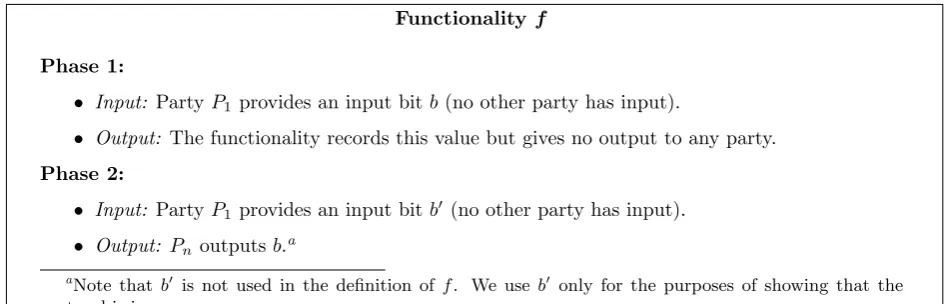
Functionality f
Phase 1:
• Input: Party P1 provides an input bitb(no other party has input).
• Output: The functionality records this value but gives no output to any party.
Phase 2:
• Input: Party P1 provides an input bitb′ (no other party has input). • Output: Pn outputsb.a
aNote that b′ is not used in the definition off. We useb′ only for the purposes of showing that the
protocol is insecure.
Figure 1: The reactive functionality for the proof of Theorem 3.1.
Proof: Ift≥n/2 then the theorem follows from the fact that there exist non-reactive functional-ities that cannot be computed securely without an honest majority [9]. Thus, we assume t < n/2 (implyingn≥3 ands >0) in what follows.
We prove Theorem 3.1 using a two-phase functionality f that corresponds (roughly) to having
P1 commit to a value; see Figure 1. Take any protocolπ computing f, and let S1 ={P1, . . . , Pt} and S2={Pt+1, . . . , Pn}; note that|S2|=s. The intuition for the theorem is as follows:
1. Say π privately computes f in the presence of semi-honest adversaries corrupting s parties. Then the parties in S2 should (jointly) know nothing about bafter phase 1.
2. Sayπsecurely computesf in the presence of malicious adversaries corruptingtparties. Then the parties in S1 should not be able to prevent Pn from learning b in the second phase. In particular, this should hold even if all parties inS1 abort before the second phase.
Intuitively this gives a contradiction since, following the first phase of the protocol, the parties in
S2 can jointly simulate an execution of the second phase of the protocol when all parties in S1
abort. The formal proof of the theorem is slightly more involved since item (2), above, is not quite true in the presence of a malicious P1 who might change his input before running the protocol.
We now prove this formally. Let π be a protocol computingf that is secure in the presence of
tnon-rushing, fail-stop adversaries; we will show thatπ cannot also be private in the presence ofs
semi-honest adversaries. Sinceπ is secure in the presence of tfail-stop adversaries, we may assume without loss of generality that the output ofPninπ is always a bit (and never⊥) as long as parties in S1 behave honestly but may abort the protocol early. We consider two real-world executions
of π. In both cases,Z choosesb and b′ uniformly and independently.2
First execution. Here we consider a non-rushing, fail-stop adversaryA1 who corrupts the parties
in S1 and instructs them to behave as follows: Run the first phase of π honestly. In the second
phase, if b′ = b then run the second phase honestly; otherwise, abort immediately. We let Pr1[·]
denote the probability of events in this execution.
Second execution. Here we consider a semi-honest adversaryA2 who corrupts the parties inS2.
At the conclusion of phase 1 of π, this adversary simulates an execution of the second phase of π
assuming all parties inS1 abort, and outputs the resulting output ofPn. We let Pr2[·] denote the
probability of events in this execution.
Claim 3.2 Pr1[Pn outputs b′] = 12 +12 ·(1−Pr2[A2 outputs b]).
Proof: In the first execution, we can consider a mental experiment in which the parties in S2
simulate the second phase ofπassuming all parties inS1abort. By definition ofA2, the probability
that the output of Pn in this mental experiment is not equal tobis exactly 1−Pr2[A2 outputsb].
Note further that this probability is independent of the valueb′ used in the second phase.
In the first execution, the parties inS1abort with probability exactly 1/2; moreover, when they
do not abort the output ofPn isb=b′. When the parties inS1 do abort thenPn outputsb′ iff the output ofPn is not equal tob. Thus,
Pr1[Pn outputsb′] = 12 +21 ·Pr1[Pn outputs ¯b|parties in S1 abort]
= 12 +12 ·(1−Pr2[A2 outputsb]),
as desired.
Claim 3.3 Pr1[Pn outputs b′]−12 is negligible.
Proof: Here we rely on the assumption that π securely computes f in the presence of a non-rushing, fail-stop adversary corrupting t parties. Consider an ideal-world execution of f in the presence of an adversary corrupting the parties in S1. In the ideal world, the final output of Pn is equal to whatever valueP1 sends to the trusted party in the first phase. Since the adversary has
no information about b′ in the first phase, the probability thatP1 sendsb′ to the trusted party in
the first phase (and hence the probability thatPn outputs b′ in the second phase) is exactly 1/2. The claim follows.
Claim 3.4 If π privately computes f in the presence of a semi-honest adversary corrupting s
parties, then Pr2[A2 outputs b]−12 is negligible.
Proof: This follows from the fact that, in an ideal-world execution off, any adversary corrupting the parties inS2 outputs the value ofbafter phase 1 with probability exactly 1/2.
The preceding three claims imply that π cannot privately compute f in the presence of a semi-honest adversary corrupting sparties. This concludes the proof of Theorem 3.1.
3.2 Non-Reactive Functionalities
We now show an impossibility result for the case of standard (i.e., non-reactive) functionalities. This result is incomparable to the result proved in the previous section, since here we rule out privacy againstmalicious adversaries and explicitly make use of the fact that the adversary can be rushing.3 The thresholds in the theorem are tight; see Section 4.2.
Theorem 3.5 Let n, t, s be such that t+s = n and t ≥ 1. Then there exists a non-reactive functionalityf˜for which there is no protocol that simultaneously:
3For non-rushing adversaries, similar negative results appear in [18, 19]. However, these apply only to protocols
• securely computesf˜in the presence of malicious adversaries corrupting t parties;
• privately computes f˜in the presence of malicious adversaries corrupting sparties.
This holds even if we consider only fail-stop adversaries in each case.
Whent≥n/2 the theorem follows from the existence of functionalities that cannot be computed securely without an honest majority [9]. Thus, we assume t < n/2 (and hence n ≥3 and s >0) in what follows. We prove the theorem in two stages: In Section 3.2.1 we present a functionalityf
for which there is no protocol that simultaneously
• securely computesf in the presence of malicious adversaries corrupting tparties;
• securely computes f with abort in the presence of malicious adversaries corruptingsparties.
Extending this, we then show in Section 3.2.2 a (slightly different) functionality ˜f that suffices to prove the theorem.
3.2.1 Ruling out Security with Abort
Fixn,s, and 1≤t < n/2 witht+s=n. Definef as follows: partiesP1 andPnhave as input bits
b1 and bn, respectively, and each receive as outputb1⊕bn (no other parties receive output). Letπ be a protocol that securely computesf in the presence of a fail-stop adversary corruptingtparties. We assume that π operates in a fixed number ofsegments, each exactly nrounds long, where only partyPi sends a message in theith round of a segment. (I.e., in any given segment firstP1 speaks,
then P2, etc. until Pn speaks and then the next segment begins.) If π is secure against a rushing adversary then it can always be transformed into a protocol of this form. Letr =r(k) denote the number of segments of the protocol. We assume that if π is run honestly, then the outputs ofP1
and Pn are correct (and, in particular, agree) with probability4 at least 7/8. Define A def= {P1, . . . , Pt}, B
def
= {Pt+1, . . . , Pn−t}, and C
def
= {Pn−t+1, . . . , Pn}. Consider the real-world execution in which Z chooses inputs for P1 and Pn uniformly and independently (see footnote 2), and then all parties run the protocol honestly except that parties in A or C may (possibly) abort at some round. (Parties inB run the protocol honestly and never abort.) Letv1i, with 0 ≤i≤r, denote the final output of P1 when parties in C all abort in segmenti+ 1 or, in
other words, when segment i is the last segment in which parties in C send any messages. (For
i= 0 this means that parties in C abort the protocol immediately without sending any messages; for i = r this means that parties in C never abort.) Define vin similarly to be the output of Pn when all parties in A abort in segment i+ 1 (i.e., send messages for the final time in segment i). Note that vi1 can be computed from the joint view of the parties in A∪B as soon as all parties in
C have sent their segment-imessages, and similarly vincan be computed from the joint view of the parties in B∪C once all parties inA have sent their segment-imessages.
Security of π implies that, for all i, we have v1i, vni ∈ {0,1}(and, in particular,v1i ̸=⊥) with all but negligible probability. This is true sinceπ provides full security against tfail-stop adversaries, and at most tparties abort in the experiment defining v1i, vni. In what follows, we will assume for simplicity thatv1i, vni ∈ {0,1}with probability 1.
4
Consider the following summation, where all probabilities are with respect to the real-world execution described earlier:
(
Pr[v01 = 1∧vn0 = 1]+ Pr[v01 = 0∧vnr = 1]− 1 2
)
(1)
+ (
Pr[v10= 0∧vn0 = 0]+ Pr[v10= 1∧vnr = 0]−1 2
)
(2)
+ r−1
∑
i=0
[(
Pr[vi1 = 0∧vni+1 = 0]+ Pr[vi1= 1∧vni = 0]−1 2
)
(3)
+ (
Pr[v1i = 1∧vin+1 = 1]+ Pr[v1i = 0∧vni = 1]− 1 2
)
(4)
+ (
Pr[v1i+1 = 0∧vni+1 = 0]+ Pr[v1i = 0∧vni+1 = 1]−1 2
)
(5)
+ (
Pr[v1i+1 = 1∧vni+1 = 1]+ Pr[vi1 = 1∧vni+1 = 0]− 1 2
)]
, (6)
which evaluates to:
Pr[v10= 1∧v0n= 1]+ Pr[v10= 0∧vrn= 1]
+ Pr[v01 = 0∧vn0 = 0]+ Pr[v01 = 1∧vrn= 0]−1
+ r−1
∑
i=0
[
Pr[v1i = 1∧vin= 0]+ Pr[vi1= 0∧vin= 1]
+ Pr[vi1+1= 0∧vin+1= 0]+ Pr[vi1+1= 1∧vin+1= 1]−1 ]
= Pr[v01 = 1∧vn0 = 1]+ Pr[v01 = 0∧vrn= 1]+ Pr[v01 = 0∧v0n= 0] + Pr[v01 = 1∧vnr = 0]+ Pr[v01 = 1∧v0n= 0]+ Pr[v01 = 0∧v0n= 1] + Pr [v1r= 0∧vrn= 0] + Pr [vr1 = 1∧vnr = 1]−2
= Pr[v01 = 0∧vnr = 1]+ Pr[v01 = 1∧vrn= 0]+ Pr [vr1 =vrn]−1
≥ Pr[v01 = 0∧b1̸=bn ]
−Pr [vnr ̸= 1∧b1 ̸=bn] + Pr[v01 = 1∧b1=bn
]
−Pr [vnr ̸= 0∧b1 =bn] + Pr [vr1 =vnr]−1
≥ Pr [
b1̸=bn|v01 = 0
]
·Pr[v01 = 0] + Pr [
b1 =bn|v10= 1
]
·Pr[v10 = 1] +3 4 −1,
using the assumed correctness of π when run honestly to completion. Since v10 is independent of
Pn’s input bn, we have Pr [
b1 ̸=bn|v01 = 0
]
= Pr[b1 =bn|v10= 1
]
= 12. It follows that the above
sum is at least 14, and so at least one of the summands (1)–(6) is at leastp(k)def= 4·(4r(1k)+2), which is noticeable. We show that this implies that π does not securely compute f with abort in the presence of a fail-stop adversary corruptingsparties. In all the cases described below,Z continues to choose b1, bn uniformly and independently; however, the set of corrupted parties I and/or the auxiliary input z given to the adversary may change.
Case 1(a). Say Pr[v0
1 = 1∧vn0 = 1 ]
+ Pr[v0
1 = 0∧vnr = 1 ]
−1
2 ≥p(k), and consider the adversary
to it byZ and random tapes for all parties in A∪B). If v10 = 1, the adversary aborts all parties inA immediately and has parties in B run π honestly with (the honest parties) C. If v0
1 = 0, the
adversary has all parties inA∪B run the entire protocol honestly.
Note that |A∪B| =s. Furthermore, the probability that Pn outputs 1 in a real execution of the protocol with this adversary is exactly
Pr[v01 = 1∧v0n= 1]+ Pr[v10= 0∧vrn= 1]≥ 1
2+p(k).
However, in an ideal execution with any adversary corrupting parties in A∪B, the honest party
Pnwill not output 1 with probability greater than 12 (given thatPn’s input is chosen uniformly at random). It follows in this case that π does not securely computef with abort in the presence of a fail-stop adversary corruptingsparties.
Case 1(b). Say Pr[v0
1 = 0∧vn0 = 0 ]
+ Pr[v0
1 = 1∧vrn= 0 ]
−1
2 ≥p(k). An argument analogous
to the above gives a real-world adversary who corrupts parties inA∪B and forcesPnto output 0 with probability noticeably greater than 1/2. This again implies that π does not securely compute
f with abort in the presence of a fail-stop adversary corruptings parties. Case 2(a). Say there exists an index i∈ {0, . . . , r(k)−1}for which
Pr[vi1= 0∧vni+1= 0]+ Pr[vi1= 1∧vin= 0]−1
2 ≥p(k).
Consider the adversary given auxiliary input z = i who corrupts the parties in A∪B and acts as follows: it runs the protocol honestly up to the end of segment i (if i = 0, this is just the beginning of the protocol). At this point, as noted earlier, the parties inA∪B jointly have enough information to compute vi
1. If vi1 = 1, then the adversary immediately aborts all parties in A. If
v1i = 0, then the parties inA send their (honestly computed) messages for segmenti+ 1 but send no more messages after that (i.e., they abort in segmenti+ 2). In either case, parties inB continue to run the entire rest of the protocol honestly.
The probability that Pn outputs 0 in a real execution of the protocol is exactly
Pr[vi1= 0∧vni+1= 0]+ Pr[vi1= 1∧vin= 0]≥ 1
2+p(k).
However, as before, in an ideal execution with any adversary corrupting parties inA∪B, the honest party Pn will not output 0 with probability greater than 12. Thus, in this case π does not securely computef with abort in the presence of a fail-stop adversary corruptingsparties.
Case 2(b). If there exists anisuch that Pr[v1i = 1∧vin+1= 1]+ Pr[vi1= 0∧vni = 1]−12 ≥p(k), an argument as above gives an adversary corrupting parties in A∪B who forces Pn to output 1 more often than can be achieved by any adversary in the ideal world.
Case 3(a). Say there exists an index i∈ {1, . . . , r(k)} such that
Pr[v1i = 0∧vin= 0]+ Pr[vi1−1= 0∧vin= 1]−1
2 ≥p(k)
party with lowest index who is in C.) At this point, the parties in B∪C can jointly computevni. If vi
n= 1, then all parties in C abort in this segment and do not send any more messages (so the last messages sent by any parties inC were sent in segmenti−1). Ifvni = 0, then all parties inC
send their (honestly generated) messages in segment ibut abort in segment i+ 1. In either case, parties in B continue to run the entire rest of the protocol honestly.
The probability that P1 outputs 0 in a real execution of the protocol is exactly
Pr[v1i = 0∧vni = 0]+ Pr[vi1−1 = 0∧vin= 1]≥ 1
2 +p(k).
However, in an ideal execution with any adversary corrupting parties in B∪C, the honest party
P1 will not output 0 with probability greater than 12 (given that its input is chosen uniformly at
random). We conclude that in this case π does not securely computef with abort in the presence of a fail-stop adversary corruptingsparties.
Case 3(b). If there exists an isuch that Pr[vi1= 1∧vin= 1]+ Pr[v1i−1 = 1∧vni = 0]−12 ≥p(k), an argument as above gives an adversary corrupting parties in B∪C who forces P1 to output 1
more often than can be achieved by any adversary in the ideal world.
3.2.2 Ruling out Privacy
The argument in the previous section shows that we cannot hope to achieve the “best of both worlds”. However, we might hope that for every functionality there is a protocol π that is secure with an honest majority and is alsoprivate even without an honest majority. Building on the result of the previous section, we rule out this possibility as well.
Given n, t, s as before, we define a function ˜f that takes inputs from P1 and Pn, and returns output to P1, Pn, and also Pt+1. On input (b1, α0, α1) from P1 and (bn, β0, β1) from Pn, where
b1, bn, α0, α1, β0, β1∈ {0,1}, functionality ˜f computes v=b1⊕bn, givesv toP1 and Pn, and gives (v, αv, βv) to Pt+1. That is:
˜
f((b1, α0, α1), λ, . . . , λ,(bn, β0, β1)) def
=
(b1⊕bn, λ, . . . , λ,|(b1⊕bn, αb{z1⊕bn, βb1⊕bn})
output ofPt+1
, λ, . . . , λ, b1⊕bn),
where we letλdenote an empty input/output.
Letπ be a protocol that securely computes ˜f in the presence of a malicious adversary corrupting
t parties. Let A, B, C be a partition of the parties as in the previous section, and recall that
Pt+1 ∈ B. Consider an experiment in which Z chooses inputs for P1 and Pn uniformly and independently, and all parties run protocol π honestly except that parties in A or C (but never
B) may possibly abort. An argument exactly as in the previous section shows that there exists a real-world adversaryA who either:
• corrupts the parties inA∪B and causesPn to output some bitv with probability noticeably greater than 1/2; or
• corrupts the parties inB∪C and causesP1 to output some bitv with probability noticeably
Assume without loss of generality that the first case holds, and there is a fail-stop adversaryAwho corrupts thesparties in A∪B and causesPn to output 0 with probability at least 1/2 +p(k) for some noticeable functionp. The key observation is thatA only causes thetparties in A to abort, and the remaining corrupted parties inBcontinue executing the entire protocol honestly. Sinceπis secure in the presence of a malicious adversary corruptingtparties, all parties inB∪C will receive their outputs (except possibly with negligible probability) even if all parties inA abort. Moreover, security of π implies that the output of the honest-looking Pt+1 will be consistent with the input
and output of the honestPn (except with negligible probability). Taken together, this means that the view of A — which includes the output generated by Pt+1 — includes β0 with probability at
least 1/2 +p′(k) for some noticeable functionp′, and furthermoreAknows when this occurs (since the output of Pt+1 includes v def= b1 ⊕bn in addition to βv). Thus, A can output a guess for β0
which is correct with probability at least
1 2+p
′(k) + 1 2·
( 1 2 −p
′(k))= 3 4 +
p′(k) 2 .
In contrast, no ideal-world adversaryA′ corruptingA∪B can output a guess forβ0which is correct
with probability better than 3/4 when Z chooses Pn’s inputs uniformly at random. This shows thatπ does not privately compute ˜f in the presence of a malicious adversary corruptingsparties.
Remark 3.6 (Protocols with expected polynomial round complexity.) The arguments in the previous sections can be extended to apply to protocols having expectedpolynomial round com-plexity. We sketch the main idea here, with respect to the proof given in Section 3.2.1. Say we have a protocol π that securely computes f and for which the expected number of segments in π is p(k). Correctness ofπ implies that if π is run honestly to completion, then the outputs of P1 andPn are correct (and, in particular, agree) with all but negligible probability. Setting r(k) = 8·r′(k), this means that we have Pr[v1r =vnr =b1⊕bn]≈7/8. The remainder of the proof is as before, except that adversaries always abort by segment r+ 1 at the latest.
4
Positive Results
In this section we explore two positive results regarding when a “best of both worlds”-type guar-antee is possible. First, we briefly describe a “folklore” protocol for any (reactive or non-reactive) functionalityf that is simultaneously secure against malicious adversaries corrupting any t < n/2 parties and secure-with-abort against malicious adversaries corrupting n−t−1 parties. In light of Cleve’s result [9] and Theorems 3.1 and 3.5, these thresholds are the best possible for general functionalities.
4.1 Achieving the “Best of Both Worlds” for Suitable Thresholds
Theorem 4.1 Let n, s, tbe such thatt+s < nandt < n/2, and assume the existence of enhanced trapdoor permutations. Then for any probabilistic polynomial-time (reactive or non-reactive) func-tionality f, there exists a protocol that simultaneously:
• securely computesf in the presence of a malicious adversary corrupting tparties;
• securely computes f with abort in the presence of a malicious adversary corrupting s parties.
Proof: If s≤ t the theorem follows from known results [12], so assume s > t. We begin with the case of non-reactive functionalities. In this case, a protocol π with the claimed properties can be derived easily by suitably modifying known protocols that achieve security for honest major-ity. In particular, such a protocol π can be obtained by following the general approach of [12, Construction 7.5.39] with the following changes:
• The verifiable secret sharing (VSS) scheme used should have threshold s+ 1, so that any
s+ 1 shares suffice to recover the secret but any s shares give no information (in at least a computational sense) about the secret.
• The “handling abort” procedure is modified as follows. If a party Pi aborts (or is detected cheating) at some point during the protocol, all remaining parties broadcast their shares of
Pi’s input and random tape. If at least s+ 1 valid shares are revealed, the protocol continues with parties carrying out the execution on Pi’s behalf. If fewer than s+ 1 valid shares are revealed, then all parties abort the protocol with output⊥.
Note that when t parties are corrupted, at least n−t ≥ s+ 1 valid shares are always revealed during the “handling abort” procedure. Thus, security ofπ in the presence of a malicious adversary corruptingt parties follows using the same analysis as in [12]. Whensparties are corrupted, they may cause the protocol to abort but cannot otherwise affect the computation since the sharing threshold is set to s+ 1. A standard argument can be used to show thatπ securely computes f
with abort in this case.
For reactive functionalities, we proceed as sketched in [12, Section 7.7.1.3] with natural modifi-cations. As there, the system statesj at the end of thejth phase of the protocol is shared among the parties; here, however, this sharing is done using thresholds+ 1 as above.
4.2 Security Against a Malicious Minority or a Semi-Honest Majority
Theorem 4.2 Let n, s, t be such that t < n/2 and s < n, and assume the existence of enhanced trapdoor permutations. Then for any probabilistic polynomial-time non-reactive functionality f, there exists a protocol that simultaneously:
• securely computesf in the presence of a malicious adversary corrupting tparties;
• securely computesf in the presence of a semi-honest adversary corruptings parties.
Proof: We assumet=⌊(n−1)/2⌋ands=n−1. We also assume without loss of generality thatf
can be reduced to secure computation of the single-output functionality (y1⊕r1)| · · · |(yn⊕rn)←
f((r1, x1), . . . ,(rn, xn)), whereri is a random pad chosen by Pi at the outset of the protocol. This reduction is secure for any number of corruptions.
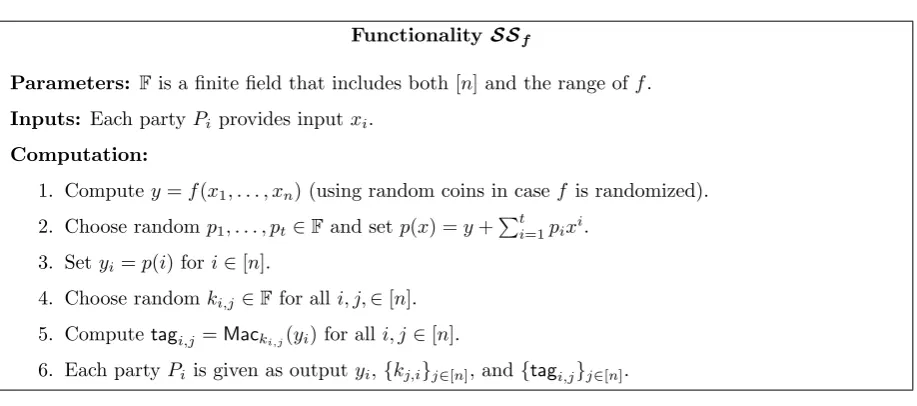
Before describing our protocol π computing f, we first define a related functionality SSf that corresponds to computing anauthenticated secret sharing off (with thresholdt+ 1). That is, SSf denotes the functionality that
1. evaluatesy =f(x1, . . . , xn);
2. computes a (t+ 1)-out-of-nShamir secret sharing [21] ofy, sending to each party its shareyi;
3. authenticates each share yi for every other party Pj using an information-theoretic MAC (denotedMac). The resulting tag is given toPi and the key is given to Pj.
See Figure 2 for details.
FunctionalitySSf
Parameters: Fis a finite field that includes both [n] and the range off.
Inputs: Each partyPi provides inputxi.
Computation:
1. Computey=f(x1, . . . , xn) (using random coins in casef is randomized).
2. Choose randomp1, . . . , pt∈Fand setp(x) =y+
∑t i=1pixi.
3. Setyi =p(i) fori∈[n].
4. Choose randomki,j∈Ffor alli, j,∈[n].
5. Computetagi,j =Macki,j(yi) for alli, j∈[n].
6. Each partyPi is given as outputyi,{kj,i}j∈[n], and {tagi,j}j∈[n].
Figure 2: Functionality SSf for authenticated secret sharing of the output off.
In Figure 3, we describe a protocol π computing f. This protocol relies on two sub-protocols: a sub-protocol πn that computes SSf, and a sub-protocol πn/2 that computes f. We require the
following security guarantees from these protocols:
• πn securely computes SSf with abort in the presence of a malicious adversary corrupting s parties, and also securely computesSSf in the presence of a semi-honest adversary corrupting
sparties.5
• πn/2 securely computesf in the presence of a malicious adversary corrupting tparties.
Protocols with the above properties can be constructed assuming the existence of enhanced trapdoor permutations [12].
Intuition for the claimed security properties of π is as follows. Consider first the case of a semi-honest adversary corrupting s parties in some set I. In this case, Phase I always completes
5
Protocol π
Inputs: Each partyPi has input (1k, xi).
Output: Each partyPi gets outputy=f(x1, . . . , xn).
Phase I:
Each party Pi does as follows:
1. Run a protocolπn computing the functionalitySSf, using input xi. Letyi, {kj,i}j∈[n], and {tagi,j}j∈[n] denote the output ofPi following execution of this protocol.
2. Ifyi=⊥, then go to Phase II. Otherwise, do:
(a) For every other partyPj, send (yi,tagi,j) toPj. Receive in return (yj,tagj,i) from each
other partyPj.
(b) Setyi′ =yi. Forj̸=i, ifMackj,i(yj) =tagj,iset yj′ =yj; otherwise, setyj′ =⊥.
(c) Reconstruct the outputy using the sharesy′1, . . . , y′n.
Phase II:
Each partyPi runs protocolπn/2 computing the functionalityf, using their original inputxi. Each
Pi outputs the output value it obtained inπt.
Figure 3: Protocol π, based on protocols πs and πt.
successfully (and so Phase II is never executed) and all honest parties learn the correct output y. Moreover, since πn is secure in the presence of a semi-honest adversary corrupting s parties, the adversary learns nothing from the execution of π other than the secret shares {yi}i∈I, which is equivalent to learning y. Next, consider the case of a malicious adversary corrupting t parties in some set I. Here, there are two possibilities:
• πn completes successfully. Protocolπnis secure with abort in the presence of a malicious adversary corrupting t < s parties. Thus, ifπn completes successfully every honest party Pi learns a (correct) shareyi of the correct output valuey(in addition to correct authentication information for this share). In step 2(a) of Phase I every honest party then obtains at least
n−t > t+ 1 correct (and valid) shares of y; furthermore, an incorrect share sent by a corrupted party is detected as invalid except with negligible probability. We conclude that honest parties output the correct value y. Finally, security of πn implies that the adversary learns nothing from this execution that is not implied by its inputs and the output valuey.
• πn does not complete successfully. In this case, we may assume the adversary learns its output inπnand then aborts this sub-protocol before the honest parties learn their outputs. By security of πn, the only thing the adversary learns from Phase I are the shares {yi}i∈I. Since these shares were generated using a secret-sharing scheme with threshold t+ 1, they reveal nothing about the outputy.
Execution of π then continues with execution of πn/2 in Phase II. Sinceπn/2 is secure in the presence of a malicious adversary corruptingtparties, this sub-protocol completes successfully and all honest parties learn the correct outputy; moreover, the adversary learns nothing from this execution that is not implied by its inputs and the output value y.
Claim 4.3 If πn securely computes SSf in the presence of a semi-honest adversary corrupting s parties, thenπ securely computesf in the presence of a semi-honest adversary corruptingsparties.
Proof: We analyze π in a hybrid model where the parties have access to a trusted party computing SSf (this trusted party computes SSf according to the first ideal model, where the adversary cannot abort the computation), and show that in this hybrid modelπsecurely computesf
in the presence of a semi-honest adversary corruptingsparties. Standard composition theorems [5, 12] imply the claim.
Let A be a semi-honest adversary in a hybrid-model execution of π (as described above). We describe the natural semi-honest adversaryA′, running an ideal-world evaluation of f, whose behavior provides a perfect simulation of the behavior of A. Adversary A′ receives the set of corrupted parties I ⊂ [n], their inputs {xi}i∈I, and auxiliary input z. It sends the inputs of the corrupted parties to the trusted party evaluating f, and receives in return an output y. Next, A′ simply runs steps 2–6 of functionality SSf (cf. Figure 2) using the value of y it obtained. The resulting values {(yi,{kj,i}j∈[n],{tagi,j}j∈[n])}i∈I are given to A as the outputs of the corrupted parties from functionalitySSf. The values{(yi,{tagi,j}j∈I)}i̸∈I are then given toAas the messages sent by the honest parties in the final round of Phase I. Finally, A′ outputs whatever A does. It is straightforward to see that the joint distribution of the honest parties’ outputs and the view of
A(run as a sub-routine of A′) in the ideal world is identical to the joint distribution of the honest parties’ outputs and the view of Ain the hybrid world. The claim follows.
Claim 4.4 If πn securely computes SSf with abort in the presence of a malicious adversary cor-rupting tparties, andπn/2 securely computesf in the presence of a malicious adversary corrupting
tparties, then π securely computes f in the presence of a malicious adversary corruptingt parties.
Proof: Once again, we analyzeπ in a hybrid model. Now, the parties have access to two trusted parties:
• a trusted party computing SSf according to the second ideal model, where the adversary may prematurely abort the computation; and
• a trusted party computing f according to the first ideal model, where the adversary cannot abort the computation.
We show that in this hybrid modelπ securely computesf in the presence of a malicious adversary corruptingtparties. Standard composition theorems [5, 12] imply the claim.
Let A be a malicious adversary in a hybrid-model execution of π (as described above). We describe a malicious adversaryA′, running an ideal-world evaluation off, whose behavior provides a perfect simulation of the behavior ofA. AdversaryA′ receives the set of corrupted partiesI ⊂[n], their inputs {xi}i∈I, and auxiliary input z. It passes these values to A, and then receives inputs
{x′i}i∈I sent by Ato the trusted party computingSSf (recall thatA operates in the hybrid world where there is a trusted party computing this functionality). A′ chooses random yi ∈F fori∈I, and then runs steps 4–6 ofSSf (cf. Figure 2). The resulting values{(yi,{kj,i}j∈[n],{tagi,j}j∈[n])}i∈I are given to A as the outputs of the corrupted parties from functionality SSf. We stress that A′ has not yet sent anything to its own trusted party computingf.
• If A aborts computation of SSf, adversary A′ continues with simulation of Phase II as described below.
• IfA allows computation of SSf to continue, thenA′ sends the inputs {x′i}i∈I to the trusted party computingf and receives in return a value y. It interpolates a degree-t polynomial p
satisfying p(0) = y and p(i) = yi for i ∈ I, and sets yi = p(i) for i ̸∈ I. Finally, it gives
{(yi,{tagi,j}j∈I)}i̸∈I to A as the messages sent by the honest parties in the final round of Phase I, and outputs whateverA outputs.
If A had aborted computation of Af, then A′ now continues with simulation of Phase II. A receives (possibly different) inputs {x′′i}i∈I from A, sends these to its trusted party computing f, and receives in return an output value y. It gives y toA, and outputs whateverA outputs.
It is not hard to verify that the joint distribution of the honest parties’ outputs and the view ofA (run as a sub-routine ofA′) in the ideal world is statistically close to the joint distribution of the honest parties’ outputs and the view ofAin the hybrid world (where the only difference arises from the possibility thatA manages to forge a tag on an invalid share). The claim follows.
Since protocols πn and πn/2 with the desired security properties can be constructed from
en-hanced trapdoor permutations, the preceding claims complete the proof of the theorem.
Remark 4.5 (Realizing adaptive security and/or universal composability.) Theorem 4.2 refers to our default model of stand-alone security against static adversaries. It is not hard to see, however, that protocol π described in the proof of that theorem can be proved secure against adaptive adversaries and/or universally composable [6] if the underlying protocols πn, πn/2 satisfy
these stronger security properties.
References
[1] Y. Aumann and Y. Lindell. Security against covert adversaries: Efficient protocols for realistic adversaries. In4th Theory of Cryptography Conference — TCC 2007, volume 4392 ofLNCS, pages 137–156. Springer, 2007.
[2] D. Beaver. Multiparty protocols tolerating half faulty processors. In Advances in Cryptology — Crypto ’89, volume 435 ofLNCS, pages 560–572. Springer, 1990.
[3] D. Beaver and S. Goldwasser. Multiparty computation with faulty majority. In 30th Annual Symposium on Foundations of Computer Science (FOCS), pages 468–473. IEEE, 1989.
[4] M. Ben-Or, S. Goldwasser, and A. Wigderson. Completeness theorems for non-cryptographic fault-tolerant distributed computation. In20th Annual ACM Symposium on Theory of Com-puting (STOC), pages 1–10. ACM Press, 1988.
[5] R. Canetti. Security and composition of multiparty cryptographic protocols. Journal of Cryp-tology, 13(1):143–202, 2000.