Public Key Cryptosystems Constructed Based on Random Pseudo Cyclic
Codes, K(IX)SE(1)PKC, Realizing Coding Rate of Exactly 1.0
Masao KASAHARA
Faculty of Informatics, Osaka Gakuin University, Suita-shi, 564-8511 Japan.
[email protected]
Abstract
In this paper, we present a new class of public-key cryptosys-tems, K(IX)SE(1)PKC realizing the coding rate of exactly 1.0, based on random pseudo cyclic codes. We show that K(IX)SE(1)PKC is secure against the various attacks includ-ing the attack based on the Gr¨obner bases calculaion (GB attack).
Keyword
Public key cryptosystem, Error-correcting code, Code based PKC, Multivariate PKC, Gr¨obner bases, PQC.
1
Introduction
Most of the multivariate PKC’s are constructed by the simul-taneous equations of degree larger than or equal to 2 [1]∼[6]. The present author recently proposed several classes of mul-tivariate PKC’s that are constructed by many sets of linear equations[7]∼[13].
It should be noted that McEliece PKC[14] can be regarded as the first member of the class of the linear multivariate PKC. In this paper we present a new class of public key cryptosys-tem, K(IX)SE(1)PKC based on pseudo cyclic codes, realizing the coding rate of exactly 1.0. We show that K(IX)SE(1)PKC is secure against the attacks including the attack based on the Gr¨obner bases calculaion (GB attack)[15].
Throughout this paper, when the variable vi takes on
a value ˜vi, we shall denote the corresponding vector v =
(v1, v2,· · · , vn) as
˜
v= (˜v1,v˜2,· · ·,˜vn). (1)
The vector v = (v1, v2,· · ·, vn) will be represented by the
polynomial as
v(x) =v1+v2x+· · ·+vnxn−1. (2)
The ˜u, ˜u(x) et al. will be defined in a similar manner.
2
K(XI)SE(1)PKC over
F
2m2.1
Construction
Let us define a few symbols.
G(x): Random polynomial for generating random pseudo cyclic code over F2m,
R0+R1x+· · ·+Rg−1xg−1+Rgxg,
where Ri (i= 1,· · ·, g−1), R0 ̸= 0
andRg̸= 0 take on an element ofF2m
equally likely in a random manner. eY : Exponent(period, order) of Y(x).
♯{Ai}: Order of the set {Ai}.
H(Ai) : Ambiguity ofAi, log2♯{Ai} (bit).
H(A|B) : Ambiguity (Conditional Entropy) of AwhenB is given (bit).
[Rij]a×b: Random matrix, where Rij (i =
1,· · · , a;j= 1,· · ·, b) takes on 0 or 1 equally likely in a random manner.
H
³
[Rij]a×b
´
: Ambiguity of [Rij]a×b ∼=ab(bit).
C : Ciphertext, (CI,CII).
CI: First ciphertext.
CII: Second ciphertext.
NV : Total number of variables.
NE : Total number of equations.
Let the message vectorAoverF2be represented by
A= (A1, A2,· · ·, AN). (3)
Throughout this paper we assume that the messages A1, A2,· · ·, AN are mutually independent and equally likely.
LetAbe transformed into
A·HI=a= (a1, a2,· · ·, aN), (4)
whereHI is anN×N non-singular random matrix over F2.
Leta be partitioned into
a= (m1, m2,· · · , mn), (5)
wheremi is given by
In the followings let us regardmi as an element ofF2m.
Let us partition the components ofa into
mA= (mg+1, mg+2,· · · , mg+f), (7)
mB= (mg+f+1, mg+f+2,· · · , mn), (8)
and
mC= (m1, m2,· · ·, mg), (9)
respectively, wherenis given by
n=g+ 2f. (10)
We letf be given by
g < f, (11)
due to the reason mentioned in 2.4. FrommA andmB, we obtain
(mA(x)mB(x)) α≡
p(x) modP(x), (12)
where P(x) is a primitive polynomial of degree f over F2m,
andαis given by
α= 1 + 2 + 22+· · ·+ 2B <2f m−1. (13) Letp(x) be represented by
p= (p1, p2,· · ·, pf). (14)
The first ciphertextCI(x) is given by
CI(x) =p(x). (15)
Remark 1 : All the components of p are calculated at the sending end from Eq.(12), for the given mA and mB.
Namely all the components are not represented by a set
of equations of degree B. 2
Regarding mA over F2m as an mf-tuple over F2, mA is
transformed into
mAHII =m′A
=¡m′g+1, m′g+2,· · · , m′g+f¢, (16) where HII is anmf ×mf non-singular random matrix over
F2m.
It should be noted that any component m′i of m′A is an element ofF2m.
Letr(x) be given by
m′A(x)xg≡r(x) modG(x)
=r1+r2x+· · ·+rgxg−1.
(17)
The code word, w(x), generated by the generator polyno-mialG(x), can be represented by
w(x) =r(x) +m′A(x)xg. (18)
Regarding the vectorr= (r1, r2,· · ·, rg) overF2mas a
gm-tuple overF2, it is transformed into
(r1, r2,· · ·, rg)HIII =t
= (t1, t2,· · · , tg),
(19)
whereHIII is agm×gmrandom non-singular matrix overF2.
We see that the ambiguity ofHIII overF2 is given
approx-imately by
|HIII| ∼=g2m2 (bit), (20)
an extremely large value forgm >∼ 80.
According to the transformation given by Eq.(19), the code wordw(x) is transformed into
w′(x) =t(x) +m′A(x)xg̸= 0 modG(x), (21)
for r(x)̸= 0. (22)
Thew′(x) is publicized.
At the sending end the message vectormC is transformed
into
{mC(x)}3=τ(x). (23)
Remark 2 : All the components of τ are calculated at the sending end from Eq.(23), for the givenmC(x). Namely
all the components ofτare not given by a set of quadratic equations.
With this τ(x), at the sending end, the word u(x) is con-structed by
u(x) =w′(x) +τ(x)xg. (24)
The second ciphertextCII(x) is given by
CII(x) =u(x). (25)
We have the following set of keys.
Public key : mA,mB,mC, w′,P(x),α,g, 3.
Secret key : HI,HII,HIII,G(x).
2.2
Encryption and Decryption
[Encryption]
Step 1: The vector ˜pis calculated from Eq.(12) for the given ˜
mA and ˜mB.
Step 2: The ciphertext ˜CI(x) is given by ˜p(x) from Eq.(15).
Step 3: Thew′(x) is caclulated from Eq.(21).
Step 4: Given ˜mC(x), the ˜τ(x) is calculated from Eq.(23).
Step 5: The ciphertext ˜CII(x) is given by ˜u(x) = ˜w′(x) +
˜
Table 1: Example of K(IX)SE(1)PKC(ρ= 1.0).
Example N m dA,dB dC g PC[G(x)]b SPK (KB)
I 544 32 6 2 3 2.94∗10−39 58.8
II 640 64 3 1 2 2.76∗10−60 184.3
[Decryption]
Step 1: The ˜t(x) is inverse transformed to ˜r(x) by ˜t·HIII−1, yielding ˜w(x) + ˜m3C(x)xg.
Step 2: The ˜mC(x) is decoded by
˜ CII(x) =
©
˜
w(x) + ˜m3C(x)ªd
≡m˜C(x) modG(x),
(26)
where dis the inverse element of 3 modulo eG, yielding
˜ w(x).
Step 3: From ˜w(x), the transformed message ˜m′A(x) is de-coded.
Step 4: The vector ˜mA is obtained by ˜m′AH−
1
II .
Step 5: LettingeP be the period ofP(x), the message ˜mB(x)
is obtained by
˜
mB(x)≡p(x)˜ βm˜−A1(x) modP(x), (27)
whereβ is given by
αβ≡1 modeP. (28)
Step 6: From ˜mA, ˜mBand ˜mC, the original message, ˜A, is
decoded by
( ˜mA,m˜B,m˜C)HI−1= ˜A
=
³
˜
A1,A˜2,· · · ,A˜N
´
. (29)
2.3
Examples
In Table 1, we present two examples of K(IX)SE(1)PKC over
F2m.
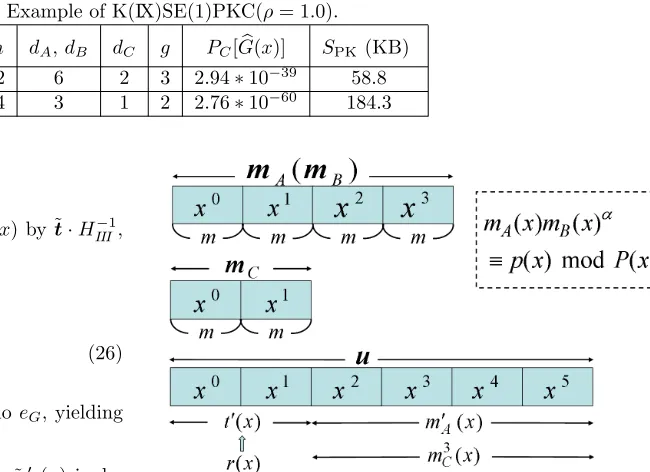
Let us show a schematic diagram of Example II.
Let us discuss on the size of the public key required for K(IX)SE(1)PKC overF2m by an example for simplicity.
Let the degree ofmY(x) be denoted by dY. In the
follow-ings, we assume that dA, dB and dC are chosen so that the
relation,
dA = dB (30)
3dC = dA (31)
Figure 1: Schematic diagram of K(IX)SE(1)PKC over F2m
(Example II in Table 1).
may hold.
The total number of variables,NV, is given by
NV =N= (dA+dB+dC+ 3)m. (32)
The total number of equations,NE, is given by
NE= (2dA+dB+ 2dC+ 5)m. (33)
The size of the public key is given by
SPK1 = NV ·NE
= (dA+dB+dC+ 3)(2dA+dB+ 2dC+ 5)m2.
(34)
2.4
Security considerations
Let us discuss on several possible attacks on K(IX)SE(1)PKC.
Attack 1: Exhaustive attack onG(x) overF2m
The generator polynomialG(x) can be represented by
G(x) =R0+R1x+· · ·+Rg−1xg−1+Rgxg, (35)
where we assume thatRi(i= 0,1,· · ·, g) takes on an element
ofF2m equally likely except that R0 and Rg are required to
be nonzero element.
As a result, the probability of estimatingG(x) correctly in
an exhaustive manner,PC
h
ˆ G(x)
i
, is given by
PC
h
ˆ G(x)
i
= (2m−1)−2·2−(g−1)m
∼= 2−(g+1)m.
Lettingmandgsatisfy
(g+ 1)m >∼ 80, (37)
the probabilityPC
h
ˆ G(x)
i
is given by
PC[G(x)]b ∼< 2−80, (38)
a sufficiently small value. For example,PC
h
ˆ G(x)
i
’s are given by 2−128= 2.94∗10−39
for Example I and 2−192 = 2.76∗10−60 for Example II in Table 1, extremely small values.
We see that K(IX)SE(1)PKC would be secure against the Attack 1 provided that Eq.(37) is satisfied. 2
Attack 2: Attack onm′A based on t
Thetis given by a linear transformation of rand is given as it is in word u. In order to be secure against the Attack 2, the relation, g < f (Eq.(11)), should be strictly satisfied. The conditional entropy,H(m′A|t) is given by
H(m′A|t) = (f−g)m (bit). (39) For exmaples I and II in Table 1, the conditional entropy H(m′A|t) is given by
H(m′A|t) = 128 (bit) (40)
a sufficiently large value.
It is easy to see that once m′A is disclosed,m3
C(x) is
dis-closed.
We conclude that K(IX)SE(1)PKC is secure against Attack
2. 2
Attack 3: Attack onmB(x) by estimating mA(x)
We assume here that Eq.(30) holds, namely dA=dB. By
estimating mA(x) in an exhaustive manner for a given p(x),
mB(x) can be disclosed. The probability of disclosingmB(x)
by estimatingmA(x) is given by
PC[ ˆmB(x)] = 2−(dA+1)m. (41)
For examples I and II, the probabilityPC[ ˆmB(x)]’s are given
by 2−7∗32 = 3.71∗10−68 and 2−4∗96 = 2.54∗10−116
respec-tively, extremely small values.
We see that K(IX)SE(1)PKC is secure against Attack 3. 2
Attack 4: GB attack on the ciphertext
The ciphertextCI(x) can be represented by a set of
simulta-neous equations of degreeB in the variablesA1, A2,· · ·, AN.
The ciphertextCII(x) can be represented by a set of linear and
quadratic equations in the variablesA1, A2,· · ·, AN. Namely
the GB attack should solve the following sets of simultaneous equations.
SE(I) : The f m simultaneous of degree B in the variables A1, A2,· · · , AN.
SE(II) : The gm linear equations and f m quadratic equa-tions in the variablesA1, A2,· · · , AN.
The degreeBtakes on 223 for Example I and, 255 for Example II, in Table 1, extremely large values. The number of variables N takes on 544 for Example I and, 640 for Exmaple II, also large values.
We conclude that K(IX)SE(1)PKC is secure against Attack
4. 2
3
Conclusion
In this paper we have presented K(IX)SE(1)PKC based on random pseudo cyclic codes. We have shown that our pro-posed K(IX)SE(1)PKC can be made sufficiently secure against the various attacks including the attack based on the Gr¨obner bases calculation.
References
[1] M.Kasahara and R.Sakai, “A Construction of Public Key Cryptosystem for Realizing Ciphertext of size 100 bit and Digital Signature Scheme”, IEICE Trans. Vol. E87-A, 1, pp.102-109, (2004-01).
[2] M.Kasahara and R.Sakai, “A Construction of Public Key Cryptosystem Based on Singular Simultaneous Equa-tions”, IEICE Trans. Vol. E88-A, 1, pp.74-79, (2005-01).
[3] M.Kasahara, “New Classes of Public Key Cryptosys-tem Constructed on the Basis of Multivariate Poly-nomials and Random Coding - Generalization of K(III)RSE(g)PKC -”, Technical Report of IEICE, ISEC 2007-118, pp.41-47, (2007-12).
[4] N. Koblitz, “Algebraic Aspect of Cryptography”, Springer Verlag, Berlin Heidelberg, (1998).
[5] T.Mastumoto and H.Imai, “Public Quadratic Polynomial-Tuples for Efficient Signature - Verification and Message-Encryption”, Advances in Cryptology, Eurocrypt’88, Springer-Verlag, pp.419-453, (1988).
[6] S.Tsujii, A.Fujioka and Y. Hirayama, “Generalization of the public-key cryptosystem based on the difficulty of solving a system of non-linear equations”, IEICE Trans. Vol.1 J-72-A, 2, pp.390-397, (1989-02).
[7] M.Kasahara, “Construction of New class of Linear Mul-tivariate Public Key Cryptosystem - Along With a Note on the Number 9999990 and its Application”, Technical Report of IEICE, ISEC 2009-44 (2009-09).
[9] M. Kasahara, “New Classes of Public Key Cryptosystems Constructed Based on Error-Correcting Codes and Prob-abilistic Structure”, Technical Report of IEICE , ISEC 2009-134 (2010-03).
[10] M. Kasahara: “A New Class of Public Key Cryptosystem Constructed Based on Error-Correcting Codes Realizing Coding Rate of Exactly 1.0”, Cryptology ePrint Archive, 2010/139 (2010).
[11] M. Kasahara: “A New Class of Public Key Cryptosys-tems Constructed Based on Error-Correcting Codes, Using K(III) Scheme”, Cryptology ePrint Archive, 2010/341 (2010).
[12] M. Kasahara: “New Class of Public Key Cryptosystem Constructed Based on Pseudo Cyclic Codes overF2 and
over F2m(m ≥7) Realizing Coding Rate of 1.0”, SITA,
(2010-12).
[13] M. Kasahara: “Public Key Cryptosystems Constructed Based on Cyclic Codes, Realizing Coding Rate of Exactly 1.0, K(XI)SE(g)PKC and K(XII)SE(g)PKC”, Technical Report of IEICE, ISEC 2011-23(2011-07).
[14] R. J. McEliece: “A public key cryptosystem based on algebraic coding theory”, DSN Prog. Re., pp.114-116, (1978).