ADOPTION OF TOTAL QUALITY MANAGEMENT PRACTICES AND PERFORMANCE OF MANUFACTURING FIRMS IN NYERI COUNTY, KENYA
JIEL JIEL DHIEU
D53F/OL/CTY/26797/15
A RESEARCH PROJECT SUBMITTED TO THE SCHOOL OF BUSINESS IN PARTIAL FULFILLMENT OF THE REQUIREMENTS FOR THE AWARD OF THE
DEGREE OF MASTER OF BUSINESS ADMINISTRATION (STRATEGIC MANAGEMENT)
OF KENYATTA UNIVERSITY
ii
DECLARATION
This project is my own original work and has not been presented for award of any degree in any university. No part of this project should be reproduced without the authority of the author and/or Kenyatta University.
……… …….. ..…………
JIEL JIEL DHIEU DATE D53F/OL/CTY/26797/15
I confirm that the work presented in this research project was carried out by the candidate under my supervision
……… ………
Mr. Shadrack Bett DATE Department of Business Administration
iii
DEDICATION
iv
ACKNOWLEDGEMENT
v
TABLE OF CONTENTS
DECLARATION ... ii
DEDICATION ... iii
ACKNOWLEDGEMENT ... iv
LIST OF TABLES ... vii
LIST OF FIGURES ... viii
OPERATIONAL DEFINITION OF TERMS ... ix
LIST OF ABBREVIATION AND ACRONYMS ... x
ABSTRACT ... xi
CHAPTER ONE ... 1
INTRODUCTION ... 1
1.1 Background of the study ... 1
1.2 Statement of the Problem ... 10
1.3 Objectives of the Study ... 12
1.4 Hypothesis... 13
1.5 Significance of the study ... 13
1.6 Scope of the Study ... 14
1.7 Limitations of the Study... 15
1.8 Organization of the Study ... 16
CHAPTER TWO ... 17
LITERATURE REVIEW ... 17
2.1 Introduction ... 17
2.2 Theoretical Review ... 17
2.3 Empirical Review... 22
2.4 Summary of Research Gaps ... 34
2.5 Conceptual Framework ... 35
CHAPTER THREE ... 37
RESEARCH METHODOLOGY ... 37
3.1 Introduction ... 37
3.2 Research Design... 37
3.3 Target population ... 37
3.4 Sampling Design ... 38
3.5 Data Collection Instruments ... 38
3.6 Validity and Reliability of the Research instrument ... 39
3.8 Data Collection Procedure ... 40
3.9 Data analysis and Presentation... 40
3.10 Ethical consideration ... 41
CHAPTER FOUR ... 42
DATA ANALYSIS, PRESENTATION AND INTERPRETATION ... 42
4.1 Introduction ... 42
vi
4.3 Continuous Improvement... 48
4.4 Employee Training... 52
4.5 Top Management Commitment ... 56
4.6 Customer Focus ... 59
4.7 Organizational Performance ... 62
4.8 Regression Analysis ... 63
4.9 Hypothesis Testing... 65
CHAPTER FIVE ... 68
SUMMARY, CONCLUSION AND RECOMMENDATIONS ... 68
5.1 Introduction ... 68
5.2 Summary of the Findings ... 68
5.3 Conclusion ... 71
5.4 Recommendations ... 72
5.5 Suggestions for Further Studies ... 73
REFERENCES ... 75
APPENDICES ... 85
vii
LIST OF TABLES
Table 2.1: Summary of the Literature Review and Research Gaps ... 34
Table 3.1: The population of the study ... 38
Table 4.1: Reliability Test... 43
Table 4.2: Provisions Adopted ... 49
Table 4.3: Rating of Continuous Improvement ... 50
Table 4.4: Modalities on Assess Training Needs... 52
Table 4.5: Implementation of Quality Management Systems ... 53
Table 4.6: Rating of Employee Training ... 53
Table 4.7: Evaluation of Top Management ... 56
Table 4.8: Heads of Department are Tasked to Accept their Responsibility ... 57
Table 4.9: Rating of Top Management Commitment ... 58
Table 4.10: Communication and Training Processes ... 60
Table 4.11: After Sales Programmes ... 60
Table 4.12: Rating of Customer Focus ... 61
Table 4.13: Organizational Performance ... 62
Table 4.14: Model Summary ... 63
Table 4.15: ANOVA ... 64
viii
LIST OF FIGURES
Figure 2.1: Conceptual Framework ... 36
Figure 4.1: Response Rate ... 42
Figure 4.2: Highest Level of Education ... 44
Figure 4.3: Education Background ... 45
Figure 4.4: Length of Service ... 46
Figure 4.5: Local or International Quality Award ... 47
Figure 4.6: Use of Standardized and Documented Operating Procedures... 48
Figure 4.7: Influence of Improvement on Organizational Performance ... 51
Figure 4.8: Influence of Employee Training on Organization Performance ... 55
ix
OPERATIONAL DEFINITION OF TERMS
Continuous improvement: This is the incremental and ongoing improvement on the quality and state of a firm‟s products and services
Customer focus: The commitment of an organization towards meeting customer needs and expectations
Employee training: The process of equipping staff with new skills, knowledge, tools and resources necessary to make confident decisions in the workplace without supervision
Manufacturing Firms Organizations or enterprises involved in the production of process
Quality management systems: These are mechanisms to direct and control an organization in order to continually improve the effectiveness and efficiency of its performance.
Top Management commitment: This is the level of dedication and hard work by the senior management of a firm to ensure quality, efficiency and results
Top management Refers to a person or group of people who direct and control an organization
x
LIST OF ABBREVIATION AND ACRONYMS
CI Continuous improvement
GDP Gross Domestic Product
ISO International Organization for Standardization
KAM Kenya Association of Manufacturers
QMP Quality Management Program
ROA Return on Assets
ROE Return on Equity
ROI Return on Investment
ROS Return on Sales
SPSS Statistical Package for the Social Sciences
TQM Total Quality management
xi ABSTRACT
1
CHAPTER ONE
INTRODUCTION
1.1 Background of the study
Quality aspects have become one of the most important factors in global competition today. Increasing demand by customers for better quality of product in market place has encouraged many companies to provide quality product and services in order to compete in the marketplace successfully. To meet the challenge of this global competition, many businesses have invested substantial resources in adapting and implementing quality management practices in their operations. Quality management is viewed as a strategy to meet or exceed customer‟s requirements and expectations. Quality management seeks excellence in all aspects of business through organization-wide continuous improvement, commitment by all, and customer focus.
2
Economic globalization brings both challenges and opportunities for most industrial companies globally, especially manufacturing companies who are confronted with a challenging and increasing competitive environment. Therefore, they should be able to create conditions that support them both in the domestic and international markets. Quality Management practices can be implemented in any sector of the economy for example manufacturing and service, the resulting outcome is reduced costs, increased productivity, and improved financial performance among others (Gaspersz, 2005). In Kenya most manufacturing firms are adopting and implementing a set of operations management practices in order to win the intense competition in the marketplace. The benefits of TQM can be achieved through identifying the sets of common TQM principles and practices as applicable to the manufacturing and service industries.
3
2005; Power, 1995). The Philosophy is particularly attractive because of the focus on quality, which offers the promise of improvement of an organization‟s performance. To implement one or more of the TQM principles, companies use a series of management practices and TQM tools associated with the principles given that the principles are the beliefs, and practices are the actions the companies take according to the principles (Boaden, 1997. The objective of the practices as management commitment and training of workers is to produce improvement in operative and business performance (Powell, 1995). Operative performance refers to customer satisfaction or product quality, while business performance relates to financial results. TQM practices became a means to improve business performance of the companies.
To provide a basis for the survival and success today and in the future, firms have to pay more attention to the needs of customers as competition intensifies, and offer them quality products to satisfy their increasing expectations. Total Quality Management (TQM) as a potential source to achieve this objective produces value, through improved understanding of customers‟ needs, improved customer satisfaction, improved internal communication, better problem solving, greater employee commitment and motivation, stronger relationships with suppliers, fewer errors, and reduce waste (Juran, 1988; Feigenbaum, 1991).
1.1.1Total Quality Management
4
useful tool for fostering learning and increasing company‟s competitive advantage (Martínez-Lorente and Martínez-Costa, 2008)
TQM practices are Leadership, effective communication, customer focus, supplier‟s relations, employee‟s empowerment, training and education, continuous improvement and process improvement. If all the practices are well implemented, organization would achieve customer satisfaction, cost effectiveness and defect free work (Peter, 1994).
According to Ehigie and McAndrew, (2005) no consensus on the date and origin source for TQM but most researchers reported the founders include; Feigenbaum (1951, 1956, 1961) TQM emerged in place of total quality control (TQC) and TQC as an effective system for integrating the quality development, quality maintenance, and quality-improvement efforts of the various groups in an organization so as to enable production and service at the most economical levels that allow for full customer satisfaction. Feigenbaum believed that all departments in organization have responsibilities for the achievement of quality, but his conceptualization of TQC did not include other management ideologies like people empowerment, teamwork, and supplier development relationships (Price, 1989). These management ideologies are now incorporated into the new management concept, TQM. Thus, TQM is an alternative to management by control (Price, 1989). Hence, Paton (1994) considered Feigenbaum as the originator of the Total Quality Management.
5
management system based on the organization‟s strategy, objectives, structure, size, products and services offered. This is also true in the airline sector. In general, Total Quality Management (TQM) is a management philosophy which is used by organizations who strive to improve their efficiency and competitiveness in the business marketplace. TQM quality factors include top management commitment and involvement, employee empowerment and culture. These factors are known by some writers as the soft aspects of management, while the hard aspects include factors such as improvement tools, techniques and systems (Oakland, 1993, 2010). Various quality factors are identified by various scholars based on their experiences in working as consultants, managers or researchers (Thiagarajan et al., 2011).
The core ideas of total quality management (TQM) were introduced in the mid-1980s by, most notably, W. Edwards Deming, Joseph Juran and Kaoru Ishikawa (Hackman and Wageman, 1995). Whilst it is acknowledged that TQM is not a clear-cut concept (Hackman and Wageman, 1995), TQM is generally understood as an integrated organization strategy for improving product and service quality (Waldman, 1994). Since the mid-eighties TQM has been (over) sold as a near-universal remedy for a range of organizational problems, including improved organizational performance.
6
have features that would enable their efficient usage and to have durability and be easily repaired.
TQM has been presented by many descriptions over the years. TQM is a way of thinking that becomes a Centre piece of an organization. It can be described as a management tool, philosophy and a set of principles which guides every member of organization who is involved in continuous improvement process to meet customer satisfaction (Choi & Eboch, 2008). The TQM concept requires an effective involvement of all members of organization in decision making because their participation are considered as critical role in all business activities for providing services to customers with high quality products (Dhillon, 2005). However, there is no standard method as to how TQM should be implemented. The organization committed to customer satisfaction through continuous improvement varies from organization to organization but it has common principles that can be applied to secure market share, increase profits and reduce costs (Kanji, 1996). TQM can be said to be the management of quality throughout all members of organization. The organization must satisfy internal and external customer needs and then use strategic planning including all functional areas to achieve strategic goals (Eldridge, Balubaid& Barber, 2006).
7 1.1.2 Organizational performance
According to Lakhal, Pasin, and Liman (2006) organizational performance refers to how well an organization achieves its market-oriented goals as well as its financial goals. Performance can also be defined as the process of quantifying the efficiency and effectiveness of action (Kathaari, 2014).
Organizational performance (OP) can be measured by indicators of efficiency, effectiveness, relevance to stakeholders and financial viability (Mitchell, 2002). Organizational performance is affected by employee‟s motivation and continuous improvement to achieve performance objective (Rampersad, 2001). Organizational performance is influenced by external environment and the organizational capacity to achieve the desired performance (Mitchell, 2002).
8
Performance measurement is very important for the effective management in organization. According to Deming without measuring something, it is impossible to improve it. Organizational performance refers to how well an organization achieves its market-oriented goals as well as its financial goals (Li, 2006). Corporate performance is not often described in detail by academics. The traditional approach to performance measurement using solely financial performance measure was found to be flawed. A number of prior studies have measured organizational performance using both financial and market criteria, including return on investment (ROI), market share, profit margin on sales, the growth of ROI, the growth of sales, and the growth of market share. In line with the above literature, the same items would be adopted to measure organizational performance in this study.
The recommended measures for financial analysis that determine a firm‟s financial performance are grouped into five broad categories: liquidity, solvency, profitability, repayment capacity and financial efficiency. The common financial indicators of financial performance include: sales growth, return on investment (ROI), return on equity (ROE), and earnings per share. The popular ratios that measure organizational performance can be summarized as profitability and growth: return on asset (ROA), return on investment (ROI), return on equity (ROE), return on sale (ROS), revenue growth, market shares, stock price, sales growth, liquidity and operational efficiency (Oye, 2006).
9
managers and morale of employees (Choi &Eboch, 2008). As compared to financial measures, nonfinancial measures are seen by the manufacturing managers as providing the greatest encouragement for risk taking and innovation and also are more effective at curtailing short-termism and gamesmanship (Bricknell, 2006). These differences are in line with popular belief. Compared to both financial and nonfinancial measures, subjective measures are seen as being the most effective at curtailing short-termism and gamesmanship (Anderson & Sohal, 2009).
Choosing performance measures is a challenge. Performance measurement systems play a key role in developing strategy, evaluating the achievement of organizational objectives and compensating managers (Kathaara, 2014). Yet many managers feel traditional financially oriented systems no longer work adequately. A recent survey of U.S. financial services companies found most were not satisfied with their measurement systems (Adam, Corbett, Flores and Harrison, 2007). They believed there was too much emphasis on financial measures such as earnings and accounting returns and little emphasis on drivers of value such as customer and employee satisfaction, innovation and quality.
1.1.3 Manufacturing firms in Nyeri County
10
manufacturing firms are Mt. Kenya Bottlers, Highlands Mineral Water company, Maisha Mills, Mukurweini Wakulima Dairy, Kiganjo KCC among others. These manufacturing firms are either small or medium size firms. Some sell their products within the country while others like coffee and tea firms sell their products both locally and internationally.
1.2 Statement of the Problem
Despite the fact that quality management practices have been recognized by many organizations as capable of transforming the quality culture and producing substantial financial results for large size companies, some concerns have been raised about validity of quality management practices to generate real economic gains and or improve financial performance of firms. A number of empirical studies have been conducted since the 1980‟s in order to explore the variance between quality management practices and financial performance. The work of Hendricks and Singhal (2007) has provided evidence of an existing relationship between quality management practices and financial performance of manufacturing firms and the effectiveness of the implementation of quality management practices. A study by Adam et al. (2007) has shown that there is a positive impact of quality management practices on financial performance of a firm. In addition, Choi and Eboch (2008) found a significant direct link between quality management practices and performance of a firm.
11
achieving the goals. Small manufacturing companies lag behind larger firms when as pertains to adoption of quality management (McMahon, 2001; Elmati and Kathawala1999). Measuring success of businesses in relation to mass production has been over played with financial measures like costs, profit, sales and return on investment being the key indicators. Useof non-financial measures like customer satisfaction levels and operational efficiencies have also been done (Chittenden, Poutziouris, &Mukhtar, 1998). Evidence of strategic benefits of quality programs and better quality has been proved to contribute to greater market share and return on investment (Cole, 1992; Phillips, Chang &Buzzell, 1983), lower manufacturing costs; improve productivity (Garvin, 1988) and improve the area of strategic performance (Zhang, 2000).
12
Weakening of trade-barriers coupled with globalization and the spread of international quality standards such as ISO 9000 to developing countries has forced firms‟ achievement of competitive advantage by provision of quality products and services (Agus, 2000). There has been extensive research on quality management practices and organization‟s quality performance, but there is still little known about the effect of quality management practices on manufacturing firms in Nyeri County. This study was a follow up on previous research by (Kimani 2012), which focused on the service industry in Nyeri County and concentrated on practices like innovation, organizational culture, documentation and traceability. The study suggested further research to be carried out in the manufacturing sector. In order to bridge the gap and provide the firms with practical assistance in dealing with this issue, the study used manufacturing firms in Nyeri County to find out the extent implementation of TQM practices contributed towards good performance of the firms.
1.3 Objectives of the Study
1.3.1 General Objectives of the Study
The general objective of the study was to evaluate the influence of total quality management practices on performance of manufacturing firms in Nyeri County
1.3.2 Specific Objectives
The specific objectives of the study were:
13
ii. To assess the effect of employee training on performance of manufacturing firms in Nyeri County.
iii. To evaluate the effect of top management commitment on performance of manufacturing firms in Nyeri County
iv. To assess the effect of customer focus on performance of manufacturing firms in Nyeri County
1.4 Hypothesis
H01: Continuous improvement does not affect performance of manufacturing firms in Nyeri County
HO2: Employee training does not affect performance of manufacturing firms in Nyeri County H03: Top management commitment does not affect performance of manufacturing firms in Nyeri County
H04: Customer focus does not affect performance of manufacturing firms in Nyeri County
1.5 Significance of the study
The findings of this study would be useful to manufacturing firms since it would provide insights on the importance of practicing quality management practices in manufacturing firms to achieve financial performance of firms.
14
adopted by firms. The study would also serve as a point of reference to academicians interested in this area and other related topics.
The county and national government‟s bodies like the Ministry of Industrialization may use the study findings study to formulate and implement policies that would help in regulating and improving the manufacturing industry considering the pivotal role it plays to create jobs and improve the economy.
This research would have important implications for managers. It would motivate top managers to invest in the time and resources to implement TQM programs. The implementation of TQM practices would be associated with enhanced enterprise performance. The study may signal the importance of ensuring a supportive organizational environment for the effective implementation of TQM.
1.6 Scope of the Study
15 1.7 Limitations of the Study
The study was limited to only four total quality management practices that influenced performance of a firm. This was because these were the key practices that enhance quality. The study was limited to manufacturing firms in Nyeri County. This was because Nyeri County had been a dominant manufacturing sector among the devolved units in Kenya.
Most of the respondents did not understand the essence of the study thus may fail to freely divulge information requisite to ensure the fruition of the data collection exercise. This is an aspect which may impend the study. The researcher overcame the challenge by way of imploring on the respondents to participate in the data collection exercise willingly.
The challenge of accessing the respondents in their places of work was immense. This was occasioned by the fact that they might be busy thus contributing to the challenge of delay in the administration of the questionnaires. The researcher overcame the challenge by way of patiently seeking prior appointments with the respondents in the wake of realizing the success of the exercise.
16 1.8 Organization of the Study
The study was presented in five chapters. Chapter one presented the background of the study, context of the study, statement of the problem, objectives of the study and research questions. It also covered the significance of the study, limitations of the study and scope of the study. Chapter two covered literature review, theoretical review and empirical review. It also covered the conceptual framework, summary of literature review as well as gaps in the literature review.
17
CHAPTER TWO
LITERATURE REVIEW
2.1 Introduction
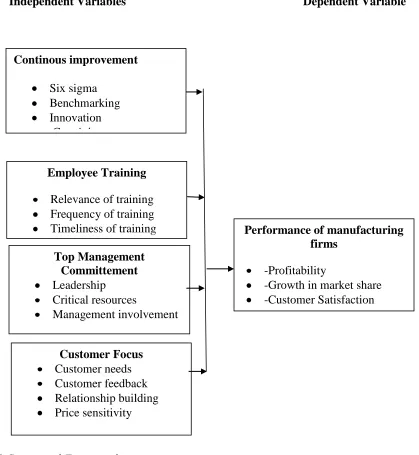
This chapter entails the literature review as guided by the objectives of the study. Theoretical review analyses the theories that support the study, empirical review reviews related literature by other authors and researchers on the selected variables to enable establish the gap while the conceptual framework illustrates the relationship between the dependent and independent variables.
2.2 Theoretical Review
The following section has the theoretical review which draws on the theories guiding the study. The study was guided by the quality improvement theory, Resource Based View Theory and the Deming‟s Theory.
2.2.1 Quality Improvement Theory
18
Deming‟s Quality Improvement Theory provides business with a plan to eliminate poor quality control issues through effective managerial techniques. It‟s a fact that management‟s behavior shapes the corporate attitude and defines what is important for the success and survival of the firm. Hubert (2010) has detailed the theoretical approach of Deming (1986) in respect to the quality management system, and it envisages the creation of an organizational system that fosters cooperation and learning to facilitate the implementation of process management practices. This, in turn, leads to the continual improvement of the processes, products, and services and helps to instill employee satisfaction. These are critical to promoting customer focus and ultimately, helping in the survival of any organization.
19
Top management is responsible for most quality problems; Kamanda (2010) asserts that it should give employees clear directions on what is considered acceptable work, and provide the methods to achieve it. These methods include an appropriate working environment and climate for work that is free of fault finding, blame or fear and instead provide clarity of issues, communicate effectively and provide appropriate environment for work to enhance performance (Lamport et al., 2010).
The top management should be committed to applying the principles and practices of System of Profound Knowledge (SOPK), where a business can simultaneously reduce costs through reducing waste, rework, staff attrition and litigation while increasing quality, customer loyalty, worker satisfaction and ultimately, profitability (Deming, 1986). Deming‟s Quality Improvement Theory is relevant to study in that it supports the variable of system automation enhance quality of products and services through continuous improvement, employee training and which organizations can use to realize performance. This theory is applicable to the study because total quality management is a comprehensive and structured approach to organizational management that seeks to improve the quality of products and services through ongoing refinements in response to continuous feedback.
2.2.2 Resource-Based View
20
nature, not perfectly mobile, not imitable, and non-substitutable without great effort (Barney, 1991). Rare and non-imitable resources are the appropriate use and allocation of core competences (Lopez, 2005). It also includes the reconfiguration of organizational routines so as to respond better to the dynamic and rapid changes of the market (Eisenhardt& Martin, 2000).
Total quality management entails practices, such as empowering employees, investing in customer relations, and building effective communication channels (Muli, 2014).This contributes to improved value of goods and services; which is achieved through influencing the strategic choice process, strategic development and deployment of the firm's inimitable, rare, and un-substitutable resources embodied in effective leadership, employees' capabilities, customer relations, and enhanced operations, among others (Eisenhardt, 2000). Reed and Lenal, (2000) argued that the two components of total quality management process and content interact with each other, and it is this interaction that generates the desired performance level in the organization. The authors contended that the content component contributes to competitive advantage; the process component generates sustainable advantage. This conforms to the resource-based value of the firm, and considers TQM elements as either a source of differentiation, cost leadership advantage, or a generator of barriers to imitation given their inherent complexity and tacitness (Corbett &Claridge, 2002).
21
competitors (Attaran&Attaran, 2004). Sustained competitive advantage is achieved when capabilities are able to produce value, are rare, are imperfectly imitable, and are exploited by the organization. Therefore, the theory is applicable to the study since TQM can generate a sustained competitive advantage which would enable an organization achieve high performance.
2.2.3 Deming's Theory
Deming‟s theory of profound knowledge is a management philosophy grounded in systems theory. It is based on the principle that each organization is composed of a system of interrelated processes and people which make up system‟s components. The success of all workers within the system is dependent on management‟s capability to orchestrate the delicate balance of each component for optimization of the entire system (Bowen, 2010). The system of profound knowledge is based on system appreciation to understand the company's processes and systems, variation knowledge to understand the occurrence of variation and their causes, knowledge theory to understand quality programs and psychology knowledge to understand human nature. Coupled with the 14 points in the Deming Management Model are seven deadly diseases that inhibit firm‟s performance and many obstacles that impede realization of quality objectives of organization.
22
effectiveness of the model through concerted leadership efforts toward establishment of cooperative and learning organization systems that facilitates achievement of efficient process management. The realization of process management practices enables organizations to achieve customer satisfaction through continuous improvement and employee fulfillment. In a subsequent study, Anderson, Rungtusanatham&Scroeder, (1995) empirically validated Deming Management Method. Subsequently this was used in empirical studies (Rungtusanatham, 1998; Fisher, 2005; Douglas & Frendendall, 2004; Singh, 2007).
The results illustrated strong support for all hypotheses of Deming Management Method. Anderson et al., (1994) emphasized the need to undertake vigorous testing of the theory to confirm its generalizability, and applicability across sectors, countries, firms, employee groups and time periods. Other researchers also argued that refinement efforts through testing of this theory would contribute toward better understanding, and assist in knowledge consolidation (Sousa and Voss 2002). Other researchers also argued for further testing the theoretical model in different contexts (Rungtusanatham et al., 1998; Fisher et al., 2005).
2.3 Empirical Review
23
2.3.1 Continuous Improvement on Adoption of Quality Management
Gustafsson (2003) on the relationship between TQM practices and performance of small size firms, it was established that the relationship between total quality management practices performance is dependent on the firm size. This is after studying a small firm of few employees and found that the fewer the employees the better since they would be managed easily and the process implementation would be easy to adapt to (Charan, 2008). These findings made Antony et al., (2002) to describe TQM practices as a role of the quality department, since they are entrusted in implementing and controlling quality the findings were that a single department cannot handle quality if the other stakeholders in the organization are not involved thus the need to involve everyone.
Zeha (2011) carried out an empirical study in Iran on implementation of TQM based of soft factors in small and medium size manufacturing firms and found out that in order to fully implement TQM effectively and also gain its benefits in form of organizational performance, organizations should pay more attention to the soft dimensions. Process improvement is a key aspect in TQM programs (Sinclair &Zairi, 1995). Process analysis has its primary objective, i.e., the reduction or elimination of variance, which Deming (1986) saw as the source of problems in providing quality products and services. A reduction in process variation leads to benefits such as increasing output uniformity, continual reduction of waste of staffing, machine time, and materials.
operator-24
controlled processes that lead to a lower unit cost, embracing kaizen (continuous improvement) philosophies, reducing the operator material handling duties, promoting a design for a manufacturing program, and achieving a compact process flow. The study also held that Continuous improvement can be efficiently achieved in organizations only if a structured continuous improvement process is in place to guide managers.
Muhammed (2010) carried out an empirical study on Evaluating the Deming Management Model of Total Quality in Telecommunication Industry in Pakistan and established that continuous improvement is one of the essential factors in TQM success. The study concluded that rapid changes in technology and customers‟ requirements require a flexible approach toward aligning organizational products, processes and services to meet and exceed ever changing customers‟ needs. The results highlight positive and statistically significant relationship with customer satisfaction and concluded that the approach leads to creativity and competitive excellence and those TQM objectives can be accomplished by constantly pursuing continuous improvement. An empirical study by Awoku (2012) on quality management practices, organization performance and supplier selection in Southern Minnesotia Manufacturing firms established that Continuous improvement have a positive significance relationship with business performance. It concluded the practice can be adopted in order to achieve high quality products and thereby improve business performance.
2.3.2 Employee Training on Adoption of Quality Management
25
quality of their work it would eliminate inspection. Chandler and Mc Evoy (2012) pointed out that employees are the prime source of human resources, their education, skills and experience need to be assessed and matched with the job requirements for maximum performance. Employee involvement was conceived to mean a feeling of psychological ownership among organizational members Koopman (2006). Unlike total quality management ideology, the traditional employee involvement is narrow minded; it is job centered rather than process-centered. The total quality management approach involves achieving broad employee interest, participation and contribution in the process of quality management.
Training helps in preparing employees towards managing the total quality management ideology in the process of production. Training equips people with the necessary skills and techniques of quality improvement. It is argued to be a powerful building block of business in the achievement of its aims and objectives Zhang, (2010). Through training, employees can identify improvement opportunities as it is directed at providing necessary skills and knowledge for all employees to be able to contribute to ongoing quality improvement process of production. Training and development programs should not be seen as a onetime event but a lifelong process Dale et al, (2010).
26
training as it helps employees at their levels to understand quality management initiatives and their roles in implementing TQM (Arshida&Agil 2012). An empirical study conducted by Samir (2003) on critical factors of TQM in Palestinian organizations showed a positive relationship between employees training and education and successful implementation of TQM. It associated employee training and education with employee empowerment and improved performance of their roles in quality management.
Yu Chu & Wang (2001) on critical factors affecting the implementation decisions and processes of ISO quality management systems in Taiwan‟s public sectors revealed that team leaders involvement, employees training and development, employee awareness among other factors are critical in implementation of quality initiatives. Employees feel involved in quality management initiatives when given timely on quality programs and therefore give it a positive approach reducing employee resistance. Consistent with the findings of Aljalahma (2011) that revealed that group culture helps in reducing employee‟s barriers, information barriers and customer related barriers that are frequently faced in the implementation of TQM while rational culture reduces top management barriers which in turn promote implementation of TQM.
27
behaviors and attitudes and leads to strengthening the organization‟s culture (Shenawy, 2007). Training and education are primary levers for change, and they have significant influence on the change process (Buch&Talentino, 2006). Training should focus on building quality skills with equal attention paid to behavioral skills and quality tools needed for change in performance management and recognition (Palo &Padhi, 2005). Training includes explanation of overall company operations and product quality specifications. Specific measures for evaluating training include the time and money spent by organizations in training employees and management in quality principles, problem solving skills, and teamwork (Black & Porter, 1996).
28
Muhammed (2010) carried out an empirical study on Evaluating the Deming Management Model of Total Quality in Telecommunication Industry in Pakistan and established that Institution of quality focused training philosophy improves individual confidence and self-esteem, enhances pride of work, inculcates team spirit, focuses on continuous improvement, and aligns organizational processes to changing customers‟ needs. The study finds positive and statistically significant relationship with process management.
29
2.3.3 Management Commitment on Adoption of Quality Management
Pheny and Teo (2013) observed that top management must communicate TQM to the entire organization to create awareness, interest, desire and action. They should provide the quality vision and create a cultural change within the organization. They should organize for trainings, empower others by allowing them to grow, delegate authority and recognize them for quality achievements. Top management must allocate resources and partner with suppliers for sharing of information in terms of new innovations and technology in the market for quality materials.
Top management commitment and leadership requires effective change in organizational culture and this can only be made possible with the deep involvement of top management to the organization‟s strategy of continuous improvement, open communication and cooperation throughout the organization. Total quality management implementation improves the organizational performance by influencing other total quality management dimensions.
30
Baidoun (2003) conducted an empirical study on critical factors of TQM in Palestinian organizations and found out that top management commitment and involvement demonstrated by: development of clear organization mission, development of quality policy and values, setting of realistic quality goals, proper planning on quality management and creating quality management structure creates quality awareness and improve implementation of quality management systems. In addition, quality management philosophy makes it easy to implement quality programs (Murphey, 2009).
A review conducted by Zakuan, (2012) on critical success factors of TQM implementation in Higher Education Institutions shows that the success of an institution depends on its quality management strategy on how it identifies, classifies, analyzes, and reacts to the changes in quality requirements. This is consistent with the findings of Sharp, (2000) on their study on factors affecting successful implementation of ISO 9001: 2000 and Kasongo & Moono (2010)‟s study on factors that lead to successful implementation of TQM that identified management strategy as one of the critical factors in implementing quality systems.
31
changes in an organization‟s culture and it is somehow impossible without management leadership. The study established that in a TQM process, effective leadership should develop a clear mission statement and then build up suitable strategies in order to support the mission. The top management needs to identify the critical success factors and to review the management structure. Leadership must ensure that the principles of quality management are implemented continually (Yusuf, 2007). The four distinctive ways that top management can support TQM implementation include allocating budgets and resources; control through visibility; monitoring progress; and planning for change (Motwani J., 2001).
Muhammed (2010) carried out an empirical study on Evaluating the Deming Management Model of Total Quality in Telecommunication Industry in Pakistan and established that visionary Leadership pursues a partnership with employees, customers, and other stakeholders. The study indicated positive and statistically significant relationship with internal customers, external customers, and learning. The study acknowledged that outstanding leaders can contribute heavily to total quality by creating inspiring innovative environment and identified strengths of senior management in areas of unwavering commitment to quality. The study concluded that visionary leadership is the driver of planning, implementing and sustaining total quality management practices in organizations.
2.3.4 Customer Focus on Adoption of Quality Management
32
philosophy of Total Quality Management (TQM) and customer focus can be traced back to the period just after the 2nd world war, led by Edward Deming. Per historical records, Americans did not take the concept seriously until the Japanese who adopted it in 1950 to resurrect their post-war business and industry used it to dominate world markets by 1980. It's a philosophy that focuses relentlessly on the needs of the customer, both internal and external, realigns the organization from detection to prevention and aims to improve continuously using statistical monitoring.
An empirical study done by Tufan (2011) on the relationship between TQM and performance of small manufacturing enterprises in Ghana found that customer focus has a significant and negative impact on internal failure. In line with this finding, Hackman & Wageman (1995) also find that implementation of TQM elevates on customer satisfaction and that provide defect preventions. In order to increase customer satisfaction, the customers‟ current and future requirements should be known by the organization. This information help firms prepare themselves to produce products and services that precisely fit to customer requirements. In addition, uncertainty is reduced and that help production system prepare itself for future conditions resulting in lower internal failure.
33
Supporting this finding Fuentes, (2004) also claim that firms emphasizing activities that seek to understand customer needs and satisfy those needs produce products with lower defects.
In Sri-Lanka a study by Sakunthala & Samanthie (2011) on the Impact of TQM Practices on Work Outcomes and Customer Satisfaction in Sri Lankan Manufacturing Organizations concluded that implementation of TQM has a positive relationship with work outcomes such as job satisfaction, work involvement, organizational commitment as well as customer satisfaction and a negative relationship with turnover intentions. Muhammed (2010) carried out an empirical study on Evaluating the Deming Management Model of Total Quality in Telecommunication Industry in Pakistan and established that customer satisfaction is at the heart of TQM philosophy. A proactive approach to responding to changing customer‟ needs are vital to attract and retain customers. By close interaction with customers, organizations can determine customers‟ changing requirements, trends and use them as a yardstick with their competitors. The study clearly established that customer satisfaction is exemplified by customer driven focus.
34
trust in the brand. The study also emphasized of the need to create value for each customer through customization and transforming customer related information into actions.
2.4 Summary of Research Gaps
Table 2.1: Summary of the Literature Review and Research Gaps
Author Topic/Area Findings Knowledge gap
Gustafsson,
(2003)
The relationship between TQM practices and performance of small size firms
The relationship between total quality management practices performance is dependent on the firm size.
The study focused on small sized firms while the current is on manufacturing firms in Kenya Zeha(2011) An empirical study in Iran on
implementation of TQM based of soft factors in small
and medium size
manufacturing
in order to fully implement TQM effectively and also gain its benefits in form of organizational performance,
organizations should pay more attention to the soft dimensions
The study was an empirical one and was done in Iran while the current is experimental and is done in Nyeri County Kenya
Baidoun (2003) An empirical study on critical factors of TQM in Palestinian organizations
top management commitment and involvement creates quality awareness and improve
implementation of quality management systems.
Study only focused on one critical factor of TQM (top management commitment)
Sakunthala & Samanthie
(2011)
Impact of TQM Practices on Work Outcomes and Customer Satisfaction in Sri Lankan Manufacturing Organizations
Implementation of TQM has a positive relationship with work outcomes such as job satisfaction, work involvement,
organizational
commitment as well as customer satisfaction and a negative relationship with turnover intentions
The study only
focused on
35 Muhammed
(2010)
An empirical study on Evaluating the Deming Management Model of Total
Quality in
Telecommunication Industry in Pakistan
Visionary Leadership pursues a partnership with employees, customers, and other stakeholders
The study did not focus on other TQM aspects but only leadership
Tufan (2011) The relationship between TQM and performance of small manufacturing enterprises in Ghana.
customer focus has a significant and negative impact on internal failure
The study only
focused on
customer focus and was done in Ghana
Source: Author (2018)
2.5 Conceptual Framework
36
Independent Variables Dependent Variable
Figure 2.1 Conceptual Framework
Source: Researcher (2018)
Top Management Committement Leadership Critical resources
Management involvement
Performance of manufacturing firms
-Profitability
-Growth in market share -Customer Satisfaction
Customer Focus Customer needs Customer feedback Relationship building Price sensitivity -
Continous improvement Six sigma
Benchmarking Innovation Creativity
37
CHAPTER THREE
RESEARCH METHODOLOGY
3.1 Introduction
This chapter describes the research design, type and source of data used in the study, the target population and sampling methods and the techniques that was used to select the sample size. It also describes how data was collected, analyzed and presented.
3.2 Research Design
The study used a descriptive research design. Descriptive research design defines a subject, often by creating a profile of a group of problems, people or events through collection of data and tabulation of frequencies on research variables or their interaction (Cooper and Schindler, 2003). The design was used because it allowed analysis of qualitative data which cannot be quantified on figures. The design involved systematic collection of data from members of a given population through questionnaires.
3.3 Target population
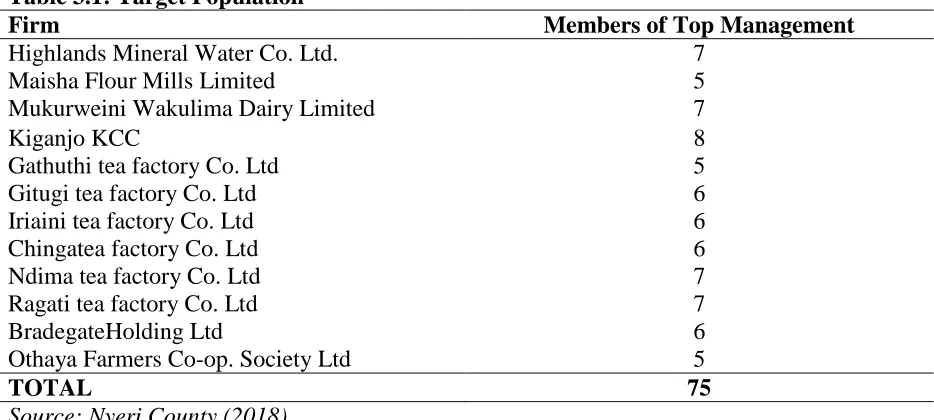
38 Table 3.1: Target Population
Firm Members of Top Management
Highlands Mineral Water Co. Ltd. 7
Maisha Flour Mills Limited 5
Mukurweini Wakulima Dairy Limited 7
Kiganjo KCC 8
Gathuthi tea factory Co. Ltd 5
Gitugi tea factory Co. Ltd 6
Iriaini tea factory Co. Ltd 6
Chingatea factory Co. Ltd 6
Ndima tea factory Co. Ltd 7
Ragati tea factory Co. Ltd 7
BradegateHolding Ltd 6
Othaya Farmers Co-op. Society Ltd 5
TOTAL 75
Source: Nyeri County (2018)
3.4 Sampling Design
The study adopted a census owing to the small number of respondents involved. According to Kothari (2004), sample size refers to the number of items to be selected from the universe to constitute a sample. The size of sample should neither be excessively large, nor too small. It should be optimum. An optimum sample is one which fulfills the requirements of efficiency, representativeness, reliability and flexibility.
3.5 Data Collection Instruments
39
questions derived from the research objectives. The questionnaires had both closed and open-ended questions.
3.6 Validity and Reliability of the Research instrument
3.6.1 Validity of Research Instruments
Validity is the degree to which a test measures what it purports to be measuring. Validity can also be said to be the degree to which results obtained from analysis of data actually represent the phenomenon under investigation (Orodho, 2005). The researcher tested the face, content and constructs validity of the questionnaire. Face validity is in relation to the misunderstanding or misinterpretation of the question. This was checked by way of employing the pre-testing method. Prior to embarking on data collection, the researcher pre-tested the questionnaires using two manufacturing firms in Nyeri County. This was done to improve the validity of the instruments. Changes were made on the questions deemed appropriate after the pre-test. Content and construct validity were tested by way of seeking expert opinion from the supervisor and specialists in total quality management.
3.6.2 Reliability of Research Instruments
40
the Cronbach Alpha method. A coefficient of 0.7 or more is considered adequate (Tavakol, 2011).
3.8 Data Collection Procedure
Permission to conduct the research was sought from the National Council of Science, Research and Innovation. The researcher hand delivered the questionnaires to the target respondents and collected them to deter collusion and enhance the response rate. The researcher made prior arrangements suitable to the schedules of the respondents. The study administered the questionnaire individually to all respondents of the study. The study exercised care and control to ensure all questionnaires issued to the respondents are received and achieve this, the study maintained a register of questionnaires, which was sent, and the ones that were received. The questionnaires were administered using a drop and pick later method.
3.9 Data analysis and Presentation
41
helped to summarize the essential features and relationships of data in order to generalize and determine patterns of behavior and particular outcomes. This process was important as it made data sensible.
3.10 Ethical consideration
42
CHAPTER FOUR
DATA ANALYSIS, PRESENTATION AND INTERPRETATION
4.1 Introduction
This chapter presents the findings of the data analysis on collected data that was coded into SPSS Version 23.0 for analysis and presentation. The study relied on primary data that was collected by use of structured questionnaires. The finding of the analyzed data was presented inform of figures and tables.
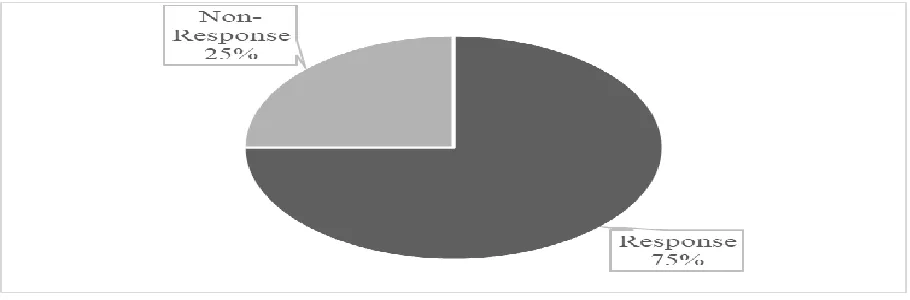
4.1.1 Response Rate
The researcher distributed 75 questionnaires to the top management levels on 12 manufacturing companies in Nyeri. The study established that 56 questionnaires were filled and returned to the researcher. This gave a response rate of 75% which is sufficient for the study. This is in agreement with Mugenda and Mugenda (2003) who established that a response rate of 50% and above is deemed okay for the study. The finding is as presented in Figure 4.1.
43 4.1.2 Reliability Test
The researcher carried a reliability test to establish whether the research instruments were reliable for the study. The Cronbach alpha was computed to establish the consistency of the results. The findings are as shown in Table 4.1.
Table 4.1: Reliability Test
Variable Number of Items Cronbach Alpha
Continous improvement 10 0.700
Employee Training 10 0.712
Top Management Committement 10 0.736
Customer Focus 10 0.789
The findings in Table 4.1 established that customer focus had the highest influence on performance as shown by the Cronbach alpha of 0.789, followed by top management commitment with a Cronbach alpha of 0.736, employee training had a Cronbach coefficient of 0.712 and continuous improvement had a Cronbach alpha coefficient of 0.700. This shows that all of the Cronbach alpha coefficient were above 0.7 an indication that the research instruments was sufficient. This is in support of Tavakol (2011) who established that a coefficient of 0.7 or more is considered adequate for the study.
4.2 Demographic Information
The researcher carried out demographic information regarding the respondents to indicate how efficient they were on the study. The findings are as shown in subsequent sections.
4.2.1 Highest Level of Education
44 Figure 4.2: Highest Level of Education
The finding in Figure 4.2 found out that majority of the respondent‟s 62% highest level of education was bachelor‟s degree followed by 23% who had master‟s degree, 12% had diploma certificates and 3% had PhD degree. The show that majority of the top management in manufacturing company in Nyeri had a degree and above. This shows that respondents were educated and would understand the questionnaire and give reliable data.
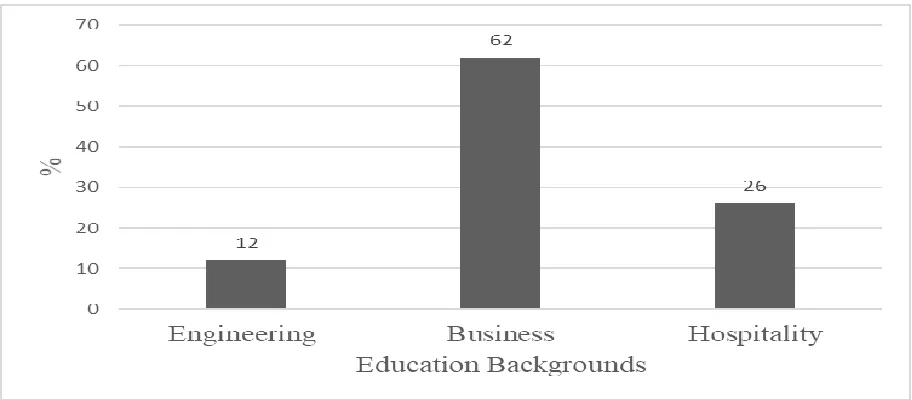
4.2.2 Education Background
45 Figure 4.3: Education Background
The study established that majority of the respondents 62% educational background was business followed by 26% who were from hospitality and lastly 12% who came form engineering background. The findings therefore show that majority of the top management had business education background an indication that they were well aware of the firm‟s performance. This shows that relevant information was sought.
4.2.3 Length of Service
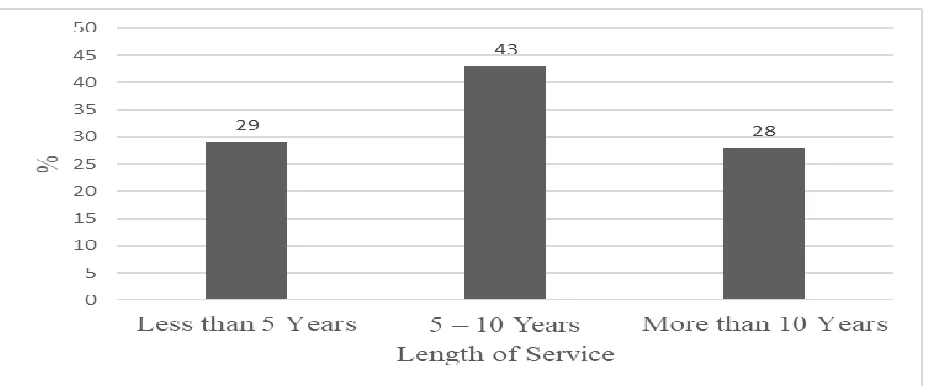
46 Figure 4.4: Length of Service
The findings in Figure 4.4 shows that 43% of the respondents came had served their organization from 5-10 years, 29% of the respondents indicated less than 5 years and 28% indicated more than 10 years. The findings show that majority of the respondent‟s length of service in their form was more than 5 years an indication that they were well conversant with their organizational performance an indication that reliable data was sought.
4.2.4 Organization Certified to Quality Systems
47
4.2.5 Certificate of International Quality Assurance System (ISO)
Respondents were asked to indicate whether their organization was planning to obtain a certificate of International Quality Assurance System (ISO) in the short term. The study established that all of the respondents agreed that, Highlands Mineral Water Co. Ltd, Maisha Flour Mills Limited, Mukurweini Wakulima Dairy Limited were planning to obtain a certificate of International Quality Assurance System (ISO). This would enhance better and quality productions from the specified firms.
4.2.6 Local or International Quality Award
Respondents were asked to indicate whether their organization obtained a local or International Quality Award. The findings are as shown in Figure 4.5.
Figure 4.5: Local or International Quality Award
48
performance was recognized their quality products. The findings established that majority of the award obtained were local award.
4.3 Continuous Improvement
4.3.1 Use of Standardized and Documented Operating Procedures
Respondents were asked to indicate whether their organization used standardized and documented operating procedures. The findings are as shown in Figure 4.6.
Figure 4.6: Use of Standardized and Documented Operating Procedures
49 4.3.2 Provisions Adopted
Respondents were asked to indicate whether there were provisions to ensure that the members understood all the business processes in place within the organization. The findings are as shown in Table 4.2.
Table 4.2: Provisions Adopted
Variable Frequency Percent
To a great extent 13 23
To a fair extent 29 52
To a low extent 14 25
Total 56 100
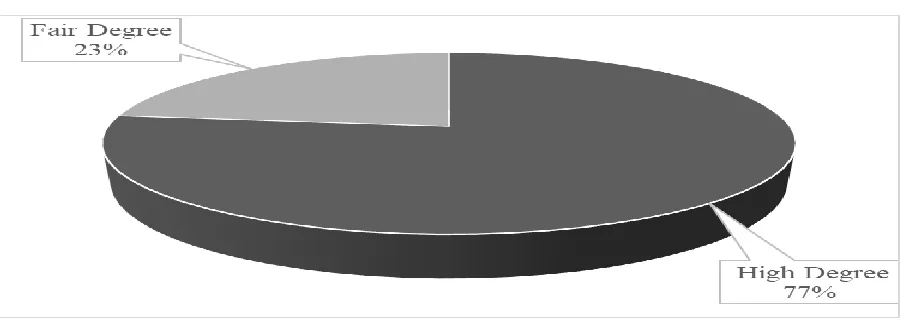
The findings show that majority of the respondents 52% indicated agreed to a fair extent that there were provisions to ensure that the members understood all the business processes in place within the organization, 25% indicated to a low extent and 23% indicated to a great extent. The findings show that majority of the respondents 42 (75%) agreed that their organization adopted provisions that allowed their members to understand their business processes. Zeha (2011) found out that in order to fully implement TQM effectively and also gain its benefits in form of organizational performance, organizations should pay more attention to the soft dimensions.
4.3.3 Rating of Continuous Improvement
50 Table 4.3: Rating of Continuous Improvement
Statement Mean Std. Dev
Our organization is kept neat and clean at all times 4.231 0.596 Production equipment is maintained well according to maintenance
plans
3.952 0.535 Our organization uses Statistical Process Control (SPC) programs for
process control and improvement
3.589 1.023 Our processes are designed to be „fool proof‟ in order to minimize the
chance of employee errors
3.725 0.985 We systematically conduct extensive benchmarking of other
organizations‟ business processes
3.235 0.895
The study pointed out that majority of the respondents agreed that their organization was kept neat and clean at all times as supported by a mean of 4.231 with standard deviation of 0.596. Majority of the respondents agreed that production equipment was maintained well according to maintenance plans as supported by a mean of 3.952 with standard deviation of 0.535. Majority of the respondents indicated that their organization used Statistical Process Control (SPC) programs for process control and improvement as supported by a mean of 3.589 with standard deviation of 1.023. This is supported by Gustafsson(2003) who established that the relationship between total quality management practices performance is dependent on the firm size.
51
4.3.4 Influence of Improvement on Organizational Performance
Respondents were asked to indicate whether continuous improvement affected organizational performance. The findings are as shown in Figure 4.7.
Figure 4.7: Influence of Improvement on Organizational Performance
52 4.4 Employee Training
4.4.1 Modalities on Assess Training Needs
Respondents were asked to indicate whether their organization had modalities to assess training needs periodically with a view of ensuring sustainable organizational performance. The findings are as shown in Table 4.4.
Table 4.4: Modalities on Assess Training Needs
Statements Frequency Percent
To a high degree 21 38
To a fair degree 26 46
To a low degree 9 16
The findings established that 46% of the respondents agreed that their company had modalities to assess training needs periodically to a fair degree, 38% indicated to a higher degree and 16% indicated to a lower degree. The findings show that majority of the respondents 47 (84%) agreed that their organization had modalities to assess training needs periodically with a view of ensuring sustainable organizational performance. This is supported by Dale et al,(2010) who states that training and development programs should not be seen as a onetime event but a lifelong process.
4.4.2 Implementation of Quality Management Systems
53
Table 4.5: Implementation of Quality Management Systems
Statements Frequency Percent
To a great extent 24 43
To a fair extent 19 34
To a low extent 13 23
The study found out that 43% of the respondents agreed to a great extent that their organization implemented quality management systems followed by 34% to a fair extent and lastly 23% to a low extent. The findings show that majority of the respondents 43 (77%) agreed that their organization implemented quality management systems to ensure continuous employee improvement. Yu Chu & Wang (2001) revealed that team leaders‟ involvement, employees training and development, employee awareness among other factors are critical in implementation of quality initiatives.
4.4.3 Rating of Employee Training
Respondents were asked to indicate how employee training influenced organization performance on a scale of 1-5. The findings are as shown in Table 4.6.
Table 4.6: Rating of Employee Training
Statement Mean Std. Dev
The selection and recruitment process in our organization is effective (in terms of the objectivity and „right man for the right job‟)
3.875 0.895 Promotion and career development programmers emphasize quality
management in the organization.
3.999 1.002 The concept of the „internal customer‟, i.e. the next person or process
down the line and including all employees, is well understood in this organization.
3.426 1.000
Communication is open and continues in three directions: up, down and across
3.652 0.598 The organization concentrates on ongoing development of personnel by
establishing extensive training programs that cover all aspects of TQM
54
The study found out that majority of the respondents agreed that the selection and recruitment process in their organization was effective (in terms of the objectivity and „right man for the right job‟) as supported by a mean of 3.875 with standard deviation of 0.895. Majority of the respondents agreed that promotion and career development programmers emphasized quality management in the organization as supported by a mean of 3.999 with standard deviation of 1.002. Majority of the respondents moderately agreed that the concept of the „internal customer‟, i.e. the next person or process down the line and including all employees, was well understood in this organization as supported by a mean of 3.426 with standard deviation of 1.000. This is in agreement with Mohanty and Lakhe (2012) who argues that the people who know the most about what is right and wrong with processes are those who do it. If trained well and given the responsibility to inspect quality of their work it would eliminate inspection.
55
4.4.4 Influence of Employee Training on Organization Performance
Respondents were asked to indicate the influence whether employee training affected organizational performance. The findings are as shown in Figure 4.8.
Figure 4.8: Influence of Employee Training on Organization Performance
The study established that majority of the respondents 87% agreed that employee training affected organizational performance while 13% indicated no. Training helps in preparing employees towards managing the total quality management ideology in the process of production. Training equips people with the necessary skills and techniques of quality improvement. It is argued to be a powerful building block of business in the achievement of its aims and objectives (Zhang, 2010).
4.4.5 How to Improve Total Quality Management Practices