On Constant-Round Concurrent Zero-Knowledge
from a Knowledge Assumption
Divya Gupta
Amit Sahai
{divyag, sahai}@cs.ucla.edu
University of California, Los Angeles, USA
August 13, 2012
Abstract
In this work, we consider the long-standing open question of constructing constant-round concurrent zero-knowledge protocols in the plain model. Resolving this question is known to require non-black-box techniques.
We consider non-black-box techniques for zero-knowledge based on knowledge assumptions, a line of thinking initiated by the work of Hada and Tanaka (CRYPTO 1998). Prior to our work, it was not known whether knowledge assumptions could be used for achieving security in the concurrent setting, due to a number of significant limitations that we discuss here. Nevertheless, we obtain the following results:
1. We obtain the first constant round concurrent zero-knowledge argument for NP in the plain model based on a new variant of knowledge of exponent assumption. Furthermore, our construction avoids the inefficiency inherent in previous non-black-box techniques such that those of Barak (FOCS 2001); we obtain our result through an efficient protocol compiler.
2. Unlike Hada and Tanaka, we do not require a knowledge assumption to argue the soundness of our protocol. Instead, we use a discrete log like assumption, which we callDiffie-Hellman Logarithm Assumption, to prove the soundness of our protocol.
3. We give evidence that our new variant of knowledge of exponent assumption is in fact plausible. In particular, we show that our assumption holds in the generic group model.
4. Knowledge assumptions are especially delicate assumptions whose plausibility may be hard to gauge. We give a novel framework to express knowledge assumptions in a more flexible way, which may allow for formulation of plausible assumptions and exploration of their impact and application in cryptography.
1
Introduction
Zero-knowledge proofs [GMR89] are fundamental and important tools in the design of crypto-graphic protocols. The original setting of zero-knowledge proofs contemplated a single prover and a single verifier executing a single protocol session in isolation. Concurrent zero-knowledge [DNS98] (cZK) extends zero-knowledge to concurrent settings, where several protocol sessions are exe-cuted at the same time involving multiple provers and verifiers. Resolving the round complexity of concurrent zero-knowledge protocols has been a long standing open problem. There have been several negative results which give lower bounds for round complexity of black box sim-ulation of cZK [KPR98, Ros00, CKPR01]. The best result, which uses black box simulation, hasω(logn) round complexity [PRS02], wherenis the security parameter. This nearly matches the best known lower bound for black box simulation [CKPR01], which states that any black-box concurrent zero-knowledge protocol must require at least ˜Ω(logn) rounds. Hence, our only hope of achieving constant roundcZK lies in non-black-box simulation. In his seminal work, Barak [Bar01] introduced the first non-black-box simulation technique, but this technique or its variants have not yet yielded a concurrent zero-knowledge protocol with lower round complexity than the work of [PRS02]. Indeed, Barak explicitly posed the problem of constructing constant-round concurrent zero-knowledge arguments as “an important open question” [Bar01]. Despite many attempts in this direction, this is still a long-standing open problem in cryptography.
In this work, we consider whether non-black-box techniques based on knowledge assumptions can be applied to achieve constant round concurrent zero-knowledge protocols. We answer this question affirmatively, by giving the first constant-round concurrent zero-knowledge protocol based on a knowledge assumption, which is a novel variant of the knowledge of exponent as-sumption first introduced by Damgard [Dam91] and used by Hada and Tanaka [HT98] in the context of ordinary zero-knowledge protocols.
Furthermore, our techniques allow us to avoid the inefficiency inherent in previous non-black-box techniques, such as those of Barak [Bar01]. Indeed, we obtain our result by providing an efficient transformation from constant round stand alone protocols to constant round concur-rently secure zero-knowledge protocols.
Recently, there has been an explosion of interest in knowledge assumptions. Knowledge assumptions became popular when these were applied to the construction of three round zero-knowledge arguments by [HT98]. This has led to a number of interesting research papers applying knowledge assumptions to a variety of different contexts [BP04, AF07, CD08, CL08, CD09, PX09, IKOS10, Gro10, GKR10, GLR11, BCCT12, DFH12]. Prior to our work, to the best of our knowledge, knowledge assumptions have not been applied successfully to achieve concurrent security. As we explore below, this is because of a number of complications which arise when one applies knowledge assumptions to concurrent settings.
Our Contributions:
We show the following:1. We obtain the first constant round concurrent zero-knowledge argument forNP in plain model based on a new variant of knowledge of exponent assumption. Our compiler to get concurrently secure protocol is efficient and avoids the inefficiency inherent in other non-black-box techniques.
2. Unlike Hada and Tanaka [HT98], we do not require a knowledge assumption to argue the soundness of our protocol. Instead, we use a discrete log like assumption, which we call
DHLA(See Section 3.1), to prove the soundness of our protocol.
3. We give evidence that our new variant of knowledge of exponent assumption is in fact plausible. In particular, we show that our assumption holds in the generic group model.
On Knowledge Assumptions and their Applications in Cryptography. Knowledge assumptions are inherently non-black-box. Informally speaking1, knowledge assumptions can
be expressed by assuming that there is a specific “Knowledge Commitment Protocol” such that we can efficiently extract the value committed by the adversary if he completes the commitment protocol successfully — in other words, we assume that any adversary that successfully completes the Knowledge Commitment Protocol must have “knowledge” of the value that it committed to. For the purpose of this introduction, assume that the Knowledge Commitment Protocol is just a two message protocol in which first the Receiver sends a random message to the Committer and then the Committer responds with a commitment to a value2. Knowledge assumptions present a number of challenges to the research community from the point of view of the falsifiability rubric of Naor [Nao03]: they do not fall in the desirable category of falsifiable assumptions in [Nao03].
Furthermore, knowledge assumptions present challenges with regard to auxiliary inputs as is also pointed out in the early works of Hada and Tanaka [HT98]. Intuitively the problem arises if we consider what happens if an adversary is given as auxiliary input an obfuscated program. The adversary simply compiles and executes the obfuscated program to obtain the commitment message. Then a knowledge assumption, which is expected to holdfor allauxiliary inputs, would imply an efficient extraction of the committed value. This would imply an efficient deobfuscation, which seems problematic. It was recently suggested by Bitansky et al [BCCT12] that it is more reasonable to assume that knowledge assumptions only hold with respect to “benign” auxiliary inputs. One of our contributions is to put forward a framework for formulating knowledge assumptions with respect toAdmissible Adversaries. This allows us to specify a set of auxiliary inputs with respect to which the knowledge of exponent assumption would hold. For applications in cryptography we want this class to be as large as possible. Despite these drawbacks, the study of knowledge assumptions in cryptography has been thriving recently. This is evident by the long list of interesting research papers cited above. (See Section 8 for more details).
Limitations of Knowledge Assumptions in the Setting of Concurrency.
Un-doubtedly, the reason that knowledge assumptions have attracted attention is because they are very useful to achieve important goals in cryptography. Indeed often it may seem that knowl-edge assumptions are so powerful that they can be used to achieve any plausible result that we want to achieve in cryptography. For example, when it comes to the simulation of protocols, intuitively it seems that whenever the adversary commits to some value, the simulator can use the knowledge assumption to extract the hidden value committed to. Hence, it seems this can become a universal technique for straight line simulation3. This intuition is false, as we describe
below.
One way to see that the above intuition is false is by observing a long list of unconditional impossibility results for concurrent simulations in plain model [CF01, Lin03, Lin04, BPS06, KLR10, GKOV12, AGJ+12] and observing that the above intuition seems to give a simulation
technique applicable to any concurrent setting. Even in restricted models of concurrency, there are many natural protocol tasks that are impossible even with knowledge assumptions. One of the most relevant examples is concurrently secure oblivious transfer (OT), in the “fixed roles” setting and with fixed inputs for honest parties. This setting is almost identical to concurrent zero-knowledge, with the only difference being that there one is trying to achieve OT as opposed to zero-knowledge, but there are no issues of “man-in-the-middle attacks” or adaptive choice of inputs. Nevertheless, a concurrently secure OT protocol in fixed roles setting and with fixed inputs for honest parties is impossible even with knowledge assumptions [GKOV12,
1
Our assumption is concrete. See Section 3.4.
2The commitment here does not refer to a semantically secure commitment scheme. 3
AGJ+12], yet as we show, there is a plausible assumption under which we achieve constant
round concurrent zero-knowledge. The negative results show that potential specific knowledge assumptions, which would be powerful enough to allow for concurrently secure OT, must be false. (We stress that the novel knowledge of exponent assumption we formulate here wouldnot
naturally provide a simulation of a concurrent OT protocol.)
As suggested above, one of the main non-trivialities of our work is to formulate a plausible knowledge assumption that would allow us to achieve constant round concurrent zero-knowledge, while remaining plausible. We begin our discussion here with natural attempts to apply knowl-edge assumptions to the concurrent setting, and their limitations. We believe that this discussion will be useful to other researchers who would like to apply knowledge assumptions to other inter-esting problems in cryptography, while also illustrating the non-triviality of achieving concurrent security using a plausible knowledge assumption.
Perhaps the most promising idea would be to formulate an “interactive” knowledge assump-tion. Informally speaking, such an assumption would say that extraction is possible after an arbitrary interaction which took place prior to the final message in the Knowledge Commitment Protocol. However, any natural formulation of such an interactive knowledge assumption would be powerful enough to achieve concurrent realization of functionalities such as OT. Hence, we know that such an assumption must be false. Indeed such an assumption would be falsified by considering a scenario in which the actions of the adversary in the Knowledge Commitment Pro-tocol are fully specified by messages that the adversary received in the past, and not directly by the adversary itself. (For example, the functionality being computed could provide the messages of the Knowledge Commitment Protocol as outputs to the adversary [BPS06, AGJ+12].) Intu-itively, in such a situation, the adversary doesn’t have any knowledge of the value he committed to, and hence the goal of extraction is untenable. Essentially the problem is that some “external knowledge” may find its way to the adversary by means of previous interactions and get used by it to generate its messages in Knowledge Commitment Protocol. Similar problems arise when trying to use auxiliary inputs to the extractor promised by a knowledge assumption in order to facilitate extraction in the concurrent setting. (See Appendix A for a brief discussion.)
Recursive Applications of Knowledge Assumptions and their Limitations.
Another approach would be to apply a knowledge assumptionrecursively for each session. What we mean by this is as follows: Essentially, a knowledge assumption transforms an adversary circuit A into another (potentially polynomially larger) circuit A0 that behaves just like Abut also outputs an extracted value. If we apply a knowledge assumption recursively, then we would transform the original adversary circuit A into A0, but then apply the knowledge assumption again to transformA0intoA00. However, clearly if such a recursion is applied a super-constant number of times, then the final circuit might be super-polynomial in size. This problem was encountered by Bitansky et al [BCCT12] in the construction of succinct non-interactive adaptive arguments of knowledge (SNARKs) using extractable collision resistant hash functions (ECRH). To prove the property of proof of knowledge, the extractor needs to extract the full Probabilistically Checkable Proof (PCP) given only the root of a Merkel tree. The natural solution is to apply the knowledge extraction recursively at each level of the tree. But since each level of extraction potentially incurs a polynomial blow up, one can apply extraction only a constant number of times. One of the major contributions of [BCCT12] was to circumvent this problem by using Merkel trees with polynomial fan-in and constant depth. Note that, however, we do not have any such option while constructing a constant round concurrent zero-knowledge protocol because the number of concurrent sessions can be any unbounded polynomial.
However, this assumption seems too strong and in fact potentially implausible4. On the other
hand, if we do not make such a strong assumption, the essence of the problem is that if we want to apply the knowledge extractor recursively, we cannot afford it to take evenm longer than
the adversary, where m is the running time of the adversary and is an arbitrary constant. Note that we do not make the +poly(n) assumption.
Intuition behind our assumption.
Our first idea is to separate the process of extraction from the behavior of the adversary. More precisely, we will think of the adversary as a circuitM. IfM completes the Knowledge Commitment Protocol, an application of our assumption to
M gives us aseparateextractor circuitE. The assumption states that the input wires ofE can be any wire inside the circuitM, including input, intermediate, or output wires. The output of E(x) is only the value committed to in the output of M(x). Now that we have separated the extractor from the adversary, we make the following observation: It is reasonable to assume that when the assumption is applied to create an extractor circuitE, the assumption does not attempt to place any “external knowledge” intoE or attempt to hide any knowledge in E. In other words, the extractor created by the assumption isnotmaliciously created. Hence, let us call itbenignand denote it byB. Note that we willonly consider benign circuits that are created by the assumption. The benign circuits are not assumed to remain benign if they are modified. Now we can state our assumption:
Assumption 1.1 (Informal knowledge assumption). Consider a pair of malicious and benign circuits (M, B) such that M completes a Knowledge Commitment Protocol and outputs a commitment to a value. Then there exists a polysize benign extractor circuitE which takes as input a subset of wires ofM, and outputs the value committed to byM. Moreover, the size of the extractor E is bounded by a fixed polynomial in the size ofM and the security parameter
n.
Now consider a recursive application of our assumption. Recall that the recursive application is required for the following: Suppose we have an adversary and we execute it to obtain some number of messages until it completes a Knowledge Commitment Protocol. Then we apply the knowledge assumption to obtain an extractor that allows us to obtain the committed value. We then use the extracted value in order to execute the adversary for some additional number of messages until it finishes another Knowledge Commitment Protocol (and so on). Let us denote by M the execution of the adversary so far. Note that the inputs to M are essentially the original inputs to the adversary together with the outputs of the extractors so far. Denote by
B the collection of extractors so far.
Now let us consider what happens when we apply our assumption to (M, B). We obtain an extractor E that extracts a value committed in the output of M. We observe that while
B was involved in the execution of the adversary, only the outputs of B were ever used by M
to compute its output commitment message. Furthermore, as argued above, B was benignly created by the assumption and thus has no external or hidden knowledge inside it. Thus we argue, that it is reasonable to assume that the size of the extractorEcreated by the assumption is a fixed polynomial in the size of only the malicious circuitM. Recall thatM contains all the malicious computations done by the adversary. We now make the following observations about our assumption.
4
Consider the following scenario: Given a random group element g from a special group G, the adversary is expected to outputgb(a commitment tob) and extractor’s task is to outputb. However, the Adversary applies a hash function on its input and gets a pseudorandom strings=s1. . . smof lengthm, wheremdepends on the running time
of the adversary and is not a fixed polynomial in length. Now, it traverses the stringsand recursively applies a special functionA, such thatA(d, gx) =gf(d,x). In other words, the adversary computesA(s
1, A(s2, . . . , A(sm, g). . .)). Now
supposeAandf satisfy the following conditions: (1)Time(A)<Time(f)(2)Time(f(s1, f(s2, . . . , f(sm,1). . .))) =m·
• We observe that without loss of generality, we can assume that in a recursive application of our assumption, the extractor created by the assumption in fact contains all of the extractors created previously inside of it. Namely the benign circuit B is a part5 of the
newly created extractor E. Thus E can make use of all of the intermediate wires of previously created extractors, without loss of generality. These intermediate values may contain useful knowledge which may help the extraction of the value committed in the output message ofM.
• We also observe that the counter-example we contemplated in Footnote 4 to the +poly(n) assumption is compatible with our assumption6. That is, the existence of the functionsA
andf specified in the counter-example would not refute our assumption. Essentially this is because our extractorE is allowed to be polynomially larger than the malicious circuit
M.
• We further validate the plausibility of specific knowledge assumption that we make (see Section. 3.4) by providing a proof that the assumption holds in the generic group model (Section. 7).
• To understand what computational complexity limitations our assumption is placing on the Knowledge Commitment Protocol, let us first examine an important complexity limitation that the knowledge of exponent assumption of Hada and Tanaka (HTKEA) [HT98] places on the Knowledge Commitment Protocol. For simplicity of notation here, let us assume that the Knowledge Commitment Protocol is a non-interactive commitment denoted by Com(x). Consider a circuitAsuch that:
A(x) =
`
z }| {
Com(Com. . .(Com(f(x))). . .)
where f isnot efficiently computable. Then the HTKEA implies that there cannot exist such a polysize circuitAfor any constant`. This is because by making constant recursive invocations of HTKEA we will be able to extractf(x) and generate a polysize circuit that computesf. Because our assumption admits further recursive invocations with efficient extractions, it would imply that such a polysize circuit A should not exist for larger values of `. However, we note that the commitment we use is size increasing, namely |Com(x)| ≥2|x|. Therefore our assumption would imply that such a circuitAcannot exist for any`which isO(log(n)). We believe that if such a complexity assumption holds for a constant`, as the HTKEA implies, then it is quite plausible that it holds for`=O(log(n)).
We describe two variants of our protocol: First, we provide a simpler protocol transformation that uses bilinear groups. This protocol is quite efficient and requires only 5 rounds. Our second protocol works with a knowledge assumption in general groups (without the need of a bilinear map), at the cost of a constant number of additional rounds, and is slightly less efficient.
Organization.
The paper is organized as follows: We discuss the technical sections be-ginning with background on zero-knowledge, canonical arguments and commitment schemes in Section 2. We describe theDHLAassumption and our knowledge assumption for bilinear groups in Section 3. We describe our protocol (which uses bilinear groups) in Section 4 and prove its soundness in Section 5. Next, we show that our protocol is zero-knowledge in a concurrent setting in Section 6. For general groups, the knowledge assumption and the protocol for concur-rent zero-knowledge is described in Appendix D. Then we prove that our knowledge assumption holds in the generic group model in Section 7. Finally, we discuss related work in Section 8.5We stress that if all recursively created extractors contain all the previously created extractors inside it, then the last invocation of the assumption only needs to embed the previous extractor (since it already contains all previous extractors). This would prevent an exponential blow-up in size that a reader might otherwise worry would occur.
6
2
Definitions and Preliminaries
In the following sections, we will denote the security parameter byn. We denote a NP-complete language byLand ifx∈LthenWL(x) returns a witness wto that fact.
Definition 2.1 (Bilinear Groups). A bilinear group is a tuple BG = (q,G,GT, e, g), whereG
andGT are cyclic groups of prime order q, g generatesG, and e:G×G→GT is an efficient
non-degenerate bilinear map, i.e. ∀X, Y ∈G ∀a, b ∈ Zq : e(Xa, Yb) = e(X, Y)ab, and e(g, g)
generates GT. Let LQG denote the set of {(q, g, e)}, where g generates a bilinear group of
prime order q, where q is an n-bit prime, and e is an efficient non-degenerate bilinear map. For brevity, we will suppress the bilinear map, when it is obvious from the context, and simply write (q, g)∈LQG. Also, we will assume that if qis an n−bit prime then any x∈Zq can be
represented by a uniquen−bit string. For ease of notation, we just usexto denote this unique string.
Definition 2.2(Interactive Arguments). LetP, V be two PPT interactive machines. We denote the probability thatV acceptsx∈Lon interacting withP byAcchP(x, w), V(x)i. We say that hP, Viis an interactive argument for an NP-complete languageLif the following two conditions are satisfied:
• Efficient Completeness: For everyx∈L, there exists a stringw, such that
AcchP(x, w), V(x)i= 1.
• Computational Soundness: For every PPT machineP∗(cheating prover), every polynomial
poly(·), all sufficiently longx /∈Land all stringsw,
AcchP∗(x, w), V(x)i< 1
poly(|x|).
Definition 2.3 (Non-Black-Box Zero-Knowledge protocol w.r.t. auxiliary input of lengthm).
Letmbe a polynomial inn. LetP, V be two PPT interactive machines. We say thathP, Viis a non-black-box zero-knowledge protocol forLw.r.t. auxiliary input of lengthmif for every PPT machineV∗there exists a PPT machineSV∗ such that the following two distribution ensembles
are indistinguishable:
{SV∗(x, y)}x∈L,y∈{0,1}m and{hP(x, w), V∗(x, y)i}x∈L,w∈WL(x),y∈{0,1}m,
where {hP(x, w), V∗(x, y)i}x∈L,w∈WL(x),y∈{0,1}m is a random variable taking the value ofV∗’s
random coins and the sequence of messages in the interaction betweenP andV∗.
2.1
Concurrent Zero-Knowledge (
cZK
)
LethP, Vibe an interactive proof system for a languageL, and consider a concurrent adversary
V∗ that given an input x∈L interacts with an unbounded number of copies of the proverP
concurrently. Moreover, there is no restriction on the scheduling of the messages betweenP and
V∗ (in particular,V∗ controls the scheduling of these messages).
The transcript of the concurrent session consists of the common input x, followed by a sequence of messages exchanged between the prover and the verifier. The view of V∗ when it
interacts withP consists of the random tape ofV∗together with the transcript of the protocol.
To prove that any protocol is zero-knowledge in the concurrent setting, we show the existence of a simulator for every concurrent verifierV∗ that interacts with m copies of P, where m is bounded by a polynomial inn.
Definition 2.4 (Non-Black-Box cZK with auxiliary input of length m). Let hP, Vi be an interactive argument system for a languageL. We say thathP, Viis non-black-box concurrent zero-knowledge if for every concurrent adversaryV∗ (with auxiliary inputy of lengthm) that runs at mostmconcurrent sessions withP, where misnc for any constantc, then there exists a probabilistic polynomial time algorithmSV∗ that runs in time polynomial in the running time
{Sm,V∗(x, y)}x∈L,y∈{0,1}m,m≤nc and{hP(x, w), V∗(x, y)i}x∈L,w∈WL(x),y∈{0,1}m,m≤nc
In the final constant round protocol for concurrent zero knowledge (Π) (see Section 4) using knowledge assumption in bilinear groups, we will use a discrete log based equivocal commitment scheme and three round canonical arguments as subroutines. Hence, we define and describe these next. Then we will describe the assumptions used to prove the soundness and the zero-knowledge properties of our protocol in bilinear groups. In the subsequent section, we will describe our protocol for concurrent zero-knowledge (Π) in detail. We describe the constant round concur-rent zero-knowledge protocol for non-bilinear groups in Appendix D. In this protocol, we also use a constant round statistically sound zero-knowledge protocol in stand alone setting (see Appendix D.1).
2.2
Canonical Arguments
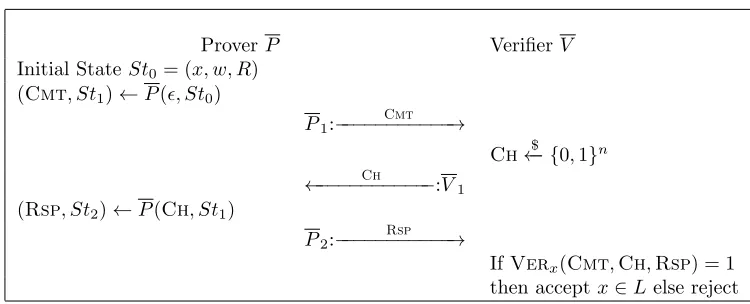
A three round canonical argumenthP , Vifor an NP-complete languageL, proposed by [HT98], is described in Figure 1. CmtandRspare the first and second messages of the prover andCh is the message sent by the verifier.
Definition 2.5. An argument systemhP , Vifor an NP-complete languageLis called a canonical argument system if it satisfies the following properties:
B0 The prover is a probabilistic polynomial time function which is given the NP-witness w. When this function is invoked with an incoming message Min and its state, it outputs Mout and its updated state. The initial state of the prover is set to (x, w, R), wherexis
the common input,wis its auxiliary input andRis the random tape. When it is invoked with (,(x, w, R)) it outputs the prover’s first message which is a commitmentCmt.
B1 The verifier selects the challengeChuniformly at random from{0,1}n.
B2 Strong-Soundness: For anyx /∈LandCmt, there exists at most one challengeCh∈ {0,1}n
for which there exists aRsp∈ {0,1}∗ such that
Verx(Cmt,Ch,Rsp) = 1.
B3 Honest Verifier Zero Knowledge (HVZK): There exists a probabilistic polynomial time Sim-ulatorSHV such that following two ensembles are computationally indistinguishable:
{SHV(x)}x∈L and{hP(x, w), V(x)i}x∈L,w∈WL(x),
where{hP(x, w), V(x)i}x∈L,w∈WL(x)is a random variable taking the value ofV’s internal
coin tosses and the sequence of messages it receives in interaction betweenP(with auxiliary inputw) andV.
One of the ways to construct such a protocol, as described by Hada and Tanaka [HT98], is parallel composition of Blum’s ZK protocol for Hamiltonicity.
ProverP VerifierV
Initial State St0= (x, w, R)
(Cmt, St1)←P(, St0)
P1:−−−−−−−−−−−Cmt →
Ch←− {0$ ,1}n Ch
←−−−−−−−−−−−:V1
(Rsp, St2)←P(Ch, St1)
P2:−−−−−−−−−−−Rsp →
IfVerx(Cmt,Ch,Rsp) = 1
then acceptx∈Lelse reject
2.3
Discrete Log based Equivocal Commitment Scheme
Com
DLThe committer and the receiver are given a group Gof prime orderq, its generatorg and an
elementB ∈Gsuch that qis an n−bit prime. To commit to x∈Zq, chooser
$
←−Zq and send Z=gx·Br. To open, the sender sends (x, r).
This commitment scheme is perfectly hiding i.e. ComDL(x) and ComDL(x0) are identically
distributed. If the committer does not know the discrete log ofB, thenComDLis
computation-ally binding under discrete log assumption. We assume that discrete log assumption holds in all the groups we consider. Also, ifZ is a commitment underComDL, then given two distinct
openings of Z to (x, r) and (x0, r0) such thatx 6=x0, one can easily solve for the discrete log
of B, sayb, as follows: b = (x−x0)·(r0−r)−1. Also, if the simulator knows the discrete log
of B, sayb, it can open Z =ComDL(x;r) as being a commitment to any x0 ∈Zq by sending r0=OpenDL(x, x0, r, b) = (x+r·b−x0)·b−1.
3
Assumptions
We begin this section by describing an assumption which is very similar to the discrete logarithm assumption (DLA). Given a (q, g)∈LQG, DLA says that given a random group elementA=ga,
for any polysize circuit, it is hard to computeawith non negligible probability. Diffie-Hellman Log Assumptionsays that given a Diffie-Hellman tuple (ga, gb, gab), it is difficult to computeb
even whenais chosen maliciously by the adversary. Let us denote Diffie-Hellman tuples byDH.
Assumption 3.1(Diffie-Hellman Log Assumption (DHLA)). For every family of probabilistic polynomial size circuitsI = {In}n≥1, everypoly(·), all sufficiently largen’s and all (q, g)∈LQG
such thatqis of lengthn, consider the following probabilistic experiment:
• In on input ( “Step 1”,1n) outputs (g, A), whereA∈G.
• Given (g, A) as input, experiment choosesb∈Z∗q and computes (B =gb, X =Ab),
thenDHLAsays that if (g, A, B, X) is a Diffie-Hellman tuple then the probability thatIn, given
this tuple, outputs discrete log ofBis negligible even whenAis chosen maliciously byIn. More
formally,
P r[In(“Step 2”, g, A, B, X|(A, B, X)∈ DH) =b:B=gb]< poly1(n),
for any choice ofA byIn.
Knowledge Assumption:
Below, by a circuitCwe mean a collection of Boolean gates and wires. We use the non-standard convention that certain gates are specially marked as output gates.Definition 3.2 (Admissible family of Adversaries). An admissible family of adversaries A is a family of sets such that the following properties hold: Each set S ∈ A is such that S = {Cn, Mn, Bn,auxn}n∈N. For each such setS, there exist constants c, c0 >0, such that Cn is a
circuit with|Cn| ≤nc, andaux⊆ {0,1}n c0
. Furthermore, {Mn, Bn} is a partition of the gates
and the wires of the circuitCn. Ifxis the input toCn then byMn(x) we refer to the result of
the computationCn(x) restricted to the output wires inMn; we defineBn(x) similarly.
We will refer to Mn and Bn as the malicious and the benign parts respectively of the
adversary circuitCn.
Definition 3.3(Aadmits polysize malicious extensions). An admissible family of adversariesA
admits polysize malicious extensionsif the following holds: For any set of circuitsS∈ Awhere
S={Cn, Mn, Bn,auxn}n∈N, and any polysize circuit family{Fn}n∈N such that∃d >0, |Fn|< ndand the input wires toF
nare a subset of the wires inMn(including both internal and output
wires) and the output wires ofBn, we have thatS0={Cn∪Fn, Mn∪Fn, Bn,auxn} ∈ A.
Assumption 3.4. [m-Knowledge of Exponent Assumption (m-KEA) w.r.t. admissible adver-saries] We say that them-Knowledge of Exponent Assumption holds with respect to a family of admissible adversaries A, if for every c > 0, there exists a constant c0 > 0 such that the following holds: For m = nc, fix any S = {C
n, Mn, Bn,auxn}n∈N ∈ A. Then there exists a
family of extraction circuits{En}n∈Nwhose inputs are a subset of any wires in Mn, such that
|En| ≤(n· |Mn|)c
0
. (Informally, this condition requires that the extraction only uses the inter-nal wires of the malicious part of the adversary.) Furthermore, we require that the following conditions hold:
1. For all sufficiently largen, every polynomialpoly(·), the following is true for allaux∈auxn:
Consider the following probabilistic experiment: For i∈[1, m], primes qi and generators gi are chosen randomly such that (qi, gi) ∈ LQG, where qi is chosen to be of length n. Values a1, . . . , am are chosen at random such that ai ∈ Z∗qi. Finally, R is chosen
uniformly at random from sufficiently long strings so that the length of the tuple x = ((q1, g1, g1a1), . . . ,(qm, gm, gmam), aux, R) is exactly the length of the input to circuit Cn.
If the input to Cn is not long enough to allow such an input then the assumption is
vacuously true for thisS. Now, we consider the output ofMn(x), which we interpret as a
tuple (j, B, X), wherej ∈[m], and bothBandXare in the group generated bygj. Then,
we interpret the output ofEn(x) as the value bj ∈Zqj, and require the following to be
true:
P rhX=Baj∧B6=gbjj i< 1 poly(n).
(Informally, this condition states that if the malicious part of the adversary outputs a tuple so that (gj, g
aj
j , B, X) form a Diffie-Hellman tuple, then the extractorEnsuccessfully
outputs the discrete log ofB with respect togj.)
2. We have that (Cn∪En, Mn, Bn∪En,auxn)∈ A. (Informally, this means that the extraction
circuit created by this assumption is benign.)
Definition 3.5. An admissible set of adversariesAcontains all polysize malicious adversaries
if for all c, c0 > 0, and for all circuit families {Cn}n∈N such that |Cn| ≤ nc, for each n there
exists some subset auxn ⊆ {0,1}n c0
, such that (Cn, Cn, ,auxn)∈ A. We say that Acontains
all polysize malicious adversaries with all polysize auxiliary inputs ifauxn ={0,1}n c0
for each circuit family above.
Theorem 3.6 (Informal). If the m-Knowledge of Exponent assumption holds with respect to an admissible adversary familyAsuch thatAcontains all polysize malicious circuits and allow polysize malicious extension, and DHLA holds, then there exist constant-round concurrent zero-knowledge arguments forNP in the plain model.
Furthermore, if A contains all polysize malicious adversaries with all polysize auxiliary in-puts, then there exist constant-round concurrent zero-knowledge arguments forNPin the plain model with respect to arbitrary auxiliary inputs.
4
Constant Round Protocol for Concurrent Zero-Knowledge
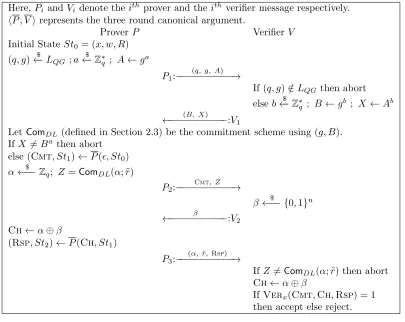
The protocol starts by asking the verifier to use Knowledge Commitment Protocol to commit to a value b in B = gb. We use equivocal commitments whose trapdoor is b to run a coin
Here,Pi andVi denote theith prover and theithverifier message respectively.
hP , Virepresents the three round canonical argument.
ProverP VerifierV
Initial StateSt0= (x, w, R)
(q, g)←−$ LQG;a
$
←−Z∗q ; A←ga
P1:
(q, g, A)
−−−−−−−−−−−→
If (q, g)∈/LQG then abort
elseb←−$ Z∗q ; B←gb ; X ←Ab
(B, X)
←−−−−−−−−−−−:V1
LetComDL (defined in Section 2.3) be the commitment scheme using (g, B).
IfX 6=Ba then abort
else (Cmt, St1)←P(, St0)
α←−−$ Zq; Z =ComDL(α; ˜r)
P2:
Cmt, Z
−−−−−−−−−−−→
β←−− {0$ ,1}n β
←−−−−−−−−−−−:V2
Ch←α⊕β
(Rsp, St2)←P(Ch, St1)
P3:
(α,r,˜ Rsp)
−−−−−−−−−−−→
IfZ6=ComDL(α; ˜r) then abort
Ch←α⊕β
IfVerx(Cmt,Ch,Rsp) = 1
then accept else reject.
Figure 2: Π: 5-Round Protocol for
c
ZK
(
P, V
)
use of a bilinear map is not crucial, and that we eliminate the need for a bilinear map in our second protocol (See Section D).
This protocol uses the discrete log based commitment schemeComDLwhich is binding under
the hardness of DHLA. The secret value b committed to by the verifier satisfies the following properties.
R1: For Soundness: Under DHLA(Assumption 3.1), any cheating prover while interacting with the honest verifier cannot get the secret coins of the verifier. Hence, any cheating prover cannot output the discrete log ofB sent by the verifier in Figure 2.
R2: For Zero-knowledge: Under m-KEA (Assumption 3.4), our simulator will be able to output the discrete log of B no matter how the verifier behaves. Once the simulator gets the secret coins of V∗, which is the trapdoor to equivocal commitment scheme, the simulation is easy.
ForR2, informally, it seems that even the cheating verifier must start by simply choosingband computing (gb, Ab) in order to pass the checkX =Ba. That is, we assume that the verifier knows the secret coinsbwhenever it passes the check. m-KEA defined in Section 3.4 captures this idea of knowledge and knowledge extraction formally. Under this variant of knowledge of exponent assumption, we will design a simulator which will extract the secret coins of the cheating verifier. Since, the simulator will have the trapdoor to ComDL, it will be able to
5
Π
is Computationally Sound
Recall thatDHLAsays that given a Diffie-Hellman tuple (g, ga, gb, gab), even ifa is chosen by the adversary, it is hard for it to guessb with non-negligible probability. We prove soundness of Π by the following two steps: LetP∗ denote the cheating prover.
• IfP∗succeeds in equivocating its commitment in coin flipping protocol then we can extract the trapdoor valueb of Knowledge Commitment Protocol from P∗. This shows that P∗
can be used to efficiently computeband thereby breakDHLA.
• We show that ifP∗ does not equivocate on its commitment in coin flipping protocol and convinces the verifier of a false statement, then such a P∗ can be used to violate the underlying strong soundness of canonical arguments. In other words, it would violate the underlying soundness of Blum’s Hamiltonicity protocol.
To prove the soundness of Π in the concurrent setting, it is sufficient to prove soundness of a single stand alone session.
For the first step, let us define the following interactive gameG:
1. Sim runs the above protocol with P∗ till P∗ commits to α using random coins ˜r in the above protocol using commitment scheme ComDL as defined before. P∗ sets Z =
ComDL(α; ˜r) and sendsZ toSim.
2. Simsendsβ to P∗.
3. P∗sends (α1, r˜1, Rsp) toSim such thatZ=ComDL(α1; ˜r1).
4. Sim rewinds P∗ to Step 2 and sends it β0 such that β0 6= β. P∗ wins if it sends (α2, ˜r2, Rsp) toSimsuch thatZ =ComDL(α2; ˜r2) andα16=α2.
Lemma 5.1. UnderDHLA, for every probabilistic polynomial time machineP∗, every polyno-mialpoly(·), and all sufficiently large n’s,
P r[P∗wins G]<poly1(n)
where probability is over choice ofα, βand coins ofP∗ andnis the security parameter.
Proof:We will prove this by contradiction. If there is a polynomialf(n) such thatP r[P∗winsG]>
1/f(n), then we can construct an adversaryAforDHLA.ArunsP∗and gets (q, g, A) and sends (g, A) to the challenger ChofDHLA. Chprepares the challenge tuple by choosing a random b
and sends (B =gb, X = Ab) to A which it forwards to P∗. P∗ and A continue running the
protocol Π until the opening ofZ asα. After this opening,ArewindsP∗ until the commitment
Z and runsP∗ again with a different β0 and looks at the opening of Z byP∗. If P∗ opens Z
to the sameα,A aborts. Else ifP∗ opens Z to a α0 such thatα6=α0, Acan computeb, the discrete log ofB, as described in Section 2.3. Asendsb toCh.
P r[AbreaksDHLA] =P r[P∗ winsG]>1/f(n). This contradictsDHLA.
Theorem 5.2. Under Lemma 5.1 and strong soundness property (B2) ofhP , Vi, protocolΠis computationally sound.
Proof: We will again prove this by contradiction. If Π is not computationally sound then there exists a PPT machine P∗ and an infinite set I = {(x, w) : x /∈ L} such that there exists a polynomialp(·) satisfying
AcchP∗(x, w), V(x)i>p(|1x|).
SinceP∗ can equivocate his commitment toαonly with a negligible probability, the only way
P∗ can convince V of a false statement is to complete the protocol successfully for multiple challenges for each (x, w)∈ I.
Using this cheating prover P∗ for Π, we will construct a cheating prover P∗ for canonical argument system which breaks the strong soundness property of the canonical argument system.
P∗ interacts with P∗ as the verifier on some (x, w)∈ I. P∗ runs the protocol till the end. If
commitment toα. This timeP∗ sends a differentβ. IfP∗ completes the protocol successfully for the second time, thenP∗gets two different tuples (Cmt,Ch1,Rsp1) and (Cmt,Ch2,Rsp2)
forx /∈Lwhich a honest verifier V would accept. This is becauseP∗ can not equivocate toα
with non-negligible probability. This would contradict the strong soundness property ofhP , Vi. Now we need to calculate the probability of success ofP∗ in breakingB2.
LetT be the transcript of Π till the prover’s commitment toα. LetpT =P r[V accepts x /∈L|T].
We are given that,
AcchP∗(x, w), V(x)i=ET(pT)>p(|1x|). 1
p(|x|)<ET(pT)≤
P rT
h
pT >12· p(1|x|)
i
·1+P rT
h
pT ≤ 12·p(|1x|)
i
·1 2·
1
p(|x|)
.
Now we know thatP rT
h
pT ≤12· 1
p(|x|)
i
≤1. By solving we get,
P rT[pT > 12· 1
p(|x|)]> 1 2p(|x|).
We call a transcriptT good when pT > 12·p(|1x|). P ∗
breaksB2on a good transcript whenP∗
succeeds in convincing the verifier on two independent choices ofβ. Hence,
P r[P∗ breaksB2]> P r[T is good]·(12· 1
p(|x|)) 2> 1
8·( 1
p(|x|)) 3.
This contradicts the strong soundness property of canonical argument system by a non-negligible probability.
6
Π
is Concurrently Zero-Knowledge
To establish the zero-knowledge property, we build a sequence of extractors through recursive applications ofm-KEA. Informally, each circuit uses the extractor provided bym-KEAto obtain the valuebcommitted byV∗ and then use this trapdoor value to equivocate in the coin flipping protocol. Through such an equivocation, the simulator can force the challenge message in Blum’s Hamiltonicity protocol to be equal to the challenge the simulator received by calling the honest verifier simulator SHV for Blum’s Hamiltonicity. We prove that the simulation is
computationally indistinguishable from the real execution through a sequence of hybrids.
Theorem 6.1. If there are mconcurrent sessions of Π and if our family of admissible adver-sariesAcontains all polynomial size adversaries and allows polysize malicious extensions, then under m-KEAand honest verifier zero-knowledge property of hP , Vi, the following distribution ensembles are computationally indistinguishable:
{SV∗(x, y)}m,x∈L,y∈{0,1}m and{hP(x, w), V∗(x, y)i}m,x∈L,w∈WL(x),y∈{0,1}m,
whereSV∗ is the zero-knowledge simulator forΠ described in Appendix B.
For the proof of this theorem refer to Appendix B. The following theorem states that the circuit of our simulatorSV∗ is a polynomial size circuit.
Theorem 6.2. The size of the circuit of the simulatorSV∗ is a fixed polynomial in the size of the circuit ofV∗ and the security parameter.
For the proof of this theorem refer to Appendix C.
7
m-KEA
holds in Bilinear Generic Group Model
In this section, we will argue thatm-KEA(Assumption 3.4) holds for any family of admissible adversaries (described below) that acts generically to the groups used in our protocol.
The Generic Group model: Given a cyclic bilinear group G, we consider the random encodingψG, that is an injective map ψG : G→ {0,1}`, where ` >3·log(|G|). We write the
also a cyclic group. Let the random encoding ofGT be ψGT. The adversary is given access to
three oracles ΦB, ΦP, and ΦT. The oracle ΦB takes as input the random encodings of group
elements in base group Gand performs the group operations multiplication and inverse inG.
Ifα, β∈ψG(G), then ΦB(α, β) gives the encoding of the product of elements represented byα
and β which is ψG(ψ−G1(α)·ψ
−1
G (β)). Also Φ
B(α,Inv) gives the encoding of the inverse of the
group element represented by α which is ψG((ψG−1(α))−
1), where α∈ ψ
G(G). ΦP also takes
random encodings of group elements in G and returns the pairing under the bilinear map e.
Given α, β ∈ψG(G), ΦP(α, β) gives the encoding of the pairing of elements represented byα
and β which is ψGT(e(ψ−G1(α), ψ
−1
G (β))). Similarly, Φ
T takes as input the random encodings
of group elements in GT and performs the group operations multiplication and inverse in GT.
If α, β ∈ ψGT(GT), then ΦT(α, β) gives the encoding of the product of elements represented
byαandβ which isψGT(ψGT−1(α)·ψ
−1
GT(β)). Also Φ
T(α,Inv) gives the encoding of the inverse
of the group element represented by α which is ψGT((ψ
−1
GT(α))
−1), where α∈ ψ
GT(GT). Let
Φ = ΦB∪ΦP∪ΦT. Without loss of generality, assumeψ
G(1G) = 0`.
Theorem 7.1. m-KEA holds in the bilinear generic group model w.r.t. a family of admissible adversariesAwhich contains all polysize malicious circuits with all polysize auxiliary inputs.
Proof: Consider the following family of admissible adversariesA={(Cn, MnΦ, Bn,auxn)}n∈N,
where MnΦ is any family of polysize malicious circuits which have access to the oracle Φ, i.e.
ΦB, ΦP and ΦT. Bnis any family of polysize circuits which do not make any calls to any of the
oracles. Cn =MnΦ∪Bn andauxn is the set of all polysize strings. Observe thatA admits any
polysize malicious extension. Looking ahead, the family of extractor circuits En will not make
any calls to Φ.
Since in the experiment described inm-KEA, the circuitCn deals withmdifferent bilinear
groups, the oracles ΦB, ΦP and ΦT also take the group number i as input. More formally,
if α, β ∈ψGi(Gi), then Φ
B(i, α, β) = ψ Gi(ψ
−1
Gi(α)·ψ
−1
Gi(β)), Φ
B(i, α,Inv) = ψ Gi((ψ
−1
Gi(α))
−1)
and ΦP(i, α, β) =ψGT ,i(ei(ψ
−1
Gi(α), ψ
−1
Gi(β))). Similar calls can be made to Φ
T to compute the
multiplication and inverse operations in the groupsGTi.
To prove the second property ofm-KEA, we would maintain the invariant that our extractor circuit familyEnwill not make any oracle calls. Now, in order to prove the theorem, we are left
to prove that the first property ofm-KEAholds.
For all sufficiently large n, given a set of circuits S = {Cn, MnΦ, Bn,auxn} ∈ A (defined
above) and for all aux ∈ auxn, we run the following experiment. For all i ∈ [m], we pick at
random (qi, gi)∈LQGand pick a random encodingψGi for the groupGiandψGTi for the group
GTi. Let Φ be the oracle for the bilinear generic group model. Now, choose valuesa1, a2, . . . , am
uniformly at random such thatai∈Z∗qi. The circuitMnΦis given the input (qi, ψGi(gi), ψGi(g ai i ))
for alli∈[m]. Let the output ofMΦ
n be (j, B, X). Now we construct the extractor circuit En
as follows:
En builds a lookup table Ti for all i ∈ [m]. Table Ti maps all group elements (α =
ψGi(g di+ai·d0i
i )) ever considered by M
Φ
n to a tuple ((di, d0i)). Informally, it maps the
encod-ing of any group element to its discrete log w.r.t. gi andgaii. Specifically, En works as follows:
It initializesTi with following two entries: ψGi(gi) maps to (1,0) andψGi(g ai
i ) maps to (0,1).
Now, consider a topological ordering τ of the gates in circuitMnΦ. Traversing in this order,
we process the oracle calls to ΦB as follows: For oracle call ΦB(i, α, β) with outcomeγ6=⊥, we
update ourTi as follows: Find the entries inTi corresponding toαandβ, sayTi(α) andTi(β).
If any one of these is not found, we call this eventMiss andEn outputsMissFail. Then find γ
inTi. If Ti(γ) exists, butTi(γ)6=Ti(α) +Ti(β) (addition is done component wise and modulo qi), we call this eventCollisionandEnoutputsCollisionFail. Else, setTi(γ) =Ti(α) +Ti(β). For
the oracle call ΦB(i, α,Inv) with outcomeγ6=⊥, we update ourT
i as follows: Find the entry
corresponding toα. If it does not exist, we call this eventMissandEnoutputsMissFail. IfTi(γ)
already exists butTi(γ)6=−Ti(α), then this event isCollisionandEnoutputsCollisionFail. Else,
setTi(γ) =−Ti(α). For the oracle calls to ΦP and ΦT,En does nothing.
After processing all the gates inMΦ
MΦ
n and interprets it as a tuple of the form (j, B, X) for somej∈[m]. IfTj(B) orTj(X) does not
exist, we call this eventOutMissand outputOutFail. Else if,Tj(B) = (b,0) and Tj(X) = (0, b), En outputs belse En outputs Fail. Consider the event when (ψG−j1(B))
aj =ψ−1
Gj(X) butTj(B)
andTj(X) are not of the form described above. We call this eventFalseNegativebecause though MΦ
n outputs a valid tuple, butEn fails to output the discrete log.
Observe that as stated earlier,En does not make any oracle calls. Instead, it only examines
the inputs and outputs of oracle calls made by MnΦ. SinceMnΦ can make at most |MnΦ| oracle calls, the total size of all the lookup tables is at most |MnΦ|. Hence, ∃c > 0 such that|E| ≤ (n·|MnΦ|)c. There are four cases in whichEnmisbehaves and below we prove that the probability
of each of these events is negligible.
1. EventMiss: This event happens whenMΦ
n makes an oracle call with input which is neither
an input toMΦ
n nor an output of some previous oracle call. This happens when MnΦ is
able to guess an `−bitstring which is a valid encoding of some group element. Hence,
Pr[Miss]≤maxi| MΦ
n|·qi
2`i ≤maxi| MΦ
n| q2
i
, which is negligible sinceMnΦis polysize.
2. Event Collision: This happens when there is a conflict between old Ti(γ) (say,(x1, y1))
and new output from ΦB forT
i(γ) (say, (x2, y2)). This would give us an equation of the
form x1+y1·ai=x2+y2·ai, where the only unknown isai. Solving this equation, En
can learn the value ofai. But ai was information theoretically hidden. So, Pr[Collision]
for any oracle call is at most q1
i. Taking union bound over all the oracle calls in M
Φ
n,
Pr[Collision]≤maxi| MΦ
n|
qi . Since,M
Φ
n is polysize, this probability is negligible.
3. Event FalseNegative: This event happens when (ψG−1 j(B))
aj = ψ−1
Gj(X) but Tj(B) and Tj(X) are not of the form (b,0) and (0, b) respectively. LetTj(B) = (x1, y1) andTj(X) =
(x2, y2). Note that since (ψG−j1(B))
aj = ψ−1
Gj(X) it is the case thataj ·(x1+y1·aj) = x2+y2·aj. This gives a quadratic equation in aj which has at most two roots. Hence,
Pr[FalseNegative]≤maxiqi2.
4. EventOutMiss: We are only concerned in the event whenEn outputsOutFailbut (B, X)
is a valid tuple of group elements. This happens whenMΦ
n successfully guesses at least
one`−bit string which is a valid encoding of some group element. As argued above for the
event Miss, this probability is bounded above by maxi| MΦ
n| q2
i
. This bound must also hold
for the eventOutMiss. Hence Pr[OutMiss∧Valid]≤maxi| MΦ
n| q2
i
, which is negligible.
We have shown the construction of En such that if MnΦ outputs a tuple (j, B, X) such that
(ψGj−1(B))aj = ψ−1
Gj(X), then En outputs b such that ψGj−1(B) = g b
j with all but negligible
probability. Since En does not make any oracle calls, {Cn ∪En, MnΦ, Bn∪En,auxn} ∈ A.
Hence,m-KEA assumption holds forAdefined above.
Remark: Note that because the adversary has to output the tuple (B, X) in the base group
G, the calls to the oracles ΦP and ΦT are simply irrelevant to the proof. Hence, they neither
arise in construction of the extractorEn nor cause any complication to its existence. Moreover,
almost the same extractor construction can be used to show that knowledge assumption for non-bilinear groups (see Appendix D) would hold in generic groups.
8
Related Work
gave a three round zero-knowledge protocol using two knowledge of exponent assumptions. Later, Bellare and Pallacio [BP04] proved that the assumption used for proving the soundness of the protocol was false, proposed a modified assumption and recovered the earlier result. We stress that in our protocol, we are able to argue soundness directly without the use of any knowledge assumption.
Extending the assumption of [BP04], Abe and Fehr [AF07] constructed the first perfect NIZK for NP with full adaptive soundness. Under knowledge of exponents assumption, Prabharakaran and Xue [PX09] constructed statistically hiding sets based on trapdoor DDH groups [DG06]. Gennaro et al. [GKR10] modify the Okamoto-Tanaka key agreement protocol to get perfect forward secrecy. Recently, Groth [Gro10] generalized the assumption of [AF07] to short non-interactive perfect zero-knowledge arguments for circuit satisfiability.
Other set of knowledge assumptions used recently are extractable functions [CD08, CD09]. All of [BCCT12, DFH12, GLR11] give one of the constructions of Extractable Collision Re-sistant Hash functions (ECRH) using Knowledge of Exponent Assumptions. Then assuming the existence of ECRH, Bitansky et al [BCCT12] modify the construction of [CL08] and prove that the modified construction is a succinct non-interactive adaptive arguments of knowledge (SNARK). They also show that existence of SNARKs imply the existence of (their notion of) ECRH. In the CRS model, they combined NIZK and SNARKs to give zero-knowledge non-interactive arguments. On the other hand, Damgard et al [DFH12] also use ECRH to construct succinct non-interactive arguments in CRS model. Using these, they give a two message protocol for two party computation which is UC-secure.
Concurrent Zero-Knowledge: The difficulty in constructing a round-efficient cZK was first observed by Dwork et al. [DNS98]. Following this, rigorous lower bounds on round complex-ity ofcZK for NP with a black-box simulator have been proven in [KPR98, Ros00, CKPR01]; the best lower bound being Ω(logn/log logn) rounds given by Canetti et al. [CKPR01]. Barak [Bar01] gave a constant round protocol for all NP, in which he gave a non-black-box simulator for zero-knowledge. Also, for any predetermined polynomialp(·), this constant round protocol is zero-knowledge even when p(n) sessions are concurrently executed. But it has a major drawback. The polynomialp(·) has to be fixed at the beginning of the protocol and the message lengths grow linearly inp(n). Killian and Petrank [KP01] gave a poly-logarithmic round protocol which is zero-knowledge even when it is executed concurrently for any (not determined) polynomial number of times. The gap between the upper and lower bounds of round complexity of black-boxcZK was closed by Prabhakaran, Rossen, and Sahai [PRS02] who gave a ˜O(logn) round protocol. Since then improving the round complexity of concurrent zero-knowledge has been an open problem.
A
Discussion regarding use of auxiliary inputs for
concur-rent simulation
A potentially promising idea for using knowledge assumptions for concurrent simulation is the following: Formulate a knowledge assumption that holds for all auxiliary inputs for the ad-versary, and then invoke the knowledge extractor provided by the knowledge assumption with different auxiliary inputs corresponding to the extraction history. In other words, one could attempt to apply a single extractor iteratively for different concurrent sessions, passing along all the information extracted so far as auxiliary input to the extractor.
Knowledge Commitment Protocol. By the definition of auxiliary input, an extractor would not be required to function in such a case. To make the intuition precise, consider an example of such an iterative application of knowledge assumption in the concurrent setting. Suppose the Adversary schedules the messages of the malicious committer (MC) as follows: First, MC asks for the random first message of the Receiver (R) in the Knowledge Commitment Protocol for all the sessions (r1, r2, . . . , rm). Now, MC chooses a functionf and completes the first Knowledge
Commitment Protocol by committing tof(r1, r2, . . . , rm). We apply the knowledge assumption
to recoverf(r1, r2, . . . , rm). Next, the MC completes another Knowledge Commitment
Proto-col. Now in order to extract, we need to provide the extractor one of the randomri’s as input
andf(r1, r2, . . . , rm) as auxiliary input. But here, depending on the function f, this auxiliary
input may be highly correlated to the inputri. In this case, the extractor isallowed to fail with
high probability. This is because the extractor is only required to work for the fixed auxiliary inputaux=f(r1, r2, . . . , rm), whenriis chosen at random independently ofaux. However, the
actual simulation would useauxthat correlates with the inputri.
B
Description of the simulator
In the concurrent setting, the verifier may start an unbounded number of sessions with the prover and may interleave them in any way he wants. One such individual session has five rounds (as shown in Figure 2). In this section, we will model our cheating verifierV∗ as a next message function with a stateγ.
V∗(Msg0, k, γ0)→(Msg, j, γ, `)
whereMsg0 is the prover’s (or simulator’s) message from the sessionkandγ0is the last state of
V∗. In response,V∗ sends messageMsg corresponding to some sessionj and changes its state toγ. Prover’s (or simulator’s) next message would be the next message from the sessionj. In caseMsg is, then the verifier is requesting for the first message of session`. Verifier can also output a special message (End,output), which means thatV∗wants to stop the execution with outputoutput.
To describe our simulatorSV∗, we will first describe a sequence of admissible adversaries
{Cn,i, Mn,i, Bn,i,auxn} and{Cn,i0 , Mn,i0 , B0n,i,auxn} for all i ∈ {1,2, . . . , m+ 1}. First, we will
describe these for i= 1 followed by i >1 recursively using{Cn,i−1, Mn,i−1, Bn,i−1,auxn} and
{Cn,i0 −1, Mn,i0 −1, B0n,i−1,auxn}. Each of these circuits will maintain and update the set of aborted
sessions calledAborted. We will assume that the simulator knows the upper bound onm, the number of sessions that V∗ executes. Also, whenever V∗ stops, our simulator stops with the output ofV∗.
Admissible adversary: {Cn,1, Mn,1, Bn,1,auxn}.
Input: (x, y,(q1, g1, ga11), . . . ,(qm, gm, gmam)) and (R1, R2), wherex∈L,y is the auxiliary input
of lengthmand (qi, gi)∈LQG, for alli. R1 is the random tape forCn,1andR2is the random
tape forV∗.
Output: (j, Bj, Xj) or (End,output).
Description: We will start building the circuit Fn,1 as follows: Fn,1 will simulate the
inter-action with V∗ until the point when V∗ sends first V1 message for some sessionj. Informally,
this is the point whenV∗ completes the “Knowledge Commitment Protocol” for the first time. SoFn,1 will keep sending the first message of the sessions requested by V∗ and wait for it to
respond for one of the sessions. WhenV∗ sendsV1 message for some session,Fn,1 outputs the
message ofV∗. More formally,
Step 1: Fn,1 setsγ= (x, y, R2) andMsg0= (q1, g1, g1a1). Fn,1 runsV∗ on (Msg0,1, γ).
Step 2: Let output ofV∗ be (Msg, j, γ, `). Now it does case analysis onMsg.
Step 2a: IfMsg =, setMsg0= (q`, g`, ga``) and runV∗ on (Msg
0, `, γ). Go to Step 2.
Step 2c: IfMsg = (End,output),Fn,1 outputs (End,output).
Note that sinceFn,1stops wheneverV∗sends theV1message of any session, the only inputs to
V∗ are prover’sP1message.
Now that we have definedFn,1, we define our admissible adversary {Cn,1, Mn,1, Bn,1,auxn}=
(Fn,1, Fn,1, ,auxn). Now we describe {Cn,0 1, Mn,0 1, B0n,1,auxn} as follows: By m-KEA, there
must exist an extractor circuit En,1 which takes a subset of the wires of Mn,1 as input and
outputs (j, bj) such that if (g aj
j , Bj, Xj)∈ DHthenBj=g bj
j with all but negligible probability.
Here, without loss of generality, for ease of notation, we have assumed thatEn,1 also outputs
j along with bj. This can be done by just using output wires of Mn,1. Then {Cn,0 1, Mn,0 1,
Bn,0 1,auxn}= (Cn,1∪En,1, Mn,1, En,1,auxn).
We now describe {Cn,i+1, Mn,i+1, Bn,i+1,auxn} and {Cn,i0 +1, Mn,i0 +1, Bn,i0 +1,auxn}
recur-sively. Informally,{Cn,i+1, Mn,i+1, Bn,i+1,auxn}would be a result of polysize malicious
exten-sions to{Cn,i0 , Mn,i0 , B0n,i,auxn} using an extension circuitFn,i+1. Here, Fn,i+1 would continue
the simulation using the output ofBn,i0 . It would start by checking if the last benign extraction was successful. If the extraction failed, it outputsSimAbort. Otherwise, it continues simulation till the point whenV∗responds with nextV1message for some sessionj. Then{Cn,i0 +1, Mn,i0 +1,
Bn,i0 +1,auxn}would do the benign extraction for sessionj.
Admissible Adversary: {Cn,i+1, Mn,i+1, Bn,i+1,auxn}for somei∈ {1,2, . . . , m}.
Input: (x, y,(q1, g1, g1a1),(q2, g2, g2a2), . . . ,(qm, gm, gamm)) and (R1, R2), where x ∈ L, y is the
auxiliary input of lengthmand (qi, gi)∈LQG, for alli. R1is the random tape forCn,1andR2
is the random tape forV∗.
Output: (j, Bj, Xj) or (End,output) orSimAbort.
Description: {Cn,i+1, Mn,i+1, Bn,i+1,auxn} is the result of polysize malicious extension to
{Cn,i0 , Mn,i0 , Bn,i0 ,auxn}. LetFn,i+1 be this malicious extension. It will simulate the interaction
with V∗ from the point when V∗ sends ith V
1 message till V∗ sends one more V1 message for
some sessionj. These messages would be simulated with the help of the extractions done by the benign part of the circuitBn,i0 so far. WhenV∗ sendsV1 message for sessionj, thenFn,i+1
stops and outputs the message ofV∗. More formally, Fn,i+1 is defined as follows:
Step 1: If{Cn,i0 , Mn,i0 , Bn,i0 ,auxn} outputsSimAbort or (End,output), thenFn,i+1 outputs the
same. Else find the last output fromV∗ in Mn,i. It would be of the form (j, Bj, Xj, γ).
SetMsg = (j, Bj, Xj) and do the following:
• Ifej(g aj
j , Bj)6=ej(Xj, gj) then add (Abort, j) toAborted. Set Msg0 = (Abort, j) and
runV∗ on (Msg0, j, γ). Go to Step 2.
• Find the corresponding output (j, bj) of Bn,i0 . If not found or if Bj 6= g bj
j , Fn,i+1
outputsSimAbort.
• If the extraction was successful, Fn,i+1 knows the discrete log of Bj, and it can
equivocate in the commitment schemeComDLj. SetZj =ComDLj(0,r˜
0
j). Run SHV
on inputx to get the view of V for session j, say (Cmtj,Chj,Rspj). Set Msg0 =
(Cmtj, Zj) and run V∗ on (Msg0, j, γ).
Step 2: Let output ofV∗be (Msg, j, γ, `) for somej andγ. NowFn,i+1 does case analysis on
Msg.
Step 2a: If (Abort, j)∈Aborted, SetMsg0= (Abort, j) andnext= (Msg0, j, γ).
Step 2b: IfMsg =V1message of sessionj, i.e. Msg = (Bj, Xj), thenFn,i+1outputs (j, Bj, Xj).
Step 2c: If Msg = V2 message of session j, i.e. Msg = βj, then find Chj, Rspj and ˜r0j
in Mn,i0 ∪Fn,i+1 and set αj = Chj⊕βj. Set ˜rj = OpenDLj(0, αj,r˜j0, bj). Set Msg0 =
(αj,r˜j,Rspj) andnext= (Msg0, j, γ).
Step 2d: IfMsg =, then setMsg0 = (q`, g`, ga`` ) andnext= (Msg
0, `, γ).
Step 2e: IfMsg = (End,output),Fn,i+1 outputs (End,output).
With the above description ofFn,i+1complete, we now define{Cn,i+1, Mn,i+1, Bn,i+1,auxn}=
(Cn,i0 ∪Fn,i+1, Mn,i0 ∪Fn,i+1, Bn,i0 ,auxn).
Now that we have defined {Cn,i+1, Mn,i+1, Bn,i+1,auxn}, we define our admissible
adver-sary {Cn,i0 +1, Mn,i0 +1, Bn,i0 +1,auxn} as follows: By m-KEA, there must exist a circuit En,i+1
which takes a subset of internal wires of Mn,i+1 as input and outputs (j, bj) such that if
(gaj
j , Bj, Xj) ∈ DH then Bj = g bj
j with all but negligible probability. Here again, without
loss of generality, for ease of notation, we assume that En,i+1 also outputs j along with bj.
This can be done by just using output wires of Mn,i+1. Then, we define {Cn,i0 +1, Mn,i0 +1,
Bn,i0 +1,auxn}= (Cn,i+1∪En,i+1, Mn,i+1, Bn,i+1∪Ei+1,auxn).
Now that we have defined this sequence of admissible adversaries, we will describe our sim-ulatorSV∗ in terms of these machines.
Circuit: SV∗.
Input: (x,y), wherex∈L andy∈auxn is the auxiliary input of lengthm.
Output: View ofV∗.
Step 1: If V∗ starts m sessions then S
V∗ generates (qi, gi)←−$ LQG for all i ∈ {1,2, . . . , m}.
Eachqi is of lengthn.
Step 2: SV∗ generatesa1, a2, . . . , am uniformly at random such that ai ∈ Z∗q
i and computes Ai=giai for alli.
Step 3: SV∗ executes the admissible adversary circuit (Cn,m+1, Mn,m+1, Bn,m+1) with the
in-puts (x, y,(q1, g1, g1a1),(q2, g2, ga22), . . . ,(qm, gm, gmam)) and (R1, R2), where x∈L,y is the
auxiliary input ofV∗of lengthmandR2is the random tape ofV∗ andR1are the random
coins forCn,m+1.
Step 4a: If (Cn,m+1, Mn,m+1, Bn,m+1) outputsSimAbortthenSV∗ also outputsSimAbort. Step 4b: If (Cn,m+1, Mn,m+1, Bn,m+1) runs to completion with output (End,output), then
SV∗ outputsoutput.
Theorem B.1. If there arem concurrent sessions ofΠ and if our family of admissible adver-sariesAcontains all polynomial size adversaries and allows polysize malicious extensions, then under m-KEAand honest verifier zero-knowledge property of hP , Vi, the following distribution ensembles are computationally indistinguishable:
{SV∗(x, y)}m,x∈L,y∈{0,1}m and{hP(x, w), V∗(x, y)i}m,x∈L,w∈W
L(x),y∈{0,1}m
Proof: We will prove indistinguishability by a sequence of hybrids. If there arem sessions we will consider 3m+ 1 hybrids, H0∪ {Hi,1,Hi,2,Hi,3}, for alli∈[m]. We will now describe the
hybrids in detail. We will assume that all the hybrids also have the witnesswfor the factx∈L.
• H0 is the honest hybrid. It runs Step 1 and 2 of SV∗ and then builds Fn,1 but does not
stop on receiving the first response from V∗. Instead it uses the witness and interacts
honestly in all the sessions. H0={Fn,1, Fn,1, ,auxn}. This hybrid is same as the honest
prover interacting withV∗.
In each of the following hybrids we build on the admissible adversary circuit{Cn,i0 , Mn,i0 , Bn,i0 ,auxn}. If its malicious partMn,i0 outputs a tuple, we will call its session numberj.
• Hi,1 runs Step 1 and 2 ofSV∗ and then builds{Cn,i0 , Mn,i0 , Bn,i0 ,auxn}with the inputs
(x, y,(q1, g1, ga11),(q2, g2, g2a2), . . . ,(qm, gm, gamm)) and (R1, R2), wherex∈L,yis the
auxil-iary input ofV∗of lengthmandR
2is the random tape ofV∗andR1are the random coins
of{Cn,i0 , Mn,i0 , Bn,i0 ,auxn}. If{Cn,i0 , Mn,i0 , Bn,i0 ,auxn}outputsSimAbort, thenHi,1does the
same. Else find the last output fromV∗ in Mn,i. It would be of the form (j, Bj, Xj, γ).
Now, start building polysize malicious extensionFn,i+1to {Cn,i0 , Mn,i0 , B0n,i,auxn}. Fn,i+1
does the following tests:
– Ifej(g aj
j , Bj)6=ej(Xj, gj) then add (Abort, j) toAborted.
– Find the corresponding output (j, bj) ofBn,i0 . If not found orBj6=g bj
j ,Fn,i+1outputs