
Nuclear spin scissors mode – experimental status
IrinaMolodtsova1,∗,EvgenyBalbutsev1, andPeterSchuck2
1Bogoliubov Laboratory of Theoretical Physics, Joint Institute for Nuclear Research, Dubna, 141980, Russia 2Institut de Physique Nucléaire, IN2P3-CNRS, Université Paris-Sud, F-91406 Orsay Cédex, France;
Laboratoire de Physique et Modélisation des Milieux Condensés, CNRS and Université Joseph Fourier, 25 avenue des Martyrs BP166, F-38042 Grenoble Cédex 9, France
Abstract. A new type of nuclear collective motion – the spin scissors mode – was predicted seven years ago. Promising signs of its existence in232Th were found. We perform a systematic analysis of experimental data onM1 excitations in rare-earth nuclei to find traces of the spin scissors mode in this area. Obvious signs of its existence are demonstrated.
1 Introduction
The nuclear scissors mode was predicted by R. R. Hilton [1] as a counter-rotation of protons against neutrons in deformed nuclei. This idea was developed in the works of T. Suzuki, D. J. Rowe [2], N. Lo Iudice, F. Palumbo [3] and other authors and confirmed
exper-imentally with its detection in 156Gd by the group of
A. Richter [4].
n
p
p n
(a)
n
p p
n
(b)
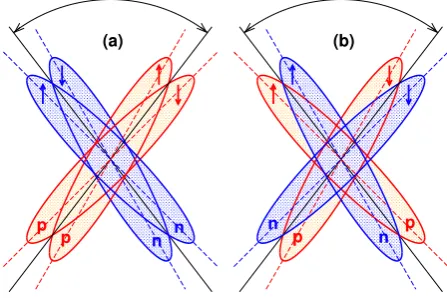
Figure 1. (a) - the orbital scissors (neutrons versus protons), (b) - spin scissors (spin-up nucleons versus spin-down nucleons). Arrows inside of ellipses show the direction of spin projections. p – protons, n – neutrons.
The Wigner Function Moments (WFM) method pre-dicts a new type of nuclear collective motion – the spin scissors mode: rotational oscillations of nucleons with spin projection "up" with respect of "spin-down"
nucle-ons. The pictorial view of these two different scissors is
shown in figure 1.
A generalization of the WFM method which takes into account spin degrees of freedom and pair correlations
si-∗e-mail: [email protected]
multaneously was outlined in [5]. As a result the agree-ment between theory and experiagree-ment in the description of nuclear scissors modes was improved considerably.
The aim of the present work – to find the experimen-tal confirmation of the splitting of low-lying (E<4 MeV)
M1 excitations in two groups corresponding to spin and
orbital scissors. It turns out that the splitting of low-lying
M1 excitations in two groups was observed and discussed
by experimentalists already at the beginning of the "scis-sors era". For example, we cite from the paper of Wes-selborget al.[6]: "The existence of the two groups poses the question whether they arise from one mode, namely from scissors mode, or whether we see evidence for two independent collective modes."
2 Brief description of the WFM method
The basis of our method is the Time Dependent Hartree-Fock (TDHF) equation for the one-body density matrix ρτ(r
1,r2,t)=r1|ρˆτ(t)|r2:
i∂ˆρ τ
∂t =
ˆ
hτ,ρˆτ, (1)
whereτis an isotopic index.
With the help of Fourier (Wigner) transformation
the density matrix ρτ(r
1,r2,t) is transformed into the
Wigner function fτ(r,p,t) and equation (1) is transformed
into TDHF equation for fτ(r,p,t).
Let us consider the simple Hamiltonian – a harmonic oscillator with separable quadrupole-quadrupole residual interaction:
H=
A
i=1
p2i
2m+
1 2mω2r2i
+ 2
µ=−2
(−1)µ
¯ κ
Z
i N
j
+κ
2
Z
ij
+
N
ij
Table 1.Scissors modes energiesEand transition probabilitiesB(M1) for164Dy. The results of calculations [9] with and without the spin part of a dipole magnetic operator (gs=0.7gfrees andgs=0 respectively).
164Dy E, MeV B(M1),µ
2
N
spin orbital centroid spin orbital
scissors scissors scissors scissors
gs=0.7gfrees 2.77 3.60 3.07 2.44 1.36 3.80
gs=0 2.77 3.60 3.50 0.76 6.10 6.86
whereq2µ = √16π/5r2Y2µandN,Z are the numbers of
neutrons and protons respectively.
Integrating the equation for the Wigner function over phase space with the weights
{r⊗p}λµ,{r⊗r}λµ,{p⊗p}λµ, (3)
where{r⊗p}λµ =
σ,ν Cλµ
1σ,1νrσpνone gets dynamic
equa-tions for second order moments
Rτ λµ(t)=
2 (2π)3
dp
dr{r⊗r}λµfτ(r,p,t),
Pτ λµ(t)=
2 (2π)3
dpdr{p⊗p}λµfτ(r,p,t),
Lτ λµ(t)=
2 (2π)3
dpdr{r⊗p}λµfτ(r,p,t), (4)
which play the role of the collective variables. Physical
meaning of these variables: R2µ– quadrupole moment of
the system andR00 – mean square radius,P2µandP00 –
quadrupole moment and mean square radius in a
momen-tum space. The variablesLλµdescribe the coupling of
mo-mentum and coordinate spaces,L1µbeing the orbital
angu-lar momentum. As a result, we obtain a system of coupled
dynamical nonlinear equations for protons (τ=p) and
neu-trons (τ=n): d
dtRτλµ−
2
mLτλµ=0, λ=0,2
d dtL
τ λµ−
1
mP τ
λµ+mω2R τ λµ
−12√5
2
j=0
2j+1{112λ1j} {Z2τ⊗Rτj}λµ=0, λ=0,1,2
d dtP
τ
λµ+2mω2L τ λµ
−24√5
2
j=0
2j+1{112λ1j} {Z2τ⊗Lτj}λµ=0, λ=0,2 (5)
where {112λ1j} is the Wigner 6j-symbol. The functions
Zn
2µ=κRn2µ+κ¯R p 2µandZ
p 2µ=κR
p
2µ+κ¯Rn2µ implement the
coupling of neutron and proton equations.
By definition [1] the scissors mode is the pure isovec-tor mode. That is why dynamical equations are usu-ally transformed into isovector and isoscalar ones. These equations are linearized and decoupled in a small ampli-tude approximation. In this case it is possible to solve them analytically, the solution being identical with that of RPA [7, 8].
We are interested in the scissors mode with quantum
number Kπ = 1+. Therefore, we need only a part of
isovector dynamical equations with µ= 1. Imposing the
time evolution via eiΩtfor all variables one transforms the
system of dynamical equations into a set of algebraic equa-tions. Eigenfrequencies are found as solutions of its secu-lar equation. It is necessary to emphasize that all conser-vation laws and sum rules are fulfilled.
Taking into account pair correlations and spin degrees of freedom allows one to get the satisfactory agreement
with experiment in the description of energies andB(M1)
values of the scissors mode [5].
Both scissors modes have an underlying orbital nature, because both are generated by the same type of collec-tive variables – by the orbital angular momenta.The dif-ference is that the "orbital" scissors are generated by the counter-oscillations of the orbital angular momentum of proton body with respect of the orbital angular momentum of neutron body, whereas the "spin" scissors are generated by the counter-oscillations of the orbital angular momen-tum of all nucleons with spin projection "up" with respect of the orbital angular momentum of all nucleons with spin projection "down". At the same time, the results of calcu-lations with and without the spin part of a dipole magnetic operator (gs =0.7gfrees andgs=0 respectively) show that
both scissors are equally sensitive to the spin dependent part of nuclear forces, demonstrating the moderate con-structive interference of the orbital and spin contributions in the case of the spin scissors mode and their very strong destructive interference in the case of the orbital scissors mode (see table 1).
3 Experimental situation
Let us analyze the experimental data in search of indica-tions of splitting. We have in mind the possible
concentra-tion of the observed 1+excitations in two more or less
sep-arated groups, the lower group being stronger than higher one.
3.1 Actinides
A very clear cut example of splitting is observed in232Th,
see figure 2. The spectrum of232Th can be divided in two
Table 1.Scissors modes energiesEand transition probabilitiesB(M1) for164Dy. The results of calculations [9] with and without the spin part of a dipole magnetic operator (gs=0.7gfrees andgs=0 respectively).
164Dy E, MeV B(M1),µ
2
N
spin orbital centroid spin orbital
scissors scissors scissors scissors
gs=0.7gfrees 2.77 3.60 3.07 2.44 1.36 3.80
gs=0 2.77 3.60 3.50 0.76 6.10 6.86
whereq2µ = √16π/5r2Y2µandN,Z are the numbers of
neutrons and protons respectively.
Integrating the equation for the Wigner function over phase space with the weights
{r⊗p}λµ,{r⊗r}λµ,{p⊗p}λµ, (3)
where{r⊗p}λµ =
σ,ν Cλµ
1σ,1νrσpνone gets dynamic
equa-tions for second order moments
Rτ λµ(t)=
2 (2π)3
dp
dr{r⊗r}λµfτ(r,p,t),
Pτ λµ(t)=
2 (2π)3
dpdr{p⊗p}λµfτ(r,p,t),
Lτ λµ(t)=
2 (2π)3
dpdr{r⊗p}λµfτ(r,p,t), (4)
which play the role of the collective variables. Physical
meaning of these variables: R2µ– quadrupole moment of
the system andR00 – mean square radius,P2µandP00 –
quadrupole moment and mean square radius in a
momen-tum space. The variablesLλµdescribe the coupling of
mo-mentum and coordinate spaces,L1µbeing the orbital
angu-lar momentum. As a result, we obtain a system of coupled
dynamical nonlinear equations for protons (τ=p) and
neu-trons (τ=n): d
dtRτλµ−
2
mLτλµ=0, λ=0,2
d dtL
τ λµ−
1
mP τ
λµ+mω2R τ λµ
−12√5
2
j=0
2j+1{112λ1j} {Z2τ⊗Rτj}λµ=0, λ=0,1,2
d dtP
τ
λµ+2mω2L τ λµ
−24√5
2
j=0
2j+1{112λ1j} {Z2τ⊗Lτj}λµ=0, λ=0,2 (5)
where {112λ1j} is the Wigner 6j-symbol. The functions
Zn
2µ=κRn2µ+κ¯R p 2µandZ
p 2µ=κR
p
2µ+κ¯Rn2µ implement the
coupling of neutron and proton equations.
By definition [1] the scissors mode is the pure isovec-tor mode. That is why dynamical equations are usu-ally transformed into isovector and isoscalar ones. These equations are linearized and decoupled in a small ampli-tude approximation. In this case it is possible to solve them analytically, the solution being identical with that of RPA [7, 8].
We are interested in the scissors mode with quantum
number Kπ = 1+. Therefore, we need only a part of
isovector dynamical equations with µ= 1. Imposing the
time evolution via eiΩtfor all variables one transforms the
system of dynamical equations into a set of algebraic equa-tions. Eigenfrequencies are found as solutions of its secu-lar equation. It is necessary to emphasize that all conser-vation laws and sum rules are fulfilled.
Taking into account pair correlations and spin degrees of freedom allows one to get the satisfactory agreement
with experiment in the description of energies andB(M1)
values of the scissors mode [5].
Both scissors modes have an underlying orbital nature, because both are generated by the same type of collec-tive variables – by the orbital angular momenta.The dif-ference is that the "orbital" scissors are generated by the counter-oscillations of the orbital angular momentum of proton body with respect of the orbital angular momentum of neutron body, whereas the "spin" scissors are generated by the counter-oscillations of the orbital angular momen-tum of all nucleons with spin projection "up" with respect of the orbital angular momentum of all nucleons with spin projection "down". At the same time, the results of calcu-lations with and without the spin part of a dipole magnetic operator (gs =0.7gfrees andgs=0 respectively) show that
both scissors are equally sensitive to the spin dependent part of nuclear forces, demonstrating the moderate con-structive interference of the orbital and spin contributions in the case of the spin scissors mode and their very strong destructive interference in the case of the orbital scissors mode (see table 1).
3 Experimental situation
Let us analyze the experimental data in search of indica-tions of splitting. We have in mind the possible
concentra-tion of the observed 1+excitations in two more or less
sep-arated groups, the lower group being stronger than higher one.
3.1 Actinides
A very clear cut example of splitting is observed in232Th,
see figure 2. The spectrum of232Th can be divided in two
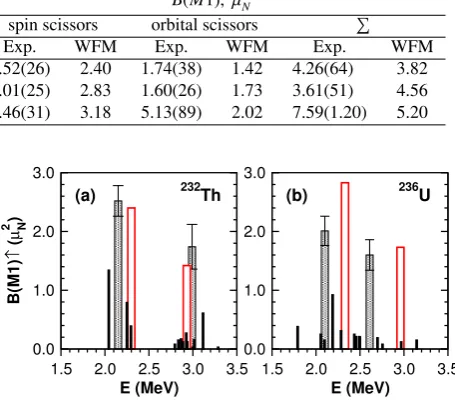
groups with certainty. For the Uranium isotopes the sep-aration of spectrum into two groups is not that obvious. To exclude any arbitrariness in their division we apply a simple technical device. We folded the experimental spec-tra with a Lorentzians of increasing width. The width was increased until only two humps remained. The obtained lower and higher groups of levels are attributed to the spin and orbital scissors modes respectively. Comparing their
Table 2.Energy centroidsEand summed transition probabilitiesB(M1) of the spin and orbital scissors. Exp. – experimental data: 232Th – [10],236U – [11],238U – [12]. WFM – the results of calculations [9], the values of all model parameters are taken from our
paper [5].
Nuclei E, MeV B(M1), µ
2 N
spin scissors orbital scissors centroid spin scissors orbital scissors
Exp. WFM Exp. WFM Exp. WFM Exp. WFM Exp. WFM Exp. WFM
232Th 2.15 2.30 2.99 2.93 2.49 2.54 2.52(26) 2.40 1.74(38) 1.42 4.26(64) 3.82
236U 2.10 2.33 2.61 2.96 2.33 2.57 2.01(25) 2.83 1.60(26) 1.73 3.61(51) 4.56
238U 2.19 2.36 2.76 3.00 2.58 2.61 2.46(31) 3.18 5.13(89) 2.02 7.59(1.20) 5.20
energy centroids and summedB(M1) values with
theoret-ical predictions we find very good agreement for 232Th,
satisfactory agreement in236U (figure 3), and a rather
con-ditional one in238U (table 2) [9].
3.2 Rare earths
We have studied practically all papers containing
experi-mental data for low-lyingM1 excitations in rare-earth
nu-clei. For the sake of convenience we have collected in
figure 4 all experimentally known spectra of low-lying 1+
excitations (see paper [13] and references therein). One glance on figure 4 is enough to understand that the situa-tion with spectra in rare-earth nuclei is complicated. Nev-ertheless, we will try to proceed in the same way as with the actinides: we fold the spectra with a Lorentzian whose width is increased until only two humps survive, if possi-ble. The states in the low-lying group are then identified as belonging to the spin scissors motion and the ones of high-lying group as orbital scissors states.
The values of B(M1) and energy centroids,
corre-sponding to the described separation, are compared with theoretical results in figure 5. For energy centroids, the picture looks quite acceptable. The distribution of the scis-sors mode strength between spin and orbital states, at first glance, does not seem convincing. However, with closer examination, encouraging examples of agreement can be
0.0 0.5 1.0 1.5 2.0
B(M1)
↑
(
µ
2 )N
0.0 0.5 1.0 1.5
B(M1)
↑
(
µ
2 )N
1.0 1.5 2.0 2.5 3.0 3.5 4.0
E (MeV)
0.0 1.0 2.0 3.0
B(M1)
↑
(
µ
2 )N
232 Th
236 U
238 U
Figure 2.The experimentally observed spectra of 1+excitations:
232Th – [10],236U – [11],238U – [12].
1.5 2.0 2.5 3.0 3.5
E (MeV)
0.0 1.0 2.0 3.0
B(M1)
↑
(
µ
2 )N
1.5 2.0 2.5 3.0 3.5
E (MeV)
0.0 1.0 2.0 3.0 232
Th 236U
(a) (b)
Figure 3.The centroids of experimentally observed spectra of 1+
excitations in232Th and236U (black rectangles with error bars) are compared with the results of WFM calculations (red rectan-gles) of the spin and orbital scissors modes [9].
found. Satisfactory (as a rule, within the tal error) agreement between theoretical and experimen-tal results was found for the orbiexperimen-tal scissors in 13 nuclei:
146,148Nd, 154Gd, 166,170Er, 174,176Yb, 176,178,180Hf, 190Os
and194,196Pt. The same degree of agreement can be found
for the spin scissors in 15 nuclei: 134Ba, 146,148,150Nd, 150,154Sm,154Gd,160Dy,172,174,176Yb,176,180Hf,192Os and
194Pt. An agreement for both, the orbital and spin
scis-sors, is observed in 8 nuclei: 146,148Nd,154Gd,174,176Yb, 176,180Hf and194Pt. As can be seen from the figure 6, the
agreement in Yb and Hf isotopes is close to the perfect one.
4 Conclusions and Outlook
The aim of this paper was to find experimental indica-tions about the existence of the "spin" scissors mode pre-dicted in our previous publications [5, 14, 15]. To this end we have performed the detailed analysis of
experimen-tal data on 1+ excitations for actinides and for nuclei of
N=82−126 major shell.
We have found good quantitative agreement between
the theory and experiment for the summedB(M1) values
and the respective energy centroids for the majority of nu-clei except for some few. The best agreement is obtained
when one attributes to the scissors mode all 1+excitations
observed in the energy interval 0<E<4 Mev (excluding separate levels in some nuclei). It turns out also that the results of our calculations [16] are in very good agreement with the sum rule derived in [13].
2.0 2.5 3.0 3.5 4.0 0.0
0.2 0.4
B(M1)
↑
,
µ
2 N 134 Ba
2.0 2.5 3.0 3.5 4.0
0.0 0.5 1.0 0.0 0.2 0.4 0.0 0.2 0.4
0.0 0.2 0.4
B(M1)
↑
,
µ
2 N 144
Nd
146
Nd
148
Nd
150
Nd
1.8 2.0 2.5 3.0 3.5 4.0
0.0 0.5 1.0 1.5 0.0 0.2 0.4 0.6 0.0 0.2 0.4 0.6
0.0 0.5 1.0 1.5
148
Sm
150
Sm
152
Sm
154
Sm
2.0 2.5 3.0 3.5 4.0
0.0 1.0 2.0 0.0 1.0 2.0 0.0 0.5 1.0 1.5
0.0 1.0 2.0
154
Gd
156
Gd
158
Gd
160
Gd
2.0 2.5 3.0 3.5 4.0
E, MeV
0.0 1.0 2.0 3.0 0.0 0.5 1.0 1.5 2.0
B(M1)
↑
,
µ
2 N0.0
0.5 1.0 1.5 2.0
160
Dy
162
Dy
164
Dy
1.8 2.0 2.5 3.0 3.5 4.0
E, MeV
0.0 0.5 1.0 1.5 0.0 0.5 1.0 1.5 2.0 0.0 0.5 1.0 1.5
166
Er
168
Er
170
Er
2.0 2.5 3.0 3.5 4.0
E, MeV
0.0 0.5 1.0 1.5 0.0 0.5 1.0 0.0 0.5 1.0 1.5
172
Yb
174
Yb
176
Yb
2.0 2.5 3.0 3.5 4.0
0.0 0.5 1.0 0.0 0.5 1.0
B(M1)
↑
,
µ
2 N
0.0 0.5 1.0 1.5
176
Hf
178
Hf
180
Hf
2.0 2.5 3.0 3.5 4.0
0.0 0.2 0.4 0.0 0.2 0.4 0.6 0.0 0.4 0.8 1.0
182
W
184
W
186
W
0.0 0.2 0.4 0.6
2.0 2.5 3.0 3.5 4.0
E, MeV
0.0 0.2 0.4 0.6
B(M1)
↑
,
µ
2 N 190
Os
192
Os
0.0 0.2 0.4 0.6 0.8
2.0 2.5 3.0 3.5 4.0
E, MeV
0.0 0.2 0.4
194
Pt
196
Pt
2.0 2.5 3.0 3.5 4.0 0.0 0.2 0.4 B(M1) ↑ , µ
2 N 134 Ba
2.0 2.5 3.0 3.5 4.0
0.0 0.5 1.0 0.0 0.2 0.4 0.0 0.2 0.4 0.0 0.2 0.4 B(M1) ↑ , µ 2 N 144 Nd 146 Nd 148 Nd 150 Nd
1.8 2.0 2.5 3.0 3.5 4.0
0.0 0.5 1.0 1.5 0.0 0.2 0.4 0.6 0.0 0.2 0.4 0.6 0.0 0.5 1.0 1.5 148 Sm 150 Sm 152 Sm 154 Sm
2.0 2.5 3.0 3.5 4.0
0.0 1.0 2.0 0.0 1.0 2.0 0.0 0.5 1.0 1.5 0.0 1.0 2.0 154 Gd 156 Gd 158 Gd 160 Gd
2.0 2.5 3.0 3.5 4.0
E, MeV 0.0 1.0 2.0 3.0 0.0 0.5 1.0 1.5 2.0 B(M1) ↑ , µ
2 N0.0
0.5 1.0 1.5 2.0 160 Dy 162 Dy 164 Dy
1.8 2.0 2.5 3.0 3.5 4.0
E, MeV 0.0 0.5 1.0 1.5 0.0 0.5 1.0 1.5 2.0 0.0 0.5 1.0 1.5 166 Er 168 Er 170 Er
2.0 2.5 3.0 3.5 4.0
E, MeV 0.0 0.5 1.0 1.5 0.0 0.5 1.0 0.0 0.5 1.0 1.5 172 Yb 174 Yb 176 Yb
2.0 2.5 3.0 3.5 4.0
0.0 0.5 1.0 0.0 0.5 1.0 B(M1) ↑ , µ 2 N 0.0 0.5 1.0 1.5 176 Hf 178 Hf 180 Hf
2.0 2.5 3.0 3.5 4.0
0.0 0.2 0.4 0.0 0.2 0.4 0.6 0.0 0.4 0.8 1.0 182 W 184 W 186 W 0.0 0.2 0.4 0.6
2.0 2.5 3.0 3.5 4.0
E, MeV 0.0 0.2 0.4 0.6 B(M1) ↑ , µ 2 N 190 Os 192 Os 0.0 0.2 0.4 0.6 0.8
2.0 2.5 3.0 3.5 4.0
E, MeV 0.0 0.2 0.4 194 Pt 196 Pt
Figure 4.The experimentally observed spectra of 1+excitations. The data are taken from references listed in table 1 of the paper [13].
2 3 4 5
E (MeV)
130 140 150 160 170 180 190 200
A 0 1 2 3 B(M1) ↑ ( µ
2 ) N
Exp.sp
WFMsp
(a)
(a’)
2 3 4 5
E (MeV)
130 140 150 160 170 180 190 200
A 0 1 2 3 B(M1) ↑ ( µ
2 ) N
Exp.or
WFMor
(b)
(b’)
Figure 5.EnergiesE(a, b) and transition probabilitiesB(M1) (a, b) of the spin scissors and the orbital scissors obtained by dividing experimental spectra into two groups. WFMspand WFMor– the results of calculations [9] for spin and orbital scissors respectively; Exp.spand Exp.or– experimental results for the same scissors.
the theory and experiment is observed in 8 nuclei. In the rest of the nuclei the situation is uncertain and requires fur-ther theoretical (and, possibly, experimental) research. In
actinides very good agreement is observed for232Th,
sat-isfactory agreement in236U, and a rather conditional one
in238U [9].
It is shown that both scissors are strongly influenced by the spin dependent part of nuclear forces, so the observed
1+states having a spin nature may also be attributed to the
scissors mode. 0.0 0.5 1.0 1.5 2.0 2.5 3.0 B(M1) ↑ ( µ
2 )N
2.0 2.5 3.0 3.5 4.0
E (MeV) 0.0 0.5 1.0 1.5 2.0 2.5 B(M1) ↑ ( µ
2 )N
0.0 0.5 1.0 1.5 2.0 2.5
2.0 2.5 3.0 3.5 4.0
E (MeV) 0.0 0.5 1.0 1.5 2.0 174 Yb 176 Yb 176 Hf 180 Hf (a) (b) (c) (d)
Figure 6. The centroids of experimentally observed spectra of 1+excitations in174,176Yb (a, b) and176,180Hf (c, d) (black rectan-gles with error bars) are compared with the results of calculations [9] (red rectangles) of the spin and orbital scissors modes. No-tice that the strength of the lower peak (spin-scissors) is always stronger than the one of the upper peak (orbital-scissors).
To gain the comprehensive insight into the fine struc-ture of the scissors mode we are going to perform the cal-culations with fourth order moments which, as we hope, will allow us to expand substantially the set of input data for the WFM method and to study the dynamics of the
spin-flip resonance and its possible influence on the scis-sors mode. Furthermore the systematic self consistent QRPA calculations with realistic forces are very desir-able. We already said [14, 15] that such excitations (spin scissors) were, undoubtedly, produced implicitly by other methods (e.g. RPA), but they never were analyzed in such terms. So it would be interesting to perform the analysis of QRPA spectra analogously to our analysis of experimental spectra. At least one example [17] of QRPA calculations exists, demonstrating rather good agreement with
experi-mental data and with our results for232Th.
Based on the presented analysis of the accumulated ex-perimental information, it can be concluded that the exis-tence of a spin (together with a spin-orbit interaction) leads to a splitting of the scissors mode into two branches corre-sponding to spin and orbital scissors.
References
[1] R. R. Hilton,Talk presented at the International
Con-ference on Nuclear Structure(Joint Institute for Nu-clear Research, Dubna, Russia, 1976) (unpublished)
[2] T. Suzuki and D. J. Rowe, Nucl. Phys. A289, 461
(1977)
[3] N. Lo Iudice and F. Palumbo, Phys. Rev. Lett.41,
1532 (1978)
[4] D. Bohle, A. Richter, W. Steffen, A. E. L. Dieperink,
N. Lo Iudice, F. Palumbo, and O. Scholten, Phys.
Lett. B137, 27 (1984)
[5] E. B. Balbutsev, I.V. Molodtsova, and P. Schuck,
Phys. Rev. C91, 064312 (2015)
[6] C. Wesselborg, P. von Brentano, K. O. Zell, R. D. Heil, H. H. Pitz, U. E. P. Berg, U. Kneissl, S. Lindenstruth, U. Seemann, and R. Stock, Phys.
Lett. B207, 22 (1988)
[7] E. B. Balbutsev and P. Schuck, Nucl. Phys. A720,
[8] E. B. Balbutsev and P. Schuck, Ann. Phys.322, 489 (2007)
[9] E. B. Balbutsev, I.V. Molodtsova, and P. Schuck,
Phys. Rev. C97, 044316 (2018)
[10] A. S. Adekola, C. T. Angell, S. L. Hammond, A. Hill, C. R. Howell, H. J. Karwowski, J. H. Kelley, and
E. Kwan, Phys. Rev. C83, 034615 (2011)
[11] J. Margraf, A. Degener, H. Friedrichs, R. D. Heil, A. Jung, U. Kneissl, S. Lindenstruth, H. H. Pitz, H. Schacht, U. Seemann, R. Stock, C. Wesselborg,
P. von Brentano, and A. Zilges, Phys. Rev. C42, 771
(1990)
[12] S. L. Hammond, A. S. Adekola, C. T. Angell, H. J. Karwowski, E. Kwan, G. Rusev, A. P. Tonchev,
W. Tornow, C. R. Howell, and J. H. Kelley, Phys.
Rev. C85, 044302 (2012)
[13] J. Enders, P. von Neumann-Cosel, C. Rangacharyulu,
and A. Richter, Phys. Rev. C71, 014306 (2005)
[14] E. B. Balbutsev, I.V. Molodtsova, and P. Schuck,
Nucl. Phys. A872, 42 (2011)
[15] E. B. Balbutsev, I.V. Molodtsova, and P. Schuck,
Phys. Rev. C88, 014306 (2013)
[16] E. B. Balbutsev, I.V. Molodtsova, and P. Schuck, Yad. Fiz.81(Iss. 5), 1 (2018)
[17] A. A. Kuliev, E. Guliyev, F. Ertugral, and S. Özkan,
![Table 1. Scissors modes energies E and transition probabilities B(M1) for 164Dy. The results of calculations [9] with and without thespin part of a dipole magnetic operator (gs = 0.7gfreesand gs = 0 respectively).](https://thumb-us.123doks.com/thumbv2/123dok_us/8027685.1335633/2.595.59.289.252.387/scissors-energies-transition-probabilities-calculations-operator-gfreesand-respectively.webp)
![Figure 4. The experimentally observed spectra of 1+ excitations. The data are taken from references listed in table 1 of the paper [13].](https://thumb-us.123doks.com/thumbv2/123dok_us/8027685.1335633/4.595.65.535.82.673/figure-experimentally-observed-spectra-excitations-taken-references-listed.webp)
![Figure 5. Energiesexperimental spectra into two groups. WFM E (a, b) and transition probabilities B(M1) (a′, b′) of the spin scissors and the orbital scissors obtained by dividingsp and WFMor – the results of calculations [9] for spin and orbital scissors respectively;Exp.sp and Exp.or – experimental results for the same scissors.](https://thumb-us.123doks.com/thumbv2/123dok_us/8027685.1335633/5.595.62.539.77.255/energiesexperimental-transition-probabilities-obtained-dividingsp-calculations-respectively-experimental.webp)
